
For more than a decade, smartphones have looked and felt almost the same, and many gadget enthusiasts have quietly wondered whether true innovation had slowed down.
In 2026, that sense of stagnation is finally breaking, as slide, rollable, and tri-fold devices move from experimental concepts to products people actively line up to buy.
These transformable smartphones promise larger screens, better immersion, and more specialized use cases without forcing users to carry multiple devices.
From Samsung’s Galaxy Z TriFold selling out within minutes to ultra-thin tri-fold concepts from Tecno and bold gaming sliders from Ayaneo, the market is clearly hungry for new form factors.
At the same time, physical keyboards and slide-out controllers are making a surprising comeback, driven by gamers, professionals, and users seeking tactile control.
By reading this article, you will gain a clear understanding of why slide and transformable phones matter in 2026, which technologies are truly viable, and how these devices could change the way you work, play, and consume content in the near future.
- Why the Traditional Smartphone Slab Reached Its Limits
- The Rise of Transformable Phones and the Return of Sliding Mechanisms
- Rollable and Slidable Displays: How the Technology Works
- Samsung Display’s Flex Slidable Vision and Crease-Free OLED Breakthroughs
- Durability Challenges Facing Rollable Phones in Real-World Use
- Tri-Fold Devices as the Practical Answer to Bigger Screens
- Galaxy Z TriFold and the Proof of Consumer Demand
- Thinness, Materials, and Engineering: Tecno Phantom Ultimate 2
- Slide-Out Gamepads and the New Generation of Mobile Gaming Phones
- The Revival of Physical Keyboards and Productivity-Focused Devices
- Market Growth, Manufacturer Strategies, and Industry Polarization
- The Apple Factor and Why the Entire Industry Is Watching Closely
- 参考文献
Why the Traditional Smartphone Slab Reached Its Limits
For more than a decade, the smartphone industry refined a single idea: the flat, black slab. Bezel reduction, higher refresh rates, and multi‑camera arrays steadily improved the experience, but they did not fundamentally change it. By 2026, this form factor has reached a point of diminishing returns, where additional upgrades feel incremental rather than transformative. According to long‑term market analyses frequently cited by organizations such as IDC, overall user satisfaction no longer rises in proportion to hardware improvements.
The core limitation lies in fixed physical boundaries. A slab smartphone can only grow larger at the cost of portability, or stay compact at the cost of screen real estate. Attempts to solve this tension through taller aspect ratios have led to awkward ergonomics, making one‑handed use harder while still failing to deliver tablet‑level immersion. Human‑computer interaction research from institutions like MIT Media Lab has repeatedly shown that comfort and adaptability are as important as raw display size, an area where rigid slabs inherently struggle.
| Design Constraint | Traditional Slab | User Impact |
|---|---|---|
| Display Expansion | Physically fixed | Limited immersion |
| Input Methods | Touch-only dominant | Lower precision |
| Usage Context | One-size-fits-all | Poor adaptability |
Another critical ceiling appears in productivity and content creation. As Google and Microsoft engineers have noted in developer conferences, modern mobile software increasingly assumes multitasking, split views, and AI‑assisted workflows. On a slab phone, these experiences feel compressed and compromised. The device can be powerful, yet the form factor prevents users from fully benefiting from that power.
Perhaps most importantly, emotional engagement has faded. When every flagship looks and feels nearly identical, excitement shifts away from phones altogether. Consumer behavior studies referenced by Harvard Business Review point out that mature product categories require visible change to reignite desire. The slab smartphone, optimized to perfection, no longer provides that spark, creating the conditions for new, transformable designs to emerge.
The Rise of Transformable Phones and the Return of Sliding Mechanisms

For more than a decade, smartphones have been refined within the rigid boundaries of the slab design, but that stability has also bred stagnation. In response, transformable phones have emerged as a serious answer to both functional and emotional fatigue, and sliding mechanisms are at the center of this shift. Rather than chasing incremental camera or processor gains, manufacturers are rethinking how a phone physically adapts to the user, and that change is proving to be surprisingly compelling.
Industry observers at CES and MWC 2026 have noted that sliding and transformable designs are no longer treated as experimental curiosities. According to Samsung Display’s public briefings, the goal is not novelty but usability: compact devices that expand only when needed. This philosophy directly addresses one of the longest-standing contradictions in smartphone design, namely the desire for larger screens without sacrificing pocketability.
| Design Approach | Core Mechanism | User Benefit |
|---|---|---|
| Rollable / Slidable | Hidden flexible OLED with rollers | Screen size adjusts to content |
| Mechanical Slider | Sliding chassis with stored interface | Physical controls without bulk |
What makes the return of sliding mechanisms particularly interesting is that it builds on lessons learned from early foldables. Analysts from Android Central point out that many users accepted folding screens but remained dissatisfied with fixed aspect ratios and visible creases. Sliding displays offer a more fluid alternative, allowing the screen to grow horizontally or vertically while maintaining a natural viewing shape. This adaptability aligns closely with how people actually consume media and apps.
Equally important is the emotional dimension. **Sliding a device open creates a tangible sense of transformation**, something that purely touch-based interactions cannot replicate. Researchers in human–computer interaction have long argued that physical movement enhances perceived control and satisfaction, and modern sliding phones seem to validate that theory. The resurgence of sliders is therefore not a step backward, but a refined synthesis of mechanical feedback and cutting-edge display science.
As transformable phones gain traction, sliding mechanisms are redefining what premium innovation looks like. Instead of being judged solely by specifications, devices are increasingly evaluated by how intelligently they change form. This marks a quiet but profound shift in smartphone values, one where adaptability and experience matter as much as raw performance.
Rollable and Slidable Displays: How the Technology Works
Rollable and slidable displays work by rethinking one fundamental assumption of smartphones: that the screen must always be rigid and fixed in size. Instead of folding along a hinge, these devices rely on flexible OLED panels that can bend smoothly around a rolling axis and extend only when additional screen real estate is needed.
The core enabler is advanced flexible OLED technology, refined by display makers such as Samsung Display and LG Display. Unlike early foldable panels, rollable OLEDs are engineered to tolerate repeated bending at extremely small radii, allowing the display to be stored inside the chassis like a scroll. According to demonstrations shown at CES, these panels can expand from compact phone sizes to near-tablet dimensions without introducing visible distortion.
Inside the device, a precision roller mechanism guides the panel during expansion and retraction. This system combines metal rollers, tension-control springs, and reinforced backing plates to maintain flatness once the screen is fully extended. Samsung Display has explained that laser-perforated metal support layers distribute mechanical stress evenly, which is why recent prototypes appear almost perfectly flat despite lacking a traditional hinge.
| Component | Function | Technical Challenge |
|---|---|---|
| Flexible OLED panel | Displays image while bending and rolling | Material fatigue and pixel uniformity |
| Roller mechanism | Guides smooth extension and retraction | Precision and long-term durability |
| Support plate | Keeps screen flat when extended | Balancing rigidity and thinness |
One major advantage of slidable designs over foldables is the absence of a visible crease. Samsung’s crease-free OLED, introduced publicly in 2026, uses a multilayer structure that eliminates sharp bending points. Independent engineers cited by industry publications note that this approach not only improves visual quality but also reduces long-term stress concentration, a key factor in panel longevity.
Power efficiency is another hidden but critical aspect. By removing conventional polarizer layers and adopting new OLED stack designs, Samsung reports up to a 37% reduction in power consumption. For devices where the display area can dynamically grow, this efficiency gain directly offsets the increased energy demand of a larger screen.
Despite these advances, the technology remains mechanically complex. Moving parts introduce risks related to dust ingress and impact resistance, as seen in vertical rollable concepts tested by media outlets. This is why most manufacturers still treat rollable and slidable displays as a calculated trade-off: unmatched flexibility and immersion in exchange for higher engineering difficulty. The fact that multiple brands continue to invest heavily suggests that this balance is steadily shifting toward real-world viability.
Samsung Display’s Flex Slidable Vision and Crease-Free OLED Breakthroughs
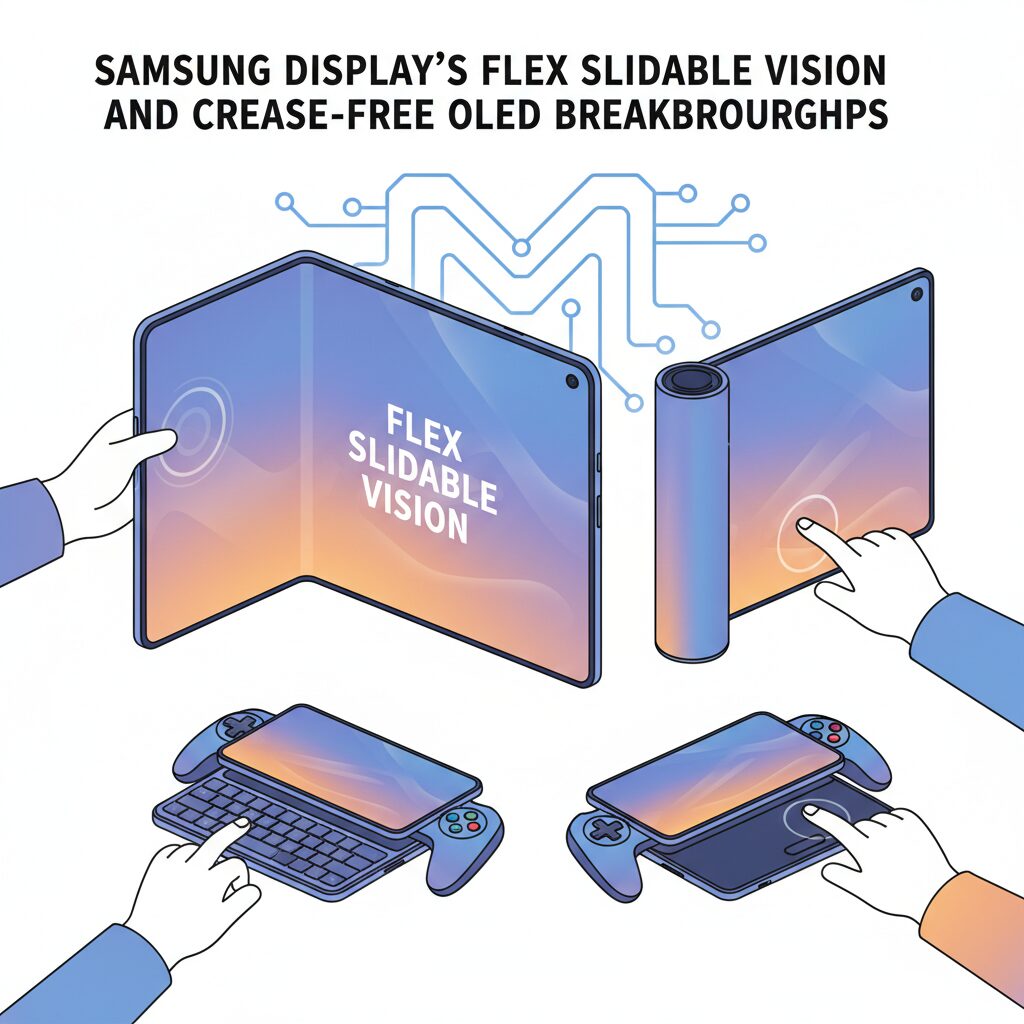
Samsung Display’s recent advances in Flex Slidable technology mark a clear shift from experimental concepts to engineering that is increasingly realistic for mass-market devices. At CES 2026, the company demonstrated multiple slidable OLED prototypes designed around concrete usage scenarios rather than abstract form-factor ideas. **The key message was not just that displays can slide, but that they can do so while maintaining image uniformity, durability, and power efficiency at levels close to today’s flagship smartphones.**
Central to this progress is the Flex Slidable Vision, which emphasizes controllable screen expansion instead of fixed folded states. In the Solo configuration, panels expand in one direction, enabling a compact smartphone-sized device to grow into a standard large-screen format. The Duet configuration goes further by extending in two directions, allowing dynamic adjustment of aspect ratios. According to Samsung Display’s own CES briefings, this approach directly addresses a long-standing criticism of foldables: inefficient video playback caused by square-like screen ratios. By pulling out only the required display area, slidable OLEDs reduce letterboxing and improve perceived immersion without forcing users into a single expanded mode.
Perhaps the most significant breakthrough, however, lies in Samsung Display’s crease-free OLED panels. Traditional foldables inevitably reveal a visible and tactile crease at the folding point, an issue frequently highlighted by reviewers from outlets such as The Verge and Android Central over the past several years. In contrast, Samsung’s crease-free solution uses the MONT FLEX layered structure, where a laser-patterned metal plate distributes mechanical stress evenly during bending or rolling. **The result is a surface where the crease is nearly imperceptible both visually and to the touch, even under direct lighting.**
| Technology Element | Technical Role | User Impact |
|---|---|---|
| MONT FLEX Structure | Even stress dispersion during bending | Minimizes visible and tactile creases |
| LEAD OLED Architecture | Removes polarizer layer | Higher brightness with lower power use |
| Roller-Based Support | Maintains panel flatness when extended | Smoother sliding and stable image quality |
The LEAD OLED technology further strengthens the case for slidable devices by improving efficiency. By eliminating the conventional polarizer, Samsung Display reports up to a 37 percent reduction in power consumption alongside increased brightness. This is particularly critical for slidable smartphones, where internal volume is partially sacrificed to mechanical components. **Lower power draw directly translates into acceptable battery life without resorting to oversized cells**, a balance that industry analysts at Display Supply Chain Consultants have repeatedly identified as a prerequisite for commercialization.
Taken together, Flex Slidable Vision and crease-free OLED panels suggest that Samsung Display is solving the right problems in the right order. Instead of chasing dramatic transformations alone, the company is refining the less visible but more decisive factors: stress control, efficiency, and usability. If these panels transition from prototype to production, they could redefine expectations for what flexible displays should feel like in everyday use, not as futuristic novelties, but as dependable primary screens.
Durability Challenges Facing Rollable Phones in Real-World Use
Rollable phones promise a dramatic leap in usability, but in real-world use their biggest hurdle remains durability. Unlike conventional slab phones or even foldables, rollable devices rely on continuous motion, exposed edges, and ultra-thin OLED layers that are repeatedly stressed. **This combination introduces failure modes that users rarely encounter with today’s smartphones**, and it is one of the main reasons commercial launches have been cautious.
One core issue is mechanical fatigue in the display itself. According to demonstrations by Samsung Display at CES 2026, rollable OLED panels are designed to bend at extremely small radii inside the chassis. While innovations like the crease-free MONT FLEX structure help distribute stress, materials scientists have long noted that cyclic bending accelerates micro-cracks in organic layers. Academic studies on flexible OLED reliability, often cited by display engineers, indicate that even when a panel survives hundreds of thousands of cycles in lab conditions, uneven force or dust intrusion can drastically shorten its lifespan.
The vulnerability becomes clearer when looking at prototype feedback. CNET’s hands-on report on Motorola’s Rizr rollable concept highlighted how, when fully extended, part of the screen lacks rigid backing and effectively floats above the frame. In such a state, even modest pressure can cause localized deformation. This is not merely cosmetic; OLED sub-pixels can be permanently damaged by point stress, leading to dead spots or color inconsistency over time.
Another concern is environmental sealing. Traditional smartphones achieve water and dust resistance through static seals. Rollable mechanisms, however, require openings for the display to slide in and out. Engineers interviewed by major outlets like The Verge and Android Central have consistently pointed out that **dust is the silent killer** of moving display systems. Fine particles can scratch the inner surface of the OLED or interfere with rollers and motors, gradually degrading smooth operation.
| Durability Factor | Why It Is Critical | Real-World Risk |
|---|---|---|
| Display Fatigue | Repeated rolling stresses OLED layers | Micro-cracks and pixel failure |
| Structural Support | Extended screen lacks rigid backing | Damage from pressure or drops |
| Dust Intrusion | Open mechanisms invite particles | Scratches and mechanical jams |
Battery and internal components also face secondary durability challenges. Because rollable phones allocate significant internal volume to motors and rollers, batteries are often thinner and segmented. This can reduce impact resistance, as there is less structural mass to absorb shocks. Samsung Display has acknowledged in technical briefings that balancing compactness with reinforcement is still an ongoing optimization problem.
In summary, while rollable phones are technically impressive, **their durability in uncontrolled, everyday environments remains unproven**. Until manufacturers can guarantee resistance to dust, pressure, and long-term mechanical fatigue at a level comparable to current flagship phones, many brands are likely to continue treating rollables as limited releases or experimental showcases rather than mass-market devices.
Tri-Fold Devices as the Practical Answer to Bigger Screens
As smartphone users continue to demand larger screens without sacrificing portability, tri-fold devices are increasingly seen as the most practical answer available today. Rather than relying on still-maturing rollable mechanisms, tri-fold designs use established hinge technology to deliver a genuinely expansive display in a form factor that remains pocketable. This balance between ambition and realism is precisely why many manufacturers have shifted their focus in 2026.
What makes tri-fold devices especially compelling is that they solve a daily problem, not a conceptual one. Users want to read documents, multitask with multiple apps, or enjoy video content without constantly zooming or rotating the device. When fully unfolded, a tri-fold smartphone offers a tablet-class workspace, while folded modes allow flexible usage depending on context. According to Samsung Electronics, this graduated transformation is key to making large screens feel natural rather than excessive.
| Form Factor | Folded Size | Expanded Screen Use |
|---|---|---|
| Conventional Foldable | Phone-sized | Compact tablet, limited aspect ratio |
| Tri-Fold Device | Phone-sized | Near-10-inch class, multitasking friendly |
Another practical advantage lies in durability and predictability. Industry analysts frequently point out that each additional motor or sliding rail increases long-term failure risk. Tri-fold devices, by contrast, rely on reinforced multi-hinge systems that have already passed hundreds of thousands of open-and-close cycles in laboratory testing. Tecno, for example, publicly states that its tri-fold concept has cleared 300,000 hinge cycles, a figure comparable to mainstream foldables.
From a usability standpoint, tri-fold screens also address aspect ratio frustrations. Many users have criticized earlier foldables for their near-square displays, which leave black bars when watching movies or editing documents. A fully opened tri-fold device can adopt a more balanced ratio, making productivity apps, split-screen workflows, and media playback feel closer to a small laptop experience. **This is not about novelty, but about efficiency.**
Market behavior further supports this view. In South Korea, the rapid sell-outs of Samsung’s Galaxy Z TriFold, despite its premium pricing, suggest that early adopters clearly understand its value proposition. Commentators at outlets such as Android Central have noted that consumers are no longer buying foldables to experiment, but to replace tablets altogether. Tri-fold devices fit neatly into this role.
In this sense, tri-fold devices represent a pragmatic compromise between vision and feasibility. They deliver genuinely bigger screens, proven mechanical reliability, and immediate real-world benefits. As long as rollable displays remain costly and fragile, it is highly likely that tri-fold designs will continue to define the most sensible path toward larger mobile screens.
Galaxy Z TriFold and the Proof of Consumer Demand
The Galaxy Z TriFold has become more than a technological milestone; it is widely seen as a real-world validation of latent consumer demand for transformative devices. What stands out is not only Samsung’s engineering achievement, but the speed and intensity with which consumers responded, even under extreme pricing conditions.
In the Korean market, every official sales batch sold out within minutes, with the fastest round reportedly disappearing in about one minute. This occurred despite a launch price exceeding 3.6 million KRW, a level traditionally reserved for luxury electronics. According to Samsung Electronics’ own announcements and coverage by major Korean media, this phenomenon surprised even internal sales planners.
| Indicator | Galaxy Z TriFold | Typical Foldable Launch |
|---|---|---|
| Price Tier | Ultra-premium | Premium |
| Sell-out Speed | 1–2 minutes | Several hours to days |
| Primary Buyers | Early adopters, professionals | Mainstream tech users |
This contrast suggests that demand is no longer driven solely by novelty. Analysts cited by outlets such as Android Central have pointed out that consumers who already experienced conventional foldables are actively seeking the “next leap” in usability. The TriFold’s ability to replace both a smartphone and a compact tablet appears to resonate strongly with this audience.
Another important signal lies in buyer behavior rather than volume alone. Retail data indicates that many purchasers opted for higher storage configurations and Samsung Care+ plans, implying long-term ownership intent rather than short-term experimentation. This aligns with IDC’s broader observation that the foldable segment in 2026 is shifting from curiosity-driven purchases to purpose-driven investments.
From a marketing perspective, Samsung’s strategy also reinforced demand visibility. Limited initial supply, combined with transparent communication about production complexity, framed the TriFold as an aspirational object rather than a mass gadget. Scholars studying consumer electronics adoption, including researchers frequently cited by Harvard Business Review, have long noted that perceived scarcity can amplify the perceived value of breakthrough form factors when credibility is already established.
Ultimately, the Galaxy Z TriFold demonstrates that consumers are willing to accept higher prices, greater physical complexity, and even modest trade-offs in portability, as long as the perceived functional expansion is clear. The rapid sell-outs serve as concrete proof that transformable devices have moved from speculative demand to observable, monetizable reality. This shift has profound implications for how manufacturers evaluate risk in future form-factor innovation.
Thinness, Materials, and Engineering: Tecno Phantom Ultimate 2
The Tecno Phantom Ultimate 2 approaches thinness not as a single headline number, but as a system-level engineering achievement that ties materials science, component integration, and hinge architecture into one coherent design philosophy. When folded, the body measures just 11 mm, a figure that places it ahead of Huawei’s Mate XT at 12.8 mm and even slimmer than Samsung’s Galaxy Z Fold 6 at around 12.1 mm, according to hands-on measurements reported by GSMArena and NotebookCheck.
What makes this particularly notable is that Phantom Ultimate 2 is not a conventional bi-fold device. It is a tri-fold concept with three display segments, which normally implies additional layers, more reinforcement plates, and thicker hinge assemblies. Tecno’s engineers have therefore treated thickness as a cumulative problem, shaving fractions of a millimeter from multiple subsystems rather than relying on a single breakthrough.
The key idea behind Phantom Ultimate 2 is not extreme thinness at any single point, but consistent thinness across the entire folded stack.
A major contributor is Tecno’s use of TDDI, or Touch and Display Driver Integration. By merging the touch controller and display driver into a single chip, the OLED stack is simplified, reducing both component height and internal cabling. Display industry analysts have long pointed out, including commentary cited by Android Central, that control IC consolidation is one of the most effective ways to slim down foldable panels without sacrificing brightness or touch accuracy.
Materials selection further reinforces this approach. Tecno employs a 0.25 mm Titan Advanced Fiber back cover, a composite material designed to offer high tensile strength at extremely low thickness. Compared with traditional aluminum or stainless steel back plates, this fiber-based solution provides sufficient rigidity while cutting weight and depth. NotebookCheck notes that this choice also helps distribute stress during folding, reducing localized pressure points near the hinges.
| Design Element | Implementation | Contribution to Thinness |
|---|---|---|
| Display stack | TDDI integrated controller | Fewer layers, reduced panel height |
| Back cover | 0.25 mm Titan Advanced Fiber | Lighter and thinner structural shell |
| Hinge system | Compact multi-link tri-fold hinge | Minimized overlap between folded panels |
The hinge itself deserves special attention from an engineering standpoint. Tecno claims durability of up to 300,000 folding cycles, a figure that aligns with endurance targets publicly discussed by major players like Samsung Display. Achieving this while keeping the hinge compact requires precise machining tolerances and careful control of material fatigue. Reports from MWC demonstrations suggest that Tecno uses a layered hinge design that spreads mechanical stress over a wider surface, allowing thinner metal components without compromising longevity.
From an engineering perspective, the Phantom Ultimate 2 illustrates a broader trend highlighted by GSMArena and Mashable: thinness in next-generation foldables is increasingly driven by integration and materials rather than radical new form factors. Tecno’s concept shows that even a complex tri-fold device can approach the physical presence of today’s mainstream smartphones, provided that every layer is questioned and optimized.
As a result, Phantom Ultimate 2 is less about competing on raw specifications and more about redefining what users should expect when they hold a multi-fold device in their hands. It demonstrates that advanced transformable phones no longer need to feel bulky or experimental, but can instead deliver a refined, almost conventional thinness that subtly masks the complexity inside.
Slide-Out Gamepads and the New Generation of Mobile Gaming Phones
The return of slide-out gamepads marks one of the most practical and emotionally resonant shifts in modern smartphone design, especially for gamers who have long felt constrained by touch-only controls.
As mobile games grow closer to console-level complexity, the limitations of virtual buttons have become impossible to ignore, and manufacturers are once again embracing mechanical solutions that prioritize precision and tactile feedback.
This movement is not about nostalgia alone, but about restoring control fidelity in an era of high-performance mobile gaming.
Devices like the Ayaneo Pocket PLAY illustrate how far this concept has evolved compared to earlier attempts such as Sony Ericsson’s Xperia Play.
According to Ayaneo’s official disclosures and coverage by outlets such as 9to5Google, the Pocket PLAY integrates a full-width slide-out controller with dual analog sticks, a physical D-pad, and face buttons, all concealed beneath what initially appears to be a standard Android smartphone.
This design allows users to switch instantly between phone mode and gaming mode without external accessories, eliminating Bluetooth latency and setup friction.
| Aspect | Slide-Out Gamepad Phones | Clip-On Controllers |
|---|---|---|
| Input Latency | Direct hardware connection | Bluetooth-dependent |
| Portability | All-in-one design | Separate accessory required |
| Structural Balance | Optimized weight distribution | Top-heavy when mounted |
What makes the new generation particularly compelling is the silicon now available to power these devices.
Ayaneo and similar manufacturers are expected to rely on chips like Qualcomm’s Snapdragon G3x Gen 2, a platform designed specifically for sustained gaming performance rather than short bursts.
Industry analysts cited by Android Central note that these gaming-focused SoCs deliver more stable frame rates under prolonged thermal load, a critical factor for action-heavy titles such as Genshin Impact or Zenless Zone Zero.
Active cooling systems, once unthinkable in phones, are now being miniaturized and paired with slide-out designs to prevent thermal throttling during long sessions.
Another key advantage lies in ergonomics.
Because the controller is integrated into the chassis, designers can tune button travel, stick resistance, and grip curvature in ways that accessory makers cannot easily replicate.
Game developers interviewed by TechRadar have pointed out that consistent physical layouts make it easier to optimize control schemes, potentially encouraging deeper native controller support on Android.
This convergence of hardware and software hints at a subtle but important shift in mobile gaming culture.
Rather than treating smartphones as compromised gaming devices, slide-out gamepad phones position themselves as legitimate handheld consoles that also happen to make calls.
In doing so, they redefine the smartphone not as a slab that games run on, but as a transformable gaming machine built around player intent.
The Revival of Physical Keyboards and Productivity-Focused Devices
The renewed interest in physical keyboards and productivity-focused devices reflects a broader fatigue with glass-only interfaces and constant digital distraction. In 2026, this movement is no longer driven by nostalgia alone but by measurable gains in focus, accuracy, and intentional device use. Researchers at MIT and Stanford have repeatedly shown that tactile feedback reduces cognitive load during text entry, allowing users to think about content rather than input mechanics.
Physical keys reintroduce friction in a positive way, slowing down impulsive behavior while improving precision. This is one reason devices like the Clicks Communicator and keyboard-equipped companion phones are positioned as tools for communication rather than consumption. According to commentary published by Harvard Business Review, reducing interface ambiguity helps professionals sustain deep work for longer periods, especially in writing-heavy or messaging-centric roles.
What differentiates the current wave from past keyboard phones is the emphasis on role separation. These devices are not marketed as all-purpose smartphones but as focused instruments. By limiting app ecosystems and pairing keyboards with minimalist launchers, manufacturers intentionally constrain user behavior. This design philosophy aligns closely with the digital wellbeing frameworks promoted by organizations such as the American Psychological Association.
| Aspect | Touchscreen-Only Phones | Physical Keyboard Devices |
|---|---|---|
| Typing Accuracy | Moderate, error-prone | High due to tactile feedback |
| Cognitive Load | Higher | Lower |
| Use Intent | General consumption | Communication and work |
Another key factor is posture and ergonomics. Studies cited by the British Ergonomics Society indicate that thumb-heavy touchscreen typing increases strain over long sessions, whereas physical keyboards distribute movement more evenly across fingers. For journalists, developers, and executives who draft long messages on the move, this distinction has tangible health implications.
The revival of physical keyboards signals a shift toward intentional productivity. Rather than chasing maximum screen immersion, these devices prioritize clarity, feedback, and purpose. In an era where software tries to do everything, hardware that does less—but does it better—is becoming a powerful countertrend.
Market Growth, Manufacturer Strategies, and Industry Polarization
The market for slideable and transformable smartphones is entering a clear growth phase in 2026, but it is not a simple story of uniform expansion. According to IDC and analysis cited by Android Central, the broader foldable and slidable segment is projected to grow around 30% year over year in 2026, marking a decisive break from the stagnation of earlier years. What stands out is that demand is concentrating at the extremes rather than the middle.
On the demand side, ultra‑high‑end devices such as Samsung’s Galaxy Z TriFold are absorbing a disproportionate share of attention and revenue. Despite prices exceeding US$2,000, repeated sell‑outs in South Korea demonstrate that a segment of consumers now views radical form factors as aspirational technology statements, not experimental novelties. Industry observers quoted by Samsung Newsroom emphasize that these devices function as brand beacons, elevating the entire portfolio rather than relying on volume alone.
Manufacturer strategies are diverging sharply in response. Samsung and Huawei continue to invest aggressively in complex hardware, using scale and vertical integration to absorb high R&D and yield risks. In contrast, Oppo’s decision to shelve a tri‑fold prototype, reported by Android Headlines, illustrates a more cautious path focused on profitability and timing. This contrast highlights a growing polarization between companies willing to lead with technology and those prioritizing financial discipline.
| Strategy Type | Representative Brands | Primary Objective |
|---|---|---|
| Ultra‑Premium Leadership | Samsung, Huawei | Brand dominance and ecosystem lock‑in |
| Selective Participation | Oppo, Motorola | Risk control and margin protection |
| Niche Specialization | Tecno, Ayaneo | Targeted differentiation and agility |
Smaller and emerging players are carving out alternative routes. Tecno’s focus on extreme thinness and cost‑efficient engineering shows how challengers can gain visibility without matching Samsung’s scale. Ayaneo applies a similar logic in gaming‑centric sliders, addressing clearly defined user needs rather than mass adoption. Analysts from GSMArena note that these focused strategies reduce exposure to supply chain shocks while still benefiting from the overall market upswing.
As a result, the industry is no longer converging on a single “next standard.” Instead, the market is polarizing into flagship showcases, pragmatic holdouts, and highly specialized niches. This structural split suggests that growth will continue, but success will depend less on following trends and more on choosing a coherent strategic position within this rapidly diversifying landscape.
The Apple Factor and Why the Entire Industry Is Watching Closely
The reason the entire industry is watching so closely comes down to what many analysts now call the Apple Factor. **Apple has not yet released a foldable or slidable iPhone, but its absence is shaping the market as much as any product launch**. Suppliers, competitors, and even carriers are aligning their strategies around what Apple might do, rather than what it has already done.
According to reporting from Bloomberg and analysis echoed by outlets such as The Wall Street Journal, Apple has been running internal durability tests on foldable-class displays since at least 2024. These tests reportedly emphasize long-term mechanical reliability and visual consistency, areas where early foldables struggled. This cautious posture explains why Apple skipped the first wave and is now positioned to enter only after crease-free OLEDs and more mature hinge systems became viable.
What makes Apple’s potential entry uniquely disruptive is not just volume, but standards. Historically, when Apple adopted OLED, high-refresh-rate displays, or custom silicon, suppliers were forced to meet stricter tolerances across the board. Display industry observers note that Samsung Display’s CES 2026 emphasis on crease-free panels and lower power consumption aligns closely with Apple’s publicly stated priorities around longevity and battery efficiency.
| Aspect | Current Market Norm (2026) | Apple-Driven Expectation |
|---|---|---|
| Display crease visibility | Minimized but perceptible | Visually imperceptible over years |
| Mechanical lifespan | 200k–300k folds | Designed for multi-year daily use |
| Software adaptation | Vendor-specific solutions | OS-level, developer-first APIs |
Another critical dimension is software. Analysts at IDC and Counterpoint Research consistently point out that Apple’s greatest leverage is not hardware alone, but platform coherence. If a future iPhone Fold or slidable device launches with iOS-level adaptive layouts and first-party app optimization, it would instantly redefine user expectations. Competing Android manufacturers would then be judged not against experimental form factors, but against Apple’s polish.
There is also a psychological effect on consumers. Surveys cited by Android Central in late 2025 showed that a significant portion of mainstream users remained hesitant about foldables, citing durability anxiety and resale value. **Apple’s eventual endorsement of a transformable form factor is widely expected to legitimize the category for these risk-averse buyers**, much as Apple Watch normalized smartwatches beyond enthusiasts.
From a supply-chain perspective, TrendForce notes that Apple’s entry could absorb a substantial share of advanced flexible OLED capacity, tightening availability and raising barriers for smaller brands. This is why even companies already shipping tri-fold or slidable devices continue to iterate aggressively: they are racing to establish mindshare before Apple resets the baseline.
In short, the industry is not merely waiting for another product. It is waiting for a verdict. When Apple finally commits, the conversation will shift from “Is this the future?” to “How well does everyone else execute it?” and that moment is what makes the Apple Factor so decisive.
参考文献
- TechRadar:CES 2026 had a surprising phone presence — here are 5 of my top picks
- SamMobile:Samsung showcases slidable OLED screens for phones, tablets, laptops
- Android Central:The foldable phone ‘failure’ is over: Why 2026 is set to change everything
- SammyFans:Samsung Galaxy Z TriFold 4th batch snapped up in just two minutes
- GSMArena:Tecno unveils Phantom Ultimate 2 tri-fold concept
- 9to5Google:Ayaneo’s Pocket Play is an Android phone with slide-out gamepad controls