For years, professional mobile video meant one thing: iPhone and ProRes. If you wanted serious color grading flexibility, reliable editing performance, and industry acceptance, Apple’s ecosystem felt like the only safe choice.
In 2026, that assumption is no longer true. Android has entered a new era with the Advanced Professional Video (APV) codec, 3nm-class chipsets like Snapdragon 8 Gen 5 and Google Tensor G5, and a maturing software ecosystem led by LumaFusion and Blackmagic Camera.
With support for up to 16‑bit depth, 4:4:4:4 chroma sampling, hardware-accelerated 8K capture, external SSD recording over high-speed USB‑C, and AI-driven ISP pipelines, Android devices such as the Galaxy S26 Ultra, Xperia 1 VII, and Pixel 10 Pro are redefining what a “phone camera” can be. In this article, you will discover how APV compares to ProRes, how next-generation silicon changes real-world workflows, and why 2026 may be the true turning point for mobile cinematography.
- The Post‑ProRes Era: Why 2026 Marks a Turning Point for Mobile Filmmaking
- What Is Advanced Professional Video (APV)? Architecture, Bit Depth, and Chroma Explained
- APV vs Apple ProRes: Compression Efficiency, Licensing, and Real‑World Editing Performance
- From Codec to Ecosystem: IETF Proposal, Open Standards, and Cross‑Platform Adoption
- Snapdragon 8 Gen 5 and Hardware Acceleration: Enabling 8K, 120fps, and AI Segmentation
- Google Tensor G5 and Computational Video: AI Zoom, Real Tone, and On‑Device Content Credentials
- Galaxy S26 Ultra: 200MP Sensor, 12‑bit APV, and External SSD Workflows
- Sony Xperia 1 VII: S‑Cinetone for Mobile, Pro Controls, and Creator‑First Hardware Design
- Pixel 10 Pro: The Rise of AI‑First Cinematography and Verified Authentic Footage
- LumaFusion 2.5 and Blackmagic Camera: Professional Editing and Log Workflows on Android
- External SSD Recording, USB‑C Speeds, and the Reality of 1GB‑Per‑Minute Footage
- Displays, Wireless Monitoring, and the Role of RGB MiniLED and Wi‑Fi 7
- Industry Voices: How APV and ProRes Coexist in Modern Production Pipelines
- The Future of the APV Ecosystem: Beyond Smartphones to Drones and Cinema Cameras
- 参考文献
The Post‑ProRes Era: Why 2026 Marks a Turning Point for Mobile Filmmaking
For years, professional mobile filmmaking has been almost synonymous with Apple ProRes. If you wanted serious color grading latitude and smooth timeline performance, you chose an iPhone. In 2026, that assumption no longer holds true.
The arrival of Advanced Professional Video (APV) on Android 16 marks a structural shift, not a feature update. Developed by Samsung and introduced at SDC23, APV has matured into a native, hardware-accelerated intermediate codec supported across flagship Android devices and major editing platforms.
Unlike delivery codecs such as H.264 or HEVC, APV uses intra-frame compression. Each frame is encoded independently, enabling precise scrubbing and frame-accurate edits without taxing the processor. According to technical documentation presented at Samsung Developer Conference and subsequent industry coverage, APV supports 10-bit, 12-bit, and up to 16-bit color depth, along with 4:2:2 and 4:4:4:4 chroma sampling.
| Feature | Samsung APV | Apple ProRes 422 HQ |
|---|---|---|
| Compression Type | Intra-frame | Intra-frame |
| Bit Depth | 10 / 12 / 16-bit | 10 / 12-bit* |
| Efficiency | ~20% smaller than ProRes | Industry baseline |
| Licensing | Royalty-free (IETF proposal) | Apple-licensed |
One of the most disruptive elements is efficiency. Industry reporting indicates that APV achieves roughly 20% better storage efficiency than comparable ProRes profiles while maintaining perceptually lossless quality. In practical terms, that means longer record times, fewer dropped frames in high-bitrate capture, and reduced storage costs on long-form projects.
This efficiency matters because APV files are still large. As detailed in technical breakdowns of the Galaxy S26 series, even 1080p APV HQ can consume around 1GB per minute. The difference is that Android flagships in 2026 are designed around this reality, with optimized USB-C pipelines and direct-to-SSD recording support.
Equally important is openness. Samsung has proposed APV to the Internet Engineering Task Force, positioning it as a public standard rather than a vendor-locked format. That decision changes the competitive landscape. For the first time, Android offers a high-end intermediate codec that is not tied to a single hardware ecosystem.
The software ecosystem has responded quickly. LumaFusion 2.5 for Android supports APV export, enabling a fully native capture-to-delivery workflow. DaVinci Resolve and FFmpeg compatibility further ensure that APV footage integrates into established professional pipelines. According to coverage from Digital Production and Post Magazine, Android editing parity with iOS is no longer theoretical.
What makes 2026 a turning point is convergence. APV is not arriving alone. It is paired with hardware acceleration in chips like Snapdragon 8 Elite Gen 5 and AI-integrated ISPs in Tensor G5, enabling 4K and even 8K high-bit-depth recording without thermal collapse. Codec, silicon, storage, and software are finally aligned.
In previous years, Android devices could shoot impressive video but lacked a unified professional backbone. Now that backbone exists. The post-ProRes era does not mean the end of ProRes; it means the end of its exclusivity in mobile filmmaking.
For creators deeply invested in mobile production, 2026 represents the moment when platform choice becomes strategic rather than constrained. Android is no longer the alternative. It is a fully realized professional filmmaking environment.
What Is Advanced Professional Video (APV)? Architecture, Bit Depth, and Chroma Explained
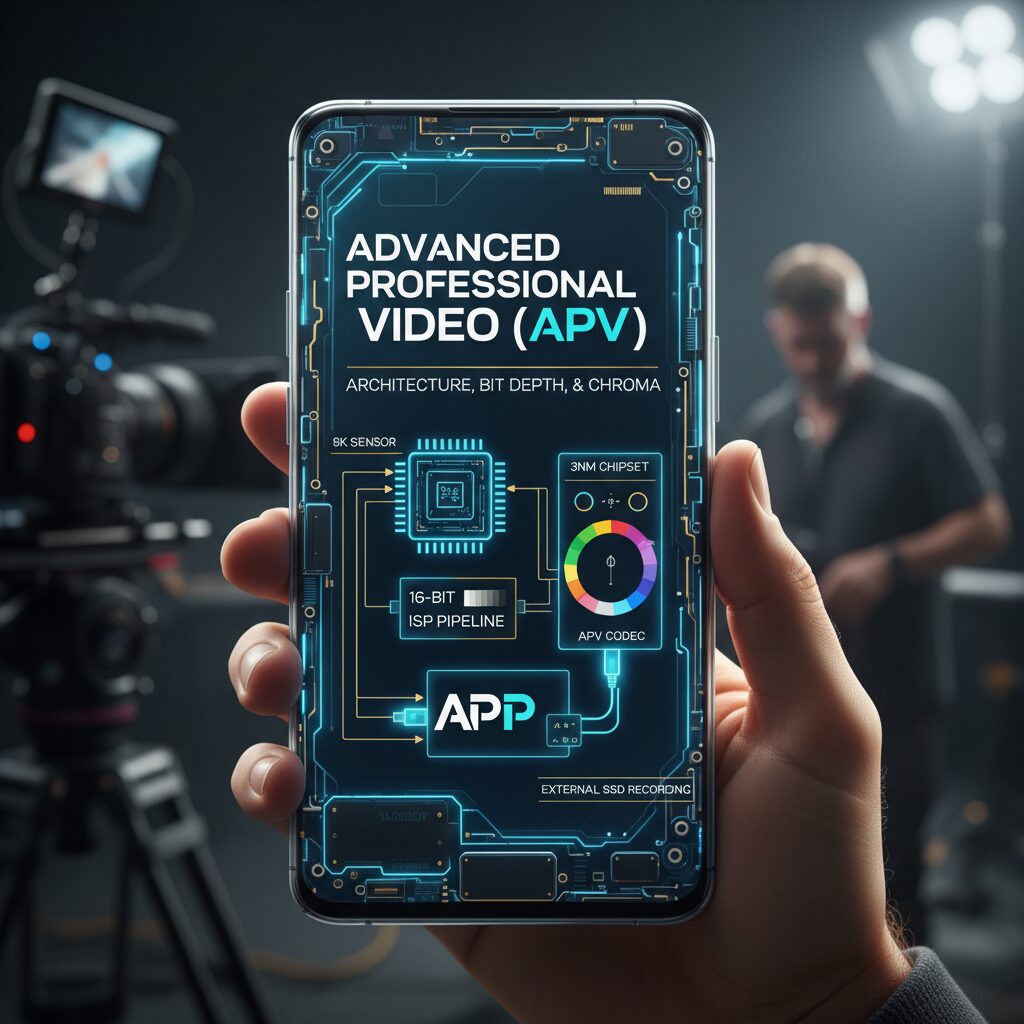
Advanced Professional Video (APV) is a next-generation intermediate codec developed by Samsung and first unveiled at SDC23, now natively integrated into Android 16. It is designed specifically for professional video acquisition and post-production on mobile devices, positioning itself as an open alternative to Apple ProRes. According to Samsung and documentation referenced by the IETF proposal process, APV aims to balance high visual fidelity with improved storage efficiency and power optimization.
At its core, APV uses an intra-frame compression architecture. This means each frame is encoded independently, rather than relying on inter-frame prediction like H.264 or HEVC. The result is significantly smoother scrubbing on a timeline, precise frame-by-frame trimming, and reduced decoding complexity during editing. For creators working in DaVinci Resolve, LumaFusion, or FFmpeg-based pipelines, this structure translates into a more responsive post-production experience.
Bit depth is one of APV’s defining technical advantages. While many consumer codecs are limited to 8-bit or 10-bit capture, APV supports 10-bit, 12-bit, and up to 16-bit precision depending on hardware implementation. Higher bit depth dramatically increases the number of tonal gradations available per channel, reducing banding in skies, skin tones, and HDR scenes. This is especially critical when performing aggressive color grading or working with Log profiles.
Chroma subsampling further defines APV’s professional intent. The codec supports 4:2:2 and full 4:4:4 sampling, as well as 4:4:4:4 configurations that include an alpha channel. This enables clean keying, advanced compositing, and VFX workflows directly from mobile-captured footage. Compared to distribution codecs that typically rely on 4:2:0 sampling, APV retains significantly more color information per pixel.
| Feature | APV Specification | Practical Impact |
|---|---|---|
| Compression Type | Intra-frame | Fast editing and accurate frame access |
| Bit Depth | 10 / 12 / 16-bit | Greater grading latitude, reduced banding |
| Chroma Sampling | Up to 4:4:4:4 | High-fidelity color and alpha support |
| Efficiency | ~20% more efficient than ProRes | Lower storage consumption at similar quality |
One of the most notable claims surrounding APV is its approximately 20% storage efficiency improvement over Apple ProRes at comparable quality levels. As reported by industry coverage and developer briefings, this efficiency gain is particularly meaningful in mobile contexts, where internal storage and sustained write speeds are constrained. For example, even 1080p 30fps APV HQ can consume around 1GB per minute, so any reduction in bitrate without visible degradation directly impacts real-world usability.
Finally, APV’s proposed royalty-free positioning and submission to the IETF signal a strategic architectural choice: openness. Unlike proprietary ecosystems, APV is being framed as a codec designed for broad adoption across devices and software platforms. For professionals, this means the architecture is not just about compression mechanics, but about building a future-proof, interoperable foundation for high-end mobile cinematography.
APV vs Apple ProRes: Compression Efficiency, Licensing, and Real‑World Editing Performance
When comparing APV and Apple ProRes, the conversation goes far beyond simple image quality. Both are intra-frame codecs designed for professional editing, but their differences in compression efficiency, licensing philosophy, and real-world performance meaningfully impact creators choosing between Android and iPhone workflows.
Core Technical Comparison
| Aspect | APV | Apple ProRes (422 HQ) |
|---|---|---|
| Compression Type | Intra-frame | Intra-frame |
| Bit Depth | 10/12/16-bit | 10-bit (up to 12-bit in 4444/RAW) |
| Chroma Sampling | Up to 4:4:4:4 | Up to 4:4:4:4 |
| Storage Efficiency | Approx. 20% smaller vs ProRes | Industry baseline |
| Licensing | Royalty-free proposal (IETF) | Apple-licensed |
Technically, both codecs rely on intra-frame compression, meaning each frame is encoded independently. This structure eliminates inter-frame prediction and makes timeline scrubbing, frame-accurate trimming, and heavy color grading significantly more responsive than long-GOP formats such as H.264 or HEVC.
The critical difference lies in efficiency. According to Samsung’s developer disclosures and coverage by SamMobile, APV achieves roughly 20% better storage efficiency than ProRes while maintaining perceptually lossless quality. In practical terms, that means longer recording times or lower storage costs at equivalent visual fidelity—an important factor when shooting 4K 100fps or 8K footage.
That efficiency matters because high-quality intra-frame codecs are inherently data-heavy. As detailed in technical breakdowns of the Galaxy S26 series, even 1080p 30fps APV HQ can consume around 1GB per minute. When scaling to higher resolutions and frame rates, file sizes increase dramatically, making compression gains operationally meaningful rather than theoretical.
Licensing and Ecosystem Strategy
Apple ProRes remains a proprietary, Apple-controlled technology. While it is widely supported across professional NLEs, hardware encoding and certain implementations require licensing agreements. This centralized control has historically ensured consistency, but it also ties the ecosystem closely to Apple hardware.
APV takes a different route. Samsung has proposed it to the IETF as a royalty-free standard, signaling an intent to build an open, multi-vendor ecosystem. If broadly adopted, this approach lowers barriers for integration into drones, action cameras, and third-party software tools. The Academy Software Foundation’s openAPV initiative further reinforces this open strategy.
The strategic contrast is clear: ProRes strengthens Apple’s vertical integration, while APV aims to expand horizontally across the broader Android and embedded-device market.
Real-World Editing Performance
In practice, editing performance depends as much on hardware acceleration as on codec design. Snapdragon 8 Elite Gen 5 and other 2026 flagship SoCs include dedicated APV encode/decode blocks, enabling smooth playback of 4K and even high-frame-rate footage directly on-device. Qualcomm’s published platform briefs emphasize sustained throughput for 8K and 10-bit HDR workflows.
On the software side, DaVinci Resolve, LumaFusion 2.5 for Android, and FFmpeg now support APV natively. This is crucial. Intra-frame codecs only deliver their full advantage when NLEs can decode them without transcoding. With APV-native export in LumaFusion, creators can shoot, edit, and master without intermediate conversions, preserving quality and saving time.
Industry commentary from working directors highlights another real-world benefit: APV and ProRes footage coexist comfortably on the same DaVinci Resolve timeline. Because both behave as high-quality intermediate codecs with strong grading latitude, mixed-camera shoots—iPhone as A-cam, Android as B-cam, or vice versa—no longer introduce workflow friction.
Ultimately, the APV vs ProRes comparison is not about replacing one with the other overnight. It is about parity plus efficiency. With comparable color depth and chroma support, measurable storage savings, and an open licensing model, APV transforms Android devices from ProRes alternatives into fully competitive professional production tools.
From Codec to Ecosystem: IETF Proposal, Open Standards, and Cross‑Platform Adoption
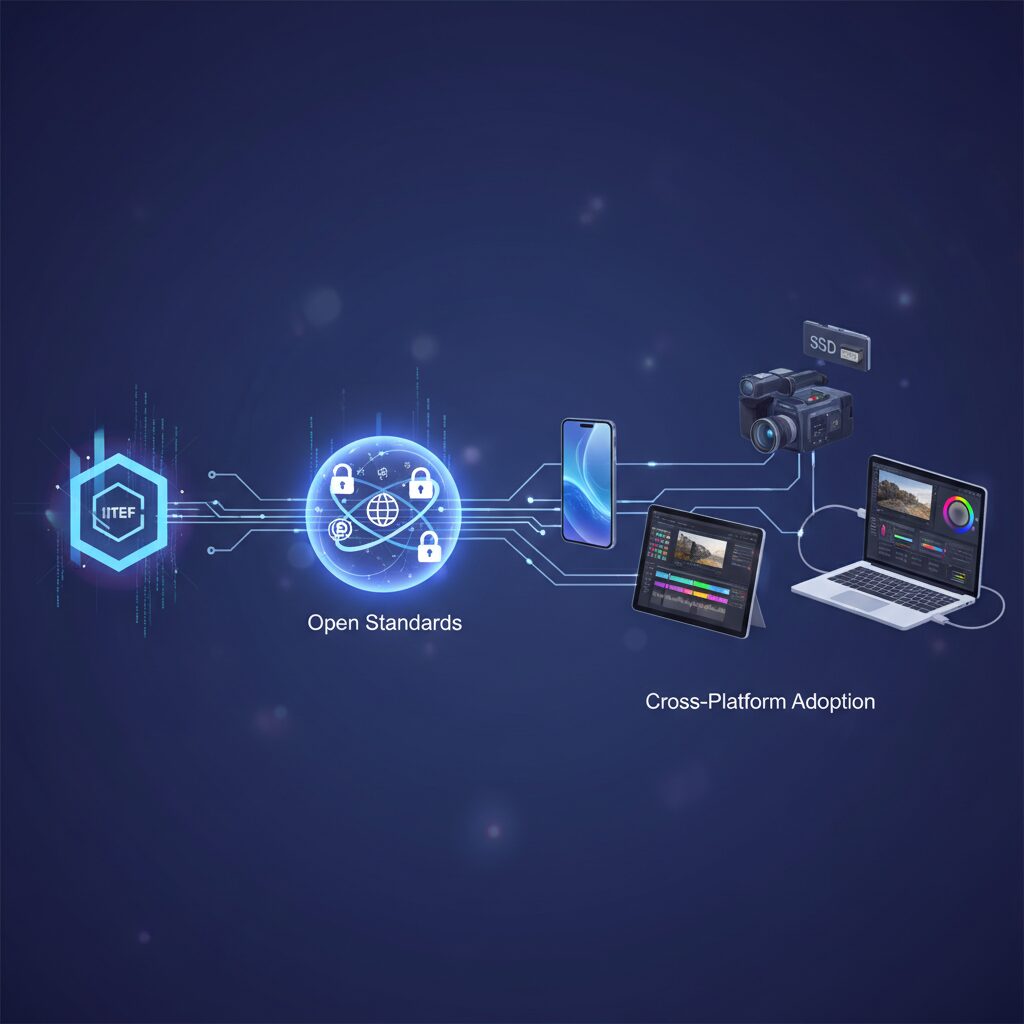
The real breakthrough of APV is not only technical performance but its transition from a proprietary codec into a shared ecosystem. Samsung’s decision to submit Advanced Professional Video to the Internet Engineering Task Force (IETF) signals a clear ambition: to position APV as an open, royalty‑free standard rather than a vendor‑locked feature. According to publicly available documentation and the Wikipedia entry on APV, the proposal aims to formalize bitstream structure, color handling, and decoding behavior under an interoperable framework.
This move fundamentally changes how professional video can evolve on Android. Instead of relying on a single manufacturer’s licensing terms, hardware makers, software developers, and even chip vendors can implement APV natively without negotiating proprietary agreements. In practical terms, that lowers the barrier for adoption across smartphones, tablets, drones, and compact cinema devices.
| Aspect | APV (IETF Proposal) | Typical Proprietary Codec |
|---|---|---|
| Licensing | Royalty‑free (proposed) | Vendor‑controlled |
| Specification Access | Public draft process | Restricted documentation |
| Implementation Scope | Multi‑vendor hardware & software | Limited ecosystem |
The impact is already visible in cross‑platform software. LumaFusion 2.5 for Android added full APV export support, aligning its feature set closely with its iOS counterpart, as reported by Digital Production and slashCAM. Meanwhile, FFmpeg integration ensures that APV can enter established post‑production pipelines without custom transcoding bridges. This interoperability is critical because professional workflows depend on predictable decoding behavior across editing bays.
Blackmagic Design’s Android camera app further demonstrates ecosystem maturity. By supporting Samsung Log and enabling Open Gate recording while maintaining compatibility with DaVinci Resolve, it effectively treats APV footage as first‑class media inside a global editing environment. That is a strong signal that the codec is not experimental but production‑ready.
Open standards create network effects. Once a codec is hardware‑accelerated in Snapdragon 8 Elite Gen 5 and other next‑generation SoCs, and simultaneously supported by major editing platforms, developers gain confidence to build LUT libraries, cloud workflows, and asset management systems around it. According to Qualcomm’s published platform briefs, hardware acceleration for high‑bit‑depth 4K and 8K workflows ensures that openness does not come at the cost of efficiency.
Cross‑platform adoption also reduces friction in mixed‑camera environments. Editors working in DaVinci Resolve can place APV clips alongside other high‑quality intraframe formats on the same timeline without compromising grading latitude. Industry commentary on forums such as Reddit’s Android community reflects growing confidence that APV footage holds up under professional color correction, reinforcing its credibility beyond marketing claims.
By moving from a single‑device feature to a standards‑driven initiative under IETF discussion, APV transforms from “a codec on a phone” into infrastructure. That shift is what enables true ecosystem growth, where hardware vendors, software developers, and creators align around a common, open foundation for high‑end mobile video production.
Snapdragon 8 Gen 5 and Hardware Acceleration: Enabling 8K, 120fps, and AI Segmentation
Snapdragon 8 Gen 5 stands at the center of Android’s push toward true cinema-grade capture. Qualcomm officially states that the platform supports up to 8K 30fps and 4K 120fps 10-bit HDR recording, but the real breakthrough lies in how its hardware blocks are architected to sustain these workloads without thermal collapse.
The combination of the custom Oryon CPU cores clocked up to 4.32GHz and a deeply upgraded Spectra AI ISP enables massive parallel throughput. Instead of treating video as a simple encode task, the chip distributes processing across ISP, GPU, and NPU simultaneously, which is essential when targeting 120fps pipelines.
High-resolution capture is no longer limited by raw sensor readout alone. It is sustained by coordinated hardware acceleration across ISP, GPU, and NPU.
The Spectra AI ISP maintains a triple 20-bit architecture, allowing greater dynamic range processing before compression. This matters especially for APV workflows, where 10-bit and higher bit depths preserve grading latitude. Qualcomm explains that on-device AI segmentation can now operate in real time even during 4K 60fps capture, isolating sky, skin, subject, and vegetation independently.
Such segmentation is not cosmetic. By applying localized tone mapping and exposure correction at the ISP level, the system avoids global compromises that typically flatten highlights or crush shadows. The result is cleaner footage before it even reaches the encoder.
| Component | Role in 8K/120fps Pipeline | Practical Impact |
|---|---|---|
| Spectra AI ISP | 20-bit processing + real-time segmentation | Improved HDR and subject isolation |
| Adreno GPU | High-throughput preview & 8K playback | Smooth monitoring at high frame rates |
| NPU (46% uplift) | AI scene analysis & enhancement | Reduced artifacts, smarter tone control |
The Adreno GPU’s slice-based architecture further improves efficiency during 8K preview and 120fps playback. Instead of maxing out a monolithic graphics core, workloads are distributed dynamically, lowering power spikes. This is crucial for field production, where sustained recording matters more than short benchmark bursts.
Qualcomm also reports up to a 46% improvement in NPU performance over the previous generation. In practical terms, this means segmentation masks are generated faster and with higher precision. When paired with APV’s intra-frame structure, each frame can carry AI-optimized tonal decisions without waiting for inter-frame prediction cycles.
8K and 120fps are not just numbers on a spec sheet. They represent a synchronized hardware ecosystem engineered for real-time intelligence. As professional creators demand higher frame rates for slow motion and 8K masters for reframing, Snapdragon 8 Gen 5 ensures the capture pipeline remains stable, color-accurate, and thermally sustainable under pressure.
This level of hardware acceleration fundamentally shifts what is possible on a smartphone. Instead of choosing between resolution, frame rate, or AI processing, creators can now run all three simultaneously, redefining the ceiling of mobile cinematography.
Google Tensor G5 and Computational Video: AI Zoom, Real Tone, and On‑Device Content Credentials
Google Tensor G5 marks a decisive shift toward what Google calls computational video. Rather than relying solely on optics or brute-force bitrate, the Pixel 10 Pro leverages AI models tightly integrated into its ISP and NPU to enhance footage in real time.
According to Google’s official blog, Tensor G5 is fabricated on a 3nm process and redesigned for sustained AI workloads, improving thermal stability during long video sessions. This matters because advanced features such as AI Zoom and Real Tone in video require continuous on-device inference at 4K resolution.
The result is not just sharper footage, but context-aware video that adapts scene by scene.
AI Zoom (Pro Res Zoom)
Tensor G5 introduces what Google refers to as Pro Res Zoom, an AI-assisted zoom pipeline that reconstructs fine detail when digitally magnifying a subject. Instead of simple pixel interpolation, the system uses trained super-resolution models to predict texture and edge fidelity.
In practical terms, this allows up to 100x zoom ranges while maintaining usable clarity in motion, particularly in well-lit conditions. NotebookCheck and other benchmark analyses note that Tensor G5’s AI throughput is optimized for such camera-first workloads rather than raw GPU ray-tracing performance.
This approach prioritizes perceptual sharpness and subject isolation over traditional optical magnification limits.
| Feature | Technical Basis | User Impact |
|---|---|---|
| AI Zoom | On-device super-resolution models | Sharper digital zoom in video |
| Real Tone (Video) | AI skin-tone segmentation | Accurate rendering across diverse complexions |
| Content Credentials | C2PA-compliant metadata signing | Verifiable authenticity |
Real Tone in Motion
Real Tone, previously known for still photography, now operates continuously in video capture. The ISP performs real-time segmentation to identify skin regions and applies calibrated color mapping designed to preserve undertones without over-brightening or desaturating.
Google has emphasized that this system was developed with diverse image datasets and expert consultation to reduce bias in imaging pipelines. In video, this becomes even more complex because lighting and white balance shift frame by frame.
By processing 10-bit video by default, Tensor G5 preserves sufficient color depth to make these corrections look natural rather than algorithmic.
On-Device Content Credentials
Perhaps the most forward-looking feature is on-device generation of Content Credentials aligned with the C2PA standard. As announced by Google, the Pixel 10 Pro can cryptographically attach metadata at capture, indicating that the footage was recorded on a specific device and has not been altered.
This is especially relevant in an era of generative AI and synthetic media. Newsrooms and documentary filmmakers increasingly demand provenance signals, and embedding them at the hardware level reduces the risk of tampering.
Authenticity becomes a built-in property of the file itself, not an afterthought added in post.
Combined, AI Zoom, Real Tone video processing, and on-device Content Credentials demonstrate that Tensor G5 is less about headline benchmark scores and more about intelligent imaging. For creators who value trust, inclusivity, and computational enhancement, this represents a new standard in Android video.
Galaxy S26 Ultra: 200MP Sensor, 12‑bit APV, and External SSD Workflows
The Galaxy S26 Ultra is positioned as the ultimate showcase for Samsung’s Advanced Professional Video (APV) ecosystem. At its core is the 200MP ISOCELL HP2 sensor paired with a brighter f/1.4 aperture, designed to maximize light intake and dynamic range in demanding conditions.
When this high-resolution sensor is combined with 12‑bit APV recording, the result is not just sharper footage but significantly richer tonal gradation. 12‑bit color depth theoretically enables 4,096 tonal values per channel, dramatically expanding flexibility in color grading compared to standard 10‑bit workflows.
According to Samsung’s technical briefings and coverage by SamMobile, the S26 Ultra supports 4K recording at 25fps, 50fps, and 100fps, as well as 8K at 25fps. These frame rate options are tailored for cinematic delivery, slow-motion flexibility, and high-resolution reframing in post-production.
| Feature | Galaxy S26 Ultra | Practical Benefit |
|---|---|---|
| Main Sensor | 200MP ISOCELL HP2 | High-detail capture, flexible cropping |
| Codec | APV (up to 12‑bit) | Greater grading latitude |
| Max Video Mode | 8K 25fps | Oversampling & cinematic workflows |
APV uses intra-frame compression, meaning each frame is encoded independently. This design significantly reduces timeline lag during scrubbing and frame-accurate trimming. As noted in documentation submitted to the IETF and summarized on Wikipedia, APV achieves perceptually lossless quality while improving storage efficiency by roughly 20% over Apple ProRes.
However, even with improved efficiency, high-bitrate recording quickly consumes storage. Industry analysis shows that 1080p 30fps in APV HQ can require around 1GB per minute. At 4K 100fps or 8K, data rates scale dramatically. This is where the Galaxy S26 Ultra’s external SSD workflow becomes transformative.
The S26 Ultra supports direct recording to external SSDs via USB‑C, allowing creators to bypass internal storage limits entirely. By connecting high-speed portable drives such as Samsung’s T-series or comparable USB‑C SSDs, users can sustain multi‑gigabit write speeds required for 12‑bit APV capture.
This changes on-set logistics in a fundamental way. Instead of offloading footage from internal storage at the end of a shoot, creators can unplug the SSD and connect it directly to a workstation. The result is a near-instant handoff into DaVinci Resolve or LumaFusion, both of which fully support APV workflows as of 2026.
From a production standpoint, this effectively turns the Galaxy S26 Ultra into a modular cinema tool. You can rig it with external power, attach a large-capacity SSD, and record extended interviews or events without thermal or storage anxiety. Combined with Snapdragon 8 Elite Gen 5 hardware acceleration for APV encode/decode, playback and review remain smooth even at high resolutions.
For serious video creators, the key takeaway is clear: the Galaxy S26 Ultra is not merely adding a new codec—it is enabling a complete professional data pipeline. High-resolution 200MP imaging, 12‑bit APV color depth, and direct-to-SSD recording converge into a workflow that rivals traditional dedicated cameras, while remaining pocketable.
In practical terms, that means fewer compromises, faster turnaround, and grading flexibility that was previously reserved for larger cinema systems. For Android-based production in 2026, this combination represents a decisive leap forward.
Sony Xperia 1 VII: S‑Cinetone for Mobile, Pro Controls, and Creator‑First Hardware Design
Sony positions the Xperia 1 VII not merely as a flagship smartphone, but as a compact extension of its Alpha and CineAlta ecosystems. At the center of this philosophy is S‑Cinetone for mobile, a color science profile derived from Sony’s professional cinema cameras.
According to Sony’s official specifications and product materials, S‑Cinetone is designed to reproduce natural skin tones and gentle highlight roll‑off straight out of camera. This means creators can achieve a cinematic look without heavy grading, a crucial advantage for fast‑turnaround projects.
In practical shooting scenarios, the difference is immediately visible. Skin retains texture without appearing oversharpened, and bright skies avoid harsh clipping, giving footage a more organic tonal transition that traditionally required Log capture and post‑processing.
| Feature | Implementation on Xperia 1 VII | Creator Benefit |
|---|---|---|
| S‑Cinetone | Native color profile for video | Cinematic tones without grading |
| Manual Controls | Shutter, ISO, WB, focus control | Precise exposure consistency |
| Audio Monitoring | 3.5mm headphone jack | Real‑time sound verification |
| Expandable Storage | microSD up to 2TB | Flexible high‑bitrate recording |
The Xperia 1 VII also emphasizes tactile control. With a dedicated two‑stage shutter button and pro‑style camera UI, it mirrors the operational logic of Sony’s mirrorless cameras. For videographers, consistent shutter angle control and manual white balance are not luxuries but necessities for multi‑camera matching.
TechRadar notes that Sony continues to prioritize hardware elements often abandoned by competitors. The retention of the 3.5mm headphone jack enables accurate audio monitoring during interviews or documentary shoots, eliminating the latency and compression risks of wireless solutions.
Storage flexibility further reinforces its creator‑first philosophy. Support for microSD cards up to 2TB allows high‑bitrate recording without immediate reliance on cloud transfer or external drives. For event shooters capturing extended 4K sessions, this translates into operational security and fewer workflow interruptions.
What truly differentiates the Xperia 1 VII is its commitment to consistency across focal lengths. Sony expanded sensor size on the ultra‑wide module, aiming to deliver more uniform color and dynamic range between lenses. For filmmakers, this reduces grading time and preserves visual continuity within a single project.
The device also integrates seamlessly as an external monitor for Sony mirrorless cameras. This hybrid capability transforms the phone into a field tool rather than a standalone gadget, enabling framing, focus checks, and mobility in tight shooting environments.
In an era where computational automation dominates mobile imaging, the Xperia 1 VII instead champions intentional control. It gives creators the choice to rely on S‑Cinetone’s refined rendering or to dial in exposure manually, treating the smartphone as a precision instrument rather than an algorithmic black box.
For serious video enthusiasts and working professionals, that philosophy makes a tangible difference. The Xperia 1 VII does not try to simplify filmmaking—it respects it.
Pixel 10 Pro: The Rise of AI‑First Cinematography and Verified Authentic Footage
Pixel 10 Pro takes a radically different path from traditional “codec-first” innovation and instead positions itself at the forefront of AI-first cinematography. Rather than overwhelming creators with manual controls, it leverages the new Tensor G5 to computationally construct the best possible frame in real time. According to Google’s official product blog, the G5 chip was designed to prioritize on-device AI pipelines, especially for video processing.
At the core of this philosophy is a tightly integrated AI video ISP. Features such as Night Sight Video dramatically reduce noise in low-light scenes, while maintaining natural texture instead of over-smoothing. Real Tone continues to operate in 10-bit video capture by default, ensuring that skin tones across diverse complexions are rendered accurately and consistently.
Pixel 10 Pro does not merely record reality. It computationally interprets, enhances, and authenticates it in real time.
Another standout capability is Pro Res Zoom, powered by AI reconstruction models running directly on Tensor G5. Instead of relying purely on digital crop, the system analyzes motion vectors and texture data frame by frame to rebuild detail during high-magnification video capture. This enables usable footage even at extreme zoom ranges, something that previously required dedicated optical hardware.
| Feature | Pixel 10 Pro Implementation | Practical Impact |
|---|---|---|
| Night Sight Video | AI noise reduction on-device | Cleaner low-light footage without heavy grain |
| Real Tone (10-bit) | Default high bit-depth recording | Accurate skin tone reproduction |
| Pro Res Zoom | AI detail reconstruction | Sharper long-range video |
| C2PA Content Credentials | On-device cryptographic signing | Verifiable authenticity |
What truly differentiates Pixel 10 Pro in 2026 is its integration of C2PA-compliant Content Credentials generated directly on the device. As noted in Google’s announcement, each verified clip can carry cryptographic metadata proving that the footage was captured on that specific device and has not been altered. In an era where generative AI makes synthetic video increasingly indistinguishable from reality, this function becomes strategically vital.
For journalists and documentary filmmakers, verified authentic footage is no longer optional. The Coalition for Content Provenance and Authenticity emphasizes that embedded provenance data is one of the most effective countermeasures against misinformation. Pixel 10 Pro operationalizes this standard at the consumer hardware level, bringing newsroom-grade verification tools into a pocket device.
The result is a new creative paradigm. Instead of spending hours stabilizing, denoising, or validating footage in post-production, creators can capture AI-enhanced and cryptographically signed video instantly. This fusion of computational imaging and built-in authenticity transforms the smartphone from a camera into a trusted capture instrument.
Pixel 10 Pro therefore represents more than incremental camera upgrades. It signals the rise of AI-first cinematography, where enhancement and verification happen simultaneously at the moment of capture, redefining what “professional” means in mobile video production.
LumaFusion 2.5 and Blackmagic Camera: Professional Editing and Log Workflows on Android
The combination of LumaFusion 2.5 and Blackmagic Camera on Android fundamentally reshapes what “mobile post-production” means in 2026. What was once a proxy workflow is now a fully professional, log-based pipeline built around APV, running natively on flagship Android hardware.
According to coverage by Digital Production and Post Magazine, LumaFusion 2.5 for Android has reached near feature parity with its iOS counterpart while adding full APV export support. This is not a minor checkbox update. It enables an end‑to‑end high-bitrate intermediate workflow without transcoding bottlenecks.
When paired with Blackmagic Camera’s Samsung Log support and Open Gate recording, Android devices now capture and finish footage using tools modeled after dedicated cinema systems.
| Stage | Tool | Key Capability |
|---|---|---|
| Acquisition | Blackmagic Camera | Samsung Log, Open Gate, manual controls |
| Edit | LumaFusion 2.5 | Magnetic timeline, multi-track 4K, APV native editing |
| Mastering | LumaFusion Export | APV high-bitrate intermediate output |
Blackmagic Camera for Android mirrors the interface logic of Blackmagic’s cinema cameras, including waveform monitoring, shutter angle control, and LUT management. With Samsung Log HDR support introduced in recent updates, creators can now capture flatter gamma profiles designed specifically for grading latitude.
The practical implication is significant. Log footage retains highlight and shadow information that would otherwise clip in standard profiles. When this material is edited directly in APV inside LumaFusion, color grading becomes fluid and artifact-resistant, thanks to APV’s intra-frame structure and 10–16-bit depth support.
Unlike long-GOP codecs such as HEVC, which require decoding reference frames during scrubbing, APV treats each frame independently. This dramatically improves timeline responsiveness, especially when stacking multiple color nodes or applying LUTs.
LumaFusion 2.5’s magnetic timeline and up to six simultaneous 4K tracks allow multicam-style edits even on tablets powered by Snapdragon 8 Elite Gen 5. Qualcomm’s published specifications confirm hardware acceleration for high-resolution 10-bit video pipelines, which directly benefits APV playback and export stability.
Open Gate recording in Blackmagic Camera adds another layer of flexibility. By capturing the full sensor area, creators can reframe for vertical and horizontal deliverables from a single master file. In social-first production environments, this eliminates duplicate shoots and preserves maximum image data for cropping.
The workflow also integrates cleanly with desktop finishing. Because APV is supported in DaVinci Resolve and FFmpeg, footage exported from LumaFusion can move into high-end color suites without generational loss. Industry observers have noted that this interoperability lowers the barrier for Android to be used in mixed-camera productions alongside ProRes systems.
For field creators, the ability to record Log in Blackmagic Camera, edit natively in LumaFusion, and export an intermediate-grade APV master—all on the same device—means the smartphone is no longer a capture tool awaiting desktop rescue. It becomes a compact, self-contained post-production environment capable of broadcast-ready output.
In 2026, this pairing represents more than app compatibility. It signals that Android has achieved a true professional Log-to-delivery workflow, built on open standards and optimized silicon, ready for serious cinematography.
External SSD Recording, USB‑C Speeds, and the Reality of 1GB‑Per‑Minute Footage
When you start recording in APV, storage stops being an abstract spec and becomes a real-world constraint. According to technical breakdowns of Samsung’s APV implementation, just one minute of 1080p 30fps APV HQ footage consumes roughly 1GB. That figure alone reshapes how you plan a shoot.
Move up to 4K at high frame rates or 8K capture, and the data rate multiplies several times over. What feels manageable for short clips quickly turns into tens or even hundreds of gigabytes during interviews, events, or documentary work.
Understanding this “1GB-per-minute reality” is the first step toward building a reliable external SSD workflow.
| Format | Approx. Data Use | 1 Hour Estimate |
|---|---|---|
| 1080p 30fps (APV HQ) | ~1GB / minute | ~60GB |
| 4K High Frame Rate | Several GB / minute | Hundreds of GB |
| 8K | Multiple times 4K | Workflow-critical |
This is precisely why 2026 flagship devices such as Galaxy S26 Ultra and Xperia 1 VII support direct recording to external SSDs over USB-C. Instead of filling internal storage in minutes, you can write straight to portable NVMe-based drives like Samsung T9 or Crucial X10 Pro.
The key is sustained throughput. APV is an intra-frame codec, optimized for editability, which means it demands consistently high write speeds rather than short bursts. A slow cable or thermal-throttled drive can break recording stability.
With modern high-speed USB-C implementations, multi‑Gbps transfer rates make real-time external recording practical. This is not just about capacity; it is about maintaining frame integrity without dropped frames.
There is also a workflow advantage that many creators underestimate. When you finish shooting, you simply unplug the SSD and connect it to your editing workstation. No lengthy file transfer, no recompression, no cloud wait time.
As coverage from professional editing tool vendors has noted, native APV support in tools like DaVinci Resolve and LumaFusion means those externally recorded files drop directly into the timeline. The SSD effectively becomes your on-set master drive.
However, this convenience comes with discipline. You must calculate capacity before rolling, monitor remaining space during long takes, and choose SSDs rated for sustained performance—not just peak benchmarks.
In practical terms, the 1GB-per-minute baseline is less a limitation and more a planning metric. Once you internalize that number, external SSD recording over high-speed USB-C transforms from a luxury feature into an essential pillar of serious Android video production.
Displays, Wireless Monitoring, and the Role of RGB MiniLED and Wi‑Fi 7
For professional creators, a display is not just a screen but a critical reference monitor. In 2026, RGB MiniLED panels announced at CES push mobile monitoring into territory once reserved for dedicated field monitors.
According to AVIXA’s CES 2026 trend report, next-generation RGB MiniLED achieves peak brightness exceeding 3,000 nits while approaching full BT.2020 color gamut coverage. This directly impacts HDR shooting accuracy in outdoor environments.
When you are capturing 10-bit or 12-bit APV footage, monitoring precision determines how confidently you can expose highlights and protect shadow detail.
| Display Tech | Peak Brightness | Color Gamut |
|---|---|---|
| Conventional OLED | ~1,000–2,000 nits | Wide (DCI-P3 typical) |
| RGB MiniLED (2026) | 3,000+ nits | Near BT.2020 coverage |
Higher sustained brightness means you can evaluate HDR tone mapping without relying on sun hoods or external displays. For log workflows such as Samsung Log in Blackmagic Camera, accurate on-device LUT preview becomes far more trustworthy.
The improvement is not only about brightness. RGB backlighting enables finer local dimming control, reducing blooming in high-contrast scenes. This helps when judging specular highlights in night cityscapes or practical lights in cinematic setups.
In practical terms, your smartphone display now behaves closer to a calibrated field monitor than a consumer panel.
Wireless monitoring has evolved just as dramatically. With Wi‑Fi 7 becoming mainstream in 2026 devices and Wi‑Fi 8 concepts unveiled at CES, bandwidth and latency improvements enable real-time video streaming from the phone to multiple external displays.
PCMag’s CES coverage highlights multi-link operation and lower latency targets in Wi‑Fi 7/8 development. For video crews, this translates into stable, low-delay monitoring across tablets or laptops on set.
Using Blackmagic Camera’s Remote Camera Control, you can stream the live feed to an iPad or another Android tablet and adjust focus, exposure, or LUTs remotely. This is particularly valuable for gimbal, car-mount, or tight-location shooting.
The key advantage is separation of roles. The smartphone records high-bitrate APV internally or to external SSD, while directors and focus pullers monitor via wireless feed without physically tethering cables.
As Wi‑Fi standards evolve toward even lower latency targets, the gap between mobile devices and traditional cinema camera ecosystems continues to narrow. Displays and wireless monitoring are no longer secondary features but foundational pillars of Android’s professional video toolkit.
Industry Voices: How APV and ProRes Coexist in Modern Production Pipelines
In 2026, conversations with cinematographers, post supervisors, and mobile-first creators reveal a clear consensus: APV and ProRes are not rivals in isolation, but complementary tools inside hybrid production pipelines. Rather than replacing ProRes outright, APV is increasingly positioned as a parallel mezzanine format optimized for Android-native capture and cloud-centric workflows.
According to documentation submitted to the IETF and technical overviews published after SDC23, APV was designed as an intra-frame, high-bit-depth intermediate codec—much like ProRes 422 HQ. This architectural similarity is precisely what enables coexistence. Editors working in DaVinci Resolve report that APV and ProRes clips behave similarly on the timeline, particularly in scrubbing responsiveness and grading tolerance.
| Aspect | APV | ProRes 422 HQ |
|---|---|---|
| Compression Type | Intra-frame | Intra-frame |
| Bit Depth | Up to 16-bit | Up to 12-bit |
| Licensing | Royalty-free (proposed) | Apple-licensed |
On commercial sets, a common scenario now involves an iPhone shooting ProRes as A‑cam and a Galaxy S26 Ultra capturing 12-bit APV as B‑cam. Colorists note that because both formats preserve 4:2:2 or higher chroma information and avoid long‑GOP compression, matching skin tones and highlight roll-off has become far less labor-intensive than when mixing HEVC with ProRes.
Blackmagic Design’s cross-platform support plays a pivotal role here. With Blackmagic Camera on Android supporting Samsung Log and direct cloud upload, and DaVinci Resolve handling both ProRes and APV natively, post-production teams can standardize their grading pipeline without forcing transcoding at ingest. This reduces turnaround time and storage duplication, especially in fast-paced documentary or news environments.
Industry editors interviewed in professional forums emphasize another advantage: storage economics. Technical analyses indicate that APV achieves roughly 20% better storage efficiency than comparable ProRes profiles while maintaining perceptually lossless quality. In multi-camera shoots where terabytes accumulate daily, this delta translates into measurable savings in SSD provisioning and cloud archiving costs.
Importantly, coexistence is also strategic. Apple’s vertically integrated ecosystem ensures tight optimization for ProRes across hardware and software. Meanwhile, APV’s open, royalty-free direction encourages adoption in drones, action cameras, and potentially compact cinema devices. The result is not fragmentation, but format specialization: ProRes dominates established Apple-centric workflows, while APV accelerates Android-driven, AI-enhanced, and cloud-synchronized productions.
From an operational standpoint, modern pipelines are format-agnostic by design. With hardware acceleration on Snapdragon 8 Elite Gen 5 and robust NLE support, production teams increasingly choose capture format based on device strengths rather than post limitations. In that sense, APV and ProRes now coexist less as competitors and more as interoperable building blocks in a multi-platform, creator-first era.
The Future of the APV Ecosystem: Beyond Smartphones to Drones and Cinema Cameras
As APV matures into a royalty‑free, IETF‑proposed standard, its impact is no longer confined to smartphones. The real inflection point begins when the same intermediate codec flows seamlessly across drones, action cameras, and compact cinema systems, creating a unified production backbone.
According to documentation around Advanced Professional Video and its open initiatives, APV supports up to 4:4:4:4 chroma sampling, 16‑bit depth, and hardware‑dependent resolutions up to 8K 120fps. These specifications are not inherently “mobile” features. They are cinema‑grade attributes that naturally extend to aerial and multi‑camera environments.
Consider how this translates beyond phones.
| Device Category | APV Advantage | Workflow Impact |
|---|---|---|
| Drones | Intra‑frame 10–16bit recording | Frame‑accurate editing, robust grading |
| Action Cameras | ~20% better storage efficiency than ProRes | Longer record times at high bitrates |
| Compact Cinema Cameras | 4:4:4:4 + Alpha support | Advanced compositing pipelines |
For drones in particular, intra‑frame compression is transformative. Aerial footage often includes rapid motion and complex textures such as foliage or water. Inter‑frame codecs can introduce motion artifacts under these conditions, but APV’s frame‑independent structure preserves detail while keeping scrubbing responsive inside DaVinci Resolve and FFmpeg‑based pipelines.
Storage efficiency also matters more in the air than on the ground. As reported in industry coverage of Samsung’s APV rollout, the codec achieves roughly 20% better storage efficiency compared with ProRes at perceptually lossless quality. On a drone with limited onboard SSD capacity, that margin can mean additional flight sequences captured without landing.
Compact cinema cameras stand to benefit from APV’s open licensing model. Because it is positioned as royalty‑free and proposed through open standards channels, manufacturers are not locked into proprietary ecosystems. This lowers barriers for mid‑tier camera makers seeking a high‑quality intermediate codec without negotiating platform‑specific agreements.
The Academy Software Foundation’s openAPV initiative signals another strategic shift: integration with professional VFX and post communities. Once drones capture APV, ground units record APV, and editorial ingests APV natively, color pipelines and LUT workflows become consistent across devices.
Wireless evolution reinforces this trajectory. With Wi‑Fi 7 demonstrations at CES 2026 highlighting low‑latency high‑bandwidth transfers, multi‑camera APV shoots can theoretically offload footage from drones and handheld rigs into shared storage in near real time. That convergence blurs the boundary between mobile capture and cinema production.
The future APV ecosystem is not about replacing smartphones with larger cameras. It is about dissolving format fragmentation across every lens in the production chain.
When aerial, handheld, and studio systems speak the same high‑bit‑depth, edit‑friendly language, creators gain flexibility without compromise. That interoperability may ultimately define the post‑ProRes era more than any single device launch.
参考文献
- SamMobile:LumaFusion video editor gains Samsung APV codec ahead of Galaxy S26 launch
- Wikipedia:Advanced Professional Video
- Qualcomm:Snapdragon 8 Gen 5 Mobile Platform
- Google Blog:Pixel 10 introduces new chip, Tensor G5
- Sony:Xperia 1 VII 256GB Specifications
- Blackmagic Design:Blackmagic Camera