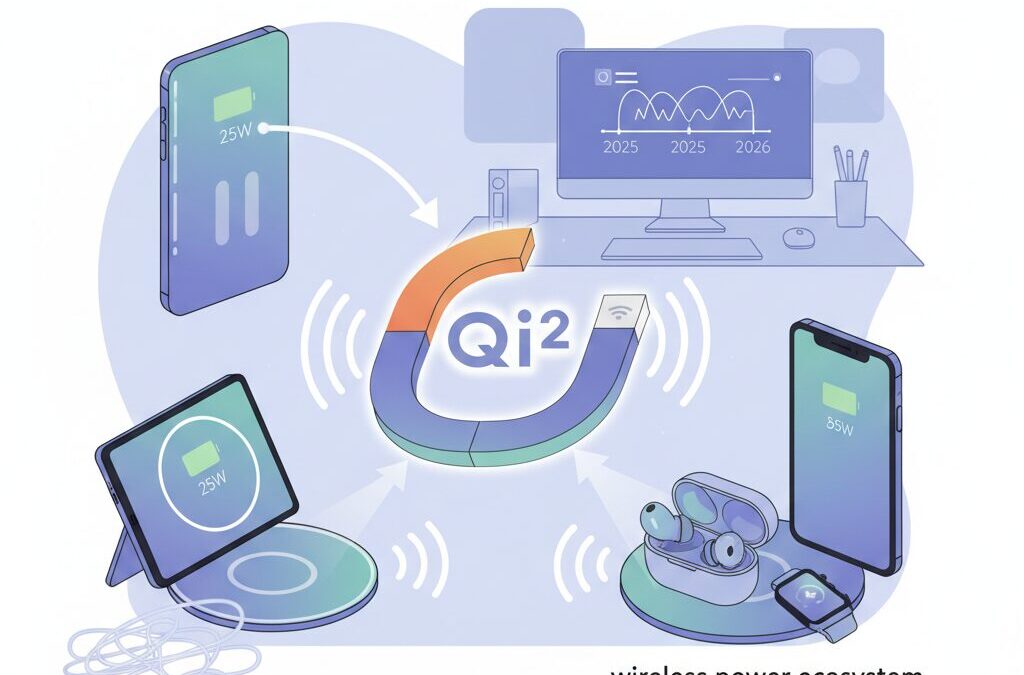
Wireless charging has quietly reached a turning point, and many gadget enthusiasts are only beginning to notice it.
For years, convenience came at the cost of slow speeds, unstable alignment, and excessive heat, making wireless charging feel like a compromise rather than a true upgrade.
With the arrival of Qi2 and its new 25W class, that long-standing trade-off is finally being challenged.
Qi2 is not just a faster version of Qi.
By standardizing magnetic alignment across platforms, it brings iPhone and Android devices closer than ever at the physical interface level, dramatically improving efficiency and consistency.
As a result, wireless charging is starting to approach the practicality of wired solutions, especially for desk and daily top-up use.
At the same time, higher power introduces new questions.
Heat management, fan noise, coil whine, and device compatibility have become critical factors, and not all manufacturers are solving them in the same way.
Understanding these differences is essential if you want to invest in chargers and accessories that will remain relevant through 2026 and beyond.
In this article, you will learn how Qi2 works, why 25W matters, which smartphones truly support it, and how major brands are shaping the ecosystem.
By the end, you will be equipped to choose the right Qi2 setup for your lifestyle, without falling for confusing labels or marketing buzzwords.
- Why Qi2 Marks a Turning Point in Wireless Charging
- From Early Qi to Magnetic Power Profile: A Short Technical History
- Qi2 Versions Explained: 15W vs 25W and What the Labels Really Mean
- Smartphone Support in 2025–2026: Apple, Pixel, and Galaxy Compared
- The Physics of Faster Wireless Charging: Heat, Efficiency, and Losses
- Active Cooling, Fan Noise, and Coil Whine: Real-World Trade-Offs
- How Major Brands Are Competing in the Qi2 Ecosystem
- Use-Case Thinking: Desk, Bedside, Travel, and Mobile Battery Scenarios
- What the Future Holds: Qi2 as the New Charging Infrastructure
- 参考文献
Why Qi2 Marks a Turning Point in Wireless Charging
Qi2 represents a genuine inflection point in the history of wireless charging because it finally addresses the problem that held the technology back for more than a decade: unreliable alignment. **Earlier Qi generations promised convenience but often delivered frustration**, with slower charging, excess heat, and inconsistent results caused by even slight coil misalignment. This gap between expectation and reality prevented wireless charging from becoming true daily infrastructure.
The turning point comes from Magnetic Power Profile, or MPP, which was standardized by the Wireless Power Consortium after Apple contributed its MagSafe technology. According to the WPC, MPP physically fixes coil position using a magnetic array and operates at a defined frequency band, dramatically improving coupling efficiency. This is not a cosmetic improvement but an architectural change that stabilizes energy transfer at the physical layer.
What makes Qi2 transformative is that this solution is no longer proprietary. For the first time, Android and iOS devices can share the same magnetic charging ecosystem without adapters or workarounds. Industry analysts at Engadget and MacRumors have pointed out that this is rare in consumer electronics, where physical interfaces are usually a source of platform lock-in rather than unification.
| Aspect | Pre-Qi2 Qi | Qi2 with MPP |
|---|---|---|
| Alignment | Manual, error-prone | Magnetic, fixed |
| Thermal behavior | Inconsistent heating | Predictable, reduced loss |
| Platform reach | Fragmented | Cross-platform standard |
This standardization has measurable consequences. Belkin’s internal testing, cited by MacRumors, shows that Qi2-enabled iPhones can reach 50 percent charge in about 30 minutes at higher power levels, a result previously associated only with wired charging. **The psychological barrier that “wireless is slow” is now breaking down**, which changes how users think about where and when charging happens.
Another reason Qi2 marks a turning point is its effect on accessory design. When alignment is guaranteed, manufacturers can engineer stands, car mounts, and multi-device stations with confidence that performance will be consistent. The WPC has emphasized that predictable alignment also improves foreign object detection accuracy, which directly impacts safety and long-term battery health.
From a market perspective, Qi2 shifts competition away from basic compatibility and toward real value, such as thermal control, noise reduction, and industrial design. Analysts note that once a technology becomes infrastructure, differentiation moves upward. **Qi2 does not merely improve wireless charging; it stabilizes it enough to become invisible**, and that invisibility is often the clearest sign that a technology has truly matured.
From Early Qi to Magnetic Power Profile: A Short Technical History
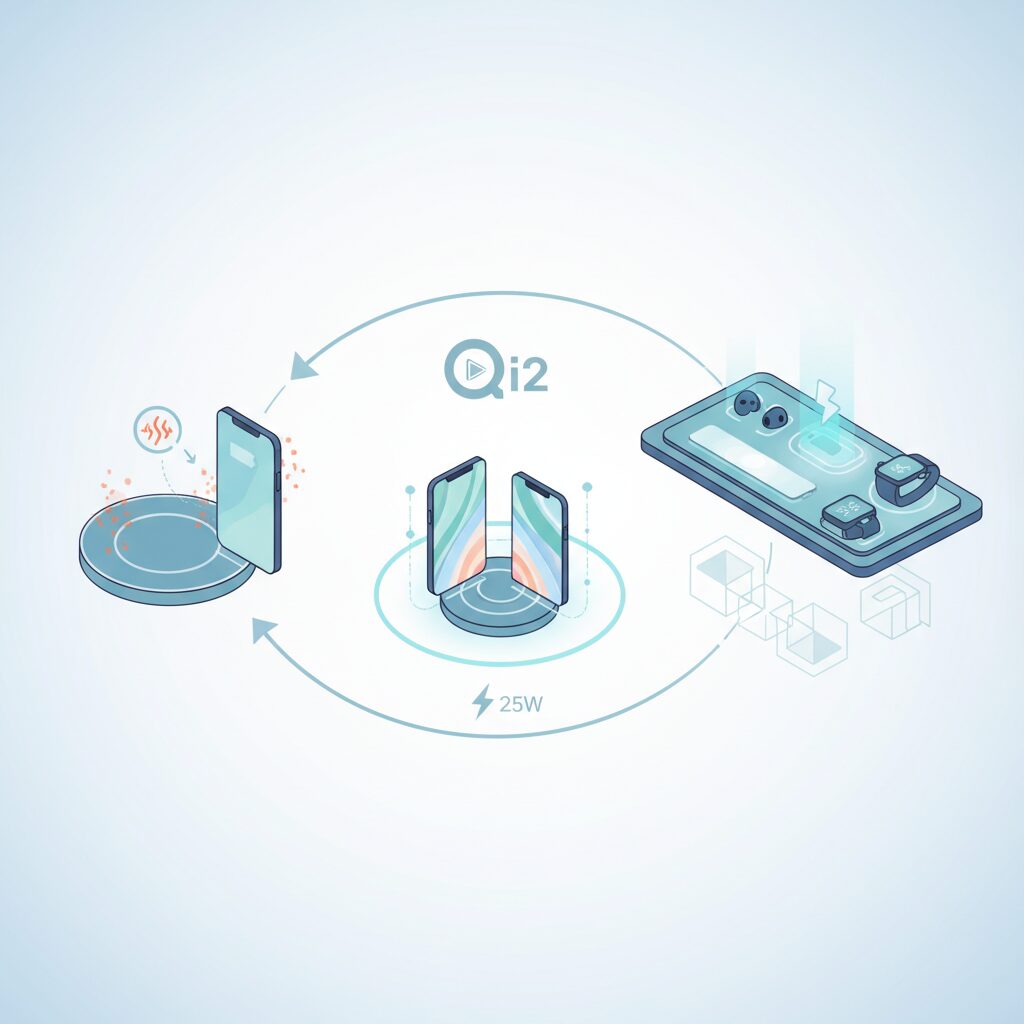
Wireless charging did not begin as a premium convenience feature, but as a compromise. Early Qi, standardized by the Wireless Power Consortium in 2010, promised cable‑free power, yet in practice it required patience and precision. **A few millimeters of coil misalignment could dramatically reduce efficiency**, leading to slower charging and excess heat. According to technical explanations published by the WPC and later analyzed by RF engineering communities, this inefficiency was not a bug but a structural limitation of inductive coupling.
As smartphones adopted metal frames and larger batteries, the weaknesses of early Qi became more visible. Users experienced warm devices, throttled charging speeds, and inconsistent results depending on how carefully a phone was placed on the pad. Research discussions in electronics engineering forums and WPC documentation consistently pointed to the same root cause: unstable magnetic coupling caused by free positioning. The technology worked, but it did not scale well with rising power demands.
The first major practical breakthrough arrived in 2020 with Apple’s MagSafe. By embedding a circular magnet array around the charging coil, Apple enforced physical alignment. This simple mechanical constraint solved a complex electromagnetic problem. **Charging became repeatable, efficient, and cooler**, not because the physics changed, but because the variables were finally controlled. However, this solution was proprietary, and for several years remained limited to the iPhone ecosystem.
| Generation | Alignment Method | Practical Impact |
|---|---|---|
| Early Qi (v1.x) | Manual placement | Unstable speed, excess heat |
| MagSafe | Magnet-assisted | Consistent 15W-class charging |
| Qi2 (MPP) | Standardized magnets | Cross-platform efficiency |
Qi2 represents the moment when this idea was democratized. Apple contributed its Magnetic Power Profile to the WPC, allowing magnet-based alignment to become an open standard rather than a brand feature. Official WPC releases describe MPP as a profile that fixes coil position and distance, typically operating around 360 kHz, which significantly improves coupling efficiency. **This is why Qi2 feels less like an incremental update and more like an architectural reset.**
From a historical perspective, Qi2 marks the transition from “wireless charging as convenience” to “wireless charging as infrastructure.” It unifies physical design rules across ecosystems, enabling accessory makers to design once and support many platforms. Industry analysts and engineers alike emphasize that this standardization, not raw wattage, is the true legacy of Qi2’s evolution from early Qi to magnetic power profiles.
Qi2 Versions Explained: 15W vs 25W and What the Labels Really Mean
As Qi2 products spread rapidly across the market, many enthusiasts find themselves confused by labels such as Qi2 15W, Qi2 25W, or even Qi2 Ready. These numbers look straightforward, but they actually hide important technical and practical differences that directly affect charging speed, heat, and long‑term usability.
Qi2 15W refers to the original Qi v2.0 specification finalized in 2023. It introduced the Magnetic Power Profile, derived from Apple’s MagSafe technology, which physically aligns the coils using magnets. According to the Wireless Power Consortium, this magnetic alignment dramatically improves energy transfer efficiency compared with older Qi EPP chargers, where real‑world output often dropped below the theoretical 15W due to misalignment.
| Label | Max Output | Key Meaning |
|---|---|---|
| Qi2 15W | 15 watts | Magnetic alignment, stable efficiency |
| Qi2 25W | 25 watts | Higher power profile, faster charging |
Qi2 25W, formally Qi v2.2.1 and finalized in mid‑2025, is not just a speed bump. It defines a new power class with stricter thermal management and communication requirements between the charger and the device. Belkin, one of the first brands to obtain official certification, reports that supported phones such as the iPhone 16 can reach around 50 percent charge in roughly 30 minutes under controlled conditions, approaching the convenience of wired charging.
However, the label alone does not guarantee that you will actually get 25W. Both the charger and the phone must explicitly support the 25W profile, and the firmware must allow it. Apple confirmed through iOS 26 documentation that only WPC‑certified Qi2 25W chargers are permitted to deliver full power, while uncertified accessories fall back to lower outputs.
This distinction also explains why some manufacturers emphasize the wording Qi2 Ready. As industry analysts cited by Engadget point out, this label usually means the internal charging circuitry understands Qi2 protocols, but magnetic alignment or full power support may depend on accessories such as special cases. For buyers, reading the wattage number without understanding the context can easily lead to disappointment.
Understanding what these labels really mean allows you to match expectations with reality. Qi2 15W already solves the biggest historical problem of wireless charging, while Qi2 25W represents the cutting edge, where speed, heat management, and certification all have to align perfectly.
Smartphone Support in 2025–2026: Apple, Pixel, and Galaxy Compared
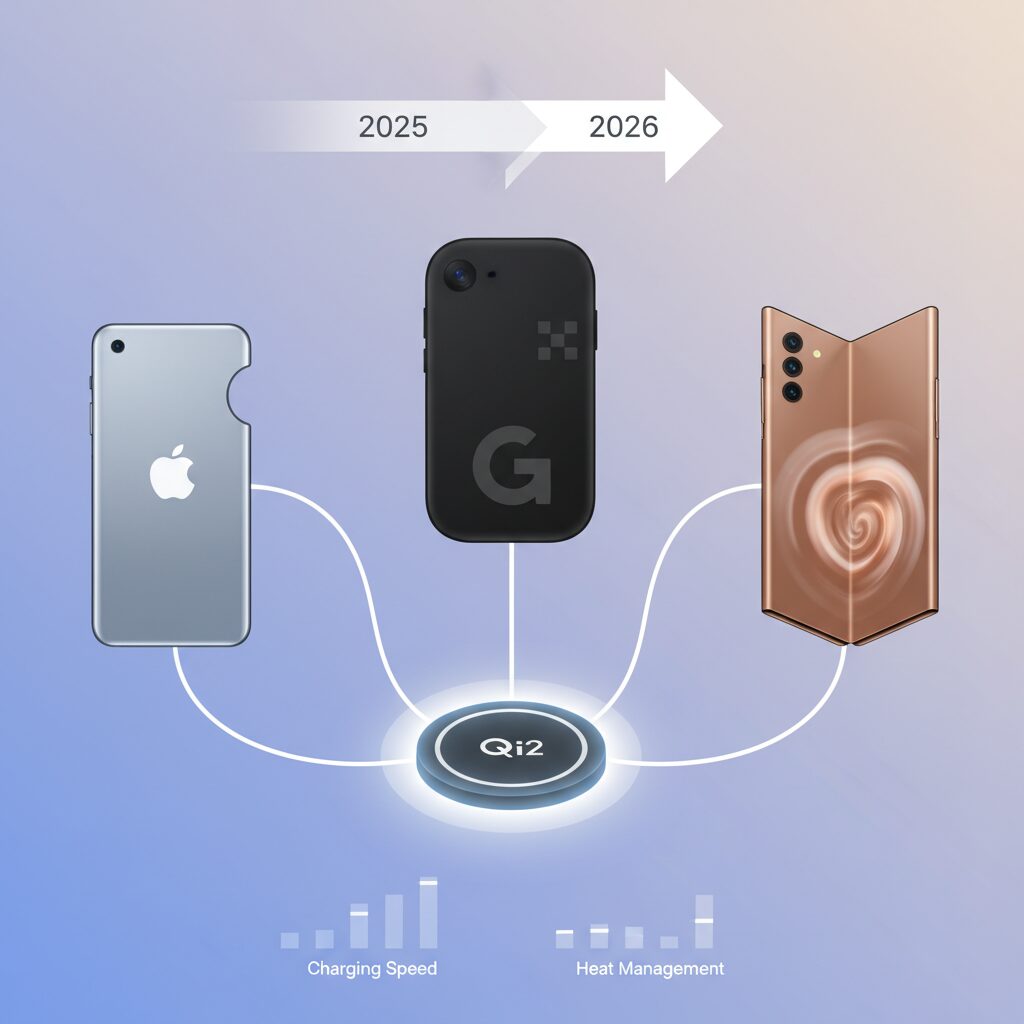
Smartphone support is the single most important factor shaping the real-world value of Qi2 in 2025–2026, and the contrast between Apple, Google, and Samsung has never been clearer. While chargers and accessories evolve rapidly, it is the handset-side implementation that determines charging speed, magnetic stability, and long-term usability.
Apple currently sets the reference point for Qi2 maturity. According to Wireless Power Consortium documentation and Apple platform analyses reported by MacRumors, the iPhone 15 series introduced standardized Qi2 at 15W, while the iPhone 16 family unlocked full 25W Qi2 charging via iOS 26. Crucially, this 25W performance is no longer limited to Apple’s own MagSafe hardware, fundamentally changing third-party accessory economics.
| Brand | Qi2 Implementation | Maximum Wireless Power | User Experience Impact |
|---|---|---|---|
| Apple iPhone | Full Qi2 with built-in magnets | 25W (iPhone 16) | Native magnetic alignment, no case required |
| Google Pixel | Full Qi2 from Pixel 10 | 25W (Pro XL) | First Android line with naked magnetic use |
| Samsung Galaxy | Qi2 Ready (no magnets) | 15W class | Case-dependent magnetic experience |
Google’s Pixel strategy represents a late but decisive pivot. After skipping Qi2 on Pixel 9, Google reversed course with the Pixel 10 lineup, integrating magnets directly into the chassis. Industry observers at Engadget have noted that this move finally eliminates the long-standing need for magnetized cases, aligning Pixel with Apple’s frictionless accessory experience.
Samsung, by contrast, has chosen a transitional path. The Galaxy S25 series supports Qi2 signaling but omits internal magnets, a decision widely interpreted by analysts as a compromise driven by S Pen interference concerns and cost structure. As PCMag reports, strong expectations now surround the Galaxy S26, which is widely rumored to adopt full 25W Qi2 with native magnets.
The practical takeaway for enthusiasts is simple but decisive. In 2025–2026, Apple users enjoy the most complete Qi2 ecosystem, Pixel users are rapidly catching up with hardware parity, and Galaxy users remain dependent on accessory choices. This gap directly influences charging reliability, accessory compatibility, and the perceived value of Qi2 as an everyday infrastructure.
The Physics of Faster Wireless Charging: Heat, Efficiency, and Losses
Faster wireless charging is ultimately a question of physics, not marketing, and the move from 15W to 25W with Qi2 makes this clearer than ever. **Whenever power transfer increases, inefficiencies are amplified as heat**, because electromagnetic induction is never perfectly efficient. According to explanations published by the Wireless Power Consortium, even small losses in coupling efficiency are converted directly into thermal energy inside both the charger and the smartphone.
The core advantage of Qi2 lies in its Magnetic Power Profile. By physically locking the transmit and receive coils into optimal alignment, Qi2 dramatically improves the coupling coefficient. This reduces stray magnetic flux, which in older Qi systems often induced eddy currents in metal components such as shielding plates or battery frames. Researchers and engineers interviewed in WPC technical briefings consistently point out that misalignment, not raw wattage, was historically the biggest driver of excess heat.
| Charging Mode | Typical Alignment | Relative Heat Loss |
|---|---|---|
| Conventional Qi (15W) | User-dependent, unstable | High and inconsistent |
| Qi2 (15W) | Magnetic, fixed | Moderate and predictable |
| Qi2 (25W) | Magnetic, fixed | Lower per watt, higher total |
What often surprises users is that Qi2 at 25W can be thermally safer than older 15W chargers under real-world conditions. Laboratory measurements shared by accessory makers like Belkin show that **a well-aligned 25W Qi2 session can generate less peak device temperature than a misaligned 15W charge** that repeatedly renegotiates power. The key distinction is stability: fewer interruptions, fewer losses, and smoother energy flow.
However, physics still sets hard limits. As electrical current rises, resistive losses inside coils and power management ICs increase proportionally. This is why active cooling appears in many 25W designs. Engineers cited by MacRumors explain that fans are not about making charging faster, but about preventing thermal throttling that would otherwise force the system to drop back to lower wattage.
Another often overlooked factor is acoustic and mechanical loss. At higher power levels, electromagnetic forces acting on coils can cause microscopic vibrations, sometimes audible as coil noise. **These vibrations represent energy that never reaches the battery**, further illustrating how efficiency, heat, and even sound are tightly linked in fast wireless charging.
In practical terms, Qi2 does not eliminate losses; it manages them more intelligently. By combining precise alignment, controlled frequencies around 360 kHz, and stricter certification requirements, the system shifts wireless charging from a convenience-first compromise to a predictable, physics-aware power delivery method that finally scales toward true fast charging.
Active Cooling, Fan Noise, and Coil Whine: Real-World Trade-Offs
When Qi2 charging moves from 15W to 25W, active cooling becomes less of an option and more of a necessity. From a thermodynamics standpoint, this shift is straightforward: higher transferred power inevitably produces more heat loss. According to the Wireless Power Consortium’s technical briefings, maintaining stable 25W wireless charging without thermal throttling is extremely difficult using passive dissipation alone. As a result, manufacturers increasingly rely on small internal fans to keep both the charger and the smartphone within safe temperature envelopes.
In real-world use, however, active cooling introduces an acoustic trade-off that spec sheets rarely explain. Review data from Macworld and Engadget consistently shows that chargers equipped with fans can sustain peak charging speeds longer, but they also generate audible noise that varies widely by design. **The difference is not merely whether a fan exists, but how it is engineered, controlled, and acoustically isolated.**
| Design Approach | Thermal Stability | Acoustic Impact |
|---|---|---|
| Passive (fanless) | Moderate at 15W, limited at 25W | Virtually silent |
| Active, low-RPM fan | Stable short to mid sessions | Low broadband noise |
| Active, high-RPM fan | Excellent even under load | Clearly audible, tonal |
Anker’s recent Qi2 25W models are often cited by reviewers for achieving a relatively balanced outcome. Measurements published by Macworld indicate that their chargers keep surface temperatures several degrees lower than fanless competitors, while subjective noise levels remain close to ambient office sound. This is largely attributed to fluid dynamic bearings and adaptive fan curves that reduce rotation speed once thermal equilibrium is reached.
By contrast, ESR’s CryoBoost-equipped chargers intentionally prioritize cooling headroom. Independent tests show that device temperatures stay measurably lower during sustained charging or simultaneous phone use. The trade-off is acoustic presence: the fan noise is more noticeable, especially in quiet environments. **For users charging at a desk with background noise, this is often acceptable, but in a bedroom it can become intrusive.**
Fan noise is not the only auditory artifact to consider. Coil whine, a phenomenon well documented in power electronics literature and explained by engineers on platforms such as Electronics Stack Exchange, has become more prominent with higher wireless charging currents. High-frequency alternating currents cause microscopic vibrations in coils and nearby magnetic components, which can enter the audible range as a high-pitched whine. At 25W, the increased current density raises the likelihood of this effect.
Well-established brands attempt to mitigate coil whine through potting compounds and tighter mechanical tolerances, yet user reports indicate that unit-to-unit variation and AC adapter compatibility still matter. **Even a premium charger can exhibit coil noise when paired with a power adapter whose switching frequency interacts poorly with the charging circuit.** This explains why some users report noise only under specific conditions rather than consistently.
From a practical perspective, these trade-offs suggest that usage context is critical. High-speed Qi2 charging excels when rapid top-ups are needed and ambient noise masks fan operation. Conversely, for overnight charging, lower wattage or fanless solutions often deliver a better overall experience. Understanding that active cooling and acoustic artifacts are inherent to 25W wireless charging helps set realistic expectations and leads to more satisfying long-term use.
How Major Brands Are Competing in the Qi2 Ecosystem
In the Qi2 ecosystem, major brands are not competing only on charging speed but on how convincingly they can translate the new standard into real-world value. Since the Wireless Power Consortium positioned Qi2 as a platform-level evolution, brand strategies now reveal clear differences in philosophy, investment priorities, and target users.
Apple’s influence remains foundational. By contributing MagSafe’s Magnetic Power Profile to Qi2, Apple effectively set the physical and experiential baseline. According to Wireless Power Consortium documentation, this move lowered entry barriers for third-party manufacturers while preserving Apple’s expectation of safety and alignment accuracy. As a result, brands aligned closely with Apple’s design language gained an immediate trust advantage.
| Brand | Core Strategy | Qi2 Differentiation |
|---|---|---|
| Anker | Technology leadership | Early Qi2 25W adoption with active cooling |
| Belkin | Apple-centric reliability | First-mover WPC certification and conservative safety tuning |
| Samsung | Gradual ecosystem control | Qi2 Ready positioning without built-in magnets |
| Japanese brands | Practical optimization | Compact design and retail accessibility |
Anker approaches Qi2 as a performance showcase. Independent reviews cited by Macworld note that its active cooling allows sustained 25W output with reduced thermal throttling, turning Qi2 into a visible upgrade rather than a silent background feature. This appeals strongly to power users who measure value in minutes saved and temperature stability.
Belkin, in contrast, competes on institutional trust. As one of the earliest brands to obtain Qi2 25W certification, it emphasizes compliance and long-term reliability over experimental features. Industry analysts often point out that this mirrors Belkin’s historical role as a “safe choice” within Apple’s accessory ecosystem.
Samsung’s Qi2 Ready stance illustrates defensive competition. By supporting Qi2 protocols without embedding magnets, Samsung preserves flexibility around hardware design and accessory sales. However, according to commentary summarized by Engadget, this also shifts part of the Qi2 experience burden onto users, creating space for rivals to position themselves as more complete solutions.
Meanwhile, Japanese manufacturers compete through refinement rather than scale. Drawing on close feedback loops from domestic consumers, they focus on form factor, ease of purchase, and perceived safety. This localized optimization shows that within Qi2, competition is no longer global versus local, but philosophy versus philosophy.
Use-Case Thinking: Desk, Bedside, Travel, and Mobile Battery Scenarios
Thinking in use cases is essential when evaluating Qi2 chargers, because the same 25W capability can feel either liberating or excessive depending on where and how you charge. Desk, bedside, travel, and mobile battery scenarios each impose different constraints on heat, noise, stability, and user attention, and Qi2’s magnetic alignment changes the trade-offs in subtle but important ways.
At a desk, Qi2 truly shines as an everyday productivity tool. Magnetic alignment eliminates micro-adjustments, allowing users to drop the phone onto the pad without breaking focus. According to evaluations discussed by the Wireless Power Consortium, stable coil coupling improves efficiency and reduces power fluctuation, which is why **25W Qi2 chargers maintain higher average charging speed during short top-ups**. In practice, this means a 15–20 minute desk break can reliably restore a meaningful percentage of battery, especially on iPhone 16 or Pixel 10 Pro XL.
| Scenario | Primary Priority | Recommended Output |
|---|---|---|
| Desk | Speed and stability | Qi2 25W with cooling |
| Bedside | Silence and safety | Qi2 15W or lower |
| Travel | Portability | Qi2 15–25W compact |
| Mobile battery | Grip and balance | Qi2 15W magnetic |
Bedside use flips the logic entirely. Overnight charging does not benefit from raw wattage, and acoustic comfort becomes critical. Independent analyses referenced by MacRumors note that active cooling and higher switching frequencies increase the risk of audible noise. For sleep environments, **a fanless Qi2 pad at 15W delivers magnetic convenience without thermal or acoustic stress**, aligning with battery longevity guidance commonly cited by Apple engineers.
Travel scenarios reward Qi2 for a different reason: predictability. Hotel desks, cafés, and airports often offer unstable surfaces and limited outlets. Magnetic attachment prevents accidental disconnects, while compact Qi2 designs reduce cable clutter. Reviews from Engadget emphasize that integrated-plug or foldable Qi2 chargers reduce setup time, which matters when charging windows are short and fragmented.
Finally, mobile battery scenarios highlight Qi2’s physical ergonomics. Magnetic power banks stay centered on the coil, avoiding efficiency loss while walking or commuting. Consumer testing summarized by Belkin shows that **consistent alignment improves real-world energy transfer compared with non-magnetic Qi**, even at the same nominal wattage. For users who rely on charging while in motion, this stability is often more valuable than peak speed.
What the Future Holds: Qi2 as the New Charging Infrastructure
Qi2 is no longer just a faster way to top up a smartphone battery; it is steadily evolving into a shared charging infrastructure that underpins the next phase of the mobile ecosystem. What makes the future of Qi2 particularly compelling is that it aligns technical standardization with real-world behavior, turning wireless charging from a convenience feature into an assumed part of daily life.
At the center of this shift is the Wireless Power Consortium’s decision to position Qi2, and especially Qi2 25W, as a long-term platform rather than a transitional update. According to the WPC, the Magnetic Power Profile was designed with scalability in mind, allowing higher power, tighter interoperability, and consistent safety rules across brands. **This is why Qi2 is increasingly discussed as infrastructure, not an accessory standard.**
The implications become clearer when looking at how charging environments are changing. Homes, offices, cars, cafés, and even hotels are beginning to assume magnetic alignment and predictable power delivery. Once Qi2-capable devices dominate the installed base, the question shifts from “Is this charger compatible?” to “Why wouldn’t it be?”
| Aspect | Pre-Qi2 Environment | Qi2-Centered Future |
|---|---|---|
| Device Alignment | Manual placement, error-prone | Magnetic, self-aligning |
| Charging Performance | Unpredictable, heat-prone | Stable, thermally optimized |
| Cross-Platform Use | Fragmented by brand | Unified across iOS and Android |
Another important future-facing element is how Qi2 reshapes accessory design. Because magnetic alignment and power negotiation are standardized, manufacturers can invest in form factor innovation instead of compatibility workarounds. Industry analysts at outlets such as Engadget and Macworld have noted that this lowers development friction and accelerates product cycles. **In practical terms, this means more refined stands, in-car mounts, and modular charging surfaces that feel intentional rather than improvised.**
Qi2 also has strategic significance beyond smartphones. Tablets, wireless earbuds, handheld gaming devices, and even small laptops are increasingly evaluated against Qi2 roadmaps. While not all of these categories will move to 25W immediately, the shared protocol allows ecosystems to converge. Apple’s decision to open MagSafe-derived technology through WPC membership is often cited by industry observers as a rare example of competitive advantage being converted into market-wide leverage.
From an infrastructure perspective, predictability matters. Facility managers and automotive suppliers prefer standards that will not fragment within two years. Qi2’s backward compatibility with existing Qi devices, combined with forward scalability, answers this requirement. According to WPC documentation, certification processes are designed to tighten rather than loosen over time, which reassures enterprise and public-space adopters.
There is also an environmental dimension that shapes Qi2’s long-term role. By reducing reliance on fragile cables and proprietary connectors, Qi2 supports longer device lifecycles and fewer accessory replacements. The WPC has repeatedly emphasized that standardized wireless charging can contribute to lower electronic waste, an argument that resonates strongly with regulators and large manufacturers alike.
Looking ahead to 2026 and beyond, Qi2 is poised to fade into the background in the best possible way. **When a technology becomes invisible, it has succeeded as infrastructure.** Qi2’s trajectory suggests a future where charging is no longer a point of friction or brand differentiation, but a quiet, reliable layer that supports whatever devices come next.
参考文献
- Wireless Power Consortium:Qi Wireless Charging Standards
- Wikipedia:Qi (standard)
- MacRumors:iOS 26 Adds 25W Qi2 Wireless Charging Support to iPhone 16 Models
- Belkin:Qi2 25W Explained: 25W Wireless Charging & Device Guide
- Engadget:Here Are All the Android Phones That Support Qi2
- everything RF:What Is the Magnetic Power Profile?