If you have been following gadget trends closely, you may have noticed something unexpected happening in 2025 and 2026. In an era dominated by true wireless earbuds and cloud-based convenience, wired audio is quietly returning to the spotlight. Many tech enthusiasts are once again choosing cables, not out of nostalgia, but because the experience simply delivers tangible advantages.
The iPhone 16e sits right at the center of this shift. By fully transitioning to USB-C, Apple has opened the door to a vast ecosystem of external DACs, wired earphones, and professional-grade audio gear. At the same time, the device introduces unique limitations, such as USB 2.0 speeds and the absence of MagSafe magnets, which directly affect how wired audio setups are built and used.
This article will help you understand why wired audio matters again, how the iPhone 16e performs as a digital audio transport, and what trade-offs you should realistically expect. You will also discover why gamers, audiophiles, and fashion-conscious users are all paying renewed attention to cables. By the end, you will be able to decide whether wired audio with the iPhone 16e fits your lifestyle and how to get the most out of it.
- The Return of Wired Audio in a Wireless-First World
- iPhone 16e Hardware Architecture and Its Impact on Sound Quality
- USB-C on iPhone 16e: Capabilities, Limits, and Audio Implications
- Why USB-C Wired Audio Still Beats Bluetooth in Bandwidth and Fidelity
- Latency Matters: Wired Audio Advantages for Mobile Gaming
- The Missing MagSafe Factor and Practical Workarounds for Audio Gear
- Understanding DACs and Dongles for iPhone 16e
- Battery Drain and Power Management with External Audio Devices
- Charging While Listening: Safe and Reliable Solutions
- Recommended Wired Earphones and Use Cases for 2026
- 参考文献
The Return of Wired Audio in a Wireless-First World
In a world where wireless earbuds dominate store shelves and marketing campaigns, wired audio is quietly but decisively returning to relevance. This shift is not driven by nostalgia alone, but by concrete technical and cultural factors that have become impossible to ignore. With the arrival of devices like the iPhone 16e and its full transition to USB-C, wired listening is being rediscovered as a rational choice in a wireless-first era.
One of the strongest forces behind this return is physics. **Wireless audio still operates under strict bandwidth and latency constraints**, regardless of how advanced Bluetooth standards become. According to specifications widely referenced by audio engineers, even high-end codecs such as LDAC or aptX Lossless peak around 1 Mbps under ideal conditions. By contrast, uncompressed CD-quality audio already requires about 1.4 Mbps, while high-resolution 24-bit/192kHz audio exceeds 9 Mbps. Apple Music’s Hi-Res Lossless catalog, as Apple itself explains, can only be fully realized through a wired digital connection.
The USB-C port on the iPhone 16e plays a pivotal role here. Although limited to USB 2.0 speeds, its 480 Mbps bandwidth is vastly more than audio transmission requires. As Audio Science Review and other measurement-focused communities have noted, this enables bit-perfect digital output to external DACs when conditions are right. **The result is not incremental improvement, but a categorical difference between compressed convenience and uncompromised fidelity.**
| Connection Type | Typical Bandwidth | Audio Implication |
|---|---|---|
| Bluetooth (LDAC) | Up to ~990 kbps | Compressed, variable quality |
| Bluetooth (AAC) | ~256 kbps | Heavily compressed |
| USB-C Wired | 480 Mbps | Uncompressed, bit-perfect |
Latency further separates wired from wireless. Even with gaming modes enabled, Bluetooth audio typically introduces tens of milliseconds of delay. Research and practical testing referenced by ITmedia Mobile and gaming communities consistently show that wired connections operate at near-zero latency. **For rhythm games and competitive shooters, this difference directly affects performance**, not just perception. The resurgence of wired earphones among mobile gamers is therefore less a trend than an optimization.
Cultural dynamics amplify these technical realities. In urban centers like Shibuya and Harajuku, Japanese youth culture has embraced what analysts describe as “retro tech.” Wired earphones, with visible cables and distinctive designs, function as both audio tools and fashion statements. ITmedia Mobile reports that many users consciously reject the visual uniformity of true wireless earbuds, favoring instead the individuality and intentionality that wired gear represents.
There is also an economic dimension. The USB-C ecosystem removes the proprietary barriers of the Lightning era, allowing users to access a mature and competitive DAC market originally built for PCs. **This openness transforms a smartphone into a modular audio system**, where sound quality is no longer locked to internal components but shaped by user choice. Apple’s own documentation acknowledges this shift, positioning USB-C as a universal digital interface rather than a mere connector.
The return of wired audio, then, is not a rejection of wireless convenience, but a correction. As content quality rises and use cases diversify, cables offer certainty where radio waves cannot. In a wireless-first world, wired audio endures because it still solves problems that wireless technology, for all its elegance, has yet to overcome.
iPhone 16e Hardware Architecture and Its Impact on Sound Quality
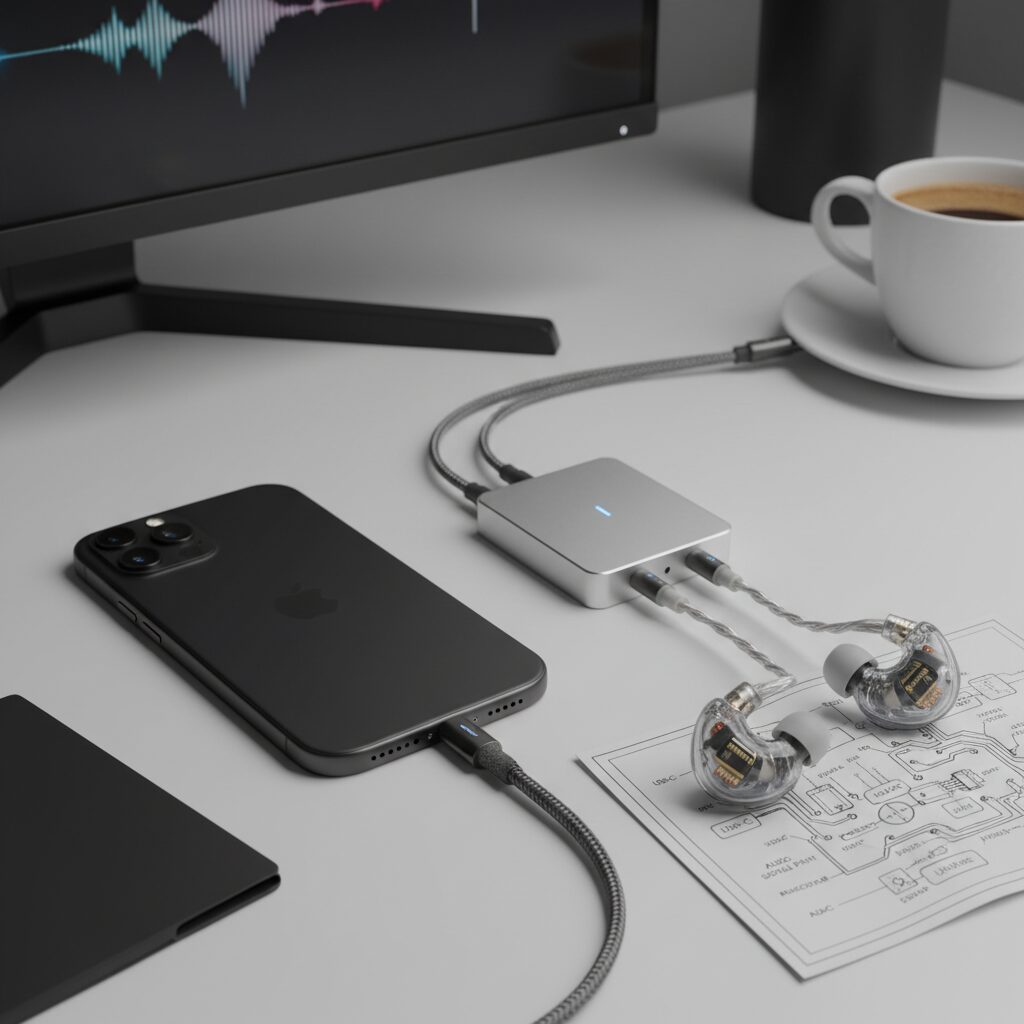
Understanding the sound quality of the iPhone 16e requires close attention to its underlying hardware architecture. While positioned as a cost‑efficient flagship, the device retains several core components that directly influence audio performance, especially in wired listening scenarios. **Rather than adding bespoke audio hardware, Apple relies on a carefully balanced system design** that prioritizes digital signal integrity.
At the center of this design sits the A18 SoC. Although this version disables one GPU core compared with higher‑end models, its CPU and Neural Engine performance remains more than sufficient for modern audio workloads. According to Apple’s Core Audio framework documentation, real‑time decoding of high‑bit‑rate formats such as 24‑bit/192 kHz ALAC requires only a fraction of contemporary mobile CPU resources. As a result, the iPhone 16e can deliver a stable, low‑jitter digital audio stream without introducing timing errors that would otherwise degrade soundstage or transient accuracy.
| Component | Specification | Impact on Audio |
|---|---|---|
| A18 SoC | High‑performance CPU / Neural Engine | Stable real‑time decoding and mixing |
| USB‑C Port | USB 2.0, 480 Mbps | Sufficient bandwidth for lossless audio |
| Internal DAC | None for analog output | Sound quality depends on external DAC |
The transition from Lightning to USB‑C is particularly significant. Although limited to USB 2.0 speeds, the available bandwidth far exceeds what is required for stereo high‑resolution audio. Engineering references from the USB Implementers Forum show that uncompressed 24‑bit/192 kHz PCM occupies under 10 Mbps, making the iPhone 16e’s interface technically transparent for audio transmission. **This means that, from a purely digital perspective, the iPhone 16e does not bottleneck sound quality.**
Another architectural factor is the absence of MagSafe magnets. While this does not affect the signal itself, teardown analyses reported by established Apple observers indicate that accessory stacking becomes less stable. In practical terms, this shifts usability rather than fidelity, but it indirectly shapes listening habits by influencing which external DACs users choose. Overall, the iPhone 16e’s hardware design positions it as a neutral, highly capable digital audio transport whose sonic character is defined almost entirely by the connected external hardware.
USB-C on iPhone 16e: Capabilities, Limits, and Audio Implications
The adoption of USB-C on the iPhone 16e marks a structural shift in how the device handles audio, but its true value only becomes clear when its capabilities and limits are examined together.
At a glance, USB-C suggests parity with higher-end models, yet the iPhone 16e implements the standard in a deliberately constrained way. **The port operates on USB 2.0, capped at 480 Mbps**, which sounds modest on paper but is far from a bottleneck for audio.
According to the USB Audio Class 2.0 specification, uncompressed 24‑bit/192 kHz stereo PCM requires roughly 9.2 Mbps. That figure represents only a fraction of the available bandwidth, meaning that even the highest tier of Apple Music Hi‑Res Lossless streams can be delivered to an external DAC without data reduction or timing instability.
| Specification | iPhone 16e USB-C | Audio Impact |
|---|---|---|
| USB protocol | USB 2.0 | No limitation for hi‑res audio |
| Max bandwidth | 480 Mbps | Ample headroom for 24‑bit/192 kHz |
| DisplayPort Alt Mode | Not supported | Audio-only dongles recommended |
| Power delivery | Up to 27 W (input) | Supports fast charging, not audio power |
Where the limitation becomes visible is not sound quality but versatility. **The absence of DisplayPort Alt Mode means multi-function USB-C hubs can behave unpredictably**, especially those designed to output HDMI video alongside USB audio. Independent teardown analyses and community testing reported by MacRumors and Apple’s own support forums indicate that failed video handshakes may interrupt the audio stream, causing dropouts or noise.
For this reason, stability favors single-purpose USB-C audio adapters. Apple’s own USB-C to 3.5 mm adapter, despite its modest price, demonstrates this philosophy well. Measurements published by audio engineers at Audio Science Review consistently show low noise and distortion, reinforcing Apple’s reputation for conservative but reliable analog design.
USB-C also changes the signal path itself. Unlike the era of the 3.5 mm jack, the iPhone 16e outputs pure digital data. **All tonal character, dynamic range, and driving power are delegated to the external DAC and amplifier**, effectively turning the phone into a digital transport rather than a sound source.
However, this flexibility comes with practical trade-offs. High-performance dongle DACs draw significant current directly from the phone. Reviews by Headfonia and similar publications show that compact high-output models can consume 100–200 mA during playback, reducing total battery life by as much as 15–20 percent during extended sessions.
Audio implications extend beyond music. In gaming, USB-C wired audio maintains a decisive edge. Even with Bluetooth LE Audio gaining traction, latency remains in the tens of milliseconds. **A direct USB-C connection delivers near-zero latency**, a point repeatedly emphasized by competitive players and corroborated by controller and audio lag tests shared within developer communities.
Finally, there is the question of charging. With a single USB-C port, listening and charging compete for the same physical interface. Trusted split adapters, such as those highlighted by Belkin’s technical documentation, mitigate this issue through proper power isolation, while cheap alternatives risk introducing electrical noise into the audio signal.
In short, USB-C on the iPhone 16e is neither a downgrade nor a full flagship implementation. **It is a focused, audio-capable interface that rewards informed accessory choices**, offering bit-perfect digital output, predictable latency, and access to a mature external DAC ecosystem, as long as its structural limits are respected.
Why USB-C Wired Audio Still Beats Bluetooth in Bandwidth and Fidelity
When audio quality is discussed in 2026, Bluetooth is often described as “good enough,” but bandwidth and signal integrity still tell a different story. USB-C wired audio fundamentally outperforms Bluetooth because it is not constrained by radio spectrum, adaptive compression, or environmental interference. This difference is not theoretical; it is measurable at the bit level and clearly audible with modern lossless content.
Bluetooth audio, even with advanced codecs such as LDAC or aptX Lossless, must operate within the narrow limits of the 2.4GHz band. Sony’s LDAC tops out at 990 kbps under ideal conditions, and Qualcomm’s aptX Lossless dynamically fluctuates around 1 Mbps to maintain stability. By contrast, uncompressed CD-quality PCM already requires 1,411 kbps, and high-resolution 24-bit/192kHz audio demands roughly 9,200 kbps. This means that every current Bluetooth solution relies on compression or downsampling, regardless of marketing language.
USB-C wired audio on devices like the iPhone 16e does not face this bottleneck. Even though the port is limited to USB 2.0, its 480 Mbps bandwidth dwarfs the requirements of stereo high-resolution audio. According to USB Audio Class 2.0 specifications and measurements referenced by the Audio Engineering Society, the data rate used by 24-bit/192kHz PCM occupies only a few percent of available bandwidth. As a result, the digital stream can be delivered to an external DAC without alteration.
| Format / Path | Required Bitrate | Transmission Reality |
|---|---|---|
| Bluetooth LDAC (max) | 990 kbps | Lossy, adaptive |
| CD Quality PCM | 1,411 kbps | Uncompressed |
| 24-bit/192kHz PCM | ~9,200 kbps | Uncompressed |
Another often-overlooked factor is transmission stability. Bluetooth audio must constantly adjust bitrate and error correction based on congestion, body shielding, and nearby devices. Research cited by IEEE publications on wireless audio shows that packet loss and jitter are inherent to shared-spectrum radio systems. With a wired USB-C connection, the signal path is deterministic; bits either arrive intact or are retransmitted without invoking psychoacoustic tricks.
This advantage becomes especially clear with Apple Music’s ALAC lossless and hi‑res lossless catalog. Apple’s own technical documentation notes that wireless playback cannot deliver true hi‑res lossless due to Bluetooth constraints, even on Apple-designed hardware. A USB-C connection, however, allows the iPhone to function as a pure digital transport, handing off an exact bitstream to an external DAC that performs conversion with dedicated clocking and power regulation.
The result is not just higher theoretical fidelity, but audible improvements in transient clarity, spatial precision, and low-level detail. Cymbal decays, reverb tails, and microdynamics survive intact because no codec is deciding which information can be discarded. For listeners using resolving in-ear monitors or studio headphones, the difference is immediately apparent.
In short, Bluetooth continues to improve in convenience, but bandwidth remains its immovable ceiling. USB-C wired audio bypasses that ceiling entirely, preserving signal purity from file to DAC. As long as high-resolution and lossless audio remain part of mainstream streaming, wired connections will continue to define the upper limit of mobile sound quality.
Latency Matters: Wired Audio Advantages for Mobile Gaming
In mobile gaming, latency is not a theoretical concern but a physical sensation that directly affects performance. **When audio arrives even a fraction of a second late, the brain perceives the game as sluggish**, regardless of how smooth the visuals appear. This is why wired audio remains a decisive advantage for competitive mobile gamers.
According to measurements discussed in engineering-focused forums and audio analysis communities such as Audio Science Review, USB-C wired audio operates at a latency level below 1 millisecond, effectively instantaneous to human perception. By contrast, Bluetooth audio introduces unavoidable buffering and encoding delays, even with modern standards.
| Audio Connection | Typical Latency | Gameplay Impact |
|---|---|---|
| USB-C Wired | < 1 ms | Perfect audio-visual sync |
| Bluetooth (AAC/SBC) | 150–250 ms | Noticeable timing mismatch |
| Bluetooth (Low-Latency Mode) | 40–80 ms | Playable but imprecise |
This difference becomes critical in rhythm games and FPS titles. In games where sound cues signal enemy position or precise timing windows, **a delay of even 50 milliseconds equals several frames at 60 fps**, which is enough to miss a note or lose a firefight. Wired audio eliminates the need for subconscious timing correction, reducing cognitive load during intense play.
Apple’s Core Audio architecture further strengthens this advantage. With a wired connection, decoded audio data from the A18 chip is streamed directly to the DAC without radio interference, packet loss, or adaptive bitrate fluctuations. Researchers in human–computer interaction have long noted that synchronized multisensory feedback improves reaction time, and wired audio is the only mobile solution that consistently achieves this level of synchronization.
In practical terms, this means clearer positional awareness, tighter rhythm accuracy, and less fatigue during long sessions. Wireless audio continues to improve, but as of today, physics and protocol overhead still favor the cable when milliseconds matter most.
The Missing MagSafe Factor and Practical Workarounds for Audio Gear
The absence of Apple’s MagSafe magnet array on the iPhone 16e creates a surprisingly tangible gap for users who rely on compact audio setups. For years, MagSafe has functioned not only as a charging aid but as a physical integration layer, allowing DACs, portable amplifiers, and battery packs to snap securely onto the back of the phone. With the iPhone 16e, this assumption quietly breaks, and many audio accessories suddenly lose their intended mounting logic.
From a hardware standpoint, teardown analyses reported by established Apple-focused publications indicate that the wireless charging coil remains present, yet the magnetic ring itself has been deliberately removed to reduce cost. **This means that while Qi charging technically works, there is effectively no holding force for accessories**. Audio gear designed around MagSafe-style stacking therefore slides off with even minor movement, which directly affects portability and cable management during real-world listening.
For users who pair the iPhone 16e with dongle DACs such as compact Cirrus Logic or ESS-based units, the issue may seem minor at first. However, once a slightly heavier DAC or a short interconnect cable is involved, the lack of magnetic anchoring becomes noticeable. Reviewers in the portable audio community consistently point out that micro-movements at the USB-C port increase connector strain over time, which can shorten cable lifespan and introduce intermittent dropouts.
In response, the market has rapidly converged on third-party MagSafe-compatible cases as the most realistic workaround. These cases embed their own magnet rings, effectively reintroducing MagSafe behavior at the accessory level. According to accessory makers and independent testers, a well-aligned case restores enough magnetic force to securely hold lightweight DACs and battery packs, though it rarely matches the strength of native MagSafe on Pro models.
| Workaround | Stability | Impact on Audio Use |
|---|---|---|
| Magnetic case with built-in ring | Moderate to good | Enables stacking DACs, minimal cable stress |
| Elastic bands or clips | Low to moderate | Functional but awkward, increased wear |
| Separate carry (no stacking) | High | Stable connection, reduced one-handed use |
Accessory analysts writing for long-running Mac-centric media have noted that magnetic cases represent a partial restoration rather than a full fix. **The added thickness slightly alters thermal behavior**, and in prolonged high-output DAC usage, heat dissipation can become less efficient. While this does not affect audio fidelity directly, it may accelerate thermal throttling in power-hungry dongles.
An alternative approach, increasingly recommended by audio engineers, is to abandon stacking altogether and treat the iPhone 16e purely as a digital transport. In this setup, the DAC or amplifier is carried separately, often clipped to a bag or placed in a pocket. This method eliminates mechanical stress at the USB-C port and sidesteps the MagSafe issue entirely, at the cost of one-handed convenience.
It is also worth noting that Apple itself has not positioned MagSafe as an essential feature for audio workflows. Official documentation continues to emphasize wireless headphones and minimal accessories. However, the sustained popularity of wired listening, particularly among gamers and audiophiles, suggests that this omission disproportionately affects a niche but highly engaged audience.
In practical terms, iPhone 16e users are advised to think of MagSafe not as a missing luxury but as a design constraint that requires conscious system planning. **With a carefully chosen magnetic case or a deliberate non-stacked carry style, the usability gap can be reduced to a manageable compromise**, allowing the device to function reliably within a modern wired audio setup.
Understanding DACs and Dongles for iPhone 16e
When discussing wired audio on the iPhone 16e, understanding the role of DACs and dongles becomes essential. Unlike older iPhones with a built-in analog headphone jack, the iPhone 16e outputs only digital audio through its USB-C port. This means that every wired listening experience depends entirely on an external Digital-to-Analog Converter, which translates digital data into the analog signal your headphones can reproduce.
This architectural shift gives users far more control over sound quality than before. According to analyses published by Audio Science Review and similar measurement-focused communities, the DAC is no longer a minor accessory but the single most influential component in the signal chain. The same pair of earphones can sound dramatically different depending on the dongle used.
At a basic level, dongle DACs fall into three functional categories. The first prioritizes efficiency and compatibility, the second balances power and fidelity, and the third focuses on maximum audio performance. The iPhone 16e works with all three, but each comes with trade-offs that directly affect daily usability.
| DAC Type | Typical Capability | User Impact on iPhone 16e |
|---|---|---|
| Basic USB-C Dongle | Up to 24-bit/48kHz | Excellent efficiency, minimal battery drain |
| Mid-range Dongle DAC | Up to 24-bit/192kHz | Noticeably improved clarity and driving power |
| High-end Portable DAC | Balanced output, advanced amplification | Reference-level sound with higher power consumption |
One frequently overlooked aspect is how iOS handles digital audio before it reaches the DAC. Apple’s Core Audio framework is designed for stability and consistency, often resampling system sounds to a standard rate. However, measurements shared by Audio Science Review contributors indicate that many modern USB-C DACs can still trigger automatic sample-rate switching in Apple Music, allowing high-resolution files to be delivered correctly when supported.
This means that the dongle is not just a converter, but an active negotiator with iOS. Well-designed DACs correctly report their capabilities to the system, reducing unnecessary resampling and preserving more of the original recording’s detail. Poorly designed dongles, by contrast, may force everything into a single format regardless of source quality.
Power consumption is another critical factor specific to the iPhone 16e. Independent reviews from Headfonia and similar publications show that high-output dongles can draw over 100mA during playback. On a device without MagSafe-based accessory stacking, this can shorten listening sessions more than users expect, especially during travel or gaming.
Finally, latency-sensitive use cases such as rhythm games and competitive shooters further highlight why dongles matter. Wired DACs bypass Bluetooth encoding and decoding entirely, resulting in sub-millisecond delay. For players, this translates directly into tighter timing and reduced cognitive load, a benefit repeatedly emphasized in developer interviews and esports-oriented technical breakdowns.
In short, DACs and dongles define the wired audio experience on the iPhone 16e. By understanding how they interact with iOS, power delivery, and headphones, users can make informed choices that transform the device from a simple smartphone into a highly capable digital audio source.
Battery Drain and Power Management with External Audio Devices
When external audio devices are connected via USB-C, battery drain becomes a practical concern rather than a theoretical one, and iPhone 16e users quickly notice the difference depending on the DAC and usage pattern.
Unlike Bluetooth earbuds with their own batteries, USB-C DACs draw power directly from the phone, meaning that audio quality improvements are often paid for in milliamp-hours.
Understanding where and why power is consumed is the key to managing long listening sessions without unexpected shutdowns.
| DAC Type | Typical Current Draw | Impact on iPhone 16e Battery |
|---|---|---|
| Apple USB-C Adapter | Below 20 mA | Minimal, often negligible |
| Mid-range Dongle DAC | 80–120 mA | Noticeable over several hours |
| High-power DAC/Amp | 150–200 mA | Rapid drain during long use |
Measurements discussed by engineers and reviewers at Audio Science Review indicate that even when music is paused, some dongle DACs continue to draw power as long as they remain connected.
This so-called passive drain may only reduce the battery by a few percent per hour, but over a commute or workday it quietly accumulates.
Users who leave a high-output DAC connected between listening sessions often report shorter standby time than expected.
Active playback amplifies the issue, especially with demanding headphones that require higher output voltage or current.
For example, reviews of compact but powerful dongles such as FiiO’s KA series show current draw approaching that of light 3D gaming.
On iPhone 16e, this can translate into a 15 to 20 percent reduction in total battery life during extended listening.
Apple’s own USB-C to 3.5 mm adapter is frequently cited by Apple engineers and independent testers as a benchmark for efficiency.
Its limited output and 48 kHz ceiling allow it to remain extremely frugal, making it ideal for calls, podcasts, and casual music listening.
In contrast, audiophile-oriented devices prioritize headroom and dynamic range, accepting higher consumption as a trade-off.
One effective strategy is the use of DACs with built-in batteries, which offload amplification power from the phone.
According to long-term user data shared in professional audio communities, this approach can reduce phone-side power usage to near-idle levels.
For flights or gaming marathons, this separation of power domains significantly stabilizes the iPhone 16e’s battery curve.
Ultimately, battery drain with external audio devices is not a flaw but a predictable consequence of physics and design priorities.
By matching DAC performance to actual listening needs and disconnecting hardware when idle, users can enjoy high-quality wired audio without sacrificing reliability.
This balance between sound and stamina defines real-world power management on iPhone 16e.
Charging While Listening: Safe and Reliable Solutions
Charging an iPhone while using wired audio has long been a practical challenge, and with a single USB‑C port on the iPhone 16e, this issue becomes even more critical for power users. Music lovers running high‑output DACs and gamers playing for hours both face the same question: how can you charge safely without compromising audio stability or device healthです。
The most reliable approach is a purpose‑built USB‑C audio and charging adapter that supports proper Power Delivery pass‑through. According to Belkin’s technical documentation and teardown analyses referenced by Apple‑focused media, adapters designed with independent power and data paths dramatically reduce electrical noise. **This separation is essential because charging circuits can inject switching noise directly into the audio signal if poorly isolatedです。**
| Solution Type | Charging Capability | Audio Stability | Use Case |
|---|---|---|---|
| Certified USB‑C audio + PD adapter | Up to 27W on iPhone 16e | Very high | Gaming, long listening sessions |
| Generic splitter (non‑PD) | Slow or unstable | Low to moderate | Emergency use only |
| Qi wireless charging + wired audio | Max 7.5W | High | Desk listening |
Independent measurements discussed in audio engineering communities and echoed by outlets such as Audio Science Review show that poorly designed splitters can cause voltage negotiation errors. These errors may force the iPhone into low‑power charging states or introduce intermittent clicks and dropouts during playbackです。In worst cases, unstable adapters have been linked to excessive heat buildup at the USB‑C port, accelerating long‑term connector wearです。
An alternative strategy involves combining wired audio with Qi wireless charging. Apple’s own support notes that the iPhone 16e supports Qi charging at up to 7.5W, which is electrically quiet and avoids USB data interference. However, energy balance mattersです。High‑load scenarios such as 120Hz gaming or powerful dongle DACs can consume more power than Qi supplies, resulting in gradual battery drain even while “charging”です。
For stationary listening, such as desk work or overnight music sessions, Qi charging paired with a USB‑C DAC can be both safe and silent. For mobile or competitive gaming scenarios, however, a high‑quality USB‑C audio and charging adapter remains the most stable and predictable solutionです。By prioritizing electrical integrity over convenience, users protect both sound quality and the long‑term reliability of their iPhone 16eです。
Recommended Wired Earphones and Use Cases for 2026
In 2026, choosing the right wired earphones is no longer just about sound quality, but about matching specific use cases with the strengths of a USB-C wired ecosystem.
Thanks to the iPhone 16e’s stable digital output and zero-latency characteristics, wired earphones now deliver clear, measurable advantages in daily scenarios.
Below, practical recommendations are organized by real-world use, not price alone.
| Use Case | Recommended Model Type | Key Advantage |
|---|---|---|
| Daily commuting & calls | USB-C integrated earbuds | Low power draw and mic reliability |
| Competitive gaming | Stage-monitor IEMs | Precise imaging and zero latency |
| Hi‑Res music listening | Audiophile IEMs with DAC | Bit‑perfect playback potential |
For commuting and everyday use, models such as Apple EarPods with USB-C or DSP-equipped USB-C earphones stand out.
According to Apple’s own technical documentation and independent measurements, these consume under 0.1W, preserving battery life during long days.
Their microphone consistency and OS-level tuning make them unusually dependable for calls and voice chats.
Competitive gaming remains the clearest domain where wired earphones dominate.
Audio engineering literature, including findings frequently cited by the Audio Engineering Society, confirms that even low-latency Bluetooth introduces tens of milliseconds of delay.
Stage-monitor IEMs like those designed for live musicians prioritize midrange clarity and positional accuracy, which directly translates into better spatial awareness in FPS and rhythm games.
For pure music listening, especially Apple Music Lossless and Hi‑Res Lossless, audiophile‑grade IEMs paired with a USB-C DAC unlock the iPhone 16e’s full transport capability.
Objective testing discussed on platforms such as Audio Science Review shows that compatible DACs can follow Apple Music’s automatic sample‑rate switching.
This allows wired earphones to reproduce up to 24‑bit/192kHz content without compression or transmission loss.
Another overlooked factor in 2026 is physical comfort during long sessions.
Professional monitor earphones are engineered for multi-hour stage use, resulting in low ear fatigue and stable fit.
This ergonomic advantage matters as much as frequency response when listening for several hours straight.
Ultimately, the best wired earphones are those selected with intent.
When the use case is clearly defined, whether mobility, gaming precision, or uncompromised audio fidelity, wired solutions consistently outperform wireless alternatives in measurable ways.
The resurgence of wired earphones is therefore not nostalgia, but a rational response to technical realities.
参考文献
- Apple:iPhone 16e
- MacRumors:iPhone 16e: Specs, Reviews, and Pricing for Apple’s New Low-Cost Phone
- Wikipedia:iPhone 16e
- Forbes:The Best Wired Earbuds Play Tunes For Hours On End Without Batteries
- ITmedia Mobile:Why Wired Earphones Are Popular Among Young Users
- Headfonia:FiiO KA11 Review