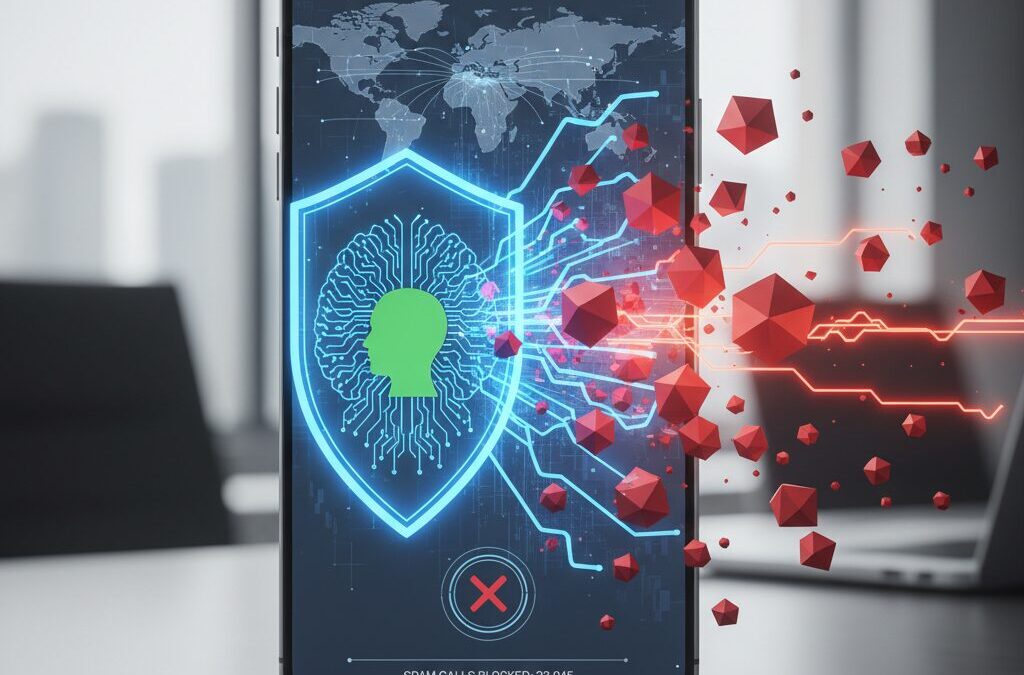
Your smartphone used to be a trusted gateway to friends, family, and business partners. Today, it can just as easily become a direct line for scammers powered by VoIP networks, robocalls, and even AI-generated voices.
In 2024 alone, Japan reported more than 20,000 recognized special fraud cases, with total damages exceeding 71.8 billion yen, according to the National Police Agency. The scale and sophistication of phone-based scams are accelerating, and similar trends are visible worldwide as attackers exploit global telecom infrastructure and generative AI tools.
In this article, we explore how automatic spam call blocking technologies are evolving in 2026—from massive cloud-based blacklists to on-device AI that analyzes conversations in real time. You will discover how carriers, OS developers, and security vendors are rebuilding trust in voice communication, and what this means for gadget enthusiasts who care about privacy, security, and cutting-edge mobile innovation.
- The Global Surge of Phone-Based Fraud and Robocalls
- Why People Still Answer Unknown Numbers: Psychology Meets Mobile Design
- Database-Driven Call Blocking: How Blacklists and Whitelists Power Modern Protection
- Tobila Systems and the Carrier-Level Defense Model in Japan
- Whoscall and the Advantage of Global Spam Intelligence Networks
- Carrier Strategies Compared: NTT Docomo, au, SoftBank, and Rakuten Mobile
- From Cloud to Edge: On-Device AI and Real-Time Call Screening
- Google Pixel’s Call Screen and Gemini Nano Scam Detection
- Apple’s iOS Approach: Silence, Live Voicemail, and CallKit Integration
- The Rise of AI Voice Cloning and Deepfake Phone Scams
- Spoofing Detection, Liveness Analysis, and On-Device AI Countermeasures
- Privacy, Regulation, and the Legal Boundaries of Automated Call Blocking
- Toward Zero-Trust Telephony: The Future of Verified Voice Communication
- 参考文献
The Global Surge of Phone-Based Fraud and Robocalls
Phone-based fraud is no longer a local nuisance. It has evolved into a borderless, technology-driven threat that undermines the very foundation of voice communication: trust. As VoIP infrastructure has expanded and international routing has become cheaper and more complex, the reliability once associated with a phone number has significantly eroded.
According to Japan’s National Police Agency, reported cases of special fraud reached 20,987 in 2024, with total damages exceeding 71.8 billion yen. This sharp increase despite ongoing public awareness campaigns demonstrates that attackers are innovating faster than traditional countermeasures.
The problem is not limited to Japan. Globally, robocalls and spoofed international numbers have become common attack vectors, exploiting regulatory gaps and cross-border telecommunications loopholes.
| Threat Type | Primary Technique | Global Impact |
|---|---|---|
| Robocalls | Automated voice broadcasts | Mass-scale targeting at minimal cost |
| Number Spoofing | Falsified caller ID via VoIP | Erodes trust in caller identity |
| International One-Ring Scams | Missed calls from overseas numbers | Premium callback fraud |
One striking shift has been the abuse of international country codes such as +1 or +44 to bypass domestic verification systems. Criminal groups increasingly route calls through foreign carriers, making enforcement jurisdictionally complex and slowing response times.
At the same time, robocalls have become psychologically optimized. Automated messages claiming unpaid fees or imminent legal action create urgency and cognitive overload. Even younger, digitally native users respond, partly because subscription-based lifestyles make “missed payments” feel plausible.
The smartphone’s always-on presence amplifies vulnerability. Unlike landlines of the past, mobile devices follow users into workplaces, bedrooms, and commutes—moments when decision-making capacity may be reduced.
Academic research on scam dynamics highlights how attackers deliberately exploit stress and time pressure to suppress analytical thinking. When combined with scalable robocall systems, this creates a high-efficiency fraud engine capable of reaching millions within hours.
Furthermore, the cost asymmetry favors attackers. Cloud telephony platforms allow thousands of calls to be launched at negligible expense, while victims bear disproportionate financial and emotional losses.
As a result, the global surge of phone-based fraud is not merely a spam problem. It represents a systemic breakdown of caller authentication and a redefinition of voice communication as a contested security surface.
Trust in voice is no longer implicit—it must now be verified. This structural shift sets the stage for technological and regulatory countermeasures that aim to rebuild confidence in an increasingly hostile telephony environment.
Why People Still Answer Unknown Numbers: Psychology Meets Mobile Design
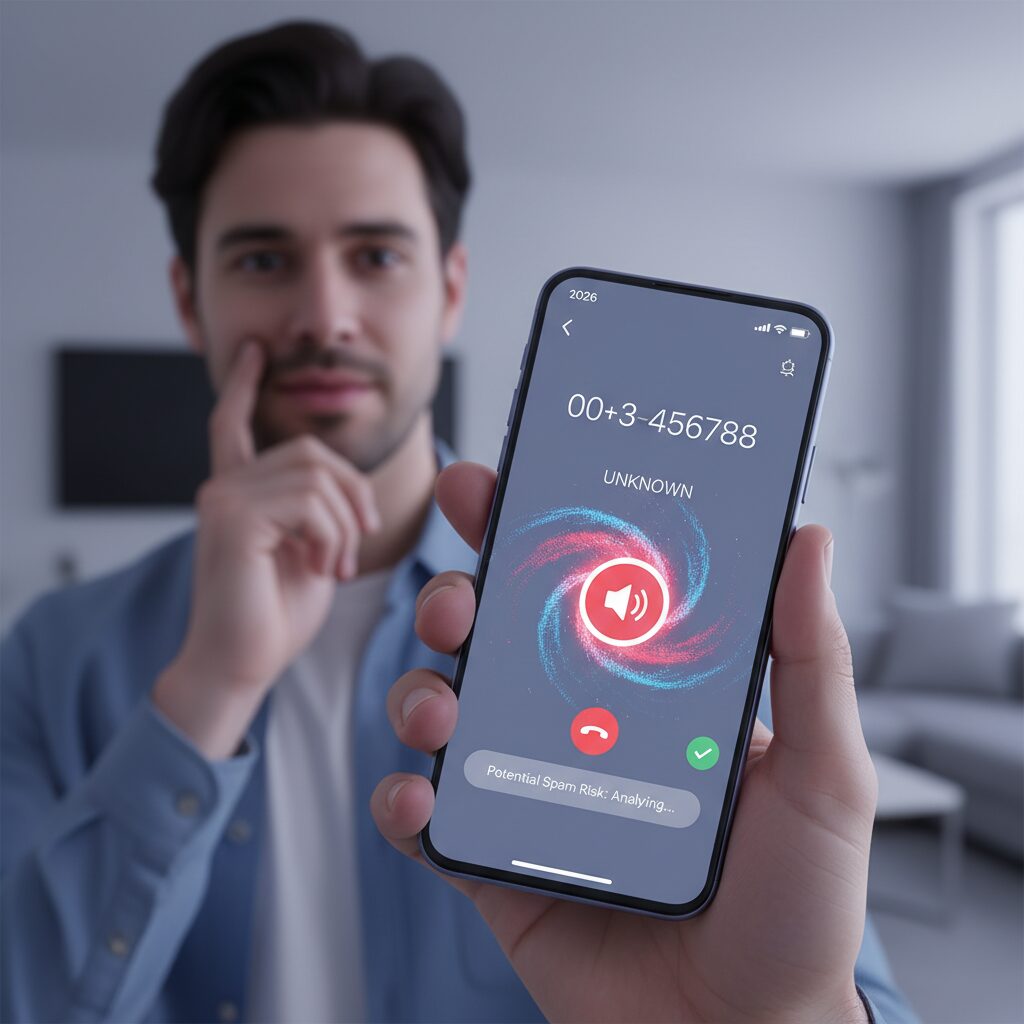
Even in 2026, when spam calls and sophisticated scams are widely reported, many people still answer unknown numbers. This behavior is not irrational. It is rooted in human psychology and reinforced by smartphone design.
According to Japan’s National Police Agency, special fraud cases exceeded 20,000 in 2024, with damages reaching over 71.8 billion yen. Despite this public awareness, response rates to suspicious calls remain high. The gap between knowledge and action is where psychology and interface design intersect.
Psychological Triggers Behind the Tap
One major factor is urgency bias. When a phone rings, especially on a device that rarely leaves our hands, the interruption feels important. Behavioral science shows that humans are wired to prioritize potential threats or urgent signals. A ringing phone activates that instinct before rational evaluation begins.
Another factor is ambiguity aversion. An unknown number represents unresolved uncertainty. For professionals, it may be a client. For job seekers, a recruiter. For younger generations using multiple subscription services, it may be a payment issue. As highlighted by law enforcement reports, scammers exploit phrases like “unpaid fee” or “legal action,” triggering fear of loss.
The fear of missing something important often outweighs the fear of being scammed. This imbalance drives split-second decisions.
How Mobile Design Lowers Psychological Barriers
Smartphone UI design also plays a decisive role. Incoming call screens are intentionally minimal. Large accept and decline buttons encourage fast action. There is rarely contextual friction before answering.
| Design Element | User Impact | Psychological Effect |
|---|---|---|
| Full-screen incoming alert | Interrupts ongoing activity | Creates urgency |
| One-tap answer | Instant connection | Reduces deliberation time |
| Minimal caller context | Limited information | Encourages curiosity |
Unlike email, which allows preview text and sender verification, voice calls demand immediate engagement. Research on cognitive load suggests that people under time pressure rely on heuristics rather than analytical reasoning. Many scam calls intentionally occur during work hours or late evenings, when cognitive resources are already depleted.
There is also a social conditioning element. For decades, answering the phone was considered polite and responsible. That norm has not fully adapted to the VoIP era, where caller ID can be spoofed and numbers easily rotated.
This design legacy matters. As VoIP and international routing have eroded the reliability of phone numbers as identity anchors, the interface has not fundamentally changed. Users are still presented with a binary choice: answer or ignore. Without embedded intelligence, that decision rests entirely on human judgment.
The persistence of answering unknown numbers is therefore not simply carelessness. It is the result of evolutionary instincts, social norms, and frictionless mobile design converging in a single swipe.
Understanding this intersection is essential. If trust in voice communication is to be rebuilt, future mobile experiences must introduce protective friction without sacrificing usability.
Database-Driven Call Blocking: How Blacklists and Whitelists Power Modern Protection
Modern call blocking is no longer a simple “reject unknown numbers” feature. It is a database-driven protection system that constantly cross-references incoming calls with massive, curated datasets in the cloud. This architecture allows smartphones and carrier networks to judge risk in milliseconds before you even swipe the screen.
At its core, the system operates on three structured layers of data, each serving a distinct role in balancing security and usability.
| Layer | Data Source | Primary Role |
|---|---|---|
| Blacklist | Police reports, confirmed fraud cases | Immediate blocking of verified threats |
| Heuristic Greylist | User reports, traffic pattern analysis | Flagging suspicious but unconfirmed numbers |
| Whitelist | Business directories, public institutions | Preventing false positives |
The blacklist is the most straightforward layer. Numbers confirmed to be used in fraud—often provided by law enforcement or reported by victims—are instantly blocked. In Japan, where special fraud cases exceeded 20,000 incidents in 2024 according to the National Police Agency, this layer acts as the first defensive wall.
The real sophistication lies in the heuristic greylist. Security vendors analyze behavioral signals such as rapid sequential dialing, one-ring patterns, or abnormal international routing. Companies like Tobila Systems publicly state detection rates around 98 percent by leveraging approximately 30,000 known nuisance numbers and continuously updating risk models. This enables proactive defense against newly rotated numbers.
Equally critical is the whitelist. With databases containing millions of legitimate business numbers—over five million in some Japanese implementations—devices can display “City Hall” or “Delivery Center” even if the number is not saved in your contacts. This dramatically reduces the fear of missing important calls, which is one of the biggest psychological barriers to aggressive blocking.
Another advantage of database-driven systems is cross-platform intelligence sharing. When a fraudulent number is detected on a fixed-line honeypot or reported by one mobile user, that intelligence propagates through the cloud to millions of devices. This network effect transforms isolated reports into collective immunity.
However, database models are inherently retrospective. They excel at stopping known or statistically suspicious numbers, but they rely on continuous updates and high-quality reporting pipelines. Their power comes from scale, structured data governance, and tight integration with carrier infrastructure.
In modern telephony protection, blacklists and whitelists are no longer static spreadsheets. They are living, algorithmically enriched ecosystems that turn raw call metadata into real-time trust decisions—before your phone ever finishes ringing.
Tobila Systems and the Carrier-Level Defense Model in Japan

In Japan’s mobile security ecosystem, Tobila Systems occupies a uniquely strategic position. Rather than operating as a standalone consumer app, the company functions as a carrier-level infrastructure provider, embedding its detection engine directly into the services of NTT Docomo, KDDI, and SoftBank.
This architecture transforms spam filtering from an optional add-on into a semi-public utility. Protection is no longer limited to individual app users; it scales across millions of subscribers through carrier integration.
According to company disclosures, Tobila maintains a database of approximately 30,000 confirmed nuisance numbers and more than 5 million legitimate business listings, achieving a published detection rate of around 98% for identified threats.
| Layer | Data Source | Function |
|---|---|---|
| Blacklist | Police & official reports | Immediate blocking of confirmed threats |
| Greylist | User reports & traffic analysis | Heuristic risk scoring |
| Whitelist | Business directory database | Caller name display & false-positive reduction |
The carrier-level model differs fundamentally from global app-centric competitors such as Truecaller or Whoscall. In Japan, filtering logic is often integrated into official carrier services, meaning the defense operates within the telecommunications layer itself.
This creates a feedback loop: when a fraudulent number targets a fixed-line household using a Tobila-powered service, that intelligence can be reflected across mobile users within the same ecosystem. The defense grid becomes cross-platform, spanning fixed phones, smartphones, and even business cloud PBX systems.
KDDI’s deployment in au Hikari Phone services demonstrates how fixed-line protection reinforces mobile security, especially among elderly households that remain prime fraud targets.
Another defining element is SMS filtering expansion. Tobila’s engine analyzes suspicious URLs and phishing keywords inside text messages, supporting carrier-branded anti-SMS fraud services. This is particularly important as phishing campaigns increasingly pivot from voice calls to smishing.
Unlike pure network blocking, however, Japan’s regulatory environment—anchored in the secrecy of communications principle under the Telecommunications Business Act—requires opt-in consent. As a result, most carrier implementations emphasize warning labels rather than silent interception.
This balance between infrastructure-level intelligence and user-controlled activation defines the Japanese carrier defense model.
Strategically, Tobila Systems operates as a gatekeeper of trust within Japan’s numbering ecosystem. Because all three major carriers rely on its database engine, the company effectively aggregates nationwide traffic intelligence while remaining behind the brand façade of each carrier.
In practical terms, this concentration enables faster response cycles to emerging fraud patterns. When criminals rotate spoofed numbers or deploy short-lived VoIP lines, heuristic analysis across aggregated traffic can flag anomalies within hours rather than days.
The result is not merely spam blocking, but a coordinated national-scale filtering mesh embedded into the telecommunications backbone itself.
Whoscall and the Advantage of Global Spam Intelligence Networks
One of Whoscall’s most decisive strengths lies in its global spam intelligence network. While many carrier-based solutions focus primarily on domestic traffic, Whoscall leverages a cross-border database built from millions of users worldwide. In an era where scam operations routinely exploit international VoIP routes, this global visibility becomes a strategic advantage.
Japan’s fraud landscape has increasingly involved international numbers such as +1 and +44 prefixes, as noted by the National Police Agency. These calls often originate outside domestic regulatory reach, making purely local blacklists reactive by nature. Whoscall’s model addresses this gap by aggregating spam reports and call pattern data across multiple countries, enabling earlier detection of emerging campaigns.
Technically, Whoscall combines user-reported data, automated traffic analysis, and business directory verification. This multi-layered dataset improves both threat detection and caller identification accuracy. The benefit is not only blocking spam but also labeling legitimate overseas businesses, reducing false positives for users who receive international calls.
| Aspect | Domestic-Focused DB | Global Intelligence Network |
|---|---|---|
| Data Scope | Primarily national traffic | Multi-country aggregated data |
| International Scam Detection | Reactive | Earlier cross-border pattern recognition |
| Use Case Fit | Domestic users | Frequent overseas communication |
For users on SIM-free devices or MVNO plans without robust carrier-level filtering, this independence is especially valuable. Whoscall operates at the application layer, integrating with smartphone operating systems to display risk labels in real time. This ensures protection even when network-level blocking is unavailable.
Another important dimension is SMS and URL scanning. As phishing campaigns increasingly combine voice calls with follow-up messages, integrated analysis across call logs and message content enhances contextual awareness. According to industry disclosures referenced in ITmedia coverage of Rakuten Mobile’s partnership, Whoscall’s premium tier includes URL risk checks and personal data leak monitoring, positioning it as more than a caller ID app.
From a strategic standpoint, global intelligence reduces the asymmetry between attackers and defenders. Fraud groups scale internationally; therefore, defensive datasets must scale in the same way. When threat intelligence is shared across borders, the window of vulnerability narrows dramatically. For internationally active professionals, cross-border e-commerce operators, and users who frequently receive overseas calls, this advantage is not theoretical but operational.
Carrier Strategies Compared: NTT Docomo, au, SoftBank, and Rakuten Mobile
Japan’s four major carriers take distinctly different approaches to automated spam call blocking, reflecting their broader network philosophies and competitive positioning. While all rely on large-scale databases and AI-assisted filtering, their integration depth, pricing models, and ecosystem strategies vary in ways that matter for security-conscious users.
| Carrier | Core Engine | Strategic Focus |
|---|---|---|
| NTT Docomo | Tobila Systems DB | Shift toward OS-level integration |
| au (KDDI) | Tobila Systems DB | Fixed + mobile household defense |
| SoftBank | Tobila + network block | Hybrid network and app control |
| Rakuten Mobile | Whoscall | Global database leverage |
NTT Docomo has gradually shifted from app-centric protection to tighter alignment with OS-native spam controls. Following the end of new Android subscriptions for its “Anshin Security (Spam SMS Countermeasure)” service in late 2024, the company has leaned more heavily on Android’s built-in filtering while continuing backend database collaboration with Tobila Systems. This reflects a pragmatic recognition that Google’s spam protection has matured significantly, allowing Docomo to reduce redundancy while maintaining detection accuracy.
au, by contrast, emphasizes what can be described as “surface defense” across the entire household. By promoting spam blocking not only for smartphones but also for au Hikari fixed-line phones, it addresses the demographic reality highlighted by the National Police Agency: elderly users with landlines remain prime fraud targets. Campaign-based free periods for fixed-line blocking show that au sees fraud prevention as a family-level infrastructure issue rather than a handset-only feature.
SoftBank differentiates itself through architectural layering. Its low-cost “Number Block” option operates at the network switch level, rejecting specified numbers before they reach the device and even playing a rejection guidance message to the caller. In parallel, its app-based “Spam Call Block”—powered by Tobila’s database—adds heuristic detection and SMS filtering, including integration with +Message. This dual structure gives users both precision targeting and automated risk scoring.
Rakuten Mobile, as the newest nationwide carrier, adopted a capital-efficient model by partnering with Whoscall. Instead of building a domestic database from scratch, it leverages Whoscall’s globally accumulated intelligence, which is particularly effective against international spoofing and overseas robocalls. For users engaged in cross-border communication, this global dataset can offer earlier detection of foreign-origin threats compared with domestically focused systems.
Another critical difference lies in ecosystem philosophy. Docomo and au increasingly embed protection into bundled security suites. SoftBank provides modular add-ons. Rakuten aligns its service with point-based incentives to accelerate adoption. According to public carrier disclosures and partner announcements, monthly pricing typically centers around 330 yen for app-level protection, with network-level blocking sometimes offered at lower fees.
Ultimately, while three carriers share Tobila Systems as a common defensive backbone—benefiting from a reported detection rate approaching 98% in its database filtering—execution strategy creates meaningful divergence. Users who prioritize seamless OS harmony may gravitate toward Docomo’s evolving model. Households with vulnerable landline users may find au’s integrated defense compelling. Those needing granular manual control may appreciate SoftBank’s layered system. Internationally active users may benefit most from Rakuten’s Whoscall integration.
The competition is therefore less about whether spam calls are blocked and more about where, how, and at what ecosystem depth interception occurs. In an era where fraud tactics mutate rapidly, that architectural nuance increasingly defines real-world resilience.
From Cloud to Edge: On-Device AI and Real-Time Call Screening
The center of gravity in call protection is shifting from the cloud to the device in your hand. While database matching blocks known malicious numbers, it cannot fully address spoofed IDs or first-time attacks. On-device AI changes the equation by analyzing context in real time, directly on the smartphone’s neural processing unit (NPU).
This architectural shift is not only about speed. It is also about privacy. Because audio data no longer needs to be streamed to external servers for analysis, sensitive conversations can be processed locally, reducing exposure risks and aligning with strict data protection expectations in markets like Japan.
Edge AI enables three critical advantages: millisecond-level response, offline resilience, and privacy-preserving analysis.
Google’s Pixel series provides a concrete example of this transition. Its Call Screen feature allows users to let the Google Assistant answer an incoming call and transcribe the caller’s intent in real time. According to Google’s official Phone app documentation, the transcription happens instantly on screen, allowing users to decide whether to answer, decline, or send a preset reply without engaging directly.
More importantly, newer devices equipped with Gemini Nano extend this capability beyond screening. As outlined in Google’s November 2025 Pixel update, Scam Detection analyzes live conversation patterns during a call. If the system detects signals such as urgent fund transfer requests or attempts to extract passwords, it triggers an on-screen warning while the call is still active.
| Layer | Primary Function | Timing |
|---|---|---|
| Cloud Database | Match known spam numbers | Before answering |
| On-Device Call Screen | Transcribe caller intent | At call reception |
| On-Device Scam Detection | Analyze conversation semantics | During live call |
This temporal dimension is crucial. Traditional systems operate pre-call. Edge AI operates mid-call. That difference matters when attackers rotate numbers or use VoIP spoofing to bypass blacklists.
Academic research on audio deepfake detection, including recent surveys indexed in PubMed Central, emphasizes that synthetic speech often exhibits subtle spectral inconsistencies. While current consumer devices do not publicly claim full deepfake voice detection in Japan, the same class of lightweight models running on NPUs makes such real-time analysis technically feasible without cloud dependency.
Real-time call screening therefore becomes behavioral, not just numerical. Instead of asking “Is this number suspicious?” the device asks “Is this conversation suspicious?” That shift mirrors the broader cybersecurity move toward zero-trust architectures, where identity alone is insufficient and continuous verification is required.
For gadget enthusiasts, this is more than a feature checkbox. It signals the emergence of the smartphone as an autonomous security agent. The device no longer waits for centralized intelligence updates; it interprets speech patterns, urgency cues, and conversational anomalies on the fly.
As AI accelerators in mobile chipsets continue to improve, the gap between cloud-scale language models and edge-deployed miniaturized models will narrow. The practical outcome is clear: real-time, on-device AI transforms call screening from passive filtering into active intervention.
Google Pixel’s Call Screen and Gemini Nano Scam Detection
Google Pixel’s Call Screen represents a shift from passive blocking to proactive call mediation. Instead of simply labeling a number as spam, the feature lets Google Assistant answer on your behalf and request the caller’s name and purpose. In Japan, as Google’s official Phone app documentation explains, users manually tap the “Screen call” button, after which the caller’s response is transcribed in real time on the display.
This design matters because it inserts a psychological buffer between you and a potential scammer. You can read the intent before exposing your voice, tone, or personal information. For users who frequently receive unknown calls—deliveries, business inquiries, or international numbers—this dramatically reduces cognitive load while preserving legitimate communication.
| Function | What It Does | User Benefit |
|---|---|---|
| Manual Call Screen | AI answers and asks caller’s purpose | Check intent without speaking |
| Real-time Transcription | Displays caller’s words instantly | Objective review of message |
| Quick Responses | Pre-set replies like “Call back later” | Safe disengagement |
The real leap forward, however, comes with Gemini Nano–powered Scam Detection on newer devices such as Pixel 9 and later. According to Google’s November 2025 Pixel Drop announcement, this lightweight on-device large language model analyzes conversation patterns during a live call. Because processing occurs locally on the device, sensitive voice data does not need to be sent to the cloud.
This on-device architecture is crucial in markets like Japan, where privacy expectations and legal interpretations around communication secrecy are strict. Gemini Nano monitors contextual signals associated with fraud—requests for urgent wire transfers, demands for gift card purchases, or inconsistencies such as a “bank employee” asking for passwords. When suspicious intent is detected, the system surfaces a real-time alert on screen.
Unlike traditional blacklist systems that rely on known numbers, Scam Detection evaluates what is being said. This makes it resilient against number spoofing and disposable VoIP lines, both of which have become common as fraud groups rotate identifiers to evade database-based filters. Academic research on audio deepfake and spoofing detection, including recent peer-reviewed analyses indexed by the U.S. National Library of Medicine, highlights that conversational context analysis adds an additional defensive layer beyond caller ID verification.
It is also important to note the staged rollout. English-language markets have received earlier access to automated protections, while Japanese support has expanded gradually through features such as Call Notes and summarization capabilities. This phased deployment reflects both linguistic model tuning and regulatory sensitivity.
Call Screen filters before you answer, and Gemini Nano protects you after you answer. Together, they create a dual-stage defense: pre-connection screening and in-conversation intelligence. For gadget enthusiasts and security-conscious users, this represents one of the most sophisticated consumer implementations of edge AI in telephony today.
In an era where attackers exploit speed and emotional pressure, inserting AI-driven friction into the call flow fundamentally changes the power balance. Pixel does not simply block calls; it actively interprets intent in real time, transforming the smartphone from a passive receiver into an intelligent security intermediary.
Apple’s iOS Approach: Silence, Live Voicemail, and CallKit Integration
Apple takes a fundamentally different path from aggressive AI call interception. Instead of actively engaging unknown callers, iOS prioritizes user control, on-device processing, and tight ecosystem integration.
The philosophy is minimal intervention, maximum privacy. This approach is reflected in three pillars: Silence Unknown Callers, Live Voicemail, and CallKit integration for third-party filtering.
Core iOS Defensive Mechanisms
| Feature | Function | Privacy Model |
|---|---|---|
| Silence Unknown Callers | Routes unknown numbers directly to voicemail | On-device filtering |
| Live Voicemail | Real-time transcription of voicemail messages | Processed locally on device |
| CallKit API | Allows spam apps to label calls in native UI | User-granted permissions |
The “Silence Unknown Callers” feature automatically sends calls from numbers not in Contacts, Mail, or Messages history to voicemail. The phone does not ring, reducing psychological pressure to answer impulsively. In Japan’s threat landscape, where robocalls often exploit urgency, this simple friction layer can be surprisingly powerful.
Unlike database-heavy carrier filtering, this mechanism does not block the call entirely. The number still appears in Recents, preserving transparency and reducing the risk of missing legitimate outreach such as delivery confirmations or hospital callbacks.
Live Voicemail, introduced in recent iOS versions, expands this concept. When someone leaves a voicemail, the message is transcribed in real time on the lock screen. Users can decide mid-message whether to pick up. Apple emphasizes that transcription occurs on-device, aligning with its long-standing privacy stance.
This design matters in light of increasing AI-powered scam calls. Rather than analyzing live conversations proactively, Apple lets the caller reveal intent first. Users observe the content safely before engaging, creating a behavioral buffer instead of algorithmic interruption.
The third pillar is CallKit. Apple opens its native call interface to vetted third-party apps such as carrier-provided filters or global databases. These apps can label incoming numbers as “Spam Risk” directly within the standard call screen.
This hybrid model allows Apple to avoid centralized call surveillance while still enabling ecosystem-level intelligence. The OS provides the secure framework; external providers supply threat data.
Compared with AI-driven live scam detection seen on some Android devices, Apple’s approach is more conservative. It does not yet intervene during an active call with contextual fraud alerts. However, it reduces attack surface through silence, visibility, and controlled extensibility.
For privacy-conscious users and enterprise environments, this balance is strategic. The system minimizes data exposure while empowering informed decision-making, reflecting Apple’s broader security doctrine: containment over confrontation.
In an era where both defensive and offensive AI are accelerating, Apple’s method demonstrates that not all innovation means deeper inspection. Sometimes, structured silence is the strongest shield.
The Rise of AI Voice Cloning and Deepfake Phone Scams
AI voice cloning has moved from research labs to consumer-grade tools at astonishing speed, and that shift is reshaping the threat landscape of phone scams. What once required professional studios can now be done with a few seconds of audio scraped from social media. According to academic surveys such as “Audio Deepfake Detection” published on PubMed Central, modern models can reproduce timbre, rhythm, and emotional tone with striking realism.
This means the human ear can no longer be treated as a reliable authentication system. Traditional “It sounds like my son” intuition is no longer a safe benchmark. In high-pressure scenarios—accidents, legal trouble, urgent transfers—victims are reacting emotionally before analytically.
How AI Voice Cloning Changes Scam Dynamics
| Factor | Traditional Scam | AI Voice Clone Scam |
|---|---|---|
| Voice authenticity | Imitated manually | Algorithmically replicated |
| Preparation cost | Training “callers” | Short audio sample required |
| Emotional impact | Moderate | Extremely high |
| Detection difficulty | Voice inconsistencies | Subtle acoustic artifacts |
Microsoft’s VALL-E and similar generative voice systems demonstrated that just seconds of recorded speech can be enough to synthesize a convincing clone. OpenAI has also introduced controlled voice generation technologies, underscoring how accessible high-fidelity synthesis has become. While these systems are designed with safeguards, the underlying technical capability is widely understood and increasingly reproducible.
In practical scam scenarios, attackers harvest voice clips from short-form videos, livestream archives, or voicemail greetings. They then stage calls that simulate distress: “I was in a car accident,” or “I need emergency funds.” Because the caller ID may already be spoofed via VoIP infrastructure, the voice clone acts as the final psychological trigger.
Researchers focusing on spoofing detection, including studies published in MDPI Sensors and arXiv preprints on deepfake voice detection, point out that synthetic audio often contains micro-level spectral irregularities. These may include over-smoothed frequency transitions or unnatural phase coherence. However, such anomalies are invisible to end users and require algorithmic inspection.
This has led to rapid development of “liveness detection” and on-device spoofing classifiers. Instead of uploading calls to the cloud—which raises privacy concerns—newer approaches aim to analyze acoustic signatures locally on smartphones using dedicated neural processing units. The goal is real-time alerts such as “This voice may be synthetically generated.”
Yet technical countermeasures face limitations. Watermarking, where AI-generated audio includes hidden identifiers, depends on voluntary compliance by model providers. Malicious actors using open-source or modified systems can bypass such safeguards. As several detection researchers emphasize, the arms race between synthesis and detection is iterative rather than final.
For highly engaged gadget users, the key takeaway is clear: voice familiarity is no longer proof of identity. Verification must shift from “recognizing the sound” to “verifying shared knowledge.” Simple family-level countermeasures—pre-agreed code phrases or callback verification to known numbers—introduce friction that AI cannot easily replicate.
Deepfake phone scams are not science fiction. They are an emergent layer built atop existing robocall ecosystems. As generative AI models continue to improve in prosody and multilingual fluency, the attack surface will expand beyond family fraud into corporate impersonation and executive voice fraud. Defensive innovation must therefore evolve just as rapidly, integrating acoustic forensics directly into the everyday smartphone experience.
Spoofing Detection, Liveness Analysis, and On-Device AI Countermeasures
As AI-generated voice scams become more sophisticated, traditional blacklist-based defenses are no longer sufficient. The next battleground is not just identifying suspicious numbers, but determining whether the voice itself is real. This is where spoofing detection, liveness analysis, and on-device AI countermeasures come into play.
The core question is simple yet profound: Is the caller a real human speaking in real time, or a synthetic reconstruction generated by AI?
Emerging Countermeasures Against Voice Spoofing
| Technology | Purpose | Key Limitation |
|---|---|---|
| Spoofing Detection | Detect synthetic or manipulated voice signals | Arms race with generative models |
| Liveness Analysis | Verify biological vocal traits in real time | Environmental noise interference |
| On-Device AI | Private, real-time inference without cloud upload | Hardware performance constraints |
According to a 2024–2025 survey published in the scientific literature on audio deepfake detection, modern spoofing detection systems analyze spectral artifacts, phase inconsistencies, and abnormal frequency distributions that often appear in synthesized speech. AI-generated voices tend to be statistically “too clean” or exhibit subtle patterns that differ from the nonlinear micro-variations produced by human vocal cords.
Liveness detection goes one step further. Rather than merely asking whether a signal is synthetic, it examines whether the sound reflects biological processes such as breath turbulence, micro tremors in pitch, and articulatory transitions shaped by lungs and vocal tract dynamics. Research published in MDPI Sensors demonstrates that multicepstral feature analysis significantly improves discrimination between live and replayed or generated voices.
This shift represents a move from identity verification to authenticity verification. Even if a voice sounds identical to a family member, the system evaluates whether the acoustic footprint matches real-time human physiology.
Another promising approach discussed in recent arXiv preprints involves embedding inaudible watermarks in AI-generated speech. If standardized globally, receiving devices could flag watermarked content as synthetic. However, this depends on cooperation from AI providers and does not prevent malicious actors from using unwatermarked open-source models.
This is why on-device AI processing has become strategically critical. Uploading live conversations to the cloud for analysis would conflict with privacy principles, especially in jurisdictions that strongly protect communication secrecy. By running lightweight detection models directly on smartphone NPUs, analysis can occur locally, minimizing exposure of sensitive voice data.
Google’s recent Pixel developments illustrate this direction. Scam Detection powered by Gemini Nano performs contextual analysis on-device, and future iterations are expected to extend beyond semantic cues to acoustic authenticity checks. The technical trajectory is clear: real-time, privacy-preserving voice forensics embedded directly in consumer hardware.
Yet this remains an arms race. As generative models reduce detectable artifacts and better simulate breath and imperfection, detection models must continuously retrain on emerging synthesis techniques. Academic reviews emphasize that no single feature guarantees robustness; ensemble modeling and adversarial training are increasingly necessary.
For security-conscious users and enterprises alike, the implication is profound. Protection no longer relies solely on who is calling, but on whether the voice itself passes forensic scrutiny. In a world where three seconds of audio can clone a person’s identity, authenticity analysis at the device level is rapidly becoming a foundational layer of digital trust.
Privacy, Regulation, and the Legal Boundaries of Automated Call Blocking
As automated call blocking becomes more intelligent, the central question is no longer only technical accuracy but legal legitimacy. In Japan, any intervention in voice communication must be reconciled with the principle of secrecy of communications under Article 4 of the Telecommunications Business Act.
This legal foundation restricts carriers from arbitrarily inspecting or blocking calls. Even when technology makes real-time filtering possible, providers cannot freely interfere without user consent.
As a result, most spam call blocking services operate under a clear opt-in framework, where users explicitly agree to filtering terms before activation.
| Legal Principle | Practical Impact |
|---|---|
| Secrecy of Communications | Prevents carriers from unilateral call interception |
| Opt-in Consent | Filtering applies only to subscribed users |
| Guideline-Based Exceptions | Limited blocking of clearly malicious mass traffic |
According to guidance issued by Japan’s Ministry of Internal Affairs and Communications, intervention without consent is permitted only under narrowly defined conditions, such as large-scale phishing SMS campaigns linked to malicious infrastructure.
This creates a structural tension. On one hand, public safety demands aggressive filtering. On the other hand, excessive monitoring risks violating constitutional protections and eroding civil liberties.
The legal boundary is therefore not technical but procedural. Consent, transparency, and proportionality determine legitimacy.
False positives represent another critical legal dimension. If an automated system blocks a legitimate hospital or municipal office call, the damage may be significant. For this reason, many services default to warning labels rather than hard blocking.
Database providers such as Tobila Systems invest heavily in maintaining large-scale business number whitelists to mitigate this risk. The goal is not only detection accuracy but defensibility in case of dispute.
In parallel, AI-based on-device analysis—such as Pixel’s Scam Detection—reduces legal exposure because conversation processing remains local to the device. Since audio is not transmitted to a central server, privacy risks are minimized.
Academic research on deepfake voice detection, including recent peer-reviewed studies in 2024 and 2025, emphasizes the importance of explainability. If a system flags a call as synthetic, users must understand why. Opaque AI judgments raise accountability concerns.
Looking forward, implementation of caller authentication frameworks like STIR/SHAKEN could shift the legal landscape. If caller identity is cryptographically verified at the network level, blocking decisions may rely less on behavioral inference and more on authentication status.
Ultimately, automated call blocking does not operate in a vacuum. It exists within a regulatory ecosystem where trust must be rebuilt without undermining fundamental communication rights. The evolution of this balance will define the next stage of telephony security.
Toward Zero-Trust Telephony: The Future of Verified Voice Communication
Trust in caller ID has already collapsed, and restoring it requires a structural shift in how voice communication is authenticated. In a world where VoIP enables number spoofing and AI can clone voices, we can no longer assume that a phone call is legitimate simply because it rings. What is emerging instead is a zero-trust model for telephony.
Zero-trust telephony means that every call must be verified, continuously evaluated, and contextually analyzed before it earns the user’s trust. This concept mirrors zero-trust architecture in cybersecurity, where no device or user is inherently trusted, even inside the network perimeter.
| Traditional Telephony | Zero-Trust Telephony |
|---|---|
| Caller ID assumed reliable | Caller identity cryptographically verified |
| Static blacklist filtering | Real-time behavioral and AI analysis |
| User decides alone | System assists with layered risk scoring |
A critical pillar of this shift is protocol-level verification. The STIR/SHAKEN framework, already deployed in parts of North America, attaches digital signatures to calls so receiving carriers can validate that the originating number has not been spoofed. Industry experts widely view this as a foundational step toward restoring trust at the signaling layer. However, global interoperability and domestic implementation consistency remain challenges.
At the device layer, on-device AI adds a second verification wall. As Google has demonstrated with Scam Detection on Pixel devices, conversational patterns can be analyzed in real time without sending raw audio to the cloud. This approach respects privacy while identifying red flags such as urgent payment demands or credential harvesting attempts.
The future is not about blocking more calls, but about scoring every interaction dynamically. Risk-based call scoring could combine carrier authentication signals, historical behavior, device-level AI interpretation, and even anomaly detection in speech characteristics. Research on audio deepfake detection published in peer-reviewed journals such as Sensors and arXiv suggests that subtle acoustic artifacts can distinguish synthetic from human speech, opening the door to automated liveness verification during calls.
Importantly, zero-trust telephony also reframes user experience. Instead of a binary “allow or block” model, users may see graded trust indicators: verified identity, partially verified, or high-risk call. This layered transparency reduces false positives while empowering informed decisions.
For enterprises, verified outbound identity could become a competitive advantage. Banks, delivery services, and government agencies may rely on cryptographic caller authentication to ensure customers recognize legitimate outreach. In such an ecosystem, trust becomes programmable rather than assumed.
The transformation will not happen overnight. It requires coordination among carriers, OS vendors, regulators, and hardware manufacturers. Yet as the National Police Agency’s fraud statistics continue to highlight the scale of voice-enabled scams, incremental defenses are no longer sufficient.
Zero-trust telephony represents a paradigm shift: from reactive spam filtering to systemic, identity-driven verification embedded across the entire voice stack. When every call must prove itself before earning attention, verified voice communication can finally begin to rebuild the trust it once took for granted.
参考文献
- National Police Agency of Japan:2024 Situation of Special Fraud (SOS47)
- Tobila Systems:Mobile App | Cloud PBX and Nuisance Call Countermeasures
- ITmedia Mobile:Rakuten Mobile launches ‘Spam Call and SMS Protection by Whoscall’ for 330 yen per month
- Google Support:Screen your calls before you answer them
- Google Blog:New features and upgrades for Pixel – November 2025 Pixel Drop
- MDPI Sensors:Improving Voice Spoofing Detection Through Extensive Analysis of Multicepstral Feature Reduction
- arXiv:On Deepfake Voice Detection – It’s All in the Presentation