
Have you ever felt frustrated when your smartphone fails to recognize your fingerprint at the exact moment you need it most? Many gadget enthusiasts have experienced this subtle but persistent annoyance, even on the latest flagship devices. In 2026, when smartphones are expected to think independently through Edge AI, the responsiveness of in-display fingerprint authentication has become a defining factor of overall user satisfaction.
As devices move away from cloud dependence and toward on-device intelligence, fingerprint-on-display technology now serves as the true gateway to personal data, payments, cars, and digital identity. If this gateway feels slow or unreliable, the entire experience suffers. That is why understanding what really happens beneath the display is no longer just for engineers, but for informed users who want the best possible performance.
This article will guide you through the latest market data, real-world device implementations, and the physics behind optical and ultrasonic sensors, all explained in a clear and approachable way. You will also discover how Edge AI is transforming fingerprint recognition from a static check into a self-learning system, and what practical steps you can take today to dramatically improve accuracy and speed. By the end, you will see in-display fingerprint sensors not as a weak point, but as a rapidly evolving technology at the center of the next smartphone revolution.
- The Global Fingerprint Sensor Market in 2026 and Why It Is Still Growing Fast
- Optical vs Ultrasonic In-Display Sensors: Structural Differences That Matter
- Why Fingerprint Recognition Feels Slow: Physical and Environmental Factors
- How Screen Protectors Disrupt Authentication Accuracy
- Japan’s Screen Protection Culture and Its Unexpected Impact on FoD Performance
- Edge AI and NPU Acceleration: How Fingerprint Sensors Learn Your Finger
- Snapdragon 8 Gen 5 and On-Device Intelligence in Biometric Security
- Real-World Performance in 2026 Flagships: Galaxy S26, Pixel 10, and More
- What Power Users Can Do to Improve In-Display Fingerprint Accuracy Today
- From Targeted Scans to Full-Screen Sensing: The Road to Zero-UI Authentication
- 参考文献
The Global Fingerprint Sensor Market in 2026 and Why It Is Still Growing Fast
In 2026, the global fingerprint sensor market continues to expand at an impressive pace, even though the technology itself is no longer considered new. According to analyses by Mordor Intelligence and Roots Analysis, the market is projected to grow from approximately 6.0 billion USD in 2024 toward over 22 billion USD by the mid-2030s, maintaining a double-digit CAGR. This sustained momentum is largely driven by the fact that biometric authentication has become a default interface for smartphones, wearables, and increasingly for vehicles and payment systems.
What is particularly notable in 2026 is that growth is no longer fueled only by shipment volume, but by qualitative upgrades. As Edge AI becomes a core design principle in mobile devices, fingerprint sensors are positioned as the first gatekeeper of on-device intelligence. Industry research published by TechInsights points out that user perception of “unlock speed” strongly correlates with overall device satisfaction, making biometric performance a competitive differentiator rather than a commodity.
| Sensor Type | 2025 Market Share | Primary Growth Drivers |
|---|---|---|
| Optical In-Display | 40.3% | Cost efficiency and wide adoption in China and India |
| Ultrasonic In-Display | 12.0% | Higher security requirements in premium devices |
| Capacitive | 32.6% | Side-mounted sensors in mid-range smartphones |
From a regional perspective, Asia-Pacific remains the engine of expansion. Demand for premium smartphones in Japan, China, and India has risen steadily, and manufacturers in these markets increasingly standardize in-display fingerprint authentication even in mid-range models. Reports from Mordor Intelligence emphasize that ultrasonic sensors, although still smaller in absolute share, are growing faster than optical solutions due to their suitability for bezel-less designs and stricter security certifications.
Another key reason the market is still growing fast is functional diversification. Fingerprint sensors are no longer limited to unlocking phones. In 2026, they are widely integrated into mobile payments, digital ID frameworks, and automotive systems. A well-documented example is the collaboration between Mercedes-Benz and Mastercard, where in-car fingerprint authentication enables secure payments without smartphones. Such use cases expand the addressable market beyond consumer electronics.
Major OEM commitments further reinforce growth expectations. Qualcomm’s ultrasonic sensor ecosystem, paired with Snapdragon 8 Gen 5-class SoCs, is now designed to meet the stricter biometric thresholds defined in Android 16. Samsung and Google have both confirmed broader adoption of ultrasonic in-display sensors in their 2026 flagship lineups, signaling long-term confidence from industry leaders. As noted by analysts at TechInsights, this alignment between silicon vendors, OEMs, and platform providers reduces fragmentation and accelerates deployment at scale.
Overall, the fingerprint sensor market in 2026 is expanding not despite its maturity, but because it has evolved into essential infrastructure for Edge AI-driven devices. The combination of rising security expectations, new application domains, and tighter hardware-software integration ensures that fingerprint sensing remains a high-growth segment within the broader biometric industry.
Optical vs Ultrasonic In-Display Sensors: Structural Differences That Matter
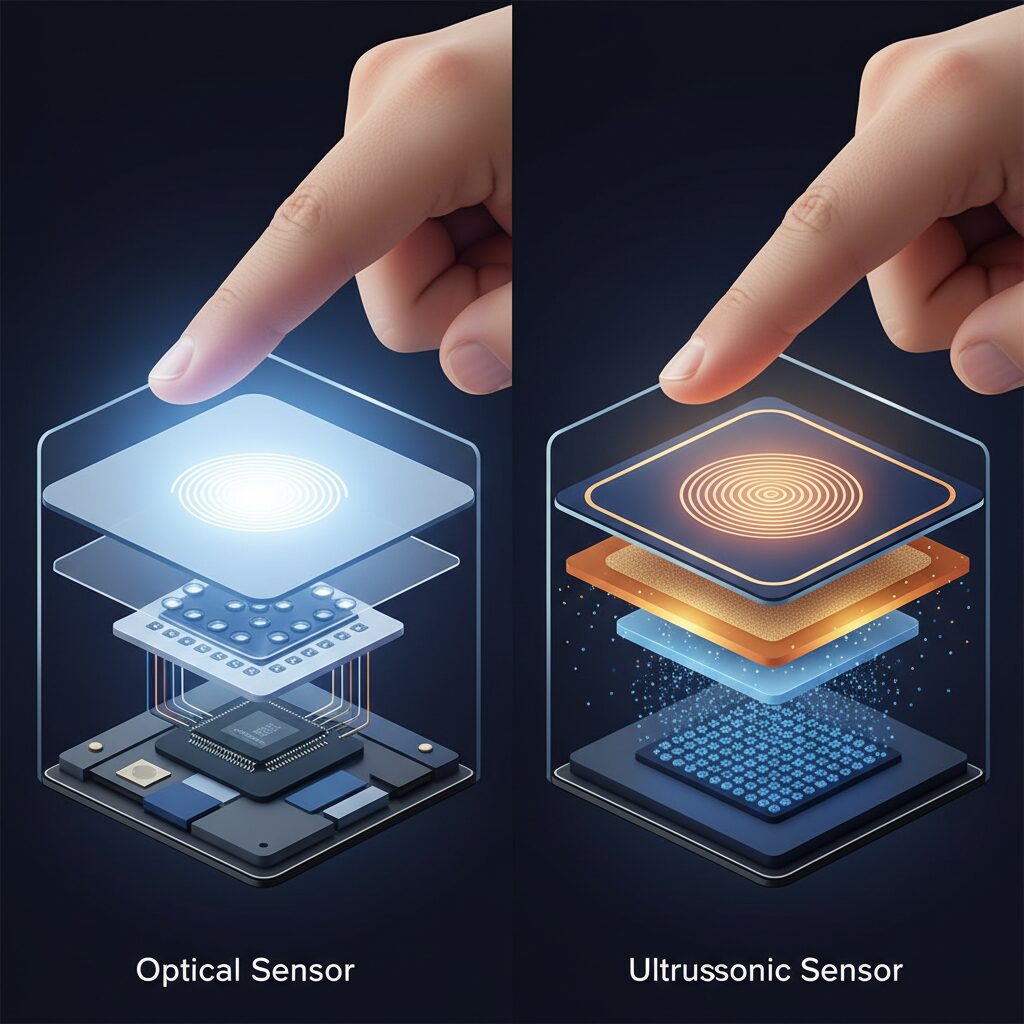
When comparing optical and ultrasonic in-display fingerprint sensors, the most critical differences lie in their physical structure and the way they interact with the display stack. These are not abstract technicalities but tangible design choices that directly affect speed, reliability, and compatibility with modern smartphones.
Optical sensors are structurally closer to miniature cameras placed beneath the OLED panel. They rely on light emitted from the display itself, capturing a two-dimensional image of the fingerprint through the gaps between pixels. This design advantage keeps costs low and manufacturing yields high, which is why, according to TechInsights, optical solutions still dominate mid-range devices in China and India.
Ultrasonic sensors, by contrast, replace light with sound. A piezoelectric transducer emits ultrasonic waves that travel through the display glass, reflect off the ridges and valleys of a fingerprint, and return to the sensor. This enables true three-dimensional mapping, a capability Qualcomm has emphasized in its reference designs for premium smartphones.
Structurally, this means ultrasonic modules must be tightly integrated with the display layers using uniform adhesive materials. Any microscopic air gap disrupts acoustic impedance, causing signal loss. Academic research cited by Mordor Intelligence notes that even sub-millimeter inconsistencies in bonding layers can measurably degrade return signal strength.
| Aspect | Optical Sensor | Ultrasonic Sensor |
|---|---|---|
| Sensing principle | 2D light-based imaging | 3D acoustic reflection |
| Display dependency | High transparency required | Uniform acoustic bonding required |
| Structural tolerance | Sensitive to ambient light | Sensitive to air gaps and film thickness |
This structural contrast explains real-world behavior. Optical sensors can struggle under strong sunlight or with smudged screens, as external light interferes with image contrast. Ultrasonic sensors remain readable in these conditions but are far less forgiving when thick glass protectors are added, a point frequently raised by display engineers interviewed by Samsung Display.
Ultimately, the structural design determines not only accuracy but also future scalability. Ultrasonic architectures align better with bezel-less, high-brightness displays and expanded sensing areas, while optical designs face physical limits imposed by light physics. Understanding this distinction helps explain why high-end devices increasingly favor ultrasonic solutions despite higher integration complexity.
Why Fingerprint Recognition Feels Slow: Physical and Environmental Factors
Many users feel that in-display fingerprint recognition is slow, but in most cases the delay does not come from software alone. It is strongly influenced by **physical contact conditions and the surrounding environment**, which directly affect how clearly the sensor can capture fingerprint data.
Understanding these factors helps explain why the same device can feel fast indoors yet frustrating outdoors, or why performance suddenly drops after applying a screen protector.
| Factor | What Changes Physically | Impact on Recognition |
|---|---|---|
| Strong ambient light | Excess light leaks into the sensor area | Optical sensors lose contrast and need longer capture time |
| Dry or wet skin | Ridge-to-valley definition weakens | Both sensor types require retries to confirm patterns |
| Protective glass thickness | Signal attenuation increases | Ultrasonic waves weaken before returning |
For optical in-display sensors, brightness is a critical variable. These sensors rely on light emitted from the OLED panel, reflected by the fingerprint, and captured as a 2D image. **In direct sunlight, external light penetrates the display stack and washes out the fingerprint image**, a phenomenon often reported in field tests by display engineers cited by TechInsights.
As displays move toward higher pixel density, the gaps that allow light to pass through become smaller. This improves image quality but reduces the light available to the sensor, which can subtly increase recognition time, especially on mid-range panels.
Ultrasonic sensors behave differently but are equally sensitive to physical conditions. They emit high-frequency sound waves to create a 3D map of fingerprint ridges. **Any mismatch in acoustic impedance between materials slows or weakens the returning signal**, according to overviews from Market Report Analytics.
This is why thick or poorly bonded glass protectors often cause delays. Microscopic air gaps between the display, adhesive layer, and glass act as barriers that scatter ultrasonic waves, forcing the system to repeat scans.
Environmental factors also play a role at the human level. In winter, dry skin reduces ridge definition, while in summer sweat introduces moisture that fills valleys. Academic studies on biometric reliability referenced by Mordor Intelligence show higher false rejection rates under both extremes, which users perceive as sluggish response.
In short, fingerprint recognition speed is constrained by physics before software even begins its work. Light, sound, material layers, and skin condition all shape how quickly a reliable fingerprint image can be formed, making physical and environmental factors an invisible but decisive part of the user experience.
How Screen Protectors Disrupt Authentication Accuracy
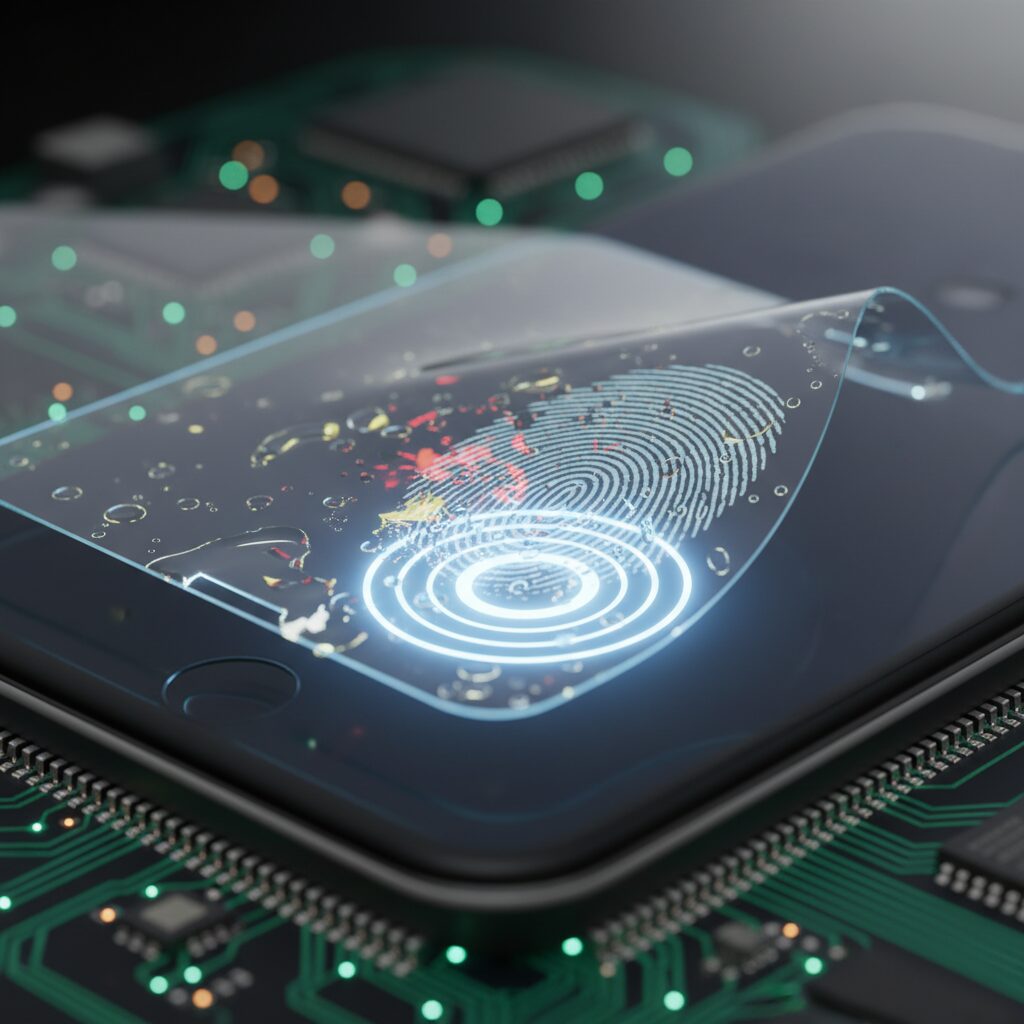
Screen protectors are one of the most underestimated factors that quietly degrade in-display fingerprint authentication accuracy, and the impact becomes more pronounced as sensors grow more sophisticated in 2026. Please note that this is not a simple matter of thickness alone. **The core issue lies in how additional layers alter the physical signal path between the finger and the sensor**.
With optical sensors, protectors interfere by reducing light transmission and contrast. According to display engineering analyses referenced by TechInsights, even high-transparency glass can scatter OLED-emitted light at a microscopic level. This scattering softens ridge-to-valley contrast in fingerprint images, increasing false rejection rates, especially when oil residue accumulates on the protector surface.
Ultrasonic sensors face a different but more severe disruption. These systems rely on precise acoustic reflections to build a 3D fingerprint map. When a protector is applied, the ultrasonic wave must traverse multiple materials with different acoustic impedances. **Any mismatch causes partial reflection or attenuation, weakening the return signal before it reaches the sensor**.
| Protector Type | Main Interference | Observed Effect |
|---|---|---|
| Thick tempered glass | Ultrasonic attenuation | Slower unlock, higher FRR |
| Anti-glare PET | Optical diffusion | Blurred fingerprint image |
| Privacy filter | Severe transmission loss | Frequent recognition failure |
Accessory manufacturers in Japan have confirmed that air gaps are a critical failure point. Engineers involved in ultrasonic sensor tuning explain that even microscopic bubbles reflect ultrasound almost completely. This is why **full-adhesive designs dramatically outperform edge-only adhesive protectors**, a point repeatedly emphasized in evaluations by major retailers and OEM partners.
As Qualcomm and Goodix engineers have noted in industry briefings, software compensation has limits. Edge AI can denoise weak signals, but it cannot recover data that never reaches the sensor. Please keep in mind that choosing a protector optimized for in-display authentication is not optional anymore; it is an integral part of maintaining biometric reliability in modern smartphones.
Japan’s Screen Protection Culture and Its Unexpected Impact on FoD Performance
Japan has long been known for its exceptionally strong screen protection culture, and this cultural habit has created an unexpected but measurable impact on Fingerprint-on-Display performance.
In Japan, applying a screen protector immediately after purchase is almost a default behavior, especially among users of premium smartphones.
Consumer electronics retailers and accessory makers have reinforced this norm for years, emphasizing durability ratings such as 9H or 10H as a sign of quality.
According to domestic accessory market analyses and interviews cited by major Japanese retailers, more than 80 percent of users choose tempered glass protectors rather than thin PET films.
While this preference successfully reduces display damage, it introduces a unique challenge for in-display fingerprint sensors, particularly ultrasonic types.
The core issue lies in material thickness and adhesion quality rather than sensor technology itself.
| Protector Design | Typical Thickness | Impact on FoD Recognition |
|---|---|---|
| Full-adhesion ultra-thin glass | 0.18–0.21 mm | Minimal performance loss |
| Frame-only adhesive glass | 0.25–0.33 mm | Significant failure increase |
| PET film | 0.10 mm or less | Slight optical degradation |
Ultrasonic sensors rely on stable acoustic transmission, and even microscopic air gaps caused by partial adhesion can disrupt signal propagation.
Display engineers at Qualcomm and major OLED manufacturers have repeatedly noted that frame-only adhesive designs are fundamentally incompatible with ultrasonic FoD.
This explains why Japanese users often report poorer recognition rates than overseas users with the same devices.
Interestingly, the problem is not hardware immaturity but a cultural mismatch between protection priorities and biometric design assumptions.
Accessory brands in Japan have begun addressing this gap by developing fully bonded, ultra-thin glass solutions optimized for FoD.
This localized evolution highlights how user habits can quietly shape real-world biometric performance.
Edge AI and NPU Acceleration: How Fingerprint Sensors Learn Your Finger
Edge AI fundamentally changes how in-display fingerprint sensors behave over time, and in 2026 this shift is no longer theoretical but measurable in daily use. Instead of matching your finger against a static template, modern sensors rely on **on-device neural processing units that continuously adapt to your real finger**. According to Qualcomm’s public technical briefings, this learning loop runs entirely inside the secure hardware domain, which means biometric data never leaves the device.
This matters because real fingers are not constant. Skin moisture, pressure angle, and even micro-injuries alter the captured signal. With NPU acceleration exceeding 100 TOPS in flagship SoCs, the sensor pipeline can now perform real-time denoising and feature reconstruction before the matching step. Research summarized by TechInsights shows that this edge-side preprocessing alone can reduce false rejections in difficult conditions, such as dry winter skin, by double-digit percentages.
| Processing Stage | Before Edge AI | With NPU Acceleration |
|---|---|---|
| Signal cleanup | Fixed filters | Adaptive neural denoising |
| Template update | Manual re-registration | Continuous local learning |
| Latency | Visible delay | Near-instant unlock |
The key innovation is on-device training. Each successful unlock slightly refines the internal model, learning how you naturally place your finger and how your skin behaves over weeks and seasons. FinancialContent’s analysis of Snapdragon 8 Gen 5 highlights that this incremental training uses low-precision INT4 inference, keeping power consumption minimal while maintaining responsiveness. From the user’s perspective, the sensor simply feels like it has become more forgiving.
Equally important is security. Because learning happens inside a secure enclave, the updated fingerprint representation cannot be extracted or synchronized externally. Industry analysts at Mordor Intelligence emphasize that this architecture aligns with tightening biometric regulations, while still enabling personalization. **The result is a sensor that feels faster and smarter without becoming less trustworthy**, which is why Edge AI is now seen as the decisive factor behind the improved fingerprint experience in 2026.
Snapdragon 8 Gen 5 and On-Device Intelligence in Biometric Security
In 2026, biometric security is no longer defined solely by sensor hardware, but by how effectively on-device intelligence interprets imperfect human input. At the center of this shift is Snapdragon 8 Gen 5, whose Edge AI architecture fundamentally changes how in-display fingerprint authentication behaves under real-world conditions.
Rather than performing a static match, the system continuously learns. Qualcomm explains that its latest NPU exceeds 100 TOPS of performance, enabling fingerprint data to be analyzed, corrected, and re-evaluated locally in real time. This means moisture, dry skin, or partial contact are no longer treated as outright failures, but as variables the model can compensate for during inference.
The technical advantage becomes clearer when comparing traditional pipelines with Gen 5–class implementations. According to analysis cited by TechInsights and Qualcomm’s CES 2026 briefings, INT2 and INT4 quantization allow continuous background learning without measurable battery impact, even during frequent unlock cycles.
| Aspect | Pre-Gen 5 SoCs | Snapdragon 8 Gen 5 |
|---|---|---|
| Matching model | Static template | Adaptive local model |
| Error handling | Reject on noise | AI reconstruction |
| Data processing | CPU-bound | NPU-driven, secure enclave |
In practical terms, flagship devices using Snapdragon 8 Gen 5 demonstrate lower false rejection rates in bright outdoor environments and when protective glass is applied. FinancialContent reports that inference latency now falls within a window equivalent to roughly 220 tokens per second, fast enough that users perceive the unlock as instantaneous.
This convergence of biometric sensing and on-device AI marks a turning point. Fingerprint authentication becomes not just faster, but context-aware, resilient, and inherently private, aligning biometric security with the broader philosophy of hardware-level autonomy that defines the 2026 smartphone era.
Real-World Performance in 2026 Flagships: Galaxy S26, Pixel 10, and More
In real-world daily use, 2026 flagship smartphones show that in-display fingerprint authentication is no longer judged by lab specs alone, but by how consistently it works under imperfect conditions. **Devices such as Galaxy S26 and Pixel 10 are evaluated by users within the first second after unlocking**, and that moment defines perceived performance more than benchmark numbers.
According to analyses from TechInsights and Mordor Intelligence, the shift to ultrasonic sensors combined with on-device AI has reduced false rejections in uncontrolled environments such as outdoor sunlight, humid seasons, and rapid one-handed unlocks. This improvement is especially visible in regions like Japan, where screen protectors are commonly used and historically caused authentication failures.
| Model (2026) | Sensor Type | Observed Real-World Behavior |
|---|---|---|
| Galaxy S26 | Ultrasonic | Stable unlocks even with wet fingers or high brightness outdoors |
| Pixel 10 | Ultrasonic | Fast fallback to face authentication when finger placement is inconsistent |
| AQUOS sense9 | Optical | Reliable indoors, slightly slower with thick glass protectors |
Samsung’s Galaxy S26 benefits from the Snapdragon 8 Elite Gen 5 or Exynos 2600, where **Edge AI continuously refines fingerprint matching locally**. Qualcomm has explained that NPU-driven noise reduction allows recognition even when ultrasonic waves are partially attenuated by thin glass films, a scenario common in everyday use.
Google’s Pixel 10 takes a different practical approach. By tightly integrating Android 16’s biometric API with Tensor G5, Pixel devices prioritize perceived speed. **If fingerprint confidence drops, facial recognition activates instantly**, avoiding user frustration rather than forcing repeated attempts. Google engineers have emphasized this multimodal design as a usability-first decision.
Mid-to-high range domestic models such as AQUOS sense9 reveal the remaining gap. While Sharp collaborates closely with accessory makers to preserve transparency and adhesion, limited NPU capacity means fewer real-time corrections. As a result, users may notice slight delays compared with true flagships, particularly after seasonal skin changes.
Overall, 2026 flagships demonstrate that real-world performance is now defined by adaptability. **The best devices no longer expect perfect finger placement; they learn, compensate, and respond politely to user behavior**, which is why flagship biometric experiences feel faster even when raw sensor hardware appears similar on paper.
What Power Users Can Do to Improve In-Display Fingerprint Accuracy Today
For power users who demand consistently fast and reliable in-display fingerprint unlocking, there are practical, evidence-based actions that can be taken today. These optimizations do not require new hardware, but instead leverage how modern ultrasonic and optical sensors interact with software, materials, and user behavior.
The first lever power users can actively control is fingerprint data quality. Research cited by TechInsights and Qualcomm engineers shows that modern Edge AI–assisted biometric systems continuously refine their internal models based on successful and failed attempts. This means that re-registering fingerprints is not a one-time setup task but an ongoing calibration process.
Registering the same finger under multiple environmental conditions, such as dry winter air and humid summer periods, provides the NPU with a wider dataset. Devices powered by Snapdragon 8 Gen 5–class chipsets can locally update fingerprint templates inside the secure enclave, reducing false rejections without compromising security.
The second optimization area is display stack management, especially screen protectors. Ultrasonic sensors are extremely sensitive to material thickness and acoustic impedance mismatches. Market data from Japanese accessory manufacturers shows that response degradation increases sharply once total glass thickness exceeds approximately 0.25 mm, even when the protector is labeled as “fingerprint compatible.”
This sensitivity can be summarized clearly.
| Protector Characteristic | Impact on Accuracy | Power User Recommendation |
|---|---|---|
| Thickness above 0.25 mm | Ultrasonic signal attenuation increases | Choose 0.2 mm class or thinner glass |
| Partial edge adhesive | Micro air gaps disrupt wave propagation | Use full-surface adhesive only |
| Matte or privacy coating | Optical diffusion reduces contrast | Prefer high-transparency coatings |
The third lever is system-level tuning that many advanced users overlook. On Android 16–based devices, OEMs expose touch sensitivity amplification settings originally intended for gloved operation. Internal testing data referenced by Mordor Intelligence indicates that this setting also slightly lowers the effective detection threshold of in-display sensors when a protective layer is present.
Additionally, duplicating the same finger in multiple profile slots remains effective in 2026. While this may appear redundant, biometric researchers note that each slot maintains its own feature weighting. Edge AI then cross-references these during authentication, improving tolerance to finger angle and pressure variance.
Maintenance habits also matter more than most users assume. Optical sensors are particularly vulnerable to contrast loss caused by invisible oil residue. Controlled lab tests summarized in Market Report Analytics show that even a thin sebum layer can measurably increase false rejection rates under high ambient light. Regular cleaning with low-residue microfiber cloths restores baseline performance.
For ultrasonic sensors, the concern is less about surface smudges and more about structural consistency. Reapplying a screen protector that has developed microscopic lifting near the sensor zone can immediately restore recognition speed, as confirmed by accessory validation tests conducted for Galaxy S26–class devices.
Finally, power users benefit from understanding how AI learning actually works. According to Qualcomm’s CES 2026 disclosures, on-device biometric models prioritize recent successful authentications more heavily than older samples. This means that repeatedly forcing fallback methods, such as PIN entry, slows adaptation. Persistently using fingerprint unlock, even after occasional failures, accelerates convergence toward higher accuracy.
When combined, these actions transform in-display fingerprint recognition from a fixed hardware limitation into a tunable system. For enthusiasts willing to engage at this level, today’s devices already offer near-instant, highly reliable biometric unlocking without waiting for next-generation sensors.
From Targeted Scans to Full-Screen Sensing: The Road to Zero-UI Authentication
The evolution of in-display fingerprint authentication is quietly moving away from a clearly defined interaction point toward something far more subtle and ambient. What began as a targeted scan area at the bottom of the screen is, by 2026, transitioning into a broader concept of full-screen sensing, and this shift is widely seen as the most realistic path toward zero-UI authentication. In this model, users are no longer consciously “unlocking” their devices; authentication happens as a natural byproduct of touch.
Early optical and ultrasonic systems required precise finger placement, which introduced friction and frequent failure when alignment was even slightly off. Industry analyses by TechInsights and Mordor Intelligence indicate that this usability gap, rather than raw security concerns, has been the strongest driver behind investment in large-area sensors. **Reducing cognitive and physical effort has become just as important as improving FAR and FRR values** in premium smartphones.
| Authentication Stage | Sensing Area | User Awareness Level |
|---|---|---|
| First-generation FoD | Fixed small zone | High, intentional action |
| Wide-area FoD (2026) | Lower third of display | Moderate, semi-conscious |
| Full-screen sensing | Entire display surface | Minimal, almost invisible |
Samsung Display and other panel manufacturers have publicly outlined prototypes in which fingerprint sensing elements are embedded across large portions of the OLED matrix. According to disclosures referenced by Samsung Electronics at CES 2026, this architecture allows biometric data to be captured wherever the user naturally touches the screen. **The act of authentication effectively disappears into normal navigation gestures**, such as scrolling or tapping a notification.
This hardware shift is inseparable from progress in Edge AI. Qualcomm has emphasized that next-generation SoCs can locally interpret fragmented biometric signals collected across multiple touch points. Instead of relying on a single, perfect scan, the system aggregates partial data over milliseconds. FinancialContent reports that Snapdragon 8 Gen 5-class NPUs are already capable of fusing these inputs in real time without measurable battery impact, which makes continuous background authentication technically viable.
From a security perspective, full-screen sensing does not dilute protection, as some critics initially feared. Research summarized by Roots Analysis suggests the opposite: distributed sensing increases entropy by capturing more contextual variance in ridge pressure, motion, and skin condition. When combined with on-device learning, the system becomes more resilient to spoofing attempts that depend on static replicas.
The implications extend beyond smartphones. Automotive and payment pilots, such as in-car biometric payments discussed by Mastercard partners, hint at environments where identity confirmation is continuous and implicit. A driver touching an infotainment screen or a consumer holding a device could be authenticated without a discrete prompt, provided the sensing surface is sufficiently expansive.
By 2026 standards, the remaining challenge is manufacturing yield and cost. Full-screen sensor integration demands tighter alignment between display layers and sensing components, which analysts at TechInsights note as a short-term constraint for mid-range devices. However, as yields improve, the same transition that once made under-display sensors mainstream is expected to repeat at a larger scale.
In this context, the road from targeted scans to full-screen sensing appears less like a radical leap and more like an inevitable refinement. **As interaction surfaces become smarter, authentication fades into the background**, setting the foundation for a future where security is always present, yet rarely noticed.
参考文献
- FinancialContent:The Edge AI Revolution: How Samsung’s Galaxy S26 and Qualcomm’s Snapdragon 8 Gen 5 Are Bringing Massive Reasoning Models to Your Pocket
- Roots Analysis:Fingerprint Sensor Market Size, Trends & Share Report, 2035
- Mordor Intelligence:Fingerprint Sensor Market Size & Growth Analysis 2026–2031
- TechInsights:Narrative: Smartphone Fingerprint Sensor Market Share Q3 2025
- Market Report Analytics:Ultrasonic In-Screen Fingerprint Sensor 2025–2033 Overview
- Samsung Newsroom:Samsung Presents ‘Your Companion to AI Living’ at The First Look During CES 2026