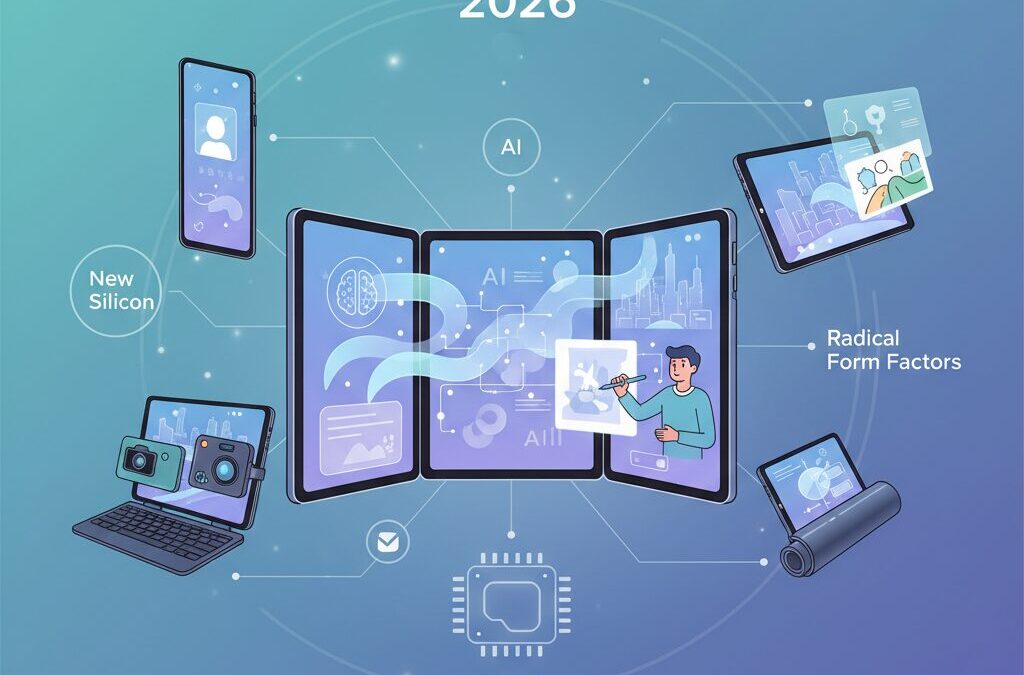
Tablets are no longer just bigger smartphones or lighter laptops, and many gadget enthusiasts are starting to feel that something fundamental has changed.
In 2026, tablets are evolving into AI-native computing devices, capable of running advanced generative AI locally while also transforming how we work, create, and consume content. With breakthroughs in custom silicon, dramatic improvements in battery efficiency, and even foldable and tri-fold designs entering the mainstream, the definition of a “tablet” is being rewritten before our eyes.
For readers who closely follow technology trends, this shift brings both excitement and confusion. Apple’s iPad lineup continues to dominate with powerful M-series chips and deep AI integration, while Android manufacturers like Samsung are experimenting with bold new form factors and alternative processors. At the same time, Windows-based tablets are quietly staging a comeback by finally delivering all-day battery life and practical performance.
This article helps you understand what truly matters in the 2026 tablet market. By exploring real-world performance data, ecosystem differences, creator-focused insights, and emerging design trends, you can clearly see which devices fit your needs and which trade-offs are unavoidable. If you want to make a smart, future-proof choice rather than chasing specs alone, this guide is designed to be worth your time.
- Why 2026 Is a Turning Point for Tablets
- From Post-PC to AI-Native Computing
- Apple’s iPad Strategy and the Power of Custom Silicon
- Apple Intelligence and On-Device AI Experiences
- Samsung and the Android Tablet Comeback
- Tri-Fold and Foldable Tablets: A New Form Factor Era
- Creators’ Perspective: Drawing, Pen Technology, and App Stability
- Windows Tablets and the Maturity of ARM-Based PCs
- Performance, Price, and Resale Value in a Global Market
- How Different Use Cases Change the Best Tablet Choice
- 参考文献
Why 2026 Is a Turning Point for Tablets
In 2026, the tablet market reaches a decisive turning point because the role of the tablet itself has fundamentally changed. For more than a decade, tablets have been described as devices that sit between smartphones and laptops. That description is no longer sufficient. According to analyses shared by Apple and Google at the beginning of 2026, tablets are now positioned as primary platforms for on-device generative AI, rather than as secondary screens.
This shift is driven by two forces moving at the same time: silicon designed specifically for AI workloads and operating systems that assume AI assistance as a default behavior. When Apple announced the integration of Google Gemini into iPadOS as part of Apple Intelligence, industry observers such as Unite.ai noted that the boundary between local and cloud intelligence effectively disappeared. This means that a tablet in 2026 is not just displaying content, but actively reasoning, summarizing, and generating it in context.
| Aspect | Before 2026 | In 2026 |
|---|---|---|
| Core role | Content consumption and light work | AI-native personal computer |
| Processing | CPU and GPU focused | Neural engines and AI accelerators |
| User expectation | Fast and portable | Context-aware and proactive |
Another reason 2026 stands out is the visible convergence of form factor innovation and AI readiness. Samsung’s tri-fold devices shown at CES 2026 were highlighted by PCMag as more than experimental hardware. They represent a future where screen size adapts to intention, while AI adapts to situation. In this environment, tablets become shape-shifting tools that respond intelligently to how and where they are used.
Market data also supports the idea of a structural shift rather than a temporary trend. MM総研 reports that iPad shipments still dominate Japan, but consumer behavior has changed. Buyers now prioritize long-term software support, AI language compatibility, and resale value. This indicates that tablets are increasingly treated as long-term computing assets, not disposable gadgets.
Finally, experts from Microsoft and Apple alike emphasize that 2026 is the first year when AI features are no longer optional add-ons. They are built into the OS, activated by default, and optimized for touch-first interaction. As a result, tablets stop competing with PCs and instead redefine what personal computing looks like. That redefinition is why 2026 is widely regarded as the moment when tablets truly cross into a new era.
From Post-PC to AI-Native Computing

The idea of the “post-PC era,” famously articulated by Steve Jobs at the launch of the first iPad in 2010, is often misunderstood as a future where PCs simply disappear. In reality, what we are witnessing in 2026 is something more nuanced and more profound. The boundary between PCs and tablets is dissolving, not because one replaces the other, but because AI-native computing reshapes how users interact with silicon itself. Tablets are no longer defined by screen size or input method alone, but by their ability to reason, summarize, generate, and assist in real time.
At the center of this shift is the transition from application-centric computing to model-centric computing. Traditional PCs and early tablets required users to choose apps, manage files, and manually orchestrate workflows. By contrast, AI-native tablets increasingly operate on intent. When a user asks for a document summary, image generation, or contextual explanation, the system determines whether the task should be handled on-device or delegated to a cloud model. According to analyses published by Unite.ai, this hybrid AI stack represents a fundamental architectural change rather than a feature update.
This change became concrete in January 2026 with the announcement of the deep integration between Apple’s iPadOS and Google’s Gemini models. Rather than positioning AI as a separate app or chatbot, Apple embedded large language models into the operating system layer. This means that everyday actions such as editing text, understanding on-screen content, or switching between tasks can be mediated by AI with contextual awareness. It can be said that the user no longer needs to “call” AI; the system anticipates when intelligence is required.
| Computing Paradigm | User Interaction | Role of the Tablet |
|---|---|---|
| Post-PC (2010s) | App-first, manual switching | Lightweight alternative to laptops |
| AI-Native (2026) | Intent-first, context-aware | Intelligent interface for reasoning |
Equally important is the evolution of silicon. Modern tablet chipsets such as Apple’s M-series or advanced ARM-based designs are built with neural processing units that prioritize inference efficiency. Research discussions cited by major semiconductor analysts emphasize that on-device AI reduces latency, preserves privacy, and lowers dependence on constant connectivity. This is particularly relevant in Japan, where commuters frequently use tablets in environments with unstable networks, making local inference a practical necessity rather than a luxury.
From a marketing and ecosystem perspective, AI-native tablets also redefine value. Performance is no longer measured only by benchmark scores but by how seamlessly the device supports cognition-heavy tasks such as learning, planning, and creative ideation. Authoritative voices in human-computer interaction research have pointed out that tools which reduce cognitive load tend to see higher long-term adoption. In this sense, tablets that integrate AI at the OS level are better positioned than those that merely add AI-powered apps on top.
Ultimately, the journey from post-PC to AI-native computing does not invalidate the PC; it reframes it. Tablets in 2026 are best understood as adaptive computing surfaces, capable of scaling from casual consumption to advanced reasoning with the assistance of embedded intelligence. This evolution explains why tablets are once again at the center of industry attention, not as compromises, but as the most direct expression of how humans and AI now collaborate.
Apple’s iPad Strategy and the Power of Custom Silicon
Apple’s iPad strategy in 2026 is best understood through one central idea: custom silicon is not a component choice but the foundation of the entire product philosophy. Since the original M1-powered iPad Pro, Apple has steadily repositioned the iPad from a mobile accessory to a silicon-first computing platform, and the arrival of the M5 chip makes this direction unmistakably clear.
Unlike competitors that adapt off-the-shelf processors, Apple designs its iPad chips in parallel with iPadOS and Apple Intelligence. According to reporting from 9to5Mac and analysis echoed by industry observers, this vertical integration allows Apple to define performance targets years in advance, aligning CPU, GPU, and Neural Engine roadmaps with specific user experiences such as on-device AI inference, real-time rendering, and ultra-low-latency pen input.
The M5 chip exemplifies this approach. Built as an evolution of Apple’s laptop-class architecture, it delivers performance that rivals or exceeds many ultraportable PCs while operating within the thermal and battery constraints of a tablet. Reviews by Gizmodo Japan highlight that sustained performance, not just peak benchmarks, is where the M5-based iPad Pro differentiates itself most clearly.
| Aspect | Apple Custom Silicon Approach | Typical Tablet SoC Approach |
|---|---|---|
| Design Goal | Workload-specific optimization for iPadOS and AI | General-purpose mobile performance |
| AI Processing | Dedicated Neural Engine tuned for Apple Intelligence | Shared or limited NPU resources |
| Lifecycle | 5年以上のOS・性能余力を想定 | 2〜3年で陳腐化しやすい |
This silicon advantage directly shapes Apple’s pricing and lineup strategy. By cascading high-end chip technologies downward, Apple ensures that even non-Pro models gain access to meaningful AI capabilities over time. The expected M4-powered iPad Air and A19-based standard iPad illustrate how Apple uses older-generation silicon to democratize advanced features without fragmenting the software ecosystem.
From a market perspective, analysts at MM総研 note that this consistency is a key reason iPadOS continues to dominate the Japanese tablet market. Users are not merely buying hardware performance; they are investing in a platform where app compatibility, resale value, and long-term updates are tightly coupled to Apple’s silicon roadmap.
Custom silicon also allows Apple to take calculated risks elsewhere. Features such as tandem OLED displays or advanced connectivity chips can be introduced without destabilizing the system, because the core compute architecture remains under Apple’s direct control. This contrasts sharply with Android tablets, where changes in SoC vendors often introduce optimization gaps.
Perhaps most importantly, Apple’s silicon strategy reinforces trust. As Apple Intelligence expands in Japanese language support, users can be confident that sensitive AI tasks run locally whenever possible, a point Apple itself emphasizes in its platform documentation. This balance of performance and privacy would be difficult to achieve without end-to-end control over the chip.
In 2026, the iPad’s competitive edge no longer comes from being thin or light. It comes from Apple’s ability to design silicon that anticipates how people will create, think, and work on a sheet of glass years into the future, and then quietly delivers that vision through every generation.
Apple Intelligence and On-Device AI Experiences

Apple Intelligence represents a decisive shift in how AI is experienced on tablets, placing on-device processing at the center of everyday workflows. Rather than relying exclusively on cloud inference, Apple’s approach emphasizes that a large portion of language understanding, image generation, and contextual assistance runs locally on iPad silicon. **This design choice directly ties user experience to the performance of Apple’s chips, while simultaneously reinforcing its long‑standing stance on privacy.** According to Apple’s own technical briefings, sensitive data such as personal messages, notes, and on‑screen context are processed without leaving the device whenever possible.
This philosophy became tangible for Japanese users in early 2026, when Apple Intelligence began rolling out native Japanese support. Writing Tools that refine tone and structure, Genmoji that adapts to conversational context, and Siri’s on‑screen awareness collectively changed the perception of AI from a novelty into a daily utility. Industry analysts have noted that this localization step was critical, as AI adoption rates correlate strongly with natural language accuracy, especially in languages with complex honorifics such as Japanese.
This balance is easier to understand when viewed in terms of latency and trust. Tasks like summarizing emails or recognizing content on the display feel instantaneous because they never touch the network. More complex requests, such as multi‑step research questions, benefit from Gemini’s large‑scale models without permanently sharing personal context. Researchers cited by Unite.AI have described this as a pragmatic middle ground between closed and fully cloud‑dependent AI systems.
| Processing Type | Primary Location | User Impact |
|---|---|---|
| Writing Tools | On‑device | Low latency, high privacy |
| Image Playground | On‑device | Offline creative use |
| Advanced reasoning | Cloud via Gemini | Broader knowledge access |
From a market perspective, analysts at MM Research Institute have pointed out that this tightly integrated AI experience reinforces ecosystem lock‑in. **The value of Apple Intelligence increases over time as it learns personal context locally, making device replacement decisions less about raw specs and more about accumulated intelligence.** In 2026, that subtle shift may prove to be Apple’s most powerful advantage in the tablet space.
Samsung and the Android Tablet Comeback
The comeback of Android tablets in 2026 is inseparable from Samsung’s strategic reset, and the shift is far more substantive than a simple product refreshです。For several years, Android tablets were seen as technically capable yet strategically unfocused, especially when compared with the tightly integrated iPad ecosystemです。Samsung’s latest moves signal a deliberate attempt to rewrite that narrativeです。
At the center of this resurgence is Samsung’s willingness to break its own precedentsです。By adopting MediaTek’s Dimensity 9400+ in the Galaxy Tab S11 series, Samsung prioritized multi-core performance and power efficiency over brand familiarityです。According to GSMArena’s silicon analysis, this 3nm-class SoC delivers sustained performance that rivals recent Snapdragon flagships in real-world multitasking, a metric that matters more for tablets than peak benchmark scoresです。
| Strategic Change | Impact | User Meaning |
|---|---|---|
| Switch to MediaTek | Lower thermal load | More stable long sessions |
| TriFold form factor | 10-inch expandable screen | Phone and tablet convergence |
Form factor innovation further reinforces this momentumです。The Galaxy Z TriFold, showcased at CES 2026, demonstrates Samsung’s hardware-first philosophy by collapsing the boundary between smartphones and tabletsです。PCMag’s hands-on impressions emphasized the near-invisible crease and sub-4mm unfolded thickness, features that reposition Android not as a cheaper alternative, but as a platform for experimentationです。
Samsung’s real bet is ecosystem confidenceです。DeX mode, S Pen integration, and tighter AI features across One UI aim to reduce friction for productivity-focused usersです。While challenges remain in app optimization, Samsung’s approach marks the first credible Android-led tablet comeback driven by differentiated hardware, not price aloneです。
Tri-Fold and Foldable Tablets: A New Form Factor Era
The emergence of tri-fold and foldable tablets in 2026 marks a decisive shift in how mobile computing is physically experienced. Until recently, tablets competed mainly on processing power and display quality, but foldable engineering now adds a new competitive axis: spatial flexibility. Devices like Samsung’s Galaxy Z TriFold demonstrate that the question is no longer how powerful a tablet is, but how many roles a single screen can realistically assume.
Tri-fold designs fundamentally challenge the traditional size trade-off that has long defined tablets. According to hands-on impressions reported by PCMag and CES 2026 attendees, the Galaxy Z TriFold expands to roughly a 10-inch display while collapsing to a smartphone-sized footprint. This effectively merges three categories—phone, mini tablet, and standard tablet—into one continuous form, reducing the need to carry multiple devices.
The technological breakthrough lies in hinge architecture and display durability. Samsung’s dual-hinge Z-shaped folding mechanism enables a fully unfolded thickness of around 3.9mm, while maintaining a folded thickness under 13mm. Industry analysts cited by GSMArena note that achieving this required not only thinner OLED layers, but also redesigned ultra-thin glass and reinforced hinge materials to withstand tens of thousands of folds without visible creasing.
| Aspect | Conventional Tablet | Tri-Fold Tablet |
|---|---|---|
| Portability | Fixed large footprint | Smartphone-sized when folded |
| Usage Modes | Single-screen only | Phone, split, full tablet |
| Hardware Complexity | Low | Very high |
From a productivity perspective, foldable tablets introduce new interaction patterns. When partially unfolded, tri-fold devices can present two or three app panes simultaneously without relying purely on software split-screen tricks. Reviewers at CES observed workflows where email, reference documents, and note-taking apps coexisted across physical screen segments, creating a more natural sense of separation that mirrors multi-monitor setups.
However, this innovation comes at a steep cost. With projected prices exceeding 2,500 US dollars, tri-fold tablets remain firmly positioned as ultra-premium products. Market researchers referenced by TechRadar emphasize that early adopters are not mainstream consumers, but executives and technology enthusiasts who value device consolidation over price efficiency.
Durability and long-term reliability also remain open questions. While Samsung claims significant improvements in hinge lifespan and crease visibility, independent long-term data is still limited. Analysts from established hardware testing outlets caution that foldable tablets should currently be viewed as first-generation category creators rather than fully mature replacements for slab-style tablets.
Even so, tri-fold and foldable tablets represent more than a novelty. They redefine the physical boundaries of what a tablet can be, signaling an era where adaptability becomes as important as raw performance. In that sense, 2026 is not merely adding another tablet shape, but introducing a new design philosophy centered on transformation and choice.
Creators’ Perspective: Drawing, Pen Technology, and App Stability
From a creator’s point of view, a tablet succeeds or fails as a digital canvas not by benchmark scores, but by how naturally it disappears under the pen. In 2026, illustrators consistently report that drawing quality is defined by three tightly linked factors: pen technology, latency consistency, and app stability during long sessions.
Pen input has reached a level where small differences matter. Apple Pencil Pro introduces squeeze gestures, barrel rotation, and subtle haptic feedback, allowing tools like Procreate and Clip Studio Paint to mimic real brushes with remarkable precision. Apple’s tight control over hardware, drivers, and iPadOS means stroke prediction and palm rejection remain stable even on dense, multi-layer canvases.
Samsung’s S Pen, based on Wacom EMR technology, still excels in low initial activation force and requires no charging. Many manga artists value this light touch for inking, especially during extended work. However, recent creator feedback highlights that stability depends less on the pen itself and more on SoC-level optimization.
| Aspect | Apple Pencil Pro | S Pen (EMR) |
|---|---|---|
| Charging | Required | Not required |
| Advanced Gestures | Squeeze, rotation, haptics | Limited |
| App Stability | Very high on iPadOS | SoC-dependent on Android |
According to reports aggregated from creator communities and Clip Studio support forums, MediaTek-based Android tablets show occasional brush lag and inconsistent stabilization under rapid strokes, an issue rarely observed on Snapdragon-based models or iPads. For professionals, this unpredictability breaks flow and directly affects output quality.
The consensus among veteran creators is clear: raw performance matters less than a predictable drawing pipeline. In that respect, Apple’s ecosystem remains the safest choice in 2026, while Android offers excellent hardware potential that still hinges on software maturity.
Windows Tablets and the Maturity of ARM-Based PCs
Windows tablets entered a long period of hesitation after the initial Surface boom, but by 2026 that uncertainty has largely disappeared. The key reason is the clear maturation of ARM-based PCs, which finally aligns performance, battery life, and software compatibility into a practical whole. What once felt like an experiment has now become a credible daily driver for users who expect a tablet to replace, not merely complement, a laptop.
At the center of this shift is Qualcomm’s Snapdragon X Elite, paired with Windows 11 on ARM. Independent evaluations by Microsoft and major hardware reviewers consistently show real-world video playback exceeding 14 hours on Surface Pro 11-class devices, while maintaining sustained performance under load. **This combination resolves the historic trade-off between endurance and responsiveness that plagued earlier Windows tablets.**
| Aspect | Legacy x86 Windows Tablets | ARM-Based Windows Tablets (2026) |
|---|---|---|
| Battery life | 6–8 hours typical use | 12–14+ hours typical use |
| Thermal behavior | Frequent fan noise, heat buildup | Cool, near-silent operation |
| App compatibility | Native but power-hungry | Native ARM + Prism emulation |
Software compatibility, once the Achilles’ heel of Windows on ARM, has quietly reached a tipping point. Microsoft’s Prism emulation layer now translates x86 applications with minimal overhead, while core productivity tools such as Office, Edge, Teams, and Zoom run natively. According to Microsoft’s own developer documentation, the performance penalty for emulated business applications has dropped to a level that most users no longer notice in everyday workflows.
This matters because Windows tablets are judged less on app novelty and more on continuity. **The ability to open years-old in-house tools, proprietary enterprise software, or niche utilities without modification gives Windows tablets an advantage iPadOS still cannot fully match.** Analysts at IDC have repeatedly emphasized that enterprise adoption depends more on legacy compatibility than raw silicon performance, a point validated by the renewed interest in Surface deployments across corporate fleets.
Another factor signaling maturity is deeper AI integration at the OS level. The Copilot key, now standard on many detachable keyboards, offers immediate access to on-device and cloud-assisted AI functions. Meeting summaries, document drafts, and contextual search are no longer add-ons but part of the Windows interaction model. This aligns with Microsoft’s Copilot+ PC strategy, positioning ARM tablets as productivity-first machines rather than consumption devices.
From a form-factor perspective, Windows tablets have also settled into a clearer identity. The Surface Pro lineage demonstrates that a thin, fanless tablet with a kickstand and full desktop OS can now deliver consistent performance without compromising mobility. **This stability marks a decisive shift from “promising concept” to “predictable tool,” which is exactly what professional users demand.**
In practical terms, the maturity of ARM-based Windows tablets means buyers no longer need to accept caveats as part of the deal. Battery anxiety, thermal throttling, and compatibility warnings have largely faded from serious reviews. What remains is a platform that finally delivers on the original Surface vision: a true tablet that behaves like a full PC when required, without apology or asterisks.
Performance, Price, and Resale Value in a Global Market
In a global tablet market reshaped by AI-native silicon and volatile exchange rates, performance alone no longer defines value. In 2026, informed buyers increasingly evaluate devices through a three-layered lens: sustained performance, real-world pricing under currency pressure, and resale value as a hedge against uncertainty. This perspective is particularly relevant in Japan, where a weak yen amplifies price gaps between domestic and overseas markets.
Raw performance has reached a point of diminishing returns for most users. Apple’s M5-equipped iPad Pro clearly leads in peak CPU and GPU throughput, rivaling or exceeding many ultraportable laptops, as highlighted by multiple benchmark analyses cited by GSMArena and Gizmodo Japan. However, Android flagships such as the Galaxy Tab S11 Ultra, powered by MediaTek’s Dimensity 9400+, have narrowed the gap enough that day-to-day differences in multitasking, video editing, or AI inference are often imperceptible outside professional workflows.
What separates devices is not maximum speed but consistency over time. Apple’s vertical integration allows iPads to maintain stable performance across OS updates for five years or more, a point frequently emphasized by analysts at MM総研 when discussing total cost of ownership. In contrast, Android tablets often launch with impressive specifications but face faster perceived aging due to shorter update cycles or app-level optimization issues.
| Category | High-End iPad | High-End Android Tablet |
|---|---|---|
| Peak Performance | Industry-leading, laptop-class | Near-flagship, rapidly improving |
| Price Stability (JP) | High but predictable | Lower MSRP, frequent discounts |
| Resale Value After 3 Years | Very high | Moderate to low |
Pricing tells a more complex story. Due to currency fluctuations, Japanese list prices for premium tablets often exceed their US equivalents by a wide margin. For example, the M5 iPad Pro starts well above the psychological 1,000-dollar line when converted to yen, while Samsung and Chinese brands strategically undercut Apple with aggressive campaigns. According to data aggregated by Kakaku.com, initial purchase price differences can exceed 30 percent for comparable screen sizes.
Yet lower upfront cost does not automatically translate into better value. Apple devices consistently dominate the secondary market. Resale platforms and retailer buyback programs show that iPads, especially Pro and mini models, retain a remarkably high percentage of their original price even after several years. This phenomenon is often attributed to long OS support, global demand, and strong brand trust, factors highlighted by both industry researchers and large refurbishers.
Android and Windows tablets, by comparison, depreciate faster despite competitive hardware. Even Samsung’s Galaxy Tab S series, which performs better than most in resale rankings, typically sees steeper value drops after the first year. For globally minded buyers who upgrade frequently, this depreciation effectively becomes an invisible cost that erodes the apparent savings of a lower MSRP.
From a global market perspective, the most rational choice in 2026 is not defined by benchmark charts but by lifecycle economics. Devices that combine sufficient performance headroom, predictable pricing, and strong resale demand deliver superior long-term value. For enthusiasts and professionals alike, understanding this balance is now as important as choosing the fastest chip on paper.
How Different Use Cases Change the Best Tablet Choice
The “best” tablet in 2026 is not a single product, because use cases now shape the definition of value more than raw specifications do. Advances in on-device AI, silicon efficiency, and form factors mean that the same device can feel either perfectly optimized or deeply mismatched, depending on how it is actually used.
For productivity-focused users, especially those replacing a laptop, sustained performance and software compatibility matter more than peak benchmarks. Microsoft’s Surface Pro series with Snapdragon X Elite illustrates this shift well. According to Microsoft’s own validation and independent long-term tests, ARM-based Windows devices now deliver over 14 hours of real-world video playback while maintaining native Office and browser performance. This changes the equation for consultants or analysts who live in spreadsheets and video calls, where battery endurance and legacy app access outweigh display flair.
By contrast, creative workflows place extreme emphasis on input latency, color accuracy, and application stability. Reviews from outlets such as Gizmodo Japan and long-running community feedback around Procreate and Clip Studio Paint show that iPad Pro models remain the safest choice for illustration and design. Even when Android tablets match or exceed benchmark scores, driver-level optimization and pen-response consistency still determine day-to-day satisfaction. In creative work, predictability often beats theoretical power.
| Primary Use Case | Key Evaluation Criteria | Tablet Characteristics That Matter Most |
|---|---|---|
| Mobile business work | Battery life, app compatibility | ARM efficiency, desktop-class OS |
| Creative production | Pen latency, color fidelity | High-refresh displays, mature apps |
| Media consumption | Aspect ratio, speakers | Wide displays, tuned audio |
Entertainment-oriented users experience a different set of priorities. For streaming, reading, and casual gaming, reviewers at TechRadar and GSMArena consistently point out that aspect ratio and speaker tuning affect comfort more than chip generation. Devices like OnePlus Pad-class tablets gain an advantage here, as their 7:5 displays reduce black bars for both video and documents, delivering a more immersive yet relaxed viewing experience.
This is particularly evident in Japan, where the rollout of Apple Intelligence in Japanese during early 2026 changed how students and professionals evaluate entry-level models. Educational users benefit less from extreme GPU power and more from reliable AI-assisted writing, summarization, and planning tools that function seamlessly in their native language. Analysts from MM総研 have noted that such practical AI availability strongly correlates with long-term device retention in the domestic market.
Finally, emerging form factors like Samsung’s tri-fold devices appeal to a very specific audience: users who value device consolidation above cost efficiency. Hands-on reports from CES 2026 describe these tablets as solving a logistical problem rather than a performance one, replacing both phone and tablet for executives and frequent travelers.
In 2026, choosing the right tablet means mapping daily behavior, not chasing headlines. The best tablet is the one whose strengths align tightly with how, where, and why it is used, and that alignment has never been more use-case dependent than it is now.
参考文献
- Unite.AI:Apple Selects Gemini for Apple Intelligence Core
- PCMag:The Massive Galaxy Z TriFold Is Turning Heads at CES 2026
- Gizmodo Japan:iPad Pro (M5) Review: No Other Tablet Comes Close
- 9to5Mac:Here’s What’s Coming for the iPad Lineup in 2026
- GSMArena:Samsung Galaxy Tab S11 Ultra Specifications
- Microsoft:Meet the New Surface Pro 11th Edition, a Copilot+ PC