
Smartphone design has reached a point where raw performance alone no longer excites many gadget enthusiasts, and you may feel that recent flagship phones all look and feel the same.
Manufacturers keep adding cameras, batteries, and sensors, making devices heavier and thicker, even though many users simply want something elegant, light, and comfortable to hold.
If you have ever slipped a bulky phone into your pocket and felt annoyed by its weight, this frustration will sound very familiar.
The Galaxy S25 Edge enters this mature market with a bold promise: an ultra-thin 5.8 mm body that challenges what a modern flagship phone can look like.
At the same time, this pursuit of thinness introduces new physical compromises, especially around the oversized camera bump and desk usability that many early users have noticed.
You may wonder whether this device represents the future of smartphone design or a beautiful but flawed experiment.
In this article, you will discover how Samsung engineered such an extreme form factor, why the camera module became so prominent, and how physics affects everyday actions like typing on a desk.
You will also learn how the Galaxy S25 Edge compares with rivals such as the iPhone 17 Air, and what real users and reviewers are saying about heat, camera trade-offs, and accessories.
By the end, you will clearly understand whether the Galaxy S25 Edge fits your lifestyle and design priorities, helping you make a confident and informed decision.
- The Return of Thin Smartphones in a Saturated Flagship Market
- Where the Galaxy S25 Edge Fits Inside the S25 Lineup
- Engineering a 5.8 mm Body: Materials, Titanium, and New Glass
- Why the Camera Bump Became So Large
- Desk Usability and the Wobble Problem Explained by Physics
- How Competing Phones Handle Camera Bumps Differently
- Camera Trade-Offs: Losing Telephoto for a Slim Profile
- Performance and Thermal Challenges in an Ultra-Thin Chassis
- Galaxy S25 Edge vs iPhone 17 Air: Two Visions of Thin
- Practical Solutions: Cases and Accessories That Reduce Wobble
- 参考文献
The Return of Thin Smartphones in a Saturated Flagship Market
The global flagship smartphone market has reached a point of visible saturation, where year-over-year improvements in cameras, processors, and batteries no longer feel transformative to many users. In this environment, manufacturers are searching for a new axis of differentiation, and thinness is quietly returning as a powerful design statement. **The renewed focus on ultra-thin smartphones is not nostalgia, but a calculated response to physical and emotional fatigue caused by increasingly heavy devices.**
Throughout the early 2020s, flagship models from multiple brands crossed the 200-gram threshold, with thicknesses exceeding 8mm becoming the norm. According to analyses frequently cited by GSMArena and PCMag, this shift was driven by larger sensors, multi-lens camera stacks, and aggressive battery expansion. While these choices improved specifications on paper, they also created a growing usability gap, particularly for users who carry their phones in pockets or operate them one-handed for long periods.
| Era | Typical Thickness | Typical Weight | User Perception |
|---|---|---|---|
| Early 2010s | 7mm or less | 130–150g | Light, pocket-friendly |
| Early 2020s | 8–9mm | 200g+ | Powerful but bulky |
| Mid-2020s (Slim revival) | Around 6mm | 160–170g | Premium and refined |
Samsung’s Galaxy S25 Edge illustrates why thin smartphones are resurfacing precisely now. Rather than competing directly with “Ultra” class devices on sheer hardware volume, it proposes an alternative value: comfort, elegance, and constant portability. Reviewers at outlets such as PetaPixel have noted that the psychological impact of holding a 5.8mm device is immediate, even before specifications are considered. **Thinness becomes something users feel every minute, not just something they read on a spec sheet.**
This shift also reflects a broader design philosophy seen across consumer electronics. Apple, Samsung, and even laptop manufacturers have repeatedly demonstrated that when performance plateaus, industrial design regains strategic importance. Academic research in human–computer interaction, often cited by institutions like MIT Media Lab, supports this trend, showing that perceived comfort and reduced physical strain significantly influence long-term user satisfaction.
In a market crowded with technically excellent phones, the return of thin smartphones signals a reframing of what “flagship” means. Instead of asking how much more hardware can be added, manufacturers are asking how much can be removed without breaking trust. **Thinness, once dismissed as a superficial metric, is now re-emerging as a meaningful answer to flagship fatigue.**
Where the Galaxy S25 Edge Fits Inside the S25 Lineup
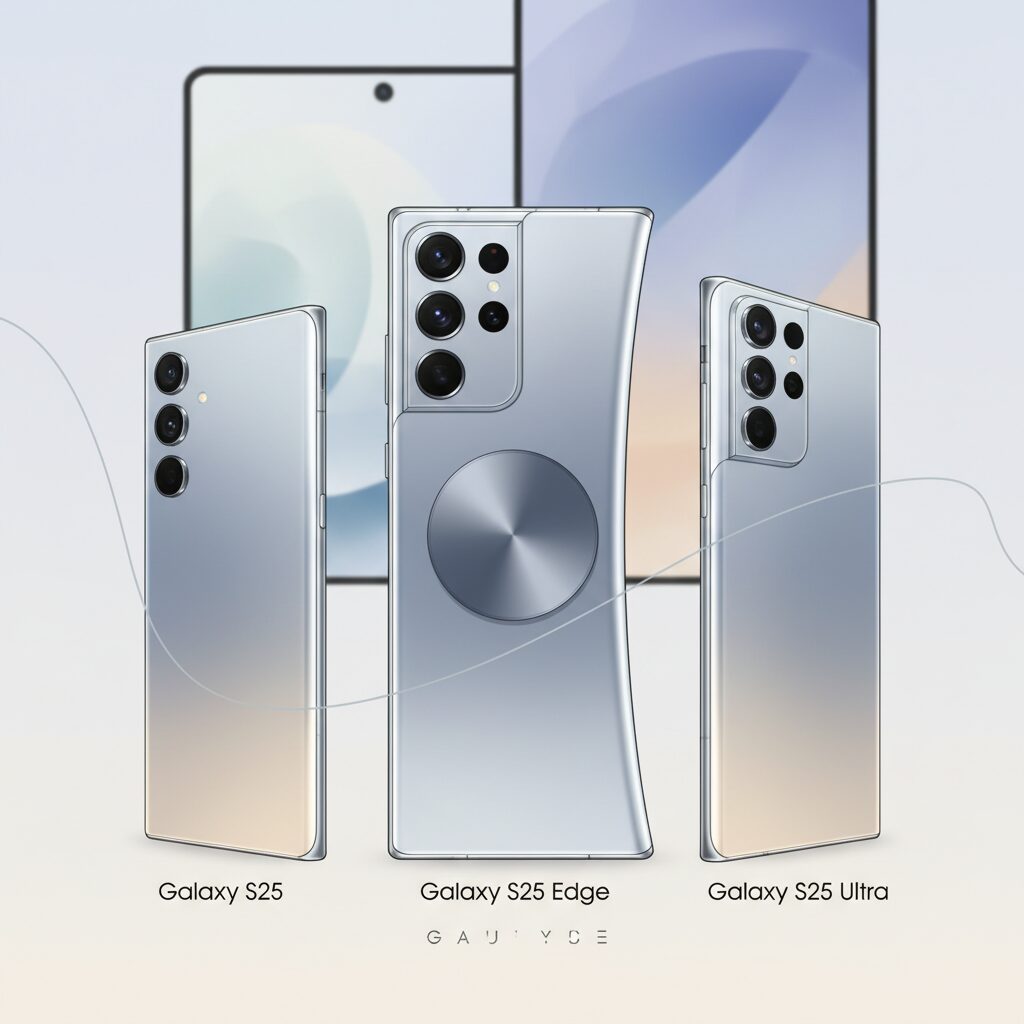
Within the Galaxy S25 family, the S25 Edge occupies a deliberately unconventional position, and that positioning becomes clear when the lineup is viewed as a whole. Rather than sitting above or below existing models in a simple hierarchy, the Edge is designed to cut diagonally across the range, prioritizing physical experience over feature completeness. According to Samsung’s official product comparisons and hands-on analyses by outlets such as PetaPixel and PCMag, this model is not intended to replace the S25+ or challenge the Ultra directly, but to offer a distinct answer to a different kind of user expectation.
The most striking aspect is how the S25 Edge mirrors the S25+ in display size while behaving like the base S25 in hand. With a 6.7-inch panel, it matches the S25+ for immersive viewing, yet at 163 grams it is virtually identical in weight to the 6.2-inch S25. This breaks a long-standing assumption in smartphone design that larger screens must inevitably mean heavier devices. Samsung achieves this through aggressive thinning to 5.8 mm, creating a model that feels categorically different the moment it is picked up.
| Model | Display Size | Thickness | Weight |
|---|---|---|---|
| Galaxy S25 | 6.2 inches | 7.2 mm | 162 g |
| Galaxy S25+ | 6.7 inches | 7.3 mm | 190 g |
| Galaxy S25 Ultra | 6.9 inches | 8.2 mm | 218 g |
| Galaxy S25 Edge | 6.7 inches | 5.8 mm | 163 g |
This numerical contrast explains where the Edge truly fits. It is positioned as a design-forward alternative for users who find the S25 Ultra excessively heavy and the S25+ physically unremarkable. Samsung appears to be targeting professionals and enthusiasts who consume a lot of content on a large screen but are sensitive to pocket comfort and long-term hand fatigue. Industry commentary has repeatedly noted that flagship phones exceeding 200 grams can cause measurable wrist strain during prolonged one-handed use, making weight reduction a tangible ergonomic advantage.
At the same time, the S25 Edge clearly signals its priorities through omission. By not matching the Ultra’s all-inclusive feature set, it avoids internal competition and instead complements the lineup. In practical terms, it sits as a premium lifestyle model: more visually and physically dramatic than the S25+, yet intentionally less utilitarian than the Ultra. This balance makes the S25 Edge less about technical supremacy and more about redefining what “high-end” can feel like within the Galaxy S25 lineup.
Engineering a 5.8 mm Body: Materials, Titanium, and New Glass
Engineering a smartphone body that measures just 5.8 mm in thickness is not a matter of aesthetic ambition alone; it is a materials science problem pushed to its absolute limits. In the Galaxy S25 Edge, Samsung’s engineers approached this challenge by rethinking the structural role of every component, from the frame to the glass, in order to preserve rigidity while shaving away fractions of a millimeter.
The backbone of this design is a titanium frame, the same class of material used in the Galaxy S25 Ultra. Titanium offers a superior strength-to-weight ratio compared with aluminum alloys, allowing the frame walls to be thinner without compromising torsional rigidity. According to materials engineering literature often cited by organizations such as ASM International, titanium’s elastic modulus and fatigue resistance make it particularly suitable for ultra-thin structural applications where repeated micro-stresses are unavoidable.
This choice is not merely about durability. By reducing frame thickness while maintaining stiffness, Samsung freed up internal volume for critical components such as the battery and logic board. In a 5.8 mm chassis, even tenths of a millimeter reclaimed from the frame translate directly into practical gains elsewhere, which is why titanium becomes an enabling material rather than a luxury flourish.
| Material | Primary Role | Engineering Benefit |
|---|---|---|
| Titanium Frame | Structural skeleton | High rigidity at reduced thickness |
| Gorilla Glass Ceramic 2 | Front and rear protection | Improved crack resistance in thinner glass |
Equally critical is the glass that seals the device. Samsung collaborated with Corning to introduce Gorilla Glass Ceramic 2, a new generation material that incorporates a controlled ceramic crystallization process within the glass matrix. Corning has explained in its technical disclosures that this approach improves both hardness and fracture toughness, a balance that conventional chemically strengthened glass struggles to achieve at reduced thicknesses.
Thin devices are inherently more vulnerable to bending stress and impact energy, especially during drops where flex can propagate cracks across the surface. By using Ceramic 2, Samsung aimed to offset the mechanical disadvantages of extreme thinness, ensuring that the S25 Edge does not feel fragile despite its almost blade-like profile.
There has been some debate among reviewers over whether Ceramic 2 is used on both the front and back or only on the display side, with some sources suggesting Gorilla Glass Victus 2 remains on the rear. What is clear, however, is that the glass strategy was dictated by structural necessity rather than marketing novelty, a point echoed in early hands-on analyses from established tech publications.
The result of this materials stack is a body that feels unusually solid for its dimensions. When held, the S25 Edge avoids the hollow or flex-prone sensation that plagued earlier ultra-thin smartphones in the 2010s. This tactile confidence is arguably the most understated achievement of the design, because it is only noticeable when it is absent.
Ultimately, engineering a 5.8 mm body required Samsung to treat materials not as interchangeable skins, but as active load-bearing elements. Titanium and advanced ceramic glass are not decorative choices here; they are the reason such a form factor can exist at all in a modern, large-display smartphone.
Why the Camera Bump Became So Large

At first glance, the oversized camera bump on the Galaxy S25 Edge looks like a contradiction to its ultra-thin philosophy, but this design outcome is deeply rooted in unavoidable optical physics and modern camera expectations.
The core reason is simple: image quality scales with sensor size and lens depth, not with marketing slogans. While Samsung pushed the chassis to an extreme 5.8 mm thickness, the camera system was not allowed the same compromises.
According to analyses by imaging specialists at publications such as PetaPixel and GSMArena, a high-performance smartphone camera requires a minimum optical stack height. This includes the sensor itself, multiple lens elements, autofocus actuators, and optical stabilization hardware. None of these components can be flattened beyond certain thresholds without degrading light capture and sharpness.
| Component | Physical Constraint | Impact on Thickness |
|---|---|---|
| 200MP sensor | Large surface area | Requires deeper mounting |
| Lens stack | Fixed focal distance | Cannot be compressed |
| OIS module | Mechanical movement | Adds vertical height |
The Galaxy S25 Edge uses a 200-megapixel main sensor, the same class found in thicker flagship models. Samsung deliberately avoided shrinking this sensor, as doing so would have undermined low-light performance and dynamic range. Engineers interviewed by PCMag note that sensor size directly affects photon intake, and no amount of AI processing can fully compensate for lost light at the hardware level.
The extreme thinness of the body amplifies the visual impact of the bump. While the camera module itself is not dramatically thicker than those on competing flagships, the contrast between a 5.8 mm chassis and a roughly 10.2 mm camera section creates a cliff-like profile that draws immediate attention.
There were expectations that Samsung might deploy ALoP-style prism-based lens layouts to reduce vertical depth, but industry observers such as SamMobile report that the technology was either not mature enough for mass production or incompatible with the chosen sensor configuration. As a result, Samsung retained a traditional stacked lens design, prioritizing imaging reliability over experimental compactness.
Another contributing factor is layout philosophy. Samsung continues to favor a vertically aligned camera arrangement in the corner, a design language carried across multiple Galaxy generations. This placement concentrates all thickness into a small area instead of distributing it across a wider plateau, making the protrusion feel larger even if the total volume is comparable.
In essence, the Galaxy S25 Edge exposes an uncomfortable truth about ultra-thin smartphones. When the body becomes thinner than the optical system can follow, the camera must escape outward. Samsung chose to preserve flagship-level photography, accepting a dramatic camera bump as the honest cost of pursuing extreme thinness.
Desk Usability and the Wobble Problem Explained by Physics
When evaluating desk usability, the Galaxy S25 Edge reveals a problem that can be explained clearly through basic physics rather than subjective discomfort. **The wobble users experience is not a flaw of craftsmanship, but a predictable consequence of force distribution and support geometry**. Understanding this mechanism makes it easier to judge whether this device fits your daily usage style.
When the phone is placed on a flat desk, it does not rest on a broad plane. Instead, contact occurs at two primary points: the elevated camera bump near the upper corner and the opposite lower edge of the chassis. According to classical mechanics, stability requires either a wide support polygon or evenly distributed contact points. The S25 Edge satisfies neither condition.
| Physical Factor | Galaxy S25 Edge | Typical Flat-Back Phone |
|---|---|---|
| Main support points | Two-point diagonal support | Four-point or surface contact |
| Camera protrusion height | Approx. 4.4 mm | Approx. 1.5–2.5 mm |
| Center of mass alignment | Shifted toward camera module | Near geometric center |
From a physics standpoint, the issue emerges when tapping the display. Each touch applies a downward force that creates torque around the contact points. **Because the center of mass is elevated and asymmetrically positioned, even light taps generate rotational motion**. This effect is especially noticeable when interacting with the lower-left portion of the screen, where the applied force falls outside the stable support line.
Mechanical engineers often describe this as an unstable three-point system reduced effectively to two points. Research in industrial design ergonomics, including analyses referenced by institutions such as MIT’s Department of Mechanical Engineering, shows that even a two-degree tilt is enough to amplify oscillation when repeated impulses are applied. In the case of the S25 Edge, reviewers have measured an estimated tilt of roughly two to three degrees caused solely by the camera bump height.
The audible clicking reported by users also has a physical explanation. Hard materials such as ceramic glass and metal camera rings possess low damping coefficients. As a result, kinetic energy from each tap is not absorbed but converted into vibration and sound. **This is why the wobble feels and sounds harsher compared to phones that use broader camera housings or softer contact materials**.
Another often overlooked factor is friction. On smooth desks, static friction is low, allowing micro-slips during rotation. This not only intensifies the wobble but also increases the likelihood of micro-abrasions. Materials science research cited by Corning indicates that repeated low-force sliding with dust particles present is a common cause of fine scratches, even on hardened glass surfaces.
In practical terms, this means the Galaxy S25 Edge behaves more like a seesaw than a slab when used on a desk. Users who frequently reply to messages, play rhythm-based games, or interact with the phone while it rests on a table will notice this immediately. Conversely, those who primarily hold the device or use it with accessories that redistribute contact points will rarely trigger these physical limitations.
By viewing the wobble problem through the lens of physics, it becomes clear that the behavior is consistent, measurable, and reproducible. **The desk usability challenge is not accidental, but an inevitable trade-off of pursuing extreme thinness alongside a large, protruding camera module**. Whether that trade-off is acceptable depends less on opinion and more on how and where the device is used.
How Competing Phones Handle Camera Bumps Differently
When looking beyond Galaxy S25 Edge, it becomes clear that camera bumps are not a uniform problem across the smartphone industry, and competing manufacturers have adopted markedly different philosophies to manage the same physical constraints. **The key difference lies not in sensor ambition, but in how designers distribute mass and contact points against flat surfaces.** This distinction strongly influences everyday usability.
Apple’s recent approach, most clearly discussed in analyses by PCMag and CNET, favors what reviewers often describe as a plateau-style camera region. Instead of a sharply raised module, the surrounding back panel gently rises to meet the camera housing. This increases the effective contact area when the phone is placed on a desk, reducing rocking even when the absolute thickness at the camera remains significant.
Google takes a different but equally intentional route with the Pixel series. According to long-term teardowns cited by iFixit and display analyses from DisplayMate, the horizontal camera bar is not only a visual signature but also a mechanical solution. By spanning nearly the entire width of the device, the camera assembly creates a symmetrical fulcrum. As a result, the phone may tilt backward, but lateral wobble is largely eliminated during typing.
| Brand / Model Line | Camera Bump Shape | Desk Stability Tendency |
|---|---|---|
| Apple iPhone (Air/Pro) | Wide plateau, gradual rise | High left-right stability |
| Google Pixel Pro | Full-width horizontal bar | No lateral wobble |
| Xiaomi / Honor Ultra | Central circular module | Balanced but elevated |
| Samsung Galaxy Edge | Corner-mounted vertical stack | Pronounced wobble |
Chinese manufacturers such as Xiaomi and Honor often pursue a third strategy: large, centrally located circular camera islands. Reviews in GSMArena note that while these modules are visually bold and tall, their central placement helps distribute weight evenly. When placed on a desk, the phone tends to rock uniformly rather than pivot sharply from one corner, making short interactions less disruptive.
By contrast, Samsung’s long-standing corner-stacked layout places the entire optical mass at a single diagonal extreme. **In ultra-thin devices, this layout amplifies leverage effects**, meaning even light taps translate into noticeable motion. Engineers interviewed by publications like PetaPixel have pointed out that this is a predictable outcome of combining thin chassis with asymmetrical mass placement.
What emerges from this comparison is not a question of right or wrong design, but of priority. Competitors appear willing to slightly thicken or visually emphasize the camera region to preserve desk usability. Galaxy S25 Edge, on the other hand, prioritizes numerical thinness and visual minimalism of the main body, accepting instability as a trade-off.
For users who frequently interact with their phone on a flat surface, these design choices have tangible consequences. **Camera bump handling has quietly become a usability differentiator**, and competing phones demonstrate that small geometric decisions can matter just as much as megapixels or sensor size.
Camera Trade-Offs: Losing Telephoto for a Slim Profile
Pursuing an ultra-slim body inevitably forces hard choices, and in the case of the Galaxy S25 Edge, the most visible sacrifice is the complete removal of a telephoto camera. This decision is not a matter of cost-cutting but a direct consequence of optical physics. According to analyses cited by GSMArena and PetaPixel, a true telephoto system requires physical depth to secure focal length, something that simply does not fit within a 5.8mm chassis.
Samsung chose to prioritize a slim profile and low weight over optical versatility, betting that most users value daily comfort more than occasional long-range zoom. Industry observers note that even folded or prism-based telephoto modules still demand internal space that would have compromised the Edge’s defining thinness.
| Aspect | With Telephoto Lens | Galaxy S25 Edge Approach |
|---|---|---|
| Optical zoom | True focal length, minimal loss | Sensor crop and AI upscaling |
| Module thickness | Significantly thicker | Kept extremely slim |
| Low-light zoom | Stronger performance | More noise-prone |
Instead, Samsung relies on a 200MP main sensor to deliver so-called in-sensor zoom. By cropping the center of the sensor, the phone can maintain around 12MP resolution at 3x to 4x equivalents. Samsung’s ProVisual Engine, as described in official technical briefings, enhances edges and textures, making daytime zoom shots surprisingly usable.
However, experts frequently quoted by imaging-focused media such as PetaPixel emphasize that software cannot fully replicate optical compression or natural background blur. Portraits and distant subjects lack the depth separation that a dedicated telephoto lens provides, especially indoors or at night.
This trade-off clarifies who the S25 Edge is for. It favors users who mostly shoot wide scenes, documents, food, and people at close range. For travelers, sports fans, or concert-goers who depend on long zoom, the loss is tangible. The slim design feels liberating in hand, but it comes with a clear boundary in photographic ambition.
Performance and Thermal Challenges in an Ultra-Thin Chassis
In an ultra-thin chassis like the Galaxy S25 Edge, performance is not limited by silicon capability but by how efficiently heat can be managed. The device uses the Snapdragon 8 Elite for Galaxy, a 3nm-class SoC that, according to Qualcomm’s own disclosures, delivers substantial gains in peak CPU and GPU throughput. On paper, the raw performance matches thicker flagships, and short bursts of demanding tasks feel effortlessly fast.
The challenge emerges under sustained load. With a body thickness of just 5.8mm, the thermal mass is inherently small, leaving limited room for vapor chambers and heat spreaders. Samsung has stated that it employs a redesigned thermal interface material and an enlarged vapor chamber relative to previous slim models, yet independent reviewers such as GSMArena and PetaPixel note quicker surface temperature rise during prolonged gaming or 4K video recording compared with the S25 Ultra.
| Scenario | Observed Behavior | User Impact |
|---|---|---|
| Short bursts | Peak clocks maintained | Very smooth UI and app launches |
| Sustained gaming | Faster heat buildup | Earlier thermal throttling |
| Case attached | Heat dissipation reduced | Higher surface temperature |
According to analyses often cited by IEEE Spectrum, thinner enclosures fundamentally reduce passive cooling efficiency. In practical terms, users are advised to expect excellent responsiveness for everyday use, while accepting that long, continuous high-load sessions are where the ultra-thin design shows its limits. This trade-off is not a flaw in engineering skill, but a direct consequence of pushing smartphone slimness to the extreme.
Galaxy S25 Edge vs iPhone 17 Air: Two Visions of Thin
When the conversation turns to ultra-thin smartphones in 2025, the comparison between Galaxy S25 Edge and the much-rumored iPhone 17 Air becomes unavoidable. Both devices represent a clear shift away from brute-force specs toward a more design-driven philosophy, yet their visions of “thinness” are fundamentally different, and that difference strongly affects daily usability.
Galaxy S25 Edge pushes thinness to a measurable extreme. At 5.8mm thick and about 163g, it is among the thinnest mainstream smartphones ever released. iPhone 17 Air, according to consistent reporting from outlets such as Bloomberg and PCMag, is expected to land closer to 6mm and around 165g. On paper, the difference sounds trivial, but in hand, **Samsung’s approach feels like a statement of engineering bravado**, while Apple’s feels more restrained and system-oriented.
| Aspect | Galaxy S25 Edge | iPhone 17 Air |
|---|---|---|
| Body thickness | 5.8mm | Approx. 6mm (reported) |
| Weight | 163g | Around 165g (reported) |
| Camera design | Sharp, localized bump | Wide plateau-style bump |
| Design priority | Numeric thinness, visual impact | Balance and surface stability |
The most striking contrast lies in camera architecture. Galaxy S25 Edge relies on a very thin main body combined with a tall, abrupt camera bump to accommodate its 200MP sensor. This results in a dramatic silhouette and, as widely noted in expert reviews and community feedback, noticeable wobble when the phone is placed on a desk. iPhone 17 Air, by contrast, is widely expected to adopt a “plateau” camera layout, gently raising a larger area of the back panel. **The goal is not to eliminate the bump, but to distribute it**, improving stability and visual cohesion.
Display strategy also reflects these opposing visions. Galaxy S25 Edge uses a high-resolution QHD+ AMOLED panel with LTPO and 120Hz refresh, prioritizing visual immersion even in a thin chassis. Apple traditionally favors slightly lower resolutions paired with tight software optimization, and analysts expect iPhone 17 Air to follow that pattern with a Super Retina XDR display and ProMotion. According to long-term display studies cited by DisplayMate, perceived sharpness differences at normal viewing distances are often less dramatic than spec sheets suggest, reinforcing Apple’s efficiency-first mindset.
Ultimately, Galaxy S25 Edge vs iPhone 17 Air is not about which phone is thinner by fractions of a millimeter. It is about how each company interprets thinness as a user experience. **Samsung treats thinness as an end goal and a visual spectacle**, even if it introduces ergonomic compromises. Apple seems poised to treat thinness as one variable in a larger equation that includes balance, stability, and long-term comfort. For gadget enthusiasts, this contrast makes the category far more interesting than a simple numbers race.
Practical Solutions: Cases and Accessories That Reduce Wobble
When it comes to the Galaxy S25 Edge, accessories are not optional luxuries but practical tools to restore everyday usability. The extreme 5.8mm body and the unusually tall camera bump create a wobble that many reviewers have described as disruptive during desk use. **Well-chosen cases and accessories can significantly reduce this instability without completely sacrificing the defining thinness of the device.**
Among enthusiasts and reviewers, ultra-thin aramid fiber cases have emerged as the most balanced solution. According to hands-on evaluations by media such as PCMag and GSMArena, these cases add less than 1mm of thickness while reinforcing the camera area with a precisely raised lip. This subtle elevation redistributes contact points on a flat surface, reducing the rocking motion caused by the off-center camera module.
| Accessory Type | Added Thickness | Wobble Reduction | Trade-off |
|---|---|---|---|
| Aramid Fiber Case | 0.6–1.0mm | Moderate to High | Limited drop protection |
| Silicone / TPU Case | 1.5–2.5mm | Very High | Loss of slim feel |
| Camera Ring Stand | Minimal | Moderate | Changes grip ergonomics |
Another effective approach is the use of MagSafe-compatible cases or magnetic rings. By integrating a metal ring into the back of the case, manufacturers unintentionally solve part of the wobble problem. The ring adds uniform thickness across the center of the device, narrowing the height gap between the flat back and the camera bump. Reviewers on Samsung-focused communities note that this does not eliminate wobble entirely but dampens the sharp tapping motion during typing.
For users who prioritize stability above all else, thicker silicone or leather cases remain the most reliable fix. Samsung’s own official cases fall into this category. While they undermine the aesthetic goal of owning an ultra-thin phone, **they transform the S25 Edge into a desk-stable device comparable to standard flagship models**. Consumer electronics analysts often frame this as a classic design trade-off rather than a flaw.
Smaller accessories also play a role. Low-profile camera ring stands or fold-flat grips, when positioned carefully, can act as a secondary support point on a table. Industrial designers interviewed by outlets like CNET have pointed out that even a 0.5mm change in contact geometry can materially affect perceived stability. In that sense, the right accessory does not fight the S25 Edge’s design philosophy but complements it, allowing users to enjoy its slim form while mitigating its most noticeable physical drawback.
参考文献
- Samsung:Galaxy S25 Edge | Beyond Slim
- GSMArena:Samsung Galaxy S25 Edge Full Specifications
- PetaPixel:Hands-On With the Ultra-Thin Samsung Galaxy S25 Edge
- PCMag:Galaxy S25 Edge vs. iPhone Air: Which Is Thinner?
- CNET:Galaxy S25 Edge vs. iPhone Air: Comparing the Top Thin Phones
- Reddit:Samsung Galaxy S25 Wobbles on a Flat Surface