Have you noticed your smartphone running out of storage faster than ever in 2026, even if you have not installed many new apps? You are not imagining it. The way storage works inside modern smartphones is undergoing a structural transformation driven by on-device AI, semiconductor supply constraints, and deeper OS-level changes.
From Apple Intelligence requiring gigabytes of reserved space to Android 16’s AI-powered resource management, today’s devices treat storage not as a passive vault but as an active workspace for machine learning models. At the same time, rising DRAM prices and chip supply prioritization for AI data centers are reshaping what manufacturers can realistically offer in base models.
In this article, you will understand why “System Data” keeps expanding, how AI models consume hidden space, what recent research says about model compression, and how hardware decisions such as single vs. multi-NAND chips affect real-world speed. By the end, you will see smartphone storage through a completely new, technical lens and learn how to adapt strategically in the AI-native era.
- The 2026 Smartphone Storage Crisis: A Structural Shift, Not User Error
- Semiconductor Supply Reallocation: How AI Data Centers Are Driving Up Memory Prices
- The “2026 AI Data” Problem and the Acceleration of On-Device AI
- Inside iOS System Data: Why “Other” Storage Keeps Expanding
- The Date-Change Cache Flush Method: Mechanism, Effectiveness, and Risks
- Android 16 and AI-Driven Resource Management: Smarter, but Heavier?
- Apple Intelligence and the 7GB Baseline: The Emergence of the “AI Tax”
- Apple–Google AI Collaboration: Hybrid Models and Persistent Local Assets
- Model Compression Breakthroughs: Quantization, Pruning, and Distillation in Practice
- Hardware Reality Check: Single NAND vs. Multi-NAND Performance Gaps
- USB4 and External Gen4 SSDs: The Rise of Hybrid Storage Strategies
- AI-Powered Home Storage: Smart Appliances as Distributed Edge Nodes
- Practical 2026 Maintenance Strategy: Cache Prioritization and App Offloading
- 参考文献
The 2026 Smartphone Storage Crisis: A Structural Shift, Not User Error
In 2026, the smartphone storage problem is no longer a matter of users “taking too many photos.” It is a structural shift driven by macroeconomics, AI integration, and semiconductor supply constraints.
According to TrendForce, DRAM prices surged 50–55% year over year heading into 2026, while manufacturers such as Samsung and SK Hynix prioritized high-bandwidth memory for AI data centers. As reported by Gigazine, this reallocation has pushed consumer device prices up by as much as 10–20%.
Storage is being squeezed from both ends: exploding AI requirements and tightening hardware supply.
| Indicator | 2025 | 2026 |
|---|---|---|
| DRAM price (YoY) | +50% | Sustained high levels |
| Smartphone price increase | ~3.2% | 10–20% |
| AI data center investment | $200B scale | $400B scale |
| On-device AI market | $17.6B | $22.2B (accelerating) |
While supply tightens, demand inside the device expands. Deloitte notes that AI’s next phase requires more computational power, not less. At the same time, EPOCH AI warns that high-quality training data is approaching saturation, pushing model development toward efficiency and on-device execution.
This pivot toward on-device AI fundamentally changes storage dynamics. Features such as Apple Intelligence now require at least 7GB of available space for full functionality, as reported by WhistleOut and 9to5Mac. These are not optional apps. They are embedded system-level assets that users cannot simply delete.
In effect, AI has become a permanent tenant inside your storage.
The structural tension becomes clear. Manufacturers face higher memory costs due to AI-driven supply prioritization, yet must allocate more internal storage to support local inference engines, context databases, and model assets. Micron’s decision to exit consumer SSD branding and focus on data centers signals where profitability lies.
This is not user error. Even disciplined users who regularly clear cache or offload apps are confronting a redefinition of what “system data” means. Storage is no longer primarily for photos and apps. It is a working substrate for continuous machine intelligence.
In 2026, smartphone storage is being reclassified as a scarce computational resource rather than passive capacity. That shift, not individual behavior, defines the crisis.
Semiconductor Supply Reallocation: How AI Data Centers Are Driving Up Memory Prices

In 2026, semiconductor supply chains are being fundamentally reshaped by one dominant force: AI data centers. What used to be a balanced allocation between consumer electronics and enterprise infrastructure has shifted dramatically toward high-margin AI workloads, and smartphones are feeling the impact directly.
Memory is no longer just a component. It is a strategic resource being redirected at a global scale.
Major manufacturers such as Samsung and SK Hynix have prioritized production of High Bandwidth Memory (HBM) for AI accelerators. As reported by Gigazine, production slots for 2026 were effectively sold out early, reflecting explosive demand from hyperscale AI operators. This reallocation has constrained supply for commodity DRAM and NAND used in smartphones and PCs.
| Indicator | 2025 | 2026 Forecast |
|---|---|---|
| DRAM price (YoY) | +50% | Continued surge (TrendForce) |
| Smartphone retail price | +3.2% | +10–20% |
| AI data center investment | $200B scale | $400B scale (Deloitte) |
According to TrendForce, average DRAM prices rose 50–55% year-over-year entering 2026. That spike does not stay upstream. It flows directly into bill-of-materials costs, pushing smartphone retail prices up by as much as 20% in some segments.
The mechanism is simple but brutal. HBM carries significantly higher margins than standard LPDDR or NAND flash. Foundries and memory fabs allocate limited capacity toward products that maximize return. AI servers, each equipped with massive memory stacks, absorb enormous volumes of wafers that would otherwise support consumer devices.
This is not a temporary shortage. It is a structural reprioritization of silicon.
Micron’s decision to exit the consumer SSD business under the Crucial brand and focus on data center markets further signals this shift. When a major supplier reallocates R&D, packaging capacity, and wafer starts toward enterprise AI, downstream availability for smartphones tightens structurally rather than cyclically.
For smartphone OEMs, this creates a dual pressure. On one side, on-device AI features demand larger memory footprints. On the other, component costs are inflating. The result is strategic compromise: either raise base storage tiers and prices, or maintain capacity while compressing margins.
Deloitte’s technology outlook emphasizes that AI’s next phase will demand more computational power, not less. That directly translates into more memory per server rack. Every additional AI cluster effectively competes with millions of smartphones for the same fabrication resources.
For gadget enthusiasts, the key takeaway is clear. The rising price of memory in 2026 is not driven by consumer demand alone. It is driven by hyperscale capital expenditure cycles measured in hundreds of billions of dollars. When AI data centers double investment year over year, the ripple effects reach the device in your pocket.
The smartphone memory squeeze is the visible edge of a much larger infrastructure transformation.
Understanding this supply reallocation helps explain why storage upgrades cost more, why base models shift upward, and why price hikes feel sudden. The battlefield is no longer between smartphone brands. It is between consumer devices and AI superclusters competing for the same silicon.
The “2026 AI Data” Problem and the Acceleration of On-Device AI
By 2026, the AI industry is facing a structural constraint often described as the “AI data problem.” According to research cited by EPOCH AI and industry analyses summarized by NTT, the supply of high-quality public text data suitable for training large language models is approaching saturation. This means that simply scaling models with ever-larger datasets is no longer sustainable.
As a result, the competitive axis has shifted from training ever-bigger cloud models to deploying more efficient, task-optimized models directly on devices. In other words, instead of relying exclusively on hyperscale data centers, companies are accelerating on-device AI to extract more value from limited data and compute.
This shift is visible in market forecasts. Deloitte notes that global AI infrastructure investment is surging toward the $400 billion scale in 2026, while at the same time the on-device AI market is projected by SNS Insider to grow from $17.6 billion to over $22 billion with accelerating momentum. The growth of both segments signals a hybrid era rather than a cloud-only future.
| Indicator | 2025 | 2026 |
|---|---|---|
| AI Data Center Investment | ~$200B | ~$400B scale |
| On-Device AI Market | $17.6B | $22.2B (growth accelerating) |
Why does the data constraint accelerate on-device AI? First, privacy and regulatory pressure make it harder to centralize user data in the cloud. Processing prompts, images, and behavioral signals locally reduces compliance risk and latency at the same time.
Second, when high-quality new training data becomes scarce, model efficiency becomes the core differentiator. Techniques such as quantization and distillation, discussed in recent surveys in Frontiers in Robotics and AI and on arXiv, enable billions-parameter models to run within smartphone-level memory footprints while preserving 95–99% of original accuracy.
This technological evolution transforms smartphones into active inference nodes rather than passive terminals. Instead of sending every query to a remote server, devices increasingly handle summarization, transcription, notification clustering, and image generation locally.
According to analyses of generative AI beyond the cloud, this architectural shift reduces round-trip latency and network dependency, which is critical in bandwidth-constrained or privacy-sensitive environments. It also redistributes energy consumption from centralized mega–data centers to billions of edge devices.
In practical terms, 2026 marks the year when storage and memory on consumer devices are redefined as strategic AI resources. The “AI data problem” is not only about model training limits. It is about how efficiently intelligence can be embedded at the edge without infinite data growth.
For gadget enthusiasts, this means that chipset design, memory bandwidth, and storage architecture are no longer secondary specs. They directly determine how much AI capability can run locally, how fast it responds, and how independent it is from the cloud. The acceleration of on-device AI is therefore not a trend but a structural response to the limits of data abundance.
Inside iOS System Data: Why “Other” Storage Keeps Expanding
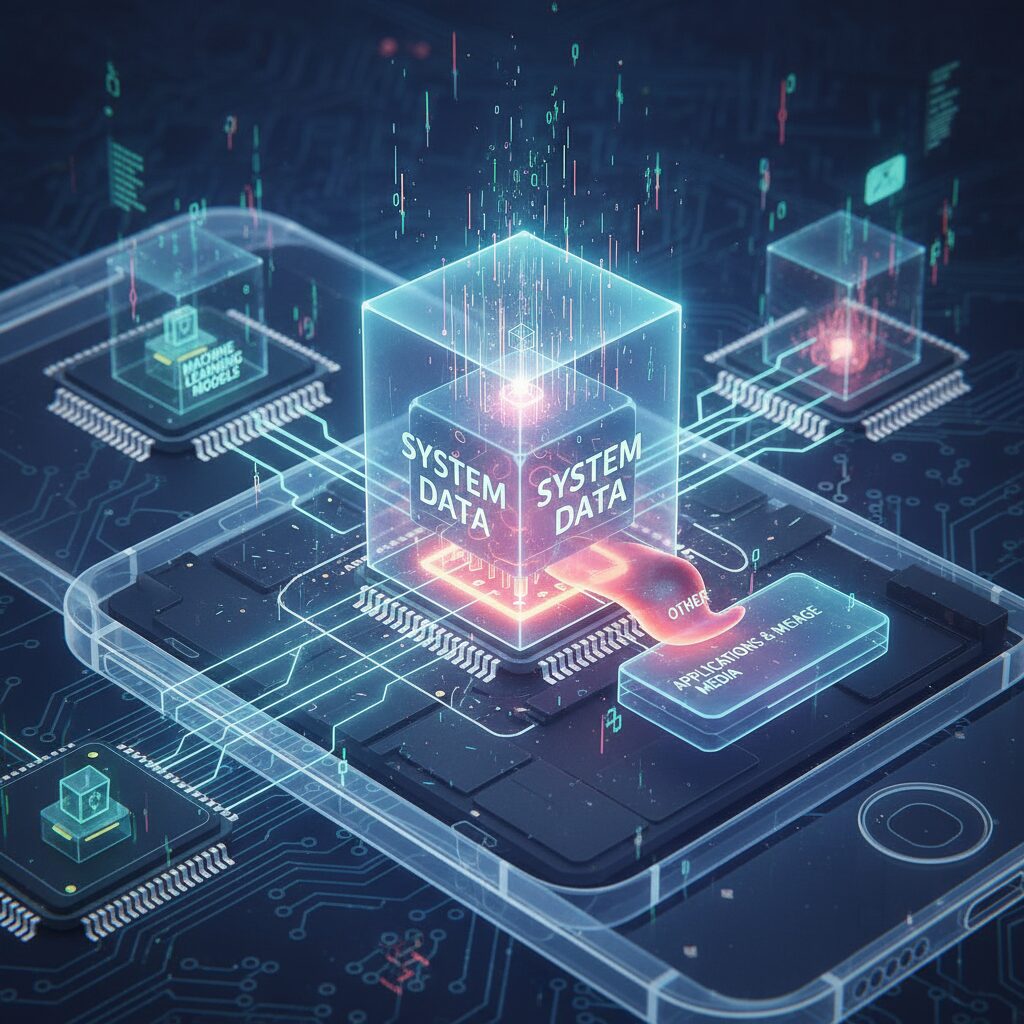
If you have ever opened iPhone Storage and found “System Data” swallowing tens of gigabytes, you are not alone. In 2026, this category has become one of the most controversial parts of iOS because it expands silently and often unpredictably.
Apple defines System Data as files not attributed to a specific app. In practice, it is a dynamic layer of caches, logs, indexes, voice assets, fonts, and temporary files generated by iOS to keep the device responsive.
The problem is not that System Data exists. The problem is that it grows faster than users can see or control.
What Actually Lives Inside “System Data”
| Component | Purpose | Why It Expands |
|---|---|---|
| System caches | Speed up app launches and searches | Accumulate with frequent usage |
| Logs & diagnostics | Error tracking and analytics | Persist after updates or crashes |
| Siri & AI assets | Voice models and language data | Updated and stored locally |
| Index files (e.g., CFSENSESC) | Predictive system behavior | Continuously regenerated |
According to technical breakdowns referenced by How-To Geek and community investigations, files such as CFSENSESC act as predictive indexes. They help iOS anticipate what you will open next. That intelligence requires constant background rewriting of small data fragments, which gradually accumulate.
Under normal conditions, iOS is designed to purge temporary caches automatically when storage runs low. Apple’s own support documentation has long described this self-managing behavior.
However, user reports in 2026 indicate edge cases where the purge mechanism stalls once available space drops below a critical threshold. Instead of shrinking, System Data continues expanding, creating a feedback loop where low storage prevents cleanup.
This is why some users see paradoxical scenarios where System Data exceeds 50GB on a 128GB device.
The Role of On-Device AI
The structural shift toward on-device AI has intensified the issue. As noted by industry analyses from Deloitte and market researchers tracking on-device AI growth, smartphones are increasingly responsible for local inference rather than cloud processing.
That shift means language assets, inference caches, and contextual databases must live locally. Even when invisible in the UI, these components behave like semi-permanent system files rather than disposable cache.
Each Siri interaction, Spotlight search, or predictive suggestion refines internal indexes. Over time, those refinements translate into megabytes and eventually gigabytes.
The opacity of this process fuels frustration. Unlike apps, System Data cannot be selectively cleared. Unlike photos, it cannot be offloaded. It sits in a protected layer of iOS, expanding as functionality grows.
Understanding this architecture changes the narrative. The expansion of “Other” storage is not purely a bug. It is a side effect of iOS evolving from a static operating system into an adaptive AI platform.
The Date-Change Cache Flush Method: Mechanism, Effectiveness, and Risks
The so-called date-change cache flush method has gained traction among power users because it exploits how iOS evaluates cache expiration internally. Instead of directly deleting “System Data,” which Apple does not allow granular access to, this technique manipulates the system clock so that cached files are treated as expired.
According to How-To Geek and multiple user reports in Apple communities, the process typically involves enabling Airplane Mode, manually advancing the device date by several months or even years, waiting briefly, and then restoring automatic date settings. During that window, the system’s cleanup daemon reassesses cached assets as stale.
iOS relies heavily on timestamp metadata to manage temporary system artifacts such as CFSENSESC indexing files, Siri voice assets, log bundles, and predictive caches. When available storage drops below a threshold, the OS is designed to purge older entries. However, as reported in 2026 user cases, certain bugs can prevent automatic purging from triggering correctly.
The date-change method effectively simulates a long passage of time, bypassing the stalled cleanup cycle. Users have documented recoveries ranging from several gigabytes to tens of gigabytes, particularly on 128GB base models where System Data had ballooned abnormally.
| Aspect | Normal Behavior | After Date Shift |
|---|---|---|
| Cache Expiration | Based on real-time aging | Instantly treated as expired |
| Cleanup Trigger | Storage-threshold dependent | Forced by time invalidation |
| User Control | Indirect | Manual intervention |
Effectiveness depends on what portion of System Data is genuinely cache versus protected system assets. Persistent AI components, such as Apple Intelligence’s required local assets of 7GB or more as noted by WhistleOut and 9to5Mac, are not affected. These are classified closer to core system resources rather than temporary files.
The risks, however, are non-trivial. Time manipulation can disrupt iMessage database consistency, invalidate authentication tokens, or create temporary iCloud sync conflicts. Because many services rely on secure time validation, abrupt shifts may trigger re-indexing or re-authentication events.
From a systems perspective, this method is a workaround, not a fix. It leverages an implementation detail rather than an officially supported maintenance pathway. Advanced users may consider it a last-resort recovery strategy when conventional cache clearing and app offloading fail.
The key takeaway is that the method works by forcing temporal invalidation, but it operates outside Apple’s intended storage governance model. As on-device AI assets grow and system partitions become more tightly managed, reliance on such techniques may become less effective over time.
Android 16 and AI-Driven Resource Management: Smarter, but Heavier?
Android 16 marks a decisive shift toward AI-driven resource management, moving beyond manual cache clearing into autonomous optimization.
Google has positioned AI at the core of the system scheduler, storage controller, and notification layer, aiming to reduce user intervention while improving long-term performance stability.
However, this intelligence comes with a trade-off: smarter automation inevitably requires additional background processing and persistent model assets.
Key Architectural Changes in Android 16
| Feature | Technical Impact | Storage/Memory Effect |
|---|---|---|
| AI Notification Summary | On-device summarization of multi-app alerts | Reduces log bloat, adds model footprint |
| 16KB Memory Page Support | Improved memory allocation efficiency | Less swap usage, better flash longevity |
| Private Space Expansion | Encrypted logical storage separation | Prevents cross-app cache pollution |
According to Google’s official Android Developers documentation, Android 16 introduces compatibility with 16KB memory pages.
This change may sound minor, but it significantly improves allocation efficiency compared to legacy 4KB pages, reducing unnecessary swap operations to flash storage.
Fewer swap writes directly translate into longer NAND lifespan and more consistent performance under AI workloads.
The AI Notification Summary system, highlighted by CNET and Google’s product blog, processes large volumes of incoming alerts locally.
Instead of storing fragmented metadata from dozens of chat threads and social apps, Android compresses semantic meaning into summarized records.
This reduces system log expansion over time, yet it requires embedded language models that remain partially resident in memory.
Private Space further strengthens logical segmentation.
Rather than merely hiding apps, it creates encrypted partitions that isolate work and personal data at the storage layer.
This sandboxing minimizes cascade effects where one poorly optimized enterprise app fills shared system cache.
Still, intelligence is not free.
On-device AI requires persistent inference assets, background indexing, and behavioral prediction datasets.
As Deloitte notes in broader AI infrastructure analysis, the next phase of AI evolution demands more compute power—not less—and that principle applies even at the smartphone edge.
For power users, the implication is clear.
Android 16 feels lighter in daily interaction, yet structurally heavier beneath the surface.
The operating system becomes a self-regulating ecosystem, constantly reallocating memory and storage in anticipation of user behavior.
The result is a paradox: fewer visible storage crises, but deeper, more permanent AI integration into system space.
Android is no longer just managing apps—it is managing intelligence itself.
And that evolution defines the true character of Android 16’s resource strategy.
Apple Intelligence and the 7GB Baseline: The Emergence of the “AI Tax”
In 2026, choosing a smartphone storage tier is no longer about how many photos you take. It is about whether your device can afford the baseline cost of intelligence. Apple Intelligence now requires at least 7GB of available storage to function properly, a figure confirmed by multiple industry reports including WhistleOut and 9to5Mac.
This 7GB is not a simple download size. It represents resident model assets, inference engines, and local contextual databases that must remain available at all times. In other words, it behaves like a permanent system allocation rather than optional app data.
The “AI Tax” is not visible on your invoice, but it permanently reduces your usable storage from day one.
To understand its impact, consider how this baseline reshapes entry-level devices.
| Storage Tier | AI Baseline (7GB) | Effective User Space Impact |
|---|---|---|
| 128GB | 7GB reserved | Noticeable constraint |
| 256GB | 7GB reserved | Moderate impact |
| 512GB+ | 7GB reserved | Minimal friction |
On a 128GB model, 7GB represents more than five percent of total capacity before accounting for iOS itself. When system data expansion and app caches are added, the practical free space can shrink rapidly. This is one reason Apple moved the iPhone 17 Pro lineup to a 256GB base configuration, as reported by industry analysts covering the pricing shift.
The situation becomes even more complex when we consider the hybrid AI architecture introduced in 2026. Apple’s partnership with Google to integrate Gemini 3 for certain advanced queries means additional inference-related assets must coexist with Apple’s own models. Even if processing is routed through Private Cloud Compute for privacy, device-side components remain resident.
This creates a new structural reality: AI is no longer an app you install or delete. It is an always-on layer embedded into the operating system.
From a market perspective, Deloitte’s analysis of AI compute demand shows that AI systems are becoming more resource-intensive, not less. While model compression research is progressing rapidly, real-world consumer deployments still require substantial local storage to guarantee responsiveness and privacy.
The result is what many power users now describe as an “AI tax.” You pay for higher storage tiers not because your media library grew, but because intelligence itself consumes space. Unlike photos, this allocation cannot be offloaded to external drives or deleted selectively.
For gadget enthusiasts, this shift changes upgrade logic entirely. The question is no longer “How much content do I create?” but “How much intelligence do I want running locally?” In 2026, storage capacity has become the silent enabler of on-device AI—and 7GB is simply the entry fee.
Apple–Google AI Collaboration: Hybrid Models and Persistent Local Assets
The most strategically significant shift in 2026 is not simply the rise of on-device AI, but the emergence of a hybrid execution model between Apple and Google. Siri no longer operates as a closed system. Instead, it selectively routes complex reasoning tasks to Google’s Gemini 3 under a structured partnership, while maintaining Apple-controlled privacy architecture.
According to industry reporting on the 2026 Apple–Google AI agreement, Apple pays roughly $1 billion annually to license Gemini 3 capabilities. This decision followed internal evaluations showing that Siri failed to process approximately 33% of complex queries at a competitive level. The collaboration is therefore not cosmetic. It directly addresses inference quality at scale.
Apple routes external AI calls through its Private Cloud Compute (PCC) layer, preserving privacy boundaries. However, even when computation occurs in the cloud, the device must store substantial local inference assets to manage context, authentication, routing logic, and fallback processing.
These assets are not user-removable. They behave like quasi-system partitions, occupying persistent storage regardless of user behavior.
| Component | Location | Storage Impact |
|---|---|---|
| Core Siri model | On-device | Permanent AI footprint |
| Gemini routing layer | On-device + PCC | White-label inference assets |
| Context database | On-device | Persistent local index growth |
What makes this architecture particularly demanding is that hybrid AI requires redundancy. If connectivity drops, the device must degrade gracefully rather than fail. That means maintaining compressed yet capable local models alongside cloud-optimized models.
Research on model compression published in Frontiers in Robotics and AI emphasizes quantization and pruning as essential for mobile deployment. Even with INT8 or INT4 compression, however, models still require several gigabytes when persistent context indexing is included. This explains why Apple Intelligence now requires at least 7GB of available space in its full implementation.
Google benefits as well. Gemini’s integration into iOS expands its inference footprint beyond Android, effectively embedding Google AI into premium Apple hardware without full platform dependency. From a strategic perspective, this is a rare case of infrastructural cooperation between rivals.
The cost of this cooperation is invisible but measurable: persistent local assets that cannot be cleared like cache.
For advanced users, this means base storage is no longer determined by photos or apps alone. It is determined by AI residency. The hybrid future does not eliminate local storage pressure. It institutionalizes it.
Model Compression Breakthroughs: Quantization, Pruning, and Distillation in Practice
As on-device AI models swell to billions of parameters, compression is no longer an academic curiosity but a deployment necessity. In 2026, the real competition is not just about model quality, but about how intelligently we shrink it without breaking user experience. Research surveys in Frontiers in Robotics and AI and recent arXiv papers make it clear that quantization, pruning, and distillation are now engineered as integrated pipelines, not isolated tricks.
Quantization reduces numerical precision of model weights and activations. Moving from FP32 to INT8 can cut model size to one quarter, and INT4 pushes it even further. According to recent LLM compression studies on arXiv, advanced methods such as GPTQ and group-wise shared quantization maintain 95–99% of original accuracy while dramatically lowering memory footprint and bandwidth pressure.
| Precision | Relative Size | Typical Use Case |
|---|---|---|
| FP32 | 100% | Training / Server inference |
| INT8 | ~25% | Mobile inference baseline |
| INT4 | ~12.5% | Edge-constrained deployment |
What matters in practice is not just storage savings but energy efficiency. Research on resource-constrained deployment reports up to 40% lower power consumption after aggressive quantization. For battery-bound smartphones, that translates directly into longer sustained AI sessions without thermal throttling.
Pruning takes a structural approach. Instead of lowering precision, it removes redundant connections or even entire neurons. Structured pruning, highlighted in recent compression reviews, can reduce model size by as much as 80% while preserving hardware-friendly tensor shapes. This is critical because unstructured sparsity often fails to deliver real-world latency gains on mobile NPUs.
Distillation complements both techniques. A large teacher model transfers its behavior to a smaller student model trained to mimic logits or hidden states. DistilBERT is a classic example frequently cited in compression literature: it retains about 97% of BERT’s performance while being roughly 40% smaller and significantly faster at inference. In practice, this means predictive text or on-device summarization can run smoothly without shipping a full-scale transformer.
This layered strategy reflects a shift from brute-force scaling to efficiency-first engineering. As surveys from the University of Manchester and other institutions emphasize, compression is now treated as a co-design problem involving hardware constraints, compiler optimization, and model architecture.
For gadget enthusiasts evaluating AI-capable smartphones, the hidden question is not “How many parameters?” but “How intelligently were they compressed?” In an era where storage and memory are economically constrained, compression quality defines whether advanced AI feels seamless or suffocating. The winners will be those who treat every bit as a strategic resource rather than a disposable luxury.
Hardware Reality Check: Single NAND vs. Multi-NAND Performance Gaps
In 2026, storage capacity alone no longer tells the full story of smartphone performance.
The architectural difference between single NAND and multi-NAND configurations has become a decisive factor, especially as on-device AI and high-bitrate video workflows push internal storage to its limits.
Two devices labeled “256GB” can deliver dramatically different real-world experiences depending on how that capacity is physically implemented.
| Capacity | NAND Configuration | Estimated AnTuTu Storage Score | Performance Impact |
|---|---|---|---|
| 256GB | Single NAND | ~100,000 | Slower large file transfers, AI model loading delays |
| 512GB / 1TB | Dual / Multi-NAND | ~150,000 | Higher sustained throughput, better pro workflows |
Investigations into the iPhone 17 series revealed that the 256GB models use a single NAND flash chip, while 512GB and 1TB variants employ multiple chips operating in parallel.
This parallelism allows the storage controller to read and write data simultaneously across channels, effectively increasing throughput without changing the interface standard.
Benchmark results shared by users show storage-related AnTuTu scores of roughly 100,000 for 256GB models versus around 150,000 for higher-capacity versions.
The gap may seem abstract in synthetic benchmarks, but it becomes tangible in demanding scenarios.
When recording 4K ProRes video, transferring multi-gigabyte files, or loading large on-device AI assets that can exceed several gigabytes, sequential and sustained write speeds matter more than nominal capacity.
Single NAND configurations are more likely to experience bottlenecks under continuous workloads.
As Deloitte has noted in its analysis of AI’s next computational phase, edge devices are handling increasingly complex tasks locally.
That shift means storage is no longer a passive repository but an active data pipeline feeding neural engines in real time.
If the pipeline narrows, AI responsiveness suffers, even if free space remains abundant.
There is also a thermal dimension to consider.
Multi-NAND setups can distribute I/O operations across chips, potentially reducing sustained stress on a single die.
Under prolonged workloads such as AI-assisted photo batch processing, this distribution can translate into more stable performance over time.
For gadget enthusiasts, the implication is clear.
Choosing a higher-capacity model may deliver not just more storage, but measurably faster storage, altering the device’s suitability for professional video, large game assets, or future AI expansions.
In 2026, understanding NAND topology is no longer optional—it is part of informed hardware literacy.
USB4 and External Gen4 SSDs: The Rise of Hybrid Storage Strategies
The structural limits of internal smartphone storage in 2026 have accelerated a quiet revolution: hybrid storage strategies built around USB4 and external Gen4 SSDs. As NAND prices climb and base models struggle under AI-related system overhead, power users are no longer relying solely on built-in flash.
With USB-C ports now supporting USB4 on flagship devices, bandwidth ceilings have expanded dramatically. Paired with PCIe Gen4-based external SSDs, users can access transfer speeds that approach high-end internal storage performance, fundamentally changing what “external” means in mobile workflows.
External SSDs are no longer backup tools. They are becoming active, high-performance working drives for AI, video, and gaming workloads.
Modern USB4 implementations enable theoretical throughput up to 40Gbps. When combined with Gen4 NVMe SSDs capable of peak speeds around 7,000MB/s under optimal conditions, the performance gap between internal and external storage narrows significantly. According to 2026 SSD market analyses, this shift is redefining purchasing decisions for creators and gamers alike.
| Storage Type | Interface | Typical Peak Speed | Primary Use Case |
|---|---|---|---|
| Internal NAND (256GB base) | UFS / Proprietary | Model-dependent | OS + AI runtime assets |
| External Gen4 SSD | USB4 | Up to 7,000MB/s (device-dependent) | 4K/ProRes video, large game files |
| External HDD (10TB+) | USB 3.x | Lower | Long-term archive |
This architecture supports a clear division of labor. Internal storage is preserved as a low-latency workspace for on-device AI engines, system caches, and frequently accessed apps. External Gen4 SSDs handle burst-heavy tasks such as 4K ProRes capture, RAW photo libraries, or multi-gigabyte game assets.
Industry guidance in 2026 increasingly recommends this layered model. High-speed SSDs are used for active projects, while high-capacity HDDs—often exceeding 10TB—serve as economical cold storage. This mirrors enterprise-tiered storage logic, now adapted to consumer mobility.
For creators, the impact is immediate. Recording directly to an external SSD reduces internal wear, mitigates performance throttling on smaller single-NAND base models, and enables rapid offloading into editing pipelines. For AI-heavy users, it ensures that system-reserved AI assets remain undisturbed by large media files.
The strategic advantage is flexibility. Instead of paying escalating premiums for higher internal tiers—amid supply-chain-driven NAND constraints—users can scale capacity externally with far better cost-per-gigabyte efficiency.
Hybrid storage also improves lifecycle management. When devices are upgraded, external SSDs transition seamlessly to the next phone, tablet, or laptop. Data sovereignty increases, cloud dependency decreases, and performance remains predictable.
In a year defined by storage scarcity and AI expansion, USB4 and Gen4 SSD adoption represents more than a connectivity upgrade. It signals a structural shift toward modular, performance-aware mobile computing—where storage is dynamically allocated rather than permanently confined within the chassis.
AI-Powered Home Storage: Smart Appliances as Distributed Edge Nodes
As AI processing shifts from the cloud to the edge, home appliances are no longer passive devices. They are becoming distributed edge nodes that store, process, and selectively transmit data. In 2026, this architectural shift directly responds to the structural pressure on smartphone storage driven by on-device AI.
Instead of forcing every photo, log file, and AI asset to reside on a handset, computation and storage are increasingly delegated across the home network. Smart refrigerators, AI-enabled NAS systems, and edge storage hubs now act as localized intelligence layers.
Samsung’s Bespoke AI refrigerators illustrate this clearly. Equipped with AI Vision Inside, internal cameras identify food items and generate structured metadata locally. High-resolution imagery is processed within the appliance, while only summarized inventory data is synchronized to the smartphone.
This edge-first design dramatically reduces redundant image storage on mobile devices. Rather than keeping dozens of food-tracking photos, the phone receives lightweight structured data, conserving both capacity and bandwidth.
Market analyses of AI-powered storage platforms indicate strong acceleration in this segment through the early 2030s, reflecting demand for intelligent data tiering and edge processing. The growth is not cosmetic. It addresses a real constraint: NAND costs remain elevated while on-device AI requirements continue expanding.
| Device Type | Primary Processing Location | Data Sent to Smartphone |
|---|---|---|
| AI Refrigerator | Internal edge processor | Summarized inventory metadata |
| AI NAS / Edge Hub | Home LAN server | Indexed results, previews |
| Smartphone | On-device NPU | User-facing interaction layer |
AI-enabled home storage systems now go beyond backup. They perform face recognition on photo libraries, generate video summaries, and pre-index search tags within the home network. The smartphone queries these results rather than executing every heavy task locally.
This distributed model aligns with broader industry commentary that AI’s next phase will demand more computational infrastructure, not less. By relocating part of that infrastructure into the household, users effectively create a micro data center optimized for privacy and low latency.
Privacy is a crucial factor. Processing within the local network reduces the need to transmit raw personal data to external cloud servers. For storage-conscious users, this also means fewer duplicated AI artifacts residing permanently on their phones.
In practical terms, this architecture enables dynamic data reallocation. Frequently accessed files remain on the smartphone. Historical archives, large media libraries, and AI-generated derivatives are tiered to home edge nodes. The result is improved energy efficiency and extended device longevity.
For gadget enthusiasts, the takeaway is strategic. Investing in AI-capable home appliances or edge storage hubs is no longer just about convenience. It is a way to redesign personal storage architecture around distributed intelligence, easing smartphone system pressure while preparing for the next wave of on-device AI expansion.
Practical 2026 Maintenance Strategy: Cache Prioritization and App Offloading
In 2026, storage maintenance is no longer about randomly deleting photos. It is about understanding which data blocks are strategically valuable and which are silently draining performance.
With on-device AI requiring persistent space and DRAM prices rising more than 50% year-over-year according to TrendForce, every gigabyte must be treated as a managed asset rather than disposable capacity.
The smartest approach today is cache prioritization combined with intelligent app offloading.
Cache Prioritization: Delete by Impact, Not by Habit
Not all cache behaves the same. Some accelerates your workflow, while some simply accumulates because the OS fails to purge it efficiently.
ZDNET and Android performance guides emphasize that oversized app caches are a primary cause of slowdowns, especially in media-heavy apps and browsers.
The key is to rank apps by data volatility and regeneration cost.
| App Category | Cache Growth Speed | Safe to Clear? |
|---|---|---|
| Browsers | High | Yes (logins reset) |
| Streaming Apps | Medium–High | Yes (offline files removed) |
| Messaging Apps | Very High (media) | Partially (media only) |
| AI/Creative Tools | Low but Heavy | Selective only |
Messaging platforms are particularly aggressive. In Japan, LINE cache sizes reaching multiple gigabytes are common, making periodic media cleanup essential.
On Android 16, AI-driven background optimization reduces some log bloat automatically, but manual review of media-heavy apps still delivers the biggest gains.
Focus on high-growth, easily reproducible cache first.
App Offloading: Precision Space Recovery
App offloading has become far more strategic in 2026. Instead of deleting apps entirely, offloading removes the binary while preserving user data.
This is critical when AI models already occupy 7GB or more of reserved space, as reported for full Apple Intelligence implementations.
Offloading rarely used but large apps—such as travel tools, seasonal games, or editing suites—can instantly free several gigabytes without disrupting stored projects.
Unlike cache clearing, offloading targets fixed application weight rather than temporary files. That makes it especially effective on 256GB devices using single NAND configurations, where storage performance is already constrained.
When combined with USB4 external SSD workflows for large media libraries, offloading transforms internal storage into a high-speed AI workspace instead of a digital attic.
The 2026 mindset is simple: keep intelligence local, move bulk elsewhere, and let only high-frequency data live on primary flash.
参考文献
- GIGAZINE:AIデータセンターの建設でチップ供給が滞ってスマホやPCが2026年に値上がりする可能性
- Deloitte:Why AI’s next phase will likely demand more computational power, not less
- How-To Geek:How to Clear System Data on iPhone (the only way that works)
- Android Developers:Android 16 features and changes list
- WhistleOut:Apple Intelligence Requirements: How to get AI on your iPhone
- Kavout:Apple and Google AI Partnership 2026: Everything You Need to Know About Gemini-Powered Siri
- Frontiers in Robotics and AI:A survey of model compression techniques: past, present, and future
- Samsung US:Smart Refrigerators with AI Features