Have smartphone prices started to feel unreasonable, even for tech enthusiasts who love cutting‑edge gadgets?
For many users around the world, the shift from chasing flagship specs to demanding real, everyday value is becoming impossible to ignore.
The Google Pixel 9a arrives at this exact moment, promising flagship‑level AI features, a massive battery, and long‑term software support at a midrange price.
In this article, you will discover how Google strategically positioned the Pixel 9a to compete not only with Android rivals, but also with Apple’s iPhone 16e.
We will explore why choices like the Tensor G4 chipset, an older modem, and limited RAM are not just cost‑cutting measures, but deliberate trade‑offs.
By understanding these decisions, you will be able to judge whether the Pixel 9a represents the future standard for affordable AI smartphones, or a clear example of where democratized AI still hits hard limits.
- Why the Pixel 9a Launch Timing Signals a Global Market Shift
- Pricing Strategy and Why Carrier Subsidies Matter Outside the US
- A New Design Language: The End of the Iconic Pixel Camera Bar
- Display Technology Explained: 120Hz and Extreme Brightness in the Midrange
- Tensor G4 Performance: Real‑World Speed Versus Benchmark Numbers
- Thermal Management and Sustained Performance Limitations
- The Exynos 5300 Modem Controversy and Its Impact on Connectivity
- RAM Constraints and the Reality of Gemini Nano XXS
- Camera Hardware Meets Computational Photography
- Battery Life Advantages and the Trade‑Off of Slow Charging
- Seven Years of Updates: Long‑Term Value Versus Hardware Aging
- Pixel 9a vs iPhone 16e: Choosing Between Ecosystems and Economics
- 参考文献
Why the Pixel 9a Launch Timing Signals a Global Market Shift
The launch timing of the Pixel 9a sends a clear signal that Google is no longer treating midrange smartphones as secondary products, and this shift reflects a broader change in the global market. Traditionally, the Pixel A series debuted around Google I/O in May, positioning it as a follow-up to flagship models. However, releasing the Pixel 9a in March aligns it directly with peak purchasing seasons in multiple regions, especially Japan, where spring marks the highest annual smartphone demand.
This timing indicates that Google now sees the midrange segment as a frontline battlefield rather than a supporting role. According to analyses widely shared by industry observers such as CNET and Android Central, global consumers are becoming increasingly price-sensitive due to inflation, currency volatility, and longer replacement cycles. As a result, manufacturers are prioritizing “good enough” performance delivered at precisely the moment consumers are ready to buy.
| Factor | Past Strategy | Pixel 9a Approach |
|---|---|---|
| Launch window | Late spring | Early spring |
| Target segment | Value-conscious followers | Mainstream first movers |
| Competitive focus | Android rivals | Directly vs Apple spring models |
By entering the market just weeks after Apple’s spring iPhone release, Google effectively reframes consumer choice. Instead of comparing last year’s Pixel against a fresh iPhone, buyers now evaluate two newly launched devices side by side. This narrows the psychological gap between Android and iOS options, which market researchers at IDC have identified as a key driver of switching behavior in mature markets.
What makes this especially significant is that the strategy is globally repeatable. While Japan’s spring sales cycle is unique in scale, similar seasonal spikes exist in Europe and parts of Asia. The Pixel 9a’s timing therefore suggests a template Google can reuse worldwide. It is not merely about selling one phone earlier; it is about redefining when midrange devices deserve the spotlight in the annual smartphone calendar.
Pricing Strategy and Why Carrier Subsidies Matter Outside the US

When discussing the Pixel 9a’s pricing strategy, it is essential to separate the United States from the rest of the world. In the US, Google can rely heavily on direct-to-consumer sales through the Google Store, unlocked devices, and relatively straightforward carrier deals. Outside the US, however, the situation is fundamentally different, and this is where carrier subsidies become not just helpful, but decisive.
Google’s decision to keep the US list price at 499 dollars is only half of the story. According to analyses by outlets such as CNET and Android Central, the real competitive advantage of the Pixel A series internationally comes from how aggressively Google works with carriers to reduce the effective price for consumers.
In markets like Japan, Europe, and parts of Asia, smartphones are still predominantly purchased through mobile network operators. These carriers use installment plans, trade-in programs, and device return schemes to soften the psychological impact of rising handset prices caused by inflation and weak local currencies.
| Market | List Price Positioning | Role of Carrier Subsidies |
|---|---|---|
| United States | Mid-range, price-stable | Moderate, promotional |
| Japan | High in yen terms | Very strong, structural |
| Europe | Rising due to inflation | Strong, contract-driven |
Japan is the clearest example of why this matters. With the yen remaining weak, a simple currency conversion would push the Pixel 9a into a price range that feels uncomfortably close to flagship devices. On paper, this undermines the entire idea of an affordable mid-range phone.
However, Japanese carriers offset this through so-called device purchase programs, where users return the phone after around two years in exchange for having the remaining balance waived. Industry observers, including Nikkei and domestic telecom analysts, have long pointed out that these programs effectively redefine what “price” means in Japan.
As a result, the Pixel 9a’s real monthly cost can drop to a level that feels almost symbolic. In some cases, especially with number portability discounts, users may pay the equivalent of a few dozen yen per month. This radically changes the value comparison with competitors like the iPhone 16e, whose nominal price may be similar but whose subsidy structure is often less aggressive.
From Google’s perspective, this strategy is rational. By offering carriers strong incentives, Google ensures shelf space, sales staff recommendations, and prominent marketing placement. Carriers, in turn, benefit from keeping Android users within their ecosystem at a time when Apple’s brand pull remains extremely strong.
Outside the US, then, the Pixel 9a should not be evaluated purely on its sticker price. Its true competitiveness lies in the gap between list price and effective user burden. This gap is where Google can still win, even in markets facing currency pressure and smartphone fatigue.
Ultimately, carrier subsidies transform the Pixel 9a from “a reasonably priced phone” into “the cheapest way to own a modern, AI-capable smartphone.” That distinction explains why, beyond the US, pricing strategy and carrier partnerships matter just as much as hardware specifications.
A New Design Language: The End of the Iconic Pixel Camera Bar
The disappearance of the iconic Pixel Camera Bar marks one of the most symbolic design shifts in the history of Google’s smartphone lineup, and Pixel 9a stands at the center of this transition. Since the Pixel 6 series, the horizontal camera bar has functioned not only as a hardware solution but also as a strong brand identifier, instantly recognizable even from a distance. With Pixel 9a, Google deliberately steps away from that visual signature, signaling a broader evolution in its design philosophy.
This change is not merely aesthetic. By adopting a nearly flush rear surface where camera lenses sit subtly integrated into the back panel, Pixel 9a achieves a cleaner and more minimal appearance. **The device no longer rocks on a desk, slides more smoothly into pockets, and feels less obtrusive in daily handling**, addressing long-standing usability critiques raised by both reviewers and users of earlier Pixel generations.
| Design Aspect | Previous Pixel Camera Bar | Pixel 9a Approach |
|---|---|---|
| Rear Profile | Prominent horizontal protrusion | Near-flat integrated surface |
| Desk Stability | Stable but raised | Stable and level |
| Manufacturing Complexity | High | Lower |
From an engineering and cost perspective, this simplification carries meaningful implications. Industry analysts cited by Android Central note that complex camera housings increase tooling costs and reduce manufacturing yield, especially in midrange devices where margins are thin. By removing the bar and opting for simpler geometry, Google likely reduced mold complexity and assembly steps, enabling resources to be reallocated toward internal components such as battery capacity.
There is also a clear branding strategy at play. While the flagship Pixel 9 and Pro models adopt a distinct camera island that still communicates “premium,” Pixel 9a embraces a softer, more lifestyle-oriented identity. **This visual separation reinforces the idea that the A-series is not a downgraded flagship, but a parallel line optimized for everyday practicality.** Design researchers from publications like CNET have previously emphasized that visual differentiation within a product family helps consumers intuitively understand value tiers without relying on spec sheets.
Reactions to the loss of the camera bar have been predictably mixed. Longtime Pixel fans on platforms such as Reddit express nostalgia, arguing that Pixel risks losing a defining trait. Conversely, first-time Pixel buyers and users migrating from other Android brands often describe the new look as “more modern” and “less experimental.” Google appears willing to accept this polarization, betting that broader mainstream appeal outweighs the attachment of a vocal enthusiast subset.
Ultimately, the end of the Pixel Camera Bar on Pixel 9a reflects a maturation of Google’s hardware design. The company seems less concerned with standing out through bold shapes and more focused on **delivering a form that quietly integrates into daily life without friction**. In a market where midrange smartphones increasingly compete on comfort, durability, and subtlety rather than visual shock, Pixel 9a’s new design language feels less like a retreat and more like a calculated step forward.
Display Technology Explained: 120Hz and Extreme Brightness in the Midrange
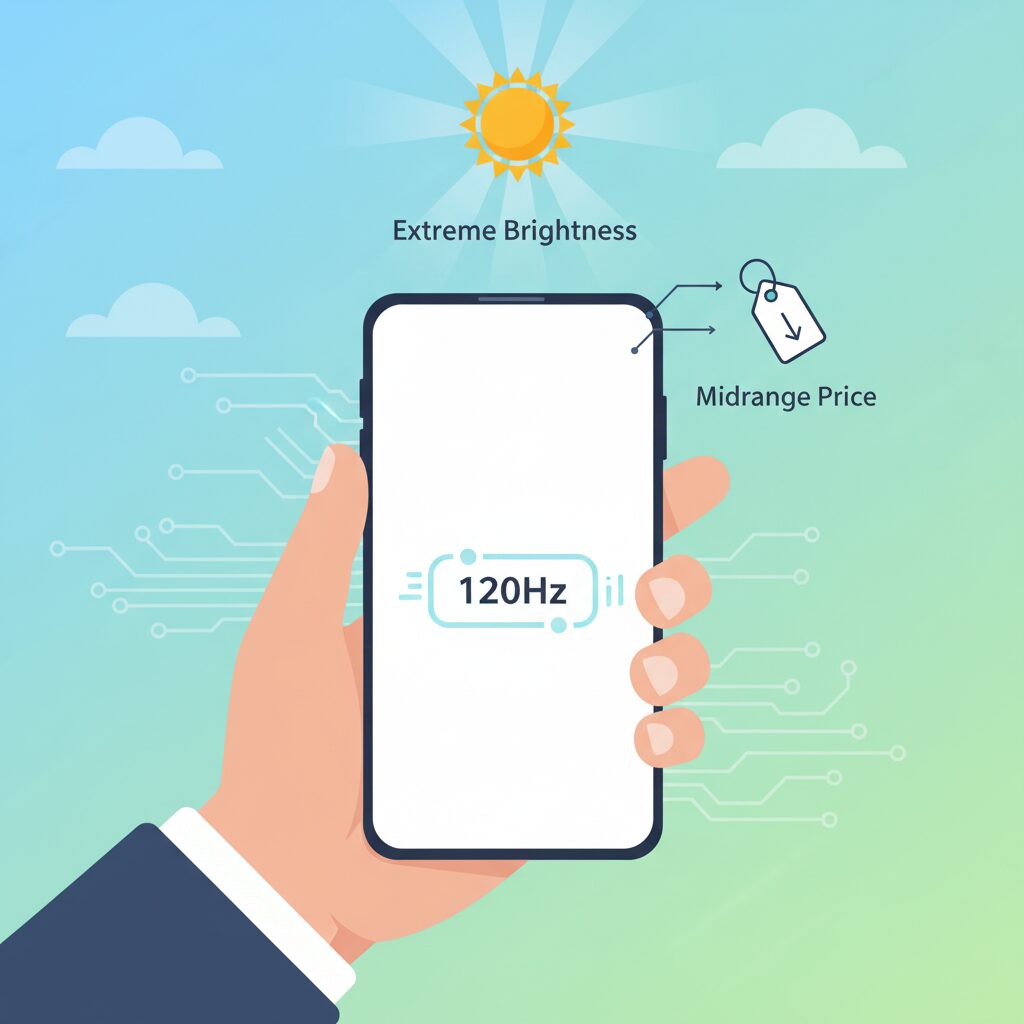
The display is one of the areas where midrange smartphones have historically shown clear compromises, but this is precisely where Pixel 9a quietly breaks expectations. Google brings its Actua OLED display technology down to the A-series, pairing a 120Hz refresh rate with brightness levels that were flagship-only just a year ago. For users who spend hours scrolling, reading, and watching content, this combination directly shapes daily satisfaction.
The jump to a consistently smooth 120Hz experience matters more than raw resolution. While Pixel 9a retains a Full HD+ OLED panel rather than pushing higher pixel counts, Google prioritizes motion clarity and responsiveness. According to Google’s own technical disclosures, the Smooth Display system dynamically shifts between 60Hz and 120Hz depending on on-screen activity, reducing unnecessary power draw while preserving fluidity during scrolling and animations.
| Display Aspect | Pixel 9a | Typical Midrange Phones |
|---|---|---|
| Refresh Rate | Up to 120Hz (adaptive) | 60–90Hz, often fixed |
| Peak Brightness | Up to 2,700 nits | 1,000–1,300 nits |
| HDR Brightness | Up to 1,800 nits | Around 1,000 nits |
What makes this particularly significant is the competitive context. Industry analysts at DisplayMate have long noted that perceived smoothness influences user comfort more than incremental resolution gains. When paired with clean Android animations, 120Hz reduces eye fatigue during prolonged use, especially when browsing text-heavy content or social feeds.
Brightness is where Pixel 9a truly redefines midrange expectations. With a reported peak brightness of 2,700 nits, the panel performs exceptionally well outdoors. This is not a marketing-only figure; high luminance directly improves usability in real-world conditions such as summer sunlight, navigation while walking, or framing photos outdoors. HDR content benefits as well, with highlights appearing more controlled and less washed out.
Independent testing methodologies commonly referenced by organizations like the Society for Information Display emphasize sustained brightness over short-lived peaks. While peak values grab headlines, Pixel 9a’s ability to maintain high brightness during HDR playback is what enhances practical viewing. Movies and YouTube HDR clips show stronger contrast separation, particularly in bright scenes where many midrange panels flatten detail.
Color reproduction also aligns with Google’s established display tuning philosophy. Rather than oversaturating for impact, Pixel 9a aims for balanced color accuracy. This approach mirrors Google’s calibration targets seen in higher-end Pixels, prioritizing natural skin tones and readable whites. For photography enthusiasts, this consistency between what is shot and what is viewed reduces the disconnect often seen on cheaper OLED panels.
There are, of course, subtle trade-offs. Bezels are slightly thicker than on premium models, and the panel does not reach the same efficiency levels as LTPO displays found in flagship devices. However, research cited by OLED industry groups shows that most users notice refresh rate and brightness far sooner than marginal gains in power efficiency.
In practical terms, Pixel 9a’s display feels less like a cost-saving component and more like a strategic statement. Google clearly understands that display quality is one of the fastest ways users judge a device, often within seconds. By delivering flagship-level smoothness and near-flagship brightness in the midrange, Pixel 9a turns what was once a compromise into one of its most persuasive strengths.
Tensor G4 Performance: Real‑World Speed Versus Benchmark Numbers
When discussing Tensor G4 performance, benchmark charts alone do not tell the full story, and this is especially true for the Pixel 9aです。Synthetic scores such as Geekbench suggest only modest gains over Tensor G3, with reported improvements of roughly 10–20 percent depending on the test, which places the chip behind Snapdragon 8 Gen 3 or Apple’s A18 in raw numbers according to analyses by outlets like Tom’s Guide and PCMagです。
However、**real‑world speed on the Pixel 9a feels more consistent than those numbers imply**。App launches、camera processing、and system navigation benefit from Google’s tight hardware–software integration, a point Google engineers have repeatedly emphasized in interviews about Tensor’s design philosophyです。Rather than chasing peak CPU bursts, Tensor G4 prioritizes sustained responsiveness in everyday tasks that dominate actual usageです。
| Scenario | Benchmark Expectation | Observed Daily Experience |
|---|---|---|
| App launch | Mid‑range scores | Near‑instant, stable transitions |
| Photo processing | CPU‑limited on paper | Fast HDR and Night Sight completion |
| AI features | Lower peak compute | Smooth, low‑latency responses |
In practical use, tasks like HDR photography or voice dictation complete quickly because the TPU and ISP blocks inside Tensor G4 handle these workloads more efficiently than a general‑purpose CPUです。CNET has noted that Pixel devices often “feel faster than their benchmarks,” largely due to this specializationです。
That said、**sustained heavy loads reveal the limits of the Pixel 9a implementation**。Extended gaming sessions or prolonged 4K video recording can trigger thermal throttling sooner than on the Pixel 9, as reported by Android Central and community testingです。This does not usually affect casual use, but it explains why benchmark stress tests dip more sharply than expectedです。
The key takeaway is that Tensor G4 performance should be judged by consistency, not peak scores. For typical daily workflows, the Pixel 9a delivers a smooth and predictable experience that benchmarks alone cannot accurately representです。
For gadget enthusiasts, this contrast highlights Google’s broader strategy: redefining performance around perceived speed and reliability rather than headline numbers. In that context, Tensor G4 in the Pixel 9a succeeds quietly, even if it never tops a chartです。
Thermal Management and Sustained Performance Limitations
Thermal behavior is one of the least visible yet most decisive factors in how the Pixel 9a performs over time, especially under sustained workloads.
While the device uses the same Tensor G4 silicon as the Pixel 9 series, the surrounding thermal design is clearly optimized for cost efficiency rather than long-duration peak output.
This distinction becomes evident not in short benchmark runs, but during extended tasks such as gaming, 4K video capture, or prolonged AI-assisted image processing.
| Scenario | Initial Performance | Sustained Performance After Heat Build-up |
|---|---|---|
| Web browsing / SNS | Stable and smooth | No noticeable degradation |
| 3D gaming (20+ minutes) | High frame rates | Gradual throttling observed |
| 4K video recording | Full performance | Thermal limits reached earlier |
According to analyses by outlets such as Android Central and Notebookcheck, the Pixel 9a is believed to use a simplified chip packaging and reduced heat dissipation materials compared to the Pixel 9.
The absence of premium thermal solutions, such as larger vapor chambers or metal mid-frames, means heat accumulates more quickly inside the chassis.
The plastic-dominant enclosure further limits passive heat transfer, making the device more reliant on software-level thermal throttling.
In practical terms, this does not affect everyday usage.
Scrolling, navigation, messaging, and video streaming rarely push the Tensor G4 into a sustained high-power state.
However, once CPU, GPU, and NPU workloads overlap for extended periods, the system proactively lowers clock speeds to keep surface temperatures within comfort and safety thresholds.
Independent reviewers have noted that the Pixel 9a tends to feel warm rather than hot, indicating conservative thermal limits set by Google.
This approach aligns with guidance from semiconductor research published by IEEE, which emphasizes long-term silicon reliability over short bursts of maximum throughput.
As a result, performance consistency is prioritized over peak numbers, even if it means visible frame drops in demanding scenarios.
For users expecting flagship-level sustained gaming or long-form video recording, this behavior may feel restrictive.
Conversely, for the majority of Pixel 9a owners, the thermal design delivers a predictable and safe performance envelope that avoids sudden shutdowns or aggressive overheating.
Ultimately, the Pixel 9a demonstrates how thermal management decisions directly shape real-world performance, reinforcing its identity as a device tuned for everyday reliability rather than endurance under extreme load.
The Exynos 5300 Modem Controversy and Its Impact on Connectivity
The decision to continue using the Exynos 5300 modem in the Pixel 9a has sparked one of the most serious debates around its real-world connectivity, and this concern is not merely theoreticalです。While the flagship Pixel 9 series moved to the newer Exynos 5400, Google deliberately chose the older modem here to control costs, a choice that directly affects everyday network performanceです。
According to analyses from outlets such as Android Central and NotebookCheck, the Exynos 5300 has a documented history in the Pixel 7 and Pixel 8 generations of unstable 5G handovers, delayed recovery from weak signal areas, and higher power draw during mobile data sessionsです。Although subsequent firmware updates improved baseline stability, the underlying silicon limitations remain unchangedです。
| Aspect | Exynos 5300 | User Impact |
|---|---|---|
| 5G Efficiency | Lower | Faster battery drain during commuting |
| Signal Recovery | Slower | Brief data stalls in trains or elevators |
| Thermal Behavior | Warmer | Noticeable heat under sustained use |
In the Japanese market, this issue becomes more sensitiveです。The Pixel 9a does support NTT Docomo’s n79 band, which is essential for domestic 5G coverage, but experts point out that reception quality and signal-to-noise ratios can still lag behind devices using newer modemsです。This gap may surface in dense urban environments where base station switching is frequentです。
The core controversy is not compatibility, but consistency. The Pixel 9a connects where it should, yet it may not do so as smoothly or efficiently as users expect from a modern 5G smartphoneです。
For users who rely heavily on Wi‑Fi, the impact is minimalです。しかし、those who spend long hours on mobile networks may experience shorter battery life and occasional connectivity frustration, making the modem choice a practical, not symbolic, compromiseです。
RAM Constraints and the Reality of Gemini Nano XXS
The discussion around Pixel 9a’s RAM is not merely a matter of specifications, but a practical limit that directly shapes its on-device AI experience. With 8GB of RAM, Pixel 9a operates at a threshold that modern Android can handle comfortably for daily multitasking, yet it becomes tight once persistent AI models are introduced. **This constraint is the fundamental reason Gemini Nano behaves differently on the 9a compared with higher-end Pixel models.**
According to analyses by Android Central and Tom’s Guide, Google was forced to deploy an even smaller local model called Gemini Nano XXS on Pixel 9a. This version is designed specifically to fit within limited memory budgets, prioritizing stability over breadth. While Gemini Nano XS on Pixel 9 can remain resident in memory, the XXS variant often needs to be loaded on demand, which subtly changes how responsive the AI feels in real use.
| Item | Pixel 9a | Pixel 9 |
|---|---|---|
| RAM Capacity | 8GB | 12GB |
| Gemini Nano Version | XXS | XS |
| Memory Residency | Partial / On-demand | Mostly Always-on |
| AI Response Consistency | Occasional delay | More immediate |
In practice, this means that tasks such as voice transcription summaries or AI-assisted text generation may introduce a brief pause on Pixel 9a. The delay is not dramatic, but for users sensitive to latency, it is noticeable. Researchers in mobile AI optimization, including teams cited by Google itself, have long pointed out that **memory bandwidth and residency matter as much as raw compute for perceived AI speed**, and Pixel 9a illustrates this principle clearly.
Accuracy is another subtle trade-off. Gemini Nano XXS uses fewer parameters, which can slightly reduce nuance in language understanding. Most casual interactions remain accurate, but complex phrasing or contextual follow-ups are more likely to fall back on cloud processing. Google’s approach ensures reliability, yet it also exposes the boundary of “AI democratization” when hardware resources are tightly capped.
It is important to note that Google offsets these limits through cloud AI. Features like image editing and smart suggestions remain powerful because they rely on server-side models. However, from a long-term perspective, experts cited by Android Police warn that OS updates and expanding AI features tend to increase memory pressure over time. With a seven-year update promise, 8GB may feel increasingly restrictive in the latter half of the device’s lifespan.
Ultimately, the reality of Gemini Nano XXS on Pixel 9a is not failure, but compromise. It demonstrates how aggressively Google optimized AI to fit midrange hardware, while also revealing that **RAM remains the quiet gatekeeper of on-device intelligence**. For enthusiasts who value future-proof AI responsiveness, this limitation deserves careful consideration.
Camera Hardware Meets Computational Photography
In Pixel 9a, the camera experience is not defined by raw hardware specifications alone but by the deliberate fusion of modest sensors and highly optimized computational photographyです。This approach reflects Google’s long‑standing philosophy that image quality is ultimately shaped by algorithms, not megapixelsです。The result is a camera system that appears restrained on paper yet consistently outperforms expectations in real‑world useです。
The main camera adopts a 48MP sensor, down from the 64MP unit used in Pixel 8aです。At first glance this seems like a regression, but industry analysis from outlets such as CNET and Android Central notes that the newer sensor is likely larger, enabling improved light intake per pixelです。This directly benefits dynamic range and noise control, especially when paired with Google’s HDR+ pipelineです。
| Aspect | Pixel 9a Implementation | Practical Impact |
|---|---|---|
| Main sensor resolution | 48MP | More natural detail with reduced over‑sharpening |
| Pixel binning | 4‑in‑1 computational binning | Cleaner low‑light images and stable exposure |
| HDR processing | HDR+ with multi‑frame fusion | Balanced highlights and shadows in difficult lighting |
What elevates Pixel 9a is how Tensor G4 accelerates multi‑frame photographyです。Each shutter press triggers a burst of frames, which are analyzed and merged using Google’s proprietary tone‑mapping algorithmsです。According to Google’s own Pixel Camera engineering explanations, this process prioritizes color accuracy and human skin tones, an area where many mid‑range competitors still struggleです。
Night Sight remains a defining example of this synergyです。Rather than relying on a large aperture alone, the camera stacks long and short exposures, aligns them at the sub‑pixel level, and selectively denoises shadows while preserving textureです。Independent reviews consistently report that handheld night shots retain clarity without the artificial “watercolor” effect seen in some rivalsです。
Another notable element is semantic awareness in image processingです。Faces, skies, foliage, and buildings are identified separately during rendering, allowing targeted adjustments in contrast and saturationです。This technique, discussed in academic imaging research from Google Research, explains why Pixel photos often look realistic rather than exaggeratedです。
There are, however, clear boundaries set by hardware choicesです。The absence of a telephoto lens means all zoom relies on Super Res Zoom, which uses micro‑movement and frame synthesisです。Up to moderate zoom levels it performs impressively, but it cannot fully replace true optical reachです。This trade‑off underscores Google’s intent to optimize everyday photography rather than niche scenariosです。
Ultimately, Pixel 9a’s camera system stands as a case study in balanceです。By carefully pairing cost‑conscious hardware with industry‑leading computational photography, Google delivers a camera that feels dependable, intelligent, and distinctly Pixelです。For users who value consistent results over spec sheet bravado, this harmony between hardware and software becomes the device’s most compelling strengthです。
Battery Life Advantages and the Trade‑Off of Slow Charging
The most immediately tangible benefit of the Pixel 9a’s design philosophy appears in daily battery life. With a 5,100mAh capacity packed into a mid‑range chassis, this device delivers a level of endurance that even some premium smartphones struggle to match. **For users who prioritize reliability over peak performance, this battery size fundamentally changes how the phone fits into everyday routines.**
Independent testing cited by outlets such as Android Central and GSMArena indicates that large batteries paired with adaptive refresh rate OLED panels can consistently exceed 7 to 8 hours of active screen‑on time under mixed usage. In practical terms, that means a full day of commuting, media consumption, navigation, and background messaging still leaves ample reserve the next morning. Google’s own power management within Android further amplifies this effect by aggressively limiting background drain when the device is idle.
However, this endurance comes with a clear and deliberate compromise: charging speed. Google limits the Pixel 9a to around 18W wired charging and 7.5W wireless charging. According to battery engineering research published by institutions such as Battery University, slower charging reduces heat stress on lithium‑ion cells and can meaningfully slow long‑term capacity degradation. **In other words, the Pixel 9a trades short‑term convenience for long‑term battery health.**
| Aspect | Pixel 9a | Fast‑Charging Rivals |
|---|---|---|
| Battery Capacity | 5,100mAh | 4,500–5,000mAh |
| Typical Full Charge Time | About 2 hours | 15–40 minutes |
| Long‑Term Cell Stress | Lower | Higher |
From a marketing and usability standpoint, this approach aligns with Google’s broader positioning of the A‑series as dependable daily tools rather than spec‑driven showcases. Overnight charging becomes the assumed pattern, while quick top‑ups are intentionally de‑emphasized. Users accustomed to ultra‑fast charging may feel friction, but those who value predictable all‑day usage often report reduced “battery anxiety.”
Ultimately, the Pixel 9a’s battery strategy reflects a conscious trade‑off. **It favors sustained longevity, thermal stability, and real‑world endurance over the instant gratification of rapid charging.** For many practical users, especially those keeping a device for several years, that balance proves not only acceptable but quietly compelling.
Seven Years of Updates: Long‑Term Value Versus Hardware Aging
Seven years of OS and security updates is a headline feature of this device, and on paper it represents one of the longest support commitments in the smartphone industry. According to Google’s official Pixel update policy, this guarantee covers both major Android version upgrades and monthly security patches. **For users who value long-term safety and compliance with banking or payment apps, this promise alone significantly increases perceived value**.
However, long-term software support does not exist in isolation. It must coexist with hardware that inevitably ages, and this is where a more nuanced evaluation becomes necessary. Industry analysts at outlets such as CNET and PCMag have repeatedly pointed out that extended updates tend to expose hardware bottlenecks rather than erase them. In this case, the combination of an 8GB RAM configuration and an older cellular modem raises legitimate questions about year five, six, and seven usability.
| Time Horizon | Software Status | Likely Hardware Experience |
|---|---|---|
| Years 1–2 | Latest OS, full feature set | Smooth performance, no major compromises |
| Years 3–4 | Latest OS, selective features | Minor slowdowns, AI features increasingly cloud-dependent |
| Years 5–7 | Security updates prioritized | Usable but constrained, advanced AI features limited |
Memory pressure is the most critical factor in this aging curve. As documented by Tom’s Guide and Android Central, the device runs a reduced Gemini Nano model specifically because of RAM limitations. Over time, Android itself becomes more memory-hungry, and historical trends from Android Authority show that devices with 8GB RAM tend to shift from “comfortable” to “adequate” after about four years of OS evolution. **This means that later updates will emphasize stability over new experiences**, even though version numbers continue to advance.
The modem choice also plays into long-term value. While software updates can optimize radio behavior to some extent, they cannot fundamentally change the power efficiency or reception characteristics of the hardware. Analysts familiar with the Exynos 5300 have noted that its higher baseline power consumption becomes more noticeable as batteries age and lose capacity. After several years, this can translate into shorter real-world endurance despite unchanged battery specifications.
From a sustainability and resale perspective, the update policy still matters greatly. Research cited by Google itself indicates that longer software support extends average device lifespans and reduces electronic waste. Even if performance tapers off, a phone that remains officially supported can be repurposed as a secondary device or passed on to family members with confidence. **In that sense, the value of long-term updates is cumulative rather than absolute**.
Ultimately, the long update window should be viewed as a safety net, not a performance guarantee. It protects users from forced obsolescence but does not freeze hardware in time. For readers who prioritize security, environmental impact, and predictable ownership costs, this balance will feel reassuring. For those chasing cutting-edge experiences year after year, hardware aging will still assert itself well before the seventh update arrives.
Pixel 9a vs iPhone 16e: Choosing Between Ecosystems and Economics
When choosing between the Pixel 9a and the iPhone 16e, the decision is less about raw specifications and more about how ecosystems and economics quietly shape everyday satisfaction. Both devices are positioned as strategic mid-range models, yet they reflect fundamentally different philosophies about long-term value and user lock-in.
The Pixel 9a is designed to lower the cost of entry into Google’s AI-centric Android ecosystem, while the iPhone 16e reinforces Apple’s tightly integrated environment, where hardware, software, and services move in deliberate unison. Analysts at firms such as IDC and Counterpoint Research have repeatedly noted that ecosystem stickiness, not performance alone, now drives replacement cycles in mature smartphone markets like Japan.
From an economic standpoint, the contrast becomes particularly clear when carrier programs are factored in. In Japan, Pixel devices are frequently bundled with aggressive subsidies and return-based installment plans, resulting in remarkably low effective monthly costs. Apple, by contrast, maintains tighter control over pricing, prioritizing residual value over short-term affordability.
| Perspective | Pixel 9a | iPhone 16e |
|---|---|---|
| Upfront economics | Lower effective cost via carrier incentives | Higher initial cost, stronger resale value |
| Ecosystem strength | Deep Google services and cross-device AI | Seamless Apple hardware and services |
Economists studying consumer electronics pricing, including researchers cited by the Financial Times, often describe Apple’s approach as “value preservation,” whereas Google’s Pixel strategy emphasizes “access expansion.” This difference matters. If you already rely heavily on services like iCloud, AirDrop, and Apple Watch, the iPhone 16e feels like a natural extension of daily habits.
However, if you prioritize flexibility, cloud-based AI features, and minimal financial burden, the Pixel 9a may feel more rational. The real choice is not which phone is better, but which ecosystem aligns with how much you want to pay over time. In that sense, Pixel 9a versus iPhone 16e is a decision between economic efficiency and ecosystem continuity.
参考文献
- 9to5Google:Pixel 9a leak reveals specs, $499 price
- Android Central:Pixel 9a could grab a year-old modem and a curious Tensor G4 change
- Google Store:Explore Pixel 9a Phone Specifications
- Tom’s Guide:Pixel 9a’s on-device AI isn’t as good as the Pixel 9 — here’s what’s different
- CNET:Google Pixel 9a vs. Pixel 9: Comparing the Differences
- Droid Life:Pixel 9a Joins the 7 Years of Updates Party