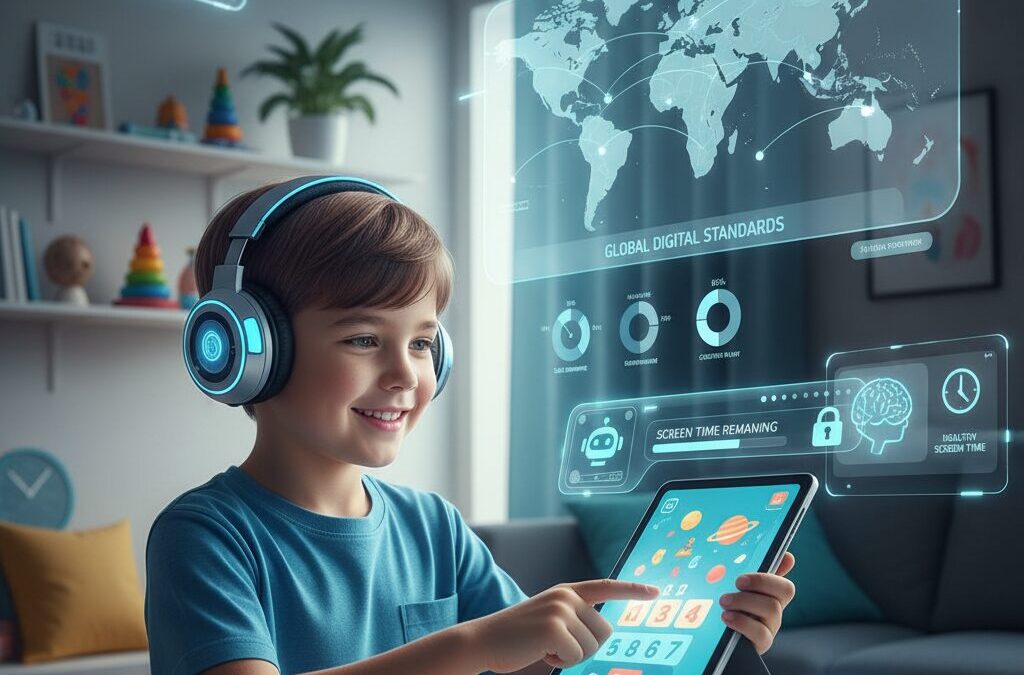
Tablets and digital devices are no longer optional extras in children’s lives in 2026; they are deeply embedded in education, communication, and everyday learning experiences.
Many parents and tech enthusiasts feel excited by the possibilities of AI-powered education, while also feeling uneasy about screen addiction, online risks, and the long-term impact on children’s health.
This article explores how children’s tablets have evolved alongside smarter parental controls, stricter global regulations, and more advanced digital classrooms.
You will learn how major platforms like Apple, Google, and Amazon are using on-device AI to protect kids, how schools are redefining learning with high-performance devices, and what scientific research says about screen time and brain development.
By the end, you will gain a clear, evidence-based perspective on how technology, policy, and education are converging to shape a safer and more powerful digital environment for the next generation.
- The 2026 Digital Education Shift: From Optional Devices to Essential Infrastructure
- Next-Generation School Tablets: Hardware Standards That Enable AI Learning
- Digital Textbooks as the Primary Learning Tool
- How AI Has Transformed Parental Controls Across Major Platforms
- Apple’s On-Device AI and Privacy-First Child Safety Model
- Google Family Link and the New Era of Extended Supervision
- Amazon Fire Kids Tablets and Ambient AI Monitoring
- What Parents Worry About Most in 2026: From Screen Addiction to Social Risks
- Scientific Evidence on Screen Time, Brain Development, and Mental Health
- Zero-Trust Security and MDM: Protecting Tablets at School and Home
- Third-Party AI Monitoring Apps and How They Interpret Online Context
- The Global Regulatory Wave Shaping Children’s Digital Access
- Digital Citizenship Education: Teaching Kids to Use Technology Responsibly
- 参考文献
The 2026 Digital Education Shift: From Optional Devices to Essential Infrastructure
In 2026, digital devices in education are no longer treated as optional learning aids but are positioned as essential infrastructure that supports everyday schooling and home study. In Japan, this shift has been accelerated by the full-scale deployment of the second phase of the GIGA School Initiative, often referred to as NEXT GIGA. According to the Ministry of Education, Culture, Sports, Science and Technology, the original one-device-per-student model has evolved into a continuously upgraded ecosystem designed for long-term use rather than emergency digitalization.
The most important change is that learning now assumes the constant presence of a capable device. Class design, homework, assessment, and even communication between schools and families are built on the premise that each student has reliable access to a tablet or computer. This marks a structural transition similar to electricity or internet connectivity becoming standard utilities in schools.
| Aspect | Before 2020 | 2026 Standard |
|---|---|---|
| Role of devices | Supplementary tools | Core learning infrastructure |
| Hardware cycle | Ad-hoc, irregular | Planned national replacement |
| Learning scope | Mainly in-class use | School and home integrated |
Hardware specifications themselves also signal this infrastructural mindset. NEXT GIGA raised baseline performance requirements to ensure that devices can handle creative tasks, real-time collaboration, and AI-assisted learning without disruption. Experts involved in government advisory panels have emphasized that insufficient performance directly translates into lost learning time, making hardware reliability a pedagogical issue rather than a technical one.
Another defining feature of the 2026 shift is the everyday integration of generative AI. Rather than experimental pilots, AI-powered tools are now embedded into learning environments, supporting drafting, problem-solving, and personalized feedback. Educational researchers point out that this normalizes AI as part of cognitive scaffolding, similar to calculators in mathematics, while simultaneously requiring schools to treat digital governance and risk management as part of their core responsibility.
As a result, digital education in 2026 is no longer about introducing devices but about maintaining a stable, secure, and future-ready infrastructure. This perspective explains why policy discussions increasingly focus on lifecycle management, system-wide updates, and resilience, reflecting a mature stage of digital transformation where devices are as indispensable as classrooms themselves.
Next-Generation School Tablets: Hardware Standards That Enable AI Learning

In 2026, school tablets are no longer evaluated as simple content viewers but as learning computers designed to support AI-assisted creativity and problem solving. **Hardware standards have become the foundation that determines whether AI learning is possible at all**, and this shift is clearly reflected in the specifications adopted under Japan’s NEXT GIGA framework.
One of the most important changes is memory and processing headroom. According to guidelines shaped by the Ministry of Education, devices with 8GB of RAM are now strongly recommended for Windows-based school tablets, while lower configurations are explicitly discouraged. This is not about speed alone. Generative AI tools used in classrooms increasingly rely on local processing for privacy reasons, and insufficient memory directly limits real-time feedback, multimodal input handling, and smooth multitasking during lessons.
| Key Requirement | Educational Rationale | AI Learning Impact |
|---|---|---|
| 8GB-class memory | Stable multitasking and creation workflows | Enables local AI inference and fast responses |
| Touch + pen input | Supports handwriting and visual thinking | Improves AI understanding of student intent |
| Dual cameras | Captures experiments and presentations | Feeds visual data into AI-based analysis |
Another defining standard is universal pen support. Educational researchers cited by MEXT emphasize that handwriting activates different cognitive pathways than typing, helping students externalize their thinking. When combined with AI, pen input allows systems to analyze problem-solving processes, not just final answers, making feedback more personalized and instruction more adaptive.
Connectivity and ports also matter more than before. USB-C has become mandatory across platforms, simplifying charging, peripheral use, and classroom management. This uniformity reduces downtime and ensures that AI-enhanced tools, such as external sensors or cameras, can be deployed without compatibility barriers.
Finally, camera requirements have evolved beyond basic video calls. Front and rear cameras are now standard, with features like subject centering on iPadOS devices. **This supports project-based learning where students document real-world activities and receive AI-supported analysis**, a learning style increasingly validated by international studies on active and inquiry-based education.
By raising hardware standards in a deliberate, evidence-based way, next-generation school tablets create an environment where AI is not an add-on but a natural extension of learning itself. The device becomes a silent partner that can keep up with students’ curiosity, rather than a bottleneck that holds it back.
Digital Textbooks as the Primary Learning Tool
In 2026, digital textbooks have firmly become the primary learning tool in classrooms, not merely a digital replica of printed pages. This shift has been driven by policy changes from Japan’s Ministry of Education, Culture, Sports, Science and Technology, which removed former usage caps and enabled lessons to be conducted entirely in digital form. **What makes this transition significant is not the disappearance of paper, but the redesign of learning itself around interactive, adaptive content**.
Unlike traditional textbooks, digital versions now function as learning platforms. Embedded quizzes, instant feedback, and adaptive difficulty allow students to progress at an individualized pace. According to guidelines and pilot outcomes referenced by MEXT, schools using full-scale digital textbooks in mathematics and English report smoother differentiation between advanced learners and those who need reinforcement. Teachers are able to monitor comprehension in real time, reducing the lag between misunderstanding and intervention.
Accessibility has also become a defining advantage. Features such as text-to-speech, adjustable font sizes, ruby annotations for kanji, and color contrast controls are no longer limited to special education settings. Research cited by MEXT indicates that these tools benefit a wide range of learners, including students with mild reading difficulties and non-native language backgrounds. **As a result, digital textbooks are increasingly viewed as universal design tools rather than accommodations for a minority**.
| Aspect | Printed Textbooks | Digital Textbooks (2026) |
|---|---|---|
| Content Update | Fixed until reprint | Regularly updated via software |
| Learning Support | Teacher-dependent | AI-assisted, adaptive feedback |
| Accessibility | Limited | Built-in, customizable |
Another important change lies in how learning data is used. Digital textbooks generate detailed logs of reading time, problem attempts, and error patterns. Educational researchers working with national projects have noted that such data, when handled under strict privacy standards, enables evidence-based lesson design. Teachers can refine explanations based on actual student behavior rather than intuition alone, making instruction more precise and efficient.
Concerns about screen fatigue and deep reading have not been ignored. That is why MEXT continues to recommend a hybrid mindset, even as digital textbooks dominate daily instruction. However, recent field reports suggest that improvements in display quality and annotation tools have narrowed the gap in long-form reading comprehension. **For many students, the ability to search, highlight, and reorganize information digitally has enhanced rather than diminished understanding**.
Ultimately, digital textbooks in 2026 represent a structural change in education infrastructure. They connect school and home seamlessly, integrate with AI-supported learning environments, and evolve continuously with curriculum needs. This is why they are no longer described as an option, but as the core medium through which modern learning is delivered.
How AI Has Transformed Parental Controls Across Major Platforms

Across major platforms, parental controls have shifted from static rule-setting to **AI-driven, context-aware protection** that adapts in real time. This transformation is not cosmetic but structural, reflecting the reality that children’s digital experiences in 2026 are shaped by generative AI, algorithmic feeds, and continuous communication rather than isolated apps or websites. Leading platform providers now position AI as the core mechanism that interprets intent, assesses risk, and intervenes with minimal friction.
Apple’s approach illustrates how deeply AI has been embedded into the operating system layer. With iOS and iPadOS 26, on-device models analyze images and communication flows to identify potentially harmful content, while preserving privacy by keeping all processing local. According to Apple’s own disclosures, this design choice was made to balance child safety with data protection, a stance that has been positively referenced by digital privacy researchers at institutions such as Stanford and the Electronic Frontier Foundation. **The key shift is that AI no longer blocks based on keywords alone, but evaluates visual and conversational context**, reducing false positives that previously frustrated families.
| Platform | AI Role | Primary Benefit |
|---|---|---|
| Apple | On-device content and image analysis | Privacy-preserving real-time intervention |
| AI filtering and supervised account logic | Extended protection into early teens | |
| Amazon | Ambient AI via voice and usage patterns | Personalized learning with oversight |
Google has taken a different but equally significant path by redefining supervision itself. Family Link’s policy update now requires parental approval to end monitoring after age 13, a decision grounded in internal risk analyses and public data showing a spike in online harm at that age. AI-enhanced filtering in Google Kids Space further curates apps and videos using guidance from academic advisors, including experts affiliated with Harvard and Georgetown. **This signals a move from age-based trust to readiness-based trust**, where AI supports parents in judging when autonomy is appropriate.
Amazon’s Fire Kids ecosystem highlights another dimension of AI transformation: continuous, ambient understanding. With Alexa+ integrated into kids’ tablets, the system observes learning progress and media preferences through voice interactions and usage trends. Importantly, Amazon emphasizes that recommendations remain transparent to parents through centralized dashboards, an approach Mozilla researchers have cited as essential for maintaining accountability in AI-mediated environments. **Parental control here becomes less about restriction and more about informed supervision**, enabled by machine learning.
Collectively, these platform strategies demonstrate that AI has redefined parental controls from rigid barriers into adaptive safety nets. The most profound change is philosophical: instead of assuming all risk can be preemptively blocked, platforms now accept uncertainty and use AI to respond dynamically. This evolution aligns with findings from pediatric and educational research bodies, including the American Academy of Pediatrics, which stress that nuanced guidance and timely intervention are more effective than blanket bans in supporting healthy digital development.
Apple’s On-Device AI and Privacy-First Child Safety Model
Apple’s approach to child safety in 2026 is defined by a clear philosophy: **intelligence should stay on the device, and privacy should never be traded for protection**. With iOS 26 and iPadOS 26, Apple has expanded its on-device AI architecture so that sensitive content analysis is processed locally, without uploading images, messages, or metadata to external servers.
This design choice directly responds to long-standing criticism of cloud-based monitoring, where safeguarding children often meant exposing their private communications to third parties. According to Apple’s own technical documentation and independent assessments referenced by the Electronic Frontier Foundation, on-device processing significantly reduces the risk of secondary data misuse while still enabling real-time intervention.
At the core of this model is Communication Safety, which now operates across Messages, AirDrop, FaceTime video messages, and the system-wide photo picker. **When potentially explicit images are detected, the AI intervenes by blurring the content and presenting age-appropriate guidance**, all without Apple gaining access to the image itself.
| Feature | Processing Location | Data Sent Off-Device |
|---|---|---|
| Image Nudity Detection | On-device neural engine | No |
| Message Content Analysis | Local AI model | No |
| Parental Alerts | Triggered locally | Optional, user-controlled |
A notable 2026 change is that **these protections are enabled by default for teen accounts aged 13 to 17**, reflecting growing evidence that adolescence is the peak risk period for online harassment and coercive contact. Research cited by the American Academy of Pediatrics shows that proactive, non-punitive interventions are more effective than retrospective monitoring in reducing harm.
Apple Intelligence adds another layer of nuance. Rather than a binary on-off switch, parents can now fine-tune how generative AI features behave. Writing assistance can be limited to grammar correction only, image generation can be disabled entirely, and Siri’s web results can be constrained to stricter filters designed for educational use.
This granularity matters because **AI misuse in education is no longer hypothetical**. Educators interviewed by OECD-affiliated researchers have noted that unrestricted generative tools can undermine learning, while carefully scoped assistance improves comprehension and confidence. Apple’s controls reflect this middle ground, embedding policy into the operating system rather than outsourcing it to third-party apps.
Perhaps the most important implication is trust. By ensuring that families do not have to choose between safety and surveillance, Apple reinforces a privacy-first norm at a time when regulatory scrutiny is intensifying worldwide. For households already invested in the Apple ecosystem, this on-device AI strategy represents one of the most mature and ethically coherent child safety frameworks available in 2026.
Google Family Link and the New Era of Extended Supervision
Google Family Link has entered a new phase in 2026, redefining what parental supervision means in a hyper-connected adolescence. The most significant shift is the policy change that prevents automatic supervision removal at age 13, requiring explicit parental consent instead. This adjustment reflects a growing recognition that digital risk does not disappear with age, especially as social platforms and generative AI tools become more complex.
According to Google’s own policy explanations and analysis cited by major technology media, incidents related to social networking conflicts and online solicitation peak around early teenage years. **Extended supervision is therefore positioned not as control, but as a transitional safety net** that adapts to a child’s readiness rather than an arbitrary birthday.
| Aspect | Before 2025 | 2026 Model |
|---|---|---|
| Supervision end | Automatic at 13 | Parental approval required |
| Content filtering | Rule-based | AI context-aware |
| Parental role | Gatekeeper | Co-decision maker |
Another quiet but important evolution lies in Google Kids Space. Educational apps and videos are now curated with input from academic advisors, including researchers affiliated with institutions such as Harvard and Georgetown. This human-in-the-loop model ensures that algorithmic recommendations align with developmental psychology, not engagement metrics.
For gadget-savvy families, the real value of Family Link in 2026 is flexibility. Screen time limits, app permissions, and AI-driven content judgments can be gradually relaxed, mirroring real-world independence. This design supports ongoing dialogue between parents and children, a point emphasized by pediatric and educational experts who argue that trust-building is more effective than abrupt restriction removal.
In this sense, Google Family Link no longer represents a parental lock, but an evolving framework for shared digital responsibility.
Amazon Fire Kids Tablets and Ambient AI Monitoring
Amazon Fire Kids Tablets in 2026 are positioned not just as child-friendly hardware, but as platforms built around **ambient AI monitoring**, a concept that quietly supports safety and learning without constant manual control. By integrating Alexa+ into the Fire HD 8 Kids and Fire HD 8 Kids Pro, Amazon shifts parental oversight from reactive restriction to continuous, context-aware supervision that operates in the background.
This ambient approach means the AI does not simply block content based on static rules. Instead, it observes usage patterns such as reading frequency, video preferences, and learning progress, and adjusts recommendations accordingly. According to Amazon’s CES 2026 disclosures, these analyses remain visible to parents through the Amazon Kids Parent Dashboard, allowing guardians to review AI-driven suggestions and intervene when necessary. **Transparency of AI behavior is a defining characteristic here**, especially when compared with more opaque recommendation systems.
| Model | Target Age | AI Monitoring Focus |
|---|---|---|
| Fire HD 8 Kids | 3–7 years | Reading habits and basic learning engagement |
| Fire HD 8 Kids Pro | 6–12 years | Learning progress and content maturity alignment |
What makes Amazon’s implementation notable is that **ambient AI monitoring is paired with strict parental override**. Parents can exclude specific topics, review recommendation histories, and control purchasing and voice interactions in detail. Independent evaluations such as those by the Mozilla Foundation have emphasized that while Amazon collects usage data, the Kids profile environment sharply limits ad exposure and commercial nudging, which reduces unintended marketing influence on children.
In practice, this design aligns with broader child development research highlighted by organizations such as the American Academy of Pediatrics, which stresses that guidance and shared awareness are more effective than blanket prohibition. Amazon Fire Kids Tablets therefore function as a living balance between autonomy and protection, where AI observes quietly, parents stay informed, and children experience digital learning with fewer abrupt interruptions.
What Parents Worry About Most in 2026: From Screen Addiction to Social Risks
In 2026, what parents worry about most has clearly shifted, and this change feels deeply personal for many families. While screen addiction remains a serious issue, it is no longer the top concern. Recent surveys in Japan show that **social risks connected to online communication now outweigh fears of simple overuse**, reflecting how children’s digital lives have become inseparable from real-world consequences.
According to nationwide usage studies cited by education and child-safety researchers, SNS-related trouble accounts for the largest share of parental anxiety. Group chat exclusion, online harassment, and unsolicited contact from adults are not abstract threats anymore. **Parents increasingly fear that a single message or algorithmic recommendation can pull their child into situations involving fraud or criminal recruitment**, including so-called dark part-time job schemes.
| Main parental concern | Estimated share | Typical triggers |
|---|---|---|
| SNS-related social risks | 40% | Cyberbullying, isolation, risky contacts |
| Device dependency | 29% | Sleep loss, routine disruption |
| Excessive gaming and spending | 23% | In-app purchases, peer pressure |
Medical and psychological evidence adds another layer to these worries. Studies reported by JAMA Pediatrics and echoed by pediatric associations indicate that **long daily screen exposure correlates with sleep problems, anxiety, and depressive symptoms**, especially among teenagers. Parents are therefore not only worried about what children see, but also about how constant connectivity reshapes their emotional resilience.
What makes 2026 distinctive is the role of AI-driven platforms. Recommendation systems can amplify trends, conflicts, or harmful content faster than adults can react. Experts from organizations such as the American Academy of Pediatrics point out that **risk is no longer limited to screen time length, but to the quality and social context of digital interactions**. This explains why parents feel uneasy even when usage appears moderate.
As a result, parental fear today is less about banning devices and more about unseen social dynamics unfolding behind the screen. Many parents express that they worry most about not noticing problems early enough. **The central anxiety of 2026 is the gap between a child’s quiet screen and the complex, sometimes dangerous, digital society on the other side**, and this concern continues to redefine how families think about technology and trust.
Scientific Evidence on Screen Time, Brain Development, and Mental Health
Scientific discussion around screen time has shifted from simple duration-based debates to a more nuanced understanding of how screens interact with the developing brain and mental health. According to peer-reviewed studies published in journals such as JAMA Pediatrics, the critical factor is not only how long children use screens, but when and in what developmental stage that exposure occurs. Early childhood, particularly before the age of five, has emerged as a uniquely sensitive window.
MRI-based research focusing on children aged three to five has shown that those exposed to more than one hour of daily screen time tend to display slower maturation of white matter pathways. These neural networks are essential for language acquisition, executive function, and processing speed. White matter development acts as the brain’s communication infrastructure, and delays during this period may affect cognitive efficiency later in childhood, even if overall intelligence scores remain within a normal range.
This does not mean that screens directly damage the brain, but rather that excessive passive use may displace activities such as caregiver interaction, free play, and sleep, all of which are strongly linked to healthy neural development. Pediatric neurologists frequently emphasize that the brain develops through multisensory, real-world experiences, something flat screens cannot fully replicate.
| Age Range | Observed Correlation | Primary Concern |
|---|---|---|
| 3–5 years | Reduced white matter integrity | Language and cognitive processing |
| 6–11 years | Behavioral and attention issues | Self-regulation and sleep |
| 12–17 years | Higher risk of anxiety and depression | Mental health and social well-being |
For adolescents, large-scale data from the U.S. Centers for Disease Control and Prevention provides a different but equally concerning picture. Teenagers with longer non-academic screen use show consistent associations with chronic sleep deprivation, increased depressive symptoms, and heightened anxiety. Sleep appears to be the key mediating factor, as late-night screen exposure disrupts circadian rhythms and reduces emotional resilience.
European evidence reinforces these findings. A 2025 Italian study examining children aged three to eleven identified a statistically significant negative correlation between PC usage time and total sleep duration. Higher tablet use was also associated with elevated scores on behavioral difficulty and ADHD-related scales, suggesting that attention and impulse control may be indirectly affected through disrupted rest patterns.
Importantly, leading medical organizations such as the American Academy of Pediatrics caution against interpreting these results as a call for blanket bans. Instead, they highlight that content quality, context of use, and parental involvement significantly moderate outcomes. Educational, interactive use under adult guidance shows markedly different associations compared to solitary, entertainment-focused consumption.
From a mental health perspective, the evidence increasingly supports a displacement model rather than a toxicity model. Screens themselves are not inherently harmful, but when they crowd out sleep, physical activity, and face-to-face social interaction, measurable risks emerge. This distinction is crucial for designing realistic screen time policies that align with both scientific evidence and the realities of modern digital education.
Zero-Trust Security and MDM: Protecting Tablets at School and Home
In 2026, protecting children’s tablets requires a fundamental shift in security thinking, and this is where Zero-Trust Security combined with Mobile Device Management plays a decisive role. Zero trust means that no network, device, or user is trusted by default, even if the tablet is inside a school building or connected to home Wi-Fi. **Every access request is continuously verified**, which is especially important now that GIGA School tablets are used seamlessly across classrooms, living rooms, and public spaces.
This approach directly addresses one of the biggest weaknesses identified by the Ministry of Education: home networks. Many households still rely on poorly secured routers, and studies conducted during the first phase of GIGA showed that malware infections and unauthorized app installations increased sharply after take-home use became standard. Zero-trust models mitigate this risk by authenticating the device and the user every time educational services or cloud resources are accessed, regardless of location.
| Security Model | Assumption | Risk for Children |
|---|---|---|
| Perimeter-based | Inside networks are safe | Home Wi-Fi becomes a blind spot |
| Zero trust | No environment is trusted | Consistent protection at school and home |
MDM systems act as the operational backbone of this model. Through centralized dashboards, schools can enforce the same security and usage policies 24 hours a day. Application restrictions, web filtering rules, and OS updates are applied automatically, ensuring that a tablet used for homework at night follows identical rules to one used during class. According to official guidance related to NEXT GIGA, this consistency significantly reduces configuration errors, which are a leading cause of data leaks in educational environments.
Another critical benefit is incident response. When a device is lost on the way home or stolen outside school grounds, administrators can immediately lock it or erase sensitive data remotely. **This capability has been highlighted by cybersecurity researchers as essential for child safety**, because educational tablets often contain learning histories, behavioral data, and sometimes personal identifiers. Without MDM, these actions would depend on parents’ technical skills, creating uneven protection.
International security experts, including those advising large public-sector deployments in the US and EU, emphasize that zero-trust architectures are particularly well suited to education because children’s usage patterns are unpredictable. A tablet may switch networks multiple times a day, and assuming a safe boundary is no longer realistic. By continuously verifying devices and enforcing MDM policies, schools and families can share responsibility without weakening security.
From a practical perspective, this model also builds trust with parents. Surveys in Japan show that guardians are more willing to allow home use when they know that filtering, updates, and emergency controls remain active at all times. In this sense, zero-trust security is not only a technical upgrade but also a social contract that supports safe learning wherever children open their tablets.
Third-Party AI Monitoring Apps and How They Interpret Online Context
Third-party AI monitoring apps play a unique role by interpreting not just what children say online, but what they mean within a broader social and emotional context. Unlike OS-level parental controls that mainly enforce predefined rules, these apps analyze conversations, search behavior, and platform-specific signals to infer risk levels in real time, which has become especially important as children’s online interactions grow more nuanced in 2026.
The core innovation lies in contextual understanding. Tools such as Bark and VigilKids rely on natural language processing models trained on millions of anonymized youth communication samples. According to independent evaluations referenced by TechRadar and AllAboutCookies, these systems distinguish between harmless slang, academic discussions, and genuinely dangerous signals such as cyberbullying escalation, grooming patterns, or self-harm ideation, reducing false positives that previously overwhelmed parents.
| Interpretation Layer | What the AI Analyzes | Practical Outcome |
|---|---|---|
| Linguistic context | Tone, intent, and sentence structure | Differentiates jokes from threats |
| Behavioral patterns | Frequency, timing, platform switching | Detects gradual risk escalation |
| Social signals | Peer interactions and power imbalance | Flags bullying or coercion |
Research-informed design also shapes how alerts are delivered. Many apps now classify findings into low, medium, and high concern tiers, notifying parents only when contextual risk crosses a meaningful threshold. This approach reflects guidance echoed by the American Academy of Pediatrics, which warns that excessive surveillance without context can harm trust and adolescent autonomy.
Another defining feature is platform-aware interpretation. AI models are tuned differently for messaging apps, video comments, or gaming chats, acknowledging that language norms vary widely across environments. For example, competitive gaming trash talk is weighted differently from private direct messages, an adjustment that recent reviews credit for improved accuracy and parental satisfaction.
Ultimately, these third-party tools act as interpretive layers between raw data and human judgment. By translating complex online behavior into understandable context, they enable parents to respond proportionately rather than reactively, supporting safety while respecting the developmental need for digital independence.
The Global Regulatory Wave Shaping Children’s Digital Access
Across the world, children’s access to digital devices is no longer treated as a purely家庭内のしつけや企業の自主対応の問題ではなく、**明確な法規制の対象**として再定義されつつあります。2026年時点で象徴的なのが、各国政府が「年齢」「責任主体」「罰則」を具体的に定め始めている点です。これにより、子ども用タブレットやSNSは、自由利用を前提とした設計から、規制順守を前提とした設計へと大きく舵を切っています。
この潮流を決定づけた事例として、2025年末に施行されたオーストラリアの16歳未満SNS全面禁止法が挙げられます。同法は、未成年者本人ではなく**プラットフォーム事業者に「合理的な年齢確認措置」を義務付けた**点が画期的でした。違反時には最大5,000万豪ドルという巨額の制裁金が科されるため、企業側はアルゴリズム設計やアカウント作成フローそのものを見直さざるを得なくなっています。
規制の焦点は「使い過ぎ」ではなく、「設計責任」へと移行しています。
この考え方は日本にも強い影響を与えています。こども家庭庁や関係省庁の議論では、青少年インターネット環境整備法の見直しにおいて、事業者側の説明責任やリスク低減義務をより明確にする方向性が示されています。これは、単に家庭にペアレンタルコントロールを委ねるのではなく、**サービス提供段階で危険を生まない設計を求める国際的スタンダード**に足並みを揃える動きといえます。
各国の規制アプローチを整理すると、共通点と違いが見えてきます。
| Region | Primary Target | Key Regulatory Feature |
|---|---|---|
| Australia | SNS platforms | Legal ban for under 16, heavy financial penalties |
| Japan | Service providers | Certification systems and duty-of-care discussions |
| United States | Data handling | Strengthened child privacy and parental consent norms |
専門家の間では、こうした動きについて「規制強化=デジタル教育の後退ではない」という見方が主流です。米国小児科学会が示す最新の提言でも、**安全な枠組みを法で整えたうえで、教育的活用を最大化することが重要**だと強調されています。無秩序な自由よりも、予測可能で説明可能なルールの方が、結果的に子どもの学びを守るという考え方です。
グローバル規制の波は、子ども用タブレットを「買って与えるだけの端末」から、「法と倫理を内蔵した教育インフラ」へと変貌させています。2026年の時点で問われているのは、どの国が最も厳しいかではなく、**どの社会が最も持続可能なデジタル環境を設計できるか**なのです。
Digital Citizenship Education: Teaching Kids to Use Technology Responsibly
Digital citizenship education has become a core pillar of how children are taught to engage with technology responsibly in 2026. As tablets, AI tools, and online platforms are no longer optional but embedded in daily learning, the focus has shifted from simply restricting usage to cultivating judgment, ethics, and self-regulation. **The central question is no longer how to block risks, but how to prepare children to face them wisely**.
According to policy discussions led by Japan’s Cabinet Office and the Children and Families Agency, traditional top-down internet morality education showed clear limitations. When controls were removed, children often lacked the skills to navigate social pressure, misinformation, or manipulative online behavior. Digital citizenship education instead emphasizes agency, teaching children to think critically about their own actions and their impact on others in digital spaces.
International research supports this shift. The American Academy of Pediatrics notes that rule-based restrictions alone do not correlate with better long-term outcomes, while households that prioritize dialogue and reflection show healthier media habits. Their updated 5 Cs framework is frequently cited by educators as a practical foundation for teaching responsibility rather than obedience.
| Educational Focus | Traditional Approach | Digital Citizenship Approach |
|---|---|---|
| Primary Goal | Risk avoidance | Ethical participation |
| Role of Adults | Monitoring and control | Guidance and co-learning |
| Child’s Position | Passive user | Active decision-maker |
In practical terms, classrooms now integrate discussions about online behavior directly into subjects such as language arts and social studies. Students analyze real-world scenarios, including group chat conflicts or AI-generated content, and explore questions of accountability, consent, and credibility. **This situational learning mirrors the complex environments children actually encounter**, making lessons more transferable to daily life.
Experts from organizations such as APCO Worldwide emphasize that digital citizenship is also inseparable from civic education. Children are encouraged to see themselves not just as consumers of content, but as contributors whose posts, comments, and creations shape digital communities. This perspective aligns with global trends that frame online spaces as extensions of public society rather than isolated playgrounds.
Another defining feature in 2026 is the treatment of generative AI. Instead of blanket bans, schools teach students how AI systems work, what biases may exist, and when human judgment must override automated output. Educational researchers warn that uncritical reliance on AI can weaken problem-solving skills, while guided use can enhance creativity and understanding when ethical boundaries are clearly discussed.
Ultimately, the strength of this approach lies in consistency between school and home. Government guidelines increasingly stress family media plans created through parent-child dialogue, reinforcing lessons learned in class. As digital environments grow more complex, **teaching responsibility as a skill, not a restriction, is proving to be the most resilient form of protection**.
参考文献
- Apple Support:Use parental controls to manage your child’s iPhone or iPad
- Apple Newsroom:Apple’s latest tools to help protect kids and teens online
- Mashable:Google changes key parental control setting in wake of criticism
- CDC:Associations Between Screen Time Use and Health Outcomes Among US Teenagers
- MDPI:Use of Technological Devices in Children Aged 3–11 Years
- TechRadar:Best parental control app of 2026: ranked and reviewed
- HealthyChildren.org:AAP Releases New Media Recommendations for a Child-Friendly Digital World