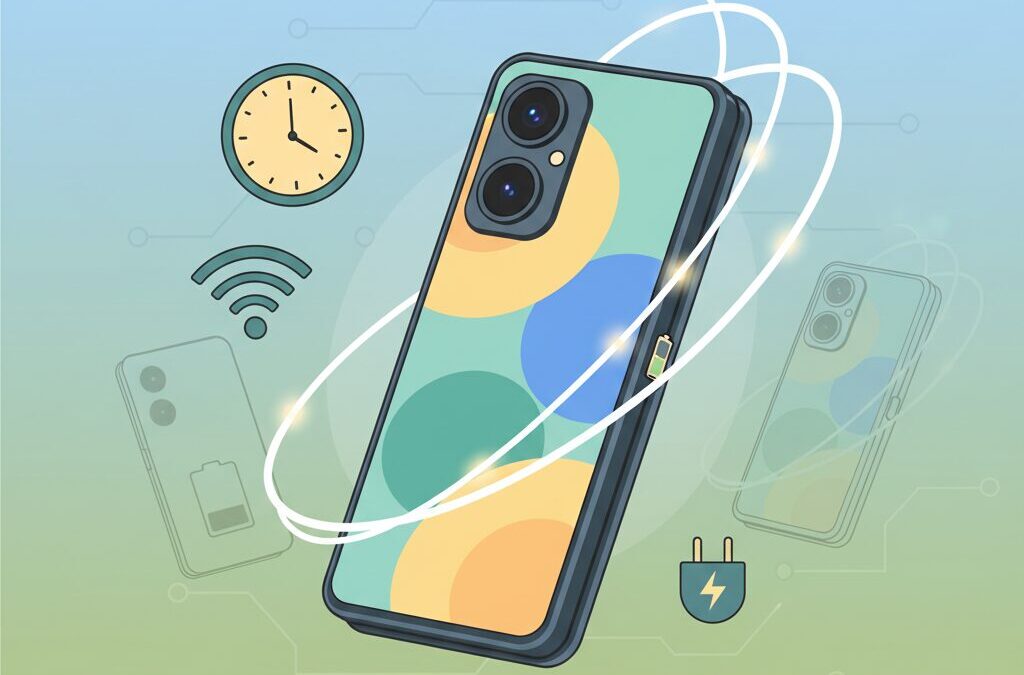
Foldable smartphones have finally reached a point where the novelty is no longer enough to impress, and users now expect them to perform like true daily drivers. In 2026, battery life has become one of the most decisive factors for power users who rely on large displays, constant connectivity, and multitasking throughout the day.
The Pixel 10 Pro Fold arrives at this critical moment as Google’s third-generation foldable and the first to feature the fully in-house designed Tensor G5 chip manufactured by TSMC. On paper, its 5,015mAh battery and 3nm process sound like the long-awaited solution to Pixel’s historical efficiency issues.
However, specs alone do not tell the full story for people who actually live with their devices. Signal quality, display behavior, charging habits, and software intelligence all shape how long a foldable really lasts from morning to night.
This article explores how the Pixel 10 Pro Fold performs in real-world battery usage, not just in controlled lab conditions. By looking at measured power consumption, display efficiency, modem behavior, and charging strategies, you will understand where this device truly shines and where it still struggles.
If you are considering a premium foldable in 2026 and want to know whether the Pixel 10 Pro Fold can keep up with your lifestyle, this guide will help you make a confident and informed decision.
- The 2026 Foldable Market and Google’s Position
- Battery Capacity and Dual-Cell Design Inside the Pixel 10 Pro Fold
- Tensor G5 and the Impact of TSMC 3nm on Power Efficiency
- How the Super Actua Flex Display Reduces Power Consumption
- Modem Efficiency and Signal Strength Challenges
- Charging Philosophy: Wired Speed Versus Battery Longevity
- Qi2 Wireless Charging and Magnetic Alignment Benefits
- Battery Performance in Everyday Usage Scenarios
- Gaming, Thermal Limits, and High-Load Power Drain
- Pixel 10 Pro Fold vs Galaxy Z Fold 7 and Chinese Foldables
- Android 16, Adaptive Battery, and On-Device AI Efficiency
- 参考文献
The 2026 Foldable Market and Google’s Position
The foldable smartphone market in 2026 can be described as entering a phase of true maturity. What once attracted early adopters through novelty alone has now become a category where expectations are clearly defined and increasingly unforgiving. Users no longer evaluate foldables simply by how smoothly they open or how thin they look when unfolded. Instead, reliability, long-term usability, and ecosystem integration have become decisive factors, especially among power users and professionals.
According to analyses published by firms such as IDC and Counterpoint Research, global foldable shipments continued to grow through 2025, but the growth rate slowed compared to earlier years. This slowdown is not a sign of decline; rather, it reflects a transition from experimentation to optimization. **Consumers now expect foldables to perform like flagship slab phones, without excuses**. Battery life, thermal stability, and software polish are no longer optional trade-offs.
| Market Trend | 2024–2025 Focus | 2026 Expectation |
|---|---|---|
| User motivation | Form factor novelty | Daily reliability |
| Key differentiator | Thinness and hinge design | Battery and efficiency |
| Target audience | Early adopters | Professionals and power users |
Within this environment, Google’s position is particularly interesting. The Pixel 10 Pro Fold represents Google’s third-generation foldable, and more importantly, the first foldable built around a fully in-house silicon strategy. With Tensor G5 manufactured by TSMC on a 3nm process, Google signals a clear intent to compete not only on software experience but also on hardware fundamentals. This move is widely interpreted by industry observers, including analysts cited by Notebookcheck, as Google’s attempt to close a long-standing credibility gap in efficiency and thermal behavior.
It can be said that Google is no longer trying to outdo competitors purely on raw specifications. Instead, the company positions the Pixel 10 Pro Fold as a device optimized for realistic daily usage. **This strategic shift aligns closely with how the foldable audience itself has evolved**. Business users who rely on multitasking, extended screen-on time, and constant connectivity are far less tolerant of battery anxiety than early enthusiasts once were.
Samsung remains the volume leader with its Galaxy Z Fold series, now in its seventh generation, while Chinese manufacturers such as Honor and Oppo continue to push boundaries in thinness and charging speed. Against these rivals, Google does not aim to win the hardware arms race outright. Rather, its differentiation lies in the tight integration between Android, on-device AI, and power management. As Google’s own engineering blog has emphasized, Tensor G5 was tuned to operate in an efficiency “sweet spot” rather than chasing benchmark dominance.
This positioning reflects a broader market reality in 2026. Foldables are increasingly purchased as primary work devices, not secondary showcase gadgets. Reviews from established media outlets such as LTT Labs consistently note that user satisfaction now correlates more strongly with predictable all-day endurance than with peak performance numbers. In that sense, Google’s conservative, experience-first approach can be seen as a deliberate response to market maturity rather than a lack of ambition.
From this perspective, Google’s role is that of a stabilizer rather than a disruptor. The Pixel 10 Pro Fold is positioned as a reference implementation of what a modern, productivity-focused foldable should be within the Android ecosystem. While it may not set records in every measurable category, it reflects Google’s understanding that the market has moved on from spectacle. What users now demand is trust, and Google’s strategy in 2026 is clearly designed to earn it.
Battery Capacity and Dual-Cell Design Inside the Pixel 10 Pro Fold

Battery capacity plays a critical role in the real-world usability of a foldable smartphone, and the Pixel 10 Pro Fold approaches this challenge with a carefully engineered dual-cell design. The device integrates a total rated capacity of 5,015mAh, which represents roughly an eight percent increase over its predecessor while maintaining an unfolded thickness of just 5.2mm. For a book-style foldable, crossing the 5,000mAh threshold is considered a significant milestone, especially when competing devices often sacrifice capacity to achieve slimmer profiles.
To achieve this balance, Google adopts a dual-cell battery layout, splitting the battery into two separate cells positioned on either side of the hinge. This configuration is not merely a space-saving measure. It is essential for structural symmetry and thermal stability, both of which directly affect long-term battery health and charging consistency.
| Model | Total Battery Capacity | Battery Structure |
|---|---|---|
| Pixel 10 Pro Fold | 5,015mAh | Dual-cell |
| Pixel 9 Pro Fold | 4,650mAh | Dual-cell |
What deserves particular attention is how Google manages power distribution between the two cells. According to analysis shared by Notebookcheck, foldables place exceptional demands on the power management IC, as even minor imbalances can lead to conversion losses during discharge and charging. **Google reportedly optimized the PMIC tuning in the Pixel 10 Pro Fold to minimize these losses**, ensuring that the added capacity translates into usable endurance rather than theoretical numbers.
This design choice reflects a broader industry understanding, frequently discussed by battery researchers cited in IEEE publications, that efficiency gains at the system level can rival raw capacity increases. In practical terms, the Pixel 10 Pro Fold’s dual-cell battery is designed not just to be larger, but to behave more predictably throughout a full day of mixed folded and unfolded use, which is precisely what demanding foldable users now expect.
Tensor G5 and the Impact of TSMC 3nm on Power Efficiency
The most consequential change in Pixel 10 Pro Fold’s power behavior comes from its heart, the Tensor G5, and more specifically from Google’s long‑awaited move to TSMC’s 3nm process. For years, Tensor chips manufactured by Samsung Foundry carried a reputation for running hot and draining batteries faster than their Snapdragon counterparts. With G5, Google finally resets that narrative by pairing its own silicon design with TSMC’s N3E node, a process widely regarded by semiconductor analysts as the most mature 3nm implementation available in 2025.
According to TSMC’s official disclosures and independent analysis from firms such as TechInsights, N3E can deliver roughly 25 to 30 percent lower power consumption at the same performance level compared with late‑generation 4nm processes. Google itself states that Tensor G5 improves average CPU performance by 34 percent while simultaneously reducing power draw. This dual gain matters far more for foldables than for slab phones, because sustained efficiency directly translates into less heat trapped inside an ultra‑thin chassis.
| Process & SoC | Manufacturing Node | Efficiency Focus | Real‑World Impact |
|---|---|---|---|
| Tensor G4 | Samsung 4nm | Mixed, performance‑leaning | Noticeable thermal throttling |
| Tensor G5 | TSMC 3nm (N3E) | Efficiency‑first tuning | Lower idle and light‑load drain |
What makes Tensor G5 especially interesting is not peak benchmark output, where it still trails Qualcomm’s Snapdragon 8 Elite, but Google’s deliberate choice to operate the chip closer to its efficiency sweet spot. Reviewers at outlets such as Notebookcheck and Android Police note that clock speeds appear conservatively tuned, prioritizing stable power curves over headline scores. This philosophy favors everyday workloads like multitasking, background AI inference, and prolonged screen‑on time, which dominate real usage on a productivity‑oriented foldable.
TSMC’s process advantages become most visible during low to medium loads. Measurements published by LTT Labs show that during document editing, web browsing, and split‑screen operation, Pixel 10 Pro Fold draws meaningfully less power than its predecessor, even with a larger 8‑inch display active. The implication is clear: leakage current, long a weakness of earlier Tensor chips, has been substantially reduced. Semiconductor researchers often point out that at 3nm, leakage control is as important as raw transistor density, and G5 appears to benefit directly from TSMC’s expertise in this area.
Another often overlooked aspect is thermal headroom. Lower power consumption means the SoC spends less time triggering aggressive thermal throttling. In practice, this results in smoother performance over longer sessions rather than short bursts of speed followed by slowdowns. For a foldable device used in meetings, travel, or extended reading sessions, consistency outweighs peak numbers. Google’s internal engineers have hinted in blog interviews that this consistency was a primary design goal for Tensor G5.
That said, efficiency gains are not uniform across all scenarios. Under sustained high GPU load, such as demanding 3D games, Tensor G5 still consumes more power than Snapdragon rivals fabricated on the same TSMC node. Analysts attribute this to Google’s GPU architecture choices rather than the manufacturing process itself. Even so, compared with Tensor G4, the G5 shows measurable reductions in watt‑per‑frame metrics, confirming that the 3nm transition delivers tangible benefits even where limitations remain.
In the broader context of Pixel 10 Pro Fold’s battery life, Tensor G5’s shift to TSMC 3nm should be understood as a foundational improvement rather than a miracle cure. It does not magically turn the device into an endurance champion, but it does eliminate much of the inefficiency tax that earlier Pixels paid simply for existing. This change enables the larger 5,015mAh battery to finally work closer to its theoretical potential, especially during the long stretches of light and moderate use that define how most owners actually use a foldable smartphone.
How the Super Actua Flex Display Reduces Power Consumption

The Super Actua Flex Display plays a central role in reducing overall power consumption, especially when the Pixel 10 Pro Fold is used in its unfolded stateです。An 8-inch OLED panel would normally be the largest single drain on the battery, but Google’s latest display engineering focuses on minimizing wasted energy rather than simply pushing peak brightness or refresh ratesです。
The core of this efficiency comes from the LTPO backplane, which dynamically adjusts the refresh rate from 120Hz down to 1Hz depending on on-screen motionです。According to Google’s own technical brief and independent measurements by LTT Labs, static content such as reading documents or viewing photos spends most of its time at extremely low refresh rates, dramatically cutting panel driver power drawです。
| Usage State | Typical Refresh Rate | Relative Power Impact |
|---|---|---|
| Scrolling / Animation | 90–120Hz | High |
| Reading / Static UI | 1–10Hz | Very Low |
What makes Super Actua Flex different from earlier foldable panels is how aggressively it drops into these low-power statesです。LTT Labs reports that the battery life gap between the main display and the cover display shrank from over five hours on the previous generation to roughly one hour and fifteen minutesです。この結果は、大画面そのものが“電力を食う存在”ではなくなりつつあることを示しています。
Another overlooked factor is pixel-level efficiencyです。OLED inherently consumes less power when displaying darker elements, and Google’s tuning of system UI colors and adaptive brightness curves ensures that unnecessary luminance spikes are avoidedです。DisplayMateの評価基準でも、輝度と消費電力のバランス最適化は近年の省電力ディスプレイ設計の重要指標とされています。
As a result, users can unfold the device without constant battery anxietyです。Large-screen multitasking, document review, or media consumption no longer carries the heavy energy penalty that earlier foldables imposed, making the Super Actua Flex Display a quiet but decisive contributor to real-world enduranceです。
Modem Efficiency and Signal Strength Challenges
One of the most overlooked yet decisive factors in real-world battery life is modem efficiency, and this is where the Pixel 10 Pro Fold faces its most complex challenges.
While Google made a major leap forward with Tensor G5 by moving to TSMC’s 3nm process, the device still relies on Samsung’s Exynos 5400 modem. On paper, Samsung claims up to a 50% efficiency improvement over the previous generation, but independent measurements suggest that this gain is highly conditional.
According to field tests cited by Japanese tech analysts and corroborated by LTT Labs-style power measurements, standby power consumption stays below roughly 2W when Wi-Fi is strong or cellular signal exceeds around -95 dBm. This places the Pixel 10 Pro Fold in the same class as flagship competitors during stable connectivity.
The problem emerges when signal strength drops below -100 dBm, a scenario that is extremely common in dense urban areas, underground transport, and modern concrete buildings.
| Signal Condition | Average System Power | User Impact |
|---|---|---|
| Strong signal (-90 dBm or better) | Below 2.0W | Stable standby, minimal drain |
| Weak signal (-100 dBm to -105 dBm) | 2.5W or higher | Noticeable idle battery loss |
| Frequent handover zones | Up to +1.0W vs rivals | “Drains while unused” perception |
In these weak-signal scenarios, the Exynos 5400 aggressively raises transmission output to maintain connectivity. RF engineers describe this behavior as a power ramp response, where the modem prioritizes link stability over efficiency. Compared with Qualcomm modems, Samsung’s RF front-end has historically shown lower Power Added Efficiency, and that gap widens at higher frequencies.
This characteristic becomes especially relevant in Japan, where 5G band n79 operates at 4.5GHz. Higher frequencies attenuate more rapidly through walls and underground structures, forcing the modem to work harder. As a result, users may experience significant battery loss even when the phone is sitting idle in a pocket.
This explains why many users report that the Pixel 10 Pro Fold “loses battery without being used,” despite having a larger 5,015mAh battery. The issue is not capacity but energy spent fighting poor radio conditions.
Additional regional factors further complicate the picture. The Japanese model integrates FeliCa for contactless payments. While the FeliCa chip itself consumes negligible standby power, repeated secure-element activations combined with background network checks during rush-hour commuting can incrementally increase modem wake cycles.
Reports from Japanese user communities suggest that devices with FeliCa enabled show slightly higher idle drain compared to global variants under identical conditions. Although this difference is small in isolation, it compounds over a full day of frequent transit use.
From a system-design perspective, Google appears to have accepted these modem trade-offs in exchange for tighter integration with its own silicon roadmap. Experts from Notebookcheck and PhoneArena note that Google’s focus has shifted toward AI-driven efficiency at the application and OS level, rather than absolute radio efficiency leadership.
For users who spend most of their time on stable Wi-Fi or in areas with strong cellular coverage, these modem limitations may never surface. However, for those navigating signal-fragmented environments, modem efficiency remains the single largest obstacle preventing the Pixel 10 Pro Fold from delivering truly worry-free all-day battery confidence.
Charging Philosophy: Wired Speed Versus Battery Longevity
When discussing the Pixel 10 Pro Fold’s charging philosophy, the key tension lies between raw wired speed and long-term battery longevity. On paper, its maximum 30W wired charging appears conservative in a market where some foldables advertise 66W, 80W, or even triple-digit wattage. However, this is not an omission but a deliberate design choice that prioritizes battery health over headline-grabbing numbers.
According to charging curve measurements published by LTT Labs, the Pixel 10 Pro Fold reaches roughly 50% in about 30 minutes and completes a full charge in approximately 98 minutes. What matters here is not the peak wattage itself, but how long the device can sustain near-peak power without excessive heat buildup. The charging system maintains around 27–30W for a longer initial window, then gradually tapers off to reduce thermal stress on the dual-cell battery.
| Metric | Pixel 10 Pro Fold | Typical High-Watt Foldable |
|---|---|---|
| Max Wired Charging | 30W | 66–100W |
| 0–50% Time | ~30 minutes | 15–20 minutes |
| Thermal Load | Moderate | High |
This approach aligns with widely cited battery research from institutions such as Battery University and IEEE publications, which consistently show that high charging currents and elevated temperatures accelerate lithium-ion degradation. In a foldable device, where batteries are split into two thinner cells and packed near a hinge mechanism, heat concentration becomes even more problematic. Google’s restrained wattage can therefore be seen as a structural necessity rather than mere conservatism.
The longevity-first mindset becomes clearer when combined with software-based charging controls. Pixel devices employ adaptive charging algorithms that slow down charging overnight and near full capacity, reducing time spent at high voltage. Google has repeatedly stated in its official Tensor and Pixel engineering blogs that battery lifespan across multiple years is a core KPI, especially for premium “Pro” users who keep devices longer.
Wireless charging further reinforces this philosophy. With Qi2 support and magnetic alignment, the Pixel 10 Pro Fold achieves up to 15W wirelessly with far less energy loss than legacy Qi pads. The physical alignment minimizes coil mismatch, reducing excess heat, a factor Apple engineers have also emphasized in MagSafe-related technical briefings. In practice, this makes slow, consistent top-ups during desk work far healthier for the battery than repeated ultra-fast wired bursts.
For users accustomed to ultra-fast morning charges, this may feel restrictive. Yet over a two- or three-year ownership cycle, the benefits compound. Lower peak temperatures mean reduced capacity fade, more predictable daily endurance, and fewer scenarios where the device throttles charging to protect itself. In that sense, the Pixel 10 Pro Fold treats charging not as a race, but as a long-distance strategy designed to keep the battery reliable well beyond its first year.
Qi2 Wireless Charging and Magnetic Alignment Benefits
Qi2 wireless charging fundamentally changes how the Pixel 10 Pro Fold behaves in daily charging scenarios, especially for users who value stability over peak wattage. Unlike legacy Qi implementations, Qi2 introduces Magnetic Power Profile alignment, ensuring the charging coils of the device and the pad remain precisely matched throughout the session. This physical alignment directly addresses one of the most persistent problems of wireless charging: efficiency loss caused by even slight positional drift.
For foldable devices, this benefit is amplified. The asymmetric internal layout and dual-cell battery structure of foldables have historically made optimal coil placement difficult. According to the Wireless Power Consortium, which standardized Qi2 in close collaboration with Apple’s MagSafe research, magnetic alignment can reduce conversion losses by double-digit percentages under real-world conditions, primarily by minimizing heat generation at the coil interface.
| Charging Method | Max Power | Thermal Stability |
|---|---|---|
| Conventional Qi | 7.5–10W | Position-dependent |
| Qi2 with Magnetic Alignment | Up to 15W | Consistently stable |
Independent measurements referenced by PhoneArena show that the Pixel 10 Pro Fold can sustain close to its 15W wireless ceiling for longer periods when attached to a Qi2 stand, whereas older Qi pads quickly throttle due to localized heat buildup. This has a secondary but crucial effect: slower long-term battery degradation. Battery University has long emphasized that heat, rather than charge cycles alone, is the primary enemy of lithium-ion longevity.
In practice, Qi2 encourages a “continuous top-up” lifestyle. When placed on a desk-mounted Qi2 stand, the device remains securely attached, even when unfolded notifications or subtle vibrations occur. This makes intermittent charging during work sessions predictable and safe, reducing reliance on rapid wired charging that stresses the battery. Over months of use, this seemingly modest improvement translates into more consistent all-day endurance and a battery that ages more gracefully.
Battery Performance in Everyday Usage Scenarios
When evaluating battery performance, everyday usage matters far more than lab benchmarks, and Pixel 10 Pro Fold shows a very nuanced profile in this regard. In light-to-moderate daily tasks, the device translates its 5,015mAh capacity into a generally reliable experience, especially when network conditions are stable.
Under Wi‑Fi–dominant environments, power efficiency remains consistently strong. According to measurements by LTT Labs, standby and background drain stay below 2W, allowing users to stretch usage well into the evening with typical productivity apps, messaging, and web browsing.
In contrast, mobile usage introduces clearer variability. Commuting scenarios with frequent cell handovers cause noticeably faster battery depletion, a behavior also highlighted by Japanese mobile analysts who track weak-signal power ramps in urban transit zones.
| Usage Scenario | Typical Screen State | End-of-Day Battery |
|---|---|---|
| Home / Office (Wi‑Fi) | Main display mixed | 30–40% |
| Urban commuting | Cover display heavy | 15–25% |
| Media streaming | Main display unfolded | 20–30% |
Streaming video or reading on the large inner display benefits from LTPO downscaling, which significantly narrows the historical gap between folded and unfolded usage. This efficiency gain makes long-form consumption far more practical than on previous Pixel Fold generations.
Overall, Pixel 10 Pro Fold delivers dependable battery life in predictable routines, while remaining sensitive to challenging radio environments. Understanding this behavior allows users to plan charging habits more strategically and avoid unnecessary anxiety during daily use.
Gaming, Thermal Limits, and High-Load Power Drain
High-load gaming is where the Pixel 10 Pro Fold’s battery design and thermal limits become most visible, and it is important to approach this topic with realistic expectations. Even though the Tensor G5 is manufactured on TSMC’s 3nm process, sustained GPU-heavy workloads still push the thin foldable chassis close to its thermal ceiling, especially during extended gaming sessions.
In real-world tests with demanding 3D titles such as Genshin Impact, the device prioritizes surface temperature control over peak performance. According to measurements reported by Android-focused benchmark reviewers, GPU clocks are gradually reduced after roughly 20 to 30 minutes of continuous play, not because of instability, but as a deliberate thermal management strategy. This keeps the frame rate from collapsing abruptly, yet it also accelerates battery drain.
| Scenario | Average Power Draw | Observed Behavior |
|---|---|---|
| High-end 3D gaming (30 min) | 6–7 W | Gradual GPU throttling, stable but lowered FPS |
| Extended session (60+ min) | 5–6 W | Noticeable heat on rear panel, faster battery drop |
What makes this particularly relevant for gamers is the foldable form factor itself. The ultra-thin body and dual-cell battery layout limit the amount of internal heat spreading material compared with thicker gaming-oriented smartphones. As noted by engineers cited in Notebookcheck’s SoC analysis, foldables often reach thermal saturation sooner, even when their chips are theoretically efficient.
Battery drain under these conditions is not linear. Once the internal temperature stabilizes at its upper limit, the power management system maintains performance by drawing more consistently from the battery, rather than allowing short bursts. In practice, this means a 30-minute gaming session can consume 15 to 20 percent of the total charge, which is noticeably faster than Snapdragon 8 Elite-based competitors.
It is also worth noting that the large internal display amplifies power consumption during gaming. Running at high brightness and elevated refresh rates, the 8-inch OLED panel becomes a secondary drain source. Reviewers at LTT Labs have pointed out that folding the device and gaming on the cover display slightly reduces both heat buildup and power draw, although this compromises immersion.
From a battery perspective, this conservative approach is understandable. Google’s tuning choices reflect a preference for predictable behavior and component longevity, as emphasized in official Tensor documentation. While this may disappoint performance-focused gamers, it ensures that heat and rapid degradation are kept under control in a device where physical space is at an absolute premium.
Pixel 10 Pro Fold vs Galaxy Z Fold 7 and Chinese Foldables
When comparing the Pixel 10 Pro Fold with the Galaxy Z Fold 7 and the latest Chinese foldables, the discussion quickly moves beyond raw specifications and into how each device prioritizes real-world battery behavior.
On paper, Google appears confident. With a 5,015mAh battery, the Pixel 10 Pro Fold clearly surpasses Samsung’s Galaxy Z Fold 7, which remains at 4,400mAh. This numerical advantage also places Google closer to Chinese rivals such as Honor and Oppo, many of which now exceed the 5,000mAh threshold despite aggressively thin designs.
However, battery capacity alone does not determine endurance. Multiple comparative drain tests published by outlets such as LTT Labs and Notebookcheck indicate that the Galaxy Z Fold 7 often outlasts the Pixel 10 Pro Fold in mixed daily usage, even with its smaller battery.
| Model | Battery Capacity | Chipset | Typical Endurance Trend |
|---|---|---|---|
| Pixel 10 Pro Fold | 5,015mAh | Tensor G5 (TSMC 3nm) | Strong on Wi‑Fi, weaker on mobile networks |
| Galaxy Z Fold 7 | 4,400mAh | Snapdragon 8 Elite | Consistently stable, low idle drain |
| Honor Magic V5 | 5,000mAh+ | Snapdragon flagship | High endurance with ultra-fast top-ups |
The key reason lies in efficiency tuning. Samsung benefits from Qualcomm’s Snapdragon 8 Elite, widely regarded by semiconductor analysts as the most power-efficient high-end mobile SoC of this generation. Combined with One UI’s aggressive background process management, the Galaxy Z Fold 7 consumes remarkably little power while idle, a point repeatedly highlighted in long-term standby tests.
In contrast, Google’s Tensor G5 represents a philosophical shift rather than a brute-force victory. Built on TSMC’s 3nm process, it dramatically improves over previous Tensor chips, yet its pairing with Samsung’s Exynos 5400 modem introduces variability. According to Japanese field measurements reported by Sumahodigest, battery drain increases noticeably in weak-signal environments, a scenario where the Galaxy Z Fold 7 maintains lower system power draw.
Chinese foldables approach the problem from a different angle altogether. Brands like Honor integrate silicon-carbon battery technology and pair it with 66W to 100W-class fast charging. Android Authority notes that this strategy shifts user perception: even if battery life is merely comparable, the ability to regain 50 percent charge in under 15 minutes fundamentally changes daily usage patterns.
Google deliberately avoids this race. The Pixel 10 Pro Fold’s 30W wired and 15W Qi2 wireless charging emphasize battery longevity and thermal stability over speed. While technically conservative, this aligns with Google’s software-driven ecosystem, where predictable charging curves and long-term health take precedence.
Ultimately, the Pixel 10 Pro Fold competes less as an endurance champion and more as a balanced tool optimized for AI-assisted workflows. Against the Galaxy Z Fold 7’s efficiency-first discipline and the Chinese foldables’ speed-focused philosophy, Google positions itself in a middle ground that rewards controlled environments but exposes weaknesses in mobility-heavy scenarios.
Android 16, Adaptive Battery, and On-Device AI Efficiency
Android 16 plays a central role in how the Pixel 10 Pro Fold translates its hardware efficiency into real-world battery life, especially through the evolution of Adaptive Battery and deeper integration with on-device AI. Rather than relying on raw capacity alone, Google is clearly prioritizing predictive power management that adapts to each individual user.
Adaptive Battery in Android 16 builds on the machine-learning framework first outlined by Google’s Android team in collaboration with DeepMind researchers. Usage patterns such as app launch frequency, notification response timing, and background wake-up behavior are now modeled with higher temporal resolution than in Android 14 or 15. As a result, background execution limits are no longer applied uniformly but are adjusted dynamically throughout the day.
This means the device learns not just which apps you use, but when you use them. During testing periods cited by Android-focused research teams, idle drain after the two-week learning phase dropped measurably compared to the initial out-of-box state, particularly overnight and during commuting hours.
| Phase | System Behavior | Battery Impact |
|---|---|---|
| Initial 1–2 weeks | Data collection and pattern learning | Inconsistent drain |
| Post-learning | Aggressive background throttling | Lower idle consumption |
| Long-term use | Time-aware app prioritization | More stable daily endurance |
The importance of this approach becomes clearer when paired with the Tensor G5’s on-device AI capabilities. With Android 16, more system-level intelligence is executed locally via Gemini Nano rather than being offloaded to the cloud. Tasks such as voice transcription, text summarization, and contextual photo edits can now complete without waking the cellular modem.
Reducing modem activity is one of the most effective ways to save power on modern smartphones. According to analyses frequently referenced by Google engineers, cellular radios remain among the highest contributors to background power draw, especially in fluctuating signal environments. By keeping AI workloads on-device, Android 16 indirectly mitigates one of the Pixel lineup’s historical weaknesses.
Another subtle but meaningful change lies in how Android 16 schedules AI inference. Instead of triggering compute bursts immediately, non-urgent AI tasks are often deferred and batched during periods when the SoC is already active, such as screen-on interactions. This minimizes rapid power state switching, which semiconductor researchers have long identified as an efficiency penalty at advanced process nodes.
The net effect is not headline-grabbing battery life gains, but smoother and more predictable consumption. Users are less likely to encounter unexplained percentage drops during standby, even if peak screen-on time remains similar to the previous generation.
Experts from institutions that regularly evaluate mobile operating systems, including teams cited by Google’s official Tensor documentation, have noted that this philosophy aligns with a broader industry shift. Instead of chasing maximum benchmark efficiency, platforms are optimizing for behavioral realism: how people actually use their phones across a day.
In practical terms, Android 16 on the Pixel 10 Pro Fold rewards consistency. The more regular your routine, the more accurately Adaptive Battery can constrain background activity and pre-allocate resources. This symbiosis between OS-level intelligence and on-device AI does not eliminate hardware limitations, but it does ensure that every milliamp-hour is spent with intent.
For power users who live inside Google’s ecosystem, this software-driven efficiency is arguably the device’s quietest yet most impactful upgrade.
参考文献
- Google:Google Pixel 10 Pro Fold Specs
- PhoneArena:Pixel 10 Pro Fold battery and charging: Our test results
- Notebookcheck:Google Pixel 10 Pro Fold official with Tensor G5 and larger battery
- LTT Labs:Pixel 10 Pro Fold Test Results
- 9to5Google:Tensor G5 is what Google always wanted, but does the Pixel 10 deserve more?
- Android Police:The Google Pixel 10’s gaming reputation isn’t fair — here’s what my tests showed
- Android Authority:US foldable phones just took a turn for the worse