
If you spend hours a day staring at your smartphone, your display is not just a screen anymore—it is a biological stimulus that directly affects your eyes, sleep, and even your nervous system. In 2026, flagship smartphones are no longer competing only on camera megapixels or benchmark scores. They are competing on visual wellness.
From DC dimming and ultra-high-frequency PWM to AI-driven brightness control, display technology has entered a new era. Clinical studies have linked certain OLED behaviors to tear film instability and increased visual fatigue, while research on blue light exposure shows measurable effects on melatonin suppression and nighttime heart rate.
This article explains how modern dimming technologies work, what the medical evidence actually says, and how major brands like Apple, Samsung, Google, Sony, and Sharp are implementing next-generation eye protection. If you care about display quality beyond resolution and brightness, this guide will help you choose your next smartphone with confidence.
- Why Visual Health Became a Core Smartphone Innovation in 2026
- PWM vs DC Dimming: The Physics Behind Flicker and Brightness Control
- Color Shift, Modulation Depth, and the Engineering Limits of OLED Panels
- What Clinical Studies Reveal About OLED Screens, Tear Film Stability, and Eye Fatigue
- Blue Light, Melatonin Suppression, and Non-Visual Neurological Effects
- Apple’s Hybrid Dimming Strategy in the iPhone 17 Series
- Samsung Galaxy S25 Ultra: High-Frequency PWM and Blue Light Reduction
- Google Pixel 10: Rebuilding the Display Subsystem Around Flicker Concerns
- Sony Xperia 1 VII and Sharp AQUOS R10: Japan’s Unique Approach to Natural Viewing
- LTPO 5.0, Variable Reset Voltage, and 9T1C Pixel Circuits Explained
- TÜV Rheinland, IEEE 1789-2015, and What ‘Flicker-Free’ Really Means
- User Communities, Flicker Sensitivity, and Real-World Testing Methods
- The Road Ahead: Hybrid Dimming, AI Eye Care, and the Path Toward MicroLED
- 参考文献
Why Visual Health Became a Core Smartphone Innovation in 2026
In 2026, smartphone innovation is no longer defined only by faster chips or higher megapixel counts. It is increasingly measured by how well a device protects the user’s eyes. As daily screen time stretches across work, entertainment, and communication, visual health has become a core design priority rather than a secondary feature.
Medical research has played a decisive role in this shift. A prospective randomized controlled study published on PubMed Central reported that after two hours of reading on OLED smartphones, participants showed statistically significant reductions in tear film stability indicators such as NIBUT and FBUT, alongside higher subjective eye strain scores compared to eINK displays. These findings reframed display technology as a biometric factor influencing ocular surface health, not merely a visual preference.
At the same time, research on artificial blue light exposure has demonstrated that short wavelengths between 415nm and 455nm suppress melatonin secretion and affect circadian rhythms. According to reviews indexed in PubMed, evening exposure can elevate heart rate and interfere with the body’s natural temperature drop before sleep. This evidence has pushed manufacturers to treat display emission spectra and flicker control as physiological variables, not cosmetic adjustments.
| Factor | Physiological Impact | 2026 Industry Response |
|---|---|---|
| PWM Flicker | Eye strain, headaches, neural load | High-frequency PWM, DC dimming, hybrid control |
| Blue Light (415–455nm) | Melatonin suppression | Low blue light OLED materials |
| Low-frequency Refresh | Perceptual instability | LTPO 5.0 with VRV compensation |
Consumer awareness has evolved just as rapidly. Online communities focused on PWM sensitivity now analyze modulation depth and refresh-rate dips with the same intensity once reserved for benchmark scores. Users report headaches, sleep disruption, or visual discomfort and directly link them to dimming strategies. As a result, display driving methods have entered mainstream purchasing criteria.
Certification bodies have reinforced this transformation. TÜV Rheinland’s updated Flicker Free and Circadian Friendly standards now evaluate invisible high-frequency flicker and melatonin impact, while IEEE 1789-2015 defines risk thresholds above 3125Hz. These frameworks give consumers measurable benchmarks and pressure brands to compete on safety metrics.
In this context, visual health in 2026 is not a marketing slogan. It is an engineering battlefield spanning OLED materials, pixel circuits, AI-based brightness algorithms, and third-party validation. Smartphones are no longer just windows to digital life. They are biological light sources interacting continuously with the human nervous system, and manufacturers are finally designing them accordingly.
PWM vs DC Dimming: The Physics Behind Flicker and Brightness Control
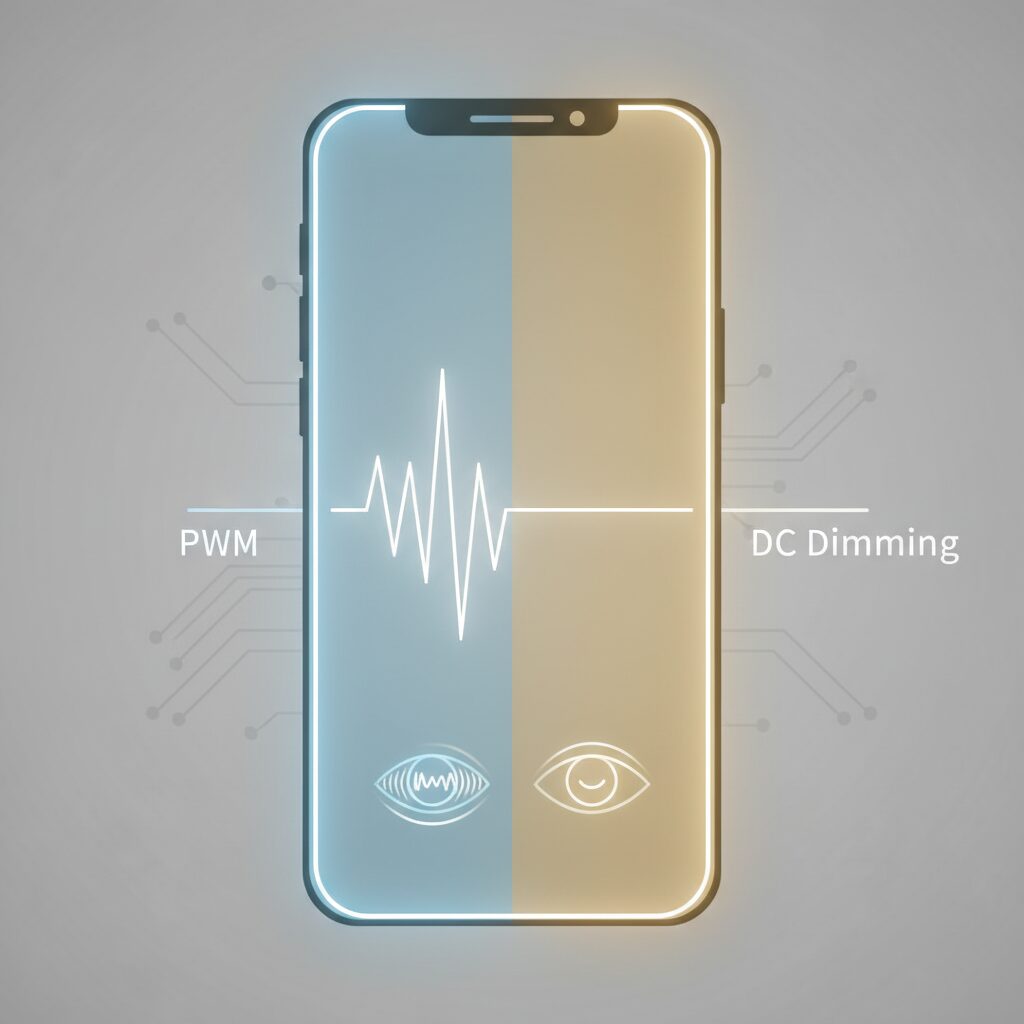
When you lower the brightness on an OLED smartphone, two fundamentally different physical strategies can be used: Pulse Width Modulation (PWM) or Direct Current (DC) dimming. Understanding the physics behind them is essential if you care about flicker, eye comfort, and display accuracy.
PWM does not reduce light intensity itself. It reduces the time the pixel stays on. DC dimming, by contrast, directly reduces the electrical current flowing through each OLED subpixel. That difference in control logic creates very different visual and physiological consequences.
How PWM Physically Works
In PWM dimming, each pixel rapidly switches between fully on and fully off. Brightness is controlled by adjusting the duty cycle, meaning the ratio of on-time to off-time within a fixed period.
| Brightness Level | Pixel State | Perceived Result |
|---|---|---|
| High | Long ON, short OFF | Minimal visible flicker |
| Low | Short ON, long OFF | Stronger flicker risk |
At high brightness, the off phase is extremely brief, so flicker perception is limited. At low brightness, however, the off interval becomes longer, increasing modulation depth. Even if the switching frequency is hundreds of hertz, the luminance fluctuation can still stimulate the visual cortex.
Research discussed in IEEE 1789-2015 shows that flicker risk depends not only on frequency but also on modulation percentage. A 480Hz signal with deep on-off contrast can feel more uncomfortable than a higher-frequency waveform with shallow modulation.
Importantly, OLED manufacturers historically favored PWM because reducing current directly can destabilize emission spectra. When current drops too low, subpixels may shift in wavelength, producing visible color shift. PWM keeps voltage stable while controlling average luminance.
How DC Dimming Changes the Equation
DC dimming lowers brightness by reducing the electrical current supplied to each pixel. The light output decreases continuously rather than intermittently.
Because the pixel never turns fully off during a cycle, theoretical flicker approaches zero. The emitted light remains temporally stable, which reduces rapid luminance oscillation hitting the retina.
The engineering challenge is maintaining chromatic stability at low current. According to panel research published on PubMed Central regarding AMOLED compensation schemes, modern backplane designs and voltage compensation techniques significantly reduce luminance instability at low drive levels. These advances make wider-range DC dimming more feasible than in earlier OLED generations.
Another factor is interaction with variable refresh rates. When refresh rates drop to 1Hz in LTPO panels, unintended brightness fluctuation can occur due to transistor hysteresis. Recent variable reset voltage techniques have been shown to reduce luminance amplitude from 0.201 cd/m² to 0.093 cd/m² at 1Hz, bringing fluctuation below human perceptibility thresholds.
From a physics standpoint, flicker is a temporal luminance modulation problem. The retina and visual cortex respond to changes over time. When light intensity oscillates, even invisibly, neural processing load increases. Studies examining non-visible flicker indicate that several hundred hertz signals can still influence reading performance and neural strain.
DC dimming reduces that oscillatory input. However, if poorly implemented, it may introduce grayscale inaccuracies or color imbalance. That is why many 2026 flagship devices adopt hybrid approaches, using DC-like behavior at higher brightness and controlled high-frequency PWM at very low levels.
For display enthusiasts, the key takeaway is this: flicker is not defined solely by frequency numbers in spec sheets. The waveform shape, modulation depth, current stability, and compensation circuitry all determine whether a screen feels comfortable over long sessions.
In practical terms, PWM is electrically efficient and color-stable but temporally discontinuous. DC dimming is temporally stable but electrically more demanding. The battle between them is not marketing rhetoric. It is a question of how photons are generated, interrupted, and delivered to your retina thousands of times per second.
Color Shift, Modulation Depth, and the Engineering Limits of OLED Panels
When discussing eye comfort in modern OLED smartphones, three technical factors inevitably surface: color shift, modulation depth, and the intrinsic engineering limits of OLED panels. These are not marketing buzzwords but tightly interconnected physical constraints that engineers must balance every time brightness is adjusted.
OLED pixels are current-driven light sources. As the supplied current decreases, especially in low-luminance scenarios below a few nits, the emission spectrum of organic materials becomes less stable. This leads to color shift, where whites may appear slightly greenish or reddish. The reason PWM dimming dominated for years is simple: keeping voltage relatively constant while pulsing the duty cycle preserves chromatic stability better than linearly lowering current.
Brightness Control vs. Color Stability
| Method | Low-Brightness Color Accuracy | Flicker Characteristics |
|---|---|---|
| PWM | Stable spectrum at fixed voltage | Depends on frequency and modulation depth |
| Pure DC | Prone to spectral shift at low current | Theoretically flicker-free |
However, PWM introduces another variable: modulation depth. This refers to the amplitude difference between peak brightness and the dimmest state within each pulse cycle. Even at high frequencies such as 480Hz or above, a 100% on-off waveform creates deep modulation. According to discussions within the IEEE 1789 framework, risk is not defined by frequency alone but by the combination of frequency and modulation percentage.
In enthusiast communities sensitive to flicker, users consistently report that a shallow modulation depth below roughly 10% often feels more comfortable than a high-frequency but fully binary waveform. This subjective experience aligns with laboratory findings showing that neural processing load increases when luminance contrast per cycle is large, even if the flicker is not consciously perceived.
The engineering challenge is that reducing modulation depth while maintaining brightness precision demands more sophisticated driver ICs and TFT backplanes. LTPO architectures improve power efficiency, but they also introduce low-frequency luminance drift when refresh rates drop. Research published on variable reset voltage compensation demonstrates that luminance amplitude at 1Hz can be reduced from 0.201 cd/m² to 0.093 cd/m², effectively mitigating low-frequency flicker without sacrificing efficiency.
Another limit comes from panel uniformity. As displays scale in size and brightness—reaching peak levels above 2,000 or even 3,000 nits in some flagship models—IR-drop across power lines causes edge-to-center luminance discrepancies. Advanced pixel circuits such as 9T1C designs compensate for voltage variation at the pixel level, stabilizing output under both DC and hybrid dimming modes.
There is also a longevity trade-off. Lowering current in DC dimming changes thermal and aging behavior of organic materials. Community experiments suggest that burn-in patterns may shift depending on dimming strategy, though large-scale controlled studies remain limited. Manufacturers therefore increasingly adopt hybrid systems: DC-like behavior at mid-to-high brightness and controlled high-frequency PWM at the extreme low end.
Ultimately, the limits of OLED are rooted in material physics. Organic emitters are sensitive to current density, temperature, and electrical history. Engineering teams in 2026 are not eliminating these constraints—they are mathematically compensating for them in real time. For gadget enthusiasts evaluating next-generation smartphones, understanding color shift and modulation depth provides a far more accurate lens than simply comparing PWM frequency numbers on a spec sheet.
What Clinical Studies Reveal About OLED Screens, Tear Film Stability, and Eye Fatigue

Clinical research over the past few years has begun to clarify how OLED displays, dimming methods, and visual fatigue are interconnected. Rather than relying on subjective impressions alone, ophthalmology studies now measure tear film stability, corneal protection, and symptom scores after controlled screen exposure.
A prospective randomized controlled study published on PubMed Central compared two-hour reading sessions on OLED smartphones and eINK displays. The results showed statistically significant deterioration in multiple ocular surface indicators after OLED use.
| Clinical Indicator | After OLED Reading | After eINK Reading |
|---|---|---|
| NIBUT (Non-invasive Tear Break-Up Time) | Significant shortening | No significant change |
| FBUT (Fluorescein Break-Up Time) | Significant shortening | No significant change |
| NIKTMH (Tear Meniscus Height) | Significant decrease | Minor decrease |
| OSDI / CVS-Q Scores | Marked increase | Slight increase |
Shortened NIBUT and FBUT indicate that the tear film becomes unstable more quickly, exposing the corneal surface and accelerating dryness. The increase in OSDI and CVS-Q scores reflects a measurable rise in subjective discomfort, including burning sensation, heaviness, and blurred vision.
These findings suggest that emissive OLED panels can disrupt ocular surface homeostasis within just two hours of continuous reading. While brightness and contrast improve readability, the physiological cost appears in tear instability and inflammatory stress.
Flicker adds another dimension. Research on visual neuroscience indicates that even high-frequency, non-perceptible flicker can increase cortical processing load. Although users may not consciously detect the modulation, the visual cortex continues to process rapid luminance changes, potentially contributing to fatigue and reduced reading efficiency.
The IEEE 1789 guideline highlights that higher modulation frequencies reduce biological risk, yet frequency alone is not decisive. Clinical discussions increasingly emphasize modulation depth, meaning how large the luminance fluctuation is during each cycle. A shallow modulation at moderate frequency may be better tolerated than deep on–off pulses at very high frequency.
Blue light exposure further interacts with fatigue. A comprehensive review on artificial blue light safety notes that wavelengths around 415–455 nm stimulate intrinsically photosensitive retinal ganglion cells, influencing melatonin suppression and alertness regulation. Prolonged evening exposure may therefore affect not only comfort but also circadian stability.
Importantly, blink rate changes were also observed in controlled experiments. Participants using OLED displays showed a gradual increase in blink frequency, interpreted as a compensatory response to ocular surface discomfort. This adaptive blinking reflects the body’s attempt to restore tear film integrity under visual stress.
From a clinical perspective, DC dimming is promising because it reduces luminance oscillation at low brightness levels. By minimizing flicker-induced neural load, it may indirectly support tear film stability during extended reading. However, long-term comparative trials specifically isolating DC dimming versus PWM under identical luminance conditions are still limited.
For gadget enthusiasts, the takeaway from current evidence is clear. Screen technology is no longer only about resolution and color gamut. Tear film metrics, blink behavior, and neurovisual load are becoming measurable endpoints. As clinical methodologies evolve, display engineering and ophthalmology are converging, reshaping how we define a truly eye-friendly screen.
Blue Light, Melatonin Suppression, and Non-Visual Neurological Effects
Blue light is not just a matter of visual brightness. It directly interacts with specialized retinal cells called intrinsically photosensitive retinal ganglion cells, or ipRGCs. These cells contain melanopsin and are particularly sensitive to short wavelengths between approximately 415nm and 455nm. According to a review published on PubMed Central, stimulation in this range suppresses melatonin secretion and shifts the body’s circadian rhythm.
This means your smartphone display can influence your biological clock even when your eyes do not feel strained. The effect is non-visual, yet neurologically significant. Exposure to blue-enriched light at night delays melatonin onset, increases alertness, and makes it harder for core body temperature to drop naturally before sleep.
| Factor | Physiological Response | Implication |
|---|---|---|
| 415–455nm blue light | Melatonin suppression | Delayed sleep onset |
| Evening LED exposure | Elevated heart rate | Increased sympathetic activity |
| Night-time screen use | Reduced core temperature drop | Shallower sleep cycles |
Recent panel innovations aim to reduce harmful short-wavelength output. Samsung Display, for example, reports reducing the proportion of high-energy blue light in its OLED panels to below 7%, compared to significantly higher levels in conventional LCDs. Devices certified under TÜV Rheinland’s “Circadian Friendly” program are evaluated specifically for their impact on melatonin suppression, not just color temperature marketing claims.
However, spectrum alone is not the whole story. Flicker interacts with the nervous system in subtler ways. Research and technical analyses have shown that even when flicker is not consciously perceived, the visual cortex continues processing pulsed light signals. Frequencies below 80Hz can be visibly disturbing, but even several hundred hertz may induce neural load in sensitive individuals.
The brain does not need you to “see” flicker for it to respond physiologically. Studies referenced in industry analyses indicate reductions in reading efficiency and increases in subjective tension under certain PWM conditions. This suggests that high modulation depth, even at elevated frequencies, can contribute to autonomic stress.
Blue light exposure in the evening has also been linked to metabolic changes. Controlled studies cited in biomedical literature report increased respiratory quotient and reduced fat oxidation after late LED exposure. In simple terms, artificial evening light can shift the body toward carbohydrate utilization, subtly influencing metabolic balance.
When DC dimming minimizes luminance fluctuation, it reduces one axis of neurological stimulation: temporal instability. Combined with spectral tuning that lowers peak blue emission, modern displays can mitigate both circadian disruption and sub-perceptual neural stress. For users who scroll in dark bedrooms or read long-form content at low brightness, these refinements are not cosmetic features. They directly affect sleep latency, recovery quality, and next-day cognitive performance.
Understanding blue light and non-visual neurological pathways reframes display technology as a biological interface. Your smartphone is not just a screen; it is a timed light source interacting with endocrine and autonomic systems. Optimizing spectrum and minimizing flicker therefore becomes a matter of systemic health, not merely eye comfort.
Apple’s Hybrid Dimming Strategy in the iPhone 17 Series
Apple has introduced a hybrid dimming system in the iPhone 17 series that fundamentally rethinks how OLED brightness should be controlled for both visual comfort and color accuracy.
Rather than choosing between pure DC dimming and conventional PWM, Apple dynamically switches its control logic depending on brightness level and ambient conditions.
This adaptive strategy is designed to minimize perceivable flicker while preserving OLED color stability at low luminance.
| Brightness Level | Dimming Behavior | Visual Impact |
|---|---|---|
| Above 50% | DC-like control with shallow refresh dips | Near-flicker-free perception |
| Below 50% | Blended PWM waveform with reduced modulation depth | Significantly reduced stroboscopic sensation |
At brightness levels above 50%, the panel behaves in what users describe as a “DC-like” manner. Instead of aggressive pulse modulation, luminance remains largely continuous, with only subtle refresh-related dips tied to the 120Hz refresh cycle.
Community measurements discussed in PWM-sensitive forums indicate that modulation depth in this range is considerably lower than in earlier iPhone generations.
This is critical because, as IEEE 1789-2015 notes, not only frequency but modulation depth determines biological risk.
Below 50% brightness, where OLED color shift becomes more problematic under true DC control, Apple blends in a moderated PWM component.
However, unlike older implementations, the waveform avoids extreme on-off contrast. The reduced modulation depth appears to mitigate the neural stress response associated with high-contrast pulsing.
Research published on PubMed Central has shown that even non-perceptible flicker can increase visual fatigue through continuous cortical processing, which makes this refinement especially relevant.
Another notable addition is a user-accessible toggle within Accessibility settings that prioritizes DC-style behavior. This move acknowledges the growing population of flicker-sensitive users who actively evaluate modulation characteristics before purchasing a device.
Unlike brands that market extremely high PWM frequencies as a singular solution, Apple’s approach focuses on waveform shaping and dynamic control rather than headline numbers.
This distinction matters because, according to discussions in expert user communities, a poorly tuned 2000Hz signal with deep modulation can feel more fatiguing than a shallower 480Hz implementation.
In practical terms, the hybrid system becomes most noticeable during nighttime reading. At moderate brightness in dark environments, the display maintains tonal consistency without the subtle “grain” or shimmer sometimes associated with aggressive PWM dimming.
At the same time, color calibration remains aligned with Apple’s wide-gamut targets, avoiding the greenish tint historically linked to low-current OLED driving.
The result is a display that adapts not only to lighting conditions, but to the physiological limits of the human visual system.
By integrating dimming logic with refresh rate control and real-time compensation, the iPhone 17 series signals a maturation of OLED driving philosophy.
It reflects an industry shift away from binary DC-versus-PWM debates toward algorithmically optimized hybrid systems.
For users deeply invested in display science, this represents one of the most technically nuanced evolutions in Apple’s panel strategy to date.
Samsung Galaxy S25 Ultra: High-Frequency PWM and Blue Light Reduction
Samsung Galaxy S25 Ultra focuses on a different philosophy from aggressive full-range DC dimming. Instead of eliminating PWM entirely, Samsung refines it through high-frequency control and material-level blue light reduction to balance color accuracy, efficiency, and visual comfort.
The device continues to use a 480Hz PWM frequency, but the real story lies in how modulation depth and emission characteristics are optimized. For many users, flicker perception depends not only on frequency but also on how drastic the brightness oscillation is.
Galaxy S25 Ultra combines 480Hz high-frequency PWM with reduced modulation depth and certified low blue light emission, aiming to lower eye strain without compromising OLED color performance.
According to discussions in PWM-sensitive communities and analyses comparing OLED driving curves, modulation depth plays a decisive role in comfort. Even at high frequencies, deep on–off transitions can trigger discomfort in sensitive users. Samsung mitigates this by smoothing luminance transitions, reducing perceived strobing.
From a blue light perspective, Samsung Display has achieved measurable reductions in harmful short-wavelength emissions. As reported in Samsung’s official disclosures, the company reduced the proportion of high-energy blue light compared to conventional LCD panels while maintaining full DCI-P3 color coverage.
| Parameter | Galaxy S25 Ultra Approach | User Impact |
|---|---|---|
| PWM Frequency | 480Hz | Reduced visible flicker compared to low-frequency panels |
| Modulation Depth | Optimized (shallower transitions) | Lower perceived stroboscopic effect |
| Blue Light Emission | Reduced short-wavelength peak | Less circadian disruption risk |
| Certification | TÜV Rheinland Eye Comfort | Verified flicker and blue light standards |
Blue light reduction is not merely a marketing label. Research published on PubMed Central highlights that wavelengths between 415nm and 455nm stimulate melanopsin-containing retinal ganglion cells, suppressing melatonin secretion at night. By lowering the intensity of these peaks, Samsung aims to reduce circadian interference during evening use.
Importantly, this reduction does not significantly distort color temperature. Samsung achieves this through material engineering rather than aggressive software filtering. As a result, users retain vivid HDR performance while benefiting from lower high-energy emission.
The S25 Ultra also carries TÜV Rheinland Eye Comfort certification. TÜV’s updated standards evaluate flicker behavior across a broad frequency range and assess blue light exposure relative to circadian sensitivity. Certification does not mean zero flicker, but it confirms that emissions and modulation remain within regulated thresholds.
For users sensitive to flicker, 480Hz may still not match ultra-high-frequency implementations above 3000Hz described in IEEE 1789-2015 as “low risk.” However, many users report that controlled modulation depth combined with stable LTPO refresh management can feel more comfortable than raw frequency numbers suggest.
In practical use, this translates to smoother low-brightness scrolling at night, fewer visible banding artifacts when viewed through a camera lens, and more stable luminance during variable refresh rate transitions. Rather than pursuing headline PWM figures, Samsung prioritizes a holistic optimization of emission spectrum, efficiency, and perceptual stability.
For gadget enthusiasts evaluating eye comfort, the Galaxy S25 Ultra demonstrates that high-frequency PWM alone is not the full story. The interaction between spectral tuning, modulation engineering, and third-party certification ultimately defines real-world viewing comfort.
Google Pixel 10: Rebuilding the Display Subsystem Around Flicker Concerns
Google’s decision to rethink the Pixel 10 display subsystem is not a minor tuning update but a structural response to the flicker backlash that surrounded the Pixel 9 series. With a PWM frequency of 240Hz, the previous model drew criticism from flicker‑sensitive users, particularly in low‑brightness environments where modulation depth becomes more perceptible. According to coverage by Tech Advisor, Google acknowledged internally that the team was investigating the issue, signaling that the Pixel 10 would not simply iterate but rebuild.
The key shift lies in treating flicker as a system-level constraint rather than a panel-level specification. Instead of relying solely on higher refresh rates or cosmetic “eye comfort” modes, Pixel 10 is expected to integrate high‑frequency PWM—rumored to exceed 1920Hz—or introduce a selectable DC dimming option. This brings Google closer to the IEEE 1789-2015 guidance, which considers higher frequencies progressively lower risk.
| Model | PWM Frequency | Strategic Direction |
|---|---|---|
| Pixel 9 | 240Hz | Conventional low-frequency PWM |
| Pixel 10 | 1920Hz+ (expected) | High-frequency PWM or DC option |
However, frequency alone does not solve the biological dimension of flicker. Research published on PubMed Central indicates that even imperceptible modulation can affect ocular surface stability and visual fatigue under prolonged exposure. This is particularly relevant for OLED devices, where luminance is actively modulated rather than passively reflected. Pixel 10’s redesign therefore extends beyond the panel to the driving algorithm.
Leveraging the Tensor G5 chip, Google is expected to implement content-aware brightness curve generation. That means the display driver IC and GPU pipeline dynamically coordinate modulation depth depending on scene luminance, ambient light, and user brightness preference. This AI-mediated dimming curve could reduce abrupt luminance transitions that strain the visual cortex, even when PWM is active.
Another important layer is LTPO optimization. Low refresh rate states, such as 1Hz always-on display, have historically introduced micro-luminance instability. Academic research on Variable Reset Voltage compensation demonstrates that brightness amplitude at 1Hz can be reduced by more than half when reset voltage is dynamically controlled. If Pixel 10 integrates similar compensation logic, it would address not just high-frequency flicker but also low-frequency drift during static viewing.
What makes this redesign significant is Google’s ecosystem positioning. Pixel devices serve as reference hardware for Android. By prioritizing flicker mitigation at the subsystem level—panel, driver, AI control, and refresh management—Google sets a precedent that eye comfort is not a marketing add-on but a core engineering metric.
In practical terms, users who previously experienced headaches or eye strain under dim lighting may find the Pixel 10 markedly more stable during nighttime browsing or extended reading. The rebuild signals a philosophical pivot: display performance is no longer measured solely by peak nits or color gamut, but by how gently light is delivered to the human nervous system.
Sony Xperia 1 VII and Sharp AQUOS R10: Japan’s Unique Approach to Natural Viewing
In the global race toward higher PWM frequencies and aggressive DC dimming, Sony and Sharp take a distinctly Japanese path. Rather than competing only on headline numbers, they focus on how a display feels in daily life—natural, stable, and easy on the eyes. This philosophy is clearly embodied in Xperia 1 VII and AQUOS R10.
Both brands interpret visual comfort not as a single specification, but as a balance of luminance stability, color accuracy, and environmental adaptation. Their approach aligns with findings published on PubMed Central showing that OLED viewing conditions can influence ocular surface stability, including metrics such as NIBUT and blink rate. Minimizing perceptual stress, therefore, becomes a design priority rather than a marketing afterthought.
Sony Xperia 1 VII: BRAVIA Intelligence in Your Hand
Xperia 1 VII integrates Sony’s BRAVIA-derived image processing, optimized by AI for mobile use. Instead of artificially boosting saturation, it aims to reproduce tones as creators intended. This matters because excessive contrast and unnatural color shifts can intensify visual fatigue over prolonged viewing.
The device adopts an LTPO panel with a 1Hz–120Hz variable refresh rate. Research on LTPO compensation schemes, including variable reset voltage techniques reported in peer-reviewed studies, demonstrates that stabilizing luminance at low refresh rates significantly reduces low-frequency flicker amplitude. By minimizing unintended brightness fluctuation during static scenes, Xperia 1 VII maintains visual calmness.
Another standout feature is “Sunlight Vision.” Using both front and rear ambient light sensors, the phone dynamically adjusts tone mapping and contrast under direct sunlight. Instead of simply pushing brightness, it preserves color balance, preventing the washed-out look that forces users to squint outdoors.
| Feature | Xperia 1 VII Approach | User Benefit |
|---|---|---|
| Variable Refresh Rate | 1Hz–120Hz LTPO | Reduced low-frequency flicker |
| Ambient Detection | Dual light sensors | Stable outdoor visibility |
| Image Processing | BRAVIA-based AI tuning | Natural color reproduction |
Sharp AQUOS R10: Precision Brightness and Environmental Harmony
Sharp approaches natural viewing from a different angle. AQUOS R10 achieves a peak brightness of 3,000 nits and maintains approximately 1,500 nits in full-white scenarios, enhancing HDR realism without relying solely on contrast tricks. High brightness alone does not guarantee comfort, but when paired with intelligent control, it reduces the need for eye strain in bright environments.
The device incorporates a 14-channel spectral sensor that analyzes surrounding light sources—LED, fluorescent, or daylight—and adjusts white balance accordingly. This environmental synchronization mirrors the broader industry shift toward circadian-aware design discussed in blue light safety reviews. By adapting spectral output to real-world lighting, AQUOS R10 reduces perceptual mismatch between screen and surroundings.
Sharp also provides a dedicated flicker suppression mode utilizing DC dimming behavior for reading and web browsing. For users sensitive to PWM modulation depth—a concern frequently discussed in enthusiast communities—this option offers a practical path to visual stability without sacrificing overall color fidelity.
Together, Xperia 1 VII and AQUOS R10 illustrate Japan’s unique display philosophy: instead of chasing extreme numerical benchmarks alone, they engineer for harmony between technology and human perception. In an era where IEEE 1789 and TÜV Rheinland certifications shape global standards, these devices demonstrate that true visual comfort lies not just in compliance, but in thoughtful integration of optics, electronics, and everyday usability.
LTPO 5.0, Variable Reset Voltage, and 9T1C Pixel Circuits Explained
LTPO 5.0, Variable Reset Voltage (VRV), and 9T1C pixel circuits represent the real hardware foundation behind next-generation eye-friendly OLED displays. While dimming algorithms attract attention, it is the transistor-level redesign of the backplane that determines whether flicker and luminance instability are fundamentally solved.
LTPO, or Low-Temperature Polycrystalline Oxide, combines LTPS and oxide TFT technologies to enable ultra-wide variable refresh rates. According to industry analyses and Patsnap’s technical review, this hybrid structure allows panels to scale dynamically from 120Hz down to 1Hz, dramatically reducing power consumption during static content such as reading or always-on display modes.
However, lowering refresh rates introduced a subtle but critical issue: low-frequency luminance fluctuation. When refresh drops, the driving TFTs experience threshold voltage shifts and charge trapping effects, leading to slight brightness drift that sensitive users may perceive as flicker.
The breakthrough comes from Variable Reset Voltage technology. In a peer-reviewed study published on PubMed Central by LG Display researchers, VRV dynamically adjusts the reset voltage during skipped frames. This compensates for hysteresis in driving TFTs and de-trapping effects in oxide TFTs.
The measured results are concrete. At 1Hz operation, luminance fluctuation amplitude was reduced from 0.201 cd/m² to 0.093 cd/m². That is more than a 50% reduction, bringing fluctuation below perceptual thresholds for most users.
| Parameter | Conventional LTPO | LTPO with VRV |
|---|---|---|
| Refresh Rate | 1Hz | 1Hz |
| Luminance Fluctuation | 0.201 cd/m² | 0.093 cd/m² |
| Perceived Stability | Minor flicker possible | Visually stable |
This improvement is particularly relevant for users sensitive to PWM artifacts, because low-frequency instability can feel similar to flicker even if PWM frequency is high. VRV directly addresses the electrical root cause rather than masking it through software smoothing.
Parallel to VRV evolution, the 9T1C pixel circuit has emerged as a structural response to large-panel uniformity challenges. As smartphones grow in size and foldable devices expand active area, IR-drop across the power line (VDD) becomes more pronounced. Voltage differences between center and edge pixels create visible brightness inconsistency.
The 9T1C design incorporates nine transistors and one capacitor per pixel. According to ResearchGate-published circuit studies, this configuration enables internal voltage compensation and significantly suppresses flicker below -50 dB at refresh rates under 10Hz.
This means ultra-low refresh and uniform luminance are no longer trade-offs. Users gain extended battery life without introducing micro-brightness oscillations that could strain the visual system.
When LTPO 5.0, VRV compensation, and 9T1C architecture operate together, the display behaves differently from earlier OLED generations. Instead of reacting passively to refresh reduction, the panel actively recalibrates each frame cycle at the transistor level.
For gadget enthusiasts evaluating 2026 flagship displays, understanding these circuit-level innovations is essential. PWM frequency numbers alone no longer define visual comfort. The real differentiator lies in how effectively the backplane maintains luminance integrity during variable refresh transitions.
In practical terms, LTPO 5.0 with VRV and 9T1C enables stable 1Hz reading mode, reduced perceptible flicker, improved uniformity on large or foldable panels, and lower power consumption simultaneously. It marks a shift from algorithmic dimming tricks to semiconductor-grade precision engineering.
TÜV Rheinland, IEEE 1789-2015, and What ‘Flicker-Free’ Really Means
When manufacturers advertise a display as “Flicker-Free,” the claim often rests on third-party certification rather than marketing language alone. Two names appear repeatedly in spec sheets and press releases: TÜV Rheinland and IEEE 1789-2015. Understanding what they actually evaluate is essential if you care about measurable eye comfort rather than branding.
TÜV Rheinland, a German testing and certification body, has developed specific criteria for displays under labels such as “Flicker Free” and “Eye Comfort.” According to publicly available certification descriptions and manufacturer disclosures, these tests evaluate flicker behavior across a wide frequency band, typically from 0Hz up to several kilohertz, covering both visible and non-visible flicker components.
| Certification | Main Focus | What It Implies |
|---|---|---|
| TÜV Flicker Free | Flicker amplitude within defined limits | Reduced visible and invisible flicker under test conditions |
| TÜV Eye Comfort | Low blue light + flicker control | Balanced spectral output and controlled modulation |
| IEEE 1789-2015 | Flicker risk vs. frequency model | Defines “low risk” and “no observable effect” zones |
IEEE 1789-2015, issued by the Institute of Electrical and Electronics Engineers, approaches flicker from a risk-model perspective. It correlates modulation frequency and modulation percentage with potential biological effects. In simplified terms, the standard indicates that very high frequencies—often cited above 3,000Hz—fall into a “no observable effect level” for typical exposure scenarios.
However, this does not automatically mean a device labeled “Flicker-Free” emits zero luminance fluctuation. In practice, most OLED smartphones still use some form of PWM at lower brightness levels. What changes is either the frequency (e.g., 1920Hz, 4320Hz) or the modulation depth, meaning the contrast between peak and trough brightness becomes shallower.
Community discussions among PWM-sensitive users frequently emphasize modulation depth as much as frequency. Even at 480Hz, some users report comfort if brightness swings are minimal. Conversely, a high-frequency signal with near 100% on–off contrast may still cause discomfort in sensitive individuals. IEEE 1789 itself models risk as a function of both variables, not frequency alone.
TÜV certifications add another layer by incorporating blue light spectrum limits. Samsung, for example, has highlighted TÜV recognition for reduced short-wavelength blue emission in its OLED panels, aligning spectral management with flicker control. This dual approach reflects growing awareness that visual comfort is multi-factorial, not solely a PWM issue.
For technically minded buyers, the takeaway is nuanced. “Flicker-Free” is a compliance statement within defined laboratory thresholds, not a guarantee of absolute DC-like behavior under every brightness condition. Reading certification details, checking frequency specifications, and understanding modulation depth provide a far clearer picture than relying on the badge alone.
In 2026, as consumers become more educated about display health metrics, these standards function less as marketing tools and more as a common language between engineers, regulators, and power users who demand quantifiable visual safety.
User Communities, Flicker Sensitivity, and Real-World Testing Methods
For readers who are highly sensitive to display behavior, official specifications are only the starting point. In 2026, user communities such as Reddit’s PWM_Sensitive and LEDStrain forums have become de facto laboratories, where early adopters share oscilloscope traces, slow‑motion recordings, and subjective symptom logs.
These discussions reveal a critical insight: flicker perception is deeply individual. Even when a device meets TÜV Rheinland “Flicker Free” criteria or operates above several hundred hertz, some users still report headaches, eye strain, or sleep disruption. Community testing often focuses not just on frequency, but on modulation depth and waveform shape.
According to IEEE 1789-2015, higher frequencies reduce theoretical biological risk, yet community reports emphasize that a shallow modulation at 480Hz may feel more comfortable than a deep on–off pattern at several kilohertz. This gap between laboratory thresholds and lived experience drives more nuanced real‑world evaluation.
| Test Focus | What Communities Check | Why It Matters |
|---|---|---|
| PWM Frequency | Exact Hz under 50% brightness | Lower Hz more likely to trigger visible flicker |
| Modulation Depth | Brightness amplitude difference | High contrast pulses increase discomfort risk |
| Hybrid Switching Point | At what % DC shifts to PWM | Critical for night-time usage |
Real‑world testing methods have also evolved beyond anecdotal impressions. A common technique is filming the display with another smartphone in slow motion at 240fps or higher. If rolling bands or dark stripes appear, users infer active PWM. While not as precise as photodiode instrumentation, this method provides a fast screening tool in retail stores.
More advanced users employ light sensors connected to oscilloscopes to capture waveform data. By comparing brightness curves at 100%, 50%, and minimum brightness, they can detect hybrid dimming transitions similar to those discussed in technical forums analyzing LTPO refresh dips and DC-like behavior.
Flicker sensitivity itself spans a spectrum. Some users report no symptoms even at 240Hz PWM, while others experience discomfort at much higher frequencies. Research summarized in PubMed on artificial light exposure indicates that even non-visible flicker can influence neural processing efficiency, which may explain why certain individuals react despite “invisible” modulation.
For practical evaluation, enthusiasts recommend testing under three conditions: low brightness in a dark room, extended reading for at least 20 minutes, and night-time use before sleep. Symptoms such as eye dryness, forehead pressure, or unusual alertness can indicate sensitivity.
Ultimately, spec sheets do not replace embodied testing. Certifications, PWM numbers, and DC dimming labels provide guidance, but real-world validation—especially for sensitive users—remains essential. In 2026, informed buyers increasingly rely on a combination of laboratory standards and collective intelligence from user communities to make safer display choices.
The Road Ahead: Hybrid Dimming, AI Eye Care, and the Path Toward MicroLED
Display innovation is no longer moving in a single direction. Instead of choosing between DC dimming and PWM, manufacturers are converging on hybrid architectures that dynamically blend both approaches depending on brightness, content, and ambient light.
This hybrid dimming model is emerging as the practical bridge between today’s OLED constraints and tomorrow’s MicroLED promise.
At higher brightness levels, many 2026 flagship devices operate in a near-DC mode, minimizing modulation depth. At lower brightness, they switch to high-frequency PWM to preserve color stability and panel longevity, while reducing perceptible flicker.
| Technology | Strength | Current Limitation |
|---|---|---|
| Full-range DC Dimming | Minimal flicker | Color shift at very low current |
| High-frequency PWM (1000Hz+) | Stable color reproduction | Residual modulation depth |
| Hybrid Dimming | Adaptive balance of both | Algorithm complexity |
| MicroLED (future) | Native DC compatibility | Manufacturing scalability |
Research published via NIH on low-frequency flicker compensation in AMOLED panels demonstrates how circuit-level innovations such as Variable Reset Voltage can suppress luminance instability even at 1Hz operation. This type of hardware evolution is what makes hybrid dimming viable rather than cosmetic.
Parallel to hardware progress, AI-driven eye care is becoming a defining frontier. Chipsets such as Google’s Tensor platform are expected to analyze content type, scrolling behavior, and ambient lux data in real time to adjust dimming curves dynamically.
The next phase is not just flicker reduction, but personalized visual ergonomics. Front-facing cameras and ambient sensors can already estimate blink rate and usage duration. According to emerging display trend analyses, adaptive systems that modify brightness slope, color temperature, and modulation depth based on user fatigue indicators are under active development.
This AI layer transforms dimming from a static specification into a behavioral system. Instead of asking whether a phone supports DC dimming, the more relevant question becomes how intelligently it manages light output across contexts such as nighttime reading, HDR video playback, or outdoor navigation.
Looking further ahead, MicroLED represents the structural solution to many OLED-era compromises. Because MicroLED uses inorganic emissive materials, it avoids organic degradation and is inherently compatible with true DC control without the same color instability risks. Industry market projections toward 2030 suggest that once yield rates improve, MicroLED could redefine smartphone display standards.
However, manufacturing complexity and cost remain substantial barriers. Until mass production becomes economically viable, OLED will continue to dominate, refined by LTPO evolution, advanced pixel circuits, and increasingly intelligent hybrid dimming algorithms.
The road ahead is therefore evolutionary rather than abrupt. Hybrid dimming stabilizes today’s OLED experience, AI systems personalize visual comfort in real time, and MicroLED waits on the horizon as the long-term architectural shift. For enthusiasts who care about eye health as much as resolution or refresh rate, this layered transition marks the most meaningful display transformation of the decade.
参考文献
- PubMed Central (NIH):Effects on the Ocular Surface from Reading on Different Smartphone Screens: A Prospective Randomized Controlled Study
- PubMed Central (NIH):A review of the current state of research on artificial blue light safety as it applies to digital devices
- PubMed Central (NIH):Improvement of flicker phenomenon at low frequencies in AMOLED displays by applying compensation scheme of variable reset voltage
- Samsung Newsroom:Samsung’s OLED Display on Galaxy Fold Receives International Recognition for Reduction in Eye-impairing Blue Light
- Tech Advisor:Google Pixel 10 PWM dimming Screen Upgrade Tipped
- ResearchGate:LTPO-based pixel circuit with highly uniform luminance and low flicker for variable refresh rate in AMOLED displays