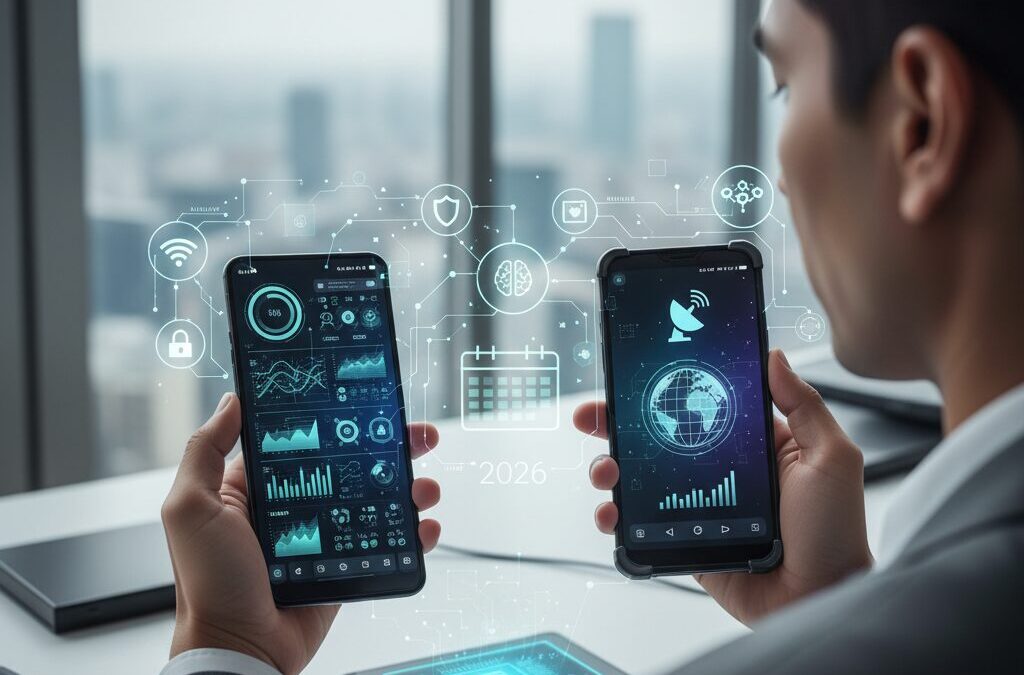
In 2026, smartphone ownership in Japan has reached 98%, signaling not growth, but saturation. Yet beneath this near-universal adoption, a new behavioral shift is accelerating: 16% of users now carry two or more smartphones, redefining what mobile productivity and resilience truly mean.
For gadget enthusiasts and professionals outside Japan, this trend offers a glimpse into the future of hyper-connected societies. From satellite-enabled redundancy and AI-dedicated devices to ultra-low-cost secondary SIM strategies, the secondary smartphone is no longer a backup—it is a strategic tool.
In this article, you will discover how multi-device optimization enhances digital well-being, strengthens risk management, unlocks next-generation AI capabilities, and reduces long-term costs. If you care about performance, flexibility, and staying ahead of tech evolution, this deep dive will show you how to design your ideal secondary smartphone setup in 2026.
- From 4% to 98%: The Statistical Evolution of Smartphone Penetration
- Why 16% of Users Now Own Multiple Smartphones
- Professional Segmentation: Separating Work and Private Life for Digital Well-Being
- Risk Hedging in a Fully Digital Society: Network Failures, Battery Degradation, and Device Loss
- 5G Saturation and the New Baseline for Secondary Devices
- Satellite-to-Smartphone Connectivity: The End of Dead Zones
- Cost Optimization with Dual SIM, eSIM, and Ultra-Low-Cost Plans
- AI-Dedicated Smartphones: Real-Time Translation, On-Device Agents, and Workflow Expansion
- Media and Entertainment Specialization: Immersive Video, High-Resolution Audio, and Live Streaming
- Hardware Trends in 2026: Solid-State Batteries, Memory Pricing, and Rugged Designs
- The Explosive Growth of the Refurbished Smartphone Market
- Smart Glasses, Edge AI, and the Future of Multi-Device Integration
- 参考文献
From 4% to 98%: The Statistical Evolution of Smartphone Penetration
In 2010, smartphones accounted for just 4% of mobile phone ownership in Japan. At that time, feature phones still dominated daily life, and mobile internet was largely optimized for proprietary ecosystems. Within only fifteen years, however, this landscape transformed dramatically.
According to NTT Docomo’s Mobile Society Research Institute, the smartphone ratio surpassed 50% in 2015, climbed past 70% in 2017, exceeded 80% in 2019, and broke through 90% in 2021. By 2025, it reached an astonishing 98%, effectively making smartphones the default infrastructure of everyday life.
This rise from 4% to 98% is not incremental growth. It represents a complete structural shift in how society connects, consumes, and conducts business.
| Year | Smartphone Penetration (Japan) |
|---|---|
| 2010 | 4% |
| 2015 | Over 50% |
| 2019 | Over 80% |
| 2021 | Over 90% |
| 2025 | 98% |
The speed of adoption is particularly striking when viewed through the lens of generational diffusion. What began as an early-adopter trend among younger users expanded rapidly into middle-aged and senior demographics. By the early 2020s, smartphones were no longer lifestyle accessories but essential tools for payments, authentication, healthcare access, and disaster information.
This penetration curve closely mirrors the acceleration phase described in classic diffusion-of-innovation theory, yet Japan’s case stands out for its near-total saturation. A 98% penetration rate signals that the market has moved beyond growth and into hyper-maturity.
Another important inflection point occurred in the secondary device category. Data from 2025 shows that 88.9% of second devices are also smartphones. This indicates that even backup or supplementary roles have transitioned fully away from feature phones.
In other words, the smartphone did not merely replace the feature phone. It absorbed every mobile role.
Shipment data reinforces this narrative. MM Research Institute projected approximately 32.05 million smartphone shipments in fiscal 2025, marking year-on-year growth of 6.7%. At the same time, 5G-compatible devices accounted for 99.5% of shipments, approaching complete technological standardization.
When penetration nears 100% and 5G reaches virtually universal inclusion, competition shifts away from access and toward optimization. The question is no longer whether people own smartphones, but how deeply those devices are embedded into workflows, entertainment, and risk management.
The statistical evolution from 4% to 98% therefore reflects more than consumer preference. It marks the transformation of smartphones into national infrastructure—ubiquitous, standardized, and indispensable across nearly every demographic segment.
Why 16% of Users Now Own Multiple Smartphones
In 2025, 16% of smartphone users in Japan owned two or more devices, with 14.3% using two and 1.7% using three or more, according to a survey released in April 2025. In a market where overall smartphone penetration has already reached 98%, this figure is not marginal. It signals a structural shift from “one person, one device” to “one person, multiple roles managed by multiple devices.”
Multiple ownership is no longer driven by novelty, but by function, risk control, and optimization. As smartphones have become the core infrastructure for payments, identification, work, and entertainment, concentrating everything on a single device has started to feel inefficient—and in some cases, dangerous.
| Number of Devices | User Share (Apr 2025) | Key Implication |
|---|---|---|
| 1 device | 84.0% | Single-role dependency |
| 2 devices | 14.3% | Functional separation |
| 3+ devices | 1.7% | Advanced specialization |
The motivations behind this shift are highly pragmatic. The same survey shows that 31.0% of multi-device users cite “separating devices by usage or scenario” as their primary reason. This reflects a growing recognition that a single smartphone cannot optimally handle every context—work, gaming, AI experimentation, finance, and private communication—without trade-offs.
Professional necessity also plays a major role. Company employees account for 46.5% of multi-device users, while self-employed and freelancers represent 37.2%. Together, they make up nearly 80% of this segment. This concentration suggests that productivity and boundary management, not hobbyism, are driving adoption.
Security and resilience are equally important. Over the past few years, large-scale carrier outages have exposed the vulnerability of relying on a single network. As mobile payments, digital IDs, and medical services increasingly depend on smartphone access, downtime is no longer an inconvenience—it is a systemic risk. Owning a second device with a different carrier SIM effectively creates personal-level redundancy.
Battery degradation is another structural factor. According to NTT Docomo’s Mobile Society Research Institute, battery deterioration has become the top trigger for smartphone replacement, rising to around half of all replacement reasons by 2025. Instead of replacing a main device immediately, many users now reposition older phones as secondary units, extending hardware lifecycle while maintaining reliability.
Cost barriers have also fallen dramatically. About 45.5% of multi-device users combine low-cost SIM plans on both devices. Services such as zero-base-fee plans or ultra-low monthly standby plans make it possible to maintain a secondary line for only a few hundred yen per month. This economic feasibility transforms multi-device ownership from a luxury into a rational optimization strategy.
Finally, technological acceleration in AI and connectivity reinforces the trend. With 5G adoption surpassing 99% of shipments from 2025 onward, even secondary devices deliver high-speed performance. At the same time, 2026 has been described by industry observers such as journalist Munekazu Nishida as a pivotal year for AI-integrated devices. Users experimenting with on-device AI, translation tools, or automation workflows increasingly prefer isolating these processes on dedicated hardware.
In a hyper-saturated smartphone market, growth no longer comes from first-time buyers. It comes from users redefining how many devices they need to live, work, and protect themselves efficiently in a fully digital society.
Professional Segmentation: Separating Work and Private Life for Digital Well-Being
In Japan’s hyper-saturated smartphone market, owning more than one device is no longer a niche behavior but a strategic choice. According to an April 2025 survey, 16% of users own two or more smartphones, and 20.7% cite separating business and private use as a primary reason. This trend reflects a deeper shift: professionals are redesigning their digital environments to protect focus, privacy, and mental stability.
For company employees and self-employed professionals—who together account for nearly 80% of multi-device owners—the boundary between work and life has become increasingly blurred. When the same device handles corporate email, client chats, family messages, and social media, cognitive switching costs accumulate. Research in organizational psychology consistently shows that frequent task switching reduces productivity and increases stress. By physically separating devices, you reduce the psychological friction of constant context changes.
Physical device separation creates a hard boundary that software settings alone cannot fully replicate. Turning off notifications is reversible and fragile. Carrying a dedicated work phone makes the boundary tangible and enforceable.
From a digital well-being perspective, this distinction supports what Japanese HR training providers describe as the balance of physical, mental, and social fulfillment in well-being design. When work notifications stop at the end of the day because the work device is left in a bag or powered down, recovery time becomes intentional rather than accidental.
Security is another decisive factor. Mixing corporate apps with personal SNS, shopping, or point-reward apps increases the attack surface. A dedicated business smartphone minimizes the risk of data leakage, especially in environments where confidential documents, AI-generated drafts, or client recordings are handled daily.
| Aspect | Single Device | Dual-Device Segmentation |
|---|---|---|
| Notification Control | Manual, reversible | Physical separation, clearer boundary |
| Data Security | Mixed personal/work data | Isolated corporate environment |
| Mental Recovery | Work always visible | Work device can be fully disengaged |
In 2026, as AI agents become deeply integrated into enterprise workflows, the argument for segmentation grows stronger. Industry commentary, including insights from technology analysts such as Muneyuki Nishida, points to 2026 as a year when AI moves from experimentation to full-scale utilization. Running enterprise AI tools, document generation systems, and internal chatbots on a dedicated work device allows your personal device to remain a space for relationships and leisure.
Professional segmentation is not about owning more gadgets. It is about designing friction where it matters. By introducing intentional boundaries between roles, you regain control over attention, reduce latent stress, and build a resilient digital routine that supports long-term performance.
For gadget enthusiasts and productivity-focused professionals, the second smartphone becomes a tool for architectural thinking. You are not just choosing hardware; you are structuring your cognitive environment. In a society where 98% of mobile users rely on smartphones as core infrastructure, mastering separation is a decisive step toward sustainable digital well-being.
Risk Hedging in a Fully Digital Society: Network Failures, Battery Degradation, and Device Loss
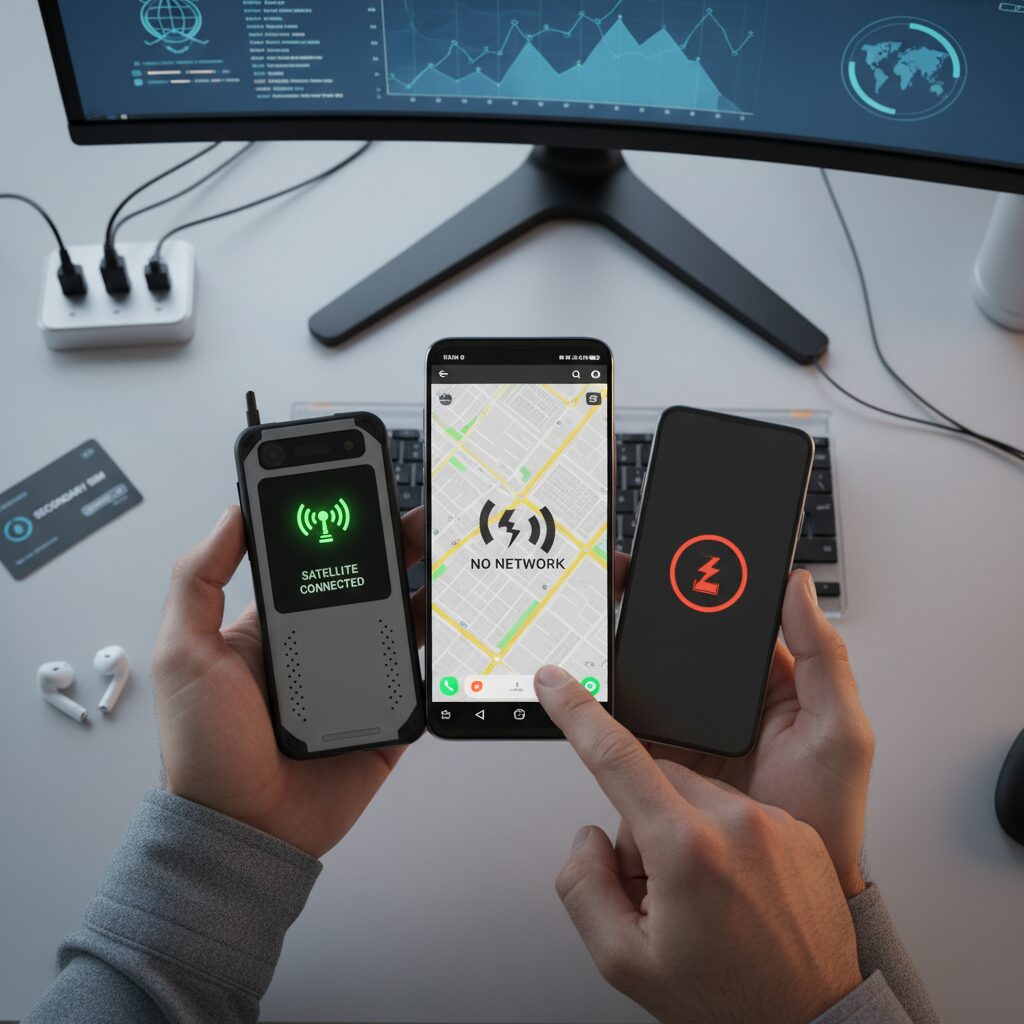
In a society where smartphone ownership has reached 98% in Japan, according to NTT Docomo’s Mobile Society Research Institute, a single device failure can instantly disrupt payments, transportation, authentication, and communication.
When digital infrastructure becomes inseparable from daily life, risk hedging is no longer optional but essential. A sub-smartphone functions as practical redundancy, not luxury.
The core risks can be categorized into three structural vulnerabilities: network failure, battery degradation, and device loss.
| Risk Type | Trigger | Impact on Daily Life |
|---|---|---|
| Network Failure | Carrier outage, disaster | Loss of payments, messaging, navigation |
| Battery Degradation | Aging cells, heavy app usage | Unexpected shutdown outside home |
| Device Loss | Theft, misplacement | Access lockout, security exposure |
Major carrier outages in the early 2020s exposed how fragile a single-network dependency can be. By maintaining a secondary device with a different carrier or low-cost SIM, users create communication redundancy that mirrors enterprise-level failover strategies.
The rapid commercialization of satellite-to-smartphone services by Japan’s four major carriers further strengthens this hedge. When terrestrial infrastructure fails, satellite-compatible devices can preserve minimum connectivity, particularly for messaging and emergency coordination.
Battery degradation presents a quieter but more frequent threat. NTT Docomo research shows that nearly half of smartphone replacements are triggered by battery deterioration. As lithium-ion capacity declines over cycles, unexpected shutdowns become more common, especially under 5G and AI-heavy workloads.
A fully charged secondary device effectively becomes a mobile power reserve with independent processing capability. Unlike a power bank, it preserves authentication apps, QR payment access, and secure messaging in parallel.
Device loss or theft adds a security dimension. With financial apps, digital IDs, and cloud access centralized on one handset, a lost phone can temporarily lock users out of essential services. A sub-device enables immediate remote lock, tracking activation, password reset, and multi-factor authentication recovery.
As smartphones increasingly function as AI terminals, authentication hubs, and satellite communication nodes, systemic dependence deepens. Risk hedging through multi-device strategy mirrors how data centers operate: distribute load, isolate failure points, and ensure recovery pathways.
For gadget enthusiasts and professionals alike, the question is no longer whether failures will occur, but how gracefully you can absorb them. A thoughtfully configured sub-smartphone transforms disruption into minor inconvenience rather than digital paralysis.
5G Saturation and the New Baseline for Secondary Devices
By 2026, 5G is no longer a premium feature. It is the default. According to MM Research Institute, 5G-compatible models account for 99.5% of shipments in FY2025 and are projected to reach virtually 100% by FY2028. This means that even secondary smartphones are now expected to deliver the same network foundation as primary devices.
The Japanese mobile market has entered what can be described as structural saturation. With smartphone penetration reaching 98% in 2025, as reported by NTT Docomo’s Mobile Society Research Institute, growth is no longer driven by first-time adoption but by replacement and multi-device ownership. In this environment, 5G performance becomes a baseline requirement rather than a differentiator.
The secondary device is no longer a “slower backup.” It operates on the same 5G infrastructure as the main device, shifting competition toward specialization, cost optimization, and resilience.
| Fiscal Year | Total Shipments | 5G Ratio |
|---|---|---|
| 2025 | 32.05 million | 99.5% |
| 2026 (forecast) | 32.95 million | 99.6% |
| 2028 (forecast) | — | 100% |
This near-universal 5G adoption has strategic implications. First, secondary smartphones can fully support high-bandwidth tasks such as cloud-based AI processing, live streaming, and large file synchronization without noticeable compromise. The performance gap that once justified limiting a second device to calls or messaging has effectively disappeared.
Second, pricing dynamics have shifted. As 5G chipsets scale across entry and mid-range models, economies of scale reduce marginal cost differences. Retail data from major electronics chains show that 5G is now standard even in devices around the ¥30,000 range. This democratization establishes 5G as infrastructure, not luxury.
Third, network redundancy gains new relevance. With all major carriers advancing satellite-to-smartphone services between 2025 and 2026, 5G terrestrial coverage is complemented by non-terrestrial extensions. A secondary device connected to a different carrier effectively becomes a parallel 5G node in a personal network architecture.
In a saturated 5G market, differentiation shifts from connectivity speed to connectivity design.
For power users, this means rethinking the role of a second device. Instead of asking whether it supports 5G, the more relevant questions are latency stability, carrier diversity, and compatibility with AI-driven services. As Watch Impress columnist Munetaka Nishida notes, 2026 is defined by the convergence of AI and devices. That convergence assumes high-speed connectivity as a given.
Ultimately, 5G saturation standardizes capability across tiers. The baseline for secondary smartphones in 2026 is simple but profound: they must be fully network-equal to primary devices. Once that condition is met, strategic value emerges not from access to 5G itself, but from how intelligently that access is deployed within a multi-device ecosystem.
Satellite-to-Smartphone Connectivity: The End of Dead Zones
For decades, “no signal” was an unavoidable reality in mountains, offshore areas, and disaster zones. In 2026, that assumption is rapidly collapsing. Thanks to direct satellite-to-smartphone connectivity, users can now send and receive communications even outside traditional cellular coverage, fundamentally redefining what mobility means.
Japan’s four major carriers have all moved toward commercial satellite integration. KDDI launched its au Starlink Direct service in April 2025 in partnership with SpaceX, while NTT Docomo and SoftBank are preparing full-scale deployments in 2026 using Starlink-based infrastructure. Rakuten Mobile, collaborating with AST SpaceMobile, plans nationwide satellite service starting in the fourth quarter of 2026, aiming beyond text to support richer data use.
| Carrier | Satellite Partner | Service Focus (2026) |
|---|---|---|
| KDDI | SpaceX (Starlink) | Commercial direct connectivity launched |
| NTT Docomo | Starlink | Nationwide expansion incl. remote areas |
| SoftBank | Starlink + HAPS | Hybrid sky-based infrastructure |
| Rakuten Mobile | AST SpaceMobile | Data-capable satellite communication |
According to coverage by Impress Watch, this shift represents not merely a backup channel but the beginning of infrastructure-level redundancy. The smartphone is no longer dependent solely on ground-based towers. Instead, it becomes a dual-layer device capable of switching between terrestrial and orbital networks.
This evolution is especially significant in a country like Japan, where earthquakes, typhoons, and mountainous terrain have historically exposed the fragility of ground networks. Satellite direct communication enhances personal resilience. Even when base stations fail, a compatible device and plan can maintain essential contact.
For gadget enthusiasts, the implications extend beyond emergencies. Outdoor creators, climbers, marine professionals, and rural entrepreneurs gain persistent connectivity without carrying specialized satellite phones. The experience increasingly resembles standard messaging apps rather than legacy satellite hardware.
Rakuten’s planned service, as reported by industry media, stands out for targeting broader data communication, potentially enabling video and social media access under satellite coverage. If realized at scale, this would mark a qualitative leap from text-only emergency messaging toward true mobile broadband from space.
Dead zones are transitioning from inevitabilities to edge cases. As satellite-to-smartphone ecosystems mature, the distinction between urban and remote connectivity continues to blur. For users designing multi-device or multi-network strategies, satellite compatibility is quickly becoming a critical specification rather than a futuristic bonus.
The end of dead zones is not marketing rhetoric anymore. It is an architectural shift in how mobile networks are built—and how smartphones are expected to perform in 2026.
Cost Optimization with Dual SIM, eSIM, and Ultra-Low-Cost Plans
Running multiple smartphones does not have to mean doubling your monthly bill. In 2026, cost optimization has become a core design principle for sub-device users, especially as 16% of users in Japan now own two or more smartphones. According to the April 2025 survey on multi-device ownership, 37.7% of users selecting a second device prioritize low monthly fees above all else. That mindset has driven the rapid adoption of dual SIM, eSIM, and ultra-low-cost plans.
The key strategy is simple: separate “always-on minimal connectivity” from “high-speed data when needed.” By combining physical SIM and eSIM, or pairing two different carriers, users build flexible and inexpensive network architectures tailored to each device’s role.
| Plan | Base Cost Structure | Best Use Case |
|---|---|---|
| povo 2.0 | 0 yen base, pay-per-use toppings | Backup line with occasional data bursts |
| mineo “My Soku” Super Light | Approx. 250 yen/month (speed-limited) | Standby, authentication, emergency use |
| IIJmio eSIM | Low monthly tiers, family discounts | Secondary data-focused device |
povo 2.0 remains particularly attractive because it allows users to maintain a number with virtually no fixed monthly charge, requiring only minimal topping purchases to keep the line active. Media reports in early 2026 confirm that promotional data campaigns and limited-time bonuses continue, reinforcing its position as a “maintenance-efficient” sub-line.
mineo’s Super Light plan, at around 250 yen per month, intentionally limits speed but ensures constant connectivity. For a sub smartphone dedicated to standby authentication apps, two-factor verification, or satellite-capable emergency communication, that trade-off is economically rational.
eSIM further enhances flexibility. As IIJmio explains, eSIM eliminates physical card swapping and enables near-instant activation. This is crucial when reallocating roles between devices, such as converting a media-focused sub phone into a travel-ready communication device within minutes.
Dual SIM configurations also function as financial risk hedging. Instead of paying for two full-featured premium plans, users distribute cost: one robust main line for heavy daily usage, and one ultra-low-cost line that activates high-speed data only when redundancy or mobility demands it.
Notably, 45.5% of multi-device users combine low-cost SIMs on both devices. This indicates a structural shift: the second phone is no longer a luxury add-on but a cost-optimized utility node within a broader digital ecosystem.
In 2026, the smartest approach is not chasing unlimited plans everywhere. It is architecting connectivity like infrastructure—minimal baseline cost, scalable performance, and carrier diversification. When done correctly, a fully redundant dual-device setup can be maintained for only a few hundred yen per month beyond the primary contract, without sacrificing resilience or flexibility.
AI-Dedicated Smartphones: Real-Time Translation, On-Device Agents, and Workflow Expansion
In 2026, AI-dedicated smartphones are no longer experimental gadgets. They are purpose-built companions designed to run real-time translation, on-device agents, and workflow automation without constantly relying on the cloud.
According to tech analyst Munetaka Nishida, 2026 is defined as “the year of AI and devices,” where intelligence shifts from servers into everyday hardware. This shift dramatically changes how a secondary smartphone can be deployed in a multi-device environment.
The real breakthrough is not smarter apps, but persistent, on-device AI that runs in parallel with your main device.
Real-Time Translation as a Dedicated Function
Live translation powered by systems such as Apple Intelligence and Google Gemini has matured into a practical daily tool. When assigned to a secondary smartphone, it becomes a constant interpreter rather than an occasional feature.
For example, pairing a sub device with wireless earbuds enables continuous speech translation during meetings or overseas travel, while the primary phone remains free for note-taking or communication.
This separation reduces cognitive load and prevents workflow interruption, which is particularly valuable for business professionals operating across languages.
| Use Case | Main Device | AI-Dedicated Sub Device |
|---|---|---|
| International Meeting | Slides, chat, scheduling | Live speech translation |
| Travel | Maps, payments | Conversation interpreter |
| Language Study | Reference materials | Pronunciation feedback & transcription |
On-Device AI Agents and Privacy
One of the most important 2026 trends is the rise of on-device AI processing. Instead of sending every query to external servers, advanced smartphones now execute summarization, transcription, and drafting tasks locally.
This architecture enhances privacy while reducing latency. For professionals handling sensitive corporate information, dedicating a secondary smartphone exclusively to AI agent operations creates a controlled computational environment.
Enterprise adoption of AI agents has moved from pilot testing to full-scale integration in 2026, as industry reporting indicates. Running document drafting, code generation, or large-scale voice search queries on a separate device prevents performance bottlenecks on the primary phone.
Workflow Expansion Through Device Parallelization
The most overlooked advantage of AI-dedicated smartphones is workflow parallelization. Instead of sequentially switching apps, users distribute cognitive tasks across hardware.
Imagine recording interviews on one device while an AI agent transcribes and indexes past recordings on another. Or generating structured meeting summaries on a sub phone while responding to clients on the main handset.
This hardware-level task segmentation increases productivity without increasing mental friction.
As AI capabilities continue to evolve in 2026, the strategic question is no longer “Does my smartphone support AI?” but rather “Which device should specialize in which intelligence layer?” In a multi-device society, AI-dedicated smartphones function as portable thinking engines that expand human capability in real time.
Media and Entertainment Specialization: Immersive Video, High-Resolution Audio, and Live Streaming
For gadget enthusiasts in 2026, a sub-smartphone is no longer just a backup device. It is a dedicated media engine designed to maximize immersive video, high-resolution audio, and live streaming without compromising the main device’s battery life or notifications.
According to the April 2025 survey on multi-device ownership, 31.0% of users cite “usage-based separation” as their primary reason for owning multiple smartphones. Media consumption is one of the most practical and performance-intensive examples of that separation.
A media-specialized sub-smartphone protects your main device’s battery, optimizes thermal performance during long sessions, and creates a distraction-free entertainment environment.
Immersive video consumption has evolved beyond casual viewing. With 5G penetration projected to exceed 99% of smartphone shipments in 2026 according to MM Research Institute, high-bitrate streaming is now the default expectation rather than a premium feature.
Running TikTok Lite or similar reward-based video apps for extended periods keeps screens active for hours. Offloading this behavior to a sub-device reduces battery degradation on the primary phone—especially significant given that NTT Docomo’s Mobile Society Research Institute reports battery deterioration as the top replacement trigger, approaching 50% of users in 2025.
Live streaming adds another layer of hardware stress. Apps such as Pococha require sustained uplink stability and thermal management. A dedicated device ensures stable encoding performance while keeping the main phone free for communication or work-related tasks.
| Use Case | Hardware Focus | Operational Benefit |
|---|---|---|
| Short-form Video | Large OLED display, efficient SoC | Reduced battery wear on main phone |
| Live Streaming | Stable 5G modem, heat control | Consistent upload and multitasking |
| Hi-Res Audio | LDAC support, high-quality DAC | Dedicated premium listening setup |
High-resolution audio is another domain where specialization pays off. Mid-range models such as Sony’s Xperia 10 series support LDAC and high-resolution playback, effectively functioning as a modern digital audio player. For enthusiasts, isolating music apps on a separate device reduces background app interference and notification noise.
This configuration mirrors the logic of dedicated audio hardware while retaining streaming flexibility. As noted in retail analyses from major electronics chains in 2026, demand for mid-range models with strong audio features remains steady among hobbyist users.
There is also a psychological advantage. A media-only smartphone becomes a controlled entertainment zone. By removing work email, messaging apps, and productivity tools, users create a clear boundary between focus time and leisure time, aligning with broader digital well-being strategies observed in corporate environments.
From a network perspective, pairing a low-cost SIM—such as a minimal maintenance plan—with a Wi-Fi-first usage model keeps operational costs minimal. Many sub-device users rely primarily on home or office Wi-Fi, activating mobile data only when streaming outdoors or during events.
In a multi-device society, immersion is no longer limited by technology but by intentional configuration. A specialized sub-smartphone transforms passive viewing into a high-performance, distraction-free media experience while extending the lifespan and functional clarity of your primary device.
Hardware Trends in 2026: Solid-State Batteries, Memory Pricing, and Rugged Designs
In 2026, hardware innovation is directly reshaping how sub-smartphones are selected and deployed. Beyond connectivity and pricing strategies, three physical trends stand out: the early commercialization of solid-state batteries, persistent memory price volatility driven by AI demand, and a renewed focus on rugged, washable designs.
For multi-device users, hardware is no longer a background specification but a strategic decision point. Each of these trends affects long-term ownership cost, reliability, and real-world usability in distinct ways.
Solid-State Batteries: The Beginning of a New Power Era
Battery degradation has been one of the top reasons for smartphone replacement in Japan, with surveys from NTT Docomo’s Mobile Society Research Institute showing that nearly half of users cite battery deterioration as their trigger for upgrading. In that context, the arrival of solid-state battery mass production marks a structural shift.
Samsung has announced mass production of solid-state batteries starting with the Galaxy Watch series in 2026, achieving roughly 1.5 times longer operating time compared to conventional lithium-ion cells. According to IDTechEx, 2026 represents the transition from hype to early application for solid-state technology in consumer devices.
| Aspect | Conventional Li-ion | Solid-State (Early Stage) |
|---|---|---|
| Energy Density | Standard | Higher (approx. 1.5× in wearables) |
| Safety | Liquid electrolyte | Solid electrolyte, improved stability |
| Degradation Risk | Noticeable over time | Expected improvement |
While smartphones themselves are still in the early adoption phase, this technological foundation signals a future where sub-devices can remain powered longer with fewer charging cycles. For secondary phones dedicated to AI agents, translation, or media playback, reduced battery anxiety directly enhances practicality.
Memory Pricing and the AI Shockwave
The explosive expansion of AI workloads since late 2025 has tightened global memory supply. Industry reporting has highlighted price increases and intermittent shortages affecting consumer electronics in 2026.
This means RAM and storage capacity are no longer trivial spec sheet numbers but cost-sensitive variables. Devices with higher memory configurations are more exposed to price volatility, influencing both new device pricing and resale value.
For sub-smartphone buyers, this creates two rational responses. First, prioritizing balanced configurations instead of over-specifying memory for limited-use devices. Second, considering certified refurbished models, which benefit from previous production cycles before peak pricing pressures.
Given that Japan’s used smartphone market reached over 3.2 million units in fiscal 2024, according to MM Research Institute, memory inflation further strengthens the economic case for strategic second-hand acquisition in 2026.
Rugged and Washable Designs: Practical Durability
As sub-smartphones increasingly serve in kitchens, workshops, outdoor environments, or as backup emergency tools, durability has moved from niche to mainstream. Models such as arrows We2 Plus emphasize resistance that allows washing with hand soap, reflecting a clear usability pivot.
Ruggedness is not about extreme adventure branding; it is about frictionless daily deployment. A device that can be cleaned after cooking, exposed to rain during commuting, or carried on hikes without anxiety delivers tangible functional value.
In a multi-device ecosystem, the main phone often remains pristine and performance-focused. The sub-phone, by contrast, becomes the operational workhorse. Hardware resilience, extended battery life through next-generation chemistry, and memory-aware purchasing decisions together define the real hardware logic of 2026.
The Explosive Growth of the Refurbished Smartphone Market
The refurbished smartphone market is expanding at an unprecedented pace in Japan, driven by rising device prices and increasingly sophisticated secondary demand. According to MM Research Institute, domestic used smartphone sales reached 3.214 million units in FY2024, up 17.7% year over year and marking the sixth consecutive annual record. This momentum reflects structural change rather than a temporary spike.
Refurbished devices are no longer a compromise choice; they are a strategic option for cost-efficient performance. As new handset prices climb due to memory cost inflation and advanced AI chip integration, more users are recalibrating their purchasing logic. For gadget enthusiasts managing multiple devices, allocating budget intelligently across main and secondary phones has become essential.
| Fiscal Year | Used Smartphone Sales (Japan) | Growth |
|---|---|---|
| FY2023 | Approx. 2.73 million units | – |
| FY2024 | 3.214 million units | +17.7% |
| FY2029 (Forecast) | Over 4 million units | Expansion expected |
The fact that refurbished devices now account for more than 10% of total combined new and used sales underscores how normalized this market has become. Industry coverage by ITmedia Mobile highlights that carrier-certified refurbished programs are a key growth engine, ensuring battery health checks, exterior grading standards, and warranty support.
This certification layer reduces perceived risk, which historically limited secondhand adoption. When major carriers resell recovered high-quality units under official inspection protocols, trust increases dramatically. As a result, refurbished devices are increasingly chosen not only by price-sensitive users but also by performance-oriented buyers who recognize value retention.
Apple’s long-term iOS support policy plays a particularly important role. Even models released seven years ago can run recent iOS versions, according to coverage by mobile industry analysts. This extended software lifecycle significantly improves total cost of ownership and strengthens resale liquidity.
Meanwhile, the Android side is benefiting from enterprise and education device refresh cycles. The second phase of Japan’s GIGA School initiative is releasing large volumes of well-maintained Android units into circulation. This institutional supply pipeline adds stability and predictable inventory flow to the refurbished ecosystem.
The explosive growth is therefore powered by three converging forces: rising flagship prices, improved refurbishment quality control, and extended software longevity. Together, they transform the secondary market from a clearance channel into a structured parallel economy.
Looking ahead, forecasts suggest sales will surpass 4 million units by FY2029. For informed consumers, this growth signals more than affordability—it represents expanding optionality, stronger competition, and a maturing digital asset cycle where smartphones retain measurable economic value long after first ownership.
Smart Glasses, Edge AI, and the Future of Multi-Device Integration
In 2026, smart glasses are no longer experimental curiosities but practical companions to smartphones. According to technology journalist Munekazu Nishida, this year marks a turning point where AI and devices evolve together, and smart glasses sit at the center of that shift. However, their real power does not lie in standalone performance. It lies in how intelligently they integrate with multiple devices.
Smart glasses function best as distributed interfaces, while smartphones act as computation and connectivity hubs. This architectural separation is crucial. Glasses prioritize lightweight design, low heat, and all-day comfort. Heavy AI inference, high-speed 5G communication, and satellite connectivity are offloaded to smartphones—often even to a dedicated sub device in a multi-device setup.
| Device | Primary Role | Key Strength |
|---|---|---|
| Smart Glasses | Interface & Display | Hands-free AR, real-time overlay |
| Main Smartphone | Communication Hub | 5G, satellite, personal data |
| Sub Smartphone | Edge AI Engine | Dedicated AI processing, task isolation |
This multi-device architecture becomes even more compelling with the rise of edge AI. In 2026, AI agents are moving from experimental deployment to practical business integration, as industry observers have noted. Running large language models, real-time translation, or on-device summarization continuously can drain battery and generate heat. By assigning these processes to a secondary smartphone in your pocket, you create a personal edge server that powers your glasses without compromising your primary device.
Edge AI reduces latency, protects privacy, and ensures resilience. Because inference occurs locally, sensitive conversations captured through smart glasses do not need to be sent to the cloud. This design aligns with growing concerns around data governance and corporate security, especially as AI agents gain access to internal documents and communication logs.
Connectivity further amplifies this integration. With all four major Japanese carriers advancing direct satellite-to-smartphone services between 2025 and 2026, a paired smartphone can maintain connectivity even in remote or disaster scenarios. Smart glasses, tethered via Bluetooth or Wi-Fi Direct, inherit that resilience. The result is not just convenience but infrastructural redundancy at a personal level.
For gadget enthusiasts, the strategic question is no longer “Which device is the most powerful?” Instead, it becomes “How should computing tasks be distributed across my devices?” A main phone for identity and communication, a sub phone optimized for AI workloads, and smart glasses for ambient interaction represent a practical blueprint for 2026.
This layered approach transforms daily workflows. Real-time translation flows from edge AI to lenses. Meeting summaries are generated on a secondary device without interrupting calls. Navigation overlays persist even if one network fails. Multi-device integration, powered by edge AI, turns smart glasses from accessories into cognitive extensions.
As AI capabilities expand and battery technologies such as solid-state designs begin entering commercial products, the efficiency gap between interface devices and processing hubs will widen. Those who design their personal ecosystem intentionally will experience not just better performance, but a fundamentally different relationship with technology—one where intelligence is ambient, distributed, and always within reach.
参考文献
- NTT Docomo Mobile Society Research Institute:Smartphone ratio rises from 4% in 2010 to 98% in 2025
- Dream News:Latest Survey on Multiple Smartphone Ownership (April 2025)
- MM Research Institute:Smartphone Shipment Forecast and 5G Penetration Trends
- K-Tai Watch:Competition in Direct Satellite-to-Smartphone Connectivity Among Japan’s Major Carriers
- MM Research Institute:Used Smartphone Sales Reach Record High for Sixth Consecutive Year
- Watch Impress:2026 Will Be the Year of AI and Devices