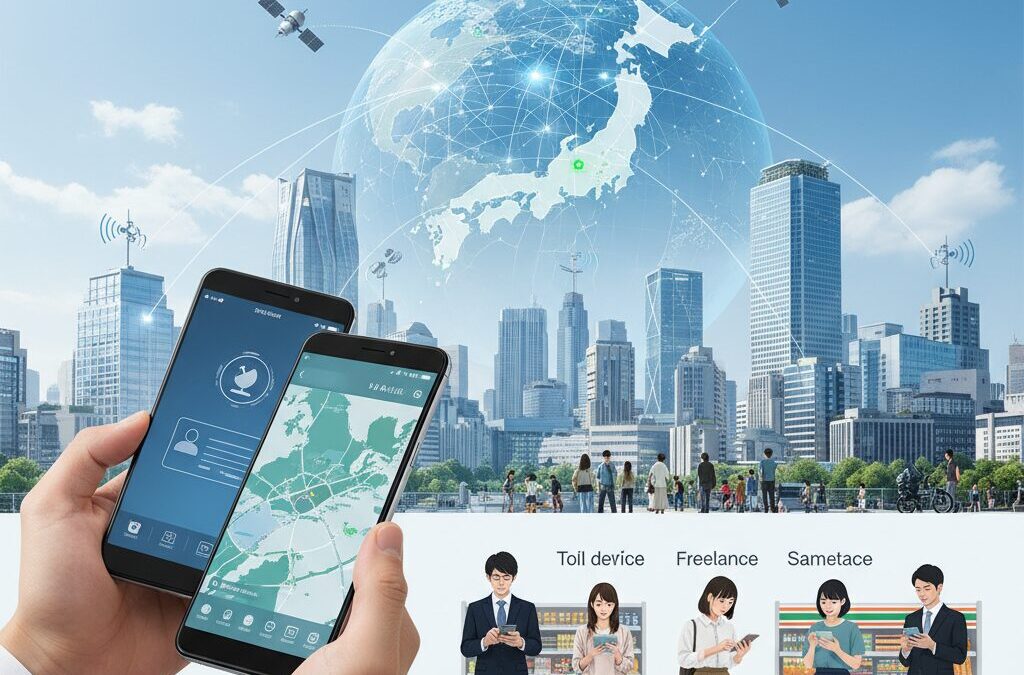
What happens when a country reaches near‑total smartphone adoption and still refuses to stop innovating?
By 2025, smartphones account for 98% of all mobile phones in Japan, transforming the device from a personal gadget into critical social infrastructure. Payments, digital ID, work communication, and even emergency response now assume constant mobile access.
In this fully saturated market, growth no longer comes from first‑time buyers. Instead, it comes from smarter operation: dual‑device ownership, low‑cost SIM combinations, seamless eSIM transfers, and—starting in 2026—direct satellite connectivity from space. Around 16% of users already operate two or more smartphones, led by company employees and freelancers seeking redundancy, privacy separation, and battery security.
At the same time, 5G Standalone networks are becoming the default, trade‑in programs are accelerating upgrade cycles to over 32 million annual shipments, and digital identity integration is raising the stakes of device migration. Satellite partnerships from NTT Docomo, KDDI, SoftBank, and Rakuten are pushing coverage toward 100% of Japan’s landmass, effectively eliminating “no signal” zones.
This article explores how Japan’s 2026 mobile ecosystem is evolving from device ownership to strategic connectivity design—and what global tech enthusiasts can learn from the world’s most advanced dual‑device society.
- From 4% to 98%: How Japan Reached Full Smartphone Saturation
- The Rise of the Dual‑Device User: 16% and Growing
- Work–Life Separation and Digital Identity Management in a Two‑Phone Era
- Why Battery Degradation Drives Over Half of All Upgrades
- Annual Shipments Rebound: Trade‑In Programs and the 32 Million Unit Cycle
- 5G Standalone Becomes the Default: Infrastructure Maturity in 2026
- eSIM Quick Transfer and Frictionless Device Migration
- Digital ID on Smartphones: Security Layers and Migration Complexity
- Satellite Direct‑to‑Smartphone Services: The End of Dead Zones
- Carrier Strategies Compared: Docomo, KDDI, SoftBank, and Rakuten
- Disaster Resilience and Business Continuity Through Multi‑Network Redundancy
- Flagship Devices Built for Multi‑Device Life: The Pixel 10 Case Study
- Migration Fatigue and the Rise of AI‑Assisted Setup
- 参考文献
From 4% to 98%: How Japan Reached Full Smartphone Saturation
In 2010, smartphones accounted for just 4% of mobile phone ownership in Japan. Within fifteen years, that figure surged to 98% by January 2025, according to Japan’s Mobile Society Research Institute. This is not a gradual diffusion story. It is a structural transformation of an entire society in record time.
The journey from 4% to 98% reflects not only consumer preference shifts, but a redesign of national infrastructure around the smartphone.
| Year | Smartphone Penetration | Key Background |
|---|---|---|
| 2010 | 4% | Early iPhone & Android adoption |
| 2015 | Over 50% | Nationwide LTE expansion |
| 2019 | 80% | Cashless payment boom |
| 2021 | Over 90% | Pandemic-driven contactless demand |
| 2025 | 98% | 3G shutdown & digital ID integration |
The first acceleration phase occurred between 2010 and 2015, when LTE networks expanded nationwide. Faster speeds and larger displays made smartphones practical for everyday communication and media consumption. Crossing the 50% mark was critical. Once smartphones became the majority device, service providers began designing primarily for mobile-first usage.
The second leap came around 2019. The explosive growth of QR-code and app-based cashless payments fundamentally changed daily behavior. Smartphones were no longer communication tools; they became wallets. This functional shift pushed late adopters into the ecosystem.
Then came the pandemic. By 2021, penetration exceeded 90%. Remote work, online medical consultations, vaccine reservations, and digital government procedures required smartphone access. According to industry surveys, this period marked the point when smartphones transitioned from convenience devices to social necessities.
The final push toward 98% was driven by structural factors. The phased shutdown of 3G networks forced remaining feature phone users to upgrade. At the same time, the integration of Japan’s My Number digital ID into smartphones made the device a carrier of official credentials. Administrative services increasingly assumed smartphone ownership as a baseline.
Market saturation at 98% does not simply mean everyone owns a device. It signals that government systems, payment networks, and telecom operators now design under the assumption of universal smartphone access. In marketing terms, the TAM for first-time buyers has effectively vanished.
This saturation also represents a qualitative shift. Early growth was hardware-driven. Later expansion was service-driven. The final stage was infrastructure-driven. Each wave reduced the friction of adoption until resistance became impractical.
Japan’s path from 4% to 98% therefore illustrates how technological adoption accelerates when ecosystem alignment occurs. Devices, networks, policy, and social behavior moved in synchrony. When that alignment is achieved, saturation is not just likely. It becomes inevitable.
The Rise of the Dual‑Device User: 16% and Growing
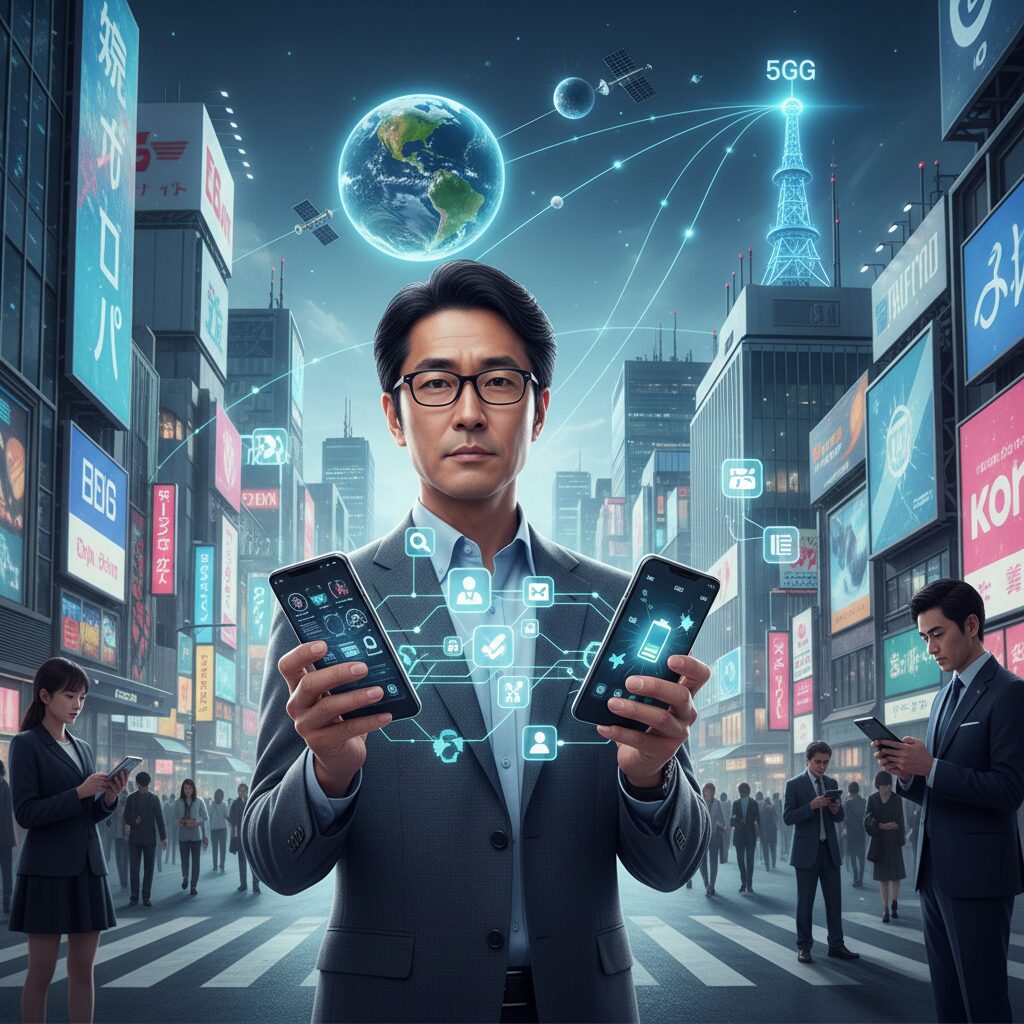
In a market where smartphone penetration has already reached 98%, growth no longer comes from first-time buyers. It comes from behavioral evolution. As of April 2025, 16% of smartphone users in Japan own two or more devices, according to a recent industry survey. That means roughly one in six users has moved beyond the single-device model.
This is not a fringe movement driven only by tech enthusiasts. It reflects a structural shift in how people manage connectivity, identity, and risk in a fully digital society.
| Ownership Type (2025) | Share of Users |
|---|---|
| Single Device | 84% |
| Two or More Devices | 16% |
What makes this 16% particularly significant is the profile of these users. Company employees account for 46.5% of dual-device owners, while self-employed and freelance professionals represent 37.2%. In other words, the rise of the dual-device user is closely tied to modern work structures.
Hybrid work, gig platforms, and client-facing digital operations all demand separation. A corporate-managed device under MDM policies does not offer the same flexibility as a personal handset. For many professionals, physical separation is simpler and safer than juggling multiple profiles on one phone.
Motivations further clarify this transformation. The top reason, cited by 31.0% of users, is functional separation by scenario. Gaming on a high-performance device while keeping communications lightweight on another. Streaming on one, secure banking on another. This is optimization, not redundancy.
Business and private separation follows at 20.7%, reinforcing the need for boundary management in an always-on culture. Meanwhile, 13.8% cite battery failure risk as a reason. In a society where payments, identification, and emergency alerts all rely on smartphones, a dead battery is no longer an inconvenience. It is a disruption of daily infrastructure.
Cost dynamics have also enabled this shift. The same survey shows that 45.5% of dual-device users combine two low-cost SIMs, while 30.9% pair a major carrier with an MVNO. Affordable secondary lines have reduced the barrier to experimentation, allowing users to design their own connectivity stack.
According to shipment forecasts from industry research firms, annual smartphone shipments remain stable at over 30 million units, supported by trade-in programs and structured upgrade cycles. This steady replacement flow creates a natural opportunity for older devices to become secondary units instead of being discarded.
The result is a layered connectivity model. A primary device anchors identity and high-security functions. A secondary device absorbs experimentation, risk, or operational load. In an environment where digital services are embedded into daily life, owning two smartphones increasingly represents resilience, efficiency, and strategic flexibility.
Sixteen percent may appear modest at first glance. But in a fully saturated market, any double-digit behavioral shift signals structural change. The dual-device user is no longer an outlier. They are an early indicator of how advanced digital societies redefine ownership in the age of total connectivity.
Work–Life Separation and Digital Identity Management in a Two‑Phone Era
In a market where 98% of mobile users in Japan already own smartphones, the real shift is no longer about access but about control. As mobile devices have evolved into lifelines for payments, public services, and even digital ID, many users are rethinking how much of their identity should live on a single device.
According to a 2025 survey, 16% of users now operate two or more smartphones, with 20.7% citing complete separation between business and private life as a primary reason. This is not simply about convenience. It is about boundary design in a permanently connected society.
Work–life separation in the two‑phone era is increasingly structured, not accidental. Company employees account for 46.5% of multi‑device users, while self‑employed professionals represent 37.2%, reflecting how modern work styles demand digital compartmentalization.
| Use Case | Primary Device | Identity Scope |
|---|---|---|
| Corporate communication | Company-managed phone | Work email, MDM apps |
| Personal life | Private phone | SNS, banking, digital ID |
| Backup / redundancy | Secondary SIM device | Emergency contact only |
This physical separation reduces cognitive load. When notifications from clients do not appear on a personal device after hours, psychological detachment becomes structurally easier. In an always‑online culture reinforced by 5G SA and emerging satellite connectivity, deliberate friction is sometimes healthier than seamlessness.
Digital identity management has also grown more complex. With My Number Card functionality embedded in smartphones, transferring devices requires strict authentication steps, including NFC reading of the physical card and certificate re‑issuance, as outlined by the official Mynaportal procedures. Because of this rigor, many advanced users adopt a tiered strategy.
This layered approach mirrors enterprise security architecture: core identity assets remain centralized, while peripheral devices access services through tokenized or session‑based permissions. The result is flexibility without diluting security.
Cost structures also influence identity design. With 45.5% of dual‑device users combining low‑cost SIMs, secondary phones are often intentionally “thin” in digital authority. They provide reachability and redundancy, not full personal sovereignty. That distinction becomes critical in theft or loss scenarios, limiting exposure.
Ultimately, the two‑phone era is less about owning more hardware and more about curating digital selves. One device represents your professional persona under policy constraints. The other reflects your autonomous identity, containing your financial, social, and civic presence. Managing these boundaries deliberately is becoming a core digital literacy skill in 2026.
Why Battery Degradation Drives Over Half of All Upgrades
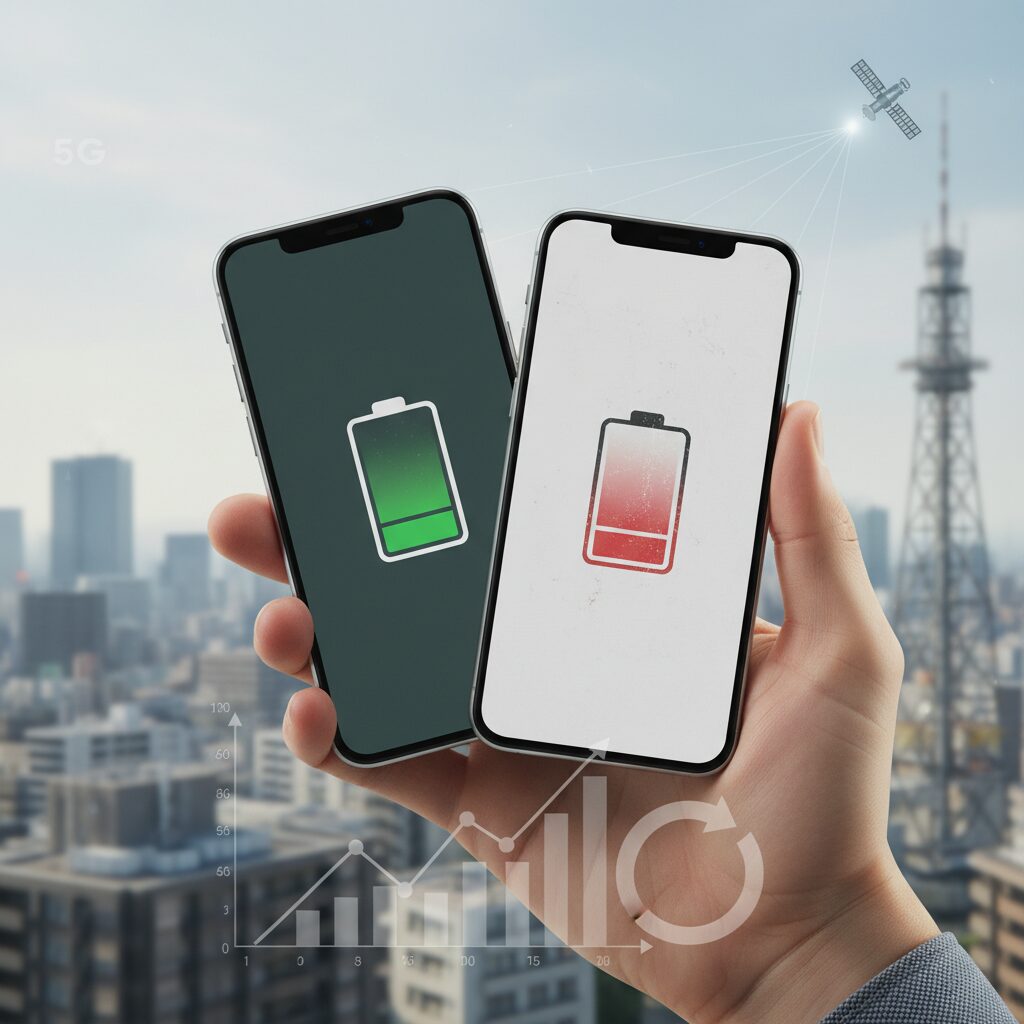
More than half of all smartphone upgrades are no longer driven by dazzling new features. They are driven by something far more fundamental: battery degradation.
According to a 2025 survey by Japan’s Mobile Society Research Institute, 52.1% of users cited battery deterioration as the primary reason for replacing their device. In 2010, that figure was around 30%. The shift is dramatic and tells us that hardware aging, not innovation hype, now dominates upgrade behavior.
| Upgrade Trigger (2025) | Share |
|---|---|
| Battery degradation | 52.1% |
| Device failure or damage | 15.9% |
| Price incentives / campaigns | 10.1% |
| New model release | 8.9% |
This data reveals a crucial insight: upgrades are increasingly reactive rather than aspirational. Users do not necessarily crave the latest chipset or camera. They replace devices because daily usability collapses when a battery no longer lasts a full day.
Modern smartphones consume significantly more power than their predecessors. 5G connectivity, high-refresh-rate displays, on-device AI processing, and constant background synchronization all accelerate charge cycles. Lithium-ion technology, while refined, still degrades with repeated charging. In real-world usage, noticeable capacity loss often appears within two to three years.
When battery health drops below a psychological threshold—often around the point where a phone cannot reliably survive a workday—trust in the device erodes. For business users, missed calls or authentication failures are unacceptable. For everyday consumers, battery anxiety becomes a constant mental burden.
Industry shipment forecasts reinforce this structural pattern. Research cited by major market analysts projects annual domestic handset shipments in the 31–33 million range for 2025–2026, supported by steady replacement demand and trade-in programs. These programs effectively institutionalize the upgrade cycle, aligning financial incentives with the natural lifespan of lithium-ion batteries.
What makes battery degradation so influential is its universality. Performance slowdowns can be tolerated. Cosmetic scratches are cosmetic. But power instability strikes at the core function of a smartphone as a social and administrative lifeline in a country where 98% of mobile users rely on smartphones.
In a fully saturated market, growth no longer comes from first-time buyers. It comes from inevitable physical decline. Battery chemistry, not marketing campaigns, has become the silent engine behind more than half of all upgrades.
Annual Shipments Rebound: Trade‑In Programs and the 32 Million Unit Cycle
Japan’s smartphone market has reached structural saturation, with penetration hitting 98% in 2025 according to the Mobile Society Research Institute. In such an environment, growth no longer comes from first-time buyers. Instead, it is driven by replacement demand and incentive design.
Shipment data reflects this shift clearly. Research cited by MM Research Institute indicates that FY2025 shipments are projected to reach 32.95 million units, up 6.1% year over year, rebounding into the 31–33 million unit range. This recovery is not accidental. It is engineered.
| Fiscal Year | Estimated Shipments | YoY Growth |
|---|---|---|
| FY2024 | Approx. 31 million units | — |
| FY2025 | 32.95 million units | +6.1% |
| FY2026 (forecast) | 31–33 million units range | Stable cycle |
The central mechanism behind this rebound is the widespread adoption of trade-in and residual value programs by major carriers. These programs lower monthly payments by assuming device return after two years, effectively institutionalizing a 24‑month upgrade rhythm.
In a saturated market, upgrade cadence replaces subscriber growth as the primary revenue engine. Carriers are no longer competing to connect new users. They are competing to accelerate device turnover within an already fully connected population.
This structure aligns closely with hardware fatigue realities. The same institute reports that 52.1% of users cite battery degradation as their main reason for replacement in 2025. Devices are not necessarily obsolete in performance terms. They are operationally constrained.
Trade-in programs cleverly convert this inevitability into predictability. When users know they will return a device in two years, psychological resistance to upgrading decreases. The sunk cost narrative disappears, replaced by a subscription-like ownership model.
Another macro factor reinforcing the 32 million unit cycle is the final phase-out of legacy 3G services, including NTT Docomo’s FOMA shutdown scheduled for March 2026. This transition compels remaining legacy users and older device holders to migrate to 5G-compatible models.
By FY2025, 5G smartphones account for 99.5% of shipments, rising to 99.6% in FY2026. The upgrade wave is therefore not about connectivity access, but about generational refresh within the 5G ecosystem, including migration toward 5G Standalone infrastructure.
The rebound in annual shipments is less a boom than a recalibration toward a managed replacement economy. Incentives, residual pricing, battery life cycles, and network transitions now synchronize around a predictable 32 million unit baseline.
For gadget enthusiasts and power users, this cycle means more frequent access to flagship hardware through structured financing. For carriers, it ensures stable ARPU and hardware-linked service retention. For the market as a whole, it signals maturity rather than volatility.
The 32 million unit rhythm represents Japan’s post-saturation equilibrium: a market where innovation alone does not drive volume, but where financial architecture and lifecycle engineering sustain continuous momentum.
5G Standalone Becomes the Default: Infrastructure Maturity in 2026
By 2026, 5G Standalone (SA) is no longer a premium option but the structural default of Japan’s mobile infrastructure.
According to industry shipment forecasts, 5G smartphones account for 99.5% of shipments in FY2025 and 99.6% in FY2026, effectively completing the transition. This shift is not merely about radio access; it reflects the maturation of a fully independent 5G core network.
For users, this means the network itself has evolved from an upgrade layer on 4G to a purpose-built digital backbone.
| Fiscal Year | 5G Smartphone Ratio | Infrastructure Context |
|---|---|---|
| FY2025 | 99.5% | 5G devices mainstreamed nationwide |
| FY2026 | 99.6% | 5G SA becomes operational baseline |
The difference between Non-Standalone (NSA) and Standalone (SA) is architectural. NSA relied partially on 4G cores, whereas SA operates on a dedicated 5G core, enabling ultra-low latency and massive device connectivity by design.
This architectural independence allows carriers to optimize network slicing, edge computing integration, and mission-critical reliability without legacy constraints.
The maturity of SA in 2026 signals that 5G is no longer in transition; it is structurally complete.
The timing is not accidental. NTT Docomo’s scheduled 3G termination in March 2026 accelerates legacy network sunset, forcing a final migration wave toward fully 5G-capable devices and infrastructure.
Shipment growth of over 6% year-on-year, supported by trade-in programs, reinforces this hardware refresh cycle, ensuring compatibility with SA-optimized networks.
As research firms note, this synchronized upgrade of device and core infrastructure creates a rare moment of systemic alignment.
Infrastructure maturity also intersects with non-terrestrial network expansion. In 2026, major carriers move forward with HAPS and satellite direct connectivity initiatives, integrating them with terrestrial 5G cores.
Because SA architecture is cloud-native and modular, it accommodates these space-based extensions more seamlessly than legacy cores could.
In practical terms, SA becomes the control tower orchestrating both ground and space connectivity.
For gadget enthusiasts, the implication is subtle but profound. Improvements are no longer measured solely by peak speed, but by consistency, latency stability, and resilience under congestion.
Applications that depend on real-time AI processing, secure digital identity verification, or simultaneous multi-device coordination benefit directly from SA’s deterministic performance characteristics.
As mobile research institutes have observed, infrastructure stability now underpins the qualitative evolution of device usage patterns.
By 2026, 5G SA is not marketed as a breakthrough feature because it has become invisible infrastructure. Its success lies in disappearing into the background while enabling everything else to scale.
When nearly every newly shipped smartphone is SA-capable and legacy networks are phased out, the market reaches a point of infrastructural equilibrium.
5G Standalone becomes the quiet default—an unseen but decisive foundation for the next phase of mobile evolution.
eSIM Quick Transfer and Frictionless Device Migration
In 2026, device upgrades are no longer occasional events but structural necessities. With annual shipments projected at around 32 million units and 5G smartphones accounting for over 99% of the market, migration has become a routine lifecycle step rather than a special task. Against this backdrop, eSIM Quick Transfer fundamentally redefines how users move between devices.
Physical SIM swapping once represented the most visible friction in a device change. Users needed ejector pins, carrier activation steps, and sometimes in-store verification. Today, with eSIM standardized across flagship models such as the latest Pixel series and many iPhone and Android devices, subscription credentials are provisioned digitally and transferred through OS-level workflows.
From Physical Constraint to Software-Orchestrated Mobility
| Aspect | Physical SIM Era | eSIM Quick Transfer Era |
|---|---|---|
| Carrier Visit | Often required | Typically unnecessary |
| Hardware Handling | SIM tray removal | No physical interaction |
| Transfer Time | Manual, multi-step | Few taps within OS |
With eSIM Quick Transfer, users can move their primary line from an old device to a new one in minutes, directly on-screen. This is particularly meaningful in Japan’s saturated 98% smartphone ownership environment, where replacement is driven less by novelty and more by battery degradation and lifecycle programs.
For dual-device users—16% of the population as of 2025—this shift is transformative. Instead of treating a secondary device as permanently tied to a secondary line, users can dynamically reassign connectivity. A business user may migrate the main line to a secure work handset during weekdays, then shift it back to a personal flagship over the weekend.
This portability aligns with broader infrastructure evolution. As major Japanese carriers roll out satellite-direct communication and HAPS-based networks in 2026, the ability to shift a line instantly between compatible devices strengthens resilience strategies. A user can migrate their active subscription to a fully charged backup handset during emergencies without waiting for physical reconfiguration.
At the same time, frictionless migration does not mean weaker security. Government-backed digital ID integration, including smartphone-based My Number Card functionality, still requires strict reissuance and NFC-based verification when changing devices. This layered approach—easy carrier transfer, rigorous identity validation—reflects a deliberate balance between usability and trust.
Industry analysts have described growing “migration fatigue” among users facing repeated upgrades driven by battery wear or trade-in cycles. OS-level automation directly addresses this pain point. Modern Android implementations, for example, restore apps, Wi-Fi credentials, and even eSIM profiles in a unified onboarding flow, minimizing manual reconfiguration.
For power users operating across ecosystems or maintaining business and private separation, this evolution enables a new operational model. Rather than planning migrations as disruptive events, users can treat devices as modular endpoints. Hardware becomes interchangeable, while the subscription, data environment, and digital identity remain continuous.
In practical terms, eSIM Quick Transfer turns device migration from a logistical task into a software routine. In a market defined by saturation, redundancy, and infrastructure innovation, that reduction in friction is not merely convenience—it is the foundation of agile, multi-device living.
Digital ID on Smartphones: Security Layers and Migration Complexity
As smartphones have become the default infrastructure for payments, public services, and identity verification, digital IDs stored on devices are no longer optional features. In Japan, where smartphone penetration has reached 98% in 2025 according to the Mobile Society Research Institute, the device itself now functions as a personal authentication hub. This structural shift fundamentally changes how security layers and migration processes must be designed.
A digital ID on a smartphone is protected not by a single lock, but by multiple stacked security mechanisms. These layers operate at hardware, OS, and procedural levels, especially when government-issued credentials such as the My Number Card are integrated into the device.
| Layer | Function | Security Role |
|---|---|---|
| Secure Hardware (Secure Element) | Isolated storage of certificates | Prevents extraction even if OS is compromised |
| OS-Level Encryption | Full-device data encryption | Protects stored credentials at rest |
| Biometric / PIN Authentication | User verification | Prevents unauthorized access |
| Procedural Re-issuance | NFC card verification | Blocks remote identity hijacking |
The migration complexity emerges precisely because these protections are intentionally strict. According to the official MyNaPortal procedures, changing devices requires password authentication for the signing certificate, NFC reading of the physical My Number Card, and re-issuance of digital certificates on the new handset. This multi-step process may feel cumbersome, but it is designed to prevent impersonation in cases of theft or loss.
Convenience is deliberately sacrificed at key points to preserve legal-grade identity assurance. Unlike transferring photos or apps, digital IDs cannot simply be backed up and restored through cloud sync. The certificate must be invalidated on the old device before activation on the new one, ensuring that only one trusted endpoint exists at a time.
In a market where 16% of users operate multiple smartphones as of April 2025, this introduces a new strategic decision: which device should hold the primary digital identity? Security-conscious users increasingly adopt a tiered model, concentrating government IDs on a main device equipped with a strong security chip, while secondary devices rely on app-level authentication tokens rather than storing core certificates.
Experts in mobile security often point out that migration fatigue grows as authentication steps multiply. Yet this friction is not accidental. It reflects a policy-level recognition that a smartphone is now equivalent to a wallet containing legal credentials, banking access, and health insurance data. The more society depends on digital ID, the more controlled its transfer must be.
As 5G SA becomes nearly universal in shipments by 2026 and eSIM transfers become seamless, the contrast is striking: connectivity moves instantly, but identity moves cautiously. This asymmetry defines the modern smartphone era. Network access is fluid, but legal identity remains tightly anchored to verified hardware.
For gadget enthusiasts and power users, understanding these layered defenses is essential. Migration is no longer just a technical setup process; it is a regulated identity handover. The sophistication of digital ID security on smartphones is not a limitation—it is a deliberate architecture built for a society that runs on mobile authentication.
Satellite Direct‑to‑Smartphone Services: The End of Dead Zones
For decades, “No Service” has been an unavoidable reality of mobile life. Mountain trails, offshore waters, disaster zones, and even rural highways have all exposed the structural limits of terrestrial base stations. In 2026, however, satellite direct‑to‑smartphone services are redefining that boundary, turning the sky itself into part of the cellular network.
The shift is not about niche satellite phones anymore. It is about ordinary smartphones connecting directly to space. Japan’s four major carriers have all moved toward commercializing satellite or HAPS-based direct communication, fundamentally changing what coverage means.
| Carrier | Technology | Commercial Timeline |
|---|---|---|
| NTT Docomo | HAPS (stratospheric platform) | FY2026 |
| KDDI | Starlink Direct | From April 2025 |
| SoftBank | LTA-type HAPS | 2026 |
| Rakuten Mobile | AST SpaceMobile | Q4 2026 |
According to industry reporting by ITmedia, each operator is building a non‑terrestrial network layer that complements ground infrastructure. This multi-layered architecture—combining terrestrial base stations, low Earth orbit satellites, and stratospheric platforms—creates redundancy at a national scale.
KDDI’s partnership with Starlink is particularly symbolic. The company aims for 100% population coverage by enabling compatible smartphones to connect directly to satellites when terrestrial signals are unavailable. The critical point is that users do not need a specialized satellite handset. The existing device in your pocket becomes space-capable.
Rakuten Mobile, working with AST SpaceMobile, targets 100% area coverage across Japan by late 2026. By transmitting terrestrial spectrum from space, it allows standard smartphones to receive broadband connectivity from orbit. This approach reframes coverage from “where towers exist” to “where the sky is visible.”
NTT Docomo and SoftBank are advancing HAPS—high-altitude platform stations positioned roughly 20 kilometers above Earth. Compared to traditional satellites, HAPS can offer lower latency and flexible deployment, especially valuable when earthquakes or typhoons damage ground infrastructure.
The implications extend far beyond convenience. During the 2024 Noto Peninsula earthquake, temporary satellite systems played a critical role when fiber lines and base stations were disrupted. With direct‑to‑smartphone capability, individuals no longer depend solely on emergency installations. Their personal devices become self-contained lifelines.
Dead zones are transforming from a geographic inevitability into a solvable engineering problem. For hikers, maritime workers, rural residents, and disaster-response teams, continuous connectivity shifts from luxury to baseline expectation.
There is also a psychological dimension. The assurance that a message, location signal, or emergency alert can be transmitted from virtually anywhere enhances what safety researchers describe as perceived security. In a society where smartphones function as digital IDs, payment tools, and communication hubs, eliminating dead zones strengthens the resilience of the entire social infrastructure.
Satellite direct‑to‑smartphone services in 2026 do not replace terrestrial networks; they complete them. The result is a communications environment where coverage is no longer defined by towers on the horizon, but by an integrated network extending from the ground to the stratosphere and beyond.
Carrier Strategies Compared: Docomo, KDDI, SoftBank, and Rakuten
As Japan’s smartphone penetration has reached 98% by 2025 according to the Mobile Society Research Institute, competition among Docomo, KDDI, SoftBank, and Rakuten has shifted from subscriber growth to network resilience, multi-device optimization, and satellite integration. Each carrier is redefining what “coverage” and “backup” truly mean in 2026.
For gadget enthusiasts and dual-device users, the strategic differences are no longer just about pricing tiers. They now directly affect how you design your personal communication redundancy.
| Carrier | Core 2026 Strategy | Satellite / HAPS Approach | Key Value Focus |
|---|---|---|---|
| NTT Docomo | Multi-layer network (ground + sky) | HAPS + satellite integration | Low latency & infrastructure depth |
| KDDI (au) | Nationwide 100% coverage goal | Starlink Direct | Direct-to-smartphone connectivity |
| SoftBank | Disaster-resilient deployment | LTA-type HAPS | Rapid area recovery |
| Rakuten Mobile | Area coverage differentiation | AST SpaceMobile | Space-based broadband |
Docomo’s approach is the most infrastructure-heavy. ITmedia reports that NTT aims to commercialize HAPS within fiscal 2026, creating a layered architecture combining terrestrial networks, low-earth orbit satellites, and stratospheric platforms. This design emphasizes low latency and redundancy across multiple altitude layers, appealing to enterprise users and professionals who prioritize stability over promotional pricing.
KDDI takes a more consumer-visible route. Its partnership with SpaceX enables “au Starlink Direct,” rolling out from April 2025 and maturing through 2026. The defining feature is that existing smartphones can connect without special satellite hardware. The company publicly targets 100% area coverage, reframing connectivity as a default right rather than a premium add-on.
SoftBank positions resilience as its core strength. By using LTA-type high-altitude platforms, it can reconstruct coverage zones quickly if ground base stations fail. For business continuity planning, this rapid deployability becomes strategically significant. In a disaster-prone country, speed of restoration may matter more than raw bandwidth.
Rakuten Mobile, partnering with AST SpaceMobile, plans to launch direct satellite service in Q4 2026. Its differentiation lies in transmitting terrestrial spectrum directly from space, aiming for full national area coverage. Rakuten frames this as “space-quality broadband,” targeting users who value bold technological disruption and cost-performance balance.
Strategically, Docomo emphasizes architectural depth, KDDI emphasizes universal reach, SoftBank emphasizes operational agility, and Rakuten emphasizes disruptive expansion. For multi-device users, combining different infrastructures—such as terrestrial-heavy Docomo with satellite-forward Rakuten—creates practical communication multihoming.
In 2026, choosing a carrier is no longer just about monthly fees. It is about which layer of the sky you trust when the ground disappears, and how that choice fits into your personal redundancy strategy.
Disaster Resilience and Business Continuity Through Multi‑Network Redundancy
In 2026, multi-network redundancy has evolved from a niche strategy into a practical foundation for disaster resilience and business continuity. With smartphone penetration reaching 98% in Japan, mobile connectivity now underpins digital ID, payments, and daily operations. When communication fails, economic and social functions stall immediately.
The commercialization of satellite and HAPS-based direct-to-smartphone services by all four major carriers fundamentally changes the risk equation. According to industry coverage reported by ITmedia, NTT Docomo, KDDI, SoftBank, and Rakuten Mobile are each advancing non-terrestrial network services that complement terrestrial base stations.
Natural disasters have repeatedly demonstrated the fragility of ground infrastructure. During the 2024 Noto Peninsula earthquake, physical base stations and fiber links were disrupted, creating isolated communication zones. In 2026, however, compatible smartphones can connect directly to satellite or stratospheric platforms, reducing dependence on damaged terrestrial assets.
For business users, this enables a layered continuity model:
| Layer | Primary Role | Failure Scenario Coverage |
|---|---|---|
| Terrestrial 5G SA | High-speed daily operations | Normal conditions |
| HAPS (Stratospheric) | Low-latency wide coverage | Regional ground disruption |
| LEO Satellite Direct | Nationwide fallback link | Large-scale infrastructure failure |
This architecture mirrors enterprise-grade multi-homing strategies long used in data centers. Now, individuals and SMEs can replicate similar redundancy simply by combining different carrier infrastructures across two devices.
KDDI’s collaboration with Starlink aims at nationwide coverage wherever the sky is visible, while Rakuten Mobile’s partnership with AST SpaceMobile targets 100% area coverage via large communication satellites. Docomo and SoftBank are advancing HAPS-based systems that deliver lower latency from the stratosphere. The technological diversity itself is the resilience.
For business continuity planning (BCP), the key is infrastructural independence rather than brand diversification. Two SIMs on the same terrestrial backbone do not provide the same protection as combining ground 5G with a non-terrestrial fallback.
Psychologically, constant connectivity also enhances perceived safety. Earlier surveys showed 13.8% of dual-device users cited battery redundancy as motivation. In 2026, that logic expands to network redundancy: ensuring that critical communications, digital identity authentication, and cloud access remain available even under extreme conditions.
For field professionals, logistics operators, remote-site engineers, and even frequent mountain hikers, multi-network setups are becoming standard operational equipment. Communication resilience is shifting from optional insurance to baseline infrastructure.
In a society where smartphones function as digital wallets, ID carriers, and authentication keys, downtime is not inconvenience but operational paralysis. Multi-network redundancy transforms personal devices into distributed lifelines, ensuring that when one layer fails, another silently takes over.
Flagship Devices Built for Multi‑Device Life: The Pixel 10 Case Study
In a market where 98% of mobile users already own a smartphone, as Japan’s Mobile Society Research Institute reports for 2025, the question is no longer who needs a smartphone, but how many and how intelligently they should be operated. In this context, flagship devices are evolving beyond raw performance and are being engineered for multi‑device life.
The Pixel 10 series, including Pixel 10 Pro XL and Pixel 10 Pro Fold, illustrates this structural shift. Rather than assuming a single‑device lifestyle, it is designed to coexist with secondary phones, tablets, and even satellite‑enabled backup lines.
The modern flagship is no longer a standalone hero device; it is the control hub of a personal, redundant communications network.
One of the clearest examples is advanced eSIM integration. As domestic eSIM adoption accelerates in 2026, supported by quick transfer features at the OS level, users can move a line between devices in minutes. For the 16% of users who already operate two or more smartphones, this means a Pixel 10 can dynamically become a main or backup device depending on context.
For instance, a business user may shift their primary line to a Fold model during travel for productivity, then revert to a lighter device on weekends. This flexibility directly addresses the 31.0% of multi‑device users who cite “use‑case separation” as their main motivation, according to April 2025 survey data.
| Multi‑Device Need | Pixel 10 Capability |
|---|---|
| Business/Private Separation (20.7%) | Dual SIM (eSIM + physical) with improved power efficiency |
| Battery/Line Redundancy (13.8%) | Seamless handoff and fast eSIM transfer |
| Ecosystem Flexibility (6.9%) | Deep Android multi‑device integration |
Security architecture is another critical pillar. With My Number Card digital integration becoming standard in 2026, device trust is no longer optional. The migration process requires strict authentication steps, including NFC verification of the physical card, as outlined by the official MyNa Portal documentation. In this environment, hardware‑level isolation for digital certificates becomes a decisive differentiator.
The Pixel 10 series responds by strengthening secure elements and authentication layers, enabling users to centralize sensitive digital ID on a primary device while maintaining operational flexibility on a secondary unit. This supports the emerging “tiered management” model among high‑literacy users: one device as identity vault, another as operational tool.
Connectivity resilience also defines the flagship of 2026. With Japan’s four major carriers commercializing satellite and HAPS‑based direct communication, smartphones are becoming terminals in a multi‑layered infrastructure. A Pixel 10 paired with a satellite‑enabled secondary line effectively creates personal network redundancy across terrestrial and non‑terrestrial systems.
Industry analysts note that shipment volumes are projected to remain above 30 million units annually through 2026, driven by trade‑in programs and 5G SA standardization. In such a replacement‑driven market, differentiation depends on how frictionless migration and multi‑device orchestration feel. Reducing migration fatigue is now as important as increasing benchmark scores.
Ultimately, the Pixel 10 case demonstrates that flagship status in 2026 is defined less by peak specs and more by systemic intelligence. It is about enabling fluid identity transfer, cost‑optimized dual‑line operation, and infrastructure‑level redundancy. For power users who treat connectivity as lifeline rather than luxury, this multi‑device readiness is the real premium feature.
Migration Fatigue and the Rise of AI‑Assisted Setup
As device upgrades accelerate and multi‑device ownership rises, a new psychological barrier is emerging: migration fatigue. In a market where 98% of mobile users already own smartphones, according to Japan’s Mobile Society Research Institute, growth no longer comes from first‑time adoption but from repeated replacement and parallel device operation.
Each replacement is no longer a simple data copy. It involves financial apps, biometric authentication, eSIM profiles, and in many cases digital ID credentials linked to government services. The cumulative cognitive load is significant, especially when upgrades are driven not by desire but by necessity such as battery degradation, which 52.1% of users cite as the primary reason for switching devices.
The complexity is structural. Consider what typically must be reconfigured during a 2026 device change.
| Category | Migration Task | Risk if Incomplete |
|---|---|---|
| Connectivity | eSIM transfer or re‑provisioning | Loss of primary line access |
| Identity | Digital ID re‑issuance via NFC card authentication | Service lockout |
| Finance | Payment app re‑authentication | Transaction failure |
| Security | Biometric and 2FA setup | Account vulnerability |
According to official My Number Portal procedures, transferring a smartphone‑embedded digital ID requires password authentication and physical NFC reading of the card before re‑issuing certificates on the new device. This multi‑step process is intentionally strict for security reasons, but it adds friction to every upgrade cycle.
For multi‑device users, who now account for 16% of the population, the challenge doubles. Which device holds the digital ID? Which line is primary? Which device receives financial authentication tokens? The more redundancy users build into their communication infrastructure, the more configuration overhead they must manage.
This is where AI‑assisted setup is becoming transformative. Rather than merely restoring apps, next‑generation OS environments analyze behavioral patterns, preferred network settings, and authentication habits to pre‑configure the new device. Instead of asking users to remember dozens of manual steps, the system predicts them.
The shift is from data transfer to environment reconstruction. AI does not just move files; it re‑creates usage context. Frequently contacted numbers are prioritized, notification hierarchies are rebuilt, and dual‑SIM preferences are restored based on historical patterns.
Google’s ecosystem evolution illustrates this direction. As eSIM adoption expands across flagship Android devices, transfer flows increasingly occur directly between devices without carrier intervention. AI layers then optimize which line is default for data, which apps are tied to which number, and how battery profiles are tuned for multi‑device coordination.
For older users in particular, this automation addresses a real barrier. Industry analysts have pointed out that upgrade hesitation often stems from fear of “losing something important.” AI‑guided step‑by‑step interfaces reduce uncertainty by verifying critical services—banking, ID, messaging—before deactivating the old device.
There is also a resilience dimension. In a market moving toward satellite‑backed connectivity and redundant lines, AI can assist in intelligently distributing roles across devices: one optimized for secure identity storage, another for communication redundancy. Rather than forcing users to manually architect this hierarchy, the system suggests best practices based on risk profiles.
Migration fatigue is therefore not a sign of technological failure, but of ecosystem maturity. As smartphones become lifelines—handling payments, authentication, and emergency communication—their transition must be treated with the same seriousness as infrastructure switchover.
AI‑assisted setup reduces friction without weakening security, enabling users to embrace multi‑device strategies without being paralyzed by configuration complexity. In 2026, the competitive advantage is no longer just hardware innovation, but how seamlessly a digital identity can move—securely, predictably, and intelligently—from one device to the next.
参考文献
- Mobile Society Research Institute:Smartphone Ratio in Japan: From 4% in 2010 to 98% in 2025
- DreamNews:April 2025 Survey on Multiple Smartphone Ownership – 16% Own Two or More Devices
- Sugoi Hikaku:Latest Survey on Multiple Smartphone Ownership (April 2025)
- MM Research Institute:Smartphone Shipments Increase 8.3% Driven by Trade‑In Programs
- WiFi Rental Honpo:2026 Latest Edition: eSIM Compatible Devices in Japan
- My Number Portal:Procedures for Changing Smartphones
- ITmedia Mobile:Explaining the Space Strategies of NTT, KDDI, SoftBank, and Rakuten Mobile
- All Connect Magazine:Rakuten’s Strongest Satellite Service: Nationwide Smartphone Satellite Launch in 2026