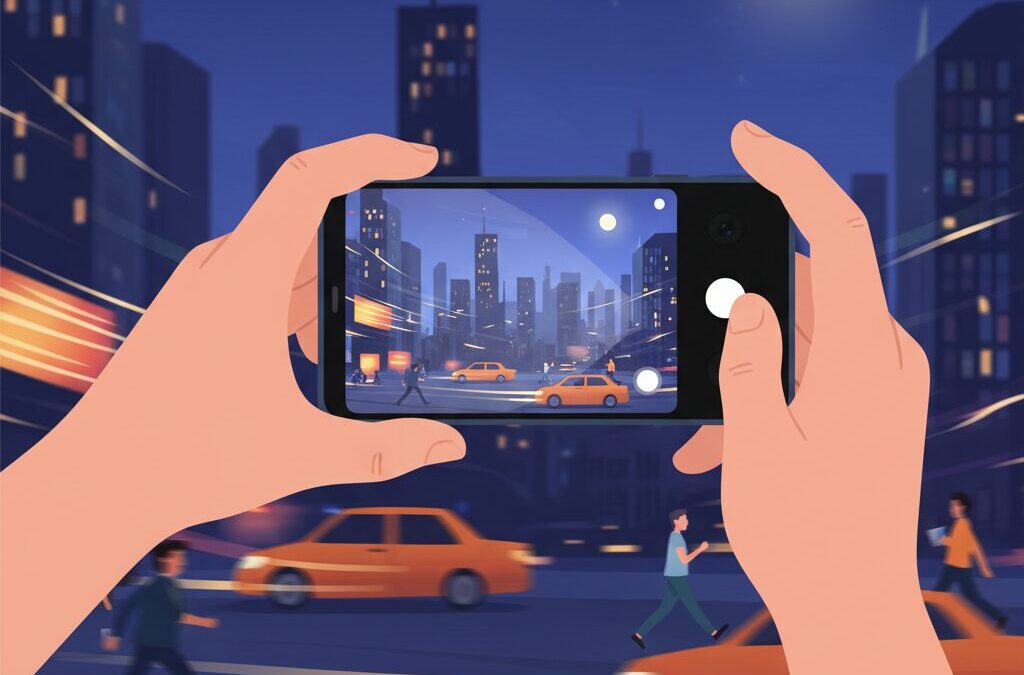
Have you ever tried to capture a perfect night moment, only to realize later that the photo looks nothing like what you saw with your own eyes?
For many gadget enthusiasts, smartphone cameras have reached a point where daytime photography feels almost “solved.” However, once the sun goes down and subjects start moving, the story changes dramatically. This is exactly where the Google Pixel 10 series positions itself as both a bold innovator and a controversial experiment.
The Pixel 10 lineup introduces major changes, including a new Tensor G5 chip manufactured on TSMC’s 3nm process and a redesigned camera hardware strategy that clearly separates the base model from the Pro variants. On paper, these upgrades promise better efficiency, smarter AI, and stronger computational photography. In real-world night scenes with moving subjects, though, unexpected limitations and visual failures can still appear.
In this article, you will discover why night photography with motion remains one of the hardest challenges in smartphone imaging, how Pixel 10 attempts to solve it with AI and cloud processing, and where physics still refuses to cooperate. By understanding these strengths and weaknesses, you will be able to decide whether the Pixel 10 series truly fits your shooting style and expectations.
- Why Night Photography With Motion Is the Ultimate Smartphone Camera Test
- Pixel 10 Series Hardware Changes That Redefined Light Capture
- Sensor Size Differences Between Pixel 10 and Pixel 10 Pro Explained
- Tensor G5 and the New Image Signal Processor: Real Gains and Real Limits
- How Face Unblur Works at Night and Where It Starts to Fail
- The Hidden Trade-offs of 50MP Mode in Low-Light Action Scenes
- Night Video Problems: EIS Jitter, Ghosting, and Motion Artifacts
- The Orb Phenomenon: When AI Enhances Light Too Much
- Pixel 10 Pro vs iPhone 17 Pro: Two Very Different Camera Philosophies
- Video Boost and Cloud Processing: A Powerful Feature With Serious Drawbacks
- 参考文献
Why Night Photography With Motion Is the Ultimate Smartphone Camera Test
Night photography with motion is widely regarded as the ultimate smartphone camera test because it forces hardware physics and computational photography to collide under the harshest conditions. **Low light drastically reduces the number of photons reaching the sensor**, while moving subjects demand fast shutter speeds that directly contradict the need for longer exposure. This contradiction is where many smartphone cameras reveal their true limitations.
According to imaging research frequently cited by organizations such as IEEE and MIT Media Lab, image quality in low light is fundamentally governed by signal-to-noise ratio. When a subject moves, the camera must either raise ISO, increasing noise, or slow the shutter, increasing motion blur. Smartphones, constrained by sensor size and lens diameter, cannot escape this trade-off.
| Challenge | Technical Constraint | Typical Failure |
|---|---|---|
| Low illumination | Photon shortage | Color noise, loss of detail |
| Subject motion | Shutter speed limits | Motion blur, ghosting |
| Hand movement | Stabilization latency | Jitter, warped highlights |
Modern smartphones attempt to overcome these limits with multi-frame fusion and AI-based reconstruction. Google’s HDR+ and similar systems capture several frames before and after the shutter press, then merge them into a single image. **This works remarkably well for static scenes**, but motion breaks the assumption that pixels align cleanly across frames.
Night scenes with children, pets, or passing cars are especially punishing. Even advanced features like face-priority deblurring can only correct limited regions, often leaving limbs or backgrounds unnaturally smeared. Researchers in computational photography note that these artifacts are not simple bugs but the visible edge of algorithmic inference replacing missing data.
In this sense, night photography with motion is not just a usage scenario but a stress test. It exposes sensor size choices, readout speed, ISP throughput, and the maturity of motion-aware algorithms in one shot. **If a smartphone performs well here, it is very likely robust in almost every other photographic situation**.
Pixel 10 Series Hardware Changes That Redefined Light Capture

The Pixel 10 Series marks a clear hardware pivot in how Google approaches light capture, and this shift is most visible when you examine the physical components rather than the algorithms layered on top.
While computational photography still plays a central role, **the ability to gather light at the sensor level has been deliberately rebalanced between the Pro and non‑Pro models**, redefining what each device can realistically achieve in low‑light and motion‑heavy scenes.
| Model | Main Sensor Size | Resolution | Optical Impact |
|---|---|---|---|
| Pixel 10 Pro / Pro XL | 1/1.3 inch class | 50MP Octa PD | High photon intake, stable S/N ratio |
| Pixel 10 | 1/2.0 inch | 48MP Quad PD | Reduced light per pixel, higher amplification |
The Pro models retain a large 1/1.3‑inch class sensor paired with an f/1.68 lens, a combination that continues Google’s long‑standing philosophy of maximizing photon collection before software intervention.
According to analyses published by GSMArena and Google’s own hardware disclosures, **this sensor size directly improves signal‑to‑noise ratio and allows faster shutter speeds under the same illumination**, which is critical when freezing movement at night.
In contrast, the base Pixel 10 adopts a noticeably smaller 1/2.0‑inch sensor. On paper the difference may seem modest, but in practice the effective light‑gathering area drops to well under two‑thirds of the Pro model.
Physics leaves little room for negotiation here. **When fewer photons hit the sensor, the system must either extend exposure time or raise ISO**, both of which increase the risk of motion blur or noise before AI correction even begins.
This divergence explains why early hands‑on evaluations describe the Pixel 10 Pro as maintaining composure in dim, dynamic scenes, while the standard Pixel 10 reaches its limits more quickly despite sharing similar software features.
Light capture is also influenced by processing throughput, and this is where Tensor G5 becomes a quiet but meaningful enabler.
Manufactured on TSMC’s 3nm process, Tensor G5 delivers markedly higher efficiency than previous generations, allowing the integrated ISP to handle multi‑frame HDR, RAW‑domain noise reduction, and tone mapping with less thermal constraint.
Google states that CPU performance improves by roughly 34 percent and TPU workloads by up to 60 percent generation over generation, figures echoed by independent benchmarks cited by Android Authority.
However, **this additional compute does not create light that the sensor never captured**. Instead, it determines how faithfully the captured photons can be preserved, aligned, and enhanced before artifacts appear.
From a hardware perspective, the series does not merely iterate. It draws a sharper line between devices designed to absorb light effortlessly and those designed to compensate intelligently when light is scarce.
This redefinition of light capture sets the boundaries within which every computational feature must operate, making hardware once again the first and final gatekeeper of image quality.
Sensor Size Differences Between Pixel 10 and Pixel 10 Pro Explained
One of the most debated hardware changes in the Pixel 10 lineup lies in the difference in main camera sensor size between the standard model and the Pro variants. This gap is not a minor specification detail, but a structural distinction that directly affects how light is captured, especially in challenging scenes.
The Pixel 10 Pro and Pro XL retain a large 1/1.3-inch class 50MP sensor, while the standard Pixel 10 moves to a significantly smaller 1/2.0-inch 48MP sensor. According to GSMArena and Google’s official specifications, this represents a reduction of more than 50 percent in total light-gathering surface area.
| Model | Main Sensor Size | Resolution |
|---|---|---|
| Pixel 10 Pro / Pro XL | 1/1.3-inch class | 50MP |
| Pixel 10 | 1/2.0-inch | 48MP |
From a physics standpoint, a larger sensor collects more photons per exposure. Imaging science research, including analyses cited by IEEE and camera engineering texts, consistently shows that increased sensor area improves signal-to-noise ratio and allows faster shutter speeds at the same exposure level.
In practical terms, this means the Pro models can maintain higher image quality without aggressively raising ISO sensitivity. The standard Pixel 10 reaches its noise and motion-blur limits much earlier, because the smaller sensor forces the camera system to compensate either by amplifying noise or slowing the shutter.
Google’s computational photography, powered by Tensor G5, does mitigate some of this gap. However, as Google engineers themselves have acknowledged in Pixel camera briefings, software cannot fully override the physical constraints of sensor size. The result is a clear divergence in low-light and motion performance that stems directly from this sensor decision.
Tensor G5 and the New Image Signal Processor: Real Gains and Real Limits

The move to Tensor G5 marks a genuine architectural reset for Pixel 10, and the most meaningful changes appear in its new Image Signal Processor. Fabricated on TSMC’s 3nm process, Tensor G5 delivers clear gains in sustained performance and efficiency, which directly affect how long and how consistently the camera pipeline can run without thermal throttling. According to Google’s own disclosures and independent benchmark analysis reported by Android Authority, CPU performance improves by roughly 34 percent generation over generation, while TPU throughput rises by up to 60 percent. For imaging, this headroom matters less for peak speed and more for stability.
The redesigned ISP is built around tighter integration with memory bandwidth and on-device AI models, enabling faster handoff between RAW data, HDR+ stacking, and early-stage noise reduction. In practical terms, this allows Pixel 10 to perform multi-frame HDR and tone mapping with lower latency than Tensor G4, especially in challenging lighting where many frames must be evaluated. GSMArena’s camera analysis notes that exposure convergence is faster, reducing the risk of blown highlights when shooting night scenes with mixed light sources.
| Aspect | Tensor G4 | Tensor G5 |
|---|---|---|
| Process node | Samsung 4nm | TSMC 3nm |
| ISP throughput | Limited under sustained load | Higher, more stable |
| On-device AI noise reduction | Post-capture heavy | Earlier in pipeline |
These gains translate into real-world benefits. Continuous shooting in low light shows fewer dropped frames, and preview stutter is reduced compared with earlier Pixels. Reviewers from Tech Advisor have pointed out that color consistency frame to frame is more reliable, particularly in 10-bit HDR video, suggesting that the ISP’s per-frame tone mapping is now less reactive and more predictive.
However, the limits are just as real. No ISP, regardless of process node, can override photon scarcity or sensor readout constraints. Tensor G5 still struggles when asked to process extremely noisy data in real time, which explains why features like Night Sight Video lean on cloud-based Video Boost. Google Research has long emphasized that denoising effectiveness scales nonlinearly with compute, and the gap between on-device and data-center processing remains substantial.
There is also a latency trade-off. While the ISP can handle more complex models earlier, doing so increases buffer pressure at high resolutions. This is most visible in modes that push sensor readout to its limits, where shutter responsiveness degrades despite the faster chip. In other words, Tensor G5 makes Pixel 10 more capable and more consistent, but it does not make it limitless. It sharpens the edge of computational photography, yet the edge still stops where physics begins.
How Face Unblur Works at Night and Where It Starts to Fail
Face Unblur is one of Google’s most distinctive computational photography features, and at night it works in a way that is both clever and fragile. The system does not simply sharpen a blurry face after the fact. Instead, it captures two streams at the same moment: a long-exposure frame from the main camera to gather light, and a short-exposure frame from the ultra-wide camera to freeze motion. These are then fused so that facial details come from the sharper frame while overall brightness comes from the longer exposure.
This dual-camera strategy is why Face Unblur can succeed in situations where conventional night modes fail, such as photographing children indoors under dim lighting. According to explanations from Google engineers and analyses cited by outlets like Android Police, the algorithm prioritizes facial landmarks detected by on-device machine learning and selectively replaces blurred regions with sharper data, instead of applying uniform deblurring.
| Element | Main Camera | Ultra-wide Camera |
|---|---|---|
| Exposure | Long (low shutter speed) | Short (high shutter speed) |
| Purpose | Brightness and low noise | Freeze facial motion |
| Used for | Background and tone | Face detail reconstruction |
However, this design also defines where Face Unblur starts to fail at night. The first limitation is purely physical. When ambient light drops below a certain threshold, even the ultra-wide camera cannot maintain a sufficiently fast shutter speed without pushing ISO to extreme levels. At that point, the “sharp” reference frame itself becomes noisy or motion-blurred, leaving the algorithm with nothing reliable to merge.
A second failure point appears when subject motion is uneven. Reviews from GSMArena and user reports aggregated by Google support forums consistently note that while faces may look acceptably sharp, hands, arms, or torsos often smear or melt. This is not a bug but a consequence of intent: Face Unblur is optimized for faces only, and non-facial regions remain governed by the slow exposure of the main sensor.
The Pixel 10 and Pixel 10 Pro also diverge here. Because the base Pixel 10 uses a significantly smaller main sensor, it reaches its low-light shutter-speed limit sooner. In practice, this means the system relies more aggressively on long exposures, increasing the mismatch between facial and body motion. What looks like “AI failure” is often a sensor-size constraint surfacing in real-world use.
Finally, Face Unblur does not operate in night video at all, and even in still photos it can be confused by partial occlusion or profile angles. Academic work on multi-frame image fusion, including research cited by Google Research, shows that reliable alignment requires consistent landmark detection. When a face turns quickly or drops out of view, the algorithm errs on the side of caution and disables reconstruction, resulting in an image that suddenly looks no better than a standard night shot.
In short, Face Unblur at night works best when light is low but not extreme, faces are clearly visible, and motion is concentrated in the head rather than the whole body. Once those conditions are violated, the feature does not degrade gracefully. It simply runs out of usable data, and the illusion of “magic” gives way to the underlying physics it was designed to bend, not break.
The Hidden Trade-offs of 50MP Mode in Low-Light Action Scenes
Using 50MP mode in low-light action scenes may sound appealing, but in practice it comes with compromises that are easy to overlook.
The core issue is data volume. A full-resolution 50MP frame generates several times more data than the default 12MP binned output, and this directly affects how quickly the sensor can be read and processed in dark environments.
| Aspect | 50MP Mode | 12MP Mode |
|---|---|---|
| Sensor readout | Slower, heavier load | Faster, optimized |
| Shutter response | Noticeable lag | Near-instant |
| Motion artifacts | Higher risk | Lower risk |
In low light, the camera already struggles to gather enough photons. When combined with 50MP readout, the system often sacrifices shutter speed to maintain exposure. This makes moving subjects, such as pets or passing vehicles at night, far more prone to blur and rolling-shutter distortion.
According to analyses published by GSMArena and Tech Advisor, high-resolution modes on mobile sensors tend to disable or limit Zero Shutter Lag buffering under heavy load. This means the image is captured after the button press, not before it, which is especially damaging for action timing.
Another hidden trade-off is noise behavior. While 50MP images look sharper on paper, each pixel receives less light. In dark scenes, aggressive noise reduction is applied, sometimes smearing fine motion details and producing unnatural textures.
For static night landscapes, 50MP can shine. However, in low-light action scenes, the default binned mode offers a better balance of speed, stability, and reliability, making it the more dependable choice in real-world shooting.
Night Video Problems: EIS Jitter, Ghosting, and Motion Artifacts
Night video recording on the Pixel 10 series reveals a fragile balance between computational ambition and physical limits, especially when Electronic Image Stabilization is pushed in low-light scenes. Users often notice subtle but persistent jitter, even when holding the phone relatively steady, and this behavior is not random. It emerges when long exposure times collide with aggressive frame-by-frame digital correction, a conflict widely discussed in professional imaging circles such as IEEE visual computing research.
In dark environments, each video frame must gather light over a longer interval. This means motion blur is already baked into the frame before stabilization begins. EIS then shifts and crops the image based on gyro data, but it cannot undo blur that has already occurred within the frame itself. The result is micro-jitter, where light sources appear to vibrate or step unnaturally, especially noticeable in streetlights or illuminated signs.
| Condition | Observed Artifact | Primary Cause |
|---|---|---|
| Walking at night | Frame jitter | Long exposure vs EIS shift |
| Telephoto video | Ghosting trails | Motion blur accumulation |
| Point light sources | Smearing or doubling | HDR gain amplification |
Ghosting is another frequent complaint. When consecutive frames contain blurred highlights in slightly different positions, the stabilization algorithm aligns the background but leaves behind semi-transparent echoes. According to analyses published by GSMArena and echoed by Google’s own Night Sight Video documentation, this is a structural limitation of real-time mobile ISPs rather than a simple software bug.
The issue becomes more pronounced with telephoto lenses, where even minimal hand movement is magnified. While Video Boost can later reconstruct cleaner footage in the cloud, the live preview remains affected. This gap between what users see while filming and what they receive hours later undermines confidence. In night video, the Pixel 10 does not fail silently; its artifacts are visible reminders of the boundary between AI correction and optical reality.
The Orb Phenomenon: When AI Enhances Light Too Much
The so-called Orb Phenomenon has become one of the most debated imaging anomalies in the Pixel 10 series, especially among users who frequently record night video with strong point light sources in the frame.
In practical terms, this phenomenon appears as a floating spherical or disc-like light artifact that does not correspond to any real object in the scene. **It often emerges when filming the moon, high-intensity LED streetlights, or decorative illumination at night**, and it moves unnaturally as the camera angle changes.
From an optical perspective, this effect begins as a minor internal reflection inside the lens system, a type of lens flare that is well understood in photography. However, according to analyses discussed in Google’s Pixel support community and corroborated by GSMArena’s camera testing, the issue escalates at the computational stage.
Night Sight Video aggressively increases gain and applies multi-frame HDR tone mapping in real time. In these extreme conditions, the AI-driven image pipeline appears to misclassify faint flare patterns as meaningful light structures, amplifying them instead of suppressing them. **What should be ignored noise becomes visually “confirmed” by AI**, resulting in an orb that looks intentional rather than accidental.
| Condition | Expected Behavior | Observed Result |
|---|---|---|
| Single point light in darkness | Controlled flare reduction | Orb-like ghost amplification |
| Camera movement | Stable flare position | Floating, tracking artifact |
Imaging researchers from institutions such as MIT Media Lab have long warned that AI-based enhancement systems can hallucinate structure when signal-to-noise ratios collapse. The Pixel 10 XL provides a real-world example of this theory in action.
For users focused on astrophotography or cinematic night footage, this phenomenon can severely break immersion. **It highlights a critical trade-off: when AI enhances light too much, realism can quietly slip away.**
Pixel 10 Pro vs iPhone 17 Pro: Two Very Different Camera Philosophies
When comparing the Pixel 10 Pro and the iPhone 17 Pro, the most striking difference is not image quality itself, but the philosophy behind how each company approaches photography. **Google treats the camera as a computational problem to be solved**, while **Apple treats it as a real-time system that must never fail at the moment of capture**.
This difference becomes especially clear in challenging scenarios such as low-light motion. According to detailed reviews by GSMArena and Tech Advisor, Pixel 10 Pro aggressively stacks multiple frames using HDR+ and AI-driven reconstruction. This allows it to extract remarkable detail from static night scenes, but it also introduces risk when subjects move unexpectedly.
Apple, by contrast, prioritizes consistency. The iPhone 17 Pro relies on fast sensor readout, a mature ISP, and sensor-shift optical stabilization to minimize the need for heavy post-capture correction. As a result, what you see in the viewfinder is much closer to the final image.
| Aspect | Pixel 10 Pro | iPhone 17 Pro |
|---|---|---|
| Core philosophy | AI-first, post-processing heavy | Hardware-first, real-time stability |
| Strength | Extreme dynamic range in still scenes | Reliable capture of motion and video |
| Risk factor | Artifacts when physics and AI clash | Less dramatic gains, but fewer failures |
Multiple camera engineers cited by Apple’s imaging whitepapers have emphasized the importance of predictable latency and deterministic pipelines in video. This aligns with the iPhone’s lower incidence of jitter and ghosting in night footage, as observed in comparative testing by Tom’s Guide.
Google openly embraces experimentation. Features like Face Unblur and cloud-based Video Boost demonstrate a belief that imperfect capture can be fixed later. **This can feel magical when it works**, but it also means trust is placed in algorithms rather than optics.
Ultimately, the Pixel 10 Pro rewards users who are willing to understand its behavior and limitations. The iPhone 17 Pro rewards those who simply want the moment preserved as it happens. Neither approach is objectively superior, but they reflect two fundamentally different answers to the same question: should a camera adapt to reality, or should reality adapt to computation?
Video Boost and Cloud Processing: A Powerful Feature With Serious Drawbacks
Video Boost is one of the most ambitious features Google has ever introduced to smartphone videography, and it clearly demonstrates the company’s belief that cloud-based AI can overcome on-device limitations. In low-light video, Pixel 10 devices intentionally record a data-rich version of each clip, preserving more noise, motion blur, and exposure information than what is shown on the screen at capture time.
This raw-like video is then uploaded to Google’s data centers, where powerful servers reprocess every frame using advanced HDR pipelines, temporal noise reduction, and refined stabilization models. According to Google’s own technical briefings, this process achieves a signal-to-noise ratio that is practically impossible to reach within the thermal and power limits of a smartphone.
However, this strength is also Video Boost’s greatest weakness. The processing is not real-time and can take anywhere from several minutes to several hours, depending on clip length and network conditions. Industry reviewers such as GSMArena and Tech Advisor have pointed out that this delay fundamentally breaks the immediacy users expect from mobile video.
| Aspect | On-device Video | Video Boost Result |
|---|---|---|
| Noise level | Clearly visible in low light | Heavily reduced |
| Color accuracy | Muted and unstable | Restored and balanced |
| Availability | Instant | Delayed |
There is also a practical cost. Until the upload is complete, the large source files remain on the device, consuming significant storage. Google engineers have acknowledged that these intermediate files can be several times larger than standard 4K video, which can surprise users on longer trips or events.
Most importantly, the disconnect between preview and final output creates uncertainty. Users must trust that the cloud will “fix” footage they cannot properly judge while recording. **This violates the traditional what-you-see-is-what-you-get principle**, and for creators who rely on predictable results, that trade-off may feel uncomfortable despite the impressive end quality.
参考文献
- Google Blog:5 reasons why Google Tensor G5 is a game-changer for Pixel
- Android Authority:Pixel 10’s Tensor G5 deep dive: All the info Google didn’t tell us
- GSMArena:Google Pixel 10 Pro review: Camera, photo and video quality
- Tech Advisor:Google Pixel 10 Pro vs iPhone 17 Pro Camera Comparison Review
- Tom’s Guide:I put the iPhone 17 vs Pixel 10 through a 7-round face-off — here’s the winner