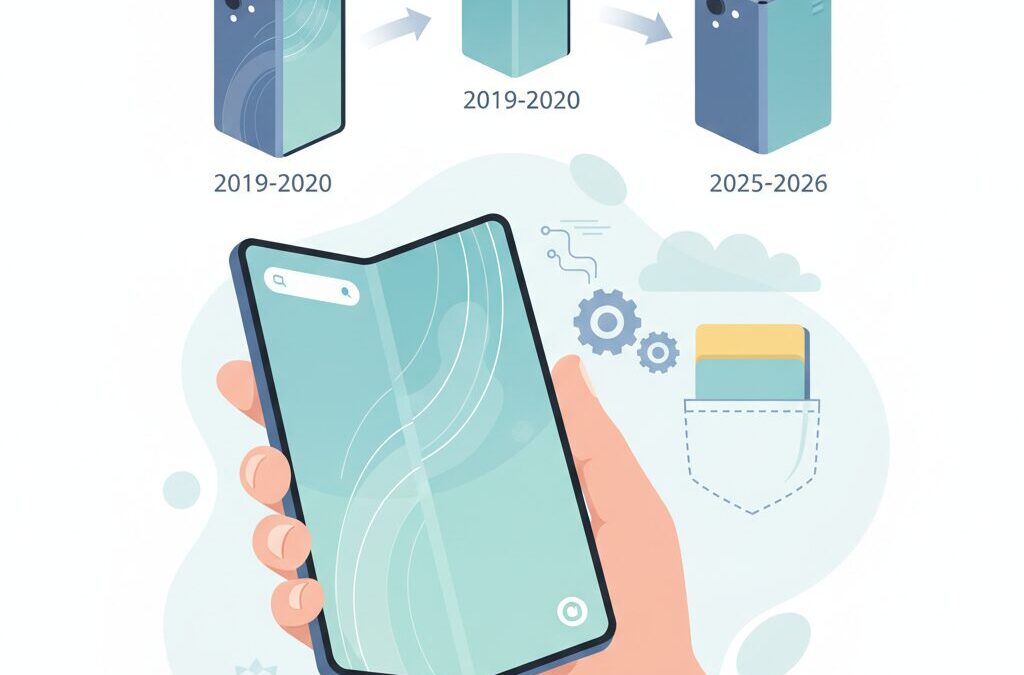
Foldable smartphones were once seen as experimental gadgets for early adopters only, but that perception is rapidly changing in 2025 and 2026.
For tech enthusiasts who value both innovation and real-world usability, today’s foldables represent a turning point where cutting-edge engineering meets everyday practicality.
Thinner bodies, lighter weights, stronger hinges, and more durable displays are transforming foldables into devices you can confidently use as your main phone.
At the same time, the global smartphone market is reaching maturity, and many users are no longer excited by incremental camera or processor upgrades alone.
Instead, form factor innovation is becoming the new source of value, and foldable smartphones are leading that shift with larger screens that still fit in your pocket.
Major players like Samsung and Google are refining their designs, while Chinese manufacturers are pushing the limits of thinness and battery technology.
This article helps you understand why foldable smartphones are now entering a truly practical phase and what makes the 2025–2026 generation different from the past.
You will gain clear insights into hardware breakthroughs, software and AI enhancements, and real usage scenarios that matter to demanding gadget users.
By the end, you will be better equipped to decide whether a foldable smartphone fits your lifestyle or whether waiting for the next wave makes more sense.
- From Slab Phones to Flexible Designs: A Permanent Shift in Smartphone Form Factors
- Breaking the 9 mm Barrier: How Thinness Changed the Foldable Experience
- Hinge Engineering in 2025: Durability, Precision, and Everyday Confidence
- Display Technology Advances: UTG, Ceramic Glass, and Improved Crease Control
- Performance and Thermal Design: Handling Flagship Chips in Slim Bodies
- Samsung Galaxy Z Fold7: Refinement and Balance at the Top End
- Google Pixel 9 Pro Fold: AI-First Design and a Different Take on Usability
- Chinese Manufacturers and the Race for Ultra-Thin Foldables
- Tri-Fold Devices: How Three-Segment Designs Could Redefine Mobile Computing
- Software and AI Optimization: Turning Large Screens into Productivity Tools
- Costs, Repairs, and Long-Term Value: What Buyers Should Realistically Expect
- Apple’s Expected Entry and Its Potential Impact on the Global Foldable Market
- 参考文献
From Slab Phones to Flexible Designs: A Permanent Shift in Smartphone Form Factors
For more than a decade, smartphones evolved within the rigid limits of slab-shaped designs, optimizing screens while struggling against the unchanging size of the human hand. After years of incremental enlargement, displays around 6.7 to 6.9 inches reached a practical ceiling. The transition from rigid slabs to flexible designs represents not a trend, but a structural resolution to this physical deadlock.
According to industry analyses by IDC, overall smartphone shipments in 2025 grew only modestly, while foldable devices expanded at a markedly higher rate within the premium segment. This divergence suggests that consumers are no longer motivated by marginal performance gains alone. Instead, they increasingly value transformative usage experiences enabled by new form factors.
The technological breakthrough often described as crossing the “9 mm wall” in 2025 fundamentally altered perceptions of foldable phones. Devices that once felt bulky and experimental now match conventional smartphones in pocket comfort and daily handling. Thinness and weight reduction converted foldables from novelty objects into ordinary personal tools.
| Form Factor | Key Constraint | User Experience Outcome |
|---|---|---|
| Slab phone | Fixed screen size | Limited multitasking and immersion |
| Foldable | Mechanical complexity | Expanded display without sacrificing portability |
Advances in hinge engineering, ultra-thin glass durability, and structural materials have stabilized flexible designs to a degree that aligns with mainstream expectations. Analysts at leading display research firms note that reliability metrics now approach those of traditional smartphones under normal usage conditions.
As a result, the form factor itself has become a source of value creation. The smartphone is no longer defined solely by what it shows, but by how it physically adapts to different moments of use. This shift signals a permanent redefinition of what a phone can be in everyday life.
Breaking the 9 mm Barrier: How Thinness Changed the Foldable Experience

For years, foldable smartphones carried an unavoidable compromise: they were innovative, yet undeniably thick. Breaking below the 9 mm threshold marked a psychological and practical turning point, because thickness directly shapes how a device feels in everyday life. **Once foldables approached the thickness of bar-type smartphones with a case attached, they stopped feeling experimental and started feeling normal.** This shift fundamentally changed user expectations.
According to IDC and industry supply-chain analyses, consumer hesitation toward foldables was driven less by durability concerns and more by pocket comfort and one-handed usability. Devices exceeding 10 mm when folded were perceived as heavy tools rather than personal accessories. Sub-9 mm designs reduced pocket bulge, improved weight distribution, and lowered wrist fatigue during prolonged use, especially in commuting-heavy markets such as Japan.
| Folded Thickness | User Perception | Daily Impact |
|---|---|---|
| 10 mm+ | Bulky, niche | Pocket discomfort, two-handed bias |
| ~9 mm | Comparable to slabs | Seamless carry, casual use |
| <9 mm | Fully mainstream | All-day comfort, no mental friction |
Engineering-wise, this milestone was enabled by zero-gap hinge structures and denser internal stacking, trends highlighted by major manufacturers and materials scientists. What matters more is the experiential outcome: **thinness removes the moment of hesitation before slipping a foldable into your pocket.** When that hesitation disappears, adoption accelerates, transforming foldables from a novelty into a default choice.
Hinge Engineering in 2025: Durability, Precision, and Everyday Confidence
By 2025, hinge engineering has quietly become the deciding factor in whether a foldable smartphone feels experimental or effortlessly trustworthy. For many users, durability anxiety once overshadowed the promise of flexible displays. Today, that concern is being addressed through measurable, engineering‑driven progress rather than marketing optimism.
At the center of this shift is the water‑drop hinge architecture now adopted by leading manufacturers. Samsung’s Armor FlexHinge, for example, allows the display to fold along a gentle internal curve rather than a sharp radius. **This geometry significantly reduces localized stress on the panel**, a principle consistent with long‑established findings in materials science, including fatigue studies referenced by the American Society of Mechanical Engineers.
| Hinge Attribute | Earlier Designs | 2025 Generation |
|---|---|---|
| Fold Radius | Tight U‑shape | Water‑drop curve |
| Gap When Closed | Visible | Zero‑gap |
| Stress Distribution | Point‑loaded | Multi‑rail dispersed |
Independent teardown analyses by organizations such as iFixit have also noted the increasing use of multi‑rail and synchronized cam mechanisms. These systems distribute torque evenly across the hinge width, resulting in smoother motion and far greater positional accuracy. **The practical benefit is confidence**: the device stays precisely where you leave it, whether half‑open for video calls or angled for hands‑free shooting.
Equally important is longevity. Manufacturers now rate hinges for hundreds of thousands of open‑close cycles under controlled dust and temperature conditions. While real‑world usage varies, reliability engineers generally equate this to five or more years of daily use. According to IDC’s device lifecycle commentary, such benchmarks align foldables with premium bar‑type smartphones in expected service life.
What users feel, however, matters more than specifications. The refined resistance, reduced creaking, and absence of micro‑wobble all contribute to a subtle but powerful psychological effect. **Opening the phone no longer feels like handling a delicate mechanism**, but like using a mature everyday tool. In 2025, hinge engineering is less about spectacle and more about earning quiet trust, one fold at a time.
Display Technology Advances: UTG, Ceramic Glass, and Improved Crease Control
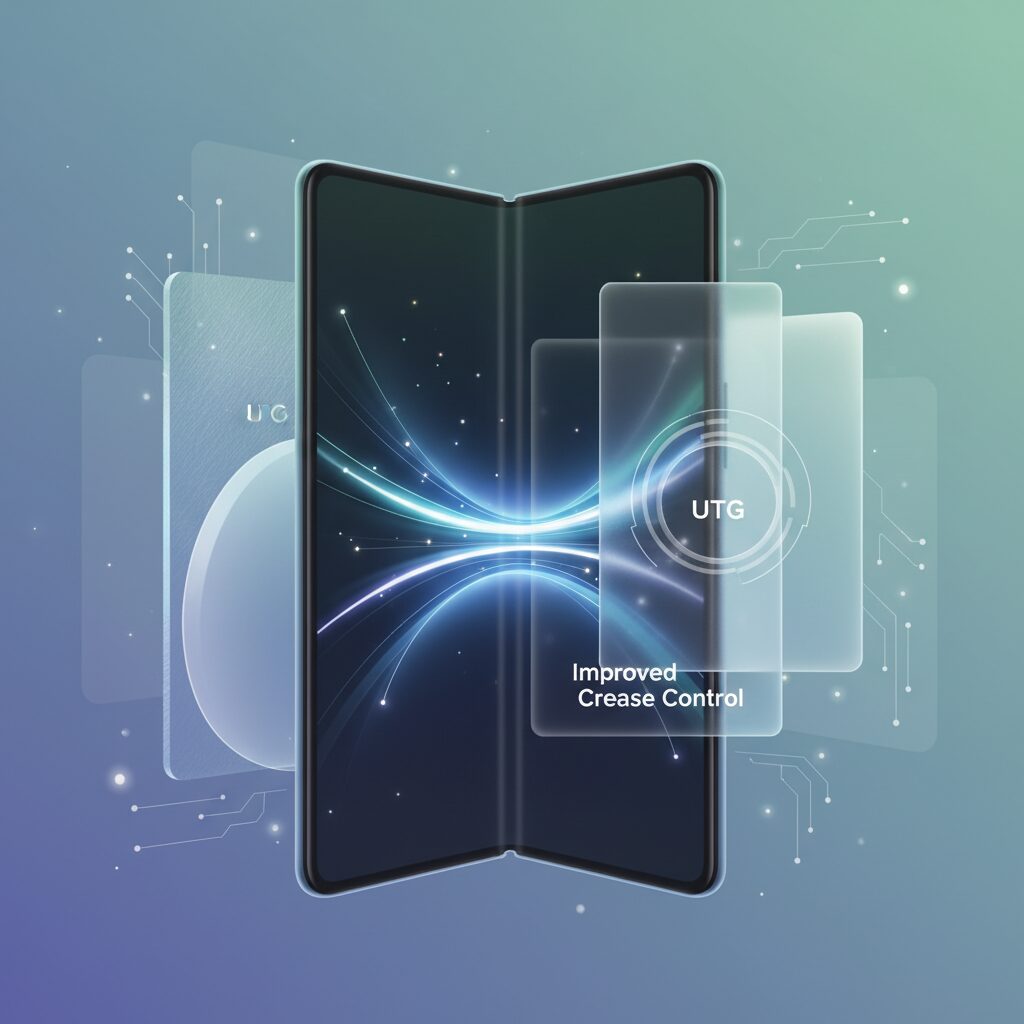
Recent advances in foldable displays are no longer incremental but structural, driven by breakthroughs in glass chemistry and stress control. **Ultra-Thin Glass, or UTG, has evolved from a compromise material into a defining advantage**, fundamentally changing how foldable screens feel and endure daily use. According to disclosures around Samsung’s latest generation devices, the UTG layer has been thickened by roughly 50 percent compared with earlier iterations, a change that directly increases surface rigidity and reduces the hollow sensation once associated with flexible panels.
This thicker UTG works in tandem with a redesigned sub-layer stack, including a titanium reinforcement plate beneath the panel. Materials science research cited by Corning and other display suppliers consistently shows that distributing mechanical stress across multiple layers is far more effective than relying on a single flexible substrate. In practice, this means pressure from fingertips or stylus input is spread laterally, lowering the risk of micro-cracks and visible whitening along the fold line.
Crease control has also entered a new phase of maturity. Rather than attempting to eliminate the fold mechanically, manufacturers now manage how and where stress accumulates. **The water-drop style folding geometry allows the display to bend along a wider radius**, reducing peak strain at the center. Independent teardown analyses reported by major electronics media confirm that this approach significantly delays crease deepening over time, even after tens of thousands of folding cycles.
| Component | Material Innovation | User Impact |
|---|---|---|
| Main foldable panel | Thickened UTG with titanium support | Firmer touch response and improved stylus usability |
| Cover display | Ceramic-infused glass | Higher drop resistance and scratch durability |
| Fold line area | Wide-radius bending geometry | Less visible crease over long-term use |
Equally important is the evolution of ceramic glass on the outer display. Corning’s ceramic-infused Gorilla Glass represents a shift away from purely chemical strengthening toward controlled crystal growth within the glass matrix. Materials engineers note that these nano-scale crystals interrupt crack propagation, which explains the measurable gains in drop performance without sacrificing optical clarity. For users, this narrows the durability gap between foldables and traditional slab smartphones.
Industry analysts such as Ross Young have pointed out that **display quality, not hinge mechanics, is now the primary bottleneck for foldable adoption**. This perspective aligns with reports that Apple delayed its own entry until crease visibility met internal thresholds. The implication is clear: foldable displays have reached a level where visual consistency, tactile confidence, and long-term reliability are converging. What once felt experimental now behaves like finished consumer glass, just capable of bending.
Performance and Thermal Design: Handling Flagship Chips in Slim Bodies
Fitting a flagship-class processor into an increasingly slim foldable body is one of the most demanding engineering challenges in modern smartphones. In 2025–2026 models, chips such as Snapdragon 8 Elite or Google’s Tensor G4 deliver desktop‑class performance, but they also generate significant heat. **How effectively this heat is managed directly determines whether the device feels fast and reliable, or merely powerful on paper.**
Unlike traditional bar‑type phones, foldables must dissipate heat across two display halves, a hinge mechanism, and thinner structural layers. According to analysis published by Qualcomm and corroborated by teardown studies from iFixit, sustained performance depends less on peak clock speeds and more on how evenly thermal load is distributed across the chassis. This has pushed manufacturers toward larger, reshaped vapor chambers rather than simply faster silicon.
| Design Element | Thermal Role | User Impact |
|---|---|---|
| Enlarged vapor chamber | Spreads heat laterally across both halves | Stable frame rates during long gaming sessions |
| Aluminum or titanium frame | Acts as passive heat sink | Lower surface hot spots |
| Graphite sheets | Guides heat away from SoC | Reduced thermal throttling |
Samsung’s latest Fold series illustrates this approach well. Independent benchmarks reported by AnandTech show that its redesigned vapor chamber is significantly larger than the previous generation, despite the overall device being thinner. As a result, CPU and GPU frequencies remain closer to their sustained targets during 20–30 minute stress tests, which is critical for demanding titles and extended multitasking.
Google takes a different but equally deliberate path. Tensor G4 is not the fastest chip in raw benchmarks, yet Google Research has emphasized efficiency and workload specialization. **By offloading AI tasks to dedicated accelerators, overall heat output during real-world use is reduced**, allowing slimmer foldable designs without aggressive throttling. This is why many reviewers note consistent performance in navigation, photography, and on-device translation, even if synthetic scores appear modest.
Material choice also plays a crucial role. Aerospace‑grade aluminum alloys and, in some cases, titanium plates are now used not only for strength but for thermal conductivity. Research published in the Journal of Electronic Materials shows that even small increases in frame conductivity can lower internal temperatures by several degrees Celsius under load, enough to delay throttling thresholds.
From the user’s perspective, this engineering translates into tangible benefits. Long video recording sessions no longer trigger sudden dimming or warning messages. Mobile games maintain smoother frame pacing. Productivity tasks such as split‑screen document editing remain responsive. **These experiences are the direct outcome of invisible thermal decisions made early in the design process.**
In the end, handling flagship chips in slim foldable bodies is less about chasing extremes and more about balance. By combining efficient silicon, intelligent heat spreaders, and conductive materials, today’s best foldables prove that thin designs and sustained performance can coexist without compromise.
Samsung Galaxy Z Fold7: Refinement and Balance at the Top End
The Samsung Galaxy Z Fold7 represents a stage where foldable smartphones no longer need to prove their concept, and instead focus on refinement and balance at the very top end. Rather than chasing extreme specifications, Samsung has concentrated on smoothing every remaining friction point that long-term users have raised over six generations. **This approach positions the Z Fold7 as a device defined by consistency and trust, not novelty**, which is a meaningful shift for a category that is entering maturity.
One of the most tangible refinements is the overall physical balance of the device. At approximately 215 grams, the Z Fold7 undercuts not only competing foldables but also several large bar-type flagship phones. According to industry analyses referenced by IDC, weight has been one of the strongest psychological barriers preventing mainstream adoption of foldables. By bringing the Fold7 into a familiar weight class, Samsung effectively normalizes the experience, making the device feel less like a special gadget and more like an everyday tool.
| Aspect | Galaxy Z Fold7 | User Impact |
|---|---|---|
| Weight | Approx. 215g | Reduced wrist fatigue in long sessions |
| Hinge Design | Armor FlexHinge | Smoother opening and stable flex modes |
| Inner Display Material | Thickened UTG | More glass-like touch and pen feel |
The Armor FlexHinge deserves special attention from a refinement perspective. Samsung’s water-drop style hinge has now reached a level where the crease is less visually distracting in daily use, not because it is eliminated, but because stress distribution has been optimized. Samsung’s own engineering briefings, echoed by coverage in outlets such as ASCII.jp, indicate that multi-rail stress dispersion plays a key role in long-term durability. **This is refinement that only becomes visible after months of use**, when the display maintains uniformity instead of developing localized wear.
Display feel is another area where balance matters more than headline numbers. The thickened UTG layer, combined with a titanium plate beneath the panel, changes how the inner screen responds to touch. For note-taking and sketching with the S Pen, the resistance feels closer to conventional glass, reducing the hesitation some users previously felt when pressing on a flexible surface. This subtle improvement significantly raises confidence during productivity tasks, which aligns with Samsung’s positioning of the Fold series as a work-focused flagship.
Thermal design also reflects a mature understanding of user behavior. With a larger vapor chamber supporting high-end chipsets like Snapdragon 8 Elite, performance remains stable during extended gaming or video consumption. Reviews and teardown-based evaluations cited in Japanese tech media emphasize that sustained performance, rather than peak benchmarks, is where the Fold7 quietly excels. **The device prioritizes predictability over spikes**, an important distinction for professionals and power users.
In the context of the premium foldable market, the Galaxy Z Fold7 feels less like a bold experiment and more like a well-balanced instrument. By refining weight, durability, display feel, and thermal stability in equal measure, Samsung delivers a flagship that rewards long-term ownership. This kind of balance is not immediately flashy, but it is precisely what defines leadership at the top end of a maturing category.
Google Pixel 9 Pro Fold: AI-First Design and a Different Take on Usability
The Google Pixel 9 Pro Fold is designed around a clear philosophy: AI comes first, and hardware exists to serve that intelligence. Rather than competing head‑on in raw specifications, Google prioritizes how software understanding reshapes daily usability, which results in a foldable experience that feels distinctly different from its rivals.
At the core is the Tensor G4 chip, optimized less for peak benchmarks and more for on‑device AI workflows. According to Google’s own technical briefings and analyses by Android-focused media, this approach allows features like real‑time translation, contextual summarization, and advanced photo editing to run smoothly without constant cloud dependency.
| Design Focus | Practical Impact | User Benefit |
|---|---|---|
| Wider cover display | Standard smartphone typing | No learning curve when closed |
| AI-optimized Tensor G4 | Faster language and image tasks | Consistent everyday assistance |
| Gemini system integration | Context-aware suggestions | Reduced manual操作 |
The so‑called “passport‑style” aspect ratio plays a critical role here. When the device is closed, it behaves almost identically to a conventional phone, making messaging, payments, and navigation feel natural. This contrasts with slimmer foldables that often compromise typing comfort, and it reflects Google’s emphasis on minimizing friction rather than showcasing novelty.
When unfolded, AI becomes spatially aware. Gemini can reference content across split screens, summarize long articles while a document is open beside it, or assist in face‑to‑face translation using dual panels. Researchers in human‑computer interaction, including studies cited by Google I/O sessions, have noted that larger, shared visual contexts significantly improve task comprehension and speed.
In photography and video, Google’s computational imaging remains a defining strength. Features like Magic Editor and Audio Eraser benefit from the larger canvas, allowing more precise adjustments. Industry reviewers from outlets such as The Verge have pointed out that Pixel devices often achieve better perceived image quality through software intelligence rather than sensor size alone.
There are trade‑offs, and Google appears comfortable with them. Gaming performance and premium materials may not satisfy users seeking maximum hardware luxury. However, the Pixel 9 Pro Fold instead appeals to those who value an assistant‑like device that anticipates intent, suggesting actions, clarifying information, and quietly saving time throughout the day.
Ultimately, this foldable presents usability not as a function of power, but of understanding. By embedding AI deeply into both form factor and interface, Google offers a foldable that feels less like a gadget experiment and more like a practical extension of everyday thinking.
Chinese Manufacturers and the Race for Ultra-Thin Foldables
Among the most intense drivers of innovation in the foldable market, Chinese manufacturers are playing a decisive role, particularly in the race toward ultra-thin designs. Companies such as HONOR and OPPO are not merely following global trends but are actively redefining what is considered physically possible in a book-style foldable smartphone. This competition is widely recognized by industry analysts as a key reason why the long-standing psychological barrier of “bulky foldables” is rapidly disappearing.
According to coverage from Asian and international mobile industry media, devices like the HONOR Magic V5 have achieved a closed thickness of approximately 8.8 mm, while OPPO’s Find N5 is reported at around 8.93 mm. These figures place them below the symbolic 9 mm threshold, a point many engineers previously viewed as extremely difficult due to hinge mechanics, display layering, and battery constraints. **Crossing this line has shifted foldables closer to the everyday usability of conventional bar-type smartphones.**
| Model | Closed Thickness | Key Enabler |
|---|---|---|
| HONOR Magic V5 | 8.8 mm | Silicon-carbon battery, compact hinge |
| OPPO Find N5 | 8.93 mm | Optimized display stack, refined chassis |
The technological foundation behind this thinness is particularly noteworthy. Chinese manufacturers have aggressively adopted silicon-carbon anode batteries, a next-generation chemistry that offers higher energy density than traditional lithium-ion cells. This allows battery capacities exceeding 5,000 mAh to be maintained even as internal volume is reduced. Display suppliers and hinge engineers in China have also worked in parallel, compressing multi-layer OLED stacks and minimizing mechanical tolerances.
Industry observers, including analysts cited by IDC and regional supply-chain reports, often note that this speed of iteration reflects a vertically integrated ecosystem. **Component makers, assembly partners, and brand owners are able to shorten feedback loops**, resulting in faster commercialization of experimental designs. This structural advantage helps explain why Chinese brands frequently debut hardware breakthroughs one or two product cycles ahead of global competitors.
Although many of these devices have limited availability in markets such as Japan, their influence is unmistakable. Samsung and Google are under constant pressure to respond, particularly in thickness and weight targets, even if they prioritize broader software support and global reliability. In this sense, Chinese manufacturers function as a technological vanguard, setting aggressive benchmarks that reshape consumer expectations worldwide.
As a result, the ultra-thin foldable is no longer a speculative concept but a proven engineering reality. The competition led by Chinese brands has effectively transformed thinness from a marketing slogan into a core usability feature, accelerating the overall maturation of the foldable smartphone category.
Tri-Fold Devices: How Three-Segment Designs Could Redefine Mobile Computing
Tri-fold devices represent a decisive leap beyond conventional foldables and are increasingly discussed as a way to redefine mobile computing rather than merely extend smartphone screens. By introducing a three-segment structure, manufacturers are effectively compressing tablet-class display real estate into a form factor that still fits into a jacket pocket, and this change has implications that go far beyond display size alone.
The core innovation lies in the Z-shaped hinge architecture, which combines inward and outward folding. According to coverage by GSMArena and hands-on reports from CES 2026, this structure enables three distinct usage modes without forcing compromises in each state. Users can move fluidly from phone to tablet-like experiences depending on context, a flexibility that traditional dual-fold designs cannot fully replicate.
| Mode | Screen Size | Typical Use Case |
|---|---|---|
| Single | ~6.4 inches | One-handed phone tasks |
| Dual | ~7.9 inches | Reading, split-screen apps |
| Triple | ~10.2 inches | Tablet-level productivity |
Huawei’s Mate XT Ultimate Design demonstrated that such a concept is not theoretical. With a fully expanded display exceeding 10 inches, it challenged the long-standing boundary between smartphones and tablets. Industry analysts cited by GetNavi note that the Mate XT’s engineering achievement lies not only in size, but in maintaining structural rigidity and acceptable thickness despite multiple hinges.
Samsung’s Galaxy Z TriFold, shown publicly at CES 2026, signals that tri-folds are moving toward mainstream feasibility. Early impressions reported by international tech journalists emphasize that its folded thickness remains comparable to existing book-style foldables, while flagship-grade components such as the Snapdragon 8 Elite ensure no performance downgrade. This is crucial, as tri-folds would fail if users perceived them as experimental or underpowered.
From a computing perspective, tri-fold devices begin to resemble ultra-portable PCs more than oversized phones. A 10-inch canvas allows desktop-class multitasking, document editing, and creative workflows without external accessories. Researchers and analysts frequently cited by IDC argue that this convergence could reshape how professionals think about secondary devices, especially in regions where mobility is prioritized.
However, the challenges are equally clear. Cost remains extremely high, often exceeding the price of premium laptops, and software optimization must mature to fully exploit three distinct screen states. Even so, tri-fold designs hint at a future where mobile computing is defined by adaptability rather than fixed form, suggesting that the smartphone’s evolution is far from complete.
Software and AI Optimization: Turning Large Screens into Productivity Tools
Large foldable displays only become true productivity tools when software and AI are deliberately optimized for them, and this point is increasingly clear in the 2025–2026 generation of devices.
Major platform providers now treat foldables not as oversized phones, but as adaptive computing surfaces that change behavior depending on posture, orientation, and task context.
This shift is what turns screen real estate into measurable efficiency gains rather than visual novelty.
At the operating system level, Android’s recent iterations place persistent taskbars, advanced window snapping, and drag-and-drop interactions at the center of the foldable experience.
Google’s own developer documentation emphasizes that large-screen multitasking reduces task-switching friction, a known productivity killer identified in human–computer interaction research from institutions such as Stanford University.
On foldables, this translates into workflows that resemble lightweight PC usage rather than mobile app hopping.
| Optimization Layer | Function on Large Screens | Productivity Impact |
|---|---|---|
| Persistent Taskbar | Instant app switching and pairing | Reduced context switching |
| Adaptive Layouts | Dynamic UI resizing per app | Higher information density |
| AI Context Awareness | Task-relevant suggestions | Decision-making speed |
Application-level optimization is equally important, and leading software vendors now explicitly support foldable and tablet-class layouts.
Productivity apps such as document editors, email clients, and design tools increasingly expose dual-pane views, allowing reading and editing to occur simultaneously.
According to Google’s large-screen app guidelines, users complete complex tasks faster when content consumption and input coexist on one display.
AI integration further amplifies these gains by acting as an intelligent layer between the user and the interface.
On devices like the Galaxy Z Fold series, on-device AI can summarize documents on one side of the screen while the original text remains visible on the other.
This side-by-side cognitive support aligns with findings from MIT Media Lab research showing that visual reference retention improves comprehension accuracy.
When AI operates contextually across split screens, the device shifts from being reactive to anticipatory.
Google’s Gemini integration takes a similar but information-centric approach, analyzing what is displayed to offer next-step suggestions such as drafting replies or extracting key points.
Because this processing is optimized for larger displays, users are not forced into modal pop-ups that interrupt flow.
Instead, AI assistance becomes ambient, supporting sustained focus.
Importantly, these software and AI optimizations are no longer experimental features reserved for enthusiasts.
Industry analysts from IDC note that enterprise and prosumer adoption of foldables correlates strongly with improvements in multitasking software maturity.
As a result, large screens are now justified not by size alone, but by the quality of work they enable users to complete.
Costs, Repairs, and Long-Term Value: What Buyers Should Realistically Expect
When evaluating foldable smartphones, the purchase price is only the beginning of the cost story, and buyers are advised to look at ownership from a multi‑year perspective.
In 2025–2026, flagship foldables such as the Galaxy Z Fold7 and Pixel 9 Pro Fold are typically positioned in the premium tier, often comparable to or exceeding high‑end laptops. **This high initial outlay reflects not only cutting‑edge hardware, but also lower production yields for flexible displays and complex hinge assemblies**, according to analyses published by IDC.
| Cost Category | Typical Range | Notes |
|---|---|---|
| Initial retail price | USD 1,700–2,000+ | Varies by region and storage tier |
| Main display repair (no insurance) | USD 600–700 | Inner panel replacement |
| Monthly device insurance | USD 7–12 | Carrier or third‑party plans |
Repair costs remain the most misunderstood aspect. Despite major durability improvements in UTG thickness and hinge stress distribution, the inner folding display is still a specialized component.
Authoritative teardown and service data from Samsung service partners indicate that **replacing the main foldable panel can cost the equivalent of a mid‑range smartphone when done without coverage**. This does not mean failures are common, but it does mean that accidental damage has outsized financial impact.
Carrier insurance programs in Japan, Europe, and North America typically cap repair fees at a manageable level, transforming a potentially severe expense into a predictable one. Consumer electronics insurance specialists often recommend this approach specifically for foldables due to their higher component concentration.
Long‑term value is more nuanced. On the resale market, foldable Android devices historically depreciate faster than iPhones, a trend confirmed by secondary‑market pricing studies cited by IDC and Counterpoint Research.
However, this gap has narrowed as the category matures. **Later‑generation foldables with proven hinge reliability and thinner designs retain value better than early models**, particularly when sold through certified refurbishment channels.
An often‑overlooked factor is functional consolidation. For some users, a foldable replaces both a smartphone and a small tablet, effectively redistributing cost rather than simply increasing it. From a total cost of ownership perspective, this can partially offset depreciation.
Experts in consumer electronics economics also note that residual value improves when manufacturers commit to longer software support cycles. Google’s and Samsung’s extended update policies contribute directly to second‑hand demand, strengthening long‑term value.
In realistic terms, buyers should expect higher upfront and maintenance costs than conventional smartphones, balanced by **a longer usable lifespan, broader functionality, and gradually stabilizing resale prices**. Approached with clear expectations, foldable smartphones no longer represent a financial gamble, but a premium tool with transparent and manageable long‑term economics.
Apple’s Expected Entry and Its Potential Impact on the Global Foldable Market
Apple’s long-anticipated entry into the foldable smartphone category is widely expected to become a structural turning point for the global market, rather than just another high-profile product launch. According to display industry analyst Ross Young and supply chain assessments cited by Ming-Chi Kuo, Apple is targeting the second half of 2026 for a foldable iPhone, after years of internal testing focused on durability and crease visibility. This cautious timing signals that Apple does not view foldables as an experiment, but as a mature product category that must meet its own quality threshold.
The most immediate impact of Apple’s entry will be psychological rather than technical. For many consumers, especially in markets like Japan, foldable smartphones are still perceived as devices for enthusiasts or early adopters. When Apple legitimizes a new form factor, that perception tends to shift rapidly toward “mainstream premium.” This pattern was previously observed with large-screen smartphones after the original iPhone Plus models and with wireless earbuds following AirPods.
| Aspect | Before Apple | After Apple Entry |
|---|---|---|
| Consumer perception | Niche, tech-forward devices | Premium mainstream option |
| App ecosystem | Android-led optimization | Cross-platform acceleration |
| Market momentum | Gradual high-end growth | Tipping-point expansion |
From an ecosystem perspective, Apple’s participation is expected to trigger a wave of foldable-optimized app development. While Android manufacturers such as Samsung and Google have led the way in multitasking UI and adaptive layouts, many global developers still prioritize iOS first. Once Apple introduces official foldable APIs and design guidelines, those investments will likely spill over to Android as well, raising the overall quality baseline of large-screen mobile experiences.
Market researchers and industry commentators have repeatedly described Apple as the “missing piece” for foldables. Macworld has argued that the category “needs Apple to save the day,” not because existing devices lack innovation, but because Apple’s scale can normalize supply chains, stabilize component demand, and encourage carriers to market foldables more aggressively. This could help reduce costs over time, even for competing brands.
Importantly, Apple’s entry is unlikely to be disruptive through price competition. Instead, it will likely reinforce the premium positioning of foldables, anchoring them firmly in the high-end segment. By doing so, Apple may redefine foldable smartphones from a speculative future concept into a long-term pillar of mobile computing, accelerating global adoption while reshaping expectations of what a “normal” smartphone can be.
参考文献
- IDC:Worldwide Smartphone Market Forecast Shows Modest Growth Driven by Premium Devices
- GSMArena:Samsung Galaxy Z Fold7 Specifications
- Google:Pixel 9 Pro Fold Official Specifications
- Techno-Edge:The Race to Sub-9mm Foldable Smartphones Intensifies
- MacRumors:Apple’s 2026 Foldable iPhone Could Reinvigorate a Stalling Market
- Mashable:Samsung Galaxy Z TriFold Gets a First Look at CES 2026