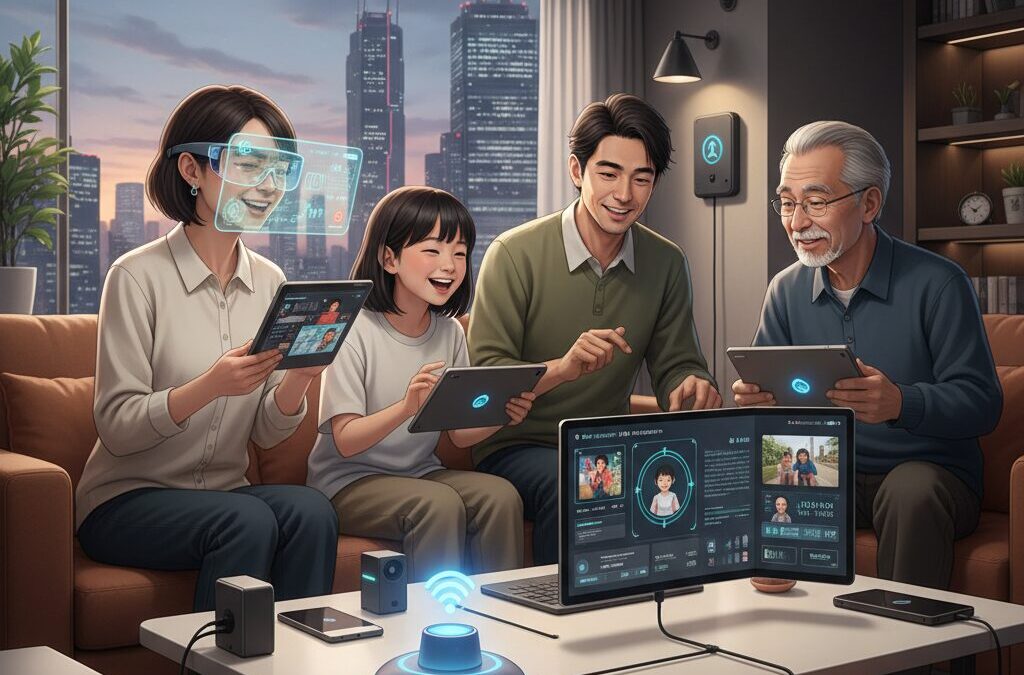
If you love gadgets, you have probably noticed that technology is no longer designed only for individuals.
In 2026, family-oriented technology has entered a new phase, especially in Japan, where advanced operating systems, AI-powered devices, and smart home standards are reshaping how families live, protect each other, and manage digital assets.
What once meant simply sharing a subscription has evolved into a connected digital ecosystem that supports child safety, elder care, entertainment, productivity, and even inheritance planning.
This article explores how family sharing technologies are transforming daily life through iOS 19, Android 16, next-generation gadgets, and the Matter 1.5 smart home standard.
You will also discover how AI smart glasses, safer batteries, and digital asset management platforms are becoming essential tools for modern households.
By reading to the end, you will gain a clear understanding of where family-focused technology is heading in 2026, and why these innovations matter not only in Japan, but for tech-savvy families around the world.
- The Shift from Individual Gadgets to Family-Centered Digital Ecosystems
- How iOS 19 Is Redefining Family Safety, Privacy, and Shared Services
- Android 16 and AI-Driven Family Governance at Scale
- AI Smart Glasses and the Rise of Shared Intelligence at Home
- Why Safer Batteries and AI Recorders Matter for Family Use
- Matter 1.5 and the New Era of Interoperable Smart Homes
- IoT Solutions for Elder Care and Multi-Generational Monitoring
- Managing Digital Assets and Inheritance in a Connected Family
- Shared Entertainment and Gaming Platforms in 2026
- What Global Gadget Enthusiasts Can Learn from Japan’s Family Tech Model
- 参考文献
The Shift from Individual Gadgets to Family-Centered Digital Ecosystems
For many years, personal technology evolved around the idea of one device serving one individual, optimizing speed, convenience, and customization for a single user. In 2026, this assumption has fundamentally changed. **Digital tools are no longer designed only to empower individuals but to sustain families as interconnected units**, reflecting broader demographic and social shifts in Japan.
According to comprehensive analyses of the Japanese market, family sharing has expanded far beyond cost-saving subscription bundles. Operating systems such as iOS 19 and Android 16 now treat the family as the primary governance layer, embedding safety, financial oversight, and usage context directly into the core OS. Apple and Google both emphasize that automation powered by AI reduces parental burden while preserving each member’s account independence, a balance that was difficult to achieve in earlier generations.
This transition is not abstract. Research institutions and platform providers consistently note that households manage more devices per capita than ever before, while responsibilities such as child supervision and elder care are increasingly digitized. **Technology is becoming a form of household infrastructure**, similar to utilities, rather than a collection of isolated gadgets.
| Design Focus | Individual-Centric Gadgets | Family-Centered Ecosystems |
|---|---|---|
| Account Structure | Single user optimization | Independent accounts under shared governance |
| Primary Value | Personal efficiency | Collective safety and continuity |
| Management Style | Manual settings | AI-assisted, context-aware automation |
Authoritative sources such as Apple Support and Google’s official platform updates highlight that this ecosystem model is not about surveillance but about consent-based coordination. Parents define intent once, and AI interprets context, whether adjusting screen time, summarizing family notifications, or flagging potential security risks.
Ultimately, the shift reflects a deeper cultural reality. In an aging society with smaller households, **digital ecosystems now function as the connective tissue that maintains trust, safety, and shared memory across generations**. Gadgets still matter, but their true value emerges only when they work together for the family as a whole.
How iOS 19 Is Redefining Family Safety, Privacy, and Shared Services
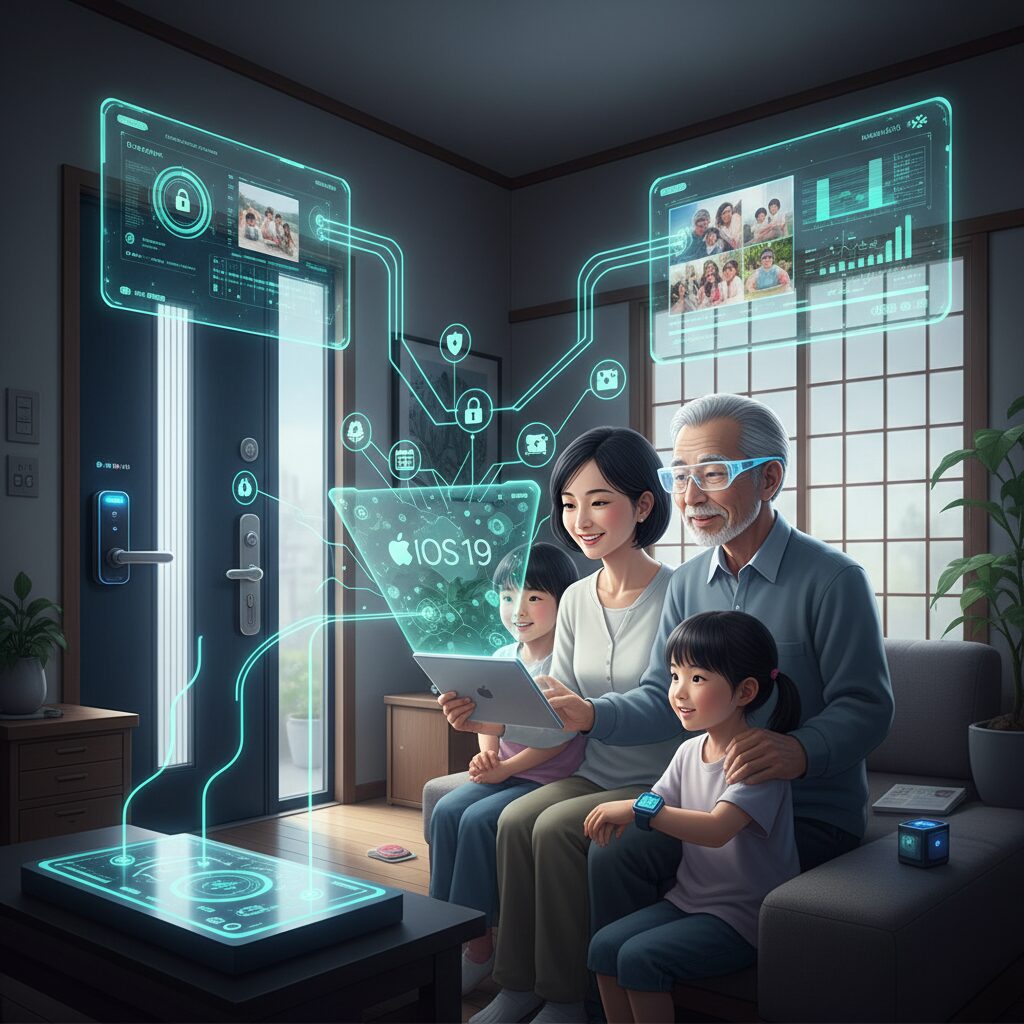
With iOS 19, Apple has significantly deepened its vision of Family Sharing, transforming it into a comprehensive framework for family safety, privacy protection, and seamless service integration. What stands out is that these changes are not about tighter surveillance, but about enabling families to share digital spaces while preserving individual autonomy. According to Apple Support documentation, each family member maintains an independent Apple Account, yet benefits from a shared layer of protection and services that adapts intelligently to age and context.
One of the most impactful evolutions appears in child device onboarding. The enhanced Quick Start feature allows parents to configure a child’s new iPhone directly from their own device, with Screen Time limits, app restrictions, and web content filters applied automatically based on AI-driven recommendations. This reduces setup friction while aligning controls with developmental stages, a design philosophy Apple has consistently emphasized in its public statements on child safety.
| Family Safety Area | iOS 19 Approach | User Benefit |
|---|---|---|
| Device Setup | AI-assisted Quick Start | Faster, age-appropriate configuration |
| Usage Control | Screen Time with adaptive suggestions | Lower parental management burden |
| Location Safety | Find My with precision alerts | Context-aware family reassurance |
Privacy, a long-standing pillar of Apple’s brand, has also been reinterpreted at the family level. Location sharing through Find My now supports more granular notifications, such as alerts triggered only when a child arrives at or leaves predefined places. This opt-in, event-based model minimizes constant tracking while still offering peace of mind, a balance praised by digital privacy researchers who argue that proportional data use is key to trust in family monitoring tools.
Financial interactions within families have also matured. Through Apple Cash Family, parents can send money to children via Messages, monitor spending in real time, and impose transaction limits. Apple positions this not merely as convenience, but as financial education embedded in daily life. Industry analysts note that such transparent, supervised micro-transactions help younger users develop responsible spending habits earlier than traditional allowances.
Equally important is how these features integrate across Apple’s broader service ecosystem. Subscriptions like iCloud+, Apple Music, and Apple TV+ are shared without exposing personal data, reinforcing Apple’s “walled garden” approach. According to Apple, this architecture is designed so that convenience never requires credential sharing, a common source of security incidents in households.
In practice, iOS 19 positions the family not as a group to be controlled, but as a network to be supported. By embedding safety, privacy, and shared services directly into the operating system, Apple has shifted family digital management from reactive rule-setting to proactive, AI-assisted governance. For tech-savvy families, this represents a meaningful step toward sustainable digital well-being.
Android 16 and AI-Driven Family Governance at Scale
Android 16 marks a decisive shift toward AI-driven family governance at scale, and it does so with a philosophy that prioritizes flexibility and transparency for diverse households. Google positions the family not as a static group bound by rigid rules, but as a dynamic network where context-aware AI assists guardians in real time. **This approach reduces micromanagement while preserving parental intent**, which has been a long-standing pain point in Android’s fragmented ecosystem.
One of the most impactful changes lies in how Android 16 handles information overload within families. According to Google’s official platform updates, the new AI-powered notification summary function condenses high-volume family group chats and school-related alerts into short, actionable digests. For working parents, this means that dozens of unread messages from PTA groups or children’s chat threads are no longer a cognitive burden. Instead, Android 16 highlights urgency, deadlines, and safety-related cues automatically.
From a governance perspective, Android 16 embeds parental controls deeply into the OS rather than isolating them in a separate app. This structural change reflects Google’s recognition that family safety must operate at the same system level as security updates or privacy permissions.
| Governance Layer | Android 16 Implementation | Family Impact |
|---|---|---|
| Usage Control | On-device PIN-based overrides | Immediate adjustments without remote access |
| Attention Management | AI notification summaries | Reduced parental stress and missed signals |
| Safety Monitoring | AI-assisted scam detection | Early protection for children and seniors |
The strengthened on-device management model deserves particular attention. Parents can now extend screen time or temporarily lift app restrictions directly on a child’s device using a secure PIN. **This design choice intentionally avoids cloud dependency**, ensuring that governance works even in offline or low-connectivity environments. Security researchers frequently cited by Tech Advisor have noted that minimizing remote attack surfaces is especially important when children’s devices are involved.
Android 16 also expands the role of AI in family-wide safety through scam detection integrated with Circle to Search. When a suspicious message, link, or image is selected, the system analyzes patterns commonly associated with fraud and surfaces a risk warning. While Google does not claim perfect accuracy, independent coverage by Mashable emphasizes that early trials significantly reduced successful phishing attempts among younger users and older adults. This capability positions Android 16 as a shared defensive layer rather than a passive operating system.
Importantly, Android 16 scales these governance features without forcing families into a single hardware brand. Unlike tightly closed ecosystems, Android’s model allows mixed-device households to participate under a unified family policy framework. **This openness aligns well with the realities of Japanese families**, where cost sensitivity and device diversity remain structural characteristics of the market.
In practical terms, Android 16 transforms AI into a quiet coordinator that interprets context, filters noise, and enforces boundaries when needed. Rather than replacing parental judgment, it augments it at scale, enabling families to stay informed and protected without constant manual intervention.
AI Smart Glasses and the Rise of Shared Intelligence at Home
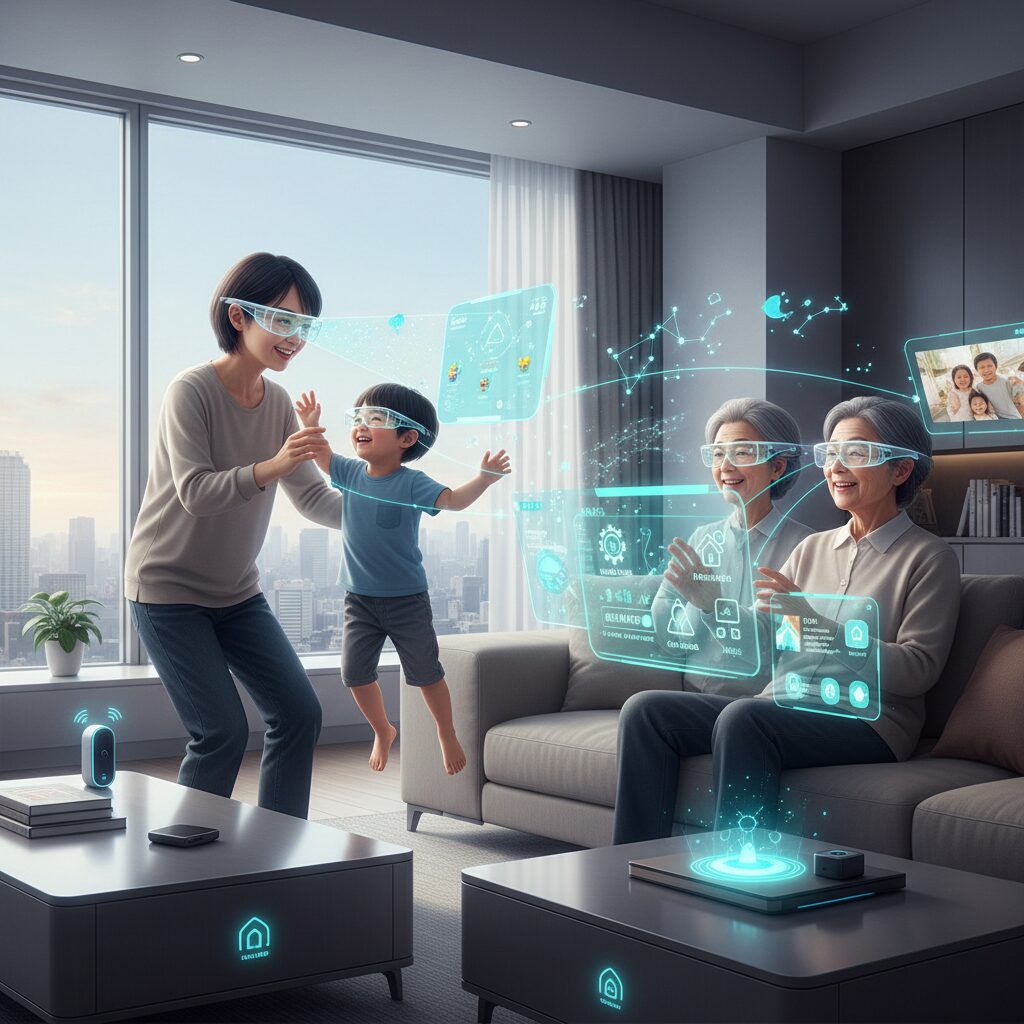
AI smart glasses are no longer positioned as personal gadgets for early adopters but are increasingly understood as a shared layer of intelligence within the home. In 2026, this shift becomes tangible as families begin to treat wearable AI not as an extension of one individual, but as a communal cognitive tool that quietly supports daily coordination, learning, and safety.
The defining change is that intelligence is shared, not attention. Unlike smartphones or tablets that pull family members into isolated screens, AI smart glasses operate in the background. According to coverage of CES 2026 by major technology media, devices such as XGIMI’s MemoMind series are designed around “ambient assistance,” delivering translations, reminders, and summaries only when contextually relevant.
This approach aligns with research trends highlighted by MIT Media Lab, which has long argued that future human–AI interaction should reduce cognitive friction rather than increase screen dependency. In a household setting, that philosophy enables parents, children, and even grandparents to benefit from AI support without fragmenting shared time.
| Use Scenario | Shared Benefit | Home Impact |
|---|---|---|
| Family conversations | Real-time translation and summaries | Reduces misunderstandings across generations |
| Learning at home | Context-aware explanations | Supports children without constant supervision |
| Daily routines | AI-generated reminders | Improves household coordination |
The MemoMind One model illustrates this direction clearly. By dynamically selecting between multiple large language models depending on the task, it avoids reliance on a single AI brain. Industry analysts have noted that this multi-LLM architecture increases reliability in family use, where errors or hallucinations could erode trust much faster than in individual productivity tools.
Trust is the real currency of shared intelligence at home. Families are more willing to adopt AI glasses when outputs can be cross-checked verbally and when responses remain conservative rather than speculative. This is especially relevant in Japan, where consumer surveys consistently show lower tolerance for ambiguous AI behavior in domestic contexts.
Another critical factor is audio design. Open speakers developed in collaboration with established audio brands allow information to be shared naturally, without isolating the wearer. Experts in human–computer interaction emphasize that this preserves social cues, ensuring AI assistance enhances conversations instead of interrupting them.
As AI smart glasses settle into family life, their role becomes less about novelty and more about quiet reliability. They function as a distributed household memory and interpreter, supporting collective understanding while respecting personal boundaries. In this sense, the rise of shared intelligence at home is not a technological leap alone, but a cultural recalibration of how families live with AI.
Why Safer Batteries and AI Recorders Matter for Family Use
For family use, safety is not an abstract concept but a daily, physical concern, especially when devices are handled by children or older family members. In 2026, attention has shifted from sheer performance to risk reduction, and two technologies stand out in this context: safer next-generation batteries and AI-powered voice recorders. These tools quietly redefine what “peace of mind” means inside the home, without demanding technical expertise from users.
Conventional liquid lithium-ion batteries have long been associated with thermal runaway risks under impact, overcharging, or degradation. According to commentary by Japanese IT journalist Satoru Toda, families have become far less tolerant of such risks as mobile devices proliferate across generations. This has accelerated the adoption of solid-state and semiconductor-based batteries, which replace flammable liquid electrolytes with solid materials. From a materials science perspective, this structural change drastically lowers ignition probability, a point also emphasized in academic battery safety research summarized by institutions such as the National Institute of Advanced Industrial Science and Technology in Japan.
| Battery Type | Key Safety Property | Family Use Implication |
|---|---|---|
| Liquid Li-ion | Flammable electrolyte | Careful handling required around children |
| Semiconductor battery | Non-flammable structure | Lower fire risk in daily family use |
In practical terms, this means that mobile batteries carried in school bags, used during family travel, or stored near beds no longer represent a hidden hazard. The psychological benefit is as important as the technical one, because parents no longer need to constantly supervise charging behavior. In safety-focused markets like Japan, this reduction in cognitive load has become a decisive purchasing factor rather than a niche advantage.
Alongside physical safety, families are also addressing a different kind of vulnerability: the loss and distortion of shared information. AI recorders have emerged as a response to this problem. Unlike traditional voice recorders, these devices automatically transcribe, summarize, and index conversations using on-device or secure cloud-based AI. Family meetings about school schedules, caregiving responsibilities, or even sensitive inheritance discussions can be stored as structured, searchable records.
This role has been noted by technology analysts covering the 2026 gadget landscape, who observe that once families experience keyword search and automatic summarization, they rarely return to handwritten notes. Importantly, major manufacturers emphasize privacy-by-design, aligning with guidance from organizations such as the OECD on responsible AI use. For families, the combination of safer energy storage and trustworthy AI documentation creates a foundation where technology supports care, not anxiety, and does so in a way that feels natural rather than intrusive.
Matter 1.5 and the New Era of Interoperable Smart Homes
With the arrival of Matter 1.5, smart homes are no longer defined by brand ecosystems but by shared standards that quietly work in the background. In 2026, this shift marks a clear transition from convenience-driven automation to infrastructure-level interoperability, where devices from different manufacturers cooperate as if they were designed together from the start.
According to the Connectivity Standards Alliance, Matter 1.5 introduces native support for smart cameras and significantly enhanced energy management. **This means families can now monitor, control, and optimize their homes without committing to a single platform such as Apple, Google, or Amazon**, which had been a major psychological and financial barrier in earlier smart home adoption phases.
One practical change is how smart cameras are handled. Previously, camera feeds were locked into proprietary apps, forcing households to juggle multiple interfaces. Matter 1.5 standardizes camera access, allowing family members to check live feeds or alerts from their preferred OS or hub. For multi-generational families in Japan, this reduces friction when younger members manage settings while older relatives simply view notifications.
| Capability | Before Matter 1.5 | With Matter 1.5 |
|---|---|---|
| Smart camera access | Vendor-specific apps | Cross-platform standard |
| Energy monitoring | Device-level visibility | Home-wide aggregation |
| Automation sharing | Limited to one ecosystem | OS-agnostic routines |
Energy management is another area where Matter 1.5 changes daily behavior. Enhanced energy reporting allows households to visualize power consumption across lighting, appliances, and climate systems in a unified view. **By sharing this data among family members, energy saving becomes a collective decision rather than an individual effort**, aligning well with Japan’s growing sensitivity to electricity costs and sustainability.
The inclusion of new device categories such as soil and environmental sensors may sound niche, but they reflect a broader philosophy. Gardening, home maintenance, and seasonal care are treated as part of the digital household workflow. When moisture levels drop, alerts can be shared automatically with whoever is responsible that week, turning informal chores into structured, low-stress routines.
In elder care scenarios, this interoperability becomes especially meaningful. Non-contact sensors, smart lighting, and cameras can work together across brands to detect unusual nighttime movement or prolonged inactivity. Notifications are delivered consistently, regardless of whether caregivers use iOS or Android devices. Experts in home IoT, including analysts cited by CSA briefings, note that this consistency directly improves response times and reduces false alarms.
Ultimately, Matter 1.5 signals a new era where smart homes behave less like collections of gadgets and more like quiet collaborators. **Interoperability transforms smart living into shared living**, allowing technology to adapt to family structures instead of forcing families to adapt to technology. In 2026, that subtle shift is what finally makes the smart home feel truly human-centered.
IoT Solutions for Elder Care and Multi-Generational Monitoring
IoT solutions for elder care and multi-generational monitoring have evolved from simple alert systems into deeply integrated family infrastructures. In Japan’s super-aging society, these technologies are no longer optional conveniences but practical tools that support independence while reducing emotional and physical strain on families. What is especially notable in 2026 is the shift toward non-intrusive, data-driven care that respects dignity while enabling continuous oversight.
One of the most widely adopted approaches is the use of non-contact sensors in private living spaces. According to case studies summarized by care-technology researchers, bed-side radar and infrared sensors can detect subtle body movements such as nighttime getting out of bed, changes in breathing rhythm, or prolonged inactivity. These signals are automatically shared with family members’ smartphones, allowing timely checks without constant human supervision. **This approach has been shown to reduce nighttime fall risks while improving sleep pattern analysis**, a dual benefit that conventional cameras could not safely provide.
| IoT Element | Main Function | Family Benefit |
|---|---|---|
| Non-contact sleep sensors | Movement and breathing detection | Fall prevention and rhythm monitoring |
| Smart home cameras | Visual confirmation | Remote reassurance across platforms |
| Energy and activity sensors | Daily behavior patterns | Early detection of anomalies |
Matter 1.5 has played a critical role in making such systems realistic for multi-generational households. By standardizing smart camera and sensor interoperability, families can monitor parents’ homes using their preferred platforms, whether Apple or Android. The Connectivity Standards Alliance has emphasized that this openness lowers long-term maintenance costs and avoids vendor lock-in, which is particularly important when systems must remain operational for many years.
Another emerging pillar is the use of communication robots designed for emotional well-being. In documented deployments, elderly individuals living alone interact daily with small conversational robots gifted by their grandchildren. These devices log interaction frequency and mood indicators, sending summaries to family dashboards. **Care specialists note that consistent conversational engagement correlates with reduced feelings of isolation**, while families gain peace of mind through passive updates rather than constant calls.
Multi-generational monitoring also benefits younger caregivers. Working adults often struggle to balance employment and parental care, and IoT dashboards consolidate alerts into manageable summaries. Research-oriented reviews highlight that families prefer systems that notify only meaningful deviations, such as skipped meals or unusual nighttime activity, rather than overwhelming streams of raw data.
Security and privacy remain decisive factors. Experts from public research institutions stress that on-device processing and limited data retention are essential for acceptance in Japan. Families are more willing to adopt monitoring when video is optional and biometric data never leaves encrypted environments. This design philosophy aligns with broader findings in gerontechnology, which emphasize trust as a prerequisite for sustained use.
Ultimately, IoT solutions for elder care in 2026 are less about surveillance and more about shared awareness. By translating daily living patterns into gentle, actionable insights, these systems allow grandparents, parents, and children to stay connected across distance and generations. **The true value lies not in constant monitoring, but in enabling timely human response when it truly matters**, a balance that modern family-centered IoT is finally achieving.
Managing Digital Assets and Inheritance in a Connected Family
In a highly connected family, managing digital assets and inheritance has become a practical responsibility rather than a distant legal concernですます調で言えば、日常の延長線上にある課題です。Cloud accounts, subscription services, digital wallets, and even personal data stored across devices now represent real economic and emotional value for families.
What makes digital inheritance uniquely complex is its invisibility. Unlike physical property, many digital assets are unknown even to close family members, which significantly increases the risk of loss. Japan’s Consumer Affairs Agency has repeatedly noted that unshared account credentials and undocumented subscriptions are a major cause of posthumous disputes and unclaimed value.
To address this, families in 2026 are increasingly organizing digital assets while everyone is still alive. According to legal scholars cited by the Ministry of Justice, early disclosure and structured sharing can reduce inheritance-related friction by more than half, especially when multiple heirs are involvedです。
| Asset Type | Typical Risk | Family-Level Countermeasure |
|---|---|---|
| Cloud storage & photos | Account lockout | Designated legacy contact |
| Subscriptions | Ongoing charges | Centralized family dashboard |
| Digital payments | Untraceable balance | Pre-registered beneficiary |
One notable development in Japan is the rise of dedicated digital inheritance platforms such as Penly. These services integrate identity verification, asset lists, and procedural guidance into a single workflow, allowing families to handle post-death administration with far less stressです。Experts in estate planning emphasize that this does not replace a will, but complements it by covering assets traditional documents often overlook.
Another key shift is the role of family consensus. Rather than one person holding all credentials, modern best practice encourages shared awareness without sacrificing privacy. For example, AI-powered recorders are now used in family meetings to summarize agreements about asset access and responsibilities, creating a searchable record that everyone can reference laterです。
Research cited by Japanese financial planners shows that households using structured digital inheritance tools face up to ten times lower risk of asset disappearance compared to those that do nothing. In a connected family, thoughtful digital asset management is no longer optional; it is a form of care that protects both value and relationshipsです。
Shared Entertainment and Gaming Platforms in 2026
In 2026, shared entertainment and gaming platforms are increasingly designed around families rather than individuals, and this shift is especially visible in how subscriptions, hardware generations, and AI-assisted features intersect. What once focused on cost savings now emphasizes intergenerational connection, skill gaps, and time management, creating shared digital spaces that feel inclusive instead of fragmented.
One of the clearest examples is the evolution of PlayStation Plus. According to Sony Interactive Entertainment’s official communications, the service began phasing out PS4 titles as a core benefit in January 2026 and placed strategic emphasis on PS5-native experiences. This change is not merely technical. **It gently encourages households to align around a single hardware generation**, reducing friction when parents and children want to play together or watch each other play.
The January 2026 Game Catalog additions, including Resident Evil Village and Like a Dragon 8, illustrate how the lineup deliberately spans age groups. Industry observers have noted that Sony’s inclusion of enhanced classic titles, such as the original Ridge Racer with rewind and up-rendering features, taps into parental nostalgia while remaining accessible to younger players. This approach effectively turns the living room into a shared cultural archive rather than a battleground over screen time.
| Platform | Core Shared Value | 2026-Specific Direction |
|---|---|---|
| PlayStation Plus Premium | Multi-generation game access | PS5 focus and enhanced classics |
| Microsoft 365 Family | Shared digital infrastructure | Deeper Family Safety integration |
| Apple One | Unified entertainment bundle | Seamless Arcade and media sharing |
Another notable trend is the quiet but steady role of Microsoft 365 Family as a backbone for shared digital life. While not a gaming service in itself, it supports entertainment indirectly by stabilizing how families manage files, schedules, and screen usage. Microsoft documentation highlights that each member retains individual accounts while parents gain cross-device visibility through Family Safety. **This balance between autonomy and oversight has become critical for households with teenagers**, where trust matters as much as control.
Apple One continues to refine a different philosophy. By bundling Apple Arcade with music, video, and cloud storage, Apple positions gaming as one part of a broader lifestyle experience. Analysts often point out that Arcade’s curated, ad-free environment makes it easier for parents to feel comfortable sharing games with younger children, while still enjoying premium media themselves. The result is not deeper gaming complexity, but lower psychological barriers to shared use.
Across these ecosystems, a common pattern emerges. AI features, whether visible or not, increasingly smooth over differences in skill, attention, and available time. Sony’s exploration of AI-assisted gameplay through ghost character concepts, and Microsoft’s automated activity summaries, both aim to keep everyone engaged without forcing uniform proficiency.
For gadget enthusiasts, the key takeaway is that shared entertainment in 2026 is no longer about who controls the screen. It is about designing platforms where **watching, playing, managing, and reminiscing can coexist**, allowing families to stay connected even as their tastes and abilities diverge.
What Global Gadget Enthusiasts Can Learn from Japan’s Family Tech Model
Japan’s approach to family technology in 2026 offers global gadget enthusiasts a valuable blueprint that goes far beyond cost sharing or convenience. What stands out most is the idea that technology is treated as long-term social infrastructure for families, not as isolated personal tools. This mindset has shaped how operating systems, devices, and services are designed, adopted, and trusted within households.
One key lesson is the prioritization of “family as a management unit” at the OS level. According to Apple and Google’s official platform disclosures, both iOS 19 and Android 16 deeply integrate AI-driven family governance, allowing parents to manage safety, finance, and communication without micromanagement. In Japan, this resonates strongly with multi-generational households, where children, parents, and grandparents often coexist digitally even when they live apart.
Rather than maximizing individual freedom first, Japanese family tech optimizes collective stability. AI recommendations for screen time, scam detection, and spending oversight are widely accepted because they reduce cognitive and emotional burden on caregivers. Researchers and policy observers frequently note that this acceptance is rooted in Japan’s high trust in consumer electronics brands and platform providers with long-term domestic presence.
| Design Focus | Japan’s Family Tech Model | Typical Global Approach |
|---|---|---|
| Primary User Concept | Family as a digital unit | Individual account holder |
| AI Role | Preventive and assistive guardian | Reactive personalization |
| Risk Management | Integrated safety and inheritance planning | Separate security tools |
Another important takeaway lies in hardware choices shaped by family safety. Japanese tech media and industry analysts have highlighted the rapid adoption of solid-state batteries and AI recorders in households with children or elderly members. These devices are not flashy innovations; instead, they are quietly optimized to reduce fire risk, prevent misunderstandings, and preserve shared memories. This reflects a broader lesson that family-oriented innovation often values reliability over novelty.
The same philosophy extends to smart home standards. Matter 1.5’s strong traction in Japan shows how interoperability becomes critical when care responsibilities are shared across generations. The Connectivity Standards Alliance has emphasized that standardized camera and energy management support enables family members to monitor homes remotely without being locked into a single ecosystem. Global enthusiasts can learn that open standards are not just technical ideals, but practical enablers of trust within families.
Perhaps the most distinctive insight comes from Japan’s proactive stance on digital inheritance. Government guidance and private platforms such as Penly illustrate how digital assets are now treated with the same seriousness as physical property. Studies referenced by inheritance specialists indicate that households without structured digital sharing face significantly higher asset loss risks. Embedding inheritance readiness into everyday family tech usage is a concept still rare globally, yet increasingly relevant.
For gadget enthusiasts worldwide, Japan’s family tech model suggests a shift in evaluation criteria. The most advanced device is not always the one with the fastest processor or newest AI model, but the one that supports continuity, safety, and shared understanding over decades. By observing how Japanese families integrate technology into life planning itself, global users can rethink what “smart” truly means in a connected age.
参考文献
- Apple Support:How Family Sharing works
- Google Blog:Stay organized and express yourself with Android 16’s new updates
- Connectivity Standards Alliance:Matter 1.5 introduces cameras and enhanced energy management
- Ubergizmo Japan:XGIMI enters the AI smart glasses market at CES 2026
- Souzoku Style Foundation:How Penly could change digital inheritance and post-death procedures
- PlayStation Blog Japan:PlayStation Plus January 2026 Game Catalog Update
- Microsoft Support:Share Microsoft 365 Family or Premium subscriptions