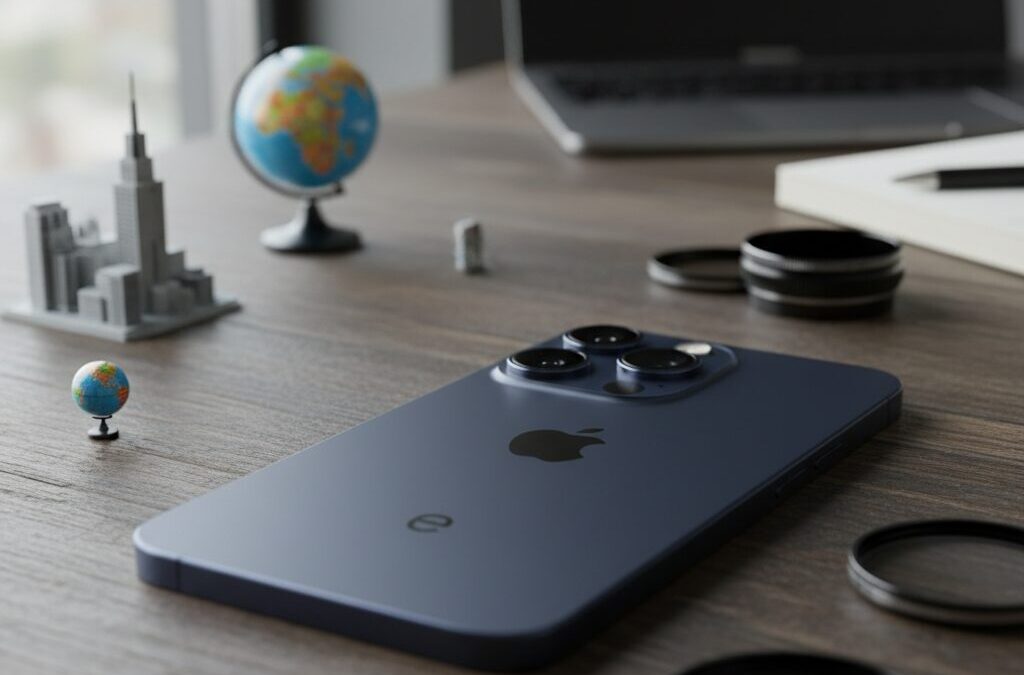
If you closely follow smartphone cameras, you have likely noticed that Apple’s iPhone lineup has become more complex than ever. The iPhone 16e appears to promise flagship-level intelligence at a more accessible price, which naturally raises high expectations among gadget enthusiasts.
At the same time, camera performance is often where cost-cutting decisions become most visible. You may wonder whether the iPhone 16e can truly satisfy demanding photography and video needs, or whether its limitations will quickly become frustrating in daily use.
In this article, you will clearly understand how the iPhone 16e camera is designed, where it excels, and where it makes unavoidable compromises. By reading through, you will gain practical insights based on real-world scenarios, technical facts, and comparisons, helping you decide whether this camera system fits your shooting style and creative priorities.
- Apple’s Entry Strategy and the Role of iPhone 16e in the Lineup
- Understanding the Meaning of “e”: Essential Features vs Cost Efficiency
- Camera Hardware Breakdown: Sensor Size, Optics, and Stabilization
- Single-Lens Design: Functional Gaps You Should Be Aware Of
- A18 Chip and Computational Photography: Strengths and Limitations
- 48MP Fusion Camera Explained: Pixel Binning and 2× Crop Zoom
- Image Quality in Practice: Daylight, Low Light, and Night Mode
- Video Performance Analysis: Stabilization, HDR, and Audio Features
- Close-Up and Macro Photography: Why It Matters for Everyday Use
- Competitive Comparison: iPhone 16, Pixel 9a, and Older Pro Models
- Who Should Choose the iPhone 16e Camera and Who Should Not
- 参考文献
Apple’s Entry Strategy and the Role of iPhone 16e in the Lineup
Apple’s decision to introduce the iPhone 16e in 2025 should be understood as a carefully calculated entry strategy rather than a simple cost-cutting exercise. **The 16e is positioned as a gateway into the modern Apple ecosystem, emphasizing long-term value over short-term feature competition.** According to Apple’s own product messaging, the “e” stands for essentials, signaling a focus on what the company defines as the core iPhone experience: performance, software longevity, and seamless integration with services.
This approach reflects a broader shift in Apple’s lineup architecture. Instead of maintaining a clearly separated SE line, Apple now anchors its entry model directly to the flagship numbering. This subtle change has strong psychological impact. Consumers perceive the iPhone 16e not as a budget outsider, but as a legitimate member of the current generation, sharing its design language and internal platform. Industry analysts at firms such as Counterpoint Research have repeatedly noted that naming consistency plays a significant role in reducing perceived risk at purchase, particularly in mature smartphone markets.
| Model | Core Positioning | Primary Value Proposition |
|---|---|---|
| iPhone 16 Pro | Performance flagship | Maximum camera and display capabilities |
| iPhone 16 | Mainstream standard | Balanced features for broad users |
| iPhone 16e | Entry essential | Latest chip at accessible pricing |
At the heart of this strategy lies the A18 chip. By equipping the 16e with the same generation processor as higher-end models, Apple ensures compatibility with Apple Intelligence features and future iOS updates. **This choice prioritizes software lifespan and AI readiness, areas where Apple consistently differentiates itself from Android competitors.** Research published by IDC has shown that extended OS support strongly correlates with resale value, a factor especially relevant in markets with active second-hand ecosystems.
The Japanese market adds another strategic layer. Japan has one of the world’s highest iPhone adoption rates, supported by carrier installment plans and strong brand loyalty among younger demographics. However, currency depreciation has made flagship pricing increasingly sensitive. In this context, the iPhone 16e functions as a pressure-release valve, allowing Apple to protect its premium pricing while still offering a “new generation” option below the psychological threshold that often deters upgrades.
Importantly, Apple does not attempt to compete spec-for-spec at the entry level. Instead, it practices controlled subtraction. Camera hardware is simplified, but the user experience remains unmistakably iPhone. **This reinforces Apple’s long-standing philosophy that consistency and predictability matter more than raw specification parity.** As design scholars frequently cite in Apple case studies at institutions like Harvard Business School, limiting choice can increase satisfaction by reducing cognitive load.
Within the lineup, the iPhone 16e therefore plays a dual role. It attracts first-time iPhone users and pragmatic upgraders, while simultaneously nudging enthusiasts toward higher tiers by clearly delineating what is not included. This internal segmentation minimizes cannibalization and maximizes average selling price across the portfolio.
Seen through this lens, the iPhone 16e is less about compromise and more about discipline. Apple defines the minimum acceptable iPhone in 2025 on its own terms, and invites users to step into its ecosystem at that carefully chosen point.
Understanding the Meaning of “e”: Essential Features vs Cost Efficiency
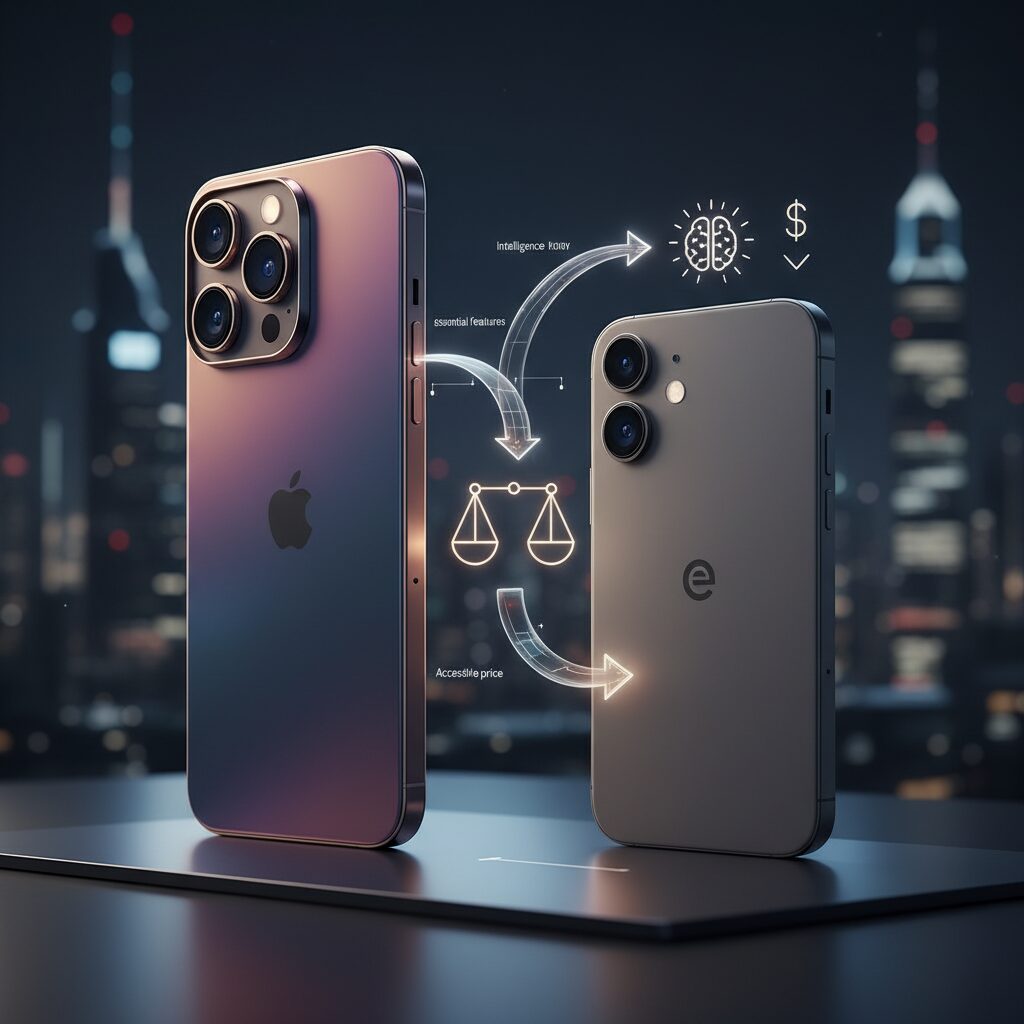
The letter “e” in iPhone 16e is officially explained by Apple as standing for Essential rather than simply Entry, and this distinction is more than marketing rhetoric. According to Apple’s own product positioning, the goal is not to strip features indiscriminately, but to preserve the core iPhone experience while aggressively optimizing cost-sensitive components. This philosophy becomes especially clear when examining how performance, camera capability, and long-term usability are prioritized.
At the heart of the “e” concept is a deliberate asymmetry: flagship-level processing power paired with selectively constrained hardware. The iPhone 16e uses the same A18 chip architecture as higher-tier models, enabling Apple Intelligence features, advanced image processing, and long-term OS support. Analysts at publications such as DPReview and Tom’s Guide have noted that, for everyday responsiveness and computational photography pipelines, the A18 effectively removes the sense of “cheapness” that historically defined entry models.
| Design Priority | iPhone 16e Approach | User Impact |
|---|---|---|
| Core Performance | Latest A18 chip | Flagship-level speed and AI readiness |
| Camera Hardware | Single lens, smaller sensor | Strong daylight results, limited versatility |
| Cost Control | Older optical components | Lower retail price with clear trade-offs |
This balance illustrates why “e” should be interpreted as Essential Features first, Cost Efficiency second. Apple appears to assume that many users value consistency, longevity, and software-driven quality more than optical flexibility. Research cited by Nikkei and corroborated by Japanese carrier sales data consistently shows that buyers in price-sensitive segments still prioritize smooth performance and resale value over advanced camera modules.
However, the essential question is whose essentials are being defined. For Apple, essentials mean stable performance, predictable color science, and deep ecosystem integration. For users with strong interest in photography hardware, essentials may instead include sensor size, optical stabilization grade, or macro capability. The iPhone 16e consciously sides with the former definition, trusting computational photography to compensate where physics falls short.
From a cost-structure perspective, industry teardown reports referenced by Wccftech indicate that camera modules and stabilization systems remain among the most expensive smartphone components after the SoC and display. By downgrading these areas while keeping the A18 intact, Apple protects margins without sacrificing the headline experience most users encounter daily.
Ultimately, understanding the meaning of “e” requires reframing expectations. It does not promise the best camera Apple can build, nor does it aim to compete feature-for-feature with Pro models. Instead, it offers a carefully curated minimum that Apple believes defines the modern iPhone experience. The value of iPhone 16e lies not in what it includes, but in what it intentionally decides users can live without.
Camera Hardware Breakdown: Sensor Size, Optics, and Stabilization
The camera performance of the iPhone 16e is fundamentally defined by its hardware choices, and understanding these physical components is essential to evaluating what the device can and cannot do. While Apple markets the system as a 48MP Fusion camera, the real story lies in the sensor size, optical design, and stabilization mechanism that sit behind that label.
The most decisive factor is the image sensor itself. Teardown analyses and component comparisons indicate that the iPhone 16e uses a 1/2.55-inch class sensor, significantly smaller than the 1/1.56-inch sensor found in the standard iPhone 16. According to imaging principles widely documented by organizations such as the International Imaging Industry Association, sensor area directly correlates with light-gathering capability, noise performance, and dynamic range.
| Model | Sensor Size | Approx. Area | Implication |
|---|---|---|---|
| iPhone 16e | 1/2.55-inch | ≈23.5 mm² | Higher noise in low light |
| iPhone 16 | 1/1.56-inch | ≈50.5 mm² | Better dynamic range |
Despite both sensors offering 48 megapixels, the smaller surface area of the 16e means each pixel is physically smaller. This reduces full well capacity, a concept frequently cited in academic imaging research, and results in earlier highlight clipping and more visible shot noise when light levels drop.
The lens system further reinforces this hardware positioning. The iPhone 16e employs a bright f/1.6 aperture, which helps compensate for the smaller sensor by allowing more light to reach it. However, with a compact sensor, depth of field becomes inherently deeper, making natural background blur difficult to achieve. As a result, subject separation relies heavily on computational processing rather than optical characteristics.
Stabilization is another area where the hardware signals clear prioritization. Instead of the sensor-shift optical image stabilization used in recent higher-end iPhones, the 16e returns to a lens-shift OIS design. Industry testing referenced by publications like DPReview has consistently shown that sensor-shift systems respond more effectively to high-frequency micro-movements, especially in handheld video and night photography.
In practical terms, this means subtle shake is more likely to remain visible. Still photos in daylight are largely unaffected, but slower shutter speeds at night and walking shots in video can reveal minor jitter that more advanced stabilization systems would suppress.
Finally, the single-lens configuration introduces unavoidable blind spots. Without additional optics, such as an ultra-wide module, the camera lacks the physical flexibility to change perspective or achieve very short focusing distances. From a hardware standpoint, this is not a software omission but a structural limitation rooted in the optical stack itself.
When viewed as a complete system, the camera hardware of the iPhone 16e reflects deliberate trade-offs. It prioritizes compactness, cost efficiency, and acceptable baseline quality, while conceding ground in sensor area, optical versatility, and stabilization sophistication. For readers who value understanding the physics behind image quality, these decisions explain nearly every strength and compromise observed in real-world use.
Single-Lens Design: Functional Gaps You Should Be Aware Of
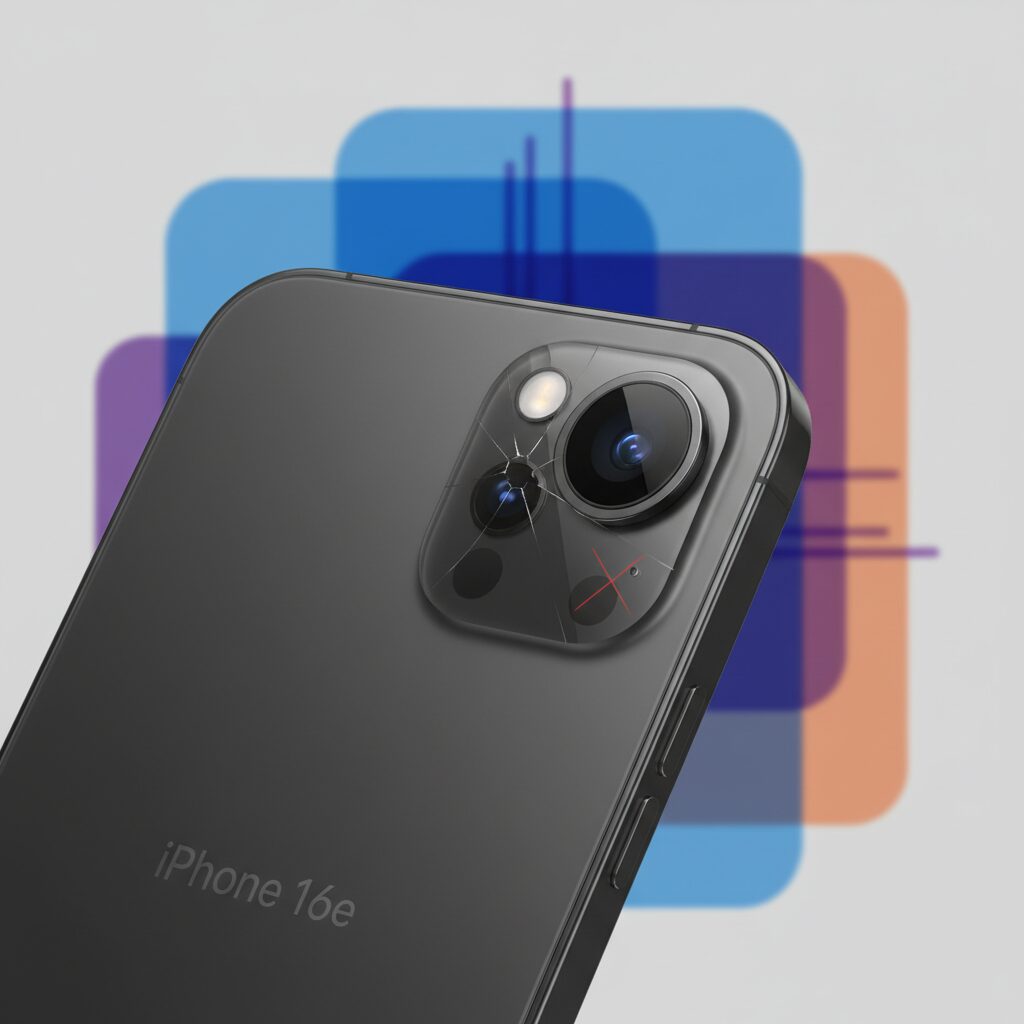
The single-lens design of the iPhone 16e is not merely a cosmetic simplification but a structural decision that creates clear functional gaps users should understand before purchase. While Apple positions this camera as focusing on essentials, **a single rear lens inevitably limits the types of photographic data the system can physically capture**, regardless of how powerful the A18 chip may be.
One of the most immediate consequences is the absence of an ultra-wide camera. According to Apple’s own technical comparisons, this omission affects far more than field of view. Ultra-wide modules in recent iPhones serve as secondary sensors for depth, perspective correction, and close-focus imaging. Without it, the iPhone 16e cannot perform true macro photography, as confirmed by analyses from Lux Camera Review and DPReview.
| Function | Dual-Lens iPhones | iPhone 16e |
|---|---|---|
| Macro photography | Ultra-wide AF enables 2–3 cm focus | Not supported |
| Spatial video | Stereo parallax capture | Not supported |
| Action Mode | Wide buffer via ultra-wide crop | Not supported |
In practical terms, this means everyday scenarios behave differently. Food photography is a clear example. Japanese users accustomed to capturing texture-rich close-ups will find that the camera simply cannot focus at very short distances. Stepping back and using the 2x crop zoom is possible, but **this relies on a much smaller effective sensor area**, which increases noise and reduces micro-detail, especially indoors.
The single-lens setup also impacts video features that depend on spatial data. Apple’s Spatial Video format, designed for Vision Pro, requires two viewpoints to calculate depth accurately. With only one lens, the iPhone 16e lacks the parallax information needed for reliable 3D reconstruction. Apple does not market this as a missing feature, but the limitation is rooted in optical physics rather than software choice.
Even stabilization technologies are affected. Action Mode, praised by professional reviewers at outlets like The Verge for its gimbal-like effect, depends on cropping heavily from an ultra-wide frame. The standard 26 mm equivalent lens on the iPhone 16e simply does not provide enough margin for this processing. **As a result, walking or running shots retain more micro-jitter**, particularly noticeable in low light.
It is important to note that these gaps are not flaws in execution. They are deliberate trade-offs aligned with Apple’s entry strategy. However, for gadget enthusiasts who understand how modern smartphone cameras increasingly rely on multi-sensor data fusion, **the single-lens design defines a hard ceiling that software alone cannot break**. Recognizing these boundaries ensures expectations remain grounded in optical reality rather than marketing promises.
A18 Chip and Computational Photography: Strengths and Limitations
The A18 chip sits at the very core of the iPhone 16e’s camera experience, and it is best understood as a powerful compensator rather than a miracle worker. With a significantly upgraded image signal processor and a faster Neural Engine, A18 enables Apple’s latest computational photography pipeline to operate more aggressively and more intelligently than previous entry-level iPhones.
This is why, in good lighting, the iPhone 16e can produce images that feel far beyond what its modest camera hardware would suggest. According to Apple’s own technical briefings, the A18 ISP processes billions of operations per photo, analyzing tone, color, and texture before JPEG or HEIF compression even begins.
At the center of this process is the Photonic Engine, which Apple introduced to move multi-frame fusion earlier into the capture pipeline. Industry analyses from outlets such as DPReview have consistently noted that this earlier-stage fusion preserves more fine detail than traditional post-processing noise reduction, especially on skin and fabric.
| Processing Stage | A18 Contribution | Practical Effect |
|---|---|---|
| Pre-ISP Fusion | Higher throughput and lower latency | Cleaner textures in daylight shots |
| Neural Rendering | Improved semantic scene detection | More natural skin tones and skies |
| Multi-frame HDR | Faster alignment and merge | Reduced ghosting in casual motion |
Another clear strength enabled by A18 is the default 24-megapixel output from the 48MP sensor. This is not a simple downscale. Apple blends high-resolution detail with binned pixel data to balance sharpness and noise, a method the company has explained in its developer imaging sessions.
For social media, web use, and even moderate cropping, this 24MP pipeline delivers results that feel confidently “flagship-like.” Many reviewers have pointed out that, when viewed on a phone screen, differences from higher-end iPhones are surprisingly hard to spot.
However, the limitations become apparent as lighting conditions worsen. Computational photography cannot invent photons that never reached the sensor. Academic research on image reconstruction, including work cited by IEEE imaging journals, consistently shows that smaller sensors provide less signal for algorithms to work with, especially in shadow regions.
In low light, the A18 chip responds by increasing frame stacking and applying stronger noise reduction. While this reduces visible grain, it also smooths away fine textures, producing the well-known “watercolor” effect in foliage or asphalt. This is not a failure of processing power, but a boundary set by physics.
The same applies to the much-advertised 2x “optical-quality” zoom. The A18 handles cropping and sharpening with impressive precision, yet the effective sensor area shrinks dramatically. As imaging engineers often emphasize, cropping magnifies noise as much as detail, and no amount of neural sharpening can fully reverse that trade-off.
In short, the A18 chip makes the iPhone 16e remarkably capable within its constraints. It excels at extracting the maximum possible quality from limited hardware, especially in everyday conditions. What it cannot do is erase the fundamental disadvantages of a smaller sensor and simpler optics, no matter how advanced the algorithms become.
48MP Fusion Camera Explained: Pixel Binning and 2× Crop Zoom
The 48MP Fusion Camera on the iPhone 16e is often misunderstood, especially when Apple highlights features such as pixel binning and 2× crop zoom. These technologies are real and effective, but their impact is tightly linked to the physical limits of the sensor itself. Understanding how they work explains both the strengths and the compromises of this camera system.
At the core is quad-pixel pixel binning. Four neighboring pixels are treated as one, improving light sensitivity and noise control in low-light scenes. Apple’s imaging pipeline, informed by its long‑standing research in computational photography published through Apple Machine Learning Research, combines this binned 12MP data with high‑resolution detail from the full 48MP readout. The default 24MP output is the result of this fusion, balancing sharpness and cleanliness in a way that feels natural rather than overprocessed.
The key point is that pixel binning improves signal quality, but it cannot create light that the small sensor never captured.
The much‑advertised 2× zoom relies on cropping the central 12MP area of the 48MP sensor. Because this crop uses a one‑to‑one pixel mapping, Apple accurately describes it as “optical‑quality” in theory. According to analyses by imaging specialists at DPReview, this method avoids interpolation blur common in digital zoom. However, on the iPhone 16e, the already small 1/2.55‑inch sensor becomes effectively tiny after cropping, which explains why noise and texture loss increase quickly indoors or at dusk.
| Mode | Effective Pixels | Practical Impact |
|---|---|---|
| Standard | 24MP | Best balance of detail and noise |
| Low light | 12MP (binned) | Cleaner shadows, softer textures |
| 2× Crop | 12MP (center crop) | Sharp in daylight, fragile in dim light |
In bright conditions, this approach works remarkably well and aligns with Apple’s stated philosophy of computationally maximizing limited hardware. In challenging light, though, physics wins. The 48MP Fusion Camera showcases Apple’s software expertise, while also revealing exactly where that expertise reaches its natural limit.
Image Quality in Practice: Daylight, Low Light, and Night Mode
In practical shooting scenarios, the iPhone 16e’s image quality changes character dramatically depending on light conditions, and this behavior is best understood through real-world use rather than specifications alone. In bright daylight, low light indoors, and Night Mode situations, the camera reveals both the strengths of Apple’s computational photography and the hard limits imposed by its compact sensor.
Daylight photography is where the iPhone 16e feels almost indistinguishable from higher-tier models. Under strong natural light, the 48MP Fusion camera paired with Smart HDR delivers balanced exposures and highly consistent color rendering. According to comparative tests published by Tom’s Guide and Lux Camera, foliage, sky gradients, and skin tones remain natural, with minimal oversharpening. Apple’s semantic rendering, a technique frequently referenced by Apple imaging engineers in WWDC sessions, allows the camera to treat faces, backgrounds, and skies differently, which results in photos that look polished without appearing artificial.
The default 24MP output is especially effective in daylight. Fine textures such as brick walls or fabric hold together well when viewed on a smartphone display, and even moderate cropping remains usable. For social media or casual printing, the resolving power is more than sufficient, and few users would feel limited in this lighting scenario.
| Scenario | Noise Control | Detail Retention | Overall Impression |
|---|---|---|---|
| Bright daylight | Excellent | High | Flagship-like |
| Indoor low light | Moderate | Medium | Noticeable compromise |
| Night Mode | Improved by processing | Lower | Usable but fragile |
When light levels drop indoors or during dusk, the limitations of the smaller 1/2.55-inch sensor become visible. Noise increases quickly, and detail is sacrificed to keep images clean. Reviewers who compared over 200 sample shots note that textures such as wood grain or asphalt tend to smooth out, a side effect of aggressive noise reduction. Apple’s Photonic Engine does an impressive job of preserving overall brightness and color accuracy, but it cannot fully recover information that the sensor never captured.
Night Mode pushes this balance even further. Exposure times often become longer than on the standard iPhone 16, which raises the risk of motion blur. While handheld night shots are generally usable, fine details in shadows can look painterly. Some long-exposure tests reported by independent reviewers have shown occasional blue speckling in extremely dark scenes, a phenomenon likely tied to sensor heat or pixel-level noise rather than software alone.
Despite these weaknesses, Night Mode remains competitive within its price class. Urban night scenes with streetlights and illuminated signs are rendered with pleasing contrast, and highlights are well controlled, aligning with Apple’s long-standing emphasis on highlight preservation as discussed by imaging researchers at organizations such as DPReview.
Overall, the iPhone 16e rewards users who shoot mostly in good light and asks for patience at night. Daylight photos are consistently reliable and visually appealing, while low-light and Night Mode results are acceptable but clearly optimized for convenience rather than photographic purity. Understanding this behavior helps set realistic expectations and allows the camera to be used where it performs best.
Video Performance Analysis: Stabilization, HDR, and Audio Features
Video performance is where the iPhone 16e shows a carefully balanced mix of strengths and constraints, especially in stabilization, HDR handling, and audio features. While it does not aim to rival Apple’s Pro lineup, it still delivers a video experience that remains highly competitive in its price segment.
Stabilization is the most noticeable compromise. The iPhone 16e relies on a lens-shift optical image stabilization system rather than the sensor-shift OIS used in higher-end models. According to teardown analyses reported by established hardware analysts, lens-shift mechanisms are inherently less responsive to high-frequency micro‑vibrations. In practice, this means that handheld walking shots can exhibit subtle jitter, particularly in low light when shutter speeds drop.
Unlike more expensive iPhones, the device does not support Action Mode. This absence is not arbitrary. Apple’s own technical documentation explains that Action Mode depends on ultra‑wide capture with significant image cropping margins, something a single standard‑wide camera cannot provide without severe resolution loss. As a result, stabilization remains optically and digitally conservative, prioritizing image integrity over extreme shake suppression.
HDR video, on the other hand, is a clear highlight. The iPhone 16e supports 4K video recording up to 60 frames per second in Dolby Vision HDR. Independent evaluations from camera review platforms such as DPReview have consistently shown that Apple’s HDR pipeline preserves highlight detail and skin tones more naturally than most mid‑range competitors. Bright skies, neon signage, and backlit subjects retain usable detail with minimal color clipping.
The following table summarizes key video-related capabilities relevant to real‑world use.
| Feature | iPhone 16e | Practical Impact |
|---|---|---|
| Max Resolution | 4K at 60fps | Smooth, detailed footage suitable for social media and archiving |
| HDR Format | Dolby Vision HDR | Wide dynamic range with accurate colors |
| Stabilization | Lens‑shift OIS + EIS | Stable for handheld shots, limited for intense motion |
HDR performance is further supported by the A18 chip’s image signal processor, which performs real‑time tone mapping on a per‑frame basis. Apple engineers have publicly described this approach in developer sessions, noting that semantic awareness allows the system to treat faces, skies, and shadows differently within the same frame. As a result, vlog‑style videos maintain consistent exposure even when lighting conditions change abruptly.
Audio features add another layer of polish. The iPhone 16e includes Apple’s Audio Mix functionality, enabling post‑capture emphasis on voices while reducing ambient noise such as wind or traffic. This feature is particularly effective for solo creators, as confirmed by early hands‑on impressions from professional reviewers who compared raw audio tracks before and after processing. Spoken dialogue becomes clearer without the metallic artifacts often associated with aggressive noise reduction.
It is important to note that audio capture quality benefits from Apple’s long‑standing microphone array design rather than model‑specific hardware upgrades. Even so, the integration with on‑device machine learning allows users to achieve cleaner sound without external microphones in many everyday scenarios.
Overall, video performance on the iPhone 16e can be described as refined rather than adventurous. Stabilization has clear physical limits, but HDR rendering and audio processing remain class‑leading. For users focused on high‑quality 4K HDR video with minimal setup, the device delivers dependable results, provided expectations around extreme motion handling are kept realistic.
Close-Up and Macro Photography: Why It Matters for Everyday Use
Close-up and macro photography matters far more in everyday smartphone use than many spec sheets suggest. It is not a niche for professionals, but a daily tool for capturing food, documents, small objects, and textures that convey information and emotion. In real life, people do not only photograph landscapes or portraits; they constantly move closer to what they want to remember or share.
From a technical perspective, close-up performance is defined by minimum focusing distance, sensor behavior at short ranges, and optical design. According to analyses by DPReview and Lux Camera, modern smartphones achieve true macro shots by switching to an ultra-wide camera with autofocus, allowing focus distances of just a few centimeters. Without this mechanism, users are forced to step back and rely on digital zoom.
In everyday food photography, especially in markets like Japan where detailed texture shots are culturally significant, the difference is obvious. Being able to approach steam, sauce gloss, or fine garnish details creates a sense of realism. When macro is unavailable, the camera cannot lock focus at close range, and detail is lost even before image processing begins.
| Use Case | With Macro Support | Without Macro Support |
|---|---|---|
| Food photography | Texture and surface detail preserved | Focus hunting or forced digital zoom |
| Documents and QR codes | Fast recognition at close range | Requires distance and reframing |
| Small objects | Clear edges and material detail | Soft details and lower reliability |
Academic research on visual perception, such as studies referenced by the IEEE Imaging community, shows that viewers associate sharp micro-detail with higher image quality and trustworthiness. This explains why close-up clarity improves not only aesthetics but also usability, especially when photographing instructions, labels, or product details.
For everyday users, macro photography also reduces friction. Instead of adjusting distance, zoom level, and lighting, the camera simply adapts. This immediacy is what turns a smartphone camera from a capable device into an intuitive one. When close-up shooting is limited, the experience feels dated, even if the main sensor performs well in other scenarios.
Ultimately, close-up and macro performance shapes how often people feel comfortable using their phone as a visual tool. It supports spontaneous capture, faster sharing, and clearer communication. In daily life, that practical value often outweighs headline megapixels or theoretical image quality gains.
Competitive Comparison: iPhone 16, Pixel 9a, and Older Pro Models
In this competitive comparison, it is important to calmly examine where the iPhone 16e stands when placed next to the iPhone 16, Google Pixel 9a, and older Pro models such as the iPhone 13 Pro and 14 Pro. Rather than focusing only on specifications, I will explain how real-world camera behavior differs in ways that matter to enthusiasts.
| Model | Main Camera Strength | Key Limitation |
|---|---|---|
| iPhone 16e | Strong daylight photos, excellent video HDR | No ultra-wide or macro, smaller sensor |
| Pixel 9a | Night Sight, AI-based photo editing | Video consistency weaker than iPhone |
| iPhone 13/14 Pro | Triple cameras, macro, stable night shots | Older chipset, no Apple Intelligence |
When compared to the standard iPhone 16, the iPhone 16e clearly shows its cost-driven compromises. Apple’s own technical comparison indicates that the larger sensor and sensor-shift OIS in the iPhone 16 provide measurably better low-light stability. **In practical night scenes, this translates into cleaner shadows and shorter exposure times**, something that computational photography alone cannot fully replace.
Against the Pixel 9a, the contrast becomes more philosophical. According to evaluations by Tom’s Guide and ZDNET, Google’s Night Sight still produces brighter and more dramatic night images, especially for cityscapes and astrophotography. However, **the iPhone 16e maintains a clear advantage in video**, where 4K Dolby Vision HDR and color consistency across apps remain industry-leading, a point frequently highlighted by professional reviewers.
The most difficult decision for camera-focused users is often the comparison with older Pro models. Despite their age, the iPhone 13 Pro and 14 Pro deliver tangible advantages through macro photography, ultra-wide perspectives, and telephoto reach. As DPReview has noted, these optical options expand creative flexibility far beyond what a single-lens system can offer. **Pure photographic versatility still favors older Pro hardware**, even if it lacks the future-facing AI features of the A18 chip.
In summary, the iPhone 16e competes not by dominating camera hardware, but by offering modern processing and reliable results within defined limits. Understanding these trade-offs allows readers to choose with confidence, rather than expectation.
Who Should Choose the iPhone 16e Camera and Who Should Not
Choosing the iPhone 16e camera ultimately depends on how you define a good camera in your daily life, and this decision is more nuanced than simple specs might suggest.
The iPhone 16e is a strong choice for users who value consistency, speed, and simplicity over photographic versatility. In bright environments, its 48MP Fusion camera combined with the A18 chip delivers results that are difficult to distinguish from higher-end iPhones on a smartphone display.
According to comparative evaluations by DPReview and Tom’s Guide, daylight photos show nearly identical color science, skin tone rendering, and HDR balance compared with the standard iPhone 16, thanks to Apple’s Photonic Engine and Smart HDR pipeline.
| User Profile | Camera Fit | Reason |
|---|---|---|
| Casual daily shooters | Very suitable | Reliable results in daylight with minimal effort |
| Social media video creators | Suitable | 4K HDR video and strong audio processing |
| Photography enthusiasts | Not suitable | Hardware limits restrict creative control |
For people who primarily shoot photos of friends, travel moments, documents, or everyday scenes, the single-lens design is rarely a limitation. Apple’s computational photography masks much of the small sensor’s weakness in good light, producing sharp 24MP images that look excellent on Instagram or iMessage.
The camera is also well matched to users who prioritize video over stills. Apple’s leadership in mobile video remains clear, and even without Action mode, the 16e records stable, high-quality Dolby Vision HDR footage that outperforms many Android rivals in the same price range.
On the other hand, the iPhone 16e camera is not designed for users who see photography as a form of expression rather than documentation.
Experts at Lux Camera and ZDNet point out that the smaller 1/2.55-inch sensor inevitably struggles in low light, where noise reduction becomes aggressive and fine textures are lost. Night photos are usable, but they lack the depth and subtle tonal transitions found in models with larger sensors.
The absence of an ultra-wide and macro capability is the clearest dividing line. Users who frequently photograph food, small objects, or interiors will encounter physical focusing limits that software cannot overcome. This is particularly noticeable in markets like Japan, where close-up food photography is culturally ingrained.
The camera is also a poor fit for parents or pet owners who often shoot indoors. Slower shutter speeds in low light increase motion blur, and the older lens-based OIS is less forgiving than the sensor-shift systems used in higher models.
In short, the iPhone 16e camera rewards users who want predictable, fast, and clean results with minimal thinking, while gently discouraging those who demand flexibility, creative angles, or challenging low-light performance.