Wireless earbuds are more powerful than ever, yet many audio enthusiasts still feel a gap between convenience and true high‑fidelity sound. You may have experienced the trade‑off yourself—cutting the cord often meant accepting compression, latency, or limited power.
Now, that compromise is rapidly disappearing. With Qualcomm’s XPAN Wi‑Fi audio, aptX Lossless, MediaTek’s AI‑driven recording engines, and the emergence of semiconductor‑based xMEMS drivers, mobile audio is entering a radically new phase.
At the same time, USB‑C dongle DACs are delivering desktop‑class amplification from a device that fits in your pocket, while streaming platforms push lossless audio to the mainstream. In this article, you will discover how silicon architecture, transducer physics, market dynamics, and psychoacoustic research are converging—and what it truly means for your next listening experience.
- From 3.5mm Jack to Wi‑Fi Audio: How Convenience and Fidelity Collided
- Snapdragon 8 Gen 3 and XPAN: Breaking the Bandwidth Barrier with Wi‑Fi
- aptX Lossless and the Shift Toward Bit‑Perfect Wireless Audio
- MediaTek Dimensity 9300: AI‑Enhanced Recording and Hybrid Connectivity
- xMEMS Solid‑State Drivers: The Semiconductor Revolution in Earbuds
- Creative Aurvana Ace 2: Real‑World Performance of xMEMS Hybrid Designs
- The Return of Wired: Why USB‑C Dongle DACs Are Booming
- FiiO KA17 vs iBasso DC‑Elite vs ONIX Alpha XI1: Pocket Desktop Power Compared
- Market Shifts: Anker’s Surge, Sony’s Premium Strategy, and Apple’s Position
- Streaming Dominance: How Lossless Subscriptions Reshape Hardware Demand
- Can You Really Hear Hi‑Res? AES Research, ABX Tests, and Meta‑Analysis
- Psychoacoustics and the Hypersonic Effect: Beyond Frequency Response
- Safe Listening in the Age of ANC: WHO Guidelines and Hearing Health
- 参考文献
From 3.5mm Jack to Wi‑Fi Audio: How Convenience and Fidelity Collided
For more than a decade, the 3.5mm headphone jack symbolized simplicity. You plugged in a pair of wired headphones, and you got predictable, lossless audio with effectively zero latency. There was no pairing process, no battery anxiety, and no codec negotiation. Convenience and fidelity coexisted naturally because the signal path was short and physically stable.
That balance shifted dramatically when major smartphone makers began removing the analog jack. The industry narrative emphasized water resistance, internal space savings, and a wireless future. In practice, the center of gravity moved toward Bluetooth, prioritizing cable-free convenience over uncompromised sound quality.
The removal of the 3.5mm jack did not just eliminate a port. It redefined the default audio architecture of mobile devices from analog simplicity to compressed wireless complexity.
Bluetooth audio relies on codecs such as SBC, AAC, and aptX, all of which traditionally use lossy compression. These codecs are designed around psychoacoustic models, discarding audio information considered less audible to the human ear. While efficient, this approach inevitably introduced a gap between source and playback, especially noticeable to trained listeners.
Latency became the second fault line. Unlike a wired connection where delay is negligible, Bluetooth audio requires encoding, transmission, buffering, and decoding. In gaming or video playback, even tens of milliseconds can disrupt immersion. This is not theoretical; it is rooted in the packet-based nature of wireless transmission.
| Era | Primary Interface | Key Trade-off |
|---|---|---|
| Pre-removal | 3.5mm Analog Jack | High fidelity, low latency, limited physical freedom |
| Early Wireless Shift | Bluetooth (Lossy Codecs) | Maximum convenience, potential quality loss and delay |
| Emerging Phase | Wi-Fi Audio / Lossless Wireless | Convenience with reduced compromise |
However, the story does not end in compromise. Qualcomm’s introduction of aptX Lossless, supported on platforms such as Snapdragon 8 Gen 3, marks a significant turning point. Under stable radio conditions, CD-quality 16-bit/44.1kHz audio can be transmitted bit-perfectly over Bluetooth. This directly addresses the long-standing criticism that wireless automatically means degraded sound.
The more radical development is XPAN, which leverages Wi-Fi instead of traditional Bluetooth for audio transmission. By utilizing the vastly greater bandwidth available in modern Wi-Fi standards, including Wi-Fi 7 capabilities referenced in Qualcomm’s documentation, it becomes technically feasible to deliver up to 24-bit/192kHz audio wirelessly. That level approaches studio master quality in a mobile context.
Crucially, XPAN also targets range and latency. Reports from industry analyses such as SoundGuys note that optimized implementations can achieve sub-50ms latency, making wireless audio viable not only for music but also for gaming. In other words, convenience and fidelity are no longer mutually exclusive by design.
What we are witnessing is not simply the death of the headphone jack, but the restructuring of mobile audio around digital-first, network-based architectures. The initial collision between convenience and fidelity exposed real limitations in bandwidth and processing. Now, advances in SoC integration, codec design, and Wi-Fi audio transport are gradually dissolving that conflict.
The future of mobile listening is no longer defined by whether a cable is present, but by how intelligently silicon and wireless protocols manage data integrity, latency, and power. The collision between convenience and fidelity is evolving into a convergence, reshaping what users can reasonably expect from a device that fits in their pocket.
Snapdragon 8 Gen 3 and XPAN: Breaking the Bandwidth Barrier with Wi‑Fi
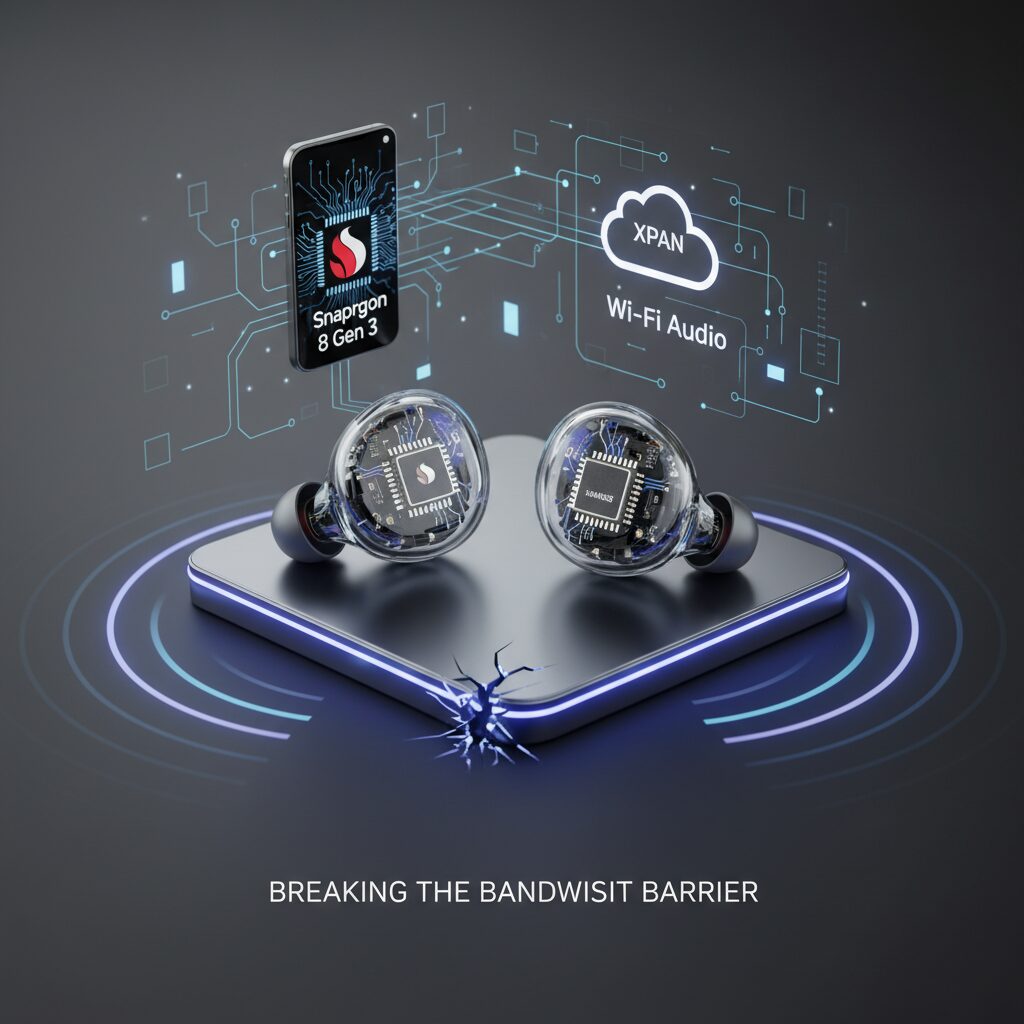
For more than a decade, Bluetooth has defined the ceiling of wireless audio. Even with advanced codecs, it has fundamentally operated within a bandwidth envelope measured in mere megabits per second. With Snapdragon 8 Gen 3 and Qualcomm’s XPAN technology, that ceiling is no longer a fixed constraint but a design choice.
Snapdragon 8 Gen 3 supports Wi‑Fi 7 (IEEE 802.11be), bringing features such as up to 320MHz channel bandwidth and 4K QAM modulation. While these capabilities are typically discussed in the context of multi‑gigabit data networking, their implication for audio is profound: wireless transmission is no longer inherently bandwidth-starved.
XPAN (Expanded Personal Area Network) leverages this Wi‑Fi foundation to transmit audio between a Snapdragon 8 Gen 3 device and compatible S7/S7 Pro audio platforms. Instead of compressing aggressively to fit Bluetooth limits, XPAN enables lossless transmission up to 24‑bit/192kHz, a specification aligned with studio master files.
| Technology | Typical Bandwidth | Max Practical Audio |
|---|---|---|
| Bluetooth (LDAC) | Up to 990 kbps | Compressed Hi‑Res |
| aptX Lossless | ~1 Mbps class | 16‑bit/44.1kHz Lossless |
| XPAN over Wi‑Fi | Wi‑Fi 7 class | 24‑bit/192kHz Lossless |
This shift is not merely about higher numbers. According to Qualcomm’s Snapdragon platform documentation and industry analysis from SoundGuys, Bluetooth’s constraint has historically forced psychoacoustic trade‑offs. With XPAN, those trade‑offs can be reduced or eliminated under stable Wi‑Fi conditions.
The most disruptive element is range and stability. Wi‑Fi coverage typically exceeds Bluetooth by a wide margin in indoor environments. In practical terms, users can leave their phone in one room and move across a house without audio dropouts, something Bluetooth often struggles to maintain.
Latency, often the Achilles’ heel of Wi‑Fi audio, has also been aggressively optimized. Reports indicate sub‑50ms latency, bringing performance into a range suitable not only for music and video but also competitive gaming scenarios. This narrows the historical gap between wired and wireless responsiveness.
Importantly, Snapdragon 8 Gen 3 does not abandon Bluetooth. It supports aptX Lossless for CD‑quality bit‑perfect delivery when Wi‑Fi is unavailable. This dual‑path strategy ensures continuity: Bluetooth for universality, Wi‑Fi for uncompromised fidelity.
In architectural terms, the bandwidth barrier has shifted from the air interface to the transducer and mastering chain. When wireless links can handle 24‑bit/192kHz losslessly, the bottleneck moves elsewhere. That is a historic turning point for mobile audio design.
For enthusiasts who once viewed “wireless” as synonymous with compromise, Snapdragon 8 Gen 3 with XPAN signals something different: a post‑Bluetooth mindset where convenience and studio‑grade transmission finally coexist.
aptX Lossless and the Shift Toward Bit‑Perfect Wireless Audio
For over a decade, Bluetooth audio has been defined by compromise. Limited bandwidth forced codecs such as SBC, AAC, and conventional aptX to rely on lossy compression, discarding data based on psychoacoustic models. That trade-off made wireless convenient, but never truly transparent.
With the arrival of aptX Lossless on platforms such as Snapdragon 8 Gen 3 and Snapdragon 8 Elite, that equation fundamentally changes. Qualcomm specifies support for mathematically lossless transmission of CD-quality audio at 16-bit/44.1kHz, meaning the decoded signal can be bit-for-bit identical to the source when radio conditions are stable.
This matters because “bit‑perfect” is not a marketing slogan but a measurable state. In digital audio engineering, it means the binary stream received by the DAC matches the original PCM data exactly. According to Qualcomm’s Snapdragon Sound documentation, aptX Lossless dynamically scales its bitrate depending on RF conditions, preserving lossless integrity when bandwidth allows and gracefully adapting when interference increases.
The practical difference becomes clearer when compared with prior codecs.
| Codec | Compression Type | Max Quality Target |
|---|---|---|
| SBC / AAC | Lossy | Below CD-equivalent (variable) |
| Conventional aptX | Lossy | Approx. CD-level (compressed) |
| aptX Lossless | Mathematically Lossless (adaptive) | 16-bit / 44.1kHz Bit‑Perfect |
Unlike LDAC, which increases bitrate but remains lossy even at its highest 990kbps mode, aptX Lossless is designed to eliminate generational degradation under ideal conditions. For listeners streaming lossless tiers from Apple Music or Amazon Music HD, this alignment between source and transmission path is critical.
The significance extends beyond raw specifications. The Audio Engineering Society has long debated whether listeners can reliably distinguish high-resolution formats from 16/44.1 in controlled tests. However, even critics of hi‑res claims acknowledge that eliminating unnecessary processing stages reduces uncertainty in the playback chain. A bit‑perfect link ensures that any perceived difference originates in mastering or hardware—not codec artifacts.
Equally important is ecosystem momentum. As multiple flagship Android devices now support Snapdragon Sound with aptX Lossless at the hardware level, wireless headphones equipped with compatible Qualcomm audio platforms can negotiate this mode automatically. This interoperability signals a structural shift: lossless is becoming a baseline expectation rather than a niche feature.
Of course, “lossless” over Bluetooth remains conditional. Radio congestion, physical distance, and multipath interference can force bitrate reduction. Yet the conceptual leap is undeniable. Wireless audio is no longer architecturally bound to lossy compression.
For enthusiasts who once defaulted to wired connections to guarantee fidelity, aptX Lossless represents a turning point. It narrows the philosophical and measurable gap between cable and air, redefining what portable audio can achieve without sacrificing convenience.
MediaTek Dimensity 9300: AI‑Enhanced Recording and Hybrid Connectivity
MediaTek Dimensity 9300 approaches mobile audio from a creator-first perspective, placing equal emphasis on capture quality and wireless stability.
Rather than focusing solely on playback bandwidth, it integrates AI-driven recording and advanced coexistence control directly into the SoC architecture.
This design philosophy reflects how smartphones are increasingly used as primary production tools, not just consumption devices.
AI‑Enhanced 3‑Microphone HDR Recording
One of the most distinctive capabilities of Dimensity 9300 is its support for 3‑microphone HDR audio recording. According to MediaTek’s official technical brief, the platform processes input from three microphones simultaneously, applying real-time AI algorithms to separate primary voice from environmental noise.
Traditional smartphone recording often struggles in high dynamic range scenarios such as outdoor vlogging, live events, or street interviews. Wind noise and sudden volume spikes can easily distort speech intelligibility.
With AI-based beamforming and noise suppression, the 9300 dynamically balances these inputs, reducing wind artifacts while preserving vocal clarity.
| Feature | Conventional Recording | Dimensity 9300 |
|---|---|---|
| Microphone Input | 1–2 mics | 3-mic array |
| Noise Handling | Basic suppression | AI real-time separation |
| Dynamic Range | Limited | HDR audio processing |
In practical terms, this enables creators to shoot short-form video content without external microphones in many scenarios. As MediaTek highlights in its developer communications, the goal is studio-like capture using only the handset.
The implication is significant: mobile audio quality is no longer constrained by hardware alone, but enhanced through computational intelligence.
Hybrid Connectivity and LightningConnect
Beyond recording, Dimensity 9300 addresses a common pain point in wireless audio—interference between Wi‑Fi and Bluetooth operating in the crowded 2.4GHz band.
The platform integrates MediaTek Wi‑Fi/BT Hybrid Coexistence 3.0, which coordinates transmission timing at the chipset level to minimize packet collisions. MediaTek reports up to 200% improvement in wireless streaming throughput in certain scenarios while maintaining Bluetooth audio stability.
This becomes particularly relevant when users stream 4K content or engage in online gaming while using wireless earbuds.
Complementing this is LightningConnect technology, which reduces Bluetooth audio latency to as low as 35ms. For competitive gaming or rhythm-based apps, that latency approaches the perceptual threshold where delay becomes noticeable.
For users, this translates into fewer dropouts, tighter audiovisual sync, and a more reliable everyday experience.
As global Bluetooth shipment forecasts cited by industry analyses indicate continued growth toward billions of LE Audio-capable devices, coexistence optimization is not optional—it is foundational.
Dimensity 9300 demonstrates that the next stage of mobile audio innovation lies in intelligent orchestration: AI-enhanced recording on the input side and tightly coordinated hybrid connectivity on the output side.
xMEMS Solid‑State Drivers: The Semiconductor Revolution in Earbuds
Even if a smartphone can transmit lossless audio, the final sound you hear is determined by the transducer. This is where xMEMS solid-state drivers mark a structural break from a century of moving-coil speaker design.
Instead of relying on a voice coil and magnet, xMEMS uses MEMS (Micro Electro Mechanical Systems) fabrication to build a silicon-based actuator directly on a wafer. Electrical signals deform a piezoelectric structure, which in turn moves an ultra-light diaphragm with extreme precision.
This is not an incremental tweak. It is a semiconductor manufacturing approach applied to acoustic output.
| Driver Type | Actuation Method | Manufacturing Process | Key Strength |
|---|---|---|---|
| Dynamic | Voice coil + magnet | Mechanical assembly | Strong bass displacement |
| Balanced Armature | Magnetic armature | Precision assembly | Compact, efficient |
| xMEMS (MEMS) | Piezoelectric silicon actuator | Semiconductor wafer process | Ultra-fast transient response |
The most significant advantage is transient speed. Because the silicon diaphragm has extremely low moving mass and high rigidity, it reacts to signal changes faster than conventional dynamic systems. Reviews of early implementations such as Creative’s Aurvana Ace 2 consistently highlight unusually crisp cymbal decay and highly defined micro-detail reproduction.
This aligns with psychoacoustic findings discussed in AES literature, where improved transient accuracy can enhance perceived clarity even when frequency response differences are subtle. Speed is not just a spec; it shapes how “real” a sound feels.
Another breakthrough lies in manufacturing consistency. Traditional drivers involve mechanical tolerances and manual assembly, which can introduce left-right variance. Semiconductor fabrication dramatically reduces unit deviation, enabling near-identical phase behavior between channels.
That phase alignment directly affects stereo imaging. When both channels behave identically, spatial cues become more stable, and center vocals lock into place with greater precision.
xMEMS drivers also demonstrate strong high-frequency extension, often reaching well beyond the audible band. While debate continues over ultrasonic audibility, studies such as Reiss’s meta-analysis suggest that under certain conditions, trained listeners can detect high-resolution differences. A driver capable of accurately reproducing these upper harmonics ensures that no information is prematurely truncated.
There are, however, physical constraints. MEMS structures have limited excursion compared to dynamic drivers, which makes deep bass reproduction challenging in a single-driver configuration. Current commercial products therefore use hybrid designs, pairing xMEMS for treble with dynamic woofers for low frequencies.
This hybridization introduces tuning complexity. If the transient character of the low-frequency driver does not match the speed of the MEMS unit, coherence can suffer. Early reviews note that integration quality varies by implementation, underscoring that the technology’s potential depends heavily on crossover design.
Still, the broader implication is profound. By shifting speaker production into semiconductor fabs, xMEMS opens the door to wafer-level scaling, tighter tolerances, and improved durability, including resistance to dust and moisture. Earbuds are no longer purely mechanical miniatures; they are becoming integrated silicon systems.
For gadget enthusiasts, this signals more than a new sound signature. It represents the convergence of microelectronics and acoustics, where Moore’s Law-style manufacturing discipline begins to influence how earbuds are built. The semiconductor revolution has officially reached your ears.
Creative Aurvana Ace 2: Real‑World Performance of xMEMS Hybrid Designs
Creative Aurvana Ace 2 is one of the first true wireless earbuds to commercialize a hybrid design that combines an xMEMS solid-state driver with a conventional dynamic driver. This configuration is not just a spec-sheet novelty. It directly shapes how the earphones behave in real listening environments.
According to hands-on evaluations by ZDNET and specialist audio reviewers, the most immediately noticeable trait is the speed and precision of the high frequencies. The xMEMS driver, built using semiconductor processes and driven by a piezoelectric actuator, has extremely low moving mass. As a result, transient response is exceptionally fast compared to traditional dynamic designs.
In practical terms, this translates into sharper attack, cleaner decay, and a heightened sense of micro-detail in cymbals, strings, and spatial cues.
| Frequency Range | Responsible Driver | Perceived Character |
|---|---|---|
| Highs | xMEMS solid-state | Fast, precise, highly resolving |
| Lows | Dynamic driver | Warm, fuller, more conventional impact |
Reviewers consistently describe the treble as unusually clean and extended, often highlighting how hi-hats and reverberation tails remain distinct even in dense mixes. Compared to many balanced armature implementations, the Ace 2 avoids harsh sibilance while maintaining clarity. This aligns with the theoretical advantages of MEMS fabrication: tighter unit-to-unit consistency and improved phase matching between left and right channels.
However, real-world performance also reveals the challenges of hybridization. Because xMEMS drivers have limited excursion, Creative pairs them with a dynamic driver to handle bass. Some critical reviews, including detailed impressions from No Borders Audiophile, note that the low end can feel comparatively softer or less defined than the hyper-precise treble.
The contrast in speed between the two driver types can create a subtle sense of incoherence, especially in fast, bass-heavy genres. When complex kick drum patterns overlap with bright percussion, the upper range remains razor-sharp while the bass lags slightly in articulation.
In everyday listening—streaming lossless tracks from Apple Music or high-bitrate services—the effect is highly genre-dependent. Acoustic jazz, classical, and vocal-centric recordings benefit most from the Ace 2’s transient agility. Spatial layering becomes more apparent, and small dynamic inflections stand out clearly. Electronic or hip-hop listeners, on the other hand, may prefer a more uniformly punchy low-end presentation.
Battery life and active noise cancelation performance, based on multiple third-party evaluations, are solid but not class-leading. Compared with flagship models from Sony or Apple, ANC effectiveness and ecosystem integration are less mature. This reinforces that the Ace 2’s primary innovation lies in driver technology rather than system-level polish.
What makes the Aurvana Ace 2 especially significant is not that it is perfect, but that it demonstrates a viable path for solid-state drivers in consumer TWS. The measurable advantages of semiconductor manufacturing—consistency, miniaturization potential, and resistance to environmental factors—suggest long-term scalability.
In real-world use, the Ace 2 feels less like a finished revolution and more like an early but convincing proof of concept. It delivers a genuinely different treble experience while exposing the tuning and crossover challenges that the next generation of xMEMS hybrids will need to solve.
For gadget enthusiasts who prioritize technical novelty and audible micro-detail, it offers a glimpse into how future wireless earbuds may evolve once hybrid integration becomes more refined and fully coherent across the entire frequency spectrum.
The Return of Wired: Why USB‑C Dongle DACs Are Booming
For nearly a decade, mobile audio has been defined by one narrative: cut the cable. Yet in 2024–2025, we are witnessing a clear countertrend. USB‑C dongle DACs are not a nostalgic niche. They are booming because the ecosystem around them has fundamentally changed.
The catalyst is structural. With the iPhone 15 series adopting USB‑C, a single digital port now spans flagship Android devices and Apple’s mainstream lineup. This hardware unification has removed friction. A dongle DAC purchased today works across platforms without proprietary adapters, dramatically expanding its addressable market.
At the same time, content quality has risen. According to the Recording Industry Association of Japan, streaming accounted for 91.8% of music distribution revenue in 2024, and major services now offer lossless or high‑resolution tiers as standard. When the source becomes lossless, the weakest link shifts to the playback chain.
| Factor | Before | Now |
|---|---|---|
| Connector | Lightning vs USB‑C split | USB‑C unified ecosystem |
| Streaming Quality | Mainly lossy | Lossless / Hi‑Res mainstream |
| Phone Output Power | Declining, jack removed | External DAC required for full performance |
There is also a hard electrical reason. Modern smartphones rarely include high‑power headphone amplifiers. Internal analog stages are constrained by space, heat, and battery priorities. In contrast, devices like the FiiO KA17 integrate dual ESS ES9069Q DAC chips and a THX AAA 78+ amplification stage, reaching up to 650mW at 32Ω in desktop mode, as detailed by specialist reviewers at Headfonia and Major HiFi. That level of output was once reserved for desktop gear.
Power matters because control matters. High‑impedance or low‑sensitivity headphones demand voltage and current stability. Without it, dynamics compress and bass loses authority. A dongle DAC externalizes that burden, reallocating physical volume and thermal headroom to sound quality rather than radios and cameras.
Latency is another overlooked driver. Wireless codecs, even advanced ones, introduce buffering and transmission delay. A wired USB connection effectively eliminates perceptible latency, which appeals not only to audiophiles but also to gamers and creators monitoring live audio.
Psychology plays a role as well. As AES research debates around high‑resolution audibility have shown, trained listeners in controlled environments can detect small but statistically significant differences under certain conditions. When enthusiasts invest in better transducers and amplification, they are aligning their hardware with that possibility. The dongle DAC becomes an affordable entry point into that experimentation.
Finally, the boom reflects segmentation. The mass market optimizes for convenience. A growing subculture optimizes for control, headroom, and measurable performance. USB‑C dongle DACs sit precisely at that intersection: pocketable, bus‑powered, yet architecturally closer to desktop audio than to earbuds.
In other words, wired has not returned out of nostalgia. It has returned because the technical and market conditions finally make it rational again.
FiiO KA17 vs iBasso DC‑Elite vs ONIX Alpha XI1: Pocket Desktop Power Compared
When people talk about “pocket desktop power,” these three dongle DAC/amps represent three very different interpretations of that idea. FiiO KA17, iBasso DC‑Elite, and ONIX Alpha XI1 are not simply spec variants—they reflect distinct design philosophies about what portable hi‑fi should prioritize.
| Model | Design Focus | Notable Architecture | Positioning |
|---|---|---|---|
| FiiO KA17 | Maximum output & versatility | Dual ES9069Q + THX AAA 78+ | Power-oriented |
| iBasso DC‑Elite | Reference-grade refinement | Flagship DAP-derived circuit + analog attenuator | Sound-quality oriented |
| ONIX Alpha XI1 | Musical tuning & usability | OLED UI + hardware controls | Tonal character oriented |
FiiO KA17 is about brute force done intelligently. Reviews from Headfonia and Major HiFi highlight its dual ESS ES9069Q DAC configuration and THX AAA 78+ amplification stage, a topology more common in desktop gear. In desktop mode with external power, it can deliver up to 650mW into 32Ω balanced loads. That level of output meaningfully expands headphone compatibility, including planar magnetics and higher-impedance dynamics that typical dongles struggle with.
The architectural separation between digital and analog stages is not marketing fluff. By isolating noise-sensitive sections, KA17 aims to reduce interference under bus power conditions. For users who rotate between IEMs and full-size headphones, this flexibility becomes a practical advantage rather than a theoretical one.
iBasso DC‑Elite takes the opposite route: less about raw wattage, more about signal purity. According to Headfonics, its circuit design borrows heavily from iBasso’s flagship DAP lineage. The inclusion of a ROHM 24‑step analog attenuator instead of conventional digital volume control is especially important. Analog attenuation avoids bit-depth truncation at low listening levels and minimizes channel imbalance, which is critical for high-sensitivity IEM users.
While it does not chase KA17’s headline output numbers, listeners frequently describe the DC‑Elite as delivering DAP‑class dynamics and spatial layering. The emphasis here is microdetail retrieval and textural smoothness rather than maximum drive.
ONIX Alpha XI1 sits in a third lane—experience and tone. Reviews from Headfonia and Moonstar point to its OLED display and onboard controls as quality-of-life advantages. Filter switching and gain adjustments can be done directly on the device, which matters for users who change headphones frequently.
Sonically, it is often characterized as warm and rich rather than hyper-analytical. In a market increasingly driven by measurable performance, XI1 reminds us that subjective musicality still shapes buying decisions.
From a broader market perspective, the rise of devices like these aligns with the growth of lossless streaming and USB‑C adoption, as noted in recent market analyses. As high-resolution content becomes mainstream, the demand shifts from convenience alone to scalable performance. These three models illustrate how far portable amplification has evolved—no longer accessories, but legitimate core components in a serious mobile audio chain.
Market Shifts: Anker’s Surge, Sony’s Premium Strategy, and Apple’s Position
The competitive landscape of mobile audio is shifting rapidly, and the latest sales data makes that clear. According to BCN Ranking, Anker’s Soundcore brand surged in 2024, even surpassing Sony in unit share during certain months and ultimately securing the No.2 position for the year. This is not a marginal fluctuation but a structural change driven by pricing power and feature democratization.
Anker’s rise is rooted in compressing high-end features into the sub-¥10,000 segment. Models such as the Soundcore P40i brought active noise cancellation and multipoint connectivity—once reserved for ¥20,000–¥30,000 flagships—into the mass market. For value-driven enthusiasts, the equation has changed from “Which brand?” to “Which spec per dollar?”
| Brand | Core Strategy | Market Impact (2024) |
|---|---|---|
| Anker (Soundcore) | High specs at aggressive pricing | Reached No.2 in unit share (BCN) |
| Sony | Premium performance + brand trust | Strong revenue share, XM5 leadership |
| Apple | Ecosystem integration | Stable top-tier presence |
Yet Sony’s position tells a different story. While unit share has been pressured, revenue-based rankings and specialty retailer data such as e☆イヤホン’s annual results show the WF-1000XM5 consistently near the top. This indicates that the premium tier remains resilient. Consumers seeking class-leading noise cancellation, LDAC support, and refined tuning are still willing to pay for Sony’s engineering credibility.
Apple, meanwhile, maintains a stable presence anchored in ecosystem lock-in. AirPods continue to benefit from seamless pairing, spatial audio integration, and tight iOS optimization. However, the data suggests that Apple’s dominance is no longer unchallenged. As feature parity expands across Android-compatible devices, differentiation increasingly depends on software integration rather than raw audio specs.
Behind these brand movements lies a macro trend. The Recording Industry Association of Japan reports that streaming now accounts for over 90% of music distribution revenue in 2024, with continued year-on-year growth. As lossless tiers become standard on services like Apple Music and Amazon Music, hardware expectations rise in parallel. Consumers exposed to higher-quality sources begin to scrutinize earbuds, codecs, and DAC performance more critically.
For gadget enthusiasts, this is not merely a brand race. It signals a deeper recalibration of value perception. Price-to-performance ratios, codec support, ecosystem synergy, and long-term platform trust now coexist as decision variables. The era of unquestioned brand dominance is fading, replaced by a data-driven, feature-literate consumer base that rewards both aggressive disruptors and uncompromising premium specialists.
Streaming Dominance: How Lossless Subscriptions Reshape Hardware Demand
The rapid normalization of lossless streaming is no longer just a content story. It is actively reshaping what consumers expect from hardware, and in turn, how manufacturers design smartphones, earbuds, and portable DACs.
According to the Recording Industry Association of Japan, streaming accounted for 91.8% of total music distribution revenue in 2024, marking 11 consecutive years of growth. As major platforms such as Apple Music and Amazon Music HD include lossless tiers at no additional cost, high-resolution catalogs are becoming a default rather than a niche upgrade.
When the content layer upgrades to lossless by default, hardware that cannot reproduce it becomes visibly outdated.
| Layer | Before Lossless Standardization | After Lossless Standardization |
|---|---|---|
| Streaming | Lossy as default | Lossless/Hi-Res included |
| Smartphone SoC | Bluetooth bandwidth bottleneck | aptX Lossless / Wi-Fi audio (XPAN) |
| Portable Audio | Convenience-focused TWS | Rise of dongle DACs and hybrid models |
This shift explains why Qualcomm emphasizes aptX Lossless and XPAN Wi-Fi audio in Snapdragon 8 Gen 3 platforms. If streaming services deliver CD-quality or higher, transmitting it through legacy lossy codecs becomes a marketing liability. Hardware vendors now compete on how faithfully they can deliver bit-perfect or near-lossless playback.
At the same time, the dongle DAC market is expanding because streaming has removed friction from accessing studio-grade files. Reviews of products like FiiO KA17 and iBasso DC-Elite consistently highlight desktop-class amplification in pocket-sized formats. Users no longer need a dedicated DAP loaded with purchased files. A smartphone plus subscription and a high-power USB DAC achieves comparable results.
Streaming dominance shifts the value proposition from “storage capacity” to “conversion and amplification quality.”
Market data also shows a polarization effect. BCN rankings indicate that cost-performance leaders such as Anker are gaining unit share in the TWS segment, while premium models like Sony’s WF-1000XM5 maintain strong revenue presence. Lossless availability intensifies this split: casual listeners accept efficient wireless codecs, while enthusiasts actively seek hardware that unlocks the full potential of high-resolution catalogs.
Interestingly, academic debate around high-resolution audibility, including AES discussions by Meyer & Moran and later meta-analyses by Reiss, adds another dimension. Even if perceptual differences are statistically small, the psychological assurance of accessing the “original master quality” influences purchasing behavior. Hardware becomes part of a credibility ecosystem around authenticity.
In other words, streaming platforms have quietly redefined baseline expectations. When millions of users carry lossless libraries in their pockets, demand naturally migrates toward chipsets, drivers, and amplification stages capable of doing that data justice. The subscription era does not reduce hardware relevance. It elevates it.
The more invisible streaming becomes, the more visible hardware performance becomes.
Can You Really Hear Hi‑Res? AES Research, ABX Tests, and Meta‑Analysis
The question “Can you really hear Hi-Res?” has been rigorously examined within the Audio Engineering Society (AES) for nearly two decades.
Rather than relying on anecdote, researchers have used double-blind ABX protocols, where listeners compare sample A and B, then identify whether X matches either, without knowing which is which.
This methodology is designed to eliminate expectation bias and placebo effects, making it the gold standard for perceptual audio research.
Key AES Studies at a Glance
| Study | Method | Main Conclusion |
|---|---|---|
| Meyer & Moran (2007) | Double-blind ABX, SACD/DVD-A vs 16/44.1 | No statistically significant identification |
| Reiss (2016) | Meta-analysis, 18 studies, 400+ subjects | Small but statistically significant detectability |
The 2007 Meyer and Moran paper, published in the Journal of the AES, tested 554 trials comparing high-resolution formats to CD-quality downconversions.
The listeners, under controlled double-blind conditions, did not achieve results exceeding chance levels.
This study has often been cited as evidence that 16-bit/44.1kHz already exceeds practical human hearing limits.
However, the debate did not end there.
In 2016, Joshua Reiss conducted a large-scale meta-analysis covering over 12,500 trials from 18 separate experiments.
His findings indicated that listeners could distinguish high-resolution audio at rates that were small but statistically significant above chance.
Crucially, the effect was not uniform.
Trained listeners such as audio engineers and musicians performed better than untrained participants.
Longer listening sessions, rather than rapid switching, also improved discrimination rates.
AES discussions on ABX reliability further emphasize statistical power and experimental sensitivity.
If the audible difference is subtle, poorly designed tests may fail to detect it even if it exists.
This reframes the question from “Is Hi-Res audible?” to “Under what conditions is it audible?”
There is also research exploring ultrasonic content beyond 20kHz.
Studies cited in psychoacoustic literature, including work discussed in Frontiers in Psychology, suggest that while ultrasonic frequencies may not be consciously heard, they could influence neural activity or perceived immersion.
These findings remain debated, but they broaden the conversation beyond simple frequency thresholds.
From a marketing perspective, this body of evidence matters.
Hi-Res is not pure myth, nor is it universally transformative.
The measurable advantage appears conditional, modest, and listener-dependent, which aligns with the mixed real-world experiences reported by enthusiasts.
For serious gadget users, the takeaway is nuanced.
If your system, environment, and ears are optimized, research suggests you may detect differences.
If not, CD-quality already delivers performance remarkably close to perceptual transparency.
Psychoacoustics and the Hypersonic Effect: Beyond Frequency Response
When discussing audio quality, frequency response often dominates the conversation. However, psychoacoustics reminds us that what we perceive is not a simple graph of Hz versus dB, but a complex interaction between sound, brain, and body. This is where the hypersonic effect enters the debate, challenging the assumption that anything above 20kHz is irrelevant.
The conventional model of human hearing defines the audible range as roughly 20Hz to 20kHz. Classic threshold studies, such as those summarized in auditory research literature, support this boundary under controlled conditions. Yet psychoacoustics does not end at the cochlea. It examines how sound is interpreted, integrated, and even embodied.
Research by Oohashi and colleagues, widely cited in discussions of high-resolution audio, reported that music containing ultrasonic components produced measurable changes in brain activity compared to band-limited versions. Using physiological indicators such as EEG responses and regional cerebral blood flow, they observed increased activation when full-spectrum recordings were played. Importantly, listeners did not report consciously “hearing” the ultrasonics, yet their bodies responded differently.
This finding shifts the conversation from detectability to influence. Traditional ABX testing, such as the well-known Meyer and Moran AES study, focuses on whether listeners can reliably distinguish formats. The hypersonic hypothesis instead asks whether the presence of ultrasonics alters affective or spatial perception without explicit identification.
| Aspect | Traditional View | Hypersonic Perspective |
|---|---|---|
| Upper Limit | ~20kHz audible ceiling | Influence may extend beyond 20kHz |
| Evaluation Method | ABX discrimination tests | Physiological and affective measures |
| Outcome Focus | Can you hear the difference? | Does your body respond differently? |
Frontiers in Psychology has discussed related questions about how music and noise interact with bodily systems, reinforcing the idea that auditory perception is multisensory and context-dependent. Some hypotheses propose that ultrasonics may be transmitted not only through air conduction but also via bone or skin conduction, subtly modulating neural processing pathways.
For gadget enthusiasts, this has practical implications. Devices capable of reproducing content up to 40kHz or beyond are often marketed as “future-proof” or “more natural.” The psychoacoustic angle suggests that their value may not lie in extending audible treble, but in preserving temporal and spatial cues embedded in wideband recordings.
The key insight is that perception is holistic. Transient accuracy, phase coherence, and ultrasonic extension may interact to produce a sense of realism that cannot be reduced to a single measurement. Even if the conscious ear stops at 20kHz, the perceptual system may integrate broader-band information in ways science is still mapping.
At the same time, the hypersonic effect remains debated. Replication challenges and methodological differences mean it should be treated as a hypothesis supported by intriguing but not universally accepted evidence. For critical listeners, this makes experimentation essential: controlled listening, varied environments, and awareness of expectation bias.
Ultimately, psychoacoustics invites us to move beyond spec-sheet thinking. Frequency response tells us what a device outputs. The hypersonic question asks something deeper: how does the entire organism experience sound? That distinction may define the next frontier of high-resolution mobile audio.
Safe Listening in the Age of ANC: WHO Guidelines and Hearing Health
Active Noise Cancellation has transformed how we listen in trains, airplanes, and open offices. By electronically reducing ambient noise, ANC allows you to hear subtle details without pushing the volume to extremes. However, safe listening in the age of ANC is not automatic. It depends on how the technology is used.
According to the World Health Organization (WHO), more than 1 billion young people worldwide are at risk of hearing loss due to unsafe listening practices. The organization’s “Make Listening Safe” initiative emphasizes that personal audio devices, especially in-ear models, can expose users to sound pressure levels high enough to cause permanent damage over time.
Hearing damage is primarily a function of sound level (dB) and exposure time. Even the most advanced codec, DAC, or driver technology cannot protect your ears if listening habits are unsafe.
| Sound Level | Maximum Recommended Exposure |
|---|---|
| 80 dB | Up to 40 hours per week |
| 85 dB | About 12 hours per week |
| 90 dB | Less than 4 hours per week |
These thresholds reflect WHO guidance that risk increases sharply as volume rises. A small increase in decibels represents a significant jump in acoustic energy. Many smartphones and wireless earbuds can easily exceed 100 dB at maximum output, particularly with tightly sealed in-ear designs.
Here is where ANC becomes a double-edged sword. In noisy environments without ANC, users often raise the volume to overcome background noise. With effective ANC, the perceived loudness of external sound drops, allowing music or podcasts to be enjoyed at lower absolute levels. When used responsibly, ANC can therefore contribute to hearing protection.
The key benefit of ANC is not louder listening, but clearer listening at lower volumes. Psychoacoustic research shows that perceived clarity improves when masking noise is reduced. This means you do not need to chase detail by increasing gain if the background is electronically suppressed.
However, there is a behavioral risk. Some listeners interpret the isolation of ANC as an invitation to increase immersion through higher volume. Over long sessions, especially with high-resolution and highly dynamic content, this can accumulate into unsafe exposure without obvious warning signs.
WHO recommends practical habits that align well with modern mobile audio ecosystems. Many operating systems now provide real-time exposure tracking and volume alerts. Setting a personal cap at around 60% of maximum output and taking listening breaks every hour are simple but effective strategies.
Open-ear and ambient-aware modes also reflect a growing health-conscious trend in the market. By reducing acoustic sealing pressure and encouraging moderate levels, these designs may lower the risk of sustained high SPL at the eardrum, although safe behavior remains essential.
In the era of lossless streaming, ultra-low latency, and semiconductor drivers, it is easy to focus on fidelity metrics. Yet your auditory system is irreplaceable hardware. The ultimate high-end upgrade is preserving your hearing sensitivity over decades, not just maximizing today’s bit depth.
Safe listening is therefore not a limitation on audio enthusiasm. It is the foundation that allows you to continue appreciating nuance, spatial detail, and dynamic contrast long into the future.
参考文献
- Qualcomm:Snapdragon® 8 Gen 3 Mobile Platform Product Brief
- SoundGuys:What is Snapdragon Sound?
- MediaTek:Dimensity 9300+ | All Big Core CPU and Gen AI
- ZDNET:I listened to wireless earbuds with xMEMS drivers, and they’ve set a new bar for me
- Headfonia:Fiio KA17 Review
- Headfonics:iBasso DC-Elite Review
- BCN+R:Anker overtakes Sony in the true wireless earphone market
- PR TIMES:2024 Annual Music Streaming Revenue Report (RIAJ)
- Audio Engineering Society:A Meta-Analysis of High Resolution Audio Perceptual Evaluation
- Frontiers in Psychology:Music and Noise: Same or Different? What Our Body Tells Us