Smartphones have quietly become the master key to modern life, storing not only personal memories but also banking access, authentication credentials, and even proof of identity.
For gadget enthusiasts, this evolution is exciting, but it also means that losing a phone today is fundamentally different from losing one just a few years ago.
What was once an inconvenience has now become a direct gateway to financial loss and identity takeover.
Around the world, major cities such as London, Paris, and San Francisco are experiencing very different trajectories in smartphone theft, revealing how crime adapts to technology.
Attackers are no longer focused on reselling devices alone, but on exploiting passcodes, cloud accounts, and human behavior to extract far greater value.
This shift has forced Apple, Google, and Samsung to rethink smartphone security from the operating system down to the silicon itself.
In response, 2026 marks a turning point where AI-driven theft detection, biometric enforcement, offline tracking, and hardware-backed identity vaults are no longer optional extras.
They are becoming the baseline for anyone who truly cares about their digital identity.
At the same time, psychological attacks such as shoulder surfing and virtual kidnapping are emerging as serious threats that technology alone cannot fully solve.
This article walks you through the global theft landscape, the latest iOS and Android defenses, and the real-world tactics criminals are using right now.
By understanding how these layers connect, you will gain practical insight into how modern smartphones defend you, where their limits still lie, and how informed users can stay one step ahead.
If you love gadgets and want to protect what truly matters inside them, this guide is designed for you.
- Why Smartphone Theft Has Become a Digital Identity Crisis
- London’s Smartphone Theft Epidemic and the Rise of Low-Risk Crime
- Paris and San Francisco: Two Very Different Outcomes
- From Resale to Data Harvesting: How Theft Economics Have Changed
- Apple’s Stolen Device Protection and Biometric Enforcement
- Offline Tracking and the Power of the Find My Network
- Android’s AI-Driven Theft Detection and Remote Locking
- Samsung Knox and Hardware-Level Smartphone Security
- SIM Swapping, eSIMs, and Network-Level Vulnerabilities
- Shoulder Surfing and the Human Factor in Smartphone Security
- Virtual Kidnapping and the Psychological Evolution of Theft
- 参考文献
Why Smartphone Theft Has Become a Digital Identity Crisis
Smartphone theft is no longer just about losing an expensive piece of hardware, and it is increasingly understood as a crisis of digital identity. Modern smartphones function as master keys to banking apps, cloud storage, authentication systems, and even social trust. According to analysis by the House of Commons Library and metropolitan police data, the explosive growth in theft across cities like London reflects this shift, where criminals are targeting not devices, but the identities stored inside them.
The fundamental reason lies in value concentration. A single unlocked smartphone can grant access to bank accounts, payment services, private communications, and recovery emails that control dozens of other accounts. Security researchers and law enforcement officials have noted that this turns a street-level snatch into a gateway for large-scale financial fraud and long-term identity abuse. As Europol and national police agencies have warned, the downstream damage often continues for months after the physical theft.
| Old Theft Model | Current Identity-Centric Model |
|---|---|
| Resale of device | Account takeover and fund extraction |
| One-time loss | Ongoing financial and reputational harm |
| Hardware-focused | Data and credential-focused |
This transformation is reinforced by crime statistics. In London alone, more than 117,000 phone thefts were recorded in 2024, yet prosecution rates remained around 0.5 percent. Experts cited by the Metropolitan Police explain that such low risk, combined with high digital rewards, makes identity theft via smartphones more attractive than traditional crimes. The device itself may be dismantled or exported, but the victim’s digital self is exploited immediately.
Academic research into shoulder surfing and passcode compromise further highlights why identity theft has become central. Studies referenced by cybersecurity journals show that once a passcode is observed, biometric protections can often be reset, allowing criminals to lock victims out of their own accounts. From that moment, cloud photos, saved documents, and even location histories become tools for fraud or extortion.
Ultimately, smartphone theft represents a collapse of the boundary between physical and digital security. Law enforcement agencies, including the FBI, emphasize that victims frequently underestimate the impact until financial accounts are drained or impersonation begins. This is why global security discussions increasingly frame smartphone theft not as petty crime, but as a direct assault on personal digital identity.
London’s Smartphone Theft Epidemic and the Rise of Low-Risk Crime

London has become a global symbol of how smartphone theft can evolve into a low-risk, high-reward crime, and the data makes that transformation hard to ignore. According to the House of Commons Library, more than 64,000 mobile phone thefts were recorded by the Metropolitan Police in the year to March 2024, accounting for over three quarters of all such crimes in England and Wales. By the end of 2024, the annual figure had climbed to 117,211 cases, and early 2025 data shows the pace has not slowed.
What truly defines this epidemic is not just scale, but impunity. Analysis cited by multiple European media outlets shows that out of roughly 106,000 recorded thefts over a recent 12‑month period, only 495 resulted in charges or formal cautions. This translates to a clearance rate of around 0.5 percent, effectively signaling to offenders that the chances of consequences are minimal.
| Metric | London (2024) | Implication |
|---|---|---|
| Recorded phone thefts | 117,211 | Industrial-scale volume |
| Cases leading to charges | ~495 | Extremely low deterrence |
| Estimated clearance rate | ~0.5% | Crime seen as low risk |
The Metropolitan Police themselves acknowledge this structural problem. James Conway, who oversees phone theft operations, has publicly stated that these crimes are now perceived as more profitable and less dangerous than drug trafficking or vehicle theft. Lightweight electric bikes and scooters enable rapid “snatch” thefts in seconds, often carried out by teenagers who face relatively mild penalties if caught.
The result is a rational criminal economy. Stolen devices, predominantly iPhones, are rarely resold locally. Instead, they are aggregated and exported to overseas markets where UK blacklisting is ineffective, or stripped for parts that retain high resale value. Estimates reported by major UK newspapers suggest the combined street value of stolen phones in London alone reaches into the tens of millions of pounds annually.
For gadget enthusiasts, this matters because London illustrates a broader trend: when enforcement lags behind technology-driven value concentration, everyday devices become prime targets. The city is not just experiencing more thefts; it is demonstrating how low-risk crime can normalize itself when systemic deterrence collapses.
Paris and San Francisco: Two Very Different Outcomes
Paris and San Francisco illustrate how smartphone theft can evolve in radically different directions depending on policy choices, policing philosophy, and collaboration with the technology sector. **Both cities faced rising theft driven by the increasing value of smartphones as gateways to digital identity**, yet their outcomes diverged sharply between 2024 and 2025.
In Paris, the problem has been amplified by its role as a global tourist hub. Research by French public security institutions shows that roughly 70% of thefts in public transport target smartphones, with the Paris Metro being the most common crime scene. Crowded platforms and train cars create ideal conditions for pickpocketing, and victims often notice the loss only minutes later, long enough for offenders to power off devices and disappear.
French authorities responded with predictive policing techniques. The Paris police deployed Risk Terrain Modelling, a data-driven method that correlates environmental factors such as stations, retail density, and pedestrian flows with historical crime data. According to analyses cited by academic and civil-society observers, this approach improved situational awareness but **did not fundamentally reverse the upward pressure caused by mass tourism and device concentration**.
| City | Primary Theft Context | Policy Approach | Observed Outcome (2024–2025) |
|---|---|---|---|
| Paris | Public transport, tourists | Predictive patrol allocation | Theft pressure remains high |
| San Francisco | Urban property crime | Law enforcement and tech collaboration | Significant crime reduction |
San Francisco tells a contrasting story. Once emblematic of urban property crime in the United States, the city reported a 39% year-on-year drop in larceny theft in early 2024 and an 11% decline in robberies, according to official city data. By the first half of 2025, robbery rates were reported to be 38% lower than in 2019, a milestone few major cities achieved.
The difference lies not only in police presence but in strategy. State-level intervention, including deployment of California Highway Patrol resources, was paired with targeted crackdowns on resale channels for stolen goods. Public statements from California officials emphasized that **disrupting the economic ecosystem around stolen devices was as important as arresting individual offenders**.
Equally important was the Bay Area’s proximity to major technology firms. Cooperation between law enforcement and platform providers accelerated the use of device tracking, remote locking, and permanent disabling features. Analysts from criminal justice research organizations note that this alignment reduced the resale value of stolen phones, directly weakening criminal incentives.
Paris, by contrast, remains constrained by cross-border resale networks and the sheer volume of transient users. Travel advisories continue to warn visitors about phone theft, highlighting that situational prevention alone struggles against globalized black markets. **The comparison shows that technology-enabled enforcement and market disruption can outperform predictive patrols when smartphone theft becomes an economic crime rather than a local nuisance**.
From Resale to Data Harvesting: How Theft Economics Have Changed
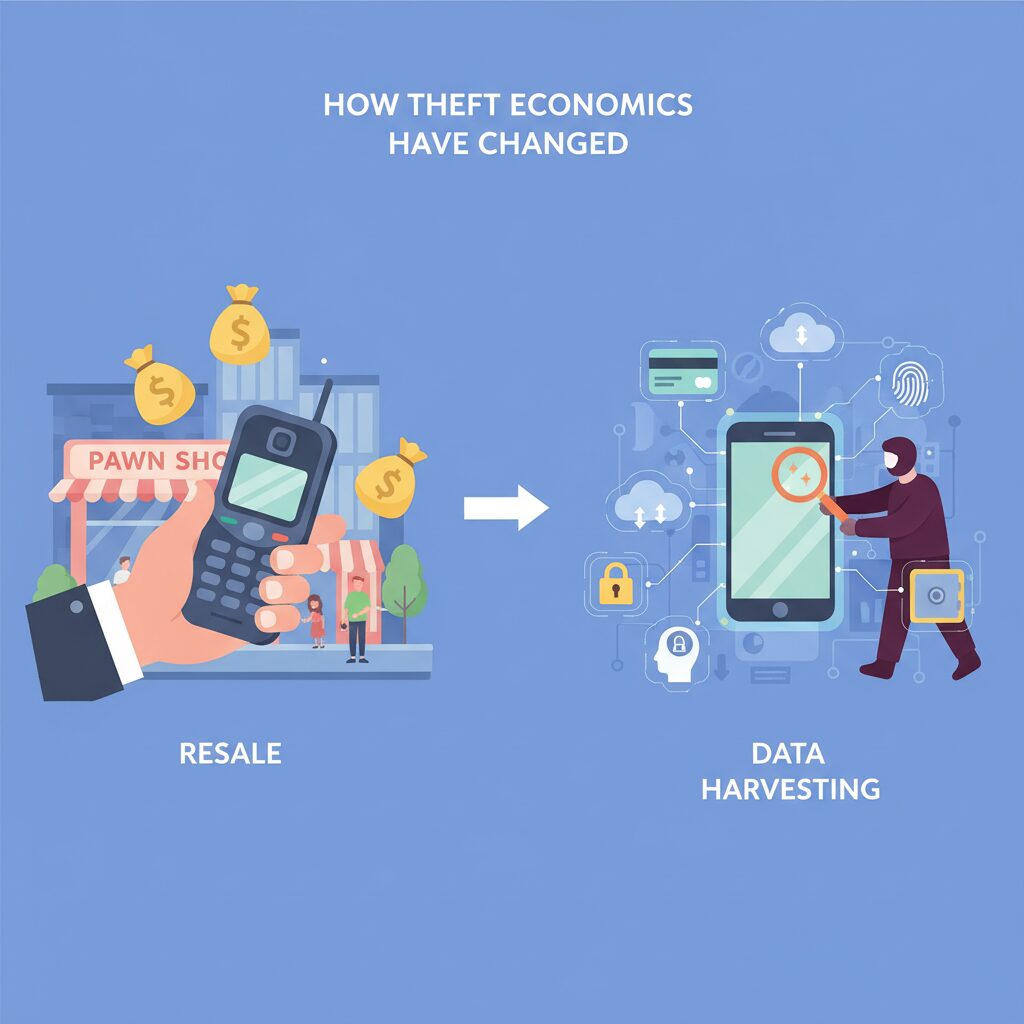
For many years, smartphone theft was driven by a simple resale logic. Steal a popular device, wipe it, and sell it as quickly as possible. However, the economics of theft have fundamentally shifted from device resale to data harvesting, and this change is reshaping how criminals operate in major cities.
According to analyses cited by the UK House of Commons Library and the Metropolitan Police Service, modern smartphones are increasingly difficult to resell due to activation locks and IMEI blacklisting. As a result, stolen phones have lost much of their value as intact products. Criminal networks have responded by redefining what is truly valuable: the data, credentials, and digital identity stored inside.
| Old Theft Model | Current Theft Model | Main Profit Source |
|---|---|---|
| Device resale | Parts harvesting | Repair market components |
| Quick cash sale | Data and account takeover | Bank transfers, extortion |
Insurance data analyzed by SquareTrade and referenced in European crime reporting indicates that a significant share of stolen iPhones in the UK now enters parts-harvesting networks. OLED displays, camera modules, and batteries retain strong secondary-market demand even when the phone itself is unusable. Apple’s expansion of activation locks to individual components in recent iOS releases directly targets this gray market, showing how clearly manufacturers recognize the shift.
More concerning is the rise of data-centric theft. Law enforcement briefings and security researchers consistently report that criminals increasingly focus on passcodes obtained through shoulder surfing. With a valid passcode, attackers can reset biometric protections, take control of cloud accounts, and drain financial apps within minutes. In this model, the phone is merely a key, not the prize.
The Metropolitan Police have openly stated that this transformation makes smartphone theft more profitable than drug distribution, while carrying far lower legal risk. A single compromised device can unlock bank accounts, payment services, and even enable follow-on crimes such as blackmail or so-called digital kidnapping, as documented by the FBI. The financial upside often exceeds what resale ever offered.
From an economic perspective, smartphone theft has become a scalable cybercrime conducted through physical means. International resale routes still exist, but they are no longer central. Instead, value is extracted immediately, often within the first hour after theft. Understanding this change is essential, because it clarifies why attackers behave with such urgency—and why protecting digital identity now matters more than protecting hardware.
Apple’s Stolen Device Protection and Biometric Enforcement
Apple’s Stolen Device Protection represents a decisive shift in smartphone security, moving the center of trust away from knowledge-based credentials and toward the human body itself. This feature, introduced with iOS 17.3 and refined through subsequent updates, is designed specifically to counter a modern threat pattern in which attackers first steal the passcode through shoulder surfing and then steal the device.
The core idea is simple but radical: knowing the correct passcode is no longer sufficient for sensitive actions. When Stolen Device Protection is active and the iPhone is outside a familiar location, critical operations such as accessing iCloud Keychain passwords, removing Activation Lock, changing Apple ID credentials, or erasing the device require successful Face ID or Touch ID authentication, with no fallback to the passcode.
According to Apple’s official security documentation, this biometric enforcement is applied selectively to high-impact actions, preserving everyday usability while hardening the points that matter most. From a security architecture perspective, Apple is redefining biometrics not as a convenience feature, but as an access control boundary.
| Action Type | Before Protection | With Protection Enabled |
|---|---|---|
| iCloud Keychain Access | Passcode fallback allowed | Biometrics only |
| Apple ID Password Change | Immediate with passcode | Biometrics + time delay |
| Device Erase | Passcode sufficient | Biometrics mandatory |
An equally important component is the one-hour Security Delay applied to account-level changes. Even if biometric authentication succeeds once, the system enforces a waiting period before completion, followed by a second biometric check. Apple Support explains that this delay is intentionally long enough to give legitimate owners time to mark the device as lost from another Apple device.
From a criminal economics standpoint, this timing barrier is devastating. Research into organized phone theft in cities like London shows that attackers rely on speed, often completing account takeovers within minutes of the theft. A forced one-hour pause collapses that model, dramatically increasing the likelihood of remote lock or wipe.
Security researchers have also emphasized the importance of configuring this protection to apply at all times, not only outside familiar locations. Location-based trust introduces edge cases, such as GPS errors or attacks near a victim’s home, where protections might silently disengage.
In practical terms, Apple’s biometric enforcement signals a broader industry trend. Digital identity is no longer guarded primarily by something you know, but by something you are, combined with enforced time friction. For users who understand the stakes of modern smartphone theft, this feature is not optional hardening, but a baseline defense for preserving financial access, personal data, and long-term digital identity.
Offline Tracking and the Power of the Find My Network
Offline tracking fundamentally changes the assumptions criminals rely on, and the Find My network represents one of the most mature implementations of this idea. **The moment a stolen device disappears from cellular or Wi‑Fi networks no longer marks the end of visibility**, and this shift has measurable implications for both recovery rates and criminal behavior.
Apple’s Find My network is built on a crowdsourced Bluetooth Low Energy mesh that quietly leverages hundreds of millions of active Apple devices worldwide. According to Apple’s platform security documentation and independent technical analyses by TidBITS, even an iPhone that has been powered off or has run out of battery can continue broadcasting an encrypted Bluetooth beacon for a limited period using power reserve mode. Nearby Apple devices relay this signal without user awareness, creating location updates in places where traditional tracking would be impossible.
This architecture introduces a key asymmetry. **Thieves must fully isolate the device from its surrounding environment**, while the owner only needs one passing Apple device for the phone to surface again. In dense urban areas like London or Paris, where Apple device density is high, this asymmetry strongly favors the victim.
| State of stolen device | Traditional tracking | Find My network |
|---|---|---|
| Powered on, online | GPS and network based | GPS plus BLE mesh |
| Powered off | Not traceable | BLE beacon via nearby devices |
| No SIM / airplane mode | Not traceable | Location relayed anonymously |
Privacy is often raised as a concern with large-scale crowdsourced tracking, yet Apple’s design is unusually strict. Academic reviews cited in Apple’s security whitepapers highlight that **location data is end‑to‑end encrypted and mathematically inaccessible to Apple itself**. Public keys rotate frequently, preventing long-term correlation or stalking by third parties, and only the owner’s trusted devices can decrypt the location. This approach has been praised by security researchers as one of the rare cases where scale and privacy coexist.
From a crime economics perspective, offline tracking weakens the resale and logistics chain. Insurance analysts referenced by SquareTrade have noted that faster owner awareness and recovery attempts increase the likelihood that stolen phones are dismantled for parts rather than resold intact. **This is not because Find My always leads to recovery, but because it injects uncertainty and delay into the theft workflow**, which directly erodes profitability.
There is also a psychological effect on users. Knowing that a phone can still be located after being switched off encourages quicker activation of Lost Mode and faster coordination with law enforcement. Apple Support guidance emphasizes that the first hour after theft is critical, and offline tracking meaningfully extends this window by preventing the device from “going dark” immediately.
In practice, the true power of the Find My network lies not in perfect recovery, but in persistence. **As long as people carry connected devices through cities, airports, trains, and cafés, a stolen phone is never truly alone**. This quiet, ambient surveillance layer does not feel dramatic, yet it steadily reshapes the balance between owners and thieves in favor of long-term digital resilience.
Android’s AI-Driven Theft Detection and Remote Locking
Android’s approach to theft prevention has shifted from passive protection to active, AI-driven intervention, and this change directly reflects how street-level smartphone theft has evolved in major cities worldwide. Instead of assuming that a device is already lost, Android now attempts to detect the moment of theft itself and respond within seconds. This transition from recovery to prevention marks one of the most significant security upgrades in the platform’s history.
At the core of this strategy is Theft Detection Lock, introduced gradually from 2024 onward. According to Google’s Android security engineering team, the feature relies on on-device machine learning models trained to recognize motion patterns associated with snatch-and-run crimes. These models analyze data from accelerometers and gyroscopes in real time, without sending raw sensor data to the cloud, preserving user privacy while enabling instant reactions.
The AI looks for a distinctive sequence: a sudden forceful movement consistent with a phone being pulled from a hand, followed by rapid displacement that suggests running, cycling, or motorized escape. When this pattern crosses a confidence threshold, the system immediately locks the screen, even if the phone was unlocked a moment earlier. This effectively neutralizes shoulder-surfing-based attacks where criminals rely on brief access to an unlocked device.
| Protection Layer | Trigger Condition | User Impact |
|---|---|---|
| Theft Detection Lock | Snatch-like motion patterns | Instant screen lock |
| Offline Device Lock | Extended network disconnection | Automatic lock without internet |
| Remote Lock | User-initiated via phone number | Rapid post-theft containment |
Independent testing by Android developers and security researchers has shown that while no motion-based system is flawless, false positives are rare in everyday use. Google reports that the model continuously adapts through federated learning, improving detection accuracy across different usage patterns and regions without collecting identifiable user data. This aligns with broader findings from academic mobile security research, which consistently emphasizes local inference as a best practice for behavioral detection systems.
AI detection alone, however, cannot cover every scenario. Recognizing this, Android complements proactive locking with simplified remote controls designed for moments of panic. Remote Lock allows users to secure their phone using only their phone number and basic verification, bypassing the need to recall complex Google account credentials under stress. From a usability standpoint, this dramatically shortens the response window during the critical minutes after a theft.
Offline Device Lock further addresses a long-standing weakness in smartphone security. Criminals often disable connectivity immediately to avoid tracking, but Android now treats prolonged offline states as suspicious. If network disconnection persists, the device locks itself automatically, closing another common avenue for post-theft exploitation. Google’s documentation notes that this feature was designed in response to real-world theft reports analyzed across Europe and North America.
What makes Android’s system particularly noteworthy is its scalability. Because these protections are delivered through Google Play services, they reach a wide range of devices running Android 10 and above, regardless of manufacturer update schedules. This OS-agnostic distribution model directly addresses fragmentation, historically Android’s biggest security liability.
In combination, AI-driven detection and rapid remote locking do not merely protect hardware; they disrupt the economics of theft. As law enforcement analyses have shown, stolen phones are increasingly valuable for the data and accounts they expose. By minimizing the time window in which that data is accessible, Android’s theft protection reduces both the financial incentive and the success rate of modern smartphone crime.
Samsung Knox and Hardware-Level Smartphone Security
Samsung Knox represents one of the most mature examples of hardware-level smartphone security available to consumers today, and it is particularly relevant in an era where stolen devices are frequently repurposed for parts harvesting or identity attacks.
What makes Knox distinctive is that it is not merely an application layer or an Android feature toggle. **Its core protections are embedded directly into the chipset and boot process**, creating a security boundary that software-based malware cannot easily cross.
Hardware Roots of Trust
At the foundation of Knox is ARM TrustZone, a physically isolated execution environment within the main processor. Sensitive operations such as cryptographic key handling and biometric verification are executed inside this secure world, separated from the normal Android OS.
| Component | Role | Security Impact |
|---|---|---|
| TrustZone | Isolated secure execution | Prevents OS-level compromise |
| Knox Vault | Dedicated security chip | Protects biometrics and keys |
According to Samsung’s official security documentation, even if Android itself is compromised, data stored in Knox Vault remains inaccessible, as it is protected by its own processor and memory. This design directly addresses the rise of advanced malware and forensic extraction tools used by organized crime groups.
Persistent Locking Against Theft
Another critical element is Knox Guard, originally developed for enterprise fleet management. **It enables persistent, chipset-level locking that survives factory resets and firmware reflashing**. Security researchers note that once a stolen Galaxy device reconnects to the internet, Knox Guard can automatically reassert control.
As Samsung has emphasized in multiple security briefings, this combination of Google’s AI-driven theft detection and Knox’s hardware-backed enforcement creates a layered defense that is unusually difficult to bypass. For users who view their smartphone as a container of financial credentials and digital identity, Knox offers protection that extends far beyond standard Android security expectations.
SIM Swapping, eSIMs, and Network-Level Vulnerabilities
As operating systems harden, attackers increasingly target the mobile network itself, where traditional device protections offer little help. SIM swapping remains one of the most damaging techniques because it shifts control of a phone number rather than the handset. According to analyses cited by the GSMA, once criminals hijack a number, they can intercept SMS-based one-time passwords and reset banking or social accounts within minutes. This turns the carrier, not the smartphone, into the weakest link.
Physical SIM cards make this attack easier. If a stolen phone’s SIM is removed and inserted into another device, the number becomes immediately usable unless a SIM PIN is enforced. Security researchers and Apple Support documentation consistently emphasize that a non-default SIM PIN is the only reliable countermeasure at this layer. Without it, even the most advanced OS-level theft protections can be bypassed at the network edge.
| Aspect | Physical SIM | eSIM |
|---|---|---|
| Removal risk | Can be physically extracted | Non-removable |
| SIM swap difficulty | Low without SIM PIN | Higher, requires device access |
| Post-reset behavior | Profile lost | Retention and biometric checks supported in latest OS |
eSIMs improve the situation but do not eliminate risk entirely. While they cannot be pulled out, carrier-side fraud or account takeover can still trigger a remote SIM swap. This is why Apple and Google have added biometric requirements for eSIM deletion and tighter reset behaviors in iOS 18 and Android 15. These changes shift the balance by binding network identity more closely to the device owner.
At a broader level, IMEI blacklisting illustrates the limits of network defenses. GSMA-managed databases cover over a hundred countries, yet gaps in participation allow stolen phones to function abroad. Until global coordination improves, SIM swapping and network-level exploits will remain a critical frontier where user settings, carrier policy, and international standards intersect.
Shoulder Surfing and the Human Factor in Smartphone Security
Shoulder surfing may sound low-tech, but in modern smartphone crime it has become one of the most efficient attack vectors. As operating systems harden encryption and device locks, attackers increasingly rely on human behavior rather than software exploits. **A single glance at a passcode entered in public can collapse years of security engineering in seconds**, and this reality reshapes how we should think about smartphone protection.
Research cited by privacy and security analysts shows how common this exposure is. According to surveys referenced by NordVPN and related security studies, roughly one in four public transport users report having witnessed someone’s phone being observed from close range. In crowded trains, cafés, or airports, attackers do not need sophisticated tools; they only need proximity, patience, and an understanding of how people naturally hold their devices.
| Factor | Why It Matters | Risk Level |
|---|---|---|
| Numeric passcodes | Finger movement patterns are easy to memorize visually | High |
| Public environments | Crowding provides cover for close observation | High |
| Unlocked device theft | Immediate access enables account takeover | Critical |
What makes shoulder surfing especially dangerous today is its role in digital identity theft. Security researchers and Apple’s own documentation explain that once an attacker knows the device passcode, they can reset biometric authentication, change cloud account credentials, and access saved passwords. **The smartphone effectively becomes a master key to banking apps, email, and social networks**, turning a physical theft into a full-scale digital robbery.
Academic work examining victims’ experiences, including studies published via ResearchGate and cited by mobile security experts, highlights a recurring pattern. Victims often underestimate the moment of exposure. They remember the theft, but not the brief instant when they entered a passcode under observation. This psychological blind spot reinforces why shoulder surfing is so effective: it exploits routine behavior rather than fear.
Operating system vendors openly acknowledge this human factor. Apple’s Stolen Device Protection and Google’s theft protection initiatives are direct responses to crimes enabled by observed passcodes. These systems attempt to remove the passcode as a universal fallback, forcing biometric confirmation and introducing time delays. **The goal is not to make shoulder surfing impossible, but to make it economically pointless for attackers**.
The most vulnerable moment is not when a phone is stolen, but when it is unlocked in public. Security failures often begin before the crime itself.
Behavioral countermeasures therefore matter as much as settings. Security professionals consistently recommend abandoning short numeric codes in favor of alphanumeric passcodes, which replace predictable finger paths with a full keyboard. In addition, pausing before entering a passcode, adjusting body position, or relying on biometrics when available can dramatically reduce exposure without sacrificing usability.
Ultimately, shoulder surfing reminds us that smartphone security is not purely technical. It is an interaction between hardware, software, and human habits. **Even the strongest encryption cannot compensate for a casually revealed secret**, and attackers understand this better than most users. Recognizing that reality is the first step toward defending not just the device in your hand, but the digital identity behind it.
Virtual Kidnapping and the Psychological Evolution of Theft
Virtual kidnapping represents a profound psychological evolution of theft, where the stolen object is no longer the smartphone itself, but the victim’s emotions, trust, and decision-making capacity. In this crime model, attackers exploit the data stored in or accessible through a phone to fabricate a kidnapping scenario, creating urgency and fear that override rational judgment.
According to the FBI’s long-running advisories on virtual kidnapping, perpetrators rarely possess the victim they claim to hold. Instead, they rely on rapid emotional manipulation, demanding immediate payment before verification can occur. **Speed, shock, and confusion are the true weapons**, not physical restraint.
Modern smartphone theft has dramatically increased the effectiveness of this tactic. Access to contacts, photos, location histories, and social media accounts allows criminals to construct highly personalized narratives. Research published in PubMed Central analyzing virtual kidnapping typologies shows that specificity, such as mentioning a child’s school or a spouse’s workplace, significantly increases compliance rates.
| Element Used | Psychological Effect | Why It Works |
|---|---|---|
| Stolen phone contacts | Authenticity bias | Victims assume only insiders know these details |
| Background screams or cries | Panic induction | Triggers fight-or-flight response |
| AI-generated voice mimicry | Emotional paralysis | Overrides logical verification instincts |
Global Guardian reports that these attacks increasingly incorporate AI-based voice cloning, sometimes trained on voicemail greetings or short social media videos. While not flawless, these synthetic voices are often convincing enough under stress. **The human brain under acute fear prioritizes emotional recognition over analytical accuracy**, making even imperfect imitations effective.
What distinguishes virtual kidnapping from earlier forms of fraud is its temporal compression. Victims are told they have minutes, not hours, to act. Criminologists describe this as decision-time collapse, a state where the victim’s ability to cross-check information rapidly deteriorates. The attacker’s goal is not persuasion, but preventing verification.
Smartphone theft accelerates this collapse by isolating the victim from reliable confirmation channels. When a primary phone is stolen, access to saved numbers, messaging apps, and authentication tools disappears. This isolation amplifies dependency on the attacker’s narrative, even when inconsistencies exist.
Experts cited by the FBI emphasize that virtual kidnapping is best understood as psychological theft rather than financial crime. The ransom amount is often modest compared to traditional extortion, but the emotional damage can be severe. Victims frequently report lingering anxiety, guilt, and loss of trust in digital communication long after the incident.
Understanding this evolution is critical for gadget-conscious users. Smartphones have become emotional leverage points, not just data containers. **As devices integrate deeper into family coordination and identity management, attackers increasingly target relationships rather than assets**, marking a fundamental shift in the nature of theft itself.
参考文献
- House of Commons Library:Mobile phone thefts
- Metropolitan Police Service:Thefts of mobile phone from January 2019 to March 2025
- Apple Support:Use Stolen Device Protection on iPhone
- Google Security Blog:Android enhances theft protection with Identity Check and expanded features
- Samsung:What is Samsung Knox?
- FBI:Virtual Kidnapping