
Public Wi‑Fi has become as essential as electricity for modern digital life, especially for people who love gadgets, cloud services, and always‑connected experiences.
With Wi‑Fi 7 enabling AR, real‑time collaboration, and seamless multi‑device use, staying online anywhere feels natural and effortless.
However, this constant connectivity also creates blind spots that many users rarely stop to question.
In 2026, cyber threats targeting public Wi‑Fi have evolved far beyond simple snooping or outdated hacking techniques.
Design‑level weaknesses in Wi‑Fi protocols, combined with AI‑driven automation, now allow attackers to operate faster, smarter, and at a massive scale.
Even networks protected by modern standards like WPA3 can expose users to silent data theft, credential hijacking, and long‑term surveillance.
This article helps you understand why public Wi‑Fi is no longer a neutral convenience but a high‑risk digital environment.
You will gain a clear view of how AI changes cyberattacks, how fake Wi‑Fi networks deceive even experienced users, and why traditional safety habits are no longer enough.
By reading to the end, you will be better equipped to enjoy cutting‑edge technology without unknowingly sacrificing your privacy or security.
- Why Public Wi‑Fi Became a Critical Digital Infrastructure
- The Psychological Trap of Always‑On Connectivity
- Design Flaws Hidden Inside Modern Wi‑Fi Standards
- MU‑MIMO Vulnerabilities and the Limits of Wi‑Fi 7
- How Encrypted Wi‑Fi Traffic Can Still Be Manipulated
- The False Sense of Security Created by WPA3 Transition Mode
- AI‑Driven Reconnaissance and Automated Target Selection
- Personalized Phishing Through Captive Portals
- Evil Twin Attacks Reinvented for 2026
- Real‑World Incidents That Expose the Human Cost
- How Compromised Devices Become Gateways to Organizations
- Government and Industry Responses to Public Wi‑Fi Risks
- What Tech‑Savvy Users Should Rethink About Wi‑Fi Safety
- AI as Defense: Emerging Security Models for the Next Era
- 参考文献
Why Public Wi‑Fi Became a Critical Digital Infrastructure
Public Wi‑Fi has quietly transformed from a convenient amenity into a critical layer of digital infrastructure that modern society depends on every day. In 2026, connectivity is no longer something people consciously “use”; it is something they exist within. High‑capacity standards such as Wi‑Fi 7 have enabled real‑time cloud workspaces, immersive AR navigation, cashless payments, and always‑on communication that seamlessly follow users through stations, airports, cafés, hospitals, and public offices.
This shift has changed the social role of Wi‑Fi itself. According to research led by Professor Francesco Restuccia at Northeastern University, Wi‑Fi has become so embedded in daily life that it effectively “disappears” from users’ awareness. That invisibility is precisely what elevates it to infrastructure status. Like electricity or running water, people only notice it when it fails, yet countless services collapse without it.
| Infrastructure | Role in Daily Life | Impact of Failure |
|---|---|---|
| Electricity | Powers homes, transport, healthcare | Immediate societal disruption |
| Water | Supports sanitation and health | Public health crisis |
| Public Wi‑Fi | Enables digital services everywhere | Economic and social paralysis |
The economic dimension reinforces this reality. Japanese police statistics for 2025–2026 show cybercrime damages exceeding 42 billion yen nationwide, with public and semi‑public networks frequently used as entry points. When public Wi‑Fi is compromised or unavailable, the effects ripple outward, interrupting logistics systems, remote work, reservation platforms, and even municipal services that rely on constant connectivity.
Equally important is the behavioral dependency that has formed. The Information‑technology Promotion Agency reports that while around 68 percent of home Wi‑Fi users feel uneasy about security, most cannot articulate specific risks. This gap between reliance and understanding highlights how Wi‑Fi now functions as a shared societal utility rather than a personal gadget. People expect it to work safely by default, just as they expect roads to be maintained or water to be clean.
Public spaces amplify this dependence. Airports without Wi‑Fi disrupt travel operations, hospitals without wireless access slow digital charting, and disaster shelters rely on public networks for information lifelines. These are no longer edge cases. Government guidelines updated by Japan’s Ministry of Internal Affairs and Communications explicitly treat public Wi‑Fi as part of national resilience planning, underscoring its role in continuity during emergencies.
For these reasons, public Wi‑Fi in 2026 is best understood not as a convenience layer, but as the connective tissue of digital society. Its reliability, availability, and trustworthiness now influence economic stability, public safety, and individual well‑being at a structural level, firmly placing it alongside the most essential infrastructures of the modern world.
The Psychological Trap of Always‑On Connectivity
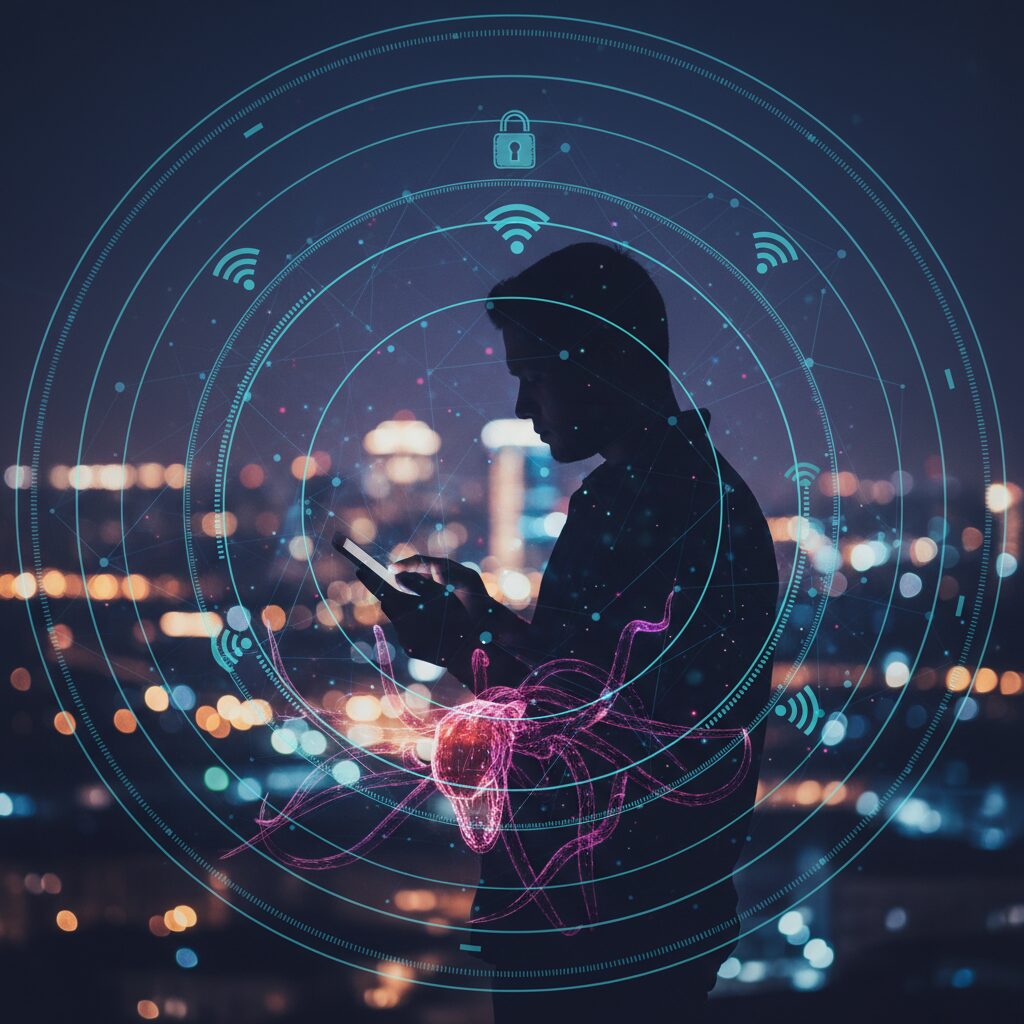
Always-on connectivity creates a subtle but powerful psychological trap. Because public Wi-Fi is everywhere and works instantly, users tend to perceive it as part of the environment rather than a deliberate choice. According to Professor Francesco Restuccia of Northeastern University, Wi-Fi has effectively “disappeared” into daily life, and this invisibility lowers vigilance. When a risk becomes ambient, the human brain stops actively evaluating it, even if the underlying danger is growing.
This cognitive shift is reinforced by behavioral psychology. Repeated exposure without immediate negative consequences leads to risk normalization, a phenomenon well documented in safety research. Each uneventful connection in a café or airport quietly trains the user to expect safety. By 2026, with Wi‑Fi 7 delivering seamless speeds for cloud services and AR experiences, the reward of convenience arrives instantly, while the cost of insecurity remains abstract and delayed.
The result is a widening gap between perceived safety and actual exposure. Data from Japan’s Information-technology Promotion Agency shows that while around 68 percent of home wireless LAN users feel uneasy, most cannot articulate specific threats. This vague anxiety paradoxically discourages concrete action, because the brain struggles to respond to risks it cannot clearly define.
| User perception | Psychological driver | Security reality |
|---|---|---|
| “It connects automatically, so it must be safe.” | Automation bias | Auto-connect increases exposure to rogue access points. |
| “It’s encrypted, so I’m protected.” | False sense of control | Protocol-level flaws can bypass encryption. |
| “I’ve never had a problem before.” | Normalcy bias | AI-driven attacks scale silently and selectively. |
Always-on connectivity also fragments attention. Studies in human–computer interaction show that frequent context switching reduces critical evaluation. When users connect while walking, boarding, or ordering, security prompts are processed peripherally. AI-enhanced captive portals exploit this state by presenting familiar visuals and context-aware messages, which feel trustworthy precisely because the user is cognitively overloaded.
In an era where AI-driven threats operate faster than human intuition, this psychological mismatch becomes a structural weakness. Understanding this trap is not about fear, but about restoring intentionality. Treating every connection as a conscious decision reintroduces friction, and that small pause is often the only moment where security can re-enter the user’s awareness.
Design Flaws Hidden Inside Modern Wi‑Fi Standards
Modern Wi‑Fi standards appear to evolve at breathtaking speed, yet beneath the surface they still carry structural compromises that were never designed for today’s threat landscape. **Backward compatibility has become one of the most persistent design liabilities**, because every new generation is required to coexist with legacy behaviors that attackers already understand in detail. According to researchers at Northeastern University, even Wi‑Fi 7 inherits assumptions from earlier IEEE 802.11 revisions that no longer hold in an era of automated and adversarial radio environments.
One example is how performance‑oriented mechanisms expose unintended attack surfaces. MU‑MIMO was introduced to maximize spectral efficiency, but its setup phase implicitly trusts channel feedback from connected devices. Academic analysis presented at IEEE INFOCOM showed that this trust can be abused to deliberately distort precoding calculations, degrading throughput for all users. **This weakness is not an implementation bug but a standards‑level design decision**, meaning firmware updates alone cannot fully eliminate the risk.
The same pattern appears in frame handling logic that dates back to the late 1990s. Fragmentation and aggregation were meant to improve reliability on noisy links, yet NYU Abu Dhabi researchers demonstrated that these processes can be manipulated to inject or extract data from encrypted sessions. What is striking is that WPA3 networks were also affected in laboratory tests, reinforcing the point that encryption strength cannot compensate for flawed protocol choreography.
| Design Choice | Original Intent | Unintended Exposure |
|---|---|---|
| MU‑MIMO feedback | Higher multi‑user efficiency | Throughput sabotage via forged signaling |
| Frame fragmentation | Reliability and speed | Packet injection inside encrypted flows |
| Transition modes | Device compatibility | Forced downgrade to weaker security |
Transition modes between WPA2 and WPA3 illustrate how convenience quietly undermines security. Industry experts from the CWNP community have repeatedly warned that allowing dual modes creates a downgrade path that attackers can reliably exploit. **Users believe they are protected by next‑generation security, while the protocol itself permits a fallback to known‑weaker behavior**.
These hidden design flaws explain why public Wi‑Fi remains fragile despite visible technological progress. Standards bodies have historically prioritized seamless connectivity and vendor interoperability, but the accumulated technical debt now collides with AI‑assisted attackers who can probe and exploit these assumptions at machine speed. Until future standards are built secure‑by‑design rather than compatibility‑by‑default, modern Wi‑Fi will continue to trade elegance in performance for structural exposure.
MU‑MIMO Vulnerabilities and the Limits of Wi‑Fi 7
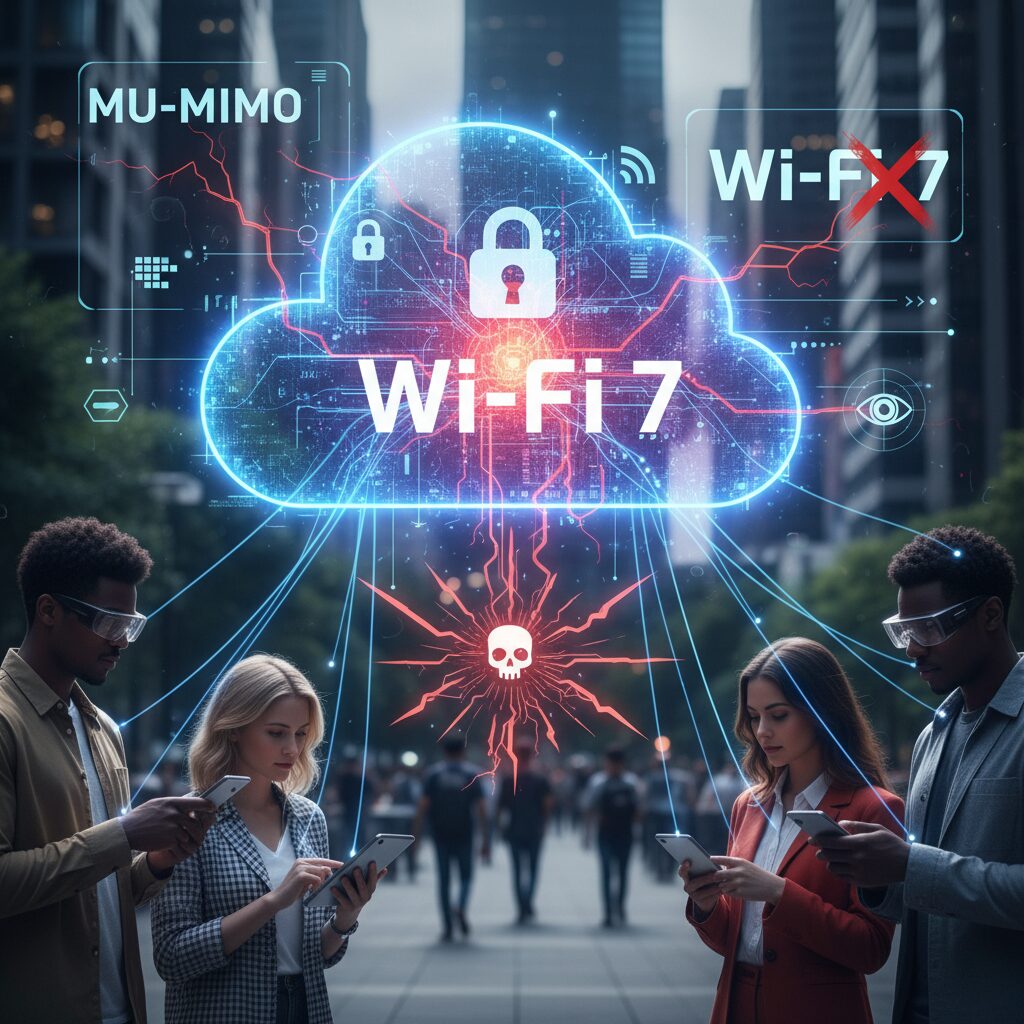
MU-MIMO has been positioned as one of the core technologies that make Wi-Fi 7 feel dramatically faster in dense environments. By allowing an access point to transmit different spatial streams to multiple devices at the same time, overall efficiency improves and latency appears to shrink. However, recent academic research makes it clear that this efficiency comes with structural weaknesses that Wi-Fi 7 itself cannot fully resolve.
According to research presented at IEEE INFOCOM 2025 by a team at Northeastern University, the vulnerability lies not in vendor-specific implementations but in the MU-MIMO setup procedure defined by the IEEE 802.11 standard. During channel state information feedback, a malicious client can inject carefully crafted signals that disrupt precoding calculations. As a result, the access point unintentionally degrades the throughput of other users connected to the same network.
The most concerning aspect is that Wi-Fi 7 does not eliminate this attack surface. Wi-Fi 7 enhances bandwidth with 320 MHz channels and multi-link operation, but it still relies on the same MU-MIMO fundamentals for backward compatibility. Security researchers note that this design choice prioritizes ecosystem continuity over clean-slate security, leaving the vulnerability effectively inherited rather than fixed.
| Aspect | Expectation with Wi-Fi 7 | Reality with MU-MIMO |
|---|---|---|
| Throughput under load | Stable and predictable | Can be deliberately destabilized |
| Attack origin | External jammer required | Single authenticated client sufficient |
| Mitigation method | Firmware updates | Largely ineffective at scale |
What makes this particularly relevant for public and enterprise Wi-Fi is scale. Researchers estimate that tens of billions of Wi-Fi-capable devices worldwide rely on MU-MIMO behavior that cannot be fundamentally changed via software patches alone. This assessment is echoed by Northeastern University’s commentary, which emphasizes that only a future-generation standard, often referred to as Wi-Fi 8, could realistically redesign the protocol to address the root cause.
From a practical standpoint, this means Wi-Fi 7 should be understood as a performance upgrade, not a security reset. Network administrators may deploy the latest hardware and still experience unexplained slowdowns triggered intentionally by a single compromised device. **The limit of Wi-Fi 7, in this context, is that higher speed amplifies the impact of protocol-level weaknesses rather than neutralizing them.**
For users and operators who assume that “newest equals safest,” MU-MIMO vulnerabilities serve as a sobering reminder. Even at the cutting edge of wireless performance, architectural decisions made for efficiency decades ago continue to shape the threat landscape in 2026.
How Encrypted Wi‑Fi Traffic Can Still Be Manipulated
Encrypted Wi‑Fi traffic often feels untouchable, yet in practice it can still be manipulated in subtle and damaging ways. Even when strong encryption such as WPA3 is enabled, attackers do not need to decrypt payloads to influence outcomes. By targeting how encrypted packets are created, fragmented, and negotiated, they can reshape user behavior and application responses without ever seeing the actual content.
A well‑documented example comes from the Fragment and Forge research disclosed by the NYU Abu Dhabi team. Their work shows that attackers can inject or reorder encrypted frames by abusing legacy fragmentation and aggregation features that have existed since the earliest IEEE 802.11 standards. Encryption remains mathematically intact, yet the receiving device processes manipulated frames as legitimate traffic, enabling data exfiltration or session interference.
This means that encryption protects confidentiality, but not necessarily integrity at every layer. Standards bodies such as IEEE and academic reviewers have repeatedly noted that backward compatibility creates gray zones where encrypted traffic can be influenced before or after cryptographic checks are applied.
| Manipulation Vector | What Is Exploited | Practical Impact |
|---|---|---|
| Frame fragmentation | Legacy 802.11 handling rules | Injection of malicious packets into encrypted flows |
| Protocol downgrade | WPA3 transition mode | Forcing weaker encryption without user awareness |
| Traffic shaping | Encrypted metadata patterns | Session disruption and selective denial of service |
Another manipulation path lies in negotiation itself. Security specialists affiliated with CWNP have warned that WPA3 transition mode allows downgrade attacks where devices are silently pushed back to WPA2. The traffic remains encrypted, yet it is encrypted under weaker assumptions. From the user’s perspective, the connection icon still signals safety, creating what experts describe as a false sense of security.
Even metadata leakage plays a role. While payloads are hidden, packet size, timing, and destination patterns remain observable. Research communities and organizations such as Northeastern University emphasize that attackers can manipulate these characteristics to throttle specific services, interrupt cloud authentication, or coerce applications into re‑authentication loops that expose credentials through secondary channels.
In real environments like cafés or airports, this manipulation is amplified by automation. AI‑assisted tools can monitor encrypted flows in real time, learning which adjustments cause retries or errors. The traffic stays encrypted end to end, yet the user experience is quietly steered toward outcomes favorable to the attacker.
Encrypted Wi‑Fi, therefore, should be understood as protected but not immutable. Encryption is a necessary foundation, not a guarantee that traffic cannot be bent, delayed, or redirected. Recognizing this distinction is essential for anyone who relies on public wireless networks in 2026.
The False Sense of Security Created by WPA3 Transition Mode
WPA3 was introduced as a long‑awaited answer to the weaknesses of WPA2, and many users understandably assume that seeing “WPA3” on a public Wi‑Fi network guarantees strong protection. However, **WPA3 Transition Mode often creates a dangerous illusion of safety rather than real security**. This mode exists to support legacy WPA2 devices, but in doing so, it quietly re‑opens doors that WPA3 was designed to close.
In Transition Mode, a single SSID accepts both WPA2 and WPA3 connections simultaneously. According to analyses by CWNP and TrustedSec, attackers can exploit this coexistence through downgrade attacks, forcing capable devices to fall back to WPA2 without the user noticing. **Even when an access point advertises WPA3, the actual session may be protected only by WPA2’s weaker mechanisms**, undermining the administrator’s intent.
| Aspect | Pure WPA3 | WPA3 Transition Mode |
|---|---|---|
| Protocol selection | WPA3 only | WPA2 or WPA3 |
| Downgrade resistance | High | Low |
| MFP enforcement | Mandatory | Optional |
A particularly subtle risk involves Management Frame Protection. WPA3 mandates MFP to block deauthentication and certain man‑in‑the‑middle attacks, yet in Transition Mode it becomes optional. Security researchers have shown that attackers can still trigger disconnections and lure devices into hostile networks, a scenario especially relevant in crowded public spaces.
What makes this threat more concerning in 2026 is automation. **AI‑assisted tools can rapidly scan for transition‑mode networks and systematically test downgrade vectors**, turning a configuration choice made for convenience into a scalable attack surface. The result is a widespread false sense of confidence, where both operators and users believe they are protected, while attackers quietly benefit from backward compatibility.
AI‑Driven Reconnaissance and Automated Target Selection
AI‑driven reconnaissance has fundamentally changed how attackers observe public Wi‑Fi environments, and in 2026 this phase has become almost entirely machine‑led. Instead of scanning networks manually, AI systems continuously monitor radio conditions, device behavior, and protocol metadata, building a live map of who is connected, how they communicate, and where weaknesses quietly persist. According to analyses cited by Northeastern University researchers, this shift reduces the window between exposure and exploitation from hours to mere seconds.
What makes this reconnaissance particularly dangerous is its ability to correlate signals that appear harmless in isolation. **Operating system fingerprints, browser negotiation patterns, and even retry behavior during packet loss are fused into a single risk profile**. AI models trained on millions of prior attacks can infer, with high confidence, whether a device is running outdated firmware or relying on insecure fallback modes such as WPA transition settings.
Once reconnaissance data is collected, automated target selection begins without human deliberation. AI ranks devices by expected return on effort, prioritizing those that combine technical vulnerability with behavioral predictability. Cybersecurity firms analyzing AI‑assisted attacks in 2026 report that devices showing routine cloud logins or repeated background synchronization are far more likely to be selected, as these patterns signal access to valuable credentials.
| Aspect | Traditional Reconnaissance | AI‑Driven Reconnaissance |
|---|---|---|
| Observation speed | Periodic, manual scans | Continuous real‑time monitoring |
| Data correlation | Single indicators | Multi‑signal behavioral fusion |
| Target choice | Human judgment | Automated risk‑reward scoring |
This automation also enables attackers to adapt instantly. When a device updates its network state or changes access points, AI systems re‑evaluate the target in real time, discarding low‑value options and escalating against newly exposed ones. **The reconnaissance phase no longer ends before the attack; it runs in parallel, constantly refining the strategy**.
Experts referenced by the Information Processing Promotion Agency emphasize that this intelligence loop explains why modern attacks feel “sudden” to users. In reality, AI has often observed the device for minutes or hours, silently waiting for the optimal moment. By the time a malicious action becomes visible, target selection has already been mathematically optimized, leaving little room for reactive defense.
In public Wi‑Fi spaces, this means every connected device is evaluated not as a person, but as a probabilistic asset. **AI‑driven reconnaissance transforms anonymity into a measurable risk**, turning ordinary connectivity into a continuous audition for exploitation. This quiet, automated selection process is what makes AI‑powered threats in 2026 both efficient and unsettlingly precise.
Personalized Phishing Through Captive Portals
Personalized phishing through captive portals has become one of the most effective attack techniques in public Wi-Fi environments by 2026, precisely because it exploits a moment users consider routine and harmless. A captive portal is the login or acceptance screen displayed when connecting to public Wi-Fi, and its familiarity lowers psychological defenses. **Attackers now treat this screen as a high-conversion marketing surface rather than a crude phishing page**, applying the same personalization logic used in legitimate digital advertising.
According to analyses cited by CyberOne Security and other industry observers, AI systems dynamically generate captive portals by combining environmental context with publicly available personal data. Location, time of day, device language, and even nearby SSIDs are correlated with scraped information from platforms such as LinkedIn or public social profiles. The result is a portal that appears uniquely relevant to the individual user, not a generic warning screen.
| Element Used | Data Source | Psychological Effect |
|---|---|---|
| Branding and logos | Physical venue context | Authenticity and trust |
| Language and tone | Device OS and locale | Reduced suspicion |
| Account prompts | Public professional data | Perceived relevance |
Research referenced by CyberOne indicates that AI-generated phishing interfaces, including captive portals, achieve interaction rates of approximately 54%, compared to around 12% for static templates. This gap is not explained by visual quality alone. **AI evaluates user hesitation in real time**, adjusting wording, button placement, or even introducing multi-factor authentication prompts at moments that feel natural, mirroring legitimate enterprise login flows.
Security researchers at Northeastern University have emphasized that the danger is amplified in public Wi-Fi scenarios because users already expect friction. A brief delay, an extra consent checkbox, or a request to re-enter credentials does not stand out as abnormal. In this context, a personalized captive portal does not feel like an intrusion, but like infrastructure doing its job.
Real-world incidents reinforce this concern. Investigations into evil twin attacks on transportation and hospitality networks have shown that captive portals are frequently used as the first touchpoint, harvesting cloud service tokens that later enable lateral movement into corporate environments. Law enforcement briefings in multiple regions have noted that victims often cannot recall a single suspicious action, only that they “connected to Wi-Fi as usual.”
What makes this threat particularly resilient is that encryption alone does not mitigate it. Even WPA3-protected networks can present a malicious captive portal if the access point itself is spoofed. As multiple academic and industry sources have warned, **the visual legitimacy of a portal is no longer a reliable indicator of network safety**. In 2026, personalized phishing through captive portals represents a convergence of human psychology, AI automation, and the invisible nature of wireless infrastructure, making it one of the most quietly dangerous attack vectors in public connectivity.
Evil Twin Attacks Reinvented for 2026
Evil Twin attacks in 2026 are no longer crude Wi‑Fi traps but highly adaptive systems designed to blend into everyday connectivity. **What has fundamentally changed is the fusion of cheap radio hardware with AI‑driven social engineering**, which turns a familiar attack into a precision instrument. According to analyses referenced by Kaspersky and Varonis, users now connect to rogue access points not because they are careless, but because the network appears contextually correct.
Attackers clone legitimate SSIDs used in cafés, airports, or hotels, then broadcast a slightly stronger signal. At the same time, deauthentication frames quietly force devices off the real network. This sequence happens in seconds and is largely invisible to the user, which security researchers describe as the most dangerous evolution of Evil Twin techniques.
| Aspect | Traditional Evil Twin | 2026 Variant |
|---|---|---|
| Setup cost | Specialized equipment | Low‑cost consumer devices |
| User deception | Generic login pages | AI‑personalized captive portals |
| Detection | Manual user awareness | Extremely difficult without tools |
Research cited by Northeastern University highlights that modern Evil Twin setups increasingly leverage AI to analyze traffic in real time. **Credentials, session cookies, and even cloud authentication tokens are extracted automatically**, enabling immediate lateral movement into personal or corporate accounts.
A well‑documented aviation incident in Australia demonstrated how devastating this can be in confined public spaces. Investigators noted that passengers trusted the in‑flight Wi‑Fi brand, unaware that a cloned network was harvesting private data at scale. Experts now emphasize that the threat is not theoretical but operational.
In 2026, Evil Twin attacks succeed because connectivity is assumed to be benign. This assumption, as multiple cybersecurity authorities warn, is precisely what attackers exploit with unprecedented efficiency.
Real‑World Incidents That Expose the Human Cost
Discussions about public Wi‑Fi vulnerabilities often stay at the technical level, but real-world incidents clearly show that these risks translate into tangible human damage. Behind every compromised packet is a person whose privacy, finances, or career can be irreversibly affected. In 2026, as connectivity becomes invisible, the human cost becomes easier to overlook, yet more severe than ever.
One of the most striking examples cited by cybersecurity researchers and law enforcement occurred in Australia between 2024 and 2025, when an attacker created an evil twin Wi‑Fi network inside a domestic flight cabin. According to court records reported by international security media, passengers unknowingly connected to a fake in‑flight Wi‑Fi access point, believing it to be the airline’s official service. Thousands of private photos, videos, and login credentials were siphoned off midair, exploiting the fact that users had no alternative connectivity and no visual cues of danger.
The consequences extended far beyond data theft. Investigators confirmed that the attacker later used the stolen credentials to monitor victims’ social media accounts and even interfere with unrelated workplace systems. The perpetrator ultimately received a sentence of over seven years in prison, but for the victims, the damage to personal dignity and long‑term trust in digital services could not be undone. Security experts referenced by Kaspersky and other vendors note that this case redefined public Wi‑Fi abuse as a form of personal violation rather than a purely technical crime.
| Incident Context | Primary Impact on Victims | Long‑Term Consequence |
|---|---|---|
| In‑flight evil twin Wi‑Fi | Private media and credentials stolen | Ongoing privacy invasion and surveillance anxiety |
| Café or airport public Wi‑Fi | Account takeover and financial fraud | Loss of savings and credit reputation |
Japan has seen similarly painful outcomes, even when attacks do not originate directly from public Wi‑Fi. National Police Agency statistics from 2025 to 2026 show a sharp rise in ransomware and unauthorized access cases, many beginning with compromised personal devices used outside secure environments. A single session on an unsecured network can quietly turn a personal smartphone into an entry point for corporate or institutional breaches, leading to mass data leaks that affect millions.
For individuals caught in these incidents, the fallout is often prolonged and deeply personal. Victims of identity theft report months or even years of dealing with fraudulent transactions, account recovery procedures, and psychological stress. According to analyses referenced in the IPA Information Security White Paper 2025, many victims experience a lasting reluctance to use digital services, which directly impacts their work efficiency and social participation.
Security researchers from Northeastern University emphasize that this erosion of trust is a societal cost. When people no longer feel safe connecting in public spaces such as hospitals, municipal buildings, or transport hubs, the promise of ubiquitous connectivity collapses. The human cost is measured not only in stolen yen or leaked records, but also in lost confidence and constrained behavior.
These incidents collectively reveal a sobering reality. Public Wi‑Fi vulnerabilities are not abstract flaws buried in protocol specifications. They surface in moments when people are traveling, working, or simply trying to stay connected. Understanding the human cost is essential, because it reframes cybersecurity from an IT problem into a matter of everyday safety and dignity. Without that perspective, the true impact of public Wi‑Fi risks in 2026 remains dangerously underestimated.
How Compromised Devices Become Gateways to Organizations
Compromised personal devices often become the most effective entry points into organizations, especially when public Wi‑Fi is involved. Laptops, smartphones, and tablets are routinely used across personal and professional contexts, and this boundary collapse creates an opportunity attackers actively exploit in 2026.
**Once a device is compromised outside the organization, it no longer behaves as an endpoint but as a trusted carrier.** From the organization’s perspective, the device appears legitimate, authenticated, and familiar, even though its internal state has already been altered by an attacker.
According to analyses referenced by the National Police Agency of Japan, a significant share of large-scale breaches begins with credential theft or session hijacking rather than direct infrastructure attacks. Public Wi‑Fi, especially when combined with AI‑driven evil twin techniques, provides an ideal environment for silently implanting malware or stealing authentication tokens.
When an employee later connects the same device to a corporate network, the attacker effectively bypasses perimeter defenses. Zero‑day exploits are not required; the trust relationship does the work. Security researchers frequently describe this as “trust inheritance,” where organizational systems extend trust to a device based solely on prior legitimacy.
The process is often fast and difficult to detect. AI‑assisted malware can remain dormant during the initial compromise, activating only when it detects corporate resources such as Microsoft 365, Slack, or internal VPN clients. **This delayed activation drastically reduces the chance of user suspicion or early detection.**
| Stage | What Happens | Why It Works |
|---|---|---|
| Public Network Exposure | Device connects to a spoofed or weakened Wi‑Fi | User vigilance is low in familiar public spaces |
| Silent Compromise | Credentials or tokens are captured | No visible disruption or alerts |
| Organizational Access | Device reconnects at work | Existing trust bypasses perimeter checks |
| Lateral Movement | Internal systems are explored | Activity resembles normal user behavior |
Research communities, including Northeastern University, have emphasized that modern Wi‑Fi vulnerabilities and AI‑driven reconnaissance significantly shorten the time between compromise and organizational impact. What once took weeks can now unfold within hours, sometimes minutes.
Real-world incidents reinforce this pattern. Japanese breach investigations from 2025 to 2026 repeatedly show attackers moving laterally after entering through a single employee account. The compromised device acts as a pivot, enabling access to shared drives, internal chat systems, and cloud dashboards.
**The danger lies not in the device itself, but in the implicit trust ecosystems surrounding it.** Even organizations with strong server-side security controls can be undermined if endpoint hygiene and network assumptions remain outdated.
In 2026, compromised devices should be viewed not as isolated failures but as mobile gateways. They carry risk across networks, locations, and contexts, transforming everyday connectivity into a strategic vulnerability that attackers understand better than ever.
Government and Industry Responses to Public Wi‑Fi Risks
Government and industry responses to public Wi‑Fi risks have accelerated notably since 2025, as policymakers began to treat wireless connectivity as critical infrastructure rather than optional convenience. In Japan, the Ministry of Internal Affairs and Communications has revised its public wireless LAN guidelines to reflect the reality of AI‑driven attacks, explicitly stating that legacy trust models are no longer sufficient. This shift reframes public Wi‑Fi from a service issue into a governance and liability issue, especially for municipalities and transport operators.
At the regulatory level, the government now expects public Wi‑Fi providers to implement measures previously reserved for enterprise networks. According to MIC documentation, certificate‑based authentication under IEEE 802.1X, peer‑to‑peer traffic isolation, and continuous vulnerability management are no longer best practices but baseline requirements. This approach mirrors recommendations from international bodies such as NIST, which emphasize zero‑trust principles even in open or semi‑open networks.
Industry responses have followed a similar trajectory, driven as much by reputational risk as by compliance. Major telecom operators and Wi‑Fi solution vendors are embedding AI‑based anomaly detection directly into access points, allowing suspicious behavior to be identified within milliseconds. Research cited by Northeastern University highlights that automated detection is essential, as human‑managed monitoring cannot match the speed of AI‑assisted reconnaissance used by attackers.
| Stakeholder | Primary Response | Intended Impact |
|---|---|---|
| Government | Mandatory security guidelines | Reduce systemic public risk |
| Telecom operators | AI‑based traffic analysis | Early attack detection |
| Equipment vendors | Secure‑by‑default firmware | Lower configuration errors |
One notable development is the growing emphasis on accountability. Legal experts have pointed out that when public Wi‑Fi providers ignore updated guidance, they may be exposed to negligence claims following data breaches. This has pushed industry players to treat security investment as cost avoidance rather than optional enhancement. In parallel, insurers are adjusting cyber‑insurance premiums based on adherence to government guidelines.
Despite these advances, gaps remain. Small businesses and local venues often lack the resources to implement enterprise‑grade defenses, creating uneven protection across public spaces. Both government panels and industry consortia now acknowledge that future policy must balance strict standards with financial and technical support, ensuring that safer public Wi‑Fi becomes the norm rather than the exception.
What Tech‑Savvy Users Should Rethink About Wi‑Fi Safety
Even highly tech‑savvy users often assume that understanding protocols and encryption standards automatically translates into safer Wi‑Fi usage, but that assumption deserves reconsideration in 2026. **Public Wi‑Fi risks no longer stem only from careless behavior or outdated hardware, but from structural issues embedded in modern standards themselves**, including Wi‑Fi 7. Researchers at Northeastern University have emphasized that backward compatibility, while essential for adoption, silently preserves legacy weaknesses that sophisticated attackers actively exploit.
One misconception among advanced users is that strong encryption such as WPA3 provides a definitive safety net. Studies from NYU Abu Dhabi demonstrate that frame fragmentation and aggregation logic, present since the earliest IEEE 802.11 designs, can still be abused to inject malicious traffic even under WPA3. **Encryption protects data in transit, but it does not guarantee the integrity of the communication context**, especially on shared public networks.
| Assumption | Reality in 2026 | Implication |
|---|---|---|
| WPA3 equals safety | Transition modes enable downgrade attacks | Users may unknowingly connect via weaker WPA2 |
| Fast Wi‑Fi is neutral | MU‑MIMO setup can be disrupted | Performance drops and covert interference |
| VPN solves everything | AI phishing bypasses tunnels | Credentials still exposed |
Another point that deserves rethinking is automation. **AI‑driven attacks now operate faster than human awareness**, reducing the time between exposure and compromise to seconds. According to cybersecurity analysts cited by the National Police Agency of Japan, abnormal access patterns increasingly originate from automated systems overseas, indicating that attackers rely less on manual targeting and more on adaptive algorithms.
Tech‑savvy users are also more likely to enable convenience features such as auto‑connect or saved SSIDs, assuming they can spot anomalies quickly. In reality, modern evil twin networks clone not only SSID names but also signal behavior and captive portals, sometimes personalized using publicly available data. Experts from Kaspersky and CWNP note that even professionals fail to distinguish these clones in real time.
What ultimately needs rethinking is the mindset itself. **Expertise should no longer mean confidence in tools alone, but continuous skepticism toward the network environment**. In an era where AI learns defensive patterns and adapts around them, awareness and restraint have become as critical as technical knowledge.
AI as Defense: Emerging Security Models for the Next Era
In 2026, security strategy is undergoing a decisive shift where AI is no longer just an operational tool but functions as an active defensive entity. **AI as Defense** represents a model in which artificial intelligence continuously learns, adapts, and responds faster than any human-led security team could realistically achieve. This approach is emerging precisely because AI-driven attacks now operate at machine speed, making traditional perimeter-based or rule-based defenses insufficient.
According to analyses shared by organizations such as Armis and Qualysec, modern AI-based security systems aggregate telemetry from endpoints, networks, and cloud services in real time. Instead of relying on predefined signatures, these systems construct behavioral baselines and detect deviations within milliseconds. **This enables threats to be identified before clear indicators of compromise appear**, fundamentally changing the defender’s position from reactive to anticipatory.
AI-driven defense treats the network like a living organism, where anomalies are detected as early symptoms rather than confirmed infections.
A core pillar of this model is behavioral analytics. AI evaluates subtle factors such as login timing, interaction patterns, data transfer rhythms, and session continuity. Research referenced by Qualysec in 2026 shows that even when valid credentials are used, AI systems can flag intrusions based on mismatched behavior profiles. This directly counters AI-powered credential theft and session hijacking attacks that increasingly originate from compromised public Wi-Fi connections.
Another defining capability is autonomous response. Unlike earlier security orchestration tools that required human approval, current platforms can isolate devices, revoke tokens, or enforce step-up authentication automatically. BitLyft reports that leading systems now perform these actions within milliseconds, effectively blocking lateral movement before attackers can escalate privileges. **Speed, not just accuracy, has become the decisive security metric.**
| Defense Aspect | Conventional Model | AI as Defense (2026) |
|---|---|---|
| Threat Detection | Signature and rules | Behavioral and predictive |
| Response Time | Minutes to hours | Milliseconds |
| Adaptability | Manual tuning | Continuous self-learning |
Zero Trust architecture is deeply intertwined with AI as Defense. As noted by cybersecurity legal analysts at Shumaker, Loop & Kendrick, every access request is treated as hostile until verified, regardless of location. AI enforces this principle dynamically, reassessing trust throughout a session rather than only at login. This approach is particularly effective against browser-in-the-middle attacks and AI agents that attempt to mimic legitimate user behavior.
Importantly, this defensive evolution also has societal implications. The Japanese Ministry of Internal Affairs and Communications emphasizes that as AI-driven threats scale globally, defensive AI helps reduce reliance on constant human vigilance. **This does not eliminate the need for security awareness, but it compensates for human cognitive limits in always-on environments like public Wi-Fi.**
AI as Defense is therefore not a future concept but an operational necessity in 2026. It acknowledges a simple reality: when attacks think, learn, and adapt autonomously, defense must do the same, continuously and invisibly, in the background of everyday connectivity.
参考文献
- Northeastern University:Research Uncovers Wi‑Fi Security Vulnerability
- Northeastern University News:How Secure Are Wi‑Fi Networks? Research Uncovers Vulnerability
- NYU Abu Dhabi:Researchers Discover Security Flaws that Make Protected Wi‑Fi Networks Vulnerable
- CyberOne Security:The AI‑Driven Threats We Expect In 2026
- Memcyco:Evil Twin Attack Prevention: Stop Real‑Time Phishing & ATO
- Cybernews:Man Sentenced to 7 Years in Prison for Using Evil Twin Wi‑Fi Network on Flight
- Qualysec:AI‑Based Security Systems: All You Need to Know in 2026