
If you care deeply about smartphone battery life, you have probably felt the same frustration many power users share today. Larger displays, on-device AI, and always-on 5G promise incredible experiences, but they also drain power faster than ever. You may be wondering whether modern flagship phones can truly keep up with these demands without forcing compromises.
The Google Pixel 10 Pro XL positions itself as a serious answer to this problem. With the largest battery ever installed in a Pixel, a brand-new silicon-carbon anode, and a Tensor G5 chip manufactured on TSMC’s 3nm process, it aims to change how battery endurance feels in daily use. At the same time, Google introduces aggressive software-level battery protection in Android 16, raising important questions about user control and long-term value.
In this article, you will gain a clear and practical understanding of how the Pixel 10 Pro XL actually manages power. By examining hardware design choices, charging behavior, software policies, and comparisons with rival flagships, you will be able to judge whether this device fits your usage style and expectations. This guide is designed to help you make a confident, informed decision before investing in Google’s latest flagship.
- Why Battery Technology Matters More Than Ever in the AI Smartphone Era
- The Role of Tensor G5 and TSMC’s 3nm Process in Power Efficiency
- Inside the 5,200mAh Battery: What Silicon-Carbon Anodes Change
- Thermal Management and Vapor Chamber Cooling Explained
- Real Charging Performance: Wired, Wireless, and Qi2 Pixelsnap
- Android 16 Power Management and the Battery Health Controversy
- Battery Life in Daily Scenarios: Wi-Fi, 5G, Gaming, and Video
- Pixel 10 Pro XL vs iPhone 17 Pro Max and Galaxy S25 Ultra
- Repairability, Battery Replacement, and Long-Term Ownership
- 参考文献
Why Battery Technology Matters More Than Ever in the AI Smartphone Era
The rise of AI-first smartphones has fundamentally changed what we expect from battery technology. Tasks that once relied on cloud processing, such as voice recognition or photo enhancement, are now increasingly handled on-device. This shift improves privacy and responsiveness, but it also places unprecedented strain on power systems.
According to industry analysis from organizations such as the IEEE and semiconductor leaders like TSMC, on-device AI workloads drive sustained power draw rather than short bursts. **Neural Processing Units operate continuously during tasks like real-time translation, generative image editing, and contextual assistance**, making battery efficiency as critical as raw capacity.
In practical terms, this means that a modern smartphone battery must support not just screen time, but parallel computation across CPU, GPU, and NPU. Google’s Pixel 10 Pro XL exemplifies this challenge, as its design responds to the exponential growth in AI-related energy demand observed across the market.
| Usage Scenario | Primary Processor | Power Characteristics |
|---|---|---|
| AI photo enhancement | NPU + GPU | Sustained medium-to-high load |
| Live language translation | NPU + CPU | Continuous background draw |
| Generative AI assistance | NPU | Extended processing sessions |
What makes this era different is that battery drain is no longer tied only to visible actions like gaming or video playback. AI features often run silently, analyzing context or preparing responses in the background. **Even when the display is off, energy consumption continues**, redefining the meaning of standby time.
Research into mobile silicon efficiency consistently shows that gains from smaller manufacturing processes can be offset if battery chemistry and power management do not evolve in parallel. This is why material science innovations, such as higher energy-density anodes, are now as strategically important as chipset performance.
For users deeply interested in gadgets, the implication is clear. In the AI smartphone era, battery technology is no longer a supporting spec. **It has become the foundation that determines whether advanced AI features feel empowering or exhausting to use in daily life**.
The Role of Tensor G5 and TSMC’s 3nm Process in Power Efficiency
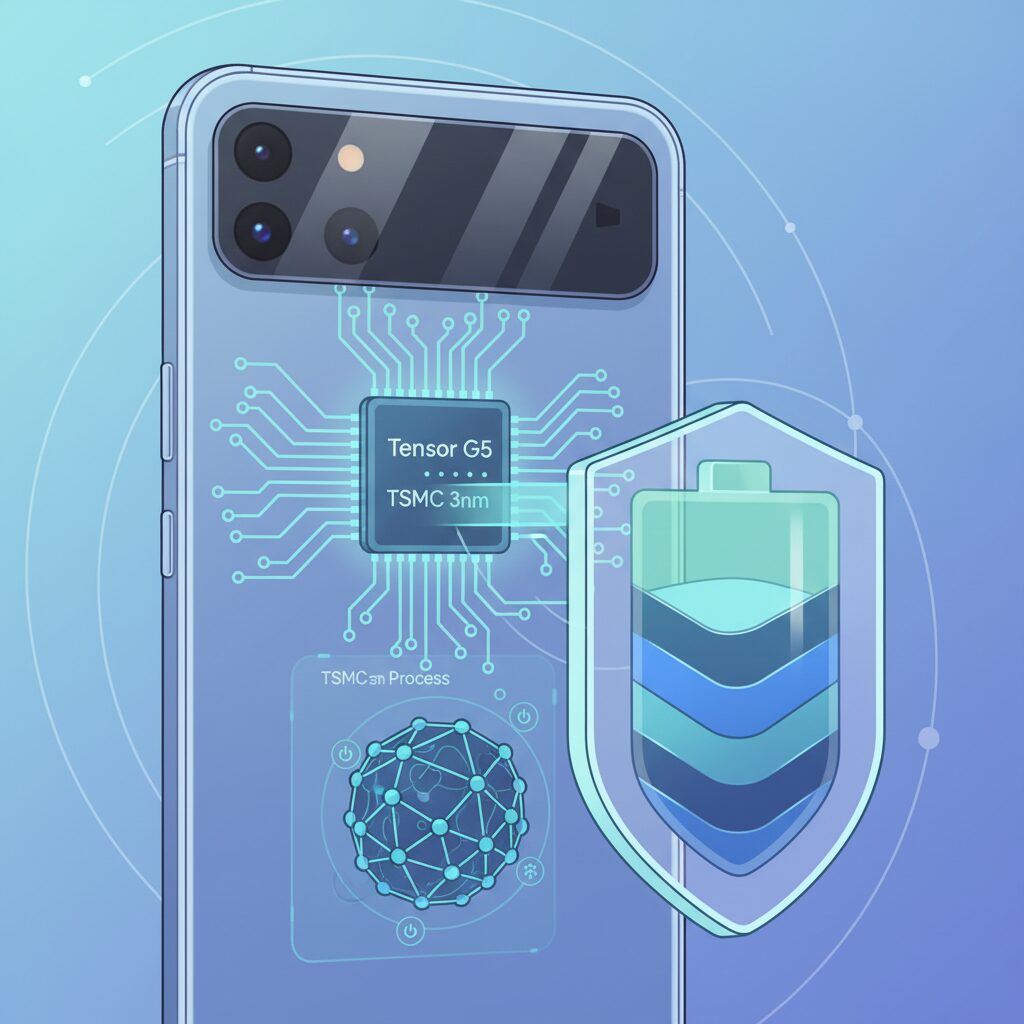
The shift to Tensor G5 fabricated on TSMC’s 3nm process represents a decisive step toward improving real-world power efficiency in the Pixel 10 Pro XLです。For several generations, Pixel devices were held back by higher leakage current and thermal overhead associated with Samsung’s 4nm and 5nm nodesです。By moving to TSMC’s second-generation 3nm process, Google directly addressed this long-standing bottleneckです。
According to semiconductor analyses cited by major industry publications, TSMC’s 3nm technology significantly reduces leakage current during idle and low-load statesです。Because smartphones spend most of their time in standby or light background processing, this characteristic has an outsized impact on daily battery lifeです。Internal estimates suggest that Tensor G5 achieves roughly a 30% improvement in power efficiency over Tensor G4 under comparable workloadsです。
| SoC | Foundry | Process Node | Efficiency Focus |
|---|---|---|---|
| Tensor G4 | Samsung | 4nm | Moderate |
| Tensor G5 | TSMC | 3nm | High |
Beyond the node shrink, Google’s CPU cluster design reinforces this efficiency-first philosophyです。By relying more heavily on mid and efficiency cores for everyday tasks, Tensor G5 avoids waking its power-hungry prime core unnecessarilyです。**This architectural restraint trades peak benchmark numbers for longer sustained battery life**, a choice that aligns with Google’s emphasis on on-device AI running continuously in the backgroundです。
Experts from established mobile chip analysts note that this combination of TSMC’s mature 3nm manufacturing and conservative power budgeting is what finally allows Pixel hardware to compete on endurance, not just featuresです。In practical use, especially under Wi‑Fi and mixed workloads, the gains from Tensor G5 translate into measurably lower drain and cooler operationです。
Inside the 5,200mAh Battery: What Silicon-Carbon Anodes Change
The headline figure of a 5,200mAh battery sounds impressive on its own, but what truly defines this battery is not the number, it is the material science behind it. The Pixel 10 Pro XL is one of the first mainstream smartphones from a major U.S. manufacturer to adopt a silicon‑carbon anode, and this single change fundamentally reshapes what users can expect from battery capacity within a familiar phone size.
Conventional lithium‑ion batteries rely on graphite anodes, a material that has reached its practical energy density ceiling. According to materials research frequently cited by institutions such as MIT and industry analysts referenced by Tom’s Guide, graphite can store only a fixed amount of lithium ions per unit volume. **Silicon, by contrast, offers nearly ten times the theoretical lithium storage capacity**, which is why it has long been considered a breakthrough candidate.
The challenge has always been durability. Pure silicon expands by up to 300 percent during charge cycles, leading to structural breakdown and rapid degradation. Google’s approach uses a silicon‑carbon composite structure, where nano‑scale silicon particles are embedded within a carbon matrix. This design absorbs expansion stress internally, dramatically improving cycle stability while still delivering a meaningful energy density gain.
Independent battery technology analyses suggest that silicon‑carbon anodes typically deliver a 10 to 20 percent volumetric energy density improvement over graphite. In the Pixel 10 Pro XL, that gain translates into roughly 140mAh of additional capacity compared to the previous Pro XL, achieved within nearly identical internal space constraints.
| Anode Material | Theoretical Capacity | Practical Impact in Smartphones |
|---|---|---|
| Graphite | Low to moderate | Stable, but limits further capacity growth |
| Silicon‑Carbon | High | Higher capacity in same volume with managed degradation |
What makes this particularly relevant for daily use is not peak endurance claims, but consistency. Reports from early endurance testing indicate that the Pixel 10 Pro XL shows its strongest advantage during mixed workloads such as web browsing, messaging, and on‑device AI processing over Wi‑Fi. **The larger energy reserve acts as a buffer**, smoothing out power spikes that would more noticeably drain smaller graphite‑based batteries.
Google’s conservative charging and thermal policies, widely discussed by battery researchers and Android analysts, further suggest that this silicon‑carbon battery is tuned for longevity rather than headline charging speed. The result is a battery system designed not just to last a day, but to remain reliable across years of use, aligning with Google’s long‑term software support strategy.
Thermal Management and Vapor Chamber Cooling Explained

Thermal management is one of the least visible yet most critical technologies shaping real-world performance, and in the Pixel 10 Pro XL it plays a decisive role in sustaining both speed and battery longevity.
As Google pushed toward higher energy density with a 5,200mAh silicon-carbon battery and a more capable Tensor G5 chip, controlling heat became a non‑negotiable engineering challenge.
Without effective heat dissipation, even the most efficient silicon quickly loses its advantage due to thermal throttling and accelerated battery degradation.
Why Vapor Chambers Matter in Modern Flagships
The Pixel 10 Pro XL adopts a large vapor chamber cooling system, a solution typically reserved for gaming-focused or ultra-premium smartphones.
A vapor chamber works by using phase change: liquid inside the sealed chamber absorbs heat, vaporizes, spreads rapidly across the chamber, then condenses in cooler areas.
This process distributes heat far more evenly than traditional graphite sheets, preventing localized hotspots around the SoC and battery.
| Cooling Method | Heat Transfer Efficiency | Impact on Sustained Performance |
|---|---|---|
| Graphite Sheet | Moderate | Noticeable throttling under prolonged load |
| Vapor Chamber | High | Stable clocks and lower surface temperature |
According to semiconductor thermal studies frequently cited by IEEE publications, spreading heat over a larger area is more effective than simply increasing peak dissipation.
The Pixel 10 Pro XL’s vapor chamber aligns precisely with this principle, covering both the Tensor G5 and adjacent power delivery components.
This design minimizes sudden thermal spikes that would otherwise trigger aggressive frequency reductions.
Thermal Control and Battery Health
Heat management is not only about performance but also long-term battery stability.
Silicon‑carbon batteries offer higher energy density, yet academic research from materials science journals notes they are more sensitive to elevated temperatures during charge and discharge.
By lowering average operating temperatures, the vapor chamber indirectly slows chemical wear inside the battery cells.
Independent teardown analyses highlighted that Google prioritized thermal pathways even over internal space efficiency.
This explains why the Pro XL variant alone receives vapor chamber cooling, while the standard model relies on simpler heat-spreading materials.
The trade-off favors sustained usability over short-term benchmark gains.
In daily use, this translates into fewer temperature-related slowdowns when recording 4K video or performing on-device AI tasks.
Rather than chasing peak numbers, Google’s cooling strategy focuses on keeping the device within an optimal thermal envelope.
This approach reflects a broader industry shift toward endurance-based performance, where stability matters more than momentary speed.
Real Charging Performance: Wired, Wireless, and Qi2 Pixelsnap
When discussing charging on the Pixel 10 Pro XL, the gap between specification sheets and real-world behavior is where the most interesting story emerges. Google advertises up to 45W wired charging, Qi2 wireless charging, and its own magnetic alignment branded as Pixelsnap, but daily usability depends far more on charging curves, thermal limits, and accessory compatibility.
In practice, the Pixel 10 Pro XL prioritizes battery longevity over raw charging speed. Multiple independent measurements reported by outlets such as CyberShack and GSMArena show that while the phone can briefly approach the advertised power levels, it rarely sustains them for long. This design choice is deliberate and closely tied to the silicon-carbon battery chemistry.
| Charging Method | Peak Power Observed | Typical Real-World Behavior |
|---|---|---|
| Wired USB-C | 30–37W (short bursts) | Gradual throttling after ~50% |
| Qi2 (Pixelsnap) | 23–25W (official stand) | Stable alignment, reduced heat |
| Legacy Qi | 5–15W | Inconsistent, sometimes <5W |
With wired charging, the Pixel 10 Pro XL delivers its fastest speeds only at low battery levels. From 0% to around 50%, power input commonly sits in the low-to-mid 30W range, then steadily declines as the battery enters constant-voltage charging. By the time the battery passes 80%, charging becomes intentionally slow. As reported by CyberShack’s deep-dive review, a full charge typically takes between 1 hour 22 minutes and 1 hour 35 minutes under normal conditions.
Thermal sensitivity plays a decisive role here. User measurements compiled by Android Gadget Hacks and community testing indicate that once battery temperature crosses roughly 37 to 40 degrees Celsius, the system immediately reduces input power. This behavior is especially noticeable during summer charging or when the device is used while plugged in. The result is consistent but conservative performance, trading speed for long-term cell stability.
Wireless charging introduces both a step forward and a potential pitfall. The Pixel 10 Pro XL supports the Qi2 standard with magnetic alignment, which Google markets as Pixelsnap. Much like Apple’s MagSafe, this ensures precise coil positioning, minimizing energy loss and excess heat. With Google’s official Pixel Stand, reviewers have observed sustained wireless charging in the 23 to 25W range, which is unusually high for wireless solutions.
However, backward compatibility is not seamless. According to reports analyzed by Android Gadget Hacks, some older third-party Qi chargers fail during protocol negotiation and default to extremely low output, sometimes as low as 3 to 4W. This phenomenon has been widely described as a “wireless charging nightmare” among early adopters. In practical terms, Qi2-certified accessories are no longer optional if you want predictable results.
What stands out most is Google’s overarching philosophy. By combining conservative charging curves, aggressive thermal throttling, and strict standards enforcement for Qi2, the Pixel 10 Pro XL treats charging as an extension of battery health management rather than a race for headline numbers. Analysts at Futurum Group note that this aligns with Google’s seven-year software support promise, where preserving battery integrity becomes a core part of the product’s long-term value.
For users coming from ultra-fast charging ecosystems, this approach may feel restrained. Yet in everyday use, especially with Pixelsnap-enabled accessories, the experience is consistent, cooler, and predictable. The Pixel 10 Pro XL does not aim to charge the fastest; it aims to age the slowest.
Android 16 Power Management and the Battery Health Controversy
Android 16 introduced one of the most aggressive power management philosophies ever seen on a mainstream smartphone, and Pixel 10 Pro XL sits at the center of that debate. Google positions this OS-level control as a necessary response to higher energy density batteries and longer software support cycles, but many enthusiasts see it as an unprecedented restriction on user autonomy.
At the core of the controversy is Battery Health Assistance, a system-level mechanism that automatically intervenes once the battery reaches 200 full charge cycles. According to analysis cited by Android Central and TechRadar, this threshold typically appears within the first year of normal use. From that point forward, Android 16 begins gradually lowering maximum charging voltage.
Technically, this behavior aligns with long-established lithium-ion chemistry. Research referenced by battery engineers and echoed in GSMArena reporting shows that even small reductions in peak voltage can dramatically slow chemical degradation. In practice, however, users experience this as a shrinking effective capacity and slower charging speeds, even though the physical battery remains intact.
| Cycle Range | System Behavior | User Impact |
|---|---|---|
| 0–199 cycles | Full voltage, unrestricted charging | Maximum capacity and peak charging speed |
| 200–1000 cycles | Gradual voltage reduction enforced by OS | Perceived capacity loss and slower top-up |
Google’s internal rationale, referenced by multiple Pixel-focused outlets, is tied directly to its seven-year update promise. A silicon-carbon battery, while denser, is also more sensitive to high-voltage stress. From Google’s perspective, software-enforced moderation is the only way to guarantee safety and longevity across that unusually long lifespan.
Critics argue that the issue is not the science but the lack of choice. Power users accustomed to manually managing charge limits on other platforms feel that Android 16 crosses an invisible line. As one commonly cited sentiment among Pixel communities suggests, the phone no longer feels fully owned once software can permanently reduce usable capacity without consent.
Beyond battery health, Android 16 also tightens background power governance. Google’s January 2026 update notes, reported by 9to5Google and Android Authority, confirm fixes for abnormal battery drain caused by misbehaving background processes. These patches improved idle efficiency, particularly on Wi‑Fi, reinforcing the idea that Android 16 prioritizes long-term stability over short-term performance bursts.
In effect, Android 16 reframes battery life as a multi-year contract rather than a daily resource. Whether that philosophy feels reassuring or restrictive depends entirely on how much control users expect over their hardware, making this one of the most polarizing software decisions Google has made in the Pixel era.
Battery Life in Daily Scenarios: Wi-Fi, 5G, Gaming, and Video
In real-world use, battery life is not defined by synthetic benchmarks but by how the device behaves across everyday scenarios such as Wi-Fi browsing, 5G connectivity, gaming, and video consumption. In these contexts, the Pixel 10 Pro XL shows a clearly segmented personality, excelling in some conditions while revealing constraints in others.
Under Wi-Fi environments, the Pixel 10 Pro XL delivers its most impressive endurance. Independent battery rundown tests cited by TechDroider and GSMArena indicate that continuous web browsing and social media scrolling over Wi-Fi can comfortably exceed 12 to 14 hours of screen-on time. This performance is largely attributed to the Tensor G5’s TSMC 3nm process and Android 16’s refined idle-state management, which minimizes background leakage power when radio conditions are stable.
| Usage Scenario | Observed Battery Behavior | Primary Influencing Factor |
|---|---|---|
| Wi-Fi Browsing & SNS | Very stable, slow drain | Low modem power draw |
| 5G Standby | Noticeable idle drain | Exynos 5400 modem efficiency |
| 3D Gaming | Gradual thermal throttling | GPU load and heat limits |
| Video Streaming | Consistently efficient | Hardware AV1 decoding |
By contrast, 5G usage remains the most battery-intensive daily scenario. Multiple user reports and comparative tests note standby drain reaching roughly 1.5 percent per hour on cellular networks, especially in areas with fluctuating signal strength. According to analysis referenced by Android Authority, this behavior is consistent with higher baseline power consumption from the Samsung-based modem, particularly during network handovers.
Gaming presents a more nuanced picture. High-load titles push both the GPU and the thermal envelope, and while the vapor chamber prevents sudden overheating, extended sessions do result in throttling. Battery consumption during graphically intensive gaming is faster than on Snapdragon-based rivals, yet it remains predictable rather than erratic, which aligns with Google’s conservative power tuning philosophy.
For video playback, the device once again performs strongly. Thanks to hardware-accelerated AV1 decoding, long-form streaming on platforms like YouTube consumes relatively little power. Reviewers from CyberShack observed that continuous video playback can approach a full day of mixed use when combined with light browsing, reinforcing the Pixel 10 Pro XL’s suitability as a media-centric device.
The key takeaway is that daily battery life depends heavily on network conditions. On Wi-Fi and during video consumption, the Pixel 10 Pro XL feels effortlessly long-lasting, while heavy 5G reliance or sustained gaming reveals the limits of its otherwise robust 5,200mAh capacity.
Pixel 10 Pro XL vs iPhone 17 Pro Max and Galaxy S25 Ultra
When comparing Pixel 10 Pro XL with iPhone 17 Pro Max and Galaxy S25 Ultra, the real story emerges not from raw specifications alone, but from how each company prioritizes power efficiency under real-world conditions. All three represent the pinnacle of their ecosystems, yet their battery behavior and system philosophy differ in meaningful ways.
Pixel 10 Pro XL is designed around capacity plus controlled efficiency. With its 5,200mAh silicon‑carbon battery and Tensor G5 built on TSMC’s 3nm process, Google clearly targets long, stable usage rather than peak bursts. According to multiple battery rundown tests reported by TechDroider, Pixel excels in Wi‑Fi and mixed daily tasks, often matching or exceeding its rivals during screen‑on activities like browsing and social media.
However, this advantage narrows in cellular-heavy scenarios. The Samsung Exynos 5400 modem inside Pixel 10 Pro XL consumes noticeably more power during 5G standby, leading to faster idle drain when traveling. This is where Apple, in particular, shows its long-standing strength.
| Model | Battery Strategy | Key Strength | Main Limitation |
|---|---|---|---|
| Pixel 10 Pro XL | Large capacity + software protection | Wi‑Fi endurance, AI efficiency | 5G standby drain |
| iPhone 17 Pro Max | Extreme SoC efficiency | Lowest idle power draw | Less user control |
| Galaxy S25 Ultra | Balanced performance tuning | Consistent all‑day use | Smaller battery size |
iPhone 17 Pro Max remains the benchmark for idle and video efficiency. Apple’s A19 Pro chip and tightly controlled iOS background management allow it to sip power when doing nothing, a fact consistently highlighted by reviewers and echoed by GSMArena’s endurance methodology. During extended 4K video recording or long standby periods, iPhone often outlasts Pixel despite having a smaller nominal battery.
Galaxy S25 Ultra takes a different route. Samsung pairs a slightly smaller battery with Snapdragon 8 Elite, leveraging high peak performance to finish tasks quickly and return to low-power states. In many mixed-use tests referenced by Android-focused reviewers, Galaxy achieves similar or slightly better overall screen‑on time than Pixel, thanks to display efficiency and modem optimization.
The key differentiator is philosophy. Pixel 10 Pro XL prioritizes sustainable battery health through Android 16’s enforced protection, even if that limits user control. iPhone emphasizes invisible efficiency with minimal user intervention. Galaxy focuses on balanced tuning across hardware and software. For users who value predictable daily endurance and AI‑driven workflows, Pixel stands strong, but those frequently on 5G or traveling may still find Apple or Samsung more forgiving.
Repairability, Battery Replacement, and Long-Term Ownership
For long-term owners, repairability and battery replacement are not abstract ideals but very practical concerns, and the Pixel 10 Pro XL shows a clear shift in Google’s priorities. Compared with earlier Pixel generations that relied heavily on permanent adhesives, this model adopts a battery mounting method designed to be serviced rather than endured. According to detailed teardowns reported by GSMArena and Android Headlines, the battery is secured with pull-tab adhesive strips that can be removed with controlled force, significantly reducing the risk of puncture or collateral damage during replacement.
This structural change matters because the Pixel 10 Pro XL is built around a high-density silicon-carbon battery, which is more sensitive to improper handling than conventional graphite-based cells. **By lowering the technical barrier to safe battery removal, Google effectively aligns hardware design with its seven-year update promise**, making long-term ownership more realistic rather than theoretical.
| Aspect | Pixel 9 Pro XL | Pixel 10 Pro XL |
|---|---|---|
| Battery fixation | Strong adhesive, no pull tabs | Pull-tab adhesive, heat-assisted |
| Access method | Front or complex disassembly | Rear glass removal only |
| Replacement risk | Moderate to high | Noticeably reduced |
Another important point is that the battery can be replaced without removing the display. This is not a minor detail. Displays are among the most fragile and expensive components in modern smartphones, and avoiding their removal lowers both labor cost and accidental breakage. Repair specialists quoted in teardown analyses note that this approach brings the Pixel 10 Pro XL closer to the serviceability standards promoted by organizations such as iFixit, even if it is not fully modular.
In Japan, where official repairs are handled by authorized providers such as iCracked, this design choice has direct financial implications. Based on published prices for recent Pixel models, the battery replacement cost for the Pixel 10 Pro XL is expected to fall in the 25,000 to 27,000 yen range. While this is not inexpensive, **the use of genuine Google parts is particularly important for silicon-carbon batteries**, where third-party cells may not match the required thermal and voltage characteristics. Industry analysts have repeatedly warned that mismatched batteries accelerate degradation and increase safety risks, a concern echoed by battery researchers cited by major technology publications.
Long-term ownership is also shaped by software behavior. Android 16’s mandatory Battery Health Assistance feature gradually reduces peak voltage after around 200 charge cycles, a policy confirmed by Android Central and TechRadar. From a user’s perspective, this can feel restrictive, but from an engineering standpoint it reduces chemical stress and delays irreversible capacity loss. **The practical result is a battery that ages more predictably**, making a planned replacement after three to four years far more effective than in older designs where degradation was uneven and sudden.
It is also worth noting that the Pixel 10 Pro XL’s internal layout leaves surrounding components, such as the vapor chamber and flex cables, largely undisturbed during battery service. Repair technicians have pointed out that this lowers cumulative wear from multiple interventions over the device’s lifespan. In other words, the phone is not only easier to repair once, but better suited to being repaired more than once.
Seen through the lens of sustainability and ownership cost, the Pixel 10 Pro XL represents a more mature approach. Rather than chasing sealed-body minimalism, Google appears to accept that batteries are consumables. **By designing for replacement instead of denial, the device supports the realistic expectation that a flagship phone should remain viable well beyond its initial warranty period**, provided the owner is willing to service it responsibly.
参考文献
- PhoneArena:Pixel 10 Pro release date, price and features
- Android Gadget Hacks:Google Tensor G5 Chip: TSMC’s 3nm Power Brings Big Changes
- Droid Life:Pixel 10 Pro XL Will Sport Biggest Pixel Battery Yet
- GSMArena:Google Pixel 10 Pro XL – Full phone specifications
- Android Central:The Pixel 10’s battery takes a hit after 200 cycles, courtesy of a feature you can’t switch off
- Android Gadget Hacks:Pixel 10 Wireless Charging Nightmare Breaks Old Chargers