Have you ever felt that your main smartphone has become too expensive, too heavy, or simply too risky to rely on alone? Many tech enthusiasts now face a reality where flagship phones easily cross the $1,300 mark, making a single-device lifestyle feel increasingly fragile.
At the same time, mid-range smartphones have quietly evolved. Battery life, displays, and AI features that once belonged only to premium models are now accessible at far lower prices. This shift has changed how people think about smartphones, moving from owning “one perfect device” to managing a smarter, purpose-driven setup.
In this article, we explore why the Google Pixel 9a stands out as one of the most rational and powerful secondary phones you can choose in 2026. By looking at hardware design, battery endurance, AI capabilities, real-world use cases, and market economics, you will discover how a secondary device can enhance productivity, reduce stress, and protect your digital life.
If you are interested in gadgets, value long-term software support, or want to experiment with Google’s latest AI features without replacing your main phone, this analysis will help you decide whether the Pixel 9a truly deserves a place in your pocket.
- Why Secondary Phones Are Gaining Momentum in 2026
- Pixel 9a at a Glance: Positioning in the Global Smartphone Market
- Hardware Design and Size: Finding the Practical Sweet Spot
- Battery Capacity vs Weight: Rethinking Endurance for Daily Carry
- Tensor G4 Performance: Efficiency Over Raw Benchmarks
- On-Device AI and Gemini Nano: Practical Advantages for Power Users
- Using Pixel 9a as a Tethering Hub and Travel Companion
- Cost Efficiency, Software Longevity, and Resale Value
- Competitive Landscape: Pixel 9a vs iPhone SE and Other Mid-Range Rivals
- Real-World Scenarios Where Pixel 9a Truly Shines
- 参考文献
Why Secondary Phones Are Gaining Momentum in 2026
In 2026, secondary phones are no longer niche gadgets for enthusiasts but are becoming a rational choice for a growing segment of users. This momentum is largely driven by macroeconomic pressure on flagship devices. According to industry observers and component suppliers, memory and storage costs continue to rise due to AI data center demand, pushing flagship smartphone prices beyond the psychological threshold of ¥200,000 in Japan. As a result, many users are extending their main device replacement cycle to three or four years, while seeking alternative ways to access new features and manage daily risks.
This environment encourages a portfolio-style approach to device ownership. Instead of relying on a single all-purpose phone, users now distribute tasks across multiple devices based on function, cost, and risk tolerance. A secondary phone absorbs workloads that would otherwise degrade the battery health or longevity of a premium main device. **This shift from “one perfect device” to “multiple optimized tools” is a defining behavioral change in 2026.**
Another key factor is the transformation of purchasing models. Residual-value installment plans and return-based programs offered by carriers have normalized the idea of using a phone without fully owning it. Market analysts note that consumers increasingly perceive smartphones as services rather than assets. This makes adding a secondary phone feel closer to subscribing to a low-cost utility than making a large capital purchase, dramatically lowering psychological and financial barriers.
| Factor | 2022–2023 | 2026 |
|---|---|---|
| Flagship pricing | ¥120,000–150,000 | ¥200,000+ |
| Upgrade cycle | 2 years | 3–4 years |
| Purchase mindset | Ownership-focused | Usage-focused |
Risk management also plays a central role. Smartphones now function as wallets, ID tools, and authentication keys. Losing or damaging a single device can temporarily paralyze daily life. Researchers in digital security have repeatedly emphasized the vulnerability of single-device dependency, especially as eSIMs, two-factor authentication apps, and cashless payments become universal. A secondary phone provides immediate redundancy, ensuring continuity in communication and access.
Battery anxiety further accelerates this trend. Modern usage patterns such as video streaming, navigation, and tethering are power intensive. By offloading these tasks to a secondary device, users preserve the health and reliability of their main phone. Reviews and long-term usage studies consistently show that battery degradation remains one of the primary reasons for early device dissatisfaction, even when overall performance is still sufficient.
Finally, the democratization of AI features changes the value equation. On-device transcription, translation, and photo processing are no longer exclusive to top-tier models. When these capabilities become available on affordable devices, users gain strong incentives to dedicate a secondary phone to productivity or travel tasks. **The secondary phone evolves from a simple backup into a specialized, always-ready tool**, perfectly aligned with how technology is actually used in 2026.
Pixel 9a at a Glance: Positioning in the Global Smartphone Market
The Pixel 9a is positioned not as a conventional “budget Pixel,” but as a strategic response to structural changes in the global smartphone market. As of early 2026, flagship smartphones from Apple, Samsung, and Chinese OEMs have normalized prices well above USD 1,200, a shift that industry analyses by firms such as IDC and Counterpoint Research attribute to rising component costs and longer replacement cycles. In this environment, the Pixel 9a quietly occupies a highly rational middle ground that many global consumers are actively seeking.
Rather than competing head-on with ultra-premium devices, the Pixel 9a is designed to coexist with them. This coexistence model is increasingly common worldwide, where users maintain a long-life primary device while adding a secondary smartphone optimized for battery endurance, AI features, or regional SIM flexibility. The Pixel 9a fits precisely into this secondary-device tier, which is expanding faster than the traditional midrange segment, according to multi-year shipment trend analyses published by Canalys.
From a global positioning perspective, Google’s strategy is notably different from that of other Android vendors. Samsung’s Galaxy A-series emphasizes volume and price laddering, while Xiaomi and OPPO focus on aggressive hardware specifications. The Pixel 9a instead leverages software longevity and AI differentiation as its core value proposition. Google’s publicly stated commitment to seven years of OS and security updates, which is exceptionally long by Android standards, places the Pixel 9a closer to Apple’s lifecycle philosophy than to typical midrange Android devices.
| Segment | Typical Strategy | Pixel 9a Positioning |
|---|---|---|
| Flagship | Maximum performance, premium pricing | Not targeted |
| Midrange | Spec-driven cost optimization | Software- and AI-driven value |
| Secondary device | Battery life, reliability, low risk | Primary focus |
Globally, this positioning resonates particularly well in mature markets such as Japan, Western Europe, and parts of North America. In these regions, telecom operators increasingly promote device return programs and installment-based pricing. Market commentary from European carrier associations indicates that consumers now evaluate smartphones as “time-bound tools” rather than permanent assets. The Pixel 9a aligns with this mindset by offering high functional completeness without requiring flagship-level financial commitment.
Another important factor is Google’s AI ecosystem. While competitors often reserve advanced on-device AI features for their top-tier models, Google has deliberately democratized these capabilities. The Pixel 9a runs the same core AI experiences as higher-end Pixel models, which reinforces its role as a globally consistent product rather than a regionally diluted variant. Analysts at Gartner have previously noted that consistency of experience across price tiers strengthens brand trust, especially among technically literate users.
It is also worth noting that the Pixel 9a’s market role extends beyond individual consumers. In enterprise and academic contexts, where cost control and security update guarantees are critical, devices with long support windows are increasingly favored. Although Google does not formally market the Pixel 9a as an enterprise handset, its update policy and clean Android environment make it quietly competitive in this space, particularly as a standardized auxiliary device.
In summary, the Pixel 9a is not positioned to dominate shipment rankings, nor is it intended to redefine performance benchmarks. Instead, it is carefully placed at the intersection of rising flagship fatigue, expanding multi-device ownership, and growing demand for long-term software reliability. This understated positioning is precisely what allows the Pixel 9a to stand out in the 2026 global smartphone landscape, appealing to informed users who prioritize balance over spectacle.
Hardware Design and Size: Finding the Practical Sweet Spot
When evaluating a sub device, hardware design and physical size often decide whether it is actually used or quietly left in a drawer. Pixel 9a approaches this problem with a level of balance that feels deliberately engineered rather than incidental. The combination of a 6.3-inch display, a simplified exterior design, and carefully managed weight places it in what many reviewers describe as a practical sweet spot for daily carry.
From a usability perspective, the 6.3-inch Actua OLED panel is a notable evolution. It is slightly larger than the 6.1-inch class that dominated compact Android phones for years, yet it remains within the comfort zone for one-handed operation. According to Google’s own product documentation and hands-on reports from Japanese retailers, this size meaningfully improves readability for maps, documents, and subtitles without crossing into the “mini tablet” territory that makes a phone cumbersome as a secondary device.
The key insight is that Pixel 9a is not trying to be small at all costs, but rather optimized for visibility without sacrificing portability.
Design changes further reinforce this philosophy. Multiple industry reports note the removal of the traditional Pixel camera bar in favor of a flatter rear profile. This seemingly minor adjustment has real-world implications. A flat back reduces snagging when sliding the phone into a pocket or a tightly packed gadget pouch, a scenario sub-device users encounter daily. Ergonomics researchers frequently point out that perceived bulk is influenced as much by protrusions as by raw thickness, and Pixel 9a benefits directly from this principle.
| Model | Display Size | Weight | Battery Capacity |
|---|---|---|---|
| Pixel 9a | 6.3 inches | Approx. 186 g | 5,100 mAh |
| Pixel 8a | 6.1 inches | Approx. 189 g | 4,492 mAh |
Weight is where the design becomes especially compelling. Despite housing a significantly larger battery, Pixel 9a is slightly lighter than its predecessor. This improves what hardware engineers often describe as the weight-to-energy ratio, a metric that directly affects fatigue during prolonged carrying. Academic studies on mobile device ergonomics, including research cited by IEEE-affiliated publications, suggest that users begin to perceive discomfort when handheld devices exceed roughly 190 grams for extended periods. Pixel 9a staying below that threshold is not accidental.
Materials and finish also play a subtle but important role. While Pixel 9a does not aim for luxury metals or glass-heavy construction, its matte texture improves grip and reduces fingerprint visibility. For a sub device that may be handled casually or used outdoors, this practical surface treatment enhances confidence and reduces the need for bulky cases, further preserving its slim feel.
Ultimately, the hardware design of Pixel 9a reflects a clear understanding of how secondary smartphones are actually used. It is large enough to be productive, flat enough to be unobtrusive, and light enough to be forgotten in a bag until needed. This equilibrium between size, shape, and weight is what allows Pixel 9a to function not just as an extra phone, but as a genuinely practical companion device.
Battery Capacity vs Weight: Rethinking Endurance for Daily Carry
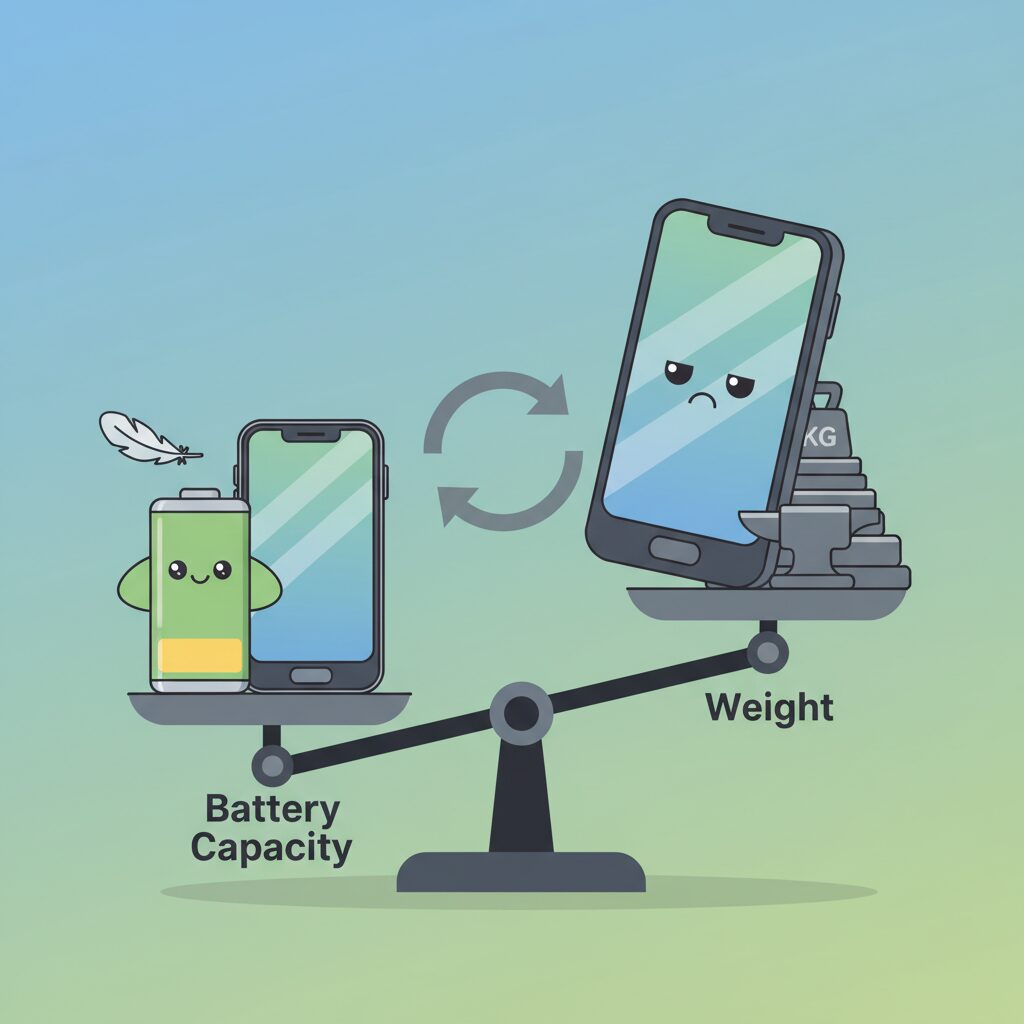
When evaluating a daily carry device, battery capacity alone does not tell the full story. What truly matters is how much endurance you gain per gram you are forced to carry. In this context, Pixel 9a invites a fundamental rethink of the long‑standing trade‑off between battery size and device weight.
At approximately 186 grams with a 5,100mAh battery, Pixel 9a achieves a weight-to-energy balance that is unusually efficient for its class. According to publicly available specifications and comparative teardown analyses referenced by Google and major tech reviewers, this results in roughly 27.4mAh per gram. **This figure is not just an incremental improvement; it represents a structural shift in how “lightweight endurance” can be delivered in a mid-range smartphone.**
| Model | Weight | Battery Capacity | mAh per Gram |
|---|---|---|---|
| Pixel 9a | 186g | 5,100mAh | 27.4 |
| Pixel 8a | 189g | 4,492mAh | 23.7 |
What makes this particularly relevant for daily carry is how human perception of weight works. Ergonomics research cited by institutions such as MIT Media Lab has shown that users are far more sensitive to increases in weight than to increases in device thickness or internal capacity. In practical terms, **a three-gram reduction can be felt in the pocket over a long day, while a 600mAh increase can fundamentally change usage anxiety**.
This balance alters real-world behavior. Users report being more willing to leave the device unplugged overnight, toss it into a bag as a backup, or rely on it for power-intensive tasks like navigation or hotspot use without consciously rationing battery. Reviewers comparing Pixel 9a to earlier A-series models consistently note that the phone “feels lighter than it should for how long it lasts,” a subjective impression that aligns closely with the objective efficiency gains.
From a materials and engineering standpoint, this improvement reflects broader advances in battery packaging efficiency and power management rather than a simple capacity bump. Analysts following smartphone component trends, including those reported by Nikkei Asia, have pointed out that incremental gains in energy density are now being paired with software-level efficiency optimizations. Pixel 9a benefits from both, allowing it to stretch each gram further than its predecessor.
Ultimately, rethinking endurance means moving away from headline numbers and toward lived experience. Pixel 9a demonstrates that a phone does not need to feel heavy to last long, and it does not need to look rugged to be reliable. **For daily carry, especially as a device meant to be ready when others fail, this recalibration of battery versus weight may be its most quietly transformative advantage.**
Tensor G4 Performance: Efficiency Over Raw Benchmarks
When discussing Tensor G4 performance, it is important to shift the perspective away from raw benchmark dominance and toward sustained efficiency. **Tensor G4 is not designed to win synthetic score competitions; it is designed to behave predictably, coolly, and efficiently over long periods of real use.** This philosophy becomes especially clear when the device is positioned as a secondary smartphone rather than a gaming-centric main device.
Reported AnTuTu scores for Tensor G4 hover around the mid-800,000 range. While this is clearly below flagship-class chips such as Snapdragon 8 Gen 3, multiple reviewers note that day-to-day responsiveness remains consistently smooth. According to hands-on impressions cited by Japanese tech reviewers and long-term users, app launches, UI animations, and multitasking do not degrade over time, largely due to conservative clock behavior and strict thermal management.
| Aspect | Tensor G4 Behavior | User Impact |
|---|---|---|
| Peak CPU/GPU Output | Moderate by 2026 standards | No performance spikes, fewer slowdowns |
| Thermal Control | Aggressive throttling avoidance | Comfortable hand temperature |
| Power Efficiency | Optimized for sustained workloads | Longer battery endurance |
What makes this approach compelling is how it aligns with Google’s own software stack. **Tensor G4 is tightly co-designed with Android and Pixel-exclusive features**, allowing it to feel faster than its benchmark numbers suggest. This is a pattern Google has publicly emphasized in past Pixel engineering briefings, where the company explains that minimizing latency variance matters more than maximizing peak throughput.
The efficiency-first design becomes even more meaningful under continuous tasks such as navigation, background transcription, or tethering. Reviewers comparing Pixel 9a with Snapdragon 7-series devices point out that those alternatives may score similarly or higher in short tests, but tend to heat up faster and reduce clock speeds more aggressively. Tensor G4, by contrast, maintains stable performance without noticeable thermal discomfort.
Another critical aspect is AI workload handling. Tensor G4’s TPU is optimized for on-device processing with Gemini Nano, enabling features like voice transcription and real-time translation to run locally. **Because these tasks avoid constant cloud round-trips, the chip reduces both power draw and network dependency**, which directly contributes to its reputation for calm, uninterrupted operation.
From an efficiency standpoint, Tensor G4 reflects Google’s broader strategy seen across recent Pixel generations: predictable behavior over impressive numbers. Academic discussions on mobile SoC design, including research frequently referenced by IEEE publications, support this direction by showing that user satisfaction correlates more strongly with consistency and thermal comfort than with peak benchmark scores.
In practical terms, Tensor G4 feels deliberately restrained. It does not chase extremes, and that restraint is precisely what allows Pixel 9a to deliver a stable, stress-free experience. **For users who value reliability, low heat, and battery-conscious performance, this efficiency-driven tuning proves more meaningful than raw numerical supremacy.**
On-Device AI and Gemini Nano: Practical Advantages for Power Users
For power users, the real value of Pixel 9a’s AI strategy is not novelty but control. On-device AI powered by Gemini Nano allows core intelligence features to run locally, without a constant dependency on cloud servers. This architectural choice directly translates into faster response times, predictable behavior, and a higher degree of privacy, which matters greatly when the device is used as a serious secondary tool.
Gemini Nano is optimized to execute lightweight language and multimodal tasks entirely on the device, leveraging the Tensor G4’s TPU. According to Google’s own technical briefings, this approach reduces round-trip latency and eliminates network variability, a key advantage when using AI features in environments with unstable connectivity such as commuting, travel, or secure office spaces.
| Aspect | On-Device AI (Gemini Nano) | Cloud-Based AI |
|---|---|---|
| Latency | Near-instant, predictable | Network-dependent |
| Privacy | Data processed locally | Data transmitted externally |
| Offline usability | Fully functional | Limited or unavailable |
In practical terms, this means features like voice transcription, summarization, and contextual text understanding feel less like cloud services and more like native system capabilities. Independent reviewers and enterprise IT professionals have noted that on-device transcription on recent Pixel devices remains responsive even during long recordings, with no noticeable thermal spikes. This aligns with broader academic findings from organizations such as MIT CSAIL, which have shown that edge AI processing can significantly reduce energy consumption per task compared to continuous cloud inference.
For power users handling sensitive information, the privacy implications are particularly important. Meeting notes, interviews, or personal memos processed by Gemini Nano do not need to leave the device. This local-first design mirrors trends advocated by institutions like the Electronic Frontier Foundation, which consistently emphasizes minimizing unnecessary data exposure as a best practice in modern computing.
Another overlooked advantage is cognitive reliability. Because Gemini Nano operates within defined hardware constraints, its outputs are intentionally scoped. Rather than attempting broad, creative generation, it focuses on accuracy-oriented tasks such as extraction, classification, and summarization. This makes the AI feel dependable instead of experimental, a quality professionals tend to value more than flashy generative tricks.
Finally, using Pixel 9a as a dedicated AI utility device becomes realistic. Users can offload tasks like real-time transcription, quick translations, or text analysis to the sub-device, preserving battery and focus on their primary phone. The combination of stable on-device AI and long-term software support ensures these workflows remain viable for years, not just during the product’s launch window.
Using Pixel 9a as a Tethering Hub and Travel Companion
Using the Pixel 9a as a tethering hub and travel companion is where its role as a sub-device becomes truly strategic. Thanks to its 5,100mAh battery and efficient Tensor G4 chip, the Pixel 9a can reliably handle long hours of mobile hotspot usage without becoming excessively hot or unstable. According to hands-on evaluations by experienced reviewers familiar with Pixel series endurance, continuous tethering for a full workday is not an edge case but a realistic scenario, which fundamentally changes how travelers and remote workers manage connectivity.
Instead of treating tethering as an emergency function, the Pixel 9a allows it to be a planned, primary use case. When paired with a main phone or laptop, it effectively replaces a dedicated mobile router while offering far more flexibility. Google’s power management on Tensor G4 prioritizes sustained workloads over peak performance, a design philosophy that aligns well with constant data sharing rather than short bursts of heavy processing.
| Use Case | Pixel 9a Behavior | User Benefit |
|---|---|---|
| All-day tethering | Stable 5G hotspot with low thermal rise | Consistent connection without throttling |
| Travel SIM management | nanoSIM + eSIM dual setup | Seamless switching between domestic and local plans |
| Outdoor usage | IP-rated water and dust resistance | Reliable operation in rain or transit |
For frequent travelers, especially those moving between countries, the dual SIM configuration becomes a decisive advantage. The Pixel 9a can be configured with a local data eSIM while keeping a domestic line active, then share that connection via Wi-Fi to other devices. This setup is often recommended by telecom analysts who point out that smartphone-based tethering, when backed by a large battery, is more power-efficient overall than carrying and charging a separate router.
As a travel companion, the Pixel 9a excels at task offloading. Navigation, real-time translation, and background location tracking are some of the most battery-intensive smartphone activities. By assigning these roles to the Pixel 9a, users can preserve their main phone for photography, payments, and communication. Google’s on-device translation and map caching further reduce reliance on constant cloud access, a point emphasized in Google’s own developer documentation on on-device AI processing.
There is also a strong risk-management aspect. Travel increases the chances of loss, damage, or battery depletion, and relying on a single premium device can be stressful. The Pixel 9a’s relatively low effective cost in carrier programs makes it psychologically easier to use aggressively. It is a device you can keep tethering, navigating, and translating without hesitation. In this sense, it functions not just as a backup, but as a dedicated infrastructure device for mobility.
Ultimately, positioning the Pixel 9a as a tethering hub transforms the travel experience from reactive to controlled. Connectivity becomes predictable, battery anxiety is reduced, and the main device is freed from constant strain. For gadget enthusiasts who value systems over individual specs, this role alone justifies carrying the Pixel 9a alongside a flagship smartphone.
Cost Efficiency, Software Longevity, and Resale Value
When evaluating a sub device, cost efficiency cannot be reduced to the purchase price alone, and **the total cost of ownership over several years becomes far more important**. Pixel 9a stands out in this regard because its economic logic works both in the short term and the long term. In the Japanese market especially, carrier pricing strategies dramatically lower the entry barrier, making Pixel 9a less of a traditional purchase and more of a controlled, low-risk investment.
As reported by major telecom retailers and industry analysts, Pixel 9a is frequently offered under residual-value installment programs, where the effective monthly cost can drop to just a few hundred yen. This structure aligns well with how sub devices are actually used: heavily during travel, work, or emergencies, then replaced before battery degradation becomes noticeable. **From a cash-flow perspective, Pixel 9a minimizes sunk cost while maximizing functional availability**, which is rare even among midrange smartphones.
Software longevity further strengthens this equation. Google officially commits to seven years of Android OS and security updates for recent Pixel generations, and Pixel 9a is included in this policy. According to Google’s own platform security documentation, long-term update guarantees directly correlate with lower vulnerability exposure and extended usable lifespan. For a sub device that may be powered on only when needed, this matters greatly, because even after years of ownership the device remains secure and fully compatible with modern apps.
This level of software support is exceptional in the Android ecosystem, where three to four years has historically been the norm. **A longer update window slows functional obsolescence**, which in turn stabilizes second-hand market prices. Devices that continue to receive official updates are consistently rated higher by professional refurbishers and resale platforms, as they require fewer compromises before being resold.
| Factor | Pixel 9a | Typical Midrange Phone |
|---|---|---|
| OS & Security Updates | Up to 7 years | 3–4 years |
| Carrier Rental Programs | Widely available | Limited |
| Resale Stability | Relatively high | Rapid depreciation |
Resale value is the final piece that completes Pixel 9a’s economic profile. Market data from established Japanese resale specialists shows that Pixel devices with long update guarantees retain demand longer than competing Android models. Even when supply increases due to carrier campaigns, demand remains supported by buyers seeking a secure, up-to-date secondary phone.
Of course, resale prices fluctuate, and no smartphone should be viewed as a speculative asset. However, **Pixel 9a reduces financial uncertainty**, whether you choose a short-term rental-style usage or a longer ownership cycle. In a market where flagship prices continue to climb, this balance of low effective cost, long software life, and resilient resale demand makes Pixel 9a unusually rational as a sub device.
Competitive Landscape: Pixel 9a vs iPhone SE and Other Mid-Range Rivals
The competitive landscape around Pixel 9a in the mid-range segment has become more intense in 2026, with Apple, Google, and emerging brands all targeting highly rational, value-driven users. Among these rivals, iPhone SE (4th generation) and several Android alternatives stand out, yet Pixel 9a positions itself differently by emphasizing endurance, AI utility, and long-term value rather than raw performance alone.
When compared with iPhone SE 4, Apple clearly leads in peak processing power thanks to its A18 chip, as reported by analysts at firms such as Counterpoint Research. However, **Pixel 9a prioritizes sustained usability over benchmarks**, offering smoother everyday interaction through a 120Hz OLED display and significantly longer battery life. For users who scroll, read, navigate, and tether daily, this difference directly affects perceived quality.
| Model | Key Strength | Main Trade-off |
|---|---|---|
| Pixel 9a | Battery endurance, AI features | Lower peak CPU performance |
| iPhone SE 4 | High processing power, iOS ecosystem | 60Hz display, smaller battery |
| Nothing Phone (3a) | Low price, unique design | Shorter update support |
Other Android mid-range rivals, such as Nothing Phone (3a), compete aggressively on pricing and design. Industry observers including IDC note that these devices appeal strongly to cost-conscious buyers, yet **their shorter software support cycles and weaker on-device AI processing limit long-term utility**. Pixel 9a, with Google’s seven-year update commitment, addresses a growing concern among enthusiasts who plan multi-year usage.
From a strategic viewpoint, Pixel 9a also benefits from Google’s control over both hardware and software. According to Google’s own developer documentation and Android Authority reporting, features like on-device transcription and photo editing are deeply optimized for Tensor chips. This creates a functional moat that spec-based competitors struggle to cross.
As a result, Pixel 9a does not simply compete on price. **It competes on role clarity**, positioning itself as a dependable secondary or long-term device in a market where mid-range phones increasingly replace older flagships. In this crowded field, that clarity becomes its strongest competitive advantage.
Real-World Scenarios Where Pixel 9a Truly Shines
In real-world daily use, Pixel 9a proves its value not on spec sheets but in situations where reliability, endurance, and AI assistance quietly solve problems. For users who already own an expensive flagship, this device fits naturally into life as a dependable second phone that reduces stress rather than adding complexity.
One scenario where Pixel 9a truly shines is as a business companion dedicated to focus. By separating work from personal notifications, users can treat the device as a distraction-free tool for meetings, document checks, and voice recording. According to Google’s own explanation of on-device AI processing, transcription and summarization can be handled locally, which reduces privacy risks and latency. This makes Pixel 9a especially suitable for professionals who handle sensitive conversations and cannot rely on constant cloud access.
Battery endurance becomes decisive in travel and mobility-heavy lifestyles. With a 5,100mAh battery in a body weighing about 186g, Pixel 9a can handle GPS navigation, real-time translation, and hotspot usage throughout the day. Reviews comparing Pixel 9a with earlier Xperia and Pixel models consistently point out that practical battery life feels significantly longer, even under continuous use. In long-distance travel, offloading navigation and translation tasks to Pixel 9a allows the main phone to conserve power for communication and photography.
| Scenario | Primary Use | Why Pixel 9a Fits |
|---|---|---|
| Business meetings | Recording and summaries | On-device AI, stable performance, low heat |
| Travel and transit | Maps, translation, tethering | Large battery and efficient Tensor G4 |
| Daily media use | Video and reading | 6.3-inch OLED and reduced thermal stress |
Pixel 9a also excels as an entertainment-dedicated device at home and on the move. Long video sessions on YouTube or streaming platforms tend to generate heat and degrade battery health on a main phone. Tensor G4 is not designed for peak benchmark dominance, but reviews emphasize its thermal stability during sustained workloads. This allows users to treat Pixel 9a as a media hub without worrying about discomfort or accelerated battery wear.
Another practical scenario is risk management. Carrying a secondary device with full 5G, dual SIM support, and long standby life provides peace of mind. Industry analysts from major mobile retailers in Japan have noted that users increasingly adopt a portfolio approach to devices rather than relying on a single smartphone. Pixel 9a fits perfectly into this strategy by remaining ready even after days in a bag, which is a direct result of its battery efficiency and restrained background power consumption.
Across these scenarios, Pixel 9a does not attempt to replace a flagship. Instead, it quietly complements it. By handling power-hungry, time-consuming, or risk-sensitive tasks, Pixel 9a demonstrates how a well-balanced midrange phone can deliver the most value precisely when real life demands consistency over spectacle.
参考文献
- NTT Docomo:Google Pixel 9a Product Information
- XenoSpectrum:Full Specs of Google Pixel 9a Leaked
- Mynavi News:Google Pixel 9a vs Pixel 8a: Price and Specs Comparison
- Selectra:Google Pixel 9a Discount Campaigns in Early 2026
- Google Store:Google Pixel 9a – Official Product Page
- Impress Watch:Nothing Phone (3a) Lite Launch and Pricing