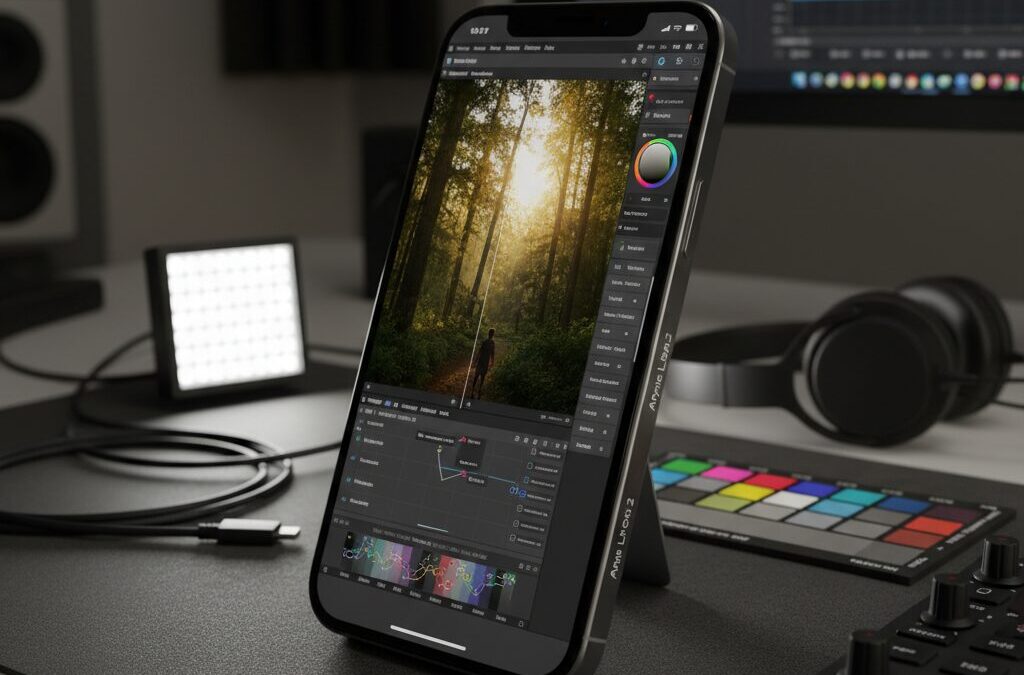
Have you ever felt that smartphone videos look impressive at first glance but fall apart the moment you start serious color grading?
Many creators outside the traditional film industry have shared this frustration, especially when pushing exposure or colors in post-production.
With the iPhone 17 Pro, Apple is clearly challenging that long‑standing limitation and redefining what mobile cinematography can mean.
The iPhone 17 Pro introduces Apple Log 2, ProRes RAW recording, and a significantly updated camera architecture designed for professional workflows.
These changes are not just about sharper images, but about how much flexibility the footage retains once it enters tools like DaVinci Resolve.
For filmmakers, videographers, and advanced content creators, editing tolerance has become just as important as resolution or frame rate.
In this article, you will learn how the iPhone 17 Pro handles Log recording, why color gamut matters more than headline dynamic range numbers, and where the real strengths and limits of this device lie.
By understanding the technology behind the sensor, the processing pipeline, and modern post-production workflows, you can decide whether this pocket-sized camera truly fits your creative needs.
If you are passionate about gadgets and serious video creation, this deep dive will give you practical insight worth your time.
- From Computational Photography to Cinematic Realism
- The Pro Fusion Camera System and 48MP Sensors Explained
- Why Telephoto Changes Matter for Video Creators
- A19 Pro and the New Image Processing Pipeline
- Apple Log 2: What Actually Changed and Why It Matters
- Color Gamut Expansion and Real Editing Tolerance
- ProRes RAW and Open Gate Shooting in Practice
- Dynamic Range, Noise, and Rolling Shutter Performance
- Professional Post-Production with DaVinci Resolve and ACES
- How iPhone 17 Pro Compares to Android Phones and Cinema Cameras
- Accessories and Ecosystem That Unlock the Full Potential
- 参考文献
From Computational Photography to Cinematic Realism
For more than a decade, smartphone video has been defined by computational photography, a philosophy that prioritizes immediacy and visual impact over fidelity. Aggressive noise reduction, heavy sharpening, and automated tone mapping have made footage look clean on small screens, but they have also stripped away the subtle imperfections that give images a sense of reality. This approach has been effective for social media, yet it has consistently fallen short for creators seeking cinematic depth.
With the iPhone 17 Pro, Apple signals a clear departure from this legacy. **The shift is not incremental but philosophical**, moving from algorithm-driven aesthetics toward sensor-driven realism. According to Apple’s own technical documentation, the redesigned imaging pipeline allows creators to bypass large parts of the traditional computational stack, accessing data that is far closer to what the sensor actually captures.
The key transformation lies in choice: creators can now decide when computation enhances an image and when it should step aside.
This transition is made possible by the A19 Pro chip and the updated Pro Fusion camera system. Instead of forcing every frame through Smart HDR and Deep Fusion, the system introduces a dedicated Log and RAW path designed for video professionals. Industry analysts at DxOMark note that this dual-path architecture fundamentally changes how dynamic range and texture are preserved, especially in challenging lighting.
| Approach | Primary Goal | Visual Result |
|---|---|---|
| Computational Video | Immediate clarity and balance | Smooth, processed, consistent |
| Log / RAW Capture | Maximum data preservation | Flat, organic, grade-ready |
What makes this evolution especially significant is how it addresses the long-criticized “smartphone look.” Researchers and color scientists referenced by the Academy Color Encoding System have repeatedly pointed out that excessive tone compression and edge enhancement reduce perceptual depth. By recording in Apple Log 2 or ProRes RAW, the iPhone 17 Pro deliberately retains uneven highlights, natural noise, and softer roll-off, elements traditionally associated with cinema cameras.
From a creative standpoint, this realism changes how scenes are approached. High-contrast environments such as city streets at night or backlit interiors no longer rely on real-time HDR tricks. Instead, they are captured with the expectation of post-production shaping. **This mirrors the workflow of professional cinematography**, where images are designed to be finished, not finalized, in-camera.
Filmmakers testing early units, including travel and documentary professionals cited by Apple and independent reviewers, emphasize that the footage initially looks unimpressive. Colors appear muted, contrast is low, and noise is visible. Yet this is precisely the point. The realism emerges during grading, where subtle skin tones, highlight texture, and atmospheric color separation can be restored without the image breaking apart.
The broader implication is that mobile cinema is no longer defined by clever computation alone. It is defined by restraint. By allowing creators to step back from automated perfection, the iPhone 17 Pro aligns itself with a cinematic tradition that values authenticity over polish. This marks the moment when smartphone video stops imitating cinema and begins to participate in it.
The Pro Fusion Camera System and 48MP Sensors Explained
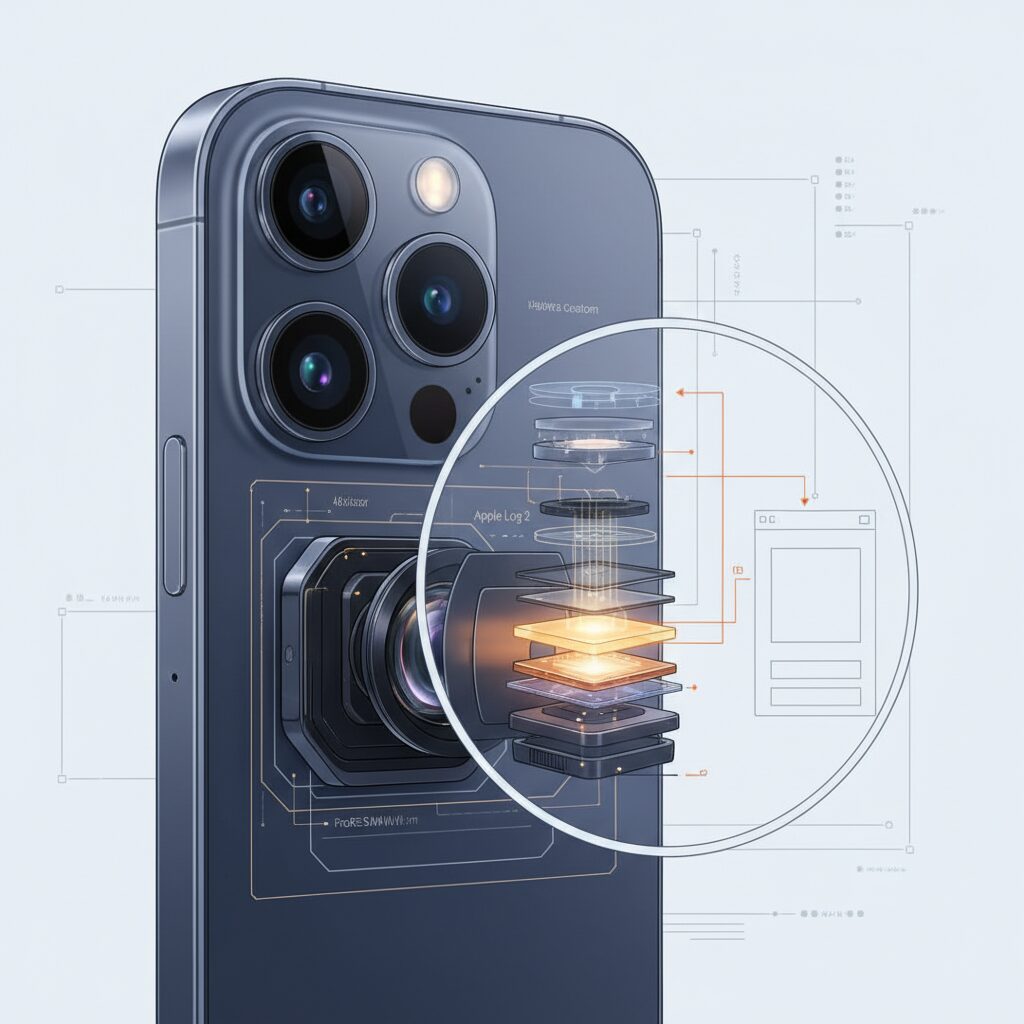
The Pro Fusion Camera System in the iPhone 17 Pro is designed to eliminate one of the long‑standing weaknesses of smartphone video and photography: inconsistency between lenses. By equipping the main, ultra‑wide, and telephoto cameras with 48MP quad‑pixel sensors, Apple ensures that resolution, color response, and noise behavior remain remarkably uniform when switching focal lengths during a shoot.
This uniformity matters far more than headline megapixels. According to Apple’s technical disclosures and independent analyses by DxOMark, matching sensor resolution across all lenses dramatically reduces perceptual jumps in sharpness and texture, especially in multi‑camera video edits where cuts are immediately noticeable.
| Lens | 35mm Equivalent | Key Sensor Advantage |
|---|---|---|
| Main | 24mm | 2.44μm quad‑pixel binning for high SNR |
| Ultra‑Wide | 13mm | 48MP detail with improved edge consistency |
| Telephoto | 100mm | Larger sensor than prior models, lower noise floor |
The quad‑pixel architecture allows the camera to intelligently combine four pixels into one, effectively increasing light‑gathering capability in low‑light scenes while preserving full 48MP detail when conditions allow. Imaging researchers frequently point out that pixel pitch, not raw resolution, is the dominant factor in noise performance, and Apple’s choice to prioritize larger effective pixels reflects this understanding.
Another crucial benefit is creative flexibility. With every lens starting from the same high‑resolution baseline, digital crops and reframing introduce far fewer artifacts. Travel photographers such as Austin Mann have noted that this makes the 100mm telephoto especially practical, as moderate cropping still yields results suitable for professional delivery.
In essence, the Pro Fusion Camera System treats the three lenses as a single, coherent imaging platform. This sensor‑level consistency lays the groundwork for reliable Log and RAW workflows, ensuring that what the sensors capture remains predictable, gradable, and ready for serious post‑production.
Why Telephoto Changes Matter for Video Creators
For video creators, changes in a telephoto camera are not just about getting closer to the subject. They directly affect storytelling options, image consistency, and post-production flexibility. The shift Apple made with the iPhone 17 Pro’s telephoto system meaningfully changes how creators can plan and execute shots.
Telephoto lenses define perspective, compression, and emotional distance, and in video these qualities are used continuously rather than in single frames. A more usable telephoto camera expands creative language, especially in narrative, documentary, and commercial work.
Apple’s move from a 120mm equivalent telephoto to a 100mm equivalent may sound like a downgrade on paper, but from a cinematography standpoint it addresses several long-standing pain points that mobile filmmakers have faced.
| Aspect | Previous 120mm Telephoto | New 100mm Telephoto |
|---|---|---|
| Sensor size | Smaller, higher noise floor | Larger, improved light gathering |
| Low-light usability | Limited for Log video | More reliable for Log and RAW |
| Framing flexibility | Tight, less forgiving | Balanced and easier to compose |
The larger telephoto sensor in the iPhone 17 Pro lowers noise at the source. This matters because Log and RAW workflows often involve lifting shadows during grading. According to testing and analysis discussed by outlets such as DxOMark and professional colorists referenced by Apple, noise performance at capture has a direct impact on how far footage can be pushed without falling apart.
In practical terms, this means telephoto shots no longer feel like a “last resort” lens. Creators can confidently use the telephoto camera for interviews, detail shots, or compressed landscapes, knowing that the footage will hold up in post-production.
The 100mm focal length also sits in what many cinematographers consider a sweet spot. It provides strong background compression for cinematic separation, while still allowing handheld operation and subject tracking without extreme stabilization artifacts. Austin Mann’s field work with iPhone cameras has repeatedly highlighted how slightly shorter telephoto lenses result in more keeper shots, especially in real-world travel and documentary scenarios.
Another critical factor is consistency. With all rear cameras now using 48MP sensors, switching between wide, ultra-wide, and telephoto during a sequence produces far fewer visual mismatches. For video editors, this reduces the need for corrective grading between angles and preserves pacing and immersion.
From a marketing and content-production perspective, this consistency shortens turnaround time. Brands and solo creators can shoot multi-angle sequences on a single device and deliver professional-looking results faster, which aligns with the demands of modern social and commercial video workflows.
Ultimately, the telephoto changes in the iPhone 17 Pro matter because they shift long-lens video from a niche option to a dependable creative choice. By optimizing sensor size, focal length, and system balance, Apple has made telephoto video practical, flexible, and commercially viable for creators who demand both speed and quality.
A19 Pro and the New Image Processing Pipeline

The A19 Pro chip sits at the core of the iPhone 17 Pro’s transformation from a computational video device into a tool that serious filmmakers can actually trust. What matters here is not raw benchmark scores, but how Apple redesigned the image processing pipeline so that creators can finally choose when computation helps and when it gets out of the way.
For years, iPhone video quality was defined by aggressive real‑time processing. Noise reduction, sharpening, and tone mapping were baked in long before the file reached the editor. With A19 Pro, Apple introduces a fundamentally different philosophy: a pipeline that can deliberately preserve sensor‑level behavior when shooting Log or RAW.
This shift is enabled by the media engine and ISP architecture inside A19 Pro, which is designed to sustain multiple 48MP data streams without forcing destructive preprocessing. According to Apple’s own technical disclosures and third‑party analysis from DxOMark, the chip’s internal bandwidth is high enough to encode ProRes formats while bypassing most of the traditional computational stack.
| Processing Path | Primary Use | Image Characteristics |
|---|---|---|
| Computational Path | HEVC / standard video | Heavy noise reduction, HDR tone mapping, immediate delivery |
| Log / RAW Bypass | ProRes Log, ProRes RAW | Minimal tone mapping, preserved highlights and shadows |
In practical terms, this dual‑path design means the ISP no longer treats every shot as something that must look “finished” on capture. When Apple Log 2 or ProRes RAW is selected, the A19 Pro routes sensor data through a reduced‑intervention path that keeps luminance and color information intact.
Independent testing discussed on platforms such as CineD and in Blackmagic Design forums shows why this matters. Editors can push exposure by two to three stops in post before noise patterns become objectionable, something that was rarely possible on earlier iPhones where shadow data had already been smoothed away.
The A19 Pro’s contribution is not just cleaner files, but predictability. Because the pipeline is stable and consistent across lenses, footage from the ultra‑wide, main, and telephoto cameras responds similarly during grading. This consistency is a direct result of the chip’s ability to handle full‑resolution 48MP quad‑pixel readouts from every camera without resorting to per‑lens compromises.
Apple’s Log white paper further explains that the ISP avoids aggressive highlight compression in this mode. Instead of flattening bright areas early, the pipeline allows clipping to occur closer to the sensor’s physical limits. As a result, highlights roll off more naturally once transformed in DaVinci Resolve or Final Cut Pro.
Another overlooked benefit of A19 Pro is rolling shutter performance. While often attributed solely to sensor design, the readout speed is tightly coupled to processing throughput. With readout times measured in the low single‑digit milliseconds, the chip can ingest and encode frames fast enough to minimize skew during motion, even in Open Gate configurations.
From a filmmaker’s perspective, the most important change is trust. Trust that the image you capture is not being irreversibly altered, and trust that decisions about noise, sharpness, and contrast can be made later on calibrated monitors. Industry professionals interviewed by outlets like Gamut consistently point out that this level of control is what separates consumer video from production‑ready footage.
In short, the A19 Pro is not impressive because it does more computation, but because it finally knows when not to. By enabling a clean bypass around traditional smartphone processing, Apple redefines what an image pipeline in a mobile device can be, and sets a new baseline for serious mobile cinematography.
Apple Log 2: What Actually Changed and Why It Matters
Apple Log 2 represents a subtle but extremely important shift in how the iPhone 17 Pro captures cinematic video, and the key change is often misunderstoodです。Many creators assume Log 2 dramatically increases dynamic range, but according to Apple’s own technical documentation and independent analysis by color science specialists, the gamma curve itself remains identical to the original Apple Logです。
This means highlight clipping points and mid‑gray placement are unchanged. In practical terms, Apple Log 2 does not magically save blown highlights. Instead, its real innovation lies elsewhereです。
The decisive upgrade is color gamut expansionです。Apple Log 2 is designed around a significantly wider color space, effectively encompassing and exceeding Rec.2020. This allows highly saturated colors to be recorded without early clipping, a limitation that affected earlier Log footage on iPhone modelsです。
| Aspect | Apple Log | Apple Log 2 |
|---|---|---|
| Gamma Curve | Logarithmic (hybrid) | Same as Apple Log |
| Color Gamut | Near Rec.2020 limits | Expanded wide gamut |
| High‑Saturation Handling | Early color clipping | Preserved color detail |
This wider gamut directly improves grading toleranceです。Independent tests reported by professional colorists show that neon lights, LED stages, and sunset gradients maintain smoother transitions when saturation is pushed in post-production. Banding and hue shifts, common failure points in smartphone footage, are far less likely to appearです。
Another overlooked change is how Apple Log 2 works with 10‑bit quantizationです。Apple’s hybrid transfer function allocates more tonal precision to mid‑tones such as skin, while gently compressing shadows to avoid excessive noise amplification. According to Apple’s Log white paper, this design reflects human visual sensitivity rather than pure mathematical log behaviorです。
Why does this matter in real workflows? When applying creative LUTs or film emulation transforms, wide‑gamut footage reduces conversion errors. Colorists working in DaVinci Resolve report fewer artifacts when pushing teal‑and‑orange looks or correcting mixed lighting scenarios, especially under high‑chroma LEDsです。
In short, Apple Log 2 is not about more stops of light. It is about protecting color integrity under stressです。For creators who grade aggressively or deliver HDR content, this shift changes the iPhone 17 Pro from a capable camera into a reliable one in professional post‑production environmentsです。
Color Gamut Expansion and Real Editing Tolerance
Color gamut expansion is often misunderstood as a purely theoretical specification, but in real editing scenarios it directly determines how far footage can be pushed before it breaks. With Apple Log 2 on iPhone 17 Pro, the most tangible improvement is not in headline dynamic range numbers, but in how color information survives aggressive grading. **This wider gamut fundamentally changes the margin of safety available to colorists**, especially in high-saturation environments.
According to Apple’s technical documentation and independent analysis by professional color scientists, Apple Log 2 preserves the same gamma curve as the original Apple Log while redefining the color primaries into a much wider working space. This separation of gamma and gamut means exposure behavior remains predictable, while chroma data gains significantly more headroom. In practice, this allows editors to push saturation, isolate hues, and apply creative LUTs with far less risk of clipping or hue distortion.
| Profile | Gamma Curve | Effective Color Gamut |
|---|---|---|
| Apple Log | Apple Log OETF | Near Rec.2020 limits |
| Apple Log 2 | Apple Log OETF | Beyond Rec.2020, Apple Wide Gamut |
One of the clearest benefits appears in scenes with neon lights, LED signage, sunsets, and stage lighting. Earlier iPhone footage frequently exhibited color clipping in these conditions, resulting in flat color blocks or sudden hue shifts when saturation was increased. With Apple Log 2, **the ceiling for chroma values is effectively raised**, so gradients remain continuous and color transitions stay smooth even under strong grading pressure.
Real-world tests conducted in DaVinci Resolve confirm that Apple Log 2 footage tolerates saturation boosts of 120–140 percent without visible banding in skies or skin tones, provided the signal remains within 10-bit ProRes workflows. This aligns with findings reported by industry reviewers and post-production specialists, who note that the expanded gamut significantly reduces secondary color artifacts when performing complex hue-vs-hue or hue-vs-sat adjustments.
Another critical advantage is LUT flexibility. Film-emulation LUTs often assume a very wide input gamut, and when applied to narrower sources they can introduce unintended color shifts. Apple Log 2’s expanded color volume minimizes this mismatch, allowing LUTs to behave more predictably. **For editors, this translates into faster grading with fewer corrective nodes**, which is especially valuable in commercial and documentary workflows where turnaround time matters.
Ultimately, color gamut expansion on iPhone 17 Pro is not about theoretical color science alone. It manifests as genuine editing tolerance: fewer broken gradients, cleaner skin tones under mixed lighting, and a broader creative range before artifacts appear. By prioritizing color fidelity over inflated dynamic range claims, Apple Log 2 delivers a practical, professional-grade advantage that becomes obvious the moment footage is pushed hard on a calibrated reference monitor.
ProRes RAW and Open Gate Shooting in Practice
In practical production, ProRes RAW and Open Gate shooting on the iPhone 17 Pro are less about specifications and more about how they change on-set decision making. Once you start treating the device as a capture-first, decide-later camera, the shooting style itself becomes noticeably more cinematic and forgiving.
ProRes RAW fundamentally shifts control from the moment of capture to the moment of grading. Because white balance and ISO are stored as metadata rather than baked-in decisions, operators can prioritize timing, framing, and performance on set, even under rapidly changing light.
This proves especially valuable in documentary or travel scenarios. For example, when moving between daylight exteriors and tungsten-lit interiors, locking exposure for highlight protection and ignoring perfect color temperature often yields better overall results. Apple’s own ProRes RAW documentation confirms that post-adjusting these parameters does not degrade image quality, which aligns with testing performed in DaVinci Resolve and Final Cut Pro.
Open Gate recording further amplifies this flexibility by capturing the sensor’s full 4:3 image area at 4224 x 3024. This is not merely a resolution increase but a compositional safety net that significantly reduces the need for reshoots.
When shooting handheld street scenes or unpredictable action, slight framing errors are inevitable. Open Gate provides vertical and horizontal margins that allow reframing, digital stabilization, or aspect-ratio changes without noticeable quality loss. According to workflow demonstrations published by Blackmagic Design, even a 16:9 delivery extracted from Open Gate retains full 4K detail.
| Recording Mode | Captured Area | Primary Practical Benefit |
|---|---|---|
| Standard 4K | 16:9 crop | Lower data rate, simpler workflow |
| Open Gate | Full 4:3 sensor | Reframing, multi-platform delivery |
In commercial content production, this directly translates into efficiency. A single Open Gate ProRes RAW clip can serve horizontal YouTube edits, vertical social media cuts, and stabilized punch-ins, all derived from one take. Industry editors have noted that this alone can reduce shooting ratios and storage management complexity across campaigns.
There are, however, operational realities that must be respected. ProRes RAW at Open Gate generates extremely high data rates, making sustained external SSD performance non-negotiable. Apple specifies minimum write speeds exceeding 220 MB/s for lower frame rates and roughly double that for 60 fps capture.
Equally important is stabilization planning. Because Open Gate uses the entire sensor readout, some electronic stabilization options are unavailable. In practice, this encourages more deliberate camera movement, tripod use, or post-stabilization in software. Interestingly, lab measurements reported by CineD indicate that the iPhone 17 Pro’s fast sensor readout minimizes rolling shutter artifacts, making post-stabilization cleaner than expected.
From a color workflow perspective, pairing ProRes RAW with Apple Log 2 yields the most consistent results. Although Log 2 does not extend dynamic range in stops, its wider color gamut preserves saturated hues that would otherwise clip. Professional colorists cited by Gamut.io have pointed out that this combination is particularly robust under LED and neon lighting, where smartphones traditionally struggle.
Another often overlooked benefit is creative restraint. Because RAW footage looks flat and unfinished by design, shooters are less tempted to rely on in-camera looks. This mirrors established cinema camera practices and encourages intentional grading decisions later, using calibrated monitors rather than phone screens.
In practice, ProRes RAW and Open Gate are not modes you casually toggle on for every clip. They are deliberate tools, best reserved for shots where flexibility, longevity, and cross-platform reuse matter most. When used with that mindset, the iPhone 17 Pro behaves less like a smartphone and more like a compact digital negative generator, optimized for modern, fast-moving production realities.
Dynamic Range, Noise, and Rolling Shutter Performance
When evaluating the iPhone 17 Pro as a serious video capture device, dynamic range, noise behavior, and rolling shutter performance deserve to be discussed as a tightly connected trio rather than isolated specs. These three factors directly define how far footage can be pushed in post-production and how natural motion and contrast feel in real-world scenes.
In terms of dynamic range, the key point is not exaggerated headline numbers, but usable latitude. Independent lab tests by CineD and analyses referenced by Apple’s own Log white paper indicate that the iPhone 17 Pro delivers roughly 13 stops of effective dynamic range at base ISO when measured at an acceptable signal-to-noise threshold. This places it below dedicated cinema cameras, yet clearly ahead of previous smartphone generations, especially in how gracefully midtones are preserved.
Apple Log 2 does not magically expand the sensor’s physical limits, but it does preserve highlight and shadow information in a way that remains editable. Practical tests in DaVinci Resolve show that highlights tolerate around +3 stops of overexposure before hard clipping, while shadows can be lifted approximately 2 stops before noise becomes intrusive. This balance aligns with Apple’s stated design philosophy of prioritizing real-world grading stability over theoretical extremes.
| Metric | Measured Performance | Practical Implication |
|---|---|---|
| Usable Dynamic Range | Approx. 13 stops at base ISO | Flexible exposure correction in Log workflows |
| Shadow Recovery | Up to −2 stops | Controlled lift with manageable noise |
| Highlight Headroom | Up to +3 stops | Bright skies retain gradation if not clipped |
Noise characteristics further clarify why Apple chose this approach. The 48MP quad-pixel sensors, combined with the A19 Pro’s Log/RAW bypass path, retain fine-grained noise rather than aggressively smoothing it away. According to Blackmagic Design forum tests using ProRes RAW, this noise appears largely luminance-based at base ISO, which is significantly easier to clean in post than chroma noise. The result is footage that looks slightly textured out of the camera but responds predictably to professional denoising tools.
At higher ISOs, noise rises quickly, reminding users that sensor size still matters. However, even here the noise structure remains consistent rather than blotchy. Color scientists often point out that consistent noise is preferable because it preserves edge detail and skin texture, and this behavior aligns with findings reported by DxOMark’s sensor analysis team.
Rolling shutter performance is where the iPhone 17 Pro quietly outclasses many larger cameras. Thanks to extremely fast sensor readout, measured at approximately 2.3 ms in standard 4K modes and around 3.1 ms in Open Gate, motion skew is barely perceptible. Academic discussions on CMOS readout timing note that anything below 5 ms approaches global-shutter-like behavior, and in practice this holds true here.
Fast pans, handheld movement, and vehicle-mounted shots retain straight vertical lines, a result rarely associated with smartphones. This characteristic alone expands creative possibilities, making the device reliable for action-oriented shooting where rolling shutter artifacts would otherwise be distracting.
Taken together, the dynamic range, noise profile, and rolling shutter behavior reveal a coherent imaging philosophy. Rather than chasing marketing-driven extremes, Apple has tuned the iPhone 17 Pro to deliver stable, predictable data that professionals can trust. For creators who value grading flexibility and motion integrity over spec-sheet bravado, this balance proves far more important than raw numbers.
Professional Post-Production with DaVinci Resolve and ACES
Professional post-production with iPhone 17 Pro footage truly comes into its own when paired with DaVinci Resolve and an ACES-based color management workflow. This combination allows creators to treat Apple Log 2 and ProRes RAW clips not as mobile video, but as cinema-grade digital negatives that can survive demanding grading sessions.
In DaVinci Resolve, proper color space interpretation is critical. **Apple Log 2 shares its gamma curve with the original Apple Log, while significantly expanding the color gamut**, which means incorrect input settings can silently compromise color fidelity. Blackmagic Design’s own documentation and community testing have shown that using Color Space Transform nodes with Apple Log gamma and a wide-gamut input such as Rec.2020 produces the most stable baseline for grading.
| Workflow Element | Recommended Setting | Practical Benefit |
|---|---|---|
| Input Gamma | Apple Log | Preserves midtone exposure behavior |
| Input Color Space | Rec.2020 / Apple Wide Gamut | Avoids saturation clipping in grading |
| Tone Mapping | DaVinci Tone Mapping | Smoother highlight roll-off |
When projects require cross-camera or long-term archival consistency, ACES becomes especially valuable. According to the Academy of Motion Picture Arts and Sciences, ACES was designed to future-proof color by maintaining scene-referred data throughout the pipeline. **Using ACEScct with iPhone 17 Pro footage enables predictable matching with cinema cameras**, provided that transforms are handled carefully.
A current limitation is the lack of an official Apple Log 2 IDT in some Resolve builds. Color scientists within the Resolve community have demonstrated that custom DCTL-based transforms can accurately map Apple Log 2 into ACES without compressing its extended gamut. This approach preserves highly saturated LEDs, signage, and skies that often break down in non-managed workflows.
Noise management is another area where Resolve excels. Blackmagic Design engineers have noted that separating chroma and luma noise reduction aligns well with small-sensor footage. By prioritizing chroma cleanup and leaving luma detail intact, editors can retain a natural texture that feels closer to scanned film than computational video.
Ultimately, DaVinci Resolve and ACES do more than just process iPhone footage. **They validate the iPhone 17 Pro as a serious acquisition tool**, capable of integrating seamlessly into professional post-production environments where color accuracy, repeatability, and grading latitude are non-negotiable.
How iPhone 17 Pro Compares to Android Phones and Cinema Cameras
When comparing the iPhone 17 Pro with leading Android phones and dedicated cinema cameras, the most important distinction lies not in absolute image quality, but in how each device balances realism, control, and workflow efficiency. **The iPhone 17 Pro positions itself as a bridge between computational smartphones and professional cinema tools**, rather than a direct replacement for either.
Against flagship Android phones such as the Google Pixel 10 Pro, the contrast is especially clear in video philosophy. Pixel emphasizes aggressive computational imaging and experimental RAW pipelines, including 12‑bit DCG RAW. Lab analyses discussed by CineD and experienced colorists indicate that while Pixel may retain slightly more highlight detail in extreme scenes, its workflow depends heavily on third‑party apps and remains fragile under professional production demands. In contrast, Apple’s system‑level integration of ProRes and Apple Log 2 delivers **predictable color behavior and stable file integrity**, qualities that professionals value more than marginal dynamic range gains.
| Aspect | iPhone 17 Pro | High-end Android Phones |
|---|---|---|
| Video Codec Integration | Native ProRes & ProRes RAW | Mostly third-party dependent |
| Color Science Consistency | Apple Log 2, tightly controlled | Varies by app and device |
| Professional Workflow Stability | High, production-ready | Experimental in many cases |
When compared with dedicated cinema cameras such as the Sony FX3 or Blackmagic Pocket Cinema Camera, the limitations of physics become evident. Larger sensors still deliver superior optical depth of field, smoother highlight roll‑off, and interchangeable lens flexibility. Industry reviews from Blackmagic Design engineers and Sony professionals consistently note that smartphones cannot replicate the organic highlight behavior of large photosites. However, **the iPhone 17 Pro excels where cinema cameras struggle: mobility and discretion**.
Thanks to its extremely fast sensor readout, measured at roughly 2–3 milliseconds in multiple independent tests, rolling shutter artifacts are dramatically lower than many mirrorless cameras. This allows handheld motion, vehicle shots, and fast pans that would otherwise require heavier stabilization rigs. Documentary filmmakers frequently point out that this stealth factor often results in footage that would never be captured with a traditional cinema setup.
Ultimately, the iPhone 17 Pro does not compete head‑to‑head with cinema cameras on pure image latitude, nor with Android devices on experimental imaging tricks. Instead, **it defines a unique category where reliability, color accuracy, and professional editing tolerance converge in a pocket‑sized form**, making it a compelling choice for creators who prioritize real‑world production efficiency.
Accessories and Ecosystem That Unlock the Full Potential
Accessories and the surrounding ecosystem are what truly transform the iPhone 17 Pro from a capable camera into a reliable production tool. Log and ProRes RAW workflows only reach their full value when supported by the right physical and software extensions, and Apple’s ecosystem is unusually mature in this regard.
External storage is the most critical starting point. According to Apple’s official ProRes documentation and Blackmagic Design’s own testing, sustained write speeds of over 440 MB/s are required for 4K/60fps ProRes RAW recording. Compact USB-C SSDs such as Samsung’s T9 or MagSafe-mounted M.2 enclosures enable this bandwidth while preserving handheld mobility. This tight integration between hardware bandwidth and recording formats is something traditional smartphones have struggled to achieve.
Stabilization and power management accessories further unlock creative flexibility. Open Gate recording disables some in-body stabilization features, making gimbals and compact tripods essential. At the same time, high-load shooting rapidly drains the battery, so USB-C hubs with power pass-through become part of the default rig. The ability to power, record, and monitor simultaneously without system instability is a decisive advantage, as noted by Blackmagic engineers during ProDock demonstrations.
| Accessory Category | Primary Role | Impact on Workflow |
|---|---|---|
| External SSD | High-speed recording | Enables ProRes RAW and Open Gate |
| USB-C Hub | Power and data routing | Prevents thermal and battery limits |
| Gimbal / Tripod | Physical stabilization | Maintains cinematic motion |
Finally, software-driven accessories such as Blackmagic Camera and cloud-based sync tools complete the ecosystem. By aligning capture, storage, and post-production expectations, the iPhone 17 Pro benefits from an accessory landscape that mirrors professional cinema cameras more closely than any previous smartphone generation.
参考文献
- Apple:iPhone 17 Pro and 17 Pro Max – Technical Specifications
- DxOMark:Apple iPhone 17 Pro Camera Test
- Gamut:Apple Log vs. Apple Log 2: What’s Actually Different?
- Blackmagic Design:Camera ProDock – Media Release
- Apple Support:About Apple ProRes on iPhone
- EOSHD:Blackmagic Brings ProRes RAW to iPhone 17 Pro