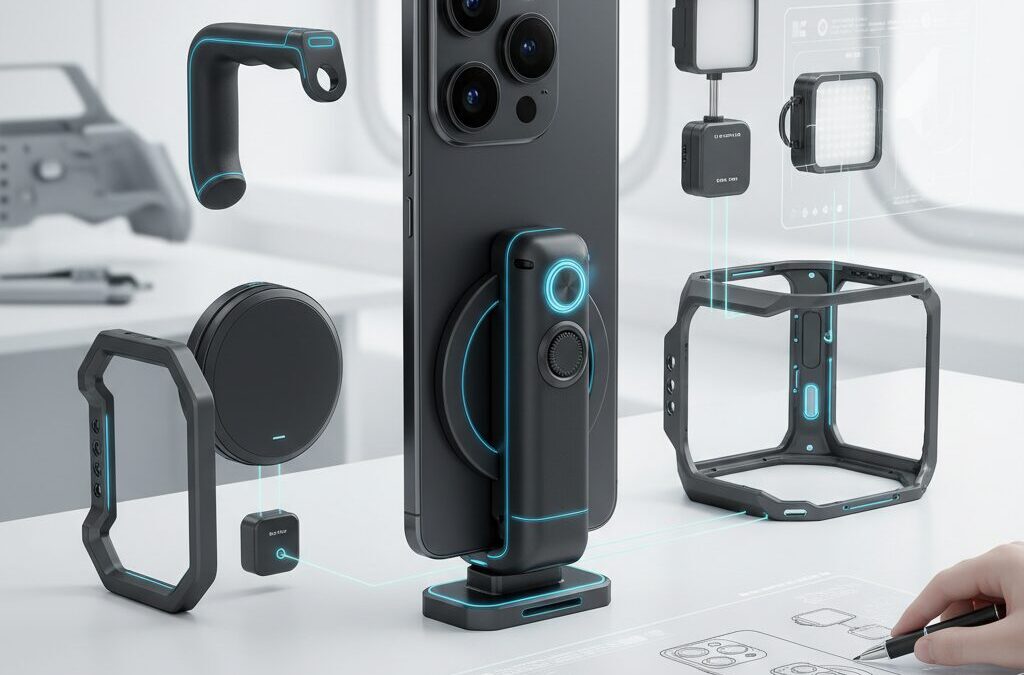
Have you noticed how today’s smartphones are starting to replace dedicated cameras in professional workflows? In 2026, flagship devices with 1-inch sensors, high-resolution imaging, and advanced computational photography are no longer experimental—they are mainstream. As image quality improves, even minor hand shake or battery drain can directly impact your final output.
At the same time, the global camera accessories market is accelerating rapidly, projected to grow from $5.52 billion in 2026 toward nearly $19.29 billion by 2035. Creators are investing not just in better phones, but in grips, cages, magnetic mounts, power systems, and modular rigs that turn a slim device into a production-ready tool.
In this article, you will explore how smartphone camera grips have evolved into a central infrastructure for mobile creators. From Bluetooth-based low-latency controls and MagSafe ecosystems to ergonomics research and CES 2026 innovations, you will discover what truly matters when building a professional mobile setup in 2026.
- Why 2026 Is a Turning Point for Smartphone Imaging
- Market Data: The Explosive Growth of the Global Camera Accessories Industry
- Bigger Sensors, Higher Resolution, Greater Stability Demands
- The Rise of Magnetic Ecosystems: From Simple Mounts to Intelligent Interfaces
- Bluetooth-Based Remote Control and the Shift Toward Low-Latency Operation
- PGYTECH MagCam 2: Modular Design Meets App-Integrated Control
- Belkin Stage PowerGrip: When Battery Capacity Becomes a Creative Advantage
- ShiftCam SnapGrip Pro and LensUltra: Building a True Optical Ecosystem
- Ergonomics and Biomechanics: Scientific Evidence Behind Grip Design
- Visual Fatigue, Balance, and the Hidden Physical Costs of Smartphone Shooting
- Japanese Consumer Trends: From Minimalist Rings to Pro Modular Rigs
- Immersive Social Media Content and the Need for Instant Orientation Switching
- CES 2026 Highlights: SmallRig’s Integrated Audio-Video Vision
- How Professionals Choose a Grip in 2026: Workflow, Power, and Long-Term Value
- 参考文献
Why 2026 Is a Turning Point for Smartphone Imaging
2026 marks a structural shift in smartphone imaging. It is no longer just about adding more megapixels or refining night mode. The entire ecosystem surrounding the smartphone camera is being rebuilt to support professional-grade creation, and that is why this year stands out as a true turning point.
According to Precedence Research, the global camera accessories market is projected to reach 5.52 billion USD in 2026, on its way toward 19.29 billion USD by 2035. This nearly 15% CAGR reflects a clear reality: imaging growth is now driven not only by smartphones themselves, but by the tools that extend them.
| Indicator (2026) | Value | Implication |
|---|---|---|
| Camera accessories market | $5.52B | Ecosystem expansion |
| Smartphone sensor market | $50.11B | AI/5G-driven demand |
| 1-inch sensor adoption | Mainstream in premium | DSLR-class light capture |
The hardware leap is undeniable. Industry analyses from Data Insights Market show that sensors above 13MP dominate shipments, with 1-inch sensors becoming common in flagship models. Larger sensors and periscope telephoto systems deliver stunning detail, but they also magnify micro-shake and handling instability. In other words, imaging power has outgrown the ergonomics of a thin slab.
This imbalance is precisely what defines 2026. Performance has reached a level where physical control, stability, and power management directly determine image quality. Computational photography can merge exposures and enhance dynamic range, yet it cannot compensate for poor grip mechanics or depleted batteries during 8K or ProRes recording.
Bluetooth 6.0 and mature magnetic ecosystems further accelerate this shift. Ultra-low latency control reduces shutter lag to milliseconds, transforming external grips and dials into real-time creative interfaces. Magnetic attachment systems, once simple mounting solutions, now integrate power delivery and data pathways. The smartphone becomes a modular imaging node rather than a standalone device.
CES 2026 reinforced this narrative. Companies like SmallRig presented creator-centric ecosystems where audio, storage, and mounting systems function as a unified production environment. The message was clear: smartphones are no longer competing with traditional cameras solely through software—they are building a parallel professional infrastructure.
Human factors research adds another critical dimension. Studies referenced by Mount Sinai and MDPI indicate sustained pinch grips increase musculoskeletal strain and posture imbalance. As sensors grow larger and devices heavier, ergonomic intervention becomes essential. The turning point in 2026 is not only technological, but biomechanical.
For highly engaged gadget enthusiasts, this means the conversation shifts from “Which phone has the best camera?” to “Which system enables the best results?” The center of gravity moves from silicon to system design. That systemic maturity is what makes 2026 the decisive year in smartphone imaging history.
Market Data: The Explosive Growth of the Global Camera Accessories Industry
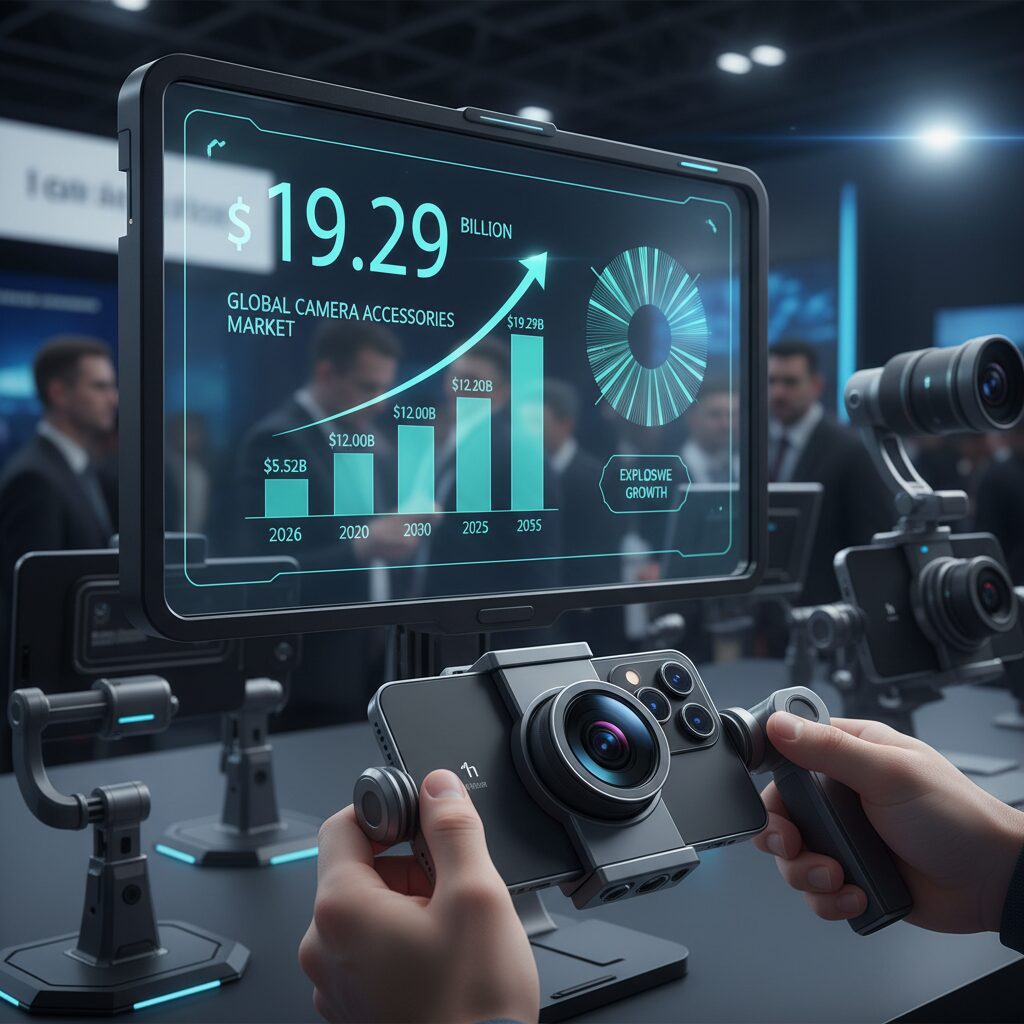
The global camera accessories industry is entering a phase of explosive expansion in 2026, fueled by the rapid evolution of smartphone imaging technology. As flagship devices integrate 1-inch sensors and increasingly rely on AI-driven computational photography, demand for stabilization, power management, and modular control tools is accelerating across both consumer and professional segments.
According to Precedence Research, the global camera accessories market reached approximately USD 4.79 billion in 2025 and is projected to grow to USD 5.52 billion in 2026. Even more striking, the market is forecast to approach USD 19.29 billion by 2035, reflecting a compound annual growth rate of 14.95% over the period. This pace of growth significantly outperforms many traditional consumer electronics categories.
| Indicator | 2025 | 2026 (Forecast) | 2035 (Forecast) |
|---|---|---|---|
| Global Camera Accessories Market | USD 4.79B | USD 5.52B | USD 19.29B |
| Projected CAGR | 14.95% | ||
Regionally, North America accounts for roughly 41% of the market share, while Asia-Pacific is emerging as the fastest-growing region. Mordor Intelligence reports that the smartphone camera lens market in Asia-Pacific is expanding at a 9.64% growth rate, supported by both manufacturing concentration and surging creator demand. This dual engine of production and consumption is reshaping global supply chains.
The expansion of accessories is also tightly linked to the broader smartphone sensor ecosystem. SkyQuest estimates the smartphone sensors market at USD 50.11 billion, driven by AI, 5G, and AR applications. As sensor resolution surpasses 13MP across dominant segments and shifts toward 100MP-class imaging, even minimal hand shake can compromise output quality. Higher resolution has directly translated into higher accessory dependency.
From an economic perspective, accessories are no longer optional add-ons but value-multiplying infrastructure. A premium smartphone body may upgrade annually, yet grips, cages, external SSD systems, and power-integrated modules often remain compatible across generations. This dynamic increases average revenue per user while stabilizing long-term ecosystem spending.
Importantly, the rise of solo creators and mobile-first production studios has redefined purchasing behavior. Market analysts note that buyers are allocating larger portions of their budgets to workflow-enhancing tools rather than solely upgrading camera bodies. The accessory market therefore benefits not just from hardware innovation, but from a structural shift in how visual content is produced and monetized.
In 2026, the camera accessories industry stands at the intersection of imaging science, creator economics, and ergonomic necessity. The data makes one conclusion clear: as smartphones approach professional imaging territory, the global accessory market is scaling in parallel, transforming from a peripheral category into a core pillar of the imaging economy.
Bigger Sensors, Higher Resolution, Greater Stability Demands
As smartphone imaging enters 2026, larger sensors and higher pixel counts are no longer marketing buzzwords but structural shifts that redefine how we shoot. Premium devices now widely adopt 1-inch sensors, and models exceeding 13MP dominate the market, with momentum clearly accelerating toward 100MP-class sensors. According to industry analyses such as Data Insights Market, this escalation in sensor size and resolution is reshaping the entire imaging value chain.
The physics is simple yet unforgiving. The larger the sensor and the higher the resolution, the more visible even the slightest micro-shake becomes. What once went unnoticed at 12MP now results in lost detail, motion blur, and compromised dynamic range when shooting at extreme resolutions.
Why Resolution Magnifies Instability
| Factor | Impact on Image | Stability Requirement |
|---|---|---|
| 1-inch sensor | Shallower depth of field | Precise focus control |
| 100MP-class output | Extreme detail reproduction | Reduced micro-vibration |
| Periscope zoom | Long focal length compression | Enhanced hand stabilization |
Larger sensors gather more light and deliver DSLR-like subject separation. However, they also introduce narrower focus planes. Even subtle forward-backward sway can shift focus off the intended subject. With periscope-style telephoto lenses extending optical reach, handshake is amplified further due to longer effective focal lengths.
DJI’s technical explanations of stabilization mechanisms highlight how small angular movements translate into significant frame displacement at telephoto ranges. In practical terms, that means handheld shooting at high zoom without support becomes increasingly unreliable.
Resolution adds another layer of complexity. A 100MP image contains dramatically more spatial information than older-generation files. While this enables aggressive cropping and professional-grade post-production, it also means that pixel-level imperfections are preserved with ruthless clarity. Minor vibrations that computational photography cannot fully compensate for remain embedded in the data.
Computational photography has advanced remarkably, integrating AI-based multi-frame stacking and motion correction. The expanding smartphone sensor market, projected at over $50 billion according to SkyQuest, is fueled partly by AI and 5G-driven imaging innovation. Yet software correction has physical limits. When motion exceeds algorithmic thresholds, detail reconstruction fails.
Video production amplifies the challenge further. High-bitrate recording formats such as ProRes push both thermal and power constraints while capturing immense data streams. Larger sensors paired with 4K, 8K, or HDR pipelines demand longer sustained takes. Over extended shooting sessions, muscle fatigue introduces incremental shake that accumulates over time.
Ergonomic research from Mount Sinai on smartphone grip posture explains that sustained pinch-style holding increases strain on small hand muscles. As fatigue sets in, fine motor control declines. In a high-resolution capture environment, this decline directly translates into visible instability.
Moreover, visual fatigue plays a role. A study indexed by the NIH demonstrated that one hour of smartphone use can significantly reduce dynamic postural stability. When creators rely heavily on screen-based framing without tactile support, their overall body balance subtly deteriorates. That instability propagates to the camera module itself.
Professional creators therefore approach stability as infrastructure rather than accessory. The rapid growth of the global camera accessories market, forecast to reach $5.52 billion in 2026 by Precedence Research, reflects this structural need. Investment in stabilization tools is no longer optional when operating at high sensor and resolution thresholds.
Another overlooked factor is weight distribution. Larger sensors and complex lens stacks add mass to camera modules. When paired with external lenses or SSD recording solutions, the center of gravity shifts outward. This increases torque on the wrist, magnifying micro-movements. Stability solutions must counterbalance not just motion, but mechanical leverage.
In essence, 2026 smartphone imaging resembles professional mirrorless workflows more than casual mobile photography. Sensor growth expands creative latitude, but simultaneously narrows tolerance for physical error. Higher resolution expands flexibility in post-production, yet demands precision at the moment of capture.
For enthusiasts and professionals alike, the message is clear. Bigger sensors promise richer light capture. Higher megapixels promise extreme detail. Advanced zoom promises cinematic framing. But all three converge on a single requirement: uncompromising stability throughout the shooting process.
The Rise of Magnetic Ecosystems: From Simple Mounts to Intelligent Interfaces
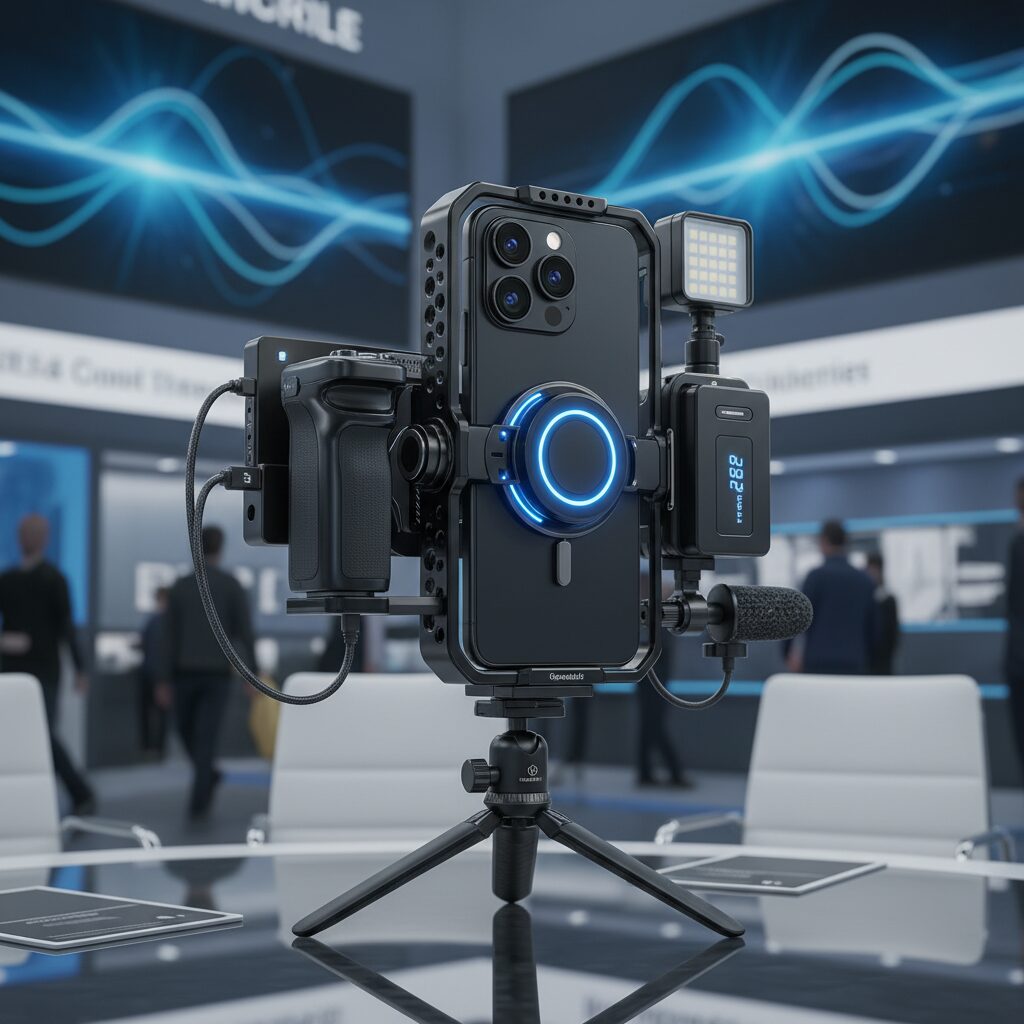
Magnetic attachment in smartphones began as a convenience feature, mainly designed for quick mounting and wireless charging alignment. However, by 2026, it has evolved into a fully integrated ecosystem that connects power, data, optics, and control into a unified interface.
What was once a simple ring of magnets is now an intelligent bridge between device and accessory. According to industry reports and product releases from brands such as PGYTECH and Belkin, modern magnetic grips no longer serve as passive holders but operate as active nodes within a broader production workflow.
Magnetic systems in 2026 function as modular interfaces, not just mounting solutions.
The transition can be understood through three distinct phases of evolution.
| Phase | Primary Function | User Impact |
|---|---|---|
| Early Magnetic Mounts | Physical alignment and attachment | Faster setup, minimal integration |
| Power-Integrated Systems | Wireless charging and battery expansion | Extended shooting time |
| Intelligent Interfaces | Data transfer, low-latency control, modular expansion | Professional-grade workflow |
The most significant shift lies in the third phase. With the standardization of advanced Bluetooth protocols and improved magnetic conductivity layers, accessories now communicate with smartphones in near real time. Control dials, shutter buttons, and zoom levers transmit inputs with millisecond-level latency, enabling creators to operate their phones with DSLR-like responsiveness.
This matters more than it may seem. As 1-inch sensors and high-resolution modules become common in premium smartphones, even micro-movements can degrade image quality. Magnetic ecosystems reduce friction in setup and operation, allowing users to react instantly without fumbling through menus.
Another key transformation is structural strength. Recent products report vertical magnetic holding forces reaching approximately 25N, significantly lowering detachment risks during active shooting. This level of stability was previously associated only with clamp-based systems, yet magnetic solutions now achieve it while maintaining rapid orientation switching.
The real breakthrough is not strength alone, but interoperability. Users can attach a grip, snap on a battery module, connect a wireless microphone receiver, and mount an SSD—all without reconfiguring the core device. Each component recognizes the ecosystem’s physical and electrical standards.
Industry coverage from CES 2026 highlighted how companies are designing accessories as expandable platforms rather than isolated tools. Instead of asking, “Does this grip fit my phone?” the more relevant question has become, “Does this grip integrate into my workflow?”
This ecosystem logic mirrors developments in other technology sectors, where modularity drives longevity and investment value. A magnetic grip purchased today may remain compatible across multiple device generations, provided the magnetic protocol remains standardized.
In practical terms, creators benefit from three measurable improvements: faster deployment time, reduced cable clutter, and seamless transition between vertical and horizontal shooting. For social media content that demands rapid format switching, this adaptability directly translates into higher production efficiency.
As smartphone imaging approaches professional territory, magnetic ecosystems represent the infrastructure layer supporting that evolution. They transform the phone from a standalone slab into a configurable production platform, where hardware extensions attach with the simplicity of a snap but perform with the intelligence of a connected system.
In 2026, magnets are no longer accessories. They are interfaces.
Bluetooth-Based Remote Control and the Shift Toward Low-Latency Operation
The evolution of Bluetooth-based remote control has fundamentally reshaped how smartphone camera grips operate in 2026. Earlier generations of wireless shutters often suffered from perceptible delay, creating a disconnect between user input and on-screen capture. With the adoption of Bluetooth 6.0 and related low-latency protocols, that gap has narrowed to the millisecond level, enabling near real-time responsiveness.
This shift toward ultra-low latency is not a minor convenience but a structural change in mobile production workflows. According to coverage of next-generation wireless accessories in early 2026, improved bandwidth allocation and interference mitigation have significantly stabilized command transmission even in crowded RF environments. For creators shooting sports, wildlife, or fast-moving street scenes, immediate shutter response directly translates into higher keeper rates.
| Aspect | Previous Bluetooth | Bluetooth 6.0 Era |
|---|---|---|
| Shutter Response | Noticeable lag | Near-instant trigger |
| Signal Stability | Prone to interference | Enhanced mitigation |
| Control Range | Limited reliability | More consistent link |
Beyond shutter release, low-latency communication now supports continuous inputs such as zoom levers and exposure dials. When paired with dedicated apps like PGYTECH’s iOS integration, adjustments to ISO or focus register immediately, restoring the tactile rhythm familiar to DSLR users.
This immediacy reduces reliance on touchscreen input, shortens reaction time, and allows creators to maintain visual contact with their subject instead of their interface. In practical terms, Bluetooth is no longer just a convenience layer. It has become a core control backbone for professional-grade mobile imaging.
PGYTECH MagCam 2: Modular Design Meets App-Integrated Control
PGYTECH MagCam 2 stands out in 2026 not merely as a camera grip, but as a modular production hub designed for creators who demand both physical control and digital integration.
At its core, the system is built around three detachable components: a magnetic grip body, a wireless control module, and an EDC-style stand. This separation allows you to reconfigure the setup depending on whether you are shooting handheld, setting up a tabletop composition, or traveling light.
This modular philosophy transforms the grip from a static accessory into a flexible workflow tool.
| Component | Primary Function | Creator Benefit |
|---|---|---|
| Magnetic Grip Body | Stable handheld shooting | Improved balance and one-handed control |
| Bluetooth Control Module | Physical dial & shutter input | Touch-free parameter adjustment |
| EDC Stand | Desktop support | Quick shift to tripod-style framing |
The most compelling aspect is its tight integration with the dedicated iOS app, PGYTECH PhotoVideo Creative. Instead of relying solely on touchscreen gestures, you can rotate a physical dial to adjust focus, exposure, ISO, or zoom in real time.
According to Digital Camera World, this design effectively bridges the gap between smartphones and dedicated cameras by restoring tactile feedback that many professionals miss when switching from mirrorless systems.
The return of physical feedback is not nostalgia; it is a measurable efficiency gain.
In fast-paced environments, even slight delays or mis-taps on a glass screen can cost a shot. By assigning critical parameters to hardware input, MagCam 2 reduces cognitive load and allows you to keep your eyes on the subject instead of the interface.
This approach aligns with broader 2026 trends, where Bluetooth-based ultra-low-latency control has become standard across premium accessories. The grip communicates with the phone seamlessly, making parameter shifts feel instantaneous rather than mediated.
For creators accustomed to DSLR ergonomics, this hybridization feels intuitive rather than experimental.
Power integration is particularly important as smartphone sensors and computational photography workloads intensify. Industry analyses show rapid growth in high-resolution sensor adoption, and increased processing demands inevitably follow. Embedding supplemental power into the grip stabilizes long-form recording sessions such as interviews or ProRes capture.
The exterior finish, including a high-quality faux leather texture and a built-in cold shoe mount, further reinforces its professional intent. You can attach a microphone or LED light without building a full cage, preserving portability while expanding capability.
MagCam 2 therefore operates at the intersection of modular hardware, app-level intelligence, and ergonomic refinement—an ecosystem-aware tool designed for creators who see their smartphone not as a casual device, but as a primary camera platform.
Belkin Stage PowerGrip: When Battery Capacity Becomes a Creative Advantage
Belkin Stage PowerGrip stands out in 2026 not because it adds more buttons or app integrations, but because it redefines what battery capacity means for creators.
With a massive 9,300mAh built directly into a DSLR-style grip, it transforms power from a backup resource into a creative enabler. According to coverage by MacRumors and The Tech Buzz, this capacity is large enough to fully recharge an iPhone, while still functioning as a stable shooting grip.
In high-bitrate mobile production, battery life is no longer a convenience issue. It is a performance variable.
| Specification | Belkin Stage PowerGrip | Creative Impact |
|---|---|---|
| Battery Capacity | 9,300mAh | Extended 4K/ProRes shooting |
| Charging Outputs | Qi + USB-C + Built-in Cable | Simultaneous multi-device workflow |
| Battery Display | LCD Percentage Indicator | Precise power management on set |
When shooting in ProRes or using AI-based subject tracking, smartphones push their processors to sustained peak loads. Industry analysis of smartphone sensors and imaging pipelines shows that computational photography and high-resolution video dramatically increase thermal and power demands.
In real-world terms, that means creators often face battery anxiety long before they run out of ideas.
PowerGrip eliminates that psychological ceiling.
Instead of rationing takes, lowering brightness, or disabling features to conserve power, creators can maintain maximum performance settings throughout a shoot. This is particularly valuable for outdoor documentary work, travel vlogging, and event coverage where charging infrastructure is limited.
The ability to charge three devices simultaneously also reshapes solo workflows. A wireless mic receiver, LED light, or secondary phone can draw power while the main device continues recording. This reduces downtime between scenes and supports continuous production environments.
Another overlooked advantage is the LCD battery monitor. Percentage-level visibility allows calculated decisions during critical moments. Rather than guessing remaining capacity, creators can align battery strategy with shot planning, especially during long interviews or live sessions.
From a marketing perspective, Belkin’s approach is strategically clear. While competitors focus on modular ecosystems or lens expansion, PowerGrip anchors its value proposition in endurance. In a market projected to surpass $5.5 billion in 2026 for camera accessories, sustained usability becomes a differentiator.
Battery capacity becomes a creative advantage when it removes hesitation.
In 2026’s mobile imaging landscape, where smartphones rival dedicated cameras, the limiting factor is often not sensor size or software sophistication, but energy availability. By embedding industrial-scale power into an ergonomic grip, Belkin shifts the conversation from “How long can I shoot?” to “How far can I push this idea?”
For creators who see their smartphone as a primary production tool rather than a secondary camera, that shift changes everything.
ShiftCam SnapGrip Pro and LensUltra: Building a True Optical Ecosystem
ShiftCam approaches mobile imaging not as a collection of accessories, but as a tightly integrated optical system. With SnapGrip Pro at the core and LensUltra expanding the front-end optics, the brand is effectively building what can be described as a true optical ecosystem for smartphones.
According to ShiftCam’s 2026 gear guides and CES briefings, the philosophy is simple: control, glass, and storage must work as one. Instead of relying solely on computational photography, creators can now shape light physically, much like they would with a mirrorless setup.
SnapGrip Pro provides a DSLR-style grip designed to counterbalance heavier external lenses. This is not merely about comfort. As ergonomics research from Mount Sinai and MDPI suggests, a thicker grip reduces wrist torque and distributes load across the palm, which becomes critical when mounting telephoto optics.
LensUltra extends the smartphone’s native focal range with purpose-built glass, including a 240mm-equivalent super-zoom telephoto and a 1.55x anamorphic lens for cinematic framing. These are not digital tricks; they reshape the incoming light before it hits the sensor.
| Component | Primary Role | Creative Impact |
|---|---|---|
| SnapGrip Pro | Ergonomic control + power stability | Improved balance with heavy optics |
| LensUltra 240mm | Optical telephoto reach | True compression and distant subject isolation |
| LensUltra 1.55x Anamorphic | Cinematic aspect transformation | Wider field with signature horizontal rendering |
The ecosystem expands further with ShiftCam’s Planck SSD series, designed for high-speed external recording. As highlighted in CES coverage such as MacVoices, this enables direct ProRes capture workflows without choking internal storage. For creators shooting high-bitrate video, this eliminates a major bottleneck.
The significance lies in integration. Grip stability supports heavier lenses. External storage sustains data throughput. Optical attachments shape image character before software processing begins. Each element reinforces the others.
In practical terms, this means a solo creator can move from street telephoto compression to cinematic widescreen storytelling without switching systems. The smartphone remains the sensor and processor, but the surrounding hardware transforms it into a modular production platform.
Rather than treating mobile photography as a compromise, ShiftCam’s ecosystem treats it as a foundation. By aligning ergonomics, optics, and data management into a cohesive architecture, SnapGrip Pro and LensUltra together illustrate what a mature smartphone optical system looks like in 2026.
Ergonomics and Biomechanics: Scientific Evidence Behind Grip Design
The rapid evolution of smartphone imaging has intensified a fundamental ergonomic problem: devices have become optically powerful, yet physically harder to hold. As sensors approach 1-inch formats and periscope lenses magnify minor tremors, biomechanics—not megapixels—often determine final image quality. Scientific literature helps explain why dedicated grips are no longer optional for serious creators.
According to Mount Sinai’s ergonomics guidance on smartphone use, prolonged “pinch grip” postures increase strain on the thumb flexor tendons and intrinsic hand muscles. When users stabilize a thin phone by squeezing its edges, the load concentrates on a small contact area, elevating muscular effort and fatigue. MDPI’s narrative review on posture and gait further notes that sustained smartphone use correlates with forward head posture and shoulder elevation, both of which reduce upper-limb stability.
From a biomechanical perspective, grip thickness directly influences torque at the wrist. A narrow device increases the moment arm between the wrist joint and the device’s center of mass, requiring greater counteracting force. A DSLR-style grip shortens this effective lever and redistributes pressure across the palm.
| Factor | Without Grip | With Ergonomic Grip |
|---|---|---|
| Load distribution | Finger-dominant, localized | Palm-supported, dispersed |
| Wrist torque | Higher moment arm | Reduced rotational demand |
| Muscle activation | Static, sustained tension | More neutral engagement |
| Postural alignment | Forward head tendency | Closer to neutral arm position |
Research indexed by the NIH on visual fatigue adds another layer. In a study of 22 healthy adults, one hour of smartphone use significantly worsened dynamic postural stability. When visual focus narrows and fatigue accumulates, balance control subtly declines. During handheld video capture—especially while walking—this instability translates into micro-shake and inconsistent framing.
An ergonomic grip introduces tactile reference points such as a shutter button or contoured handle. These cues reduce overreliance on visual feedback and allow the neuromuscular system to stabilize through proprioception. Physical controls create a closed sensory loop: touch guides motion, motion refines framing. This principle mirrors traditional camera design, where mechanical feedback enhances motor precision.
Angle-adjusted grips also support a more neutral forearm position. By aligning the wrist closer to anatomical neutral, compressive forces on tendons decrease, potentially lowering the risk of musculoskeletal disorders described in occupational health literature. Over long shooting sessions—such as ProRes recording or extended Vlog takes—small biomechanical efficiencies compound into measurable endurance gains.
In essence, the scientific case for grip design rests on load redistribution, torque reduction, and sensory optimization. As smartphone cameras rival dedicated systems, the human hand remains the limiting factor. Ergonomic engineering bridges that gap, translating optical performance into repeatable, physically sustainable results.
Visual Fatigue, Balance, and the Hidden Physical Costs of Smartphone Shooting
As smartphone cameras reach 1-inch sensors and 100MP-class resolution in 2026, the physical demands on the human body quietly increase. While image quality has advanced dramatically, the way we hold and look at our devices has not evolved at the same pace.
The hidden cost of smartphone shooting is no longer just battery drain or storage limits, but visual fatigue, postural instability, and cumulative musculoskeletal stress.
Understanding these risks is essential if you shoot frequently, especially for long-form video, ProRes recording, or telephoto photography where even micro-movements matter.
Visual Fatigue and Balance Instability
A study published on PubMed Central by the NIH examined the effects of smartphone-induced visual fatigue on healthy adults. After just one hour of continuous smartphone use, participants showed a significant decline in dynamic postural stability.
In practical terms, this means that prolonged screen focus can measurably reduce balance control. For creators shooting handheld video while walking, climbing stairs, or working in crowded environments, this has real implications.
| Condition | Observed Effect |
|---|---|
| 1 hour continuous smartphone viewing | Increased visual fatigue |
| Post-use balance testing | Reduced dynamic stability |
The mechanism is straightforward. Continuous near-focus viewing strains the visual system, and visual input plays a major role in maintaining balance. When that input becomes fatigued, the body compensates less effectively.
For smartphone shooters, this can translate into shakier footage, slower reflexes, and even elevated fall risk in motion-heavy scenarios.
Musculoskeletal Load: The Grip Problem
According to ergonomic guidance from Mount Sinai Hospital and reviews published by MDPI, sustained pinch-style gripping of smartphones increases stress on the thumb flexors, wrist extensors, and small intrinsic hand muscles.
Unlike DSLR bodies that distribute load across the palm, smartphones are thin and require continuous finger tension. During telephoto shooting or 8K video capture, users often tighten their grip unconsciously to stabilize the frame.
This creates three biomechanical stressors.
First, a longer moment arm between wrist joint and device center of mass increases torque demand. Second, static muscle contraction reduces blood flow, accelerating fatigue. Third, forward head posture—common during framing—adds cervical spine strain.
A thicker, DSLR-style grip reduces torque, distributes pressure across the palm, and helps maintain a more neutral wrist position.
Research in mobile ergonomics has shown that broader contact surfaces reduce localized tendon loading. Even small changes in grip geometry can meaningfully alter muscle activation patterns.
Tactile Feedback as a Stability Tool
Another overlooked factor is tactile feedback. Physical shutter buttons and contoured grips provide proprioceptive cues. You feel where the device is in space without relying entirely on vision.
This matters because heavy visual dependence increases cognitive load. When your fingers can confirm orientation and stability, your eyes are freed to evaluate composition rather than micromanage hand position.
In fast-paced environments—street photography, live events, or Vlog-style movement—this tactile reinforcement improves overall body coordination.
In other words, a well-designed grip is not only about comfort. It is a balance-assist device, a fatigue mitigator, and a performance enhancer.
As smartphone imaging continues to rival traditional cameras, the physical interface between human and device becomes increasingly critical. Ignoring ergonomics may not show immediate consequences, but over months or years of frequent shooting, the cumulative strain becomes difficult to overlook.
For serious creators in 2026, investing in ergonomic stability is not a luxury. It is a preventive strategy for both better footage and long-term physical resilience.
Japanese Consumer Trends: From Minimalist Rings to Pro Modular Rigs
Japanese consumers in 2026 are redefining what a “camera grip” means. On one end, ultra-minimalist rings and adhesive grips dominate daily life. On the other, fully modular rigs with batteries, lenses, SSDs, and wireless audio systems are becoming mainstream among serious creators.
This polarization is not a contradiction but a reflection of highly segmented needs. According to domestic ranking data published in January 2026, low-cost adhesive grips continue to occupy top sales positions, while professional modular systems steadily gain traction among advanced users.
| Segment | Typical Product | Primary Motivation |
|---|---|---|
| Minimalist | Adhesive ring / slim stand | Drop prevention, portability, design |
| Magnetic mid-range | MagSafe-compatible grip | Quick rotation, SNS shooting |
| Pro modular | Grip + lens + SSD + mic | Professional video workflow |
In the minimalist tier, products priced under ¥2,000 remain strong sellers. Platforms such as MyBest show that simple white or transparent grips rank highly, signaling that aesthetics and everyday usability still outweigh advanced features for the mass market. Japanese users tend to favor compactness and subtle design harmony with their cases.
At the same time, magnetic systems are spreading rapidly. Influenced by Instagram trends analyzed by Comnico, content increasingly instructs viewers to tilt or rotate their phones. This behavioral shift makes quick vertical-horizontal switching a functional necessity rather than a luxury. Magnetic grips meet that demand with seamless rotation and fast detachment.
The most striking evolution appears in the professional modular tier. Inspired by ecosystems presented at CES 2026, Japanese creators are assembling rigs combining grips, 240mm-equivalent telephoto lenses, anamorphic adapters, and high-speed external SSDs. This reflects a broader market expansion: Precedence Research estimates the global camera accessories market will reach USD 5.52 billion in 2026, with strong momentum in Asia-Pacific.
What differentiates Japan is the coexistence of precision minimalism and obsessive modularity. Users who start with a ¥500 ring often upgrade step-by-step into magnetic grips and eventually into cage-based systems. As some professional photographers note in interviews, investing in a durable grip that survives multiple smartphone upgrades becomes a rational long-term strategy.
From minimalist rings to pro modular rigs, Japanese consumer behavior reveals a layered adoption curve. Convenience drives entry, aesthetics shape preference, and performance justifies escalation. In 2026, the grip is no longer a minor accessory but a strategic choice that signals how seriously one approaches mobile creation.
Immersive Social Media Content and the Need for Instant Orientation Switching
Immersive social media content in 2026 no longer assumes that the viewer passively scrolls in a single orientation. Instead, leading brands and creators design experiences that require the device to be rotated, tilted, or repositioned in real time. As Instagram and TikTok continue to prioritize full-screen vertical formats, some campaigns intentionally disrupt this norm and instruct users to switch to landscape for cinematic impact. This shift has created a new technical and ergonomic demand: instant, frictionless orientation switching.
According to case studies highlighted by Comnico in its analysis of successful Instagram brand posts, high-performing campaigns increasingly include explicit on-screen cues such as “rotate your phone” or “tilt to explore.” Luxury watch brands like IWC have demonstrated that asking viewers to turn their smartphones horizontally can dramatically enhance perceived visual quality by unlocking a wider, film-like frame. The key is not the instruction itself, but the speed and smoothness with which users can comply.
When a viewer is told to rotate the device but struggles due to an unstable grip or awkward hand posture, the immersive spell breaks. Research published on PubMed regarding visual fatigue and balance function shows that prolonged smartphone focus can already destabilize posture. If, at that moment, the user must regrip a thin device to change orientation, cognitive load and physical strain increase simultaneously. Seamless rotation is therefore not a luxury feature but a usability requirement.
Magnetic grip systems have become particularly relevant in this context. Because MagSafe-compatible grips allow near-instant 90-degree rotation without detaching clamps or readjusting screws, they align perfectly with immersive content mechanics. The ability to pivot from portrait to landscape within a second supports interactive storytelling formats, including ASMR reels from airlines such as JAL or “touch the screen” engagement videos from entertainment studios.
| Content Type | Required Orientation | Switching Frequency | Grip Advantage |
|---|---|---|---|
| Vertical Shorts/Reels | Portrait | Low | Stable one-hand hold |
| Cinematic Brand Film | Landscape | Medium | Quick 90° magnetic rotation |
| Interactive Tilt Experience | Dynamic (Tilt/Rotate) | High | Secure multi-angle control |
The table illustrates how switching frequency directly correlates with grip design relevance. In static portrait viewing, minimal hardware suffices. However, in dynamic or instruction-driven content, hardware responsiveness becomes central to the experience. Magnetic systems with reinforced holding force, such as those rated up to 25N in recent product releases, provide the physical confidence required for rapid movement without fear of device detachment.
There is also a behavioral dimension to consider. DJI explains in its educational materials on stabilization tools that minimizing micro-shake is essential for professional-looking footage. The same principle applies on the viewer side. When users rotate their device smoothly, without wobble or rebalancing, the perceived quality of the content increases. Orientation switching thus becomes part of the storytelling grammar.
Bluetooth 6.0-enabled accessories further enhance this ecosystem. With millisecond-level response times now common in wireless control devices, creators can integrate orientation-based triggers with external grips, shutters, or modules. For example, a creator filming a dual-format piece may capture vertical teaser footage and instantly rotate to landscape for a main scene, without latency in control input. This real-time adaptability supports hybrid publishing strategies optimized for multiple platforms.
From an ergonomic perspective, Mount Sinai’s guidance on smartphone handling warns against sustained pinch grips and wrist deviation. Instant orientation switching is safest when the grip redistributes torque across the palm rather than forcing thumb-dominant rotation. A DSLR-style handle or textured magnetic grip reduces the moment arm stress described in ergonomics literature, enabling repeated rotation without cumulative strain.
Immersive media in 2026 is no longer format-bound; it is orientation-fluid. Viewers are participants who physically respond to narrative prompts. This reality transforms the humble grip into a kinetic interface between digital instruction and human biomechanics.
For gadget enthusiasts and serious creators alike, the takeaway is clear. The next wave of social content will not merely ask for attention; it will demand motion. Devices and accessories that enable immediate, stable, and ergonomic orientation switching will define the standard of immersive engagement. In this environment, hardware agility becomes storytelling power.
CES 2026 Highlights: SmallRig’s Integrated Audio-Video Vision
At CES 2026, SmallRig did not simply unveil new accessories. It presented a clear vision of an integrated audio-video ecosystem built around the smartphone as a serious production tool.
The company’s booth was designed as a live creator space, allowing visitors to shoot, monitor, and review content on-site. This experiential approach demonstrated how tightly hardware integration now defines professional mobile workflows.
The centerpiece of this strategy was the S70 wireless microphone system. Engineered to physically and electronically integrate with SmallRig smartphone cages such as the 4299 series, the S70 delivers 48kHz/24-bit studio-grade audio while minimizing cable clutter.
According to SmallRig’s official CES materials, the receiver is designed to dock seamlessly into the cage structure, transforming what used to be an external accessory into a modular component of the rig. This reduces setup time and improves balance during handheld shooting.
| Component | Function | Production Impact |
|---|---|---|
| S70 Transmitter | Wireless audio capture | Clean voice recording at 48kHz/24-bit |
| S70 Receiver | Cage-integrated module | Reduced cables, improved weight distribution |
| Smartphone Cage | Mounting & expansion base | Unified audio-video workflow |
This level of integration addresses a long-standing pain point in mobile production. As imaging capabilities have expanded into ProRes and high-bitrate formats, audio quality has often lagged behind due to unstable mounts or improvised microphone setups.
By embedding audio structurally into the rig, SmallRig effectively eliminates weak connection points. The result is a more reliable capture environment, especially for run-and-gun creators who cannot afford signal dropouts or tangled wiring.
Equally notable was SmallRig’s collaboration with the Transformers franchise. Rather than being a superficial design exercise, the partnership reinforced the brand’s identity around mechanical precision and durability.
The industrial aesthetic symbolized robustness, aligning with professional expectations for reliability. In Asian markets in particular, where collector culture and brand storytelling strongly influence purchasing behavior, this strategy deepens emotional engagement with production gear.
Industry observers at CES highlighted how SmallRig’s approach reflects a broader shift in mobile filmmaking: the move from fragmented accessories toward unified systems. The company’s creator-space booth underscored that modern smartphone production is no longer about isolated tools, but about interoperability.
CES 2026 made one thing evident: SmallRig is positioning itself not as a parts manufacturer, but as an ecosystem architect. By synchronizing cage design, wireless audio, and modular expansion into a cohesive structure, it is redefining what a “mobile rig” can be in a professional context.
For creators who demand efficiency, stability, and studio-grade sound without sacrificing mobility, SmallRig’s integrated audio-video vision signals a decisive step forward in the evolution of smartphone-based filmmaking.
How Professionals Choose a Grip in 2026: Workflow, Power, and Long-Term Value
In 2026, professionals no longer choose a grip based on appearance or brand alone. They evaluate it as a core production tool that affects workflow speed, power sustainability, and long-term return on investment. As smartphone sensors surpass 1-inch formats and computational photography grows heavier, even minor friction in handling or battery management directly impacts output quality.
The modern grip is selected as infrastructure, not as an accessory. Market projections show the global camera accessories market reaching $5.52 billion in 2026 with a projected CAGR of 14.95%, according to Precedence Research. That growth reflects a structural shift: creators now design their rigs around stability and power from day one.
Professionals typically evaluate grips across three decision axes.
| Decision Axis | What Professionals Check | Why It Matters |
|---|---|---|
| Workflow Speed | Magnetic mounting, Bluetooth 6.0 latency | Captures fleeting moments without delay |
| Power Strategy | Integrated battery capacity, charging pass-through | Sustains ProRes/8K recording sessions |
| System Longevity | Cross-device compatibility, modular expandability | Protects long-term gear investment |
Workflow comes first. Bluetooth 6.0’s lower latency, now standard in high-end accessories, minimizes shutter delay to milliseconds. For wildlife or sports shooters, that difference determines whether a decisive frame is secured or missed. Magnetic systems with stronger holding force, such as 25N-class attachments seen in recent models, allow instant portrait-to-landscape transitions without mechanical re-clamping.
Power is the second filter. High-bitrate formats like ProRes place sustained load on smartphone processors, accelerating battery drain. Grips integrating 3,000mAh to 9,300mAh batteries are not viewed as convenience features but as continuity tools. As noted in coverage by MacRumors and industry reports, hybrid grip–power bank designs are increasingly adopted on location because they prevent workflow interruption.
Long-term value is where experienced creators differentiate themselves. Rather than buying disposable accessories, many invest in modular ecosystems—grips that integrate with cages, SSD storage, wireless audio, and lens systems. Interviews with professional photographers in 2026 emphasize that a well-built grip often outlives multiple smartphone upgrade cycles, effectively amortizing its cost.
Ergonomics also influences purchasing decisions more than ever. Research from Mount Sinai and MDPI links prolonged smartphone gripping to musculoskeletal strain. DSLR-style grips redistribute torque and reduce static thumb load, lowering fatigue during extended shoots. For commercial creators producing hours of content weekly, this is not comfort—it is occupational health.
Ultimately, professionals in 2026 reverse the traditional buying logic. They do not ask which grip fits their phone. They ask which grip architecture supports their production model, power demands, and five-year equipment roadmap. That strategic mindset defines how the top tier of creators builds sustainable mobile imaging systems today.
参考文献
- Precedence Research:Camera Accessories Market Size to Hit USD 19.29 Bn by 2035
- Mordor Intelligence:Smartphone Camera Lens Market Report | Industry Analysis, Size & Forecast
- Digital Camera World:PGYTech is bridging the gap between phones and cameras by introducing the MagCam Phone Grip
- MacRumors:Belkin Launches Hybrid Camera Grip and Power Bank
- Mount Sinai:Smartphones and Ergonomics
- MDPI Applied Sciences:Effects of Smartphone Use on Posture and Gait: A Narrative Review
- SmallRig:SmallRig at CES 2026: New S70 Launch, Free Giveaways & Booth Highlights