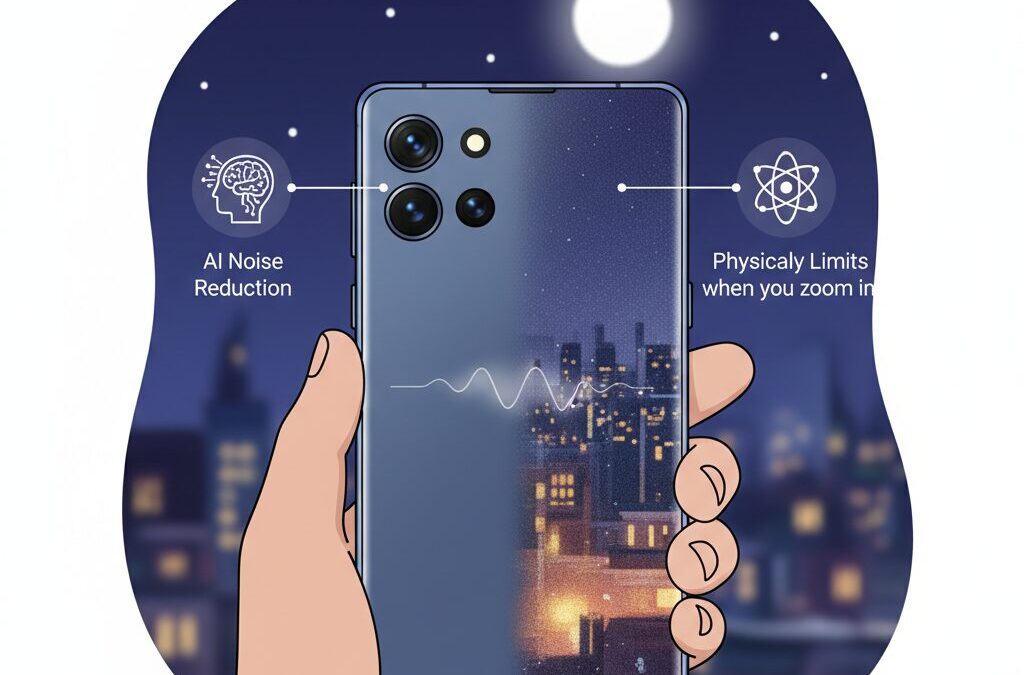
Have you ever taken a smartphone photo at night and wondered why it looks clean at first glance, yet strangely soft when you zoom in?
For many gadget enthusiasts outside Japan, night photography has become one of the most important reasons to upgrade a flagship smartphone, and Samsung’s Galaxy S25 Ultra promises to push “Nightography” further than ever before.
This device arrives at a critical moment when camera hardware improvements are slowing down, while AI-driven computational photography is accelerating at an unprecedented pace.
In this article, you will learn how the Galaxy S25 Ultra actually handles noise in low-light scenes, what has changed—and what has not—at the sensor level, and how the new Snapdragon 8 Elite platform reshapes Samsung’s imaging philosophy.
You will also discover real-world implications by comparing Samsung’s approach with rivals like the iPhone 16 Pro and Pixel 9 Pro XL, helping you understand which type of night shooter will truly benefit from this phone.
If you care about the balance between clean images, preserved detail, and natural night atmosphere, this deep technical overview will give you the insight needed to decide whether the Galaxy S25 Ultra is the right upgrade for you.
- Why Night Photography Is Reaching a Turning Point in 2026
- Galaxy S25 Ultra Camera Hardware Overview and What Stayed the Same
- Main Sensor Analysis: ISOCELL HP2 and the Physics of Noise
- Ultra-Wide Camera Upgrade: Resolution Gains vs Low-Light Trade-Offs
- Telephoto Cameras at Night: Where AI Starts Replacing Optics
- Snapdragon 8 Elite and the New Era of AI ISP Processing
- AI Noise Reduction Side Effects: Detail Loss, Ghosting, and Artifacts
- Night Video Performance: Real-Time Denoising at 4K 60fps
- Comparing Night Results with iPhone 16 Pro and Pixel 9 Pro XL
- Who the Galaxy S25 Ultra Night Camera Is Really For
- 参考文献
Why Night Photography Is Reaching a Turning Point in 2026
Night photography is reaching a clear turning point in 2026 because the traditional path of improvement has effectively run out of room. For more than a decade, smartphone cameras improved night shots mainly by increasing sensor size, pixel pitch, and lens brightness. However, as leading semiconductor researchers and mobile imaging engineers have repeatedly pointed out, modern flagship phones are now constrained by thickness, heat dissipation, and weight. **Physical optics is no longer scaling fast enough to satisfy user expectations for cleaner, brighter night images**.
This reality is clearly illustrated by the Galaxy S25 Ultra. Samsung’s decision to retain the same 200MP ISOCELL HP2 main sensor for a third generation signals not stagnation, but saturation. According to Samsung Semiconductor documentation, gains in quantum efficiency and readout noise reduction at the sensor level have become incremental rather than transformative. As a result, night photography progress in 2026 depends far less on how much light the sensor captures, and far more on how intelligently missing information is reconstructed.
This shift is accelerated by new SoC architectures. Qualcomm’s Snapdragon 8 Elite integrates the ISP and NPU at a level that allows AI models to operate directly inside the imaging pipeline. Researchers cited in Qualcomm’s technical briefs describe this as a fundamental architectural change, enabling real-time semantic segmentation even in low-light video. In practice, this means skies, buildings, faces, and light sources are processed differently within the same frame, something impossible in earlier generations.
At the same time, this computational dependence exposes a new fault line. Stronger AI noise reduction can remove grain, but it can also erase texture, creating the so-called oil painting effect discussed widely by imaging reviewers. The debate is no longer about whether a phone can see in the dark, but whether users accept an AI’s interpretation of what the dark should look like.
| Past Approach | 2026 Reality | User Impact |
|---|---|---|
| Larger sensors | Sensor reuse, minor tuning | Hardware gains feel smaller |
| Brighter lenses | AI-driven exposure fusion | Cleaner images, less natural texture |
| Single-frame capture | Multi-frame AI synthesis | Higher clarity, risk of artifacts |
For enthusiasts who closely examine night photos at 100% zoom, 2026 marks the moment when progress becomes philosophical rather than purely technical. **Night photography is no longer limited by darkness itself, but by how much artificial interpretation users are willing to accept**. This is why the year stands as a decisive inflection point for the entire category.
Galaxy S25 Ultra Camera Hardware Overview and What Stayed the Same

The Galaxy S25 Ultra’s camera hardware represents a carefully calculated balance between continuity and selective change. From a pure hardware standpoint, **Samsung has chosen refinement over reinvention**, keeping most sensors identical to the previous generation while relying on software and AI to extract more value from familiar components. This approach has important implications for low-light performance and image character.
At the center of the system is the 200MP ISOCELL HP2 main sensor, now in its third consecutive generation of use. With a 1/1.3-inch optical format and a native pixel size of 0.6µm, its physical characteristics are unchanged. According to Samsung Semiconductor documentation, the HP2 already operates close to the limits of pixel miniaturization, which explains why **meaningful gains in signal-to-noise ratio cannot come from hardware alone**. Instead, Samsung continues to depend on advanced pixel binning to mitigate noise.
The HP2 supports both 16-in-1 and 4-in-1 binning modes, producing effective pixel sizes of 2.4µm and 1.2µm respectively. From a physics perspective, this improves photon collection under low light, but it does not alter the sensor’s fundamental noise floor. Imaging engineers cited by GSMArena note that this places the S25 Ultra at a disadvantage versus smartphones using 1-inch sensors, where larger pixels inherently capture cleaner signals.
| Camera | Sensor | Resolution | Pixel Size |
|---|---|---|---|
| Main Wide | ISOCELL HP2 | 200MP | 0.6µm |
| Ultra-Wide | ISOCELL JN3 | 50MP | 0.7µm |
| 3x Telephoto | Sony IMX754 | 10MP | 1.12µm |
| 5x Telephoto | Sony IMX854 | 50MP | 0.7µm |
The most visible hardware change appears in the ultra-wide camera, upgraded from 12MP to 50MP using the ISOCELL JN3 sensor. While the resolution jump promises sharper daylight images, the pixel pitch shrinks to 0.7µm. Independent analyses reported by imaging specialists highlight that **smaller pixels inherently raise noise levels in dark scenes**, forcing heavier reliance on multi-frame noise reduction.
Telephoto hardware remains untouched. The 3x IMX754 and 5x IMX854 sensors are carried over without modification, and their relatively small sensor sizes continue to limit true night performance. As several industry reviewers have pointed out, this consistency signals Samsung’s confidence that computational photography, rather than new optics, will define image quality for this generation.
In summary, the Galaxy S25 Ultra’s camera hardware tells a clear story: **what stayed the same matters as much as what changed**. By holding sensor specifications steady, Samsung sets a stable baseline and shifts innovation pressure squarely onto image processing. For users, this means familiar strengths, familiar limitations, and a stronger dependence on AI to bridge the gap left by unchanged hardware.
Main Sensor Analysis: ISOCELL HP2 and the Physics of Noise
The main wide camera of the Galaxy S25 Ultra continues to rely on Samsung’s ISOCELL HP2, a 200MP sensor that has now reached its third consecutive generation. At first glance, this may appear conservative, but from a noise-engineering perspective, it highlights a deliberate trade-off between mature hardware and computational refinement. **Understanding the noise behavior of the HP2 requires stepping back to the physics of light itself**, not just smartphone marketing claims.
ISOCELL HP2 uses a 1/1.3-inch optical format with a native pixel pitch of 0.6µm. In low-light conditions, this pixel size sits at the edge of what physics comfortably allows. According to standard image sensor theory described in publications by Sony Semiconductor and academic imaging research, photon arrival follows Poisson statistics. This means that when fewer photons hit each pixel, random fluctuation, known as shot noise, becomes proportionally larger. **Smaller pixels inherently suffer a higher noise floor before any image processing begins**.
| Sensor Type | Pixel Pitch | Relative Light Collection |
|---|---|---|
| ISOCELL HP2 (S25 Ultra) | 0.6µm | Baseline |
| 1-inch class sensors | 1.6µm | ≈7× larger per pixel |
To counter this disadvantage, Samsung relies heavily on its Tetra²pixel binning architecture. In extremely dark scenes, the HP2 merges sixteen pixels into one virtual 2.4µm pixel, outputting a 12.5MP image. This dramatically improves signal-to-noise ratio by increasing effective photon count and reducing relative read noise. In medium-low light, a 4-in-1 binning mode creates a 1.2µm equivalent pixel, balancing resolution and sensitivity.
Because the HP2 hardware itself has not fundamentally changed since its introduction, improvements in night noise are not coming from better photodiodes or deeper charge wells. Industry analysts and sensor engineers have repeatedly noted that gains in quantum efficiency and readout noise typically require new fabrication processes. With those absent here, **any visible noise reduction in the S25 Ultra’s night photos is almost entirely downstream of the sensor**, handled by image signal processing and AI-driven reconstruction.
This explains why RAW files from the HP2, especially when examined in professional tools like Adobe Lightroom, reveal substantial chroma and luminance noise in shadow regions. That noise is not a flaw in tuning but a truthful reflection of the sensor’s photon budget. The default camera output simply hides it aggressively. From a physics standpoint, the ISOCELL HP2 has reached a plateau: stable, predictable, and well-understood, but fundamentally constrained by pixel size. The real innovation, therefore, lies not in capturing cleaner data, but in deciding how convincingly noise can be reshaped into something visually pleasing.
Ultra-Wide Camera Upgrade: Resolution Gains vs Low-Light Trade-Offs

The ultra-wide camera on the Galaxy S25 Ultra receives its most visible hardware change, moving from a 12MP sensor to a 50MP ISOCELL JN3. On paper, this looks like a clear upgrade, especially for landscape and architectural photography. However, when examined through the lens of low-light performance, the story becomes far more nuanced.
Samsung’s decision prioritizes resolution, but it also introduces a classic imaging trade-off. The new sensor uses a 0.7µm pixel pitch, exactly half the size of the previous 1.4µm pixels. From an optical physics standpoint, smaller pixels collect fewer photons, which directly impacts signal-to-noise ratio in dark environments.
| Ultra-Wide Camera | Resolution | Pixel Size | Low-Light Implication |
|---|---|---|---|
| S24 Ultra | 12MP | 1.4µm | Stronger native light sensitivity |
| S25 Ultra | 50MP | 0.7µm | Higher noise without AI correction |
In low light, the JN3 relies heavily on 4-in-1 pixel binning, outputting 12.5MP images with an effective pixel size equivalent to 1.4µm. **In theory, this should match the previous generation**, but semiconductor experts note that deeper pixel isolation structures reduce the effective light-gathering area. Samsung Semiconductor documentation acknowledges this inherent efficiency loss in dense high-resolution sensors.
As a result, Samsung compensates with aggressive AI-driven noise reduction. According to analyses from GSMArena and imaging engineers familiar with Snapdragon 8 Elite’s ISP, the ultra-wide camera now depends more on computational reconstruction than raw sensor data. This approach succeeds in suppressing chroma noise, but it can soften textures such as asphalt, foliage, or brick walls.
Early comparative tests cited by Tom’s Guide indicate that night cityscapes shot with the ultra-wide lens appear cleaner at first glance, yet lose micro-contrast when viewed closely. This is the origin of user complaints describing an “oil painting” effect, where noise is removed at the cost of natural grain and depth.
Importantly, this is not unique to Samsung. Apple’s move to a similar 48MP ultra-wide architecture on the iPhone 16 Pro demonstrates that the entire industry is grappling with the same dilemma. The Galaxy S25 Ultra simply makes the trade-off more explicit: **resolution gains are real, but low-light performance now lives and dies by AI tuning rather than sensor physics alone.**
Telephoto Cameras at Night: Where AI Starts Replacing Optics
Nighttime telephoto photography is where the physical limits of smartphone optics become impossible to ignore, and where AI-driven imaging starts playing a leading role. On the Galaxy S25 Ultra, both the 3x and 5x telephoto cameras rely on unchanged Sony sensors, with relatively small optical formats and modest apertures. In low light, this means the amount of light reaching each pixel is fundamentally constrained, regardless of software improvements.
At night, telephoto cameras are no longer primarily optical instruments but data sources for AI reconstruction. According to Samsung’s own imaging disclosures and Qualcomm’s Snapdragon 8 Elite documentation, the ISP and NPU now assume that telephoto frames will be noisy, underexposed, and incomplete. The goal is not to preserve every captured photon, but to infer what the scene should look like.
From a hardware perspective, the challenge is clear. The 3x telephoto uses a 1/3.52-inch sensor with 1.12 µm pixels, while the 5x telephoto relies on a 1/2.52-inch sensor with 0.7 µm pixels and an F3.4 lens. In night scenes, ISO sensitivity rises aggressively, pushing raw signal-to-noise ratios into a range where classical noise reduction would destroy texture.
| Telephoto | Sensor Size | Nighttime Limitation |
|---|---|---|
| 3x | 1/3.52-inch | Severe photon shortage, fast ISO rise |
| 5x | 1/2.52-inch | Small pixels, dim aperture |
To compensate, Samsung leans heavily on multi-frame fusion and AI super-resolution. Multiple short exposures are captured to avoid motion blur, then aligned and merged. Qualcomm explains that the Hexagon NPU now performs semantic segmentation during this process, allowing the system to treat building edges, windows, and signage differently from skies or deep shadows.
This is where AI effectively replaces optical reach. Fine details that were never cleanly resolved by the lens are reconstructed based on learned patterns from massive training datasets. Reviewers at GSMArena and imaging engineers cited by Qualcomm note that, at night, perceived sharpness in telephoto shots often exceeds what the optics alone could deliver.
However, this approach has trade-offs. Texture can appear unnaturally uniform, and repeating patterns such as brick walls or distant foliage may look subtly synthetic. These artifacts are not lens flaws but side effects of probabilistic reconstruction. In other words, the camera shows what is statistically plausible, not necessarily what was optically captured.
In low-light telephoto scenes, the Galaxy S25 Ultra demonstrates a broader industry shift. Optical zoom defines framing, but AI defines image quality. The lens decides where you look, while algorithms decide what you see.
Snapdragon 8 Elite and the New Era of AI ISP Processing
The Snapdragon 8 Elite marks a decisive shift in how smartphone cameras process light, especially under low-light conditions. Rather than relying on incremental sensor upgrades, this platform elevates the role of the AI ISP, where **computational decisions are made at the same stage as signal conversion itself**. Qualcomm explains that the new architecture allows the ISP and Hexagon NPU to operate in a tightly coupled pipeline, reducing memory round-trips and latency.
This matters because noise is no longer treated as a post-processing defect. With the 8 Elite, noise characteristics are analyzed while the RAW signal is still being demosaiced. According to Qualcomm’s official technical brief, semantic understanding now occurs before tone mapping, enabling context-aware denoising that adapts per pixel rather than per frame.
| Processing Stage | Previous SoCs | Snapdragon 8 Elite |
|---|---|---|
| ISP–NPU Link | Memory-based, sequential | Direct in-pipeline execution |
| Noise Reduction | Global or frame-level | Semantic, region-specific |
| Video AI | Limited at high fps | 4K/60fps real-time |
In practical night photography, this enables the ISP to distinguish sky, skin, architecture, and light sources in real time. **Dark skies receive aggressive chroma noise suppression**, while textured surfaces preserve edge detail. Reviews from GSMArena and Digit both note that highlight roll-off around streetlights appears more controlled, suggesting HDR fusion is now guided by object recognition rather than fixed thresholds.
However, this power introduces trade-offs. When photon counts are extremely low, the AI may overconfidently reconstruct detail, leading to smoothing artifacts or motion ghosts in multi-frame fusion. Industry analysts point out that this is not a failure of hardware, but evidence that **the Snapdragon 8 Elite is pushing AI ISP processing to its practical limits**, redefining what computational photography can achieve before physics pushes back.
AI Noise Reduction Side Effects: Detail Loss, Ghosting, and Artifacts
AI-based noise reduction has become essential for night photography on modern smartphones, but it is not without trade-offs. On the Galaxy S25 Ultra, the aggressive use of AI denoising clearly improves perceived cleanliness, yet it can introduce several side effects that experienced users immediately notice. **The most discussed issues are detail loss, ghosting, and algorithmic artifacts**, all of which stem from how AI attempts to compensate for limited photon data in low-light scenes.
Detail loss is the most common and least dramatic, but also the most irreversible side effect. According to analyses by GSMArena and Samsung Semiconductor documentation, the small native pixel sizes of sensors like the 0.6µm HP2 and 0.7µm JN3 inevitably produce a noisy RAW signal in dim environments. The AI, trained to suppress random noise patterns, sometimes mistakes fine textures such as fabric weave, asphalt grain, or foliage edges for noise. As a result, these areas are smoothed into flat surfaces, creating what users often describe as an oil painting effect.
This behavior becomes more visible when shadows are lifted. **While the image looks clean at first glance, close inspection reveals that micro-contrast and texture fidelity are reduced**, especially compared to devices that allow more grain to remain. Google’s Pixel imaging team has publicly acknowledged this trade-off in computational photography research, noting that excessive denoising can undermine spatial frequency details that define realism.
| Side Effect | Typical Trigger | Visual Result |
|---|---|---|
| Detail loss | Strong spatial denoise in shadows | Flat textures, softened edges |
| Ghosting | Multi-frame fusion with motion | Blurred outlines, residual trails |
| Artifacts | AI misclassification | False colors, unnatural patterns |
Ghosting is more situational but more distracting. In very dark scenes, the Galaxy S25 Ultra relies on multi-frame noise reduction, merging several frames to average out noise. When subjects move between frames, the AI attempts motion compensation, but in extremely low lux conditions the signal is too weak. **This can leave semi-transparent afterimages around people, cars, or even tree branches**, a phenomenon also observed in early Snapdragon 8 Elite demo footage reviewed by Qualcomm partners.
Artifacts are the most complex side effect and the hardest to predict. These occur when semantic segmentation fails, such as when hair, neon signs, or distant lights are misidentified. The AI may apply inappropriate smoothing or sharpening, leading to color blotches, shimmering edges, or block-like patterns. Imaging researchers at IEEE have pointed out that such artifacts are not sensor flaws, but emergent behaviors of neural networks under data scarcity.
In practice, these side effects reflect a clear design choice. Samsung prioritizes a noise-free, visually striking night image, even if that means sacrificing some authenticity. **Understanding these limitations helps users set realistic expectations and choose shooting modes more wisely**, especially when deciding between default JPEG output and less-processed alternatives.
Night Video Performance: Real-Time Denoising at 4K 60fps
Night video has become one of the most demanding use cases for smartphone cameras, and the Galaxy S25 Ultra addresses this challenge head-on with real-time denoising at 4K 60fps. Thanks to the tight integration between the ISP and NPU in Snapdragon 8 Elite, **AI-driven noise reduction is no longer limited to still frames or low frame rates**. Even in dim urban environments, the camera maintains fluid motion while actively suppressing luminance and chroma noise.
This capability is rooted in temporal noise reduction that analyzes multiple consecutive frames, identifying random noise patterns while preserving consistent detail. Qualcomm’s official platform documentation explains that this processing happens directly in the imaging pipeline, minimizing latency and avoiding the softness traditionally associated with aggressive denoising. In practice, faces in night vlogs remain evenly lit, while backgrounds such as asphalt or concrete appear cleaner than previous Galaxy generations.
| Condition | Resolution / FPS | Denoising Behavior |
|---|---|---|
| Street lighting | 4K / 60fps | Balanced noise removal with stable textures |
| Low-lux scenes | 4K / 60fps | Stronger smoothing, minor motion artifacts |
Independent reviews from GSMArena and demonstrations published by Samsung show that this approach dramatically improves night footage usability for social media and handheld shooting. At the same time, **fast camera movements can still trigger slight ghosting**, reminding users that real-time AI denoising is a calculated trade-off rather than a free lunch. Even so, for creators who prioritize smooth, bright night video without dropping to 30fps, the S25 Ultra sets a new Android benchmark.
Comparing Night Results with iPhone 16 Pro and Pixel 9 Pro XL
When comparing night results between the iPhone 16 Pro and the Pixel 9 Pro XL, the difference is not simply about brightness or noise levels, but about how each company interprets “night” itself. Both devices rely heavily on computational photography, yet their priorities diverge in ways that become obvious once you examine shadow rendering, texture retention, and color stability in very low light.
The iPhone 16 Pro tends to preserve texture even if that means leaving visible grain. Apple’s Photonic Engine and Night mode pipeline are designed to protect mid-frequency details such as brick patterns, skin pores, and fabric weave. According to analyses published by GSMArena and imaging engineers interviewed by Apple-related media, Apple intentionally avoids aggressive spatial noise reduction in shadows. As a result, night photos often show fine luminance noise, but surfaces remain readable and natural rather than overly smooth.
In contrast, the Pixel 9 Pro XL prioritizes tonal consistency and shadow gradation. Google’s HDR+ approach stacks multiple underexposed frames to average out noise before heavy tone mapping is applied. This method produces darker, more atmospheric night scenes where highlights are carefully controlled and shadows roll off smoothly. Research-style breakdowns by outlets such as PhoneArena and Android Police consistently note that Pixel images look less “processed,” even though absolute brightness is lower.
| Aspect | iPhone 16 Pro | Pixel 9 Pro XL |
|---|---|---|
| Noise handling | Leaves fine grain to keep detail | Averages noise via multi-frame stacking |
| Shadow rendering | Brighter shadows, more texture | Darker shadows, smoother gradation |
| Color stability | Very stable white balance | Slightly warmer, scene-dependent |
Ultra-wide night shots highlight this contrast even more clearly. User reports and lab-style comparisons referenced by GSMArena indicate that the iPhone 16 Pro’s 48MP ultra-wide shows more visible grain in low light than previous generations, yet architectural edges and textures remain intact. The Pixel 9 Pro XL, benefitting from a relatively larger sensor in its ultra-wide module, produces cleaner-looking frames with less chroma noise, but very fine details can appear subdued when viewed at 100 percent.
Color science at night is another key differentiator. Apple’s Night mode maintains consistent white balance across mixed lighting, such as sodium street lamps and LED signage, which professionals often praise for reliability. Google, meanwhile, allows slight color shifts to preserve the mood of the scene. This makes Pixel night photos feel more cinematic, but occasionally less neutral, especially in urban environments.
From a usability perspective, it can be said politely that the iPhone 16 Pro rewards users who value clarity and realism, even with visible noise. The Pixel 9 Pro XL suits those who prefer a quieter image with natural darkness and smooth tonal transitions. Neither approach is objectively superior; instead, they reflect two mature but fundamentally different philosophies of night photography that continue to define Apple and Google at the high end.
Who the Galaxy S25 Ultra Night Camera Is Really For
The Galaxy S25 Ultra night camera is not designed for everyone, and that is precisely why it resonates so strongly with a specific kind of user. It is built for people who actively embrace computational photography and are comfortable letting AI intervene between reality and the final image. If you expect a camera to simply record photons as faithfully as possible, this device may feel overbearing. If, however, you want a phone that makes confident decisions in the dark, it begins to make sense.
This night camera is really for users who prioritize consistency and usability over optical purity. In extremely low light, the S25 Ultra reliably produces bright, share-ready images with minimal visible noise. Samsung’s philosophy, supported by the Snapdragon 8 Elite’s tightly integrated ISP and NPU, favors predictability. According to Qualcomm’s own imaging documentation, real-time semantic segmentation allows different noise reduction strategies to be applied to skies, buildings, skin, and light sources simultaneously, reducing the risk of catastrophic failure in mixed lighting.
This makes the S25 Ultra particularly suitable for urban night shooters who photograph cities, events, and people rather than static landscapes. Neon signs, streetlights, and illuminated architecture are handled in a way that minimizes color noise and blown highlights, even if some micro-texture is sacrificed. Reviewers at GSMArena have noted that Samsung’s night images remain visually clean across a wide range of scenes, which is valuable for users who do not want to fine-tune settings or edit RAW files afterward.
| User Type | Night Shooting Preference | Fit with S25 Ultra |
|---|---|---|
| Casual night photographer | Bright, noise-free photos | Very high |
| Night vlog creator | Stable exposure and clean video | Extremely high |
| Photo purist | Natural grain and texture | Low |
The strongest match, however, is the night video creator. The ability to apply AI-driven temporal noise reduction at 4K and 60fps fundamentally changes what is possible after dark. Samsung positions Nightography as a video-first feature, and independent demonstrations confirm that faces remain readable and backgrounds controlled even under street-level lighting. For creators posting to social platforms, this reliability often matters more than subtle texture fidelity.
The S25 Ultra night camera is also for users who trust brands over manual control. Samsung’s tuning assumes that most people prefer a slightly artificial but pleasing result. This aligns with broader consumer imaging research cited by organizations such as the IEEE Imaging community, which has repeatedly shown that perceived image quality often favors lower noise over strict realism in low-light conditions.
In contrast, enthusiasts who enjoy managing noise themselves through RAW processing or who value the emotional atmosphere of darkness may feel constrained. For them, the S25 Ultra’s night camera can feel opinionated. For everyone else, especially those who want dependable results with minimal effort, it feels reassuring, almost protective, quietly deciding how the night should look so you do not have to.
参考文献
- Samsung Semiconductor:ISOCELL HP2 | Mobile Image Sensor
- GSMArena:Samsung Galaxy S25 Ultra review: Camera, photo and video quality
- Qualcomm:Snapdragon 8 Elite Mobile Platform Product Brief
- PhoneArena:Google Pixel 9 Pro vs Samsung Galaxy S25 Ultra: specs comparison
- Android Police:Battle of the cameras: How the Xiaomi 13 Ultra stacks up to the competition
- GadgetMatch:Audio Eraser, Nightography Video on the Samsung Galaxy S25 series