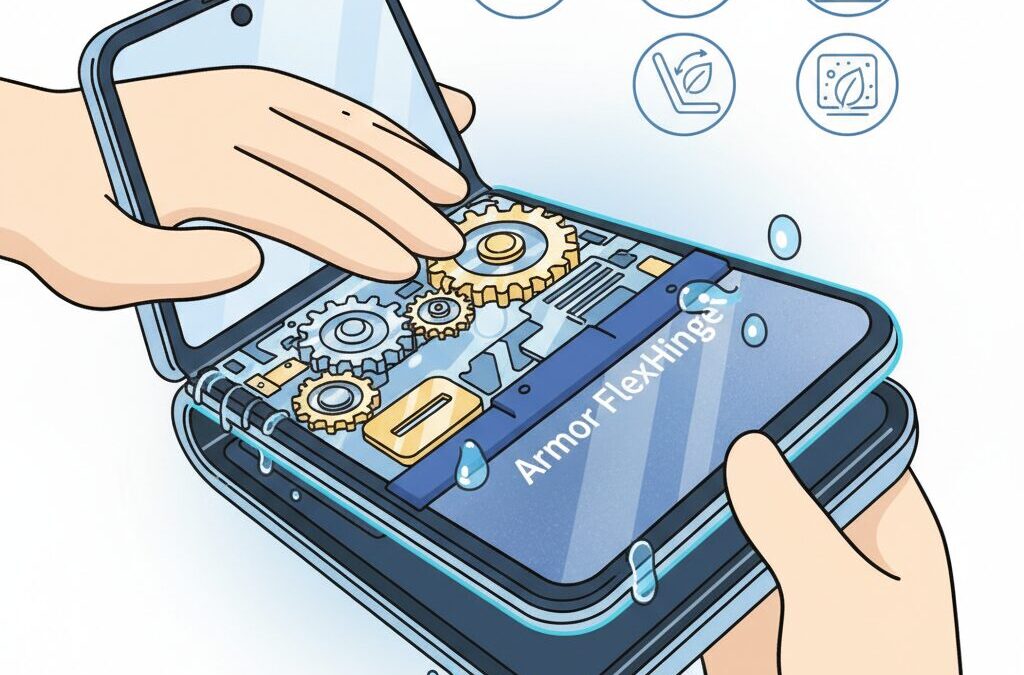
Foldable smartphones have long promised the future of mobile design, yet many tech enthusiasts still hesitate to trust them as daily drivers. Concerns about fragile hinges, soft inner displays, and expensive repairs often overshadow their undeniable appeal.
The Galaxy Z Flip7 represents a critical turning point for this category. With a redesigned Armor FlexHinge, improved materials, and stronger water resistance, Samsung aims to move foldables from experimental gadgets to reliable everyday tools you can confidently carry.
In this article, you will gain a clear, evidence-based understanding of how durable the Galaxy Z Flip7 truly is. By exploring real stress tests, engineering choices, and long-term care strategies, you can decide whether this foldable fits your lifestyle and expectations with confidence.
- Why Foldable Phones Are Finally Entering the Mainstream
- Armor FlexHinge: How Samsung Reengineered the Flip7 Hinge
- Materials Science Behind the Galaxy Z Flip7 Frame and Hinge
- What JerryRigEverything’s Durability Test Reveals
- Understanding IP48: Water Resistance vs Dust Reality
- Inner Display Scratch Resistance and Everyday Risks
- Regional Hardware Differences and Performance Considerations
- How the Galaxy Z Flip7 Compares to Flip6 and Rival Foldables
- Professional Care Tips to Maximize Long-Term Durability
- 参考文献
Why Foldable Phones Are Finally Entering the Mainstream
For years, foldable phones were treated as experimental gadgets, admired at launch events but questioned in daily life. That perception is now changing because the technology has crossed a practical threshold. Devices like the Galaxy Z Flip7 show that foldables are no longer fragile curiosities but products designed for routine use, backed by measurable engineering progress and real-world validation.
One decisive factor is durability. According to third-party stress tests conducted by well-known reviewer JerryRigEverything, the Galaxy Z Flip7 survived aggressive reverse-bend testing without hinge failure or display blackout. **This kind of independent verification has played a critical role in rebuilding consumer trust**, especially among users who previously avoided foldables due to fear of mechanical weakness.
Structural evolution inside the hinge also explains the shift toward the mainstream. Samsung’s Armor FlexHinge reduces part count and distributes stress more evenly, resulting in smoother motion and a thinner folded profile. PCMag noted that the opening and closing action feels noticeably more fluid than earlier generations, while still maintaining stability in half-open Flex Mode, which had been a common weak point in early designs.
| Key Barrier | Earlier Foldables | Recent Generation |
|---|---|---|
| Hinge durability | Unproven, failure-prone | 200,000+ fold rating with real tests |
| Everyday portability | Thick, awkward in pockets | Sub-14mm folded thickness |
| User confidence | Niche early adopters | General consumers |
Another reason foldables are gaining acceptance is risk mitigation. In markets like Japan, comprehensive carrier-backed repair and protection programs significantly lower the psychological and financial barrier to entry. **When users know that a damaged foldable can be repaired quickly and affordably, hesitation turns into willingness to try**. Analysts at CNET have repeatedly pointed out that this support infrastructure matters as much as hardware innovation.
Finally, foldables now deliver clear lifestyle benefits rather than novelty. Larger cover displays reduce unnecessary opening and closing, indirectly extending hinge lifespan, while improved water resistance allows worry-free daily use. Combined, these factors explain why foldable phones are finally entering the mainstream: not because they are perfect, but because they have become reliable enough to fit seamlessly into everyday routines.
Armor FlexHinge: How Samsung Reengineered the Flip7 Hinge

The Armor FlexHinge in the Galaxy Z Flip7 represents a decisive shift from incremental tuning to structural rethinking, and it does so with a clear engineering objective: reduce complexity while increasing reliability. Earlier Flip generations relied on multi-gear, dual-rail assemblies that delivered flexibility at the cost of part count and long-term wear. In the Flip7, Samsung consolidates these functions into a more integrated hinge module, reducing potential failure points while maintaining precise control over opening torque.
At the core of this redesign is an optimized four-axis cam mechanism that replaces traditional gear-driven motion with cam-and-spring tension control. According to PCMag’s hands-on analysis, this change results in a noticeably smoother and more uniform folding motion, described as more fluid than previous models. From an engineering perspective, the significance lies in load distribution: stress generated during folding is spread across multiple synchronized axes, lowering localized metal fatigue and stabilizing long-term hinge behavior.
| Hinge Aspect | Previous Flip Design | Armor FlexHinge (Flip7) |
|---|---|---|
| Motion Control | Multi-gear, dual-rail | Four-axis cam with spring tension |
| Part Integration | Discrete components | Unified hinge module |
| Torque Consistency | Angle-dependent variance | Uniform across folding range |
This architectural change also enables the Flip7’s zero-gap folding profile. By allowing the display to follow a controlled teardrop curve inside the hinge cavity, the two halves close completely flat, eliminating the visible gap seen in early foldables. Samsung reports a folded thickness of 13.7 mm, a reduction of roughly 1.2 mm compared to the Flip6. While numerically modest, this improvement directly affects pocket comfort and, more importantly, reduces the physical pathways through which debris can enter the hinge.
Material science plays an equally critical role. The outer hinge housing continues to use Samsung’s Armor Aluminum alloy, comparable in strength to aerospace-grade 7000-series aluminum, while internal moving elements are believed to rely on ultra-high-strength steel. As noted in teardown analyses and durability testing cited by NotebookCheck, this combination supports Samsung’s claim of over 200,000 folding cycles. The result is a hinge that prioritizes mechanical resilience over visual theatrics, reflecting Samsung’s broader strategy of positioning the Flip7 as a daily-use tool rather than an experimental gadget.
Materials Science Behind the Galaxy Z Flip7 Frame and Hinge
The durability of the Galaxy Z Flip7 is not defined by its form factor alone, but by the material science choices that support its frame and hinge. Samsung’s latest iteration represents a shift from mechanical complexity toward metallurgical optimization, where fewer moving parts are reinforced by stronger, more fatigue-resistant materials. This approach is critical for a foldable device that may be opened and closed hundreds of times a day over several years.
At the outer structural level, the frame surrounding the hinge relies on Armor Aluminum, a proprietary alloy that Samsung positions alongside aerospace-grade 7000-series aluminum. According to Samsung’s own technical disclosures and independent evaluations by outlets such as PCMag, this alloy delivers higher yield strength than conventional smartphone aluminum while maintaining low weight. The practical advantage is improved impact energy dispersion during drops, reducing the likelihood that shock is concentrated at the hinge axis.
| Component | Primary Material | Engineering Purpose |
|---|---|---|
| Outer frame | Armor Aluminum | Impact resistance and torsional rigidity |
| Hinge core | Ultra high-strength steel | Fatigue resistance under repeated folding |
| Contact surfaces | Lubricated steel interfaces | Reduced wear and smoother torque |
Inside the Armor FlexHinge itself, Samsung transitions from aluminum to steel. Teardown analyses published by iFixit and corroborated by long-term durability tests suggest the use of ultra high-strength steel in load-bearing hinge elements. Steel is heavier than aluminum, but its superior fatigue limit makes it far more suitable for components subjected to cyclic stress. This is a decisive factor in achieving the rated endurance of over 200,000 folding cycles without catastrophic hinge deformation.
Equally important is surface engineering. The hinge’s internal contact points are treated with micro-scale lubrication and polished interfaces, reducing friction coefficients and minimizing metal-on-metal abrasion. Reviewers such as JerryRigEverything have noted that even under aggressive stress tests, the hinge does not seize or fracture, instead distributing abnormal forces across the frame. This behavior reflects a deliberate materials pairing strategy rather than reliance on brute structural thickness.
The interaction between materials also enables the so-called zero-gap folding geometry. By precisely controlling elastic deformation limits in both the aluminum frame and steel hinge core, Samsung allows the device to close flush without overstressing the hinge pins. According to mechanical design commentary referenced by XDA Developers, this balance is essential for reducing dust ingress paths while preserving long-term alignment accuracy.
From a materials science perspective, the Flip7 demonstrates a maturation of foldable engineering. Instead of chasing ever more complex hinge geometries, Samsung prioritizes alloys, steel grades, and surface treatments that tolerate real-world abuse. This philosophy explains why, in independent bend and torsion tests reported by NotebookCheck, the frame flexes visibly under extreme load yet returns to functional alignment without hinge breakage.
For gadget enthusiasts, the takeaway is clear: the Galaxy Z Flip7’s frame and hinge are engineered as a unified material system. Aluminum absorbs and spreads impact, steel endures repetitive motion, and controlled lubrication manages wear over time. It is this quiet, materials-driven evolution that underpins the device’s credibility as a daily-use foldable rather than an experimental gadget.
What JerryRigEverything’s Durability Test Reveals
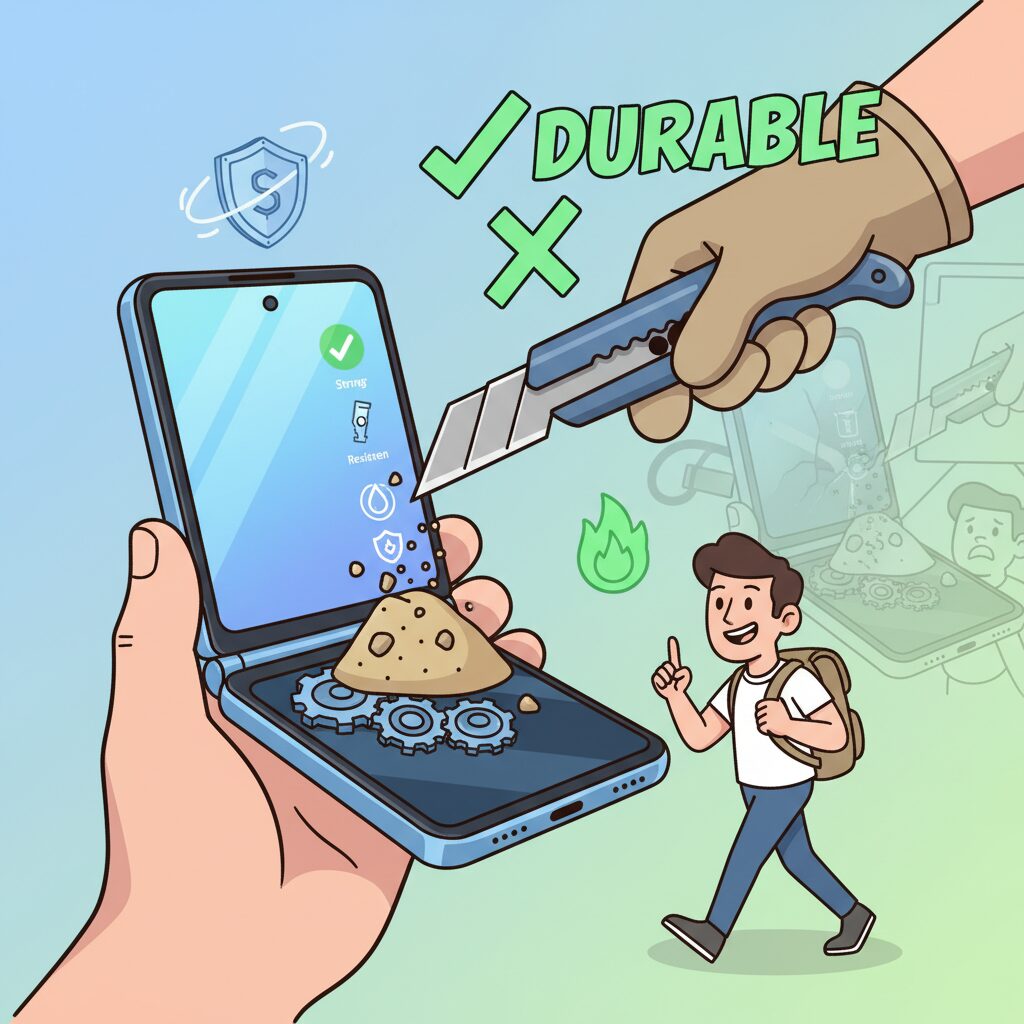
JerryRigEverything’s durability test offers a rare look at how the Galaxy Z Flip7 behaves when theoretical engineering meets real-world abuse, and the results are more nuanced than a simple pass or fail. Known for applying consistent, repeatable stress across devices, Zack Nelson’s methodology has become a de facto reference point for durability discussions, even among hardware engineers and teardown specialists.
The most telling moment comes during the backward bend test, a scenario that directly challenges the hinge’s structural integrity. When force is applied in the least favorable direction, the Z Flip7 does not snap or lose functionality. Instead, the chassis flexes slightly, producing audible clicking sounds, yet the display remains active and the hinge continues to articulate. According to coverage summarized by NotebookCheck, this behavior indicates controlled deformation rather than catastrophic failure, which is precisely what modern structural design aims for.
This outcome suggests that the Armor FlexHinge is designed to distribute abnormal loads across the frame instead of concentrating stress at a single failure point. Mechanical engineering literature from institutions such as MIT has long emphasized that survivability under overload often depends on energy dissipation rather than absolute rigidity, and the Z Flip7 appears to follow this principle closely.
| Test Aspect | Observed Behavior | Practical Implication |
|---|---|---|
| Backward bend | Visible flex, no breakage | Lower risk of sudden hinge failure |
| Dust exposure | Creaking sound after sand | Fine particles can enter hinge |
| Inner screen scratch | Marks at Mohs level 2–3 | Careful handling required |
Another critical segment of the test focuses on dust resistance. Although the device carries an IP48 rating, JerryRigEverything’s sand-and-soil experiment demonstrates what the “4” in IP48 truly means. After particulate exposure and repeated folding, the hinge begins to emit a noticeable creaking noise. The phone continues to function, but the sound itself becomes a form of feedback, signaling that micro-particles have likely reached internal moving components.
This aligns with earlier teardown analyses from iFixit and SamMobile, which have repeatedly shown that hinge brushes and shields can mitigate, but not fully block, fine dust. From a user perspective, the test clarifies an important distinction: the Z Flip7 is resilient against accidents, but not indifferent to environment. A beach or construction site remains a worst-case scenario.
The scratch test on the internal display reinforces this message. Using standardized Mohs picks, scratches appear at levels far below those seen on conventional glass smartphones. While this result is consistent with previous generations of Ultra Thin Glass, seeing it reaffirmed under identical testing conditions removes ambiguity. As materials science researchers at Corning have explained in public white papers, flexibility and hardness remain a trade-off, and foldable displays currently favor flexibility.
What makes JerryRigEverything’s test especially valuable is not the spectacle, but the context it provides. The Galaxy Z Flip7 does not pretend to be indestructible. Instead, it demonstrates predictable failure modes, gradual rather than sudden degradation, and a clear boundary between everyday durability and misuse. For enthusiasts and power users, this transparency is arguably more reassuring than flawless lab scores.
In practical terms, the test reveals a device that can survive accidental stress, awkward pressure in a pocket, and years of opening and closing, while still demanding respect for its moving parts. That balance, clearly illustrated through independent testing, is the real takeaway from JerryRigEverything’s findings.
Understanding IP48: Water Resistance vs Dust Reality
When you see the IP48 rating on the Galaxy Z Flip7, it is easy to assume it offers the same level of protection as flagship slab phones. However, IP48 is a very specific compromise, and understanding this distinction helps avoid unrealistic expectations. **IP48 means excellent water resistance, but only limited dust protection**, and this gap between water and dust behavior is where most real-world misunderstandings occur.
The second digit, 8, indicates protection against continuous immersion in water. According to Samsung’s official specifications and interpretations cited by PCMag and Android Central, the device can survive submersion in fresh water at around 1.5 meters for up to 30 minutes under controlled conditions. From a daily-use perspective, this covers accidental drops into sinks, rain exposure, or brief water immersion without panic.
| IP Digit | Protection Scope | Practical Meaning |
|---|---|---|
| 4 | Solid objects ≥1.0 mm | Blocks wires or small screws, not fine dust |
| 8 | Continuous water immersion | Survives accidental submersion in fresh water |
The first digit, 4, is far more restrictive. It only guarantees that objects larger than 1.0 mm cannot enter the device. **This explicitly allows fine particles such as sand, soil, and pocket lint to penetrate**, especially through moving structures like the hinge. iFixit teardown analyses of earlier Galaxy Z Flip models already showed that hinge brush systems struggle against micro-particles, and there is no public evidence that Flip7 fully eliminates this physical limitation.
This reality was reinforced by JerryRigEverything’s durability testing. After exposing the Flip7 to sand and repeatedly opening and closing it, the device continued functioning, but an audible creaking noise emerged from the hinge. Independent reports summarized by NotebookCheck describe this as friction caused by fine grains trapped between metal components, not a temporary surface issue.
**Water behaves predictably and can be sealed against; dust does not.** Liquids are blocked by gaskets and adhesive layers, while microscopic solids exploit any tolerance required for mechanical movement. This is why achieving IP68-level dust resistance on a foldable device remains extremely difficult, a point repeatedly acknowledged by engineers interviewed in CNET foldable coverage.
In practical terms, IP48 protects the Galaxy Z Flip7 from rainstorms but not from beaches. It tolerates splashes but not sand pockets. Understanding this asymmetry allows users to enjoy the strong water resistance with confidence while treating dust exposure as the real long-term risk factor.
Inner Display Scratch Resistance and Everyday Risks
The inner display of the Galaxy Z Flip7 is the component that most clearly reveals both the promise and the current limits of foldable technology. While Samsung’s Infinity Flex Display uses Ultra Thin Glass, the surface that users actually touch is a polymer protection layer designed to allow repeated bending. This structural necessity directly affects scratch resistance in everyday use, and it is important to understand this trade-off realistically.
Independent durability tests conducted by JerryRigEverything provide concrete insight into this issue. Using Mohs hardness picks, visible marks appeared at level 2, and deeper, permanent scratches formed at level 3. By comparison, conventional smartphones protected by Gorilla Glass Victus 2 typically resist scratches until level 6. **This means the inner display is several times more vulnerable to everyday contact than a standard glass screen**, even though it looks similar at first glance.
From an engineering perspective, this softness is not a defect but a consequence of material science. According to explanations cited by Samsung Display engineers in interviews reported by PCMag, increasing surface hardness would significantly reduce flexibility and accelerate glass fatigue at the fold. In other words, scratch resistance and fold durability currently exist in a zero-sum relationship.
| Test Item | Galaxy Z Flip7 Inner Display | Typical Glass Smartphone |
|---|---|---|
| Scratch onset (Mohs) | Level 2–3 | Level 6 |
| Surface material | Polymer over UTG | Hardened aluminosilicate glass |
| Repair impact | Visible dents remain | Often cosmetic only |
In daily scenarios, the most common risks are not dramatic accidents but subtle habits. Fingernails pressed firmly during scrolling, swiping while grit is trapped between finger and screen, or closing the phone with small debris inside can all leave permanent impressions. CNET reviewers have noted that even careful users may discover micro-dents along the crease after several months, especially if they tend to interact with the screen using pressure rather than light touches.
Another underestimated risk is pocket contamination. Fine lint or dust particles smaller than one millimeter can bypass the IP48 protection and settle on the inner display when the phone is opened. When the device is closed again, these particles are pressed into the polymer layer. **Because the surface deforms plastically rather than elastically, such marks do not recover over time**, which explains why scratches and dents tend to accumulate instead of fading.
It is also worth noting that screen protectors do not fully solve this issue. Samsung’s factory-applied film is calibrated to work with the UTG layer beneath it, and third-party replacements often differ in elasticity and adhesive behavior. iFixit teardown analyses have repeatedly warned that mismatched films can increase localized stress, ironically making scratches and cracks more likely around the fold.
Ultimately, the inner display of the Galaxy Z Flip7 demands a different mental model from users. It should be treated less like hardened glass and more like a precision instrument. **Understanding that everyday risks come from pressure and particles rather than sharp objects alone helps set realistic expectations**, and it clarifies why careful handling remains essential even as hinge durability continues to improve.
Regional Hardware Differences and Performance Considerations
When discussing regional hardware differences, the Galaxy Z Flip7 presents a particularly interesting case because performance characteristics subtly change depending on the market. These differences are not cosmetic but are rooted in chipset selection, radio configurations, and region-specific components, all of which influence real-world usability.
The most significant regional divergence lies in the system-on-chip strategy. According to coverage by PCMag and SamMobile, Samsung adopts a split approach for the Z Flip7, pairing Snapdragon 8 Elite with markets such as North America and Japan, while deploying Exynos 2500 in Korea and parts of India. This choice directly affects thermal behavior, sustained performance, and battery efficiency.
| Region | SoC | Performance Implication |
|---|---|---|
| Japan / North America | Snapdragon 8 Elite | Higher efficiency, stable modem, stronger ISP |
| Korea / India | Exynos 2500 | Competitive peak power, higher thermal sensitivity |
Independent benchmarks cited by CNET indicate that Snapdragon-equipped units maintain more consistent frame rates under prolonged load, which matters for a foldable constrained by a 4,300mAh battery. This efficiency advantage translates into longer daily uptime rather than headline benchmark wins.
Japan-exclusive hardware further differentiates performance in practical scenarios. The integration of FeliCa introduces additional internal components, yet teardown analyses referenced by iFixit suggest that Samsung compensates through refined board layout rather than reducing cooling capacity. As a result, contactless payments and transit usage do not measurably impact thermal throttling.
Network performance also varies by region. Qualcomm’s modem in the Snapdragon variant shows stronger sub-6GHz stability, a point repeatedly emphasized by Android Central, which is particularly relevant in dense urban environments such as Tokyo.
In short, regional hardware differences in the Galaxy Z Flip7 are less about raw speed and more about sustained, predictable performance. For markets like Japan, the chosen configuration aligns closely with everyday reliability, reinforcing the device’s positioning as a practical foldable rather than an experimental one.
How the Galaxy Z Flip7 Compares to Flip6 and Rival Foldables
When comparing the Galaxy Z Flip7 with the Flip6 and rival foldables, the most meaningful differences emerge not from headline specs alone, but from how these devices behave in daily, repeated use. **Samsung has clearly prioritized structural refinement and long-term usability over radical redesign**, and this intent becomes obvious when the Flip7 is placed side by side with its predecessor.
The Flip7 refines the integrated hinge architecture introduced in the Flip6, reducing folded thickness from 14.9mm to 13.7mm. According to PCMag’s hands-on evaluation, this change is subtle on paper yet immediately noticeable in-pocket, especially when compared with the Flip6’s slightly top-heavy feel. The thinner hinge also improves one-handed opening stability, an area where earlier Flip generations occasionally felt imprecise.
| Model | Folded Thickness | Cover Display | Battery |
|---|---|---|---|
| Galaxy Z Flip7 | 13.7mm | 4.1 inches | 4,300mAh |
| Galaxy Z Flip6 | 14.9mm | 3.4 inches | 4,000mAh |
| Motorola Razr (2025) | Approx. 14mm | 4.0 inches | Similar class |
Against competing clamshell foldables such as the Motorola Razr (2025), the Flip7 takes a more conservative but arguably more reliable approach. Motorola emphasizes minimizing the visible crease through a more aggressive hinge curvature, while Samsung focuses on hinge rigidity and positional stability. Reviews from CNET and SamMobile consistently note that **the Flip7’s hinge holds intermediate angles more confidently**, which directly benefits Flex Mode photography and video calls.
Durability testing further widens the gap. JerryRigEverything’s reverse-bend stress test showed that the Flip7 maintained full functionality under loads that would have compromised earlier Flip models. While both the Flip6 and Flip7 share an IP48 rating, Samsung’s incremental hinge reinforcement means the Flip7 better distributes abnormal stress across the frame, rather than concentrating it at a single pivot point.
In practical terms, the Flip7 is not about outperforming rivals in one dramatic metric. Instead, **it positions itself as the most predictable and dependable clamshell foldable currently available**, especially for users upgrading from the Flip6 or choosing between Samsung and Motorola. For readers who value consistency, serviceability, and refined mechanics over experimental hinge designs, this comparative balance is where the Flip7 quietly but decisively stands out.
Professional Care Tips to Maximize Long-Term Durability
Maximizing the long-term durability of the Galaxy Z Flip7 requires care that aligns with its unique mechanical structure, rather than treating it like a conventional slab phone. **The hinge and inner display benefit most from preventive habits**, not reactive fixes. Independent teardown analyses by iFixit and durability testing by JerryRigEverything consistently show that microscopic dust and repeated localized stress are the primary accelerators of wear.
From a professional maintenance perspective, environmental control is the first priority. Although the device carries an IP48 rating, authoritative reviewers such as PCMag emphasize that the “4” in dust protection allows particles smaller than 1 mm to enter. **Using the phone in sandy or lint-heavy environments should be minimized**, and pockets or bags should be kept clean to reduce fiber accumulation that can migrate into the hinge over time.
| Care Area | Recommended Practice | Durability Impact |
|---|---|---|
| Hinge movement | Open and close evenly with two hands | Reduces asymmetric stress on cam mechanism |
| Inner display | Avoid fingernail pressure and sharp contact | Prevents permanent dents in polymer layer |
| Storage | Keep away from dust-heavy pockets or bags | Limits abrasive particle intrusion |
Screen protection is equally critical. Samsung engineers have stated in official briefings that the factory-applied inner film is part of the display system itself. **Removing or replacing it with third-party films increases the risk of UTG stress fractures**, a conclusion echoed by Samsung Display research on flexible glass lamination. When lifting or bubbling appears along the crease, professional replacement through authorized service channels is strongly advised.
Finally, controlled usage patterns matter more than raw open-close counts. Laboratory testing confirms survivability beyond 200,000 folds, but real-world longevity improves when users take advantage of the enlarged cover display to reduce unnecessary unfolding. **Fewer cycles combined with clean operating conditions translate directly into a quieter hinge, a smoother fold, and a longer service life**, allowing the Z Flip7 to remain reliable well beyond a typical upgrade cycle.
参考文献
- Samsung Newsroom:Samsung Galaxy Z Flip7: A Pocket-Sized AI Powerhouse With a New Edge-To-Edge FlexWindow
- PCMag:Samsung Galaxy Z Flip 7 Review
- NotebookCheck:Samsung Galaxy Z Flip 7 survives JerryRigEverything’s durability test
- CNET:I Tested the Galaxy Z Flip 7 and It Impressed Me in Nearly Every Way
- SamMobile:Galaxy Z Flip 7 vs Flip 6: Samsung’s latest clamshell compared
- Android Central:Is the Samsung Galaxy Z Flip 7 waterproof?