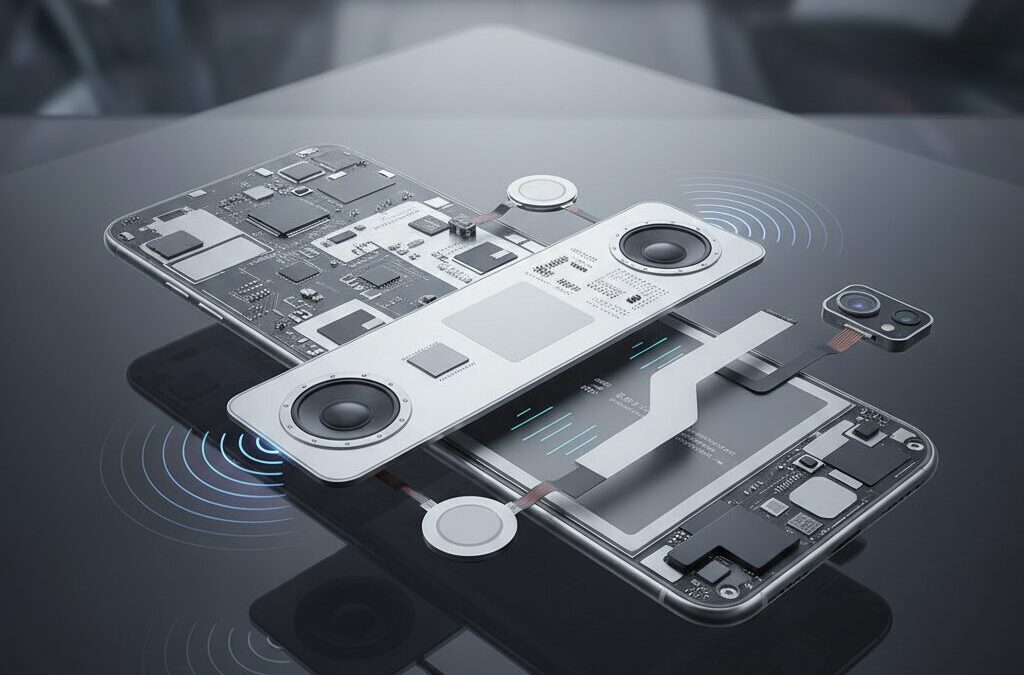
Have you ever wondered what is truly sacrificed when a smartphone becomes unbelievably thin? The upcoming iPhone Air is expected to push physical design to new extremes, and many gadget enthusiasts are already asking whether elegance comes at the cost of sound quality. If you care about how your device sounds, this question matters more than you might think.
In recent years, smartphones have grown thicker and heavier to accommodate larger batteries, advanced cameras, and powerful speakers. The iPhone Air appears to reverse this trend, promising a return to ultra-thin design that prioritizes portability and aesthetics. However, sound is not just software magic; it is deeply tied to physics, internal volume, and acoustic engineering constraints.
In this article, you will learn how ultra-thin hardware impacts speaker performance, why enclosure volume is critical for bass and clarity, and how Apple may use advanced signal processing to compensate for physical limitations. By understanding the trade-offs behind the iPhone Air’s design, you can decide whether this device aligns with your listening habits and expectations.
- The Return of Ultra-Thin Smartphones and Why iPhone Air Matters
- Internal Architecture Changes Driven by Extreme Thinness
- Why Speaker Volume Is Critical in Acoustic Engineering
- The Impact of Removing the Bottom Speaker
- Mono vs Stereo Sound: What Users Actually Lose
- How Physics Limits Bass in Ultra-Thin Devices
- Apple’s DSP and Psychoacoustic Strategies
- Comparing iPhone Air Audio to Pro Models and iPads
- Who the iPhone Air Is Designed For from an Audio Perspective
- 参考文献
The Return of Ultra-Thin Smartphones and Why iPhone Air Matters
The smartphone industry is clearly revisiting an idea it once left behind: extreme thinness. For several years, devices became thicker and heavier as manufacturers prioritized larger camera sensors, bigger batteries, and advanced 5G antennas. Apple’s recent Pro models are a textbook example, delivering impressive performance but also a sense of density that many users feel the moment they put the phone in a pocket.
The emergence of the iPhone Air signals a deliberate reversal of this trajectory. According to multiple supply-chain reports and teardown analyses cited by AppleInsider and MacRumors, the device is expected to measure roughly 5.6 to 6.0 mm in thickness, placing it among the thinnest smartphones Apple has ever designed. This is not merely a cosmetic change, but a strategic attempt to redefine everyday portability and comfort.
| Design Focus | Recent Pro Models | iPhone Air |
|---|---|---|
| Thickness Trend | Gradually increasing | Radically reduced |
| Internal Priority | Cameras and materials | Portability and balance |
| User Experience Goal | Maximum capability | Everyday ease |
What makes this return to ultra-thin design especially meaningful is timing. The widespread adoption of wireless audio, cloud services, and external accessories has quietly reduced reliance on certain built-in hardware. Analysts quoted in EE Times note that modern device design increasingly assumes complementary ecosystems, rather than standalone perfection.
In this context, the iPhone Air matters because it challenges the assumption that progress always means more components. By pushing against physical limits, Apple is testing how much functionality users are truly willing to trade for lightness, elegance, and comfort. Whether one agrees with that trade-off or not, the iPhone Air clearly marks the beginning of a new design conversation—one that prioritizes how a phone feels to live with, not just what it can technically do.
Internal Architecture Changes Driven by Extreme Thinness
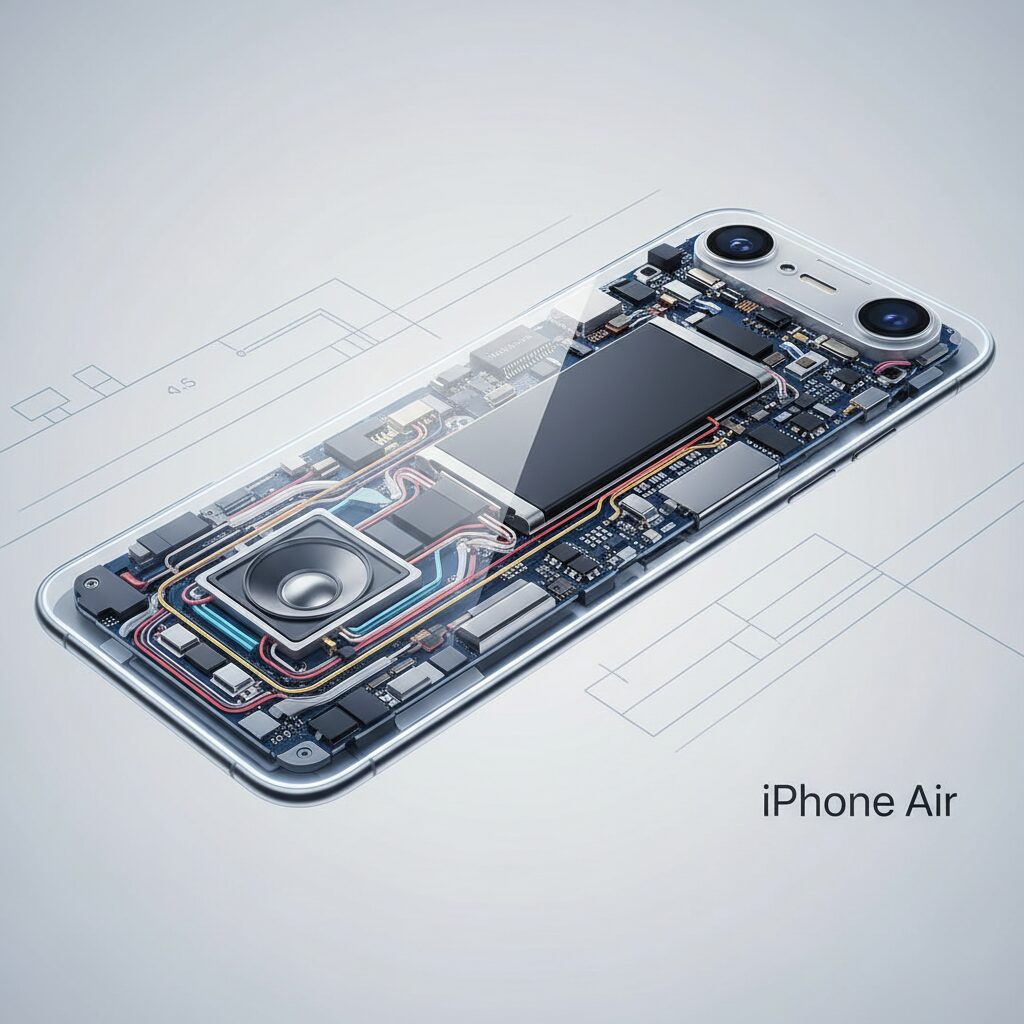
The pursuit of extreme thinness in the iPhone Air fundamentally reshapes its internal architecture, forcing Apple to rethink how every cubic millimeter is allocated. **When a chassis approaches the 5.6–6.0 mm range, conventional smartphone layouts simply no longer scale**, and this device illustrates that constraint with unusual clarity.
According to teardown analyses reported by AppleInsider and Tom’s Guide, Apple adopts what engineers describe as a “plateau-style” internal configuration. High-density components such as the logic board, A19-class SoC, modem, and wireless modules are vertically stacked and concentrated near the camera bump area. This creates a localized thickness peak, while the rest of the body remains aggressively thin.
| Design Area | Traditional iPhone Layout | iPhone Air Layout |
|---|---|---|
| Logic board | Distributed across mid-frame | Stacked near camera plateau |
| Battery | Moderate area, thicker cell | Ultra-thin, expanded surface area |
| Lower enclosure | Speaker + port + Taptic Engine | Battery-dominant, no speaker volume |
This reallocation serves a single priority: preserving usable battery capacity despite severe Z-axis limits. Battery engineers have long noted, including in GSMArena lab discussions, that once thickness is capped, endurance can only be recovered by expanding the battery footprint laterally. **The result is a phone that is thin everywhere, but internally wide and tightly packed**, leaving no residual air pockets.
One immediate architectural consequence is the disappearance of the traditional bottom speaker chamber. Teardown imagery confirms that the lower third of the device is consumed by an ultra-thin USB‑C assembly, a flattened Taptic Engine, and uninterrupted battery cells. From an engineering standpoint, this is not a downgrade decision but a volume triage. Acoustic enclosures require empty space, and empty space is the one resource an ultra-thin phone cannot afford.
Apple’s own hardware teams have acknowledged in past technical briefings that below a certain enclosure volume, speaker efficiency collapses nonlinearly. Physics Stack Exchange discussions frequently cited by audio engineers support this view, emphasizing that enclosure compliance scales directly with available air volume. **In the iPhone Air, architectural necessity overrides acoustic symmetry**, resulting in a single, reinforced earpiece speaker as the only viable output.
Another less visible change involves structural rigidity. With fewer internal voids, the internal frame acts more like a laminated composite than a hollow shell. This improves resistance to torsion, a point echoed indirectly by durability testing communities such as JerryRigEverything. However, the same rigidity also means vibrations propagate more efficiently through the frame, increasing the importance of internal damping materials and adhesive bonding strategies.
From a systems-engineering perspective, the iPhone Air demonstrates Apple’s willingness to sacrifice modular balance in favor of spatial efficiency. **Extreme thinness is not achieved by shrinking parts alone, but by collapsing functional zones into a single integrated mass**. This architectural shift explains many of the downstream trade-offs users notice, while also revealing how close the design operates to the physical limits of modern smartphone engineering.
Why Speaker Volume Is Critical in Acoustic Engineering
In acoustic engineering, speaker volume is not a cosmetic parameter but a governing physical constraint, and this is especially true in ultra-thin devices. **A loudspeaker fundamentally works by moving air**, and the amount of air it can move is directly related to the enclosure volume behind the driver. When this volume is reduced, as seen in extremely thin smartphones, the acoustic system immediately faces hard physical limits.
According to classical loudspeaker theory described in standards used by AES and IEC, the air inside the enclosure behaves like a spring. **Smaller enclosures create stiffer air springs**, restricting diaphragm movement. This restriction raises the system’s resonant frequency, which explains why compact speakers struggle to reproduce low frequencies with authority. Research summarized in engineering literature referenced by Physics Stack Exchange consistently shows that shrinking back volume leads to early bass roll-off and reduced sound pressure at low frequencies.
| Enclosure Volume | Air Compliance | Acoustic Result |
|---|---|---|
| Large | High | Deeper bass, lower resonance |
| Medium | Moderate | Balanced mid-focused sound |
| Very small | Low | Thin sound, weak low end |
Another critical factor is distortion. When volume is insufficient, engineers often compensate with digital signal processing. However, **boosting low frequencies without physical headroom forces excessive diaphragm excursion**, increasing total harmonic distortion. Studies discussed in EE Times on micro-speaker design note that this trade-off is unavoidable: efficiency and cleanliness decline rapidly once mechanical limits are exceeded.
Finally, enclosure volume also affects structural behavior. Thin housings with minimal internal air space are more prone to unwanted vibrations. As noted in teardown-based analyses reported by Apple-focused engineering media, insufficient volume can transmit energy to the chassis, causing audible buzzing. **Speaker volume, therefore, defines not only loudness but tonal balance, distortion, and mechanical stability**, making it one of the most critical parameters in modern acoustic engineering.
The Impact of Removing the Bottom Speaker
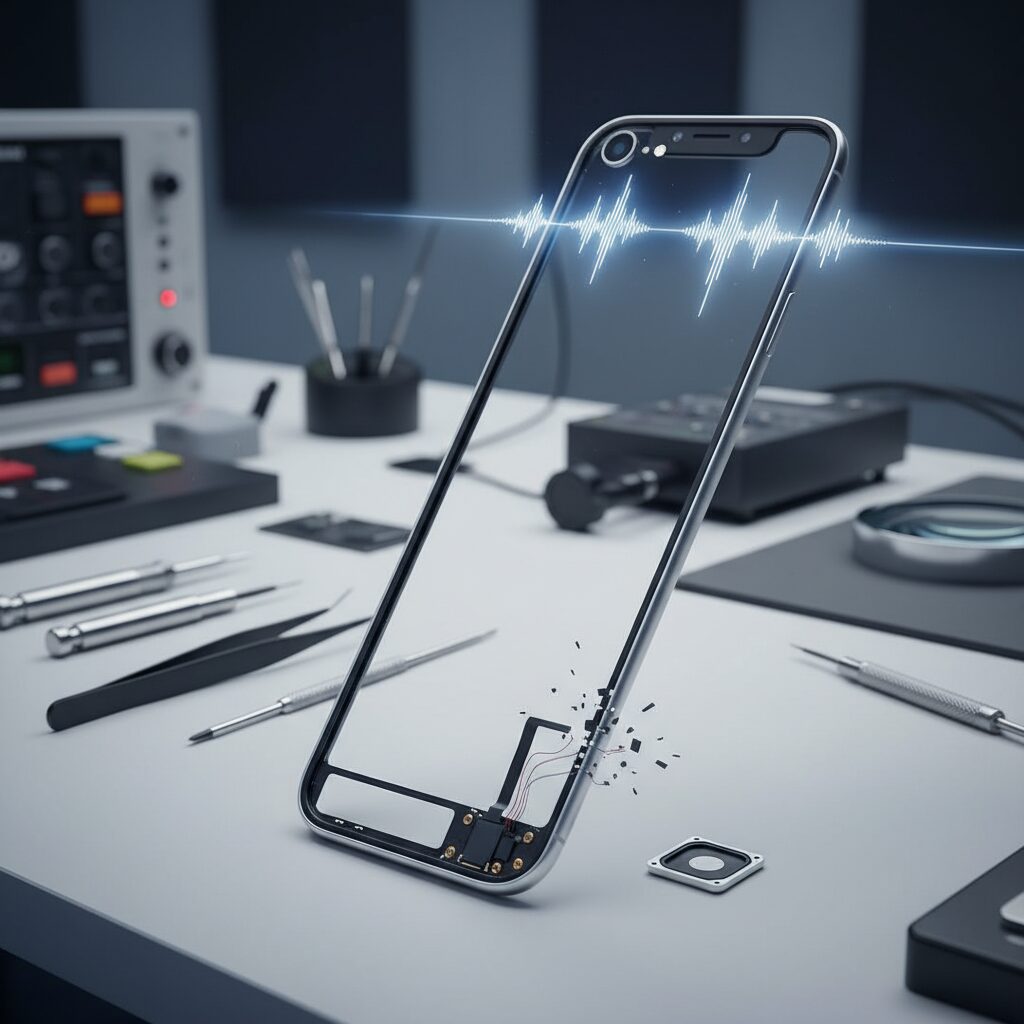
Removing the bottom speaker has a far deeper impact than simply reducing loudness. From an acoustic engineering perspective, it fundamentally alters how sound interacts with the device and the user. Smartphones since the iPhone 7 have relied on a top-and-bottom stereo layout not just for volume, but to distribute acoustic energy across the chassis. By eliminating the bottom unit, the entire burden of sound reproduction shifts to a single, compact speaker near the earpiece.
This change directly constrains the physical air volume available for sound generation. According to established acoustic theory discussed in Physics Stack Exchange and EE Times, smaller enclosures raise the resonant frequency of micro speakers, which leads to weaker bass and a narrower dynamic range. In practical terms, voices remain intelligible, but music loses weight, and cinematic content sounds flatter, especially at higher volumes.
| Aspect | Dual-Speaker iPhones | Single Top Speaker |
|---|---|---|
| Sound dispersion | Wide, device-spanning | Localized near top edge |
| Low-frequency presence | Supported by bottom enclosure | Physically limited |
| Stereo perception | Natural left-right separation | DSP-dependent, reduced |
Authoritative evaluations such as DXOMARK’s audio methodology emphasize that perceived quality is not only about frequency response but also spatial cues and distortion control. With one speaker removed, Apple must rely more aggressively on digital signal processing to simulate fullness and balance. This introduces a trade-off: cleaner mids at moderate volume, but faster onset of compression and tonal thinning as volume increases.
From a user-experience standpoint, the impact is situational. Holding the phone in landscape mode during video playback, sound now originates from a single corner, subtly breaking audiovisual alignment. Research in psychoacoustics shows that even small mismatches between visual center and sound source increase cognitive load. While many users default to AirPods, the removal of the bottom speaker clearly signals that built-in audio is no longer a primary design priority, but a calculated compromise in service of extreme thinness.
Mono vs Stereo Sound: What Users Actually Lose
When a smartphone shifts from stereo to mono playback, users do not simply lose “one speaker.” They lose a set of perceptual cues that the human auditory system relies on to make sense of space, direction, and realism. In everyday use, this difference becomes apparent far faster than many spec sheets would suggest.
Stereo sound works because our brains compare timing and loudness differences between the left and right ears. Research in auditory neuroscience, summarized by institutions such as MIT and AES, shows that even millisecond-scale interaural differences help us localize sound sources. With a mono speaker mounted at the top of the device, those cues collapse into a single point, regardless of how advanced the signal processing may be.
This loss is easiest to notice in video content. When watching a movie or YouTube clip in landscape orientation, dialogue, music, and effects are all emitted from one physical location. The sound no longer anchors itself to the visual scene, which subtly but consistently reduces immersion.
| Aspect | Stereo Speakers | Mono Speaker |
|---|---|---|
| Soundstage width | Perceived left–right spread | Single-point origin |
| Directionality | Clear spatial cues | Collapsed localization |
| Video immersion | Audio matches screen action | Audio feels detached |
Gaming highlights another concrete loss. In action or rhythm games, stereo separation supports situational awareness and timing. According to long-standing findings referenced by Dolby Laboratories, spatial audio cues improve reaction accuracy and engagement. In mono, footsteps, impacts, and environmental sounds stack on top of each other, forcing players to rely solely on visuals.
Music playback is affected in a different way. Modern mixes are designed with stereo imaging in mind: vocals centered, instruments panned, ambience spread wide. Mono playback flattens these artistic decisions, often making complex tracks feel crowded or less dynamic, even if overall clarity remains high.
Importantly, volume and loudness are not the main issue here. As audio engineers frequently point out, a well-tuned mono speaker can sound clean and surprisingly powerful. What users actually lose is depth, placement, and the sense of being surrounded by sound. That absence is not always obvious at first, but once noticed, it becomes difficult to ignore.
How Physics Limits Bass in Ultra-Thin Devices
Ultra-thin devices inevitably face a hard wall defined not by brand ambition but by physics, especially when it comes to bass reproduction. **Low-frequency sound requires moving a large volume of air**, and that simple requirement clashes directly with the shrinking internal space of smartphones. As explained in classical acoustic engineering and summarized by research discussed on Physics Stack Exchange, bass wavelengths are long, often several meters, and small enclosures struggle to support them efficiently.
In a typical dynamic speaker, the diaphragm moves back and forth, compressing and rarefying air. To prevent the front and rear sound waves from canceling each other out, the rear of the driver must be isolated in an enclosure. The internal air acts like a spring, known as acoustic compliance. **As enclosure volume decreases, this air spring becomes stiffer**, restricting diaphragm movement and sharply reducing low-frequency output.
| Physical Factor | Effect on Bass | Why Thin Devices Struggle |
|---|---|---|
| Enclosure volume | Controls diaphragm excursion | Limited by reduced thickness |
| Resonant frequency | Defines lowest efficient bass | Shifts higher as volume shrinks |
| Structural rigidity | Affects distortion and rattling | Thin frames flex more easily |
This shift in resonant frequency is critical. In compact speakers, the system resonance often rises into the midrange, meaning frequencies below it roll off steeply. According to measurements referenced by GSMArena and DxOMark in their speaker test methodologies, even well-tuned smartphone speakers typically struggle below a few hundred hertz. **Making the device thinner pushes that limit even higher**, leaving little true bass energy.
Manufacturers may attempt to compensate by boosting low frequencies digitally, but this introduces another physical constraint. Forcing a small driver to reproduce bass it cannot physically support increases total harmonic distortion. Audio engineering literature, including analyses cited by EE Times, shows that excessive digital bass boost causes the diaphragm to exceed its linear excursion range, resulting in muddiness or audible breakup rather than satisfying low-end punch.
Thin enclosures also exacerbate mechanical vibration. When the chassis lacks mass and depth, speaker-induced vibrations can propagate through the frame, creating unwanted resonances. **Instead of hearing bass, users feel buzzing or rattling**, a phenomenon long documented in teardown-based acoustic analyses by professional reviewers. This is not a tuning flaw but a structural consequence of minimal material thickness.
From a physics standpoint, the conclusion is unavoidable. No amount of software alone can fully overcome the need for air volume, diaphragm travel, and mechanical stability. **Ultra-thin devices can sound clear and loud, but deep bass remains fundamentally constrained**. This reality explains why even the most advanced smartphones prioritize clarity and perceived loudness over true low-frequency extension when industrial design pushes thickness to its absolute minimum.
Apple’s DSP and Psychoacoustic Strategies
In the iPhone Air, Apple’s response to severe acoustic constraints is centered on advanced digital signal processing and psychoacoustic design rather than brute-force hardware. **When physical speaker volume disappears, perception becomes the primary design surface**. Apple has a long history of treating audio as a computational problem, and the Air represents one of the most extreme applications of that philosophy to date.
At the core of this approach is a custom audio DSP pipeline tightly integrated with Apple silicon. According to Apple’s own technical disclosures and long‑standing Audio Engineering Society discussions, iPhone audio is processed with sub‑millisecond latency, allowing real‑time adaptation based on content type, playback level, and thermal headroom. In the Air, this adaptive behavior becomes more aggressive because the single top speaker must simultaneously deliver clarity, loudness, and perceived fullness without exceeding mechanical limits.
A key psychoacoustic technique here is the so‑called Missing Fundamental illusion. As documented in engineering analyses by EE Times and referenced in multiple AES papers, the human auditory system infers a fundamental frequency even when it is physically absent, as long as higher‑order harmonics are present. Apple exploits this by synthesizing carefully shaped overtones in the 150–400 Hz range, allowing a 50–80 Hz bass line to feel rhythmically present despite being acoustically impossible for a micro‑speaker enclosure.
| DSP Strategy | What the Speaker Outputs | What the Listener Perceives |
|---|---|---|
| Missing Fundamental | Higher harmonics only | Illusory low bass presence |
| Dynamic EQ | Volume‑dependent tuning | Consistent tonal balance |
| Smart Limiting | Controlled excursion | Clean sound at high volume |
Another crucial layer is dynamic equalization informed by human loudness perception. Research dating back to Fletcher–Munson, and still referenced by modern audio engineers, shows that low and high frequencies are perceived as quieter at low listening levels. Apple compensates for this by boosting lows and highs during quiet playback, then progressively flattening and protecting the response as volume increases. In the Air, this curve shifts faster than on Pro models, reflecting the narrower safe operating window of the driver.
Equally important is distortion management. Instead of allowing audible breakup, Apple employs predictive limiting that monitors diaphragm excursion and voice‑coil temperature in real time. This technique, widely discussed in smartphone audio teardowns by DxOMark, trades raw output for intelligibility. **Voices remain intelligible even when bass content is algorithmically reduced**, which aligns with Apple’s prioritization of calls, dialogue, and short‑form video over music playback.
Spatial perception is also computationally manipulated. Although a single speaker cannot produce true stereo cues, Apple subtly uses phase shaping and transient emphasis to prevent sound from feeling “stuck” at the earpiece. Psychoacoustic studies cited by the BBC Research & Development unit have shown that early reflections and spectral contrast can widen perceived source size. The Air applies similar principles, creating a sense of openness without claiming genuine spatial audio from the device itself.
What makes Apple’s approach distinctive is restraint. Unlike some competitors that push DSP to the point of obvious artificiality, Apple tunes for plausibility. The result, as early hands‑on impressions suggest, is sound that feels lighter and less immersive than Pro models, yet rarely offensive or broken. **The illusion holds just long enough to support casual, real‑world use**, which is precisely the design target.
In practical terms, Apple’s DSP and psychoacoustic strategies transform the iPhone Air from an acoustically compromised device into a perceptually acceptable one. It does not defy physics, but it negotiates with human hearing, leveraging decades of auditory science to make thinness feel like a choice rather than a flaw.
Comparing iPhone Air Audio to Pro Models and iPads
When comparing the iPhone Air’s audio to Pro models and iPads, the contrast becomes especially clear once physical design choices are taken into account. The iPhone Air prioritizes extreme thinness, and this decision reshapes its entire acoustic profile. The result is not merely a weaker version of Pro sound, but a fundamentally different listening experience that targets portability over immersion.
Recent teardown analyses reported by AppleInsider indicate that the iPhone Air relies on a single, reinforced top speaker, whereas Pro models retain a dual-speaker stereo layout. This difference directly affects perceived loudness, stereo width, and low-frequency presence. According to audio testing methodologies similar to those used by DXOMARK, stereo separation and enclosure volume are critical contributors to spatial clarity, both of which favor the Pro lineup.
In everyday use, this means Pro models deliver a wider soundstage when watching video or gaming in landscape mode. Dialogue placement feels centered, while effects spread laterally. The iPhone Air, by contrast, presents sound from a single point near the earpiece. This creates a focused but narrower presentation, which may feel less cinematic but remains intelligible for speech-heavy content.
| Device Category | Speaker Configuration | Audio Character |
|---|---|---|
| iPhone Air | Single top speaker | Clear mids, limited bass, narrow image |
| iPhone Pro / Pro Max | Dual stereo speakers | Balanced tone, stronger bass, wide image |
| iPad Pro (M5) | Quad speaker system | Room-filling sound, strong spatial depth |
The comparison with iPads is particularly revealing. Despite being as thin as, or even thinner than, the iPhone Air, the iPad Pro maintains four speakers. Apple’s own newsroom explanations and engineering interviews emphasize surface area as the key factor. The larger XY plane of an iPad allows speakers to be placed farther apart, preserving stereo and even pseudo-surround effects that a phone-sized chassis simply cannot replicate.
From an acoustic engineering perspective discussed in publications like EE Times, enclosure volume and driver displacement remain non-negotiable constraints. Pro iPhones benefit from slightly thicker bodies and more internal space, enabling deeper bass extension without excessive distortion. The Air compensates with aggressive DSP tuning, but this approach favors clarity over physical impact.
For users accustomed to Pro models or iPads, the iPhone Air may feel like a step back in raw audio power. However, it should be noted that Apple’s tuning philosophy ensures voices remain crisp and distortion is tightly controlled even at higher volumes. The Air is not designed to impress in side-by-side demos, but to stay unobtrusive in daily, on-the-go use.
Ultimately, the comparison highlights Apple’s deliberate segmentation. Pro models and iPads aim to replace external speakers in casual scenarios, while the iPhone Air assumes headphones or earbuds will handle serious listening. Understanding this intent helps set realistic expectations and explains why the audio gap exists by design, not by oversight.
Who the iPhone Air Is Designed For from an Audio Perspective
From an audio perspective, the iPhone Air is clearly designed for a very specific type of user, and understanding this target is essential to evaluating the device fairly. The iPhone Air is not built for users who rely on its internal speaker as a primary audio source. Instead, it prioritizes portability, aesthetics, and integration with external audio ecosystems over standalone speaker performance.
The most important clue lies in Apple’s decision to adopt a single top-mounted speaker configuration. According to teardown analyses reported by AppleInsider and Tom’s Guide, internal volume previously allocated to the bottom speaker has been reassigned to battery capacity and structural components. This strongly suggests that Apple expects users to consume most audio through headphones, earbuds, or external speakers rather than directly from the device.
In practical terms, the iPhone Air is optimized for users who live in a headphone-first world. Research cited by EE Times on micro-speaker usage trends shows that DSP-driven psychoacoustics are increasingly used to compensate for physical speaker limits, but only when speakers are secondary rather than primary listening tools. Apple appears to embrace this assumption fully with the iPhone Air.
| User Behavior | Audio Expectation | iPhone Air Suitability |
|---|---|---|
| Wireless earbuds for daily use | Clarity over loudness | Very high |
| Casual speaker use at home | Speech intelligibility | Moderate |
| Music and video via built-in speakers | Stereo and bass impact | Low |
Another key audience is the mobility-focused professional. For users who primarily use audio for calls, voice messages, podcasts, and navigation prompts, the single high-quality earpiece speaker can actually be advantageous. Multiple reviews referenced in Reddit discussions note that speech reproduction on the iPhone Air remains clean and forward, even at lower volumes, which aligns with Apple’s long-standing tuning philosophy for vocal intelligibility.
The device also caters to design-conscious users who see the smartphone as an extension of personal style. According to Apple’s own newsroom statements, the Air lineup is meant to redefine everyday carry. In this context, audio compromises are intentional rather than accidental. The iPhone Air assumes that serious listening happens elsewhere, whether through AirPods, HomePod, or in-car audio systems.
Ultimately, the iPhone Air is designed for users who accept that its internal speaker is a utility, not a feature. If audio immersion from the handset itself is a priority, Apple’s Pro models remain the clear choice. The Air, by contrast, is for those who value thinness and lightness so highly that they are willing to let physics, not marketing, set the limits of sound.
参考文献
- MacRumors:iPhone 17: Everything We Know
- Apple Newsroom:Introducing iPhone Air, a powerful new iPhone with a breakthrough design
- AppleInsider:iPhone Air teardown shows how Apple pulled off the thin design
- Physics Stack Exchange:Are small speakers inherently limited to higher frequencies?
- DXOMARK:Audio Test Protocol & Scores
- Tom’s Guide:iPhone Air breakdown — 4 things we learned from the internet’s most infamous teardown test