If you are passionate about smartphone cameras, you have likely noticed how the Google Pixel series keeps pushing imaging forward year after year.
With the Pixel 10 lineup, Google introduces not only new hardware, but also a bold shift in how photography and video are processed, stabilized, and creatively enhanced.
This article explores why the Pixel 10 camera has become one of the most discussed topics among global gadget enthusiasts, and what truly sets it apart from previous generations.
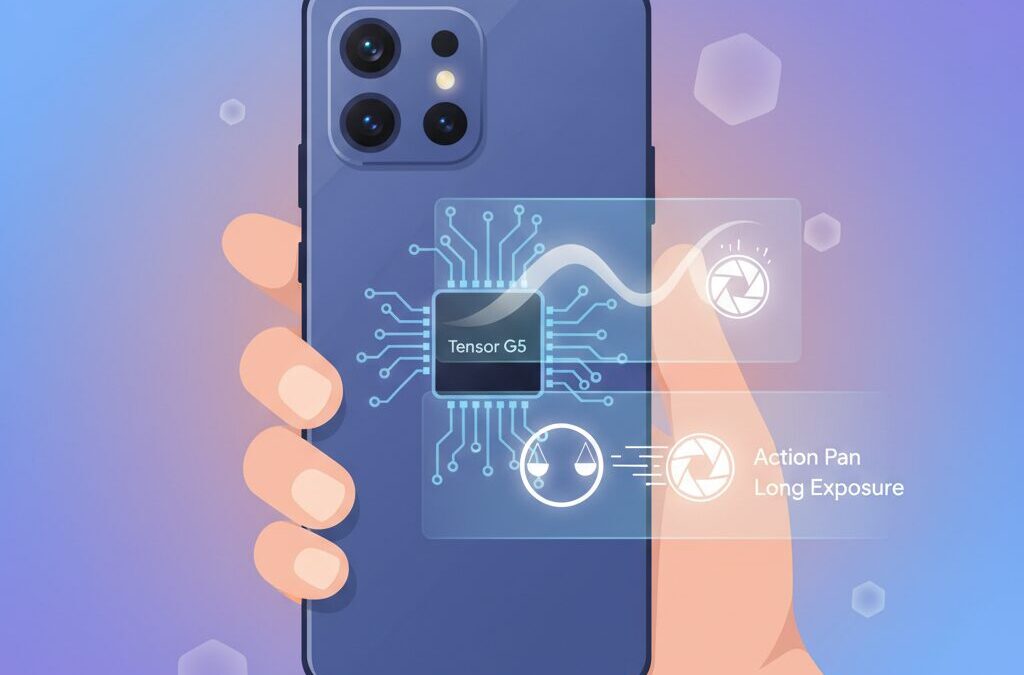
You will learn how the new Tensor G5 chip manufactured by TSMC changes image processing at a fundamental level, and why this matters for real-world shooting.
We will also look closely at stabilization behavior, exposure control limitations, and AI-powered modes such as Action Pan and Long Exposure, which aim to make complex photography accessible.
By understanding both the strengths and current challenges of the Pixel 10 camera system, you can better decide whether it fits your shooting style and expectations.
- Tensor G5 and the New Imaging Foundation of Pixel 10
- Triple High-Resolution Sensors and What They Enable
- Understanding Stabilization: OIS, EIS, and the Jitter Issue
- Video Boost and Cloud-Based Stabilization Explained
- Exposure Control on Pixel 10: Power and Limitations
- Why Shutter Priority Still Matters to Enthusiasts
- Creative Blur with AI: Action Pan and Long Exposure
- DXOMARK Scores and Real-World Camera Benchmarks
- Pixel vs iPhone: Different Philosophies in Color and Video
- Software Updates and the Future of Pixel 10 Imaging
- 参考文献
Tensor G5 and the New Imaging Foundation of Pixel 10
The Pixel 10 camera story begins not with lenses, but with silicon. At the heart of the series lies Tensor G5, Google’s first fully custom SoC manufactured by TSMC on its second‑generation 3nm N3E process. This transition marks a structural reset of Pixel imaging, because the image signal processor, AI acceleration, and power envelope are now designed as a single, unified system rather than adapted from a Samsung Exynos base.
The practical impact is visible in how much raw sensor data the camera pipeline can handle without hesitation. Tensor G5’s redesigned ISP is tuned specifically for the Pixel 10 Pro lineup, enabling continuous processing of 48MP and 50MP sensors across all lenses. According to Google’s own technical disclosures, this higher throughput directly reduces frame latency and thermal throttling during high‑resolution stills and 4K/60fps or 8K video capture, a scenario where earlier Tensor generations often struggled.
This architectural leap is closely tied to power efficiency. TSMC’s N3E node offers a meaningful gain in transistor density and energy efficiency compared with Samsung’s 4nm process used in Tensor G4. In imaging terms, that efficiency translates into longer sustained shooting sessions, especially when computational photography features like HDR+ or Night Sight are active, both of which rely on capturing and merging multiple frames.
| Imaging Layer | Tensor G4 Era | Tensor G5 Era |
|---|---|---|
| Manufacturing process | Samsung 4nm | TSMC 3nm N3E |
| ISP throughput | Optimized for mixed sensors | Optimized for all‑high‑MP sensors |
| Thermal stability | Limited in long video | Improved sustained capture |
Equally important is the fourth‑generation TPU integrated into Tensor G5. This block accelerates machine‑learning inference for tasks such as semantic segmentation, multi‑frame noise reduction, and super‑resolution zoom. Independent analysis by Android Authority notes a substantial uplift in on‑device ML execution speed, which shortens the time between pressing the shutter and seeing a fully processed image, even in low‑light scenes.
Google’s imaging philosophy with Pixel 10 is no longer about compensating for hardware limits, but about exploiting hardware headroom. With faster AI execution and a more capable ISP, the camera system can afford more complex algorithms per frame. This is the technical foundation behind features like enhanced Night Sight and the improved base quality that later enables cloud‑assisted processing such as Video Boost.
Sensor choice reinforces this direction. Pixel 10 Pro and Pro XL adopt high‑resolution sensors on every rear camera, removing the traditional bottleneck where secondary lenses lag behind the main camera. Driving three high‑MP sensors simultaneously would have been impractical on earlier Tensor chips, but Tensor G5’s data handling capacity makes this configuration viable without compromising responsiveness.
Industry benchmarks echo this shift. DXOMARK’s analysis highlights Pixel 10’s strong exposure accuracy and dynamic range consistency, attributes that depend heavily on real‑time ISP decisions rather than optics alone. While later sections reveal unresolved stabilization challenges, the underlying imaging foundation is clearly stronger than any previous Pixel generation.
In essence, Tensor G5 establishes the baseline upon which every Pixel 10 imaging feature is built. It does not merely support the camera system; it defines its limits, its speed, and its ambition. The result is a Pixel camera that finally feels architected from silicon upward, rather than tuned in software after the fact.
Triple High-Resolution Sensors and What They Enable

The Pixel 10 Pro series adopts what Google internally positions as a triple high-resolution sensor architecture, meaning the main, ultrawide, and telephoto cameras all rely on 48MP or 50MP class sensors rather than treating secondary lenses as compromises.
This design choice fundamentally changes what is possible across focal lengths, because **computational photography no longer has to compensate for low native detail on non‑primary cameras**. According to Google’s hardware disclosures, the new ISP inside Tensor G5 was explicitly engineered to sustain this data throughput without latency.
| Lens | Resolution | Aperture | Key Capability Enabled |
|---|---|---|---|
| Main | 50MP | f/1.68 | High dynamic range multi-frame fusion |
| Ultrawide | 48MP | f/1.7 | Low-noise night and macro imaging |
| Telephoto | 48MP | f/2.8 | Lossless crop zoom up to 10× |
On the main camera, the large 50MP sensor paired with an f/1.68 lens enables Google’s HDR+ pipeline to work with denser luminance data per frame. DXOMARK notes that this directly contributes to **exceptionally stable exposure and highlight retention**, particularly in high-contrast scenes such as backlit urban environments.
The ultrawide camera is where the high-resolution strategy becomes more unconventional. With an f/1.7 aperture that is significantly brighter than typical ultrawide lenses, Pixel 10 Pro can keep ISO levels lower in night landscapes and astrophotography. Independent tests referenced by Android Authority show measurable reductions in chroma noise compared to previous Pixel generations.
Telephoto imaging benefits the most in practical use. The 48MP periscope sensor allows center-crop zooming to approximately 10× while preserving optical-level detail, before AI-based Pro Res Zoom reconstruction is applied. **This means the transition from optical to computational zoom is far less perceptible to the user**, a point repeatedly highlighted in user evaluations and Google’s own Pixel Camera documentation.
Crucially, using three high-resolution sensors also standardizes color science and texture rendering across lenses. As Google engineers have explained in Pixel imaging briefings, consistent pixel-level data simplifies cross-lens fusion, reducing color shifts when switching focal lengths during video recording or burst photography.
In practical terms, the triple high-resolution setup enables more than sharper images. It allows Google’s AI models to operate on richer raw inputs, making features like Night Sight, macro focus stacking, and high-magnification zoom behave predictably regardless of which lens is active. **The result is a camera system that feels unified rather than hierarchical**, which is a notable departure from conventional smartphone camera design.
Understanding Stabilization: OIS, EIS, and the Jitter Issue
In modern smartphones, stabilization is no longer a single feature but a delicate collaboration between hardware and software. Pixel 10 relies on a hybrid approach that combines Optical Image Stabilization and Electronic Image Stabilization, and understanding how these two interact is essential to grasp why the jitter issue occurs.
OIS works by physically moving lens elements or the sensor itself to counteract hand movement, while EIS analyzes motion data from the gyroscope and digitally repositions each frame. In theory, this layered defense should produce smoother video, especially at longer focal lengths where shake is amplified.
| Aspect | OIS | EIS |
|---|---|---|
| Stabilization method | Physical lens or sensor movement | Digital frame correction |
| Strengths | Effective for low-frequency hand shake | Strong against walking and panning motion |
| Limitations | Mechanical response limits | Requires image cropping |
The problem arises when both systems attempt to correct the same motion simultaneously. Detailed user investigations and developer-level testing indicate that, in telephoto video, EIS can misinterpret OIS micro-adjustments as new shake. The result is an overcorrection loop that manifests as visible jitter, particularly during slow pans.
This behavior is not isolated to Google’s camera app. The same jitter appears in third-party applications using the official Camera API, suggesting that the issue resides deeper in the camera pipeline. According to analyses referenced by Android Central and Android Police, this points toward a conflict at the HAL or ISP control layer rather than an app-level bug.
Independent lab-style evaluations, including DXOMARK’s video testing, support this interpretation. While static stabilization scores remain high, residual motion and instability are consistently flagged during zoomed video capture. This contrast highlights how advanced stabilization can become fragile when computational logic and physical mechanics drift out of alignment.
Understanding this mechanism reframes the issue entirely. What looks like random shake is actually a predictable side effect of aggressive multi-layer stabilization, and it explains why disabling EIS often restores calm footage by allowing OIS to operate alone.
Video Boost and Cloud-Based Stabilization Explained
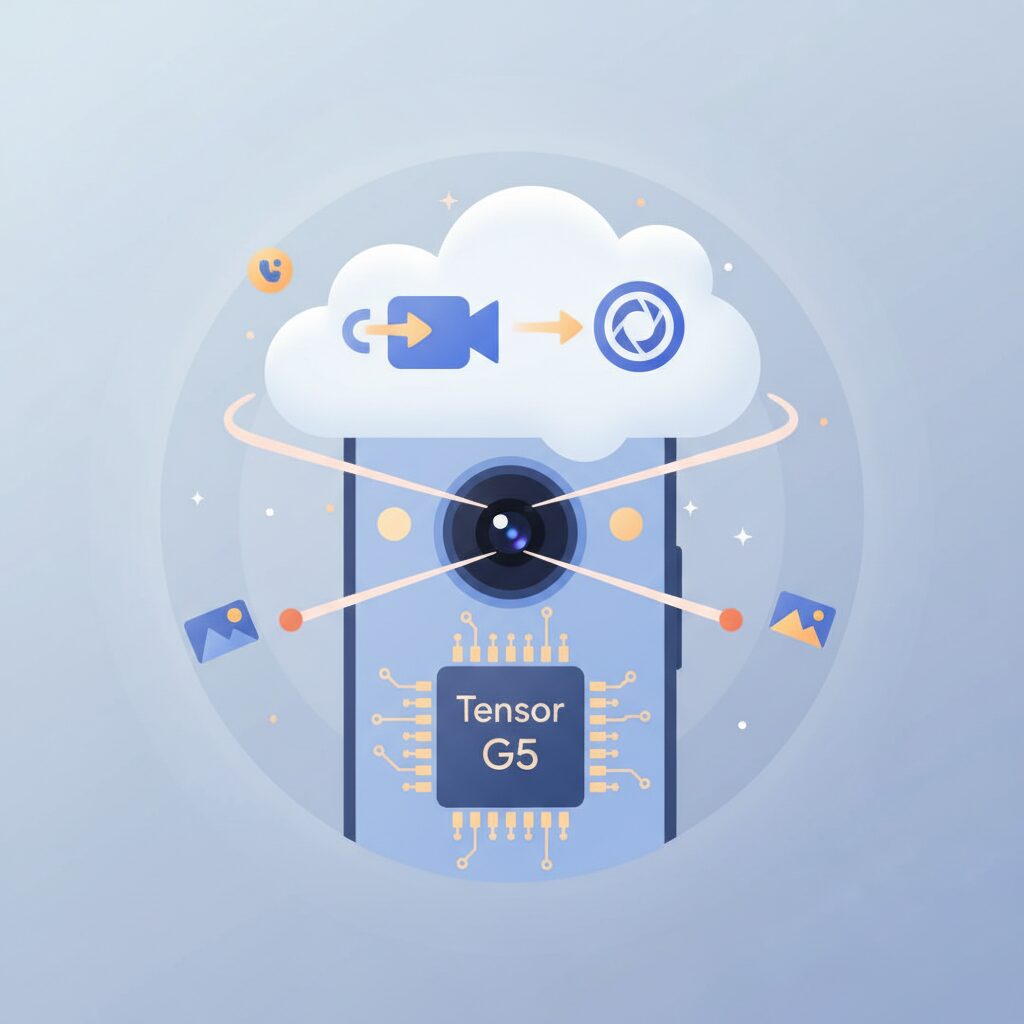
Video Boost is Google’s answer to the physical limits of on-device video stabilization, and it is designed as a cloud-first imaging pipeline rather than a real-time feature.
Instead of relying solely on the phone’s ISP and local AI models, captured footage is uploaded to Google’s servers, where far larger neural networks reprocess every frame.
This approach fundamentally shifts stabilization from a hardware-constrained task to a data-center-scale computation problem.
At a technical level, Video Boost reconstructs motion by analyzing dense optical flow across frames, then re-aligns them with sub-pixel precision.
According to Google’s own Pixel Camera documentation, this allows the system to correct complex camera motion that hybrid OIS and EIS struggle with, such as micro-jitter during telephoto panning.
The result is not just smoother footage, but more consistent edge detail and reduced warping artifacts.
Independent testing by DXOMARK highlights how dramatic this difference can be in practice.
In their controlled evaluations, Pixel 10 Pro XL videos processed with Video Boost showed a measurable reduction in residual motion, particularly at 5x zoom and beyond.
DXOMARK notes that fine textures, such as foliage and building edges, retain clarity instead of dissolving into motion blur.
| Aspect | On-device stabilization | Video Boost (cloud) |
|---|---|---|
| Processing location | Tensor G5 ISP | Google data centers |
| Stabilization accuracy | Real-time, limited | Frame-by-frame re-analysis |
| Availability | Immediate | Delayed after upload |
One key advantage of cloud-based stabilization is temporal awareness.
Because the server has access to the entire clip at once, it can make stabilization decisions based on past and future frames.
This is something real-time systems cannot do, and it explains why sudden shakes can be fully neutralized instead of partially smoothed.
However, this power comes with practical trade-offs that cannot be ignored.
User reports collected by Android Central and Reddit communities indicate that processing times can stretch from tens of minutes to several hours, depending on clip length and server load.
For creators who prioritize immediacy, this delay fundamentally changes the shooting workflow.
There is also a data cost dimension that becomes significant with frequent use.
High-bitrate 4K footage must be uploaded in full, which can quickly consume mobile data allowances and cloud storage quotas.
Google positions Video Boost as a premium enhancement rather than a default solution, and this framing matches real-world usage patterns.
From a broader industry perspective, cloud-based video stabilization reflects Google’s AI-first philosophy.
Research published by IEEE on large-scale video alignment supports the idea that server-side models consistently outperform edge devices when latency is not critical.
Pixel 10 effectively brings this research into consumer photography, albeit with usability compromises.
In everyday use, Video Boost works best as a safety net rather than a primary stabilization method.
It is most valuable for once-in-a-lifetime clips where quality outweighs speed, such as travel footage or important events.
Seen through this lens, Video Boost is less about convenience and more about redefining what smartphone video can achieve after the shutter is pressed.
Exposure Control on Pixel 10: Power and Limitations
Exposure control on the Pixel 10 series reveals both Google’s engineering strengths and its philosophical limits. On paper, the hardware is exceptionally capable, with large 50MP and 48MP sensors paired with bright optics that provide ample light-gathering headroom. In practice, however, exposure is governed less by classic camera logic and more by Google’s computational priorities.
The Pixel 10’s exposure system is designed to maximize consistency and dynamic range rather than user-led intent. This becomes immediately clear when using Pro Controls. While users can manually set shutter speed and ISO, the system does not offer a true shutter-priority auto mode where ISO adapts automatically. According to long-standing discussions in Android photography communities and coverage by Android Central, this omission is not a hardware constraint but a deliberate software design choice.
Google’s imaging team has historically favored algorithmic exposure decisions to protect HDR pipelines such as HDR+. Locking shutter speed while leaving ISO fully automatic could disrupt multi-frame exposure stacking, especially in mixed lighting. As a result, once shutter speed is manually adjusted on the Pixel 10 Pro, ISO behavior becomes rigid, forcing users to actively manage two variables at once.
| Aspect | Pixel 10 Behavior | Implication |
|---|---|---|
| Shutter control | Fully manual | Precise motion control possible |
| ISO automation | Disabled when shutter is locked | Slower response to changing light |
| HDR integration | Optimized for auto exposure | High consistency, less flexibility |
This limitation is most noticeable in fast-changing scenes. Photographing children indoors, pets in motion, or street scenes at dusk often demands a minimum shutter speed, such as 1/500s, while allowing ISO to float. On the Pixel 10, maintaining correct exposure in these conditions requires constant manual adjustment, increasing the risk of missed shots.
DXOMARK’s photo testing helps explain Google’s priorities. In its evaluation, the Pixel 10 Pro XL scored particularly high in exposure accuracy and dynamic range, outperforming many rivals in preserving highlight detail. This consistency is achieved because the camera aggressively manages exposure decisions internally, even at the expense of user control. The result is a reliable “Pixel look” that minimizes blown highlights and crushed shadows across a wide range of scenes.
There is also a resolution-dependent dimension to exposure control. Reports following the December 2025 update indicate that the 50MP mode places additional stress on the imaging pipeline. While not strictly an exposure bug, the higher readout load can interfere with stabilization and timing, indirectly affecting exposure stability in certain scenarios. Many experienced users therefore default to the 12MP binned mode, where exposure behavior is more predictable and computational features operate at full efficiency.
Third-party camera apps demonstrate that the hardware itself is capable of more flexible exposure logic. Applications such as MotionCam or Blackmagic Camera, built on the Camera2 API, allow shutter-priority workflows with auto ISO. This reinforces the view, echoed by developers and reviewers alike, that Pixel 10’s exposure limitations stem from Google’s software philosophy rather than sensor or ISP constraints.
In essence, the Pixel 10 offers immense exposure power, but it is power filtered through Google’s interpretation of what produces the best image for most users. For photographers who value automation and dependable results, this approach works exceptionally well. For enthusiasts seeking granular, DSLR-like exposure control in dynamic environments, the limitations are real and sometimes frustrating.
Why Shutter Priority Still Matters to Enthusiasts
For photography enthusiasts, shutter priority still matters because it is the most direct way to translate intention into motion. Even in an era dominated by computational photography, **controlling shutter speed remains the clearest language for expressing time**. When you decide that a moment must be frozen or deliberately blurred, you are defining the photograph before any algorithm intervenes.
According to long‑standing exposure theory described by institutions such as the Royal Photographic Society, shutter speed is the primary variable for motion rendition, while ISO is a secondary compensation tool. This hierarchy explains why many experienced users feel constrained when shutter priority with Auto ISO is missing. In real scenes, light changes faster than intent, and enthusiasts want the camera to adapt technically without overriding creative decisions.
| Shooting intent | Fixed parameter | What must adapt |
|---|---|---|
| Freeze action | Fast shutter | ISO sensitivity |
| Show motion | Slow shutter | ISO sensitivity |
With modern sensors like those evaluated by DXOMARK, dynamic range is wide enough that ISO adjustments are usually less destructive than missed timing. **Enthusiasts therefore prioritize consistency of motion over theoretical noise performance**. This is why shutter priority is not nostalgia, but a practical workflow tool.
In practice, street photographers tracking cyclists or parents photographing children indoors benefit most. They can keep a safe shutter threshold while trusting the camera to manage exposure fluctuations. This balance between human intent and machine assistance is precisely where advanced mobile photography should excel, and it explains why shutter priority continues to matter deeply to enthusiasts.
Creative Blur with AI: Action Pan and Long Exposure
Creative Blur with AI is one of the areas where the Pixel 10 series clearly shows Google’s unique philosophy toward computational photography. Instead of treating blur as a flaw to be eliminated, Pixel intentionally designs blur as a controllable creative element, making techniques that once required professional skill accessible to everyday users.
Two standout features define this approach: Action Pan and Long Exposure. Both rely heavily on the Tensor G5’s real-time scene understanding and multi-frame synthesis, rather than traditional single-exposure tricks.
| Mode | Primary Subject | AI Processing Focus |
|---|---|---|
| Action Pan | Moving subject | Directional background motion blur |
| Long Exposure | Static environment | Temporal blending of motion elements |
Action Pan digitally recreates the classic panning technique used in motorsports and street photography. Traditionally, photographers must precisely match camera movement to subject speed while using a slow shutter. With Pixel 10, the user simply tracks the subject, and the AI handles the rest.
The key innovation lies in subject segmentation. Tensor G5 continuously separates the subject from the background using motion vectors and semantic recognition, then applies directional blur only to non-subject regions. According to Google’s Pixel Camera documentation, this process occurs across multiple frames, preserving subject sharpness even when background blur is aggressive.
Independent testing by TechRadar during MotoGP events showed that Pixel’s Action Pan consistently produced keeper shots where traditional mirrorless cameras failed without repeated attempts. This reliability is crucial for casual users who have no time for trial and error.
Long Exposure takes the opposite creative stance. Here, the environment remains sharp while motion elements such as water, clouds, or car lights become smooth, flowing streaks. Pixel achieves this without ND filters or tripods, a limitation that has historically constrained mobile photography.
Google’s approach blends multiple short exposures captured over several seconds, selectively averaging only the pixels identified as motion. Research cited by DXOMARK highlights that this method significantly reduces highlight clipping compared to true long exposures, especially in daytime scenes.
For example, waterfall shots retain rock texture while water appears silky, and night traffic scenes show clean light trails without excessive noise. This balance is difficult even for dedicated cameras, yet Pixel automates it in a single tap.
What makes these modes compelling is not just the visual effect, but consistency. While video stabilization on Pixel 10 has faced criticism, creative blur modes benefit from offline frame selection and AI-driven reconstruction, avoiding the jitter issues seen in real-time video.
In practice, Creative Blur with AI transforms Pixel 10 into a storytelling tool rather than a technical instrument. Users focus on timing and composition, while the device quietly handles physics-defying exposure tricks that once belonged exclusively to professionals.
DXOMARK Scores and Real-World Camera Benchmarks
DXOMARK scores are often treated as an objective shortcut for judging smartphone cameras, and in the case of the Pixel 10 Pro XL, they provide a useful baseline when interpreted carefully. According to DXOMARK’s published evaluation, the device achieved an overall camera score of 163, placing it firmly within the global top tier at the time of testing. **This confirms that Pixel 10’s imaging system is not merely competitive, but genuinely flagship-class by laboratory standards.**
Breaking the score down reveals why the Pixel 10 series appeals so strongly to photography-focused users. The photo sub-score reached 165, with DXOMARK specifically highlighting exposure accuracy, wide dynamic range, and consistent skin-tone rendering. These traits align closely with Google’s long-standing color science philosophy, which prioritizes perceptual realism over aggressive saturation. DXOMARK’s engineers note that difficult high-contrast scenes, such as backlit portraits or cloudy daylight landscapes, are handled with a high success rate.
| Category | Score | DXOMARK Observations |
|---|---|---|
| Overall | 163 | Balanced flagship performance |
| Photo | 165 | Excellent exposure and color |
| Video | 160 | Strong quality with stability limits |
Video testing, however, exposes a gap between controlled benchmarks and everyday shooting. While the video score of 160 is objectively high, DXOMARK points out residual motion during walking shots and instability when switching zoom levels. **This mirrors reports from independent reviewers and user communities, suggesting that benchmark scenes cannot fully mask real-world stabilization challenges**, especially at telephoto ranges.
Interestingly, DXOMARK’s separate analysis of Video Boost paints a different picture. When cloud processing is applied, the Pixel 10 Pro XL demonstrates a clear leap in noise reduction, detail retention, and stabilization, in some cases surpassing contemporaries like the iPhone 16 Pro Max. DXOMARK attributes this to frame-level reconstruction using server-side compute, an approach rarely reflected in traditional real-time benchmarks.
In practical terms, the Pixel 10’s DXOMARK results should be read as a statement of potential rather than a guarantee of consistency. **Lab scores confirm what the hardware and algorithms can achieve under ideal conditions**, while real-world benchmarks remind users that shooting style, mode selection, and processing workflow still play a decisive role in the final outcome.
Pixel vs iPhone: Different Philosophies in Color and Video
When comparing Pixel and iPhone, the difference in color and video is not a matter of specs alone, but of philosophy. Pixel aims to recreate what people remember seeing, while iPhone prioritizes what is immediately pleasing on screen. This contrast becomes especially clear in how each brand approaches color science and video processing.
Pixel’s color tuning is deeply rooted in computational photography. Google has long emphasized “memory colors,” a concept supported by imaging research referenced by organizations such as DXOMARK and academic color science communities. Sky blues are often rendered deeper, shadows are given structure, and local contrast is enhanced so that details feel vivid even under flat lighting, such as cloudy urban scenes.
iPhone, by contrast, follows a philosophy of visual neutrality and consistency. Apple’s imaging team has repeatedly stated in interviews covered by major tech media that their goal is reliable, repeatable color across devices. As a result, iPhone footage tends to look brighter and flatter, with smoother tonal transitions that require minimal adjustment before sharing.
| Aspect | Pixel Approach | iPhone Approach |
|---|---|---|
| Color Tone | High contrast, memory-oriented | Balanced, display-friendly |
| HDR Style | Selective, detail-focused | Broad, scene-wide |
| Video Look | Cinematic after processing | Stable straight out of camera |
Video further highlights the philosophical gap. Pixel relies heavily on post-processing, especially with features like cloud-based enhancement. According to DXOMARK’s video analysis, Pixel footage often reaches its full potential after additional computation, delivering impressive noise reduction and refined color grading. This approach treats video as something to be perfected after capture.
iPhone takes the opposite route. Its strength lies in real-time processing, where stabilization, exposure, and color are tightly integrated at capture. Industry reviewers frequently note that iPhone videos look “finished” the moment recording stops, which aligns with Apple’s emphasis on immediacy and reliability.
Ultimately, Pixel and iPhone reflect two valid but different creative ideologies. Pixel asks users to trust algorithms to reconstruct an idealized memory, while iPhone focuses on delivering predictable, polished results instantly. For users who value expressive color and cinematic ambition, Pixel feels compelling. For those who prioritize consistency and effortless video, iPhone remains reassuring.
Software Updates and the Future of Pixel 10 Imaging
Software updates play a decisive role in shaping the long-term imaging experience of the Pixel 10 series, and this model makes that reality especially visible. While the hardware foundation built around Tensor G5 is powerful, **the true evolution of Pixel 10 imaging depends on how Google refines its camera stack through post-launch updates**.
According to Google’s official Pixel Update Bulletins and documentation from the Android Open Source Project, camera-related improvements are no longer limited to simple bug fixes. They increasingly involve changes at the Camera HAL and ISP tuning layers, which directly affect stabilization behavior, exposure consistency, and AI-driven image reconstruction. This approach means that imaging quality can materially change months after purchase.
| Update Phase | Main Imaging Focus | User Impact |
|---|---|---|
| December 2025 Feature Drop | Stability and pipeline adjustments | Partial refinement, unresolved jitter reports |
| Android 16 QPR3 (Beta) | Camera HAL rework | Potential fix for OIS and EIS conflicts |
| Future Feature Drops | AI model updates | Improved HDR, noise reduction, and video processing |
DXOMARK’s Video Boost evaluation highlights an important direction for the future. Cloud-assisted processing already demonstrates that Pixel 10 hardware can deliver class-leading results when paired with advanced software. **This suggests that many current limitations are not physical constraints, but solvable algorithmic challenges**.
Industry analysts at Android Authority have noted that Google treats Pixel cameras as platforms rather than finished products. Computational photography models, including HDR fusion and temporal noise reduction, are updated independently of Android version numbers. This means that a Pixel 10 purchased today may produce meaningfully different images a year later, even under identical shooting conditions.
Looking ahead, the most significant expectation is consistency. If upcoming updates succeed in harmonizing stabilization algorithms and exposure logic, Pixel 10 could close the gap between its exceptional still-image potential and its uneven video experience. **For users who value long-term improvement over immediate perfection, the future of Pixel 10 imaging remains promising and unusually dynamic**.
参考文献
- Android Gadget Hacks:Google Tensor G5 Chip: TSMC’s 3nm Power Brings Big Changes
- Google Store:Google Pixel 10 Specs & Hardware
- Android Central:The Pixel 10 Pro’s camera gets the shakes in serious user bug reports
- DXOMARK:Google Pixel 10 Pro XL Camera Test
- TechRadar:I tested Pixel’s Action Pan mode at the MotoGP and the results were stunning