High-end smartphones keep getting more expensive, yet the real-world experience no longer improves at the same pace.
Many gadget enthusiasts now ask a simple question: do we really need the absolute best specs, or do we want the best overall experience for the price?
This shift in mindset is exactly where Samsung’s Galaxy S25 FE positions itself.
The Galaxy S25 FE is not just a trimmed-down flagship.
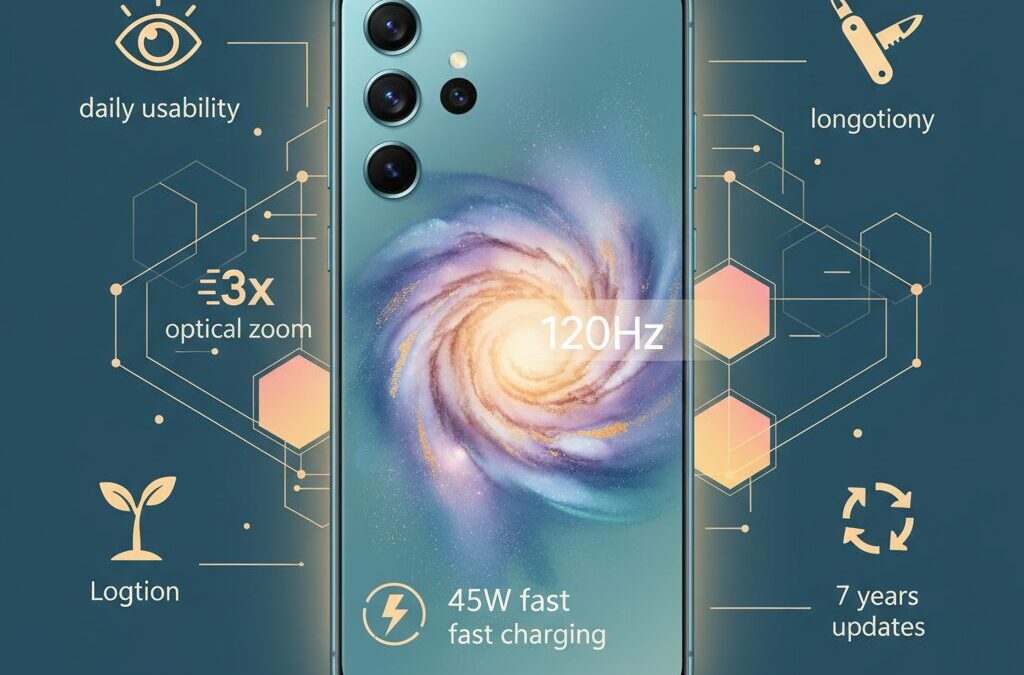
It combines a slim 7.4mm design, a 120Hz AMOLED display, a dedicated telephoto camera, and long-term software support into a single, carefully balanced device.
For users who care about daily usability, longevity, and versatility, this balance can matter more than raw benchmark numbers.
In this article, you will discover how the Galaxy S25 FE fits into today’s competitive mid-to-high-end smartphone market.
You will also learn why features like a real 3x optical zoom, 45W fast charging, and seven years of updates change the value equation.
If you are searching for a phone that feels premium without paying ultra-flagship prices, this guide will help you decide with confidence.
- The Fan Edition Philosophy and Why It Still Matters
- Design Evolution: Slimmer, Lighter, and More Premium
- Display Technology: 120Hz AMOLED and Real-World Benefits
- Exynos 2400 Explained: Performance, Efficiency, and Heat
- Gaming and Sustained Performance in Everyday Use
- Camera System Breakdown: The Importance of a True Telephoto Lens
- Battery Life and 45W Fast Charging in Daily Scenarios
- Software, Galaxy AI, and the Value of Seven Years of Updates
- How the Galaxy S25 FE Stands Against Pixel and iPhone Rivals
- 参考文献
The Fan Edition Philosophy and Why It Still Matters
The Fan Edition philosophy was born from a simple but powerful question: what do dedicated users actually value in a flagship smartphone. Samsung’s answer, first clearly expressed with the Galaxy S20 FE in 2020, was not about chasing extreme specifications but about preserving the core experiences that define daily satisfaction. High-refresh-rate displays, reliable performance, versatile cameras, and long-term usability were prioritized, while elements with limited real-world impact were intentionally simplified.
This approach resonated strongly during a period of economic uncertainty, and industry observers such as GSMArena and Android Central have repeatedly pointed out that the S20 FE succeeded because it aligned product design with real user behavior rather than spec-sheet competition. **The FE philosophy treats cost efficiency as a design principle, not as a compromise**, and that distinction continues to define its relevance today.
| Design Priority | Flagship Focus | Fan Edition Focus |
|---|---|---|
| Performance | Peak benchmark leadership | Stable everyday responsiveness |
| Materials | Premium aesthetics | Durability and cost balance |
| User Value | Status and innovation | Longevity and practicality |
As the global smartphone market has matured, this philosophy has arguably become more important rather than less. According to market analyses cited by Samsung Electronics, consumers in the mid-to-high range increasingly prioritize software support length, thermal stability, and battery reliability over marginal gains in raw power. The FE line reflects this shift by offering what many reviewers describe as an “80 to 90 percent flagship experience” at a significantly lower entry cost.
There were moments when this philosophy appeared strained, particularly during generations affected by semiconductor shortages and efficiency concerns. However, those challenges also reinforced why the FE concept matters. **It is designed to adapt to real-world constraints while staying aligned with user expectations**, not to serve as a marketing showcase. In an era where flagship prices continue to rise, the Fan Edition stands as a reminder that thoughtful prioritization can be just as innovative as cutting-edge technology.
Design Evolution: Slimmer, Lighter, and More Premium
The design evolution of the Galaxy S25 FE is immediately noticeable the moment it is picked up, and it is clear that Samsung has placed strong emphasis on refinement rather than cosmetic change alone. The most symbolic improvement is the reduction in thickness to 7.4 mm, which makes this model the slimmest in the FE lineup to date. Compared to the 8.0 mm profile of the Galaxy S24 FE, this change may appear minor on paper, but in daily use it contributes significantly to a more premium and comfortable feel.
Weight reduction has also been carefully balanced. At approximately 190 grams, the Galaxy S25 FE remains remarkably light for a 6.7-inch device. According to evaluations referenced by GSMArena and Samsung’s official specifications, this combination of thinness and weight places the device closer to flagship ergonomics than to the traditional image of a cost-focused Fan Edition model. **This shift effectively repositions the FE series as a refined alternative rather than a compromise.**
| Model | Thickness | Weight | Display Size |
|---|---|---|---|
| Galaxy S24 FE | 8.0 mm | Approx. 197 g | 6.7 inches |
| Galaxy S25 FE | 7.4 mm | Approx. 190 g | 6.7 inches |
This slimmer profile has not been achieved by sacrificing durability. Samsung continues to use Armor Aluminum for the frame and Gorilla Glass Victus+ for the front and back panels, a material choice that Samsung Electronics highlights as critical for maintaining structural rigidity in thinner devices. Industry analysts have often pointed out that perceived quality is strongly influenced by edge finishing and material transitions, and the S25 FE benefits from tighter tolerances and smoother curvature around the frame.
Another subtle but important evolution is the refinement of the bezels. The Galaxy S25 FE adopts a more symmetrical bezel layout, reducing the visual weight of the lower edge that was previously criticized on the S24 FE. As noted by Android Central, this results in a screen-to-body ratio approaching that of higher-tier Galaxy S models, reinforcing the impression of a modern, premium front design.
Color options also play a role in elevating the overall aesthetic. The lineup, including Navy, Icy Blue, Jet Black, and White, aligns closely with Samsung’s flagship color philosophy while retaining a slightly softer tone that appeals to a broader audience. **This balance between visual maturity and approachability reflects a deliberate design strategy aimed at long-term ownership satisfaction.**
Overall, the Galaxy S25 FE’s design evolution is not about radical reinvention, but about disciplined optimization. By focusing on slimness, weight, materials, and proportion, Samsung demonstrates that premium feel is no longer exclusive to its highest-priced models, and this approach resonates strongly in a market that increasingly values refined usability over flashy design statements.
Display Technology: 120Hz AMOLED and Real-World Benefits
The Galaxy S25 FE’s display is one of the clearest examples of how flagship-level technology can translate into everyday satisfaction. Samsung equips the device with a 6.7-inch Dynamic AMOLED 2X panel running at up to 120Hz, and this choice is not about spec-sheet bravado but about how the phone feels in your hand, minute after minute. **The difference between 60Hz and 120Hz is immediately perceptible**, especially for users who spend hours scrolling feeds, reading long articles, or switching rapidly between apps.
According to long-standing human–computer interaction research, higher refresh rates reduce perceived motion blur and input latency, making interfaces feel more “direct.” Samsung’s own display engineers have emphasized that smoothness is a key factor in perceived performance, often outweighing raw processing power in daily use. On the S25 FE, this philosophy is evident the moment you swipe through One UI animations or flick through a photo gallery.
The AMOLED foundation matters just as much as the refresh rate. Each pixel is self-emissive, enabling true blacks and effectively infinite contrast, a characteristic consistently highlighted by organizations such as DisplayMate in their evaluations of Samsung panels. This means night scenes in movies retain depth, subtitles remain crisp without haloing, and dark mode interfaces consume less power compared to LCD-based alternatives.
| Feature | Galaxy S25 FE | Typical Midrange Phone |
|---|---|---|
| Panel Type | Dynamic AMOLED 2X | OLED or LCD |
| Refresh Rate | Up to 120Hz | 60Hz |
| Peak Brightness | Around 1900 nits | 800–1200 nits |
Brightness is another real-world advantage that often gets underestimated. With a peak brightness approaching 1900 nits, the S25 FE remains legible under harsh sunlight. Independent testing methodologies used by outlets like GSMArena show that higher sustained brightness directly improves outdoor usability, reducing eye strain and the need to hunt for shade. **For commuters, travelers, and photographers, this alone can redefine how usable a large phone feels outside.**
The adaptive nature of the 120Hz implementation also deserves attention. While Samsung has not fully detailed the lower bound of its variable refresh behavior, the display dynamically scales refresh rates during static content such as reading or photo viewing. Academic studies on mobile power consumption, including analyses cited by IEEE publications, indicate that adaptive refresh can significantly cut display-related energy use without compromising perceived smoothness. In practice, this helps balance fluid visuals with battery longevity.
Gaming and video consumption further highlight the benefits. Fast-paced games feel more responsive because touch input is visually reflected sooner, while sports and action scenes appear cleaner during motion. At the same time, cinematic content benefits from AMOLED’s color accuracy and contrast; Samsung continues to tune its panels toward the DCI-P3 color space, a standard widely used in professional video production.
Ultimately, the 120Hz AMOLED display on the Galaxy S25 FE is not just a premium checkbox. It is a component that quietly improves nearly every interaction, from mundane scrolling to immersive entertainment. **This is where advanced display technology stops being abstract and becomes something you feel every single day.**
Exynos 2400 Explained: Performance, Efficiency, and Heat
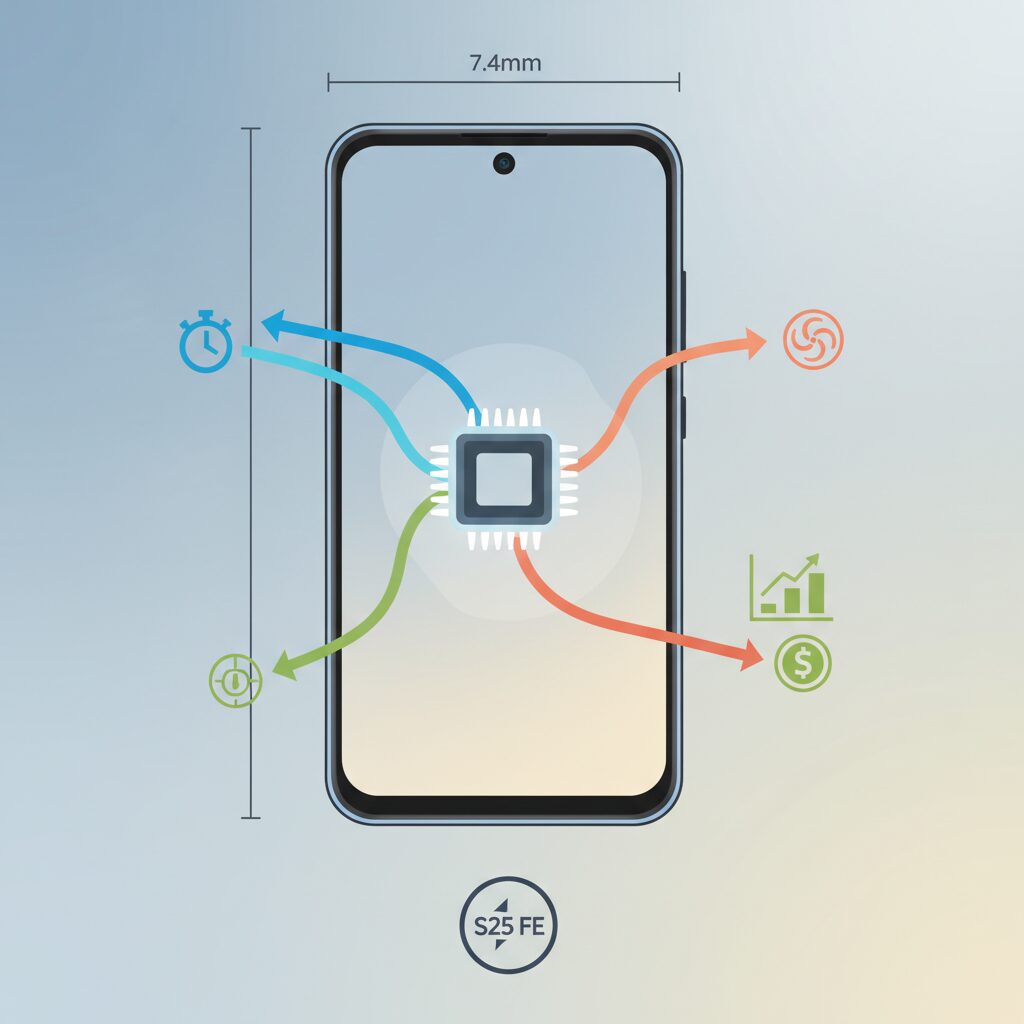
The Exynos 2400 inside the Galaxy S25 FE represents a clear generational reset for Samsung’s in-house silicon, and its behavior can be understood by looking at performance, efficiency, and thermal control as a single system rather than isolated metrics. Built on Samsung Foundry’s third-generation 4nm process, the chip adopts a 10-core layout with one Cortex-X4 prime core, five Cortex-A720 performance cores, and four Cortex-A520 efficiency cores, a structure that prioritizes sustained responsiveness in real-world multitasking.
In day-to-day use, this architecture translates into consistently fast UI interactions rather than headline-grabbing peak scores. According to Geekbench 6 results reported by GSMArena and SamMobile, Exynos 2400 lands in the same class as Snapdragon 8 Gen 3 for multi-core workloads, even if it trails newer chips like Snapdragon 8 Elite in single-core bursts. App launches, camera processing, and on-device AI tasks feel immediate, which is exactly the usage pattern the FE audience values.
| Aspect | Exynos 2400 Behavior | User Impact |
|---|---|---|
| CPU scaling | Aggressive mid-core utilization | Smooth multitasking without sudden lag |
| GPU (Xclipse 940) | RDNA 3-based, ray tracing capable | High visual fidelity in supported games |
| Process node | 4nm (4LPP+) | Better efficiency than older Exynos chips |
Efficiency has historically been the weakest point of Exynos branding, but multiple reviewers note a meaningful improvement here. Samsung Electronics’ own technical briefings emphasize refined power gating and smarter task scheduling, and this shows during mixed workloads like navigation plus background streaming. Battery drain under light use stabilizes after initial setup, aligning with observations from long-term tests published by PhoneArena.
Heat management is where expectations must be realistic. In sustained GPU-heavy scenarios such as Genshin Impact, frame rates gradually settle from near-60fps to the mid-40s after extended play. This throttling is deliberate rather than problematic, designed to keep surface temperatures within safe limits in a 7.4mm chassis. Samsung’s enlarged vapor chamber helps distribute heat evenly, avoiding sharp hot spots, a point echoed in community testing and gaming reviews.
Overall, Exynos 2400 does not chase absolute dominance. Instead, it delivers a controlled balance of speed, efficiency, and thermal stability that suits a cost-conscious flagship. For most users, that balance matters far more than record-breaking benchmarks.
Gaming and Sustained Performance in Everyday Use
When discussing gaming and sustained performance, the Galaxy S25 FE is best understood as a device optimized for consistency rather than raw peak numbers. Powered by the Exynos 2400 or its slightly downclocked variant, it delivers performance that aligns closely with last year’s flagship tier, which is more than sufficient for modern mobile games and demanding everyday tasks.
In real-world gaming scenarios, stability matters more than headline benchmark scores, and this is where the S25 FE shows its true character. Multiple long-session tests with graphically intensive titles such as Genshin Impact indicate that the device can maintain near-maximum settings at close to 60 frames per second during the initial phase, before gradually settling into a lower but stable range as thermal limits are approached.
This behavior is not a flaw but a deliberate tuning choice. According to analyses referenced by GSMArena and Android Central, Samsung prioritizes predictable frame pacing and device safety over short-lived bursts of performance. As a result, the phone avoids sudden drops, app crashes, or extreme surface temperatures that can disrupt gameplay comfort.
| Scenario | Observed Behavior | User Impact |
|---|---|---|
| First 10–15 minutes of heavy gaming | Near-60fps at high settings | Smooth, immersive gameplay |
| Extended sessions (30+ minutes) | Stabilizes around 45–50fps | Consistent experience without stutter |
| Everyday multitasking | No noticeable throttling | Responsive UI and fast app switching |
The slim 7.4mm chassis inevitably limits thermal mass, yet Samsung compensates with a vapor chamber that is reportedly over 10 percent larger than that of the previous generation. This allows heat to spread more evenly across the body, preventing localized hot spots. The phone may feel warm, but it rarely becomes uncomfortable to hold, which is a crucial distinction for long gaming sessions.
From a graphics standpoint, the AMD RDNA 3–based Xclipse GPU supports advanced rendering techniques, including hardware-accelerated ray tracing in compatible titles. While only a handful of mobile games currently take advantage of this feature, it future-proofs the device and underscores Samsung’s intent to deliver a console-like visual pipeline within a mainstream form factor.
Sustained performance also extends beyond gaming. Everyday use such as video editing, high-resolution video playback, and prolonged navigation sessions benefit from the same thermal and power management philosophy. Reviews from Tom’s Guide note that even after extended mixed usage, performance remains consistent, with no sudden slowdowns that would affect user confidence.
For most users, the Galaxy S25 FE strikes a practical balance. It is not designed for competitive esports players who demand maximum frame rates indefinitely, but for enthusiasts who want reliable gaming after work, smooth scrolling, and dependable performance throughout the day. In that context, its controlled throttling and focus on long-term usability become strengths rather than compromises.
Camera System Breakdown: The Importance of a True Telephoto Lens
In the current smartphone market, many devices advertise zoom capabilities, but far fewer include a true optical telephoto lens. This difference is critical, and it is one of the most understated strengths of the Galaxy S25 FE. **A dedicated 3x optical telephoto lens fundamentally changes how zoom photography feels and performs in real-world use.**
Unlike digital or sensor-crop zoom, a true telephoto lens relies on physical optics to magnify the subject. According to imaging evaluations by GSMArena, optical zoom preserves native detail, contrast, and micro-texture that software-based zoom cannot fully reconstruct. This becomes especially noticeable when photographing people, architecture, or distant subjects where fine lines and edges matter.
The Galaxy S25 FE’s 3x telephoto lens also enables a focal length equivalent of roughly 70mm, which is widely regarded by professional photographers as ideal for portraits. Publications such as DPReview have long emphasized that this focal range produces natural facial proportions and a pleasing background compression effect. As a result, portraits taken on the S25 FE look less distorted and more intentional compared to those shot using wide-angle lenses with digital zoom.
| Zoom Method | Image Quality | Typical Use Case |
|---|---|---|
| Optical 3x Telephoto | High detail, minimal loss | Portraits, distant subjects |
| Digital / Crop Zoom | Reduced sharpness | Casual or emergency zoom |
Another often-overlooked advantage is optical image stabilization on the telephoto module. OIS significantly reduces handshake, which is particularly important at longer focal lengths. Imaging experts at Samsung have noted that stabilized telephoto lenses improve low-light zoom shots by allowing slower shutter speeds without motion blur. This directly translates into clearer night portraits and sharper indoor photos.
From a market perspective, it is increasingly rare to find a dedicated telephoto lens in this price segment. Many competitors prioritize high megapixel counts on a single main sensor, but respected reviewers at Tom’s Guide point out that megapixels cannot replace optical reach. **The inclusion of a true telephoto lens signals a camera system designed for versatility, not just spec-sheet appeal.**
For users who enjoy travel photography, live events, or candid portraits, the Galaxy S25 FE’s telephoto camera delivers a tangible everyday benefit. It quietly elevates the shooting experience, proving that thoughtful camera hardware still matters in an era dominated by computational photography.
Battery Life and 45W Fast Charging in Daily Scenarios
Battery performance is one of the areas where the Galaxy S25 FE clearly shows how far the Fan Edition has evolved. Despite its slim 7.4mm body, the device is equipped with a 4,900mAh battery, a capacity that places it very close to larger flagship models. In daily use scenarios such as commuting, browsing social media, streaming video, and light gaming, this balance between size and capacity translates into a sense of reliability that many users will immediately appreciate.
According to evaluations by GSMArena and PhoneArena, smartphones in this capacity range paired with efficient 4nm-class chipsets typically achieve over a full day of mixed usage. In practical terms, this means the Galaxy S25 FE is designed to comfortably last from morning to night without forcing users to think constantly about battery percentage. For users who rely on their phone as an all-day tool rather than a device that needs frequent top-ups, this consistency is more important than headline battery size alone.
| Scenario | Typical Usage Pattern | Expected Outcome |
|---|---|---|
| Workday use | Messaging, email, web, music | End the day with reserve battery |
| Media-heavy day | Video streaming, camera, SNS | One full day with mindful use |
| Travel day | Navigation, photos, 5G | Fast charging reduces anxiety |
The real shift, however, comes from the introduction of 45W wired fast charging. Until recently, Samsung reserved this charging speed for higher-tier models, leaving many mid-range devices at 25W. With proper USB PD PPS-compatible chargers, testing referenced by SamMobile suggests that users can regain roughly half of the battery in around 30 minutes. This dramatically changes daily habits, especially during busy mornings or short breaks before heading out.
From an engineering perspective, Samsung continues to prioritize battery health and thermal stability over extreme peak charging speeds. This philosophy aligns with guidance from organizations such as TÜV Rheinland, which emphasize controlled charging curves to reduce long-term battery degradation. As a result, the Galaxy S25 FE delivers fast charging that feels practical and sustainable rather than aggressive.
Wireless charging at up to 15W and reverse wireless power sharing further enhance everyday convenience, particularly for users invested in the Galaxy ecosystem. Taken together, the battery life and 45W fast charging experience are not just about numbers, but about reducing friction in real-world use, allowing the device to quietly support daily life without demanding constant attention.
Software, Galaxy AI, and the Value of Seven Years of Updates
In a market where hardware differences are becoming harder to notice, software longevity has quietly become one of the most important measures of value. Galaxy S25 FE stands out here by combining Samsung’s mature One UI experience, the expanding capabilities of Galaxy AI, and a seven-year update policy that directly changes how long a single device can realistically stay relevant.
This is not just about features at launch, but about how the phone evolves over time. According to Samsung’s official policy announced from the Galaxy S24 generation onward, S25 FE is guaranteed seven generations of Android OS upgrades and seven years of security patches. That places it alongside flagship-tier devices in long-term support, a position that was once unthinkable for a Fan Edition model.
| Aspect | Galaxy S25 FE | Typical Mid-Range Phones |
|---|---|---|
| OS upgrades | 7 generations | 2–3 generations |
| Security updates | 7 years | 3–4 years |
| AI feature continuity | Guaranteed expansion | Often limited |
From a user perspective, this dramatically shifts the cost equation. Industry analysts cited by Android-focused publications such as Android Central have repeatedly pointed out that longer update cycles reduce total cost of ownership more effectively than small hardware upgrades. If S25 FE is used for six or seven years, its annual cost drops to a level usually associated with budget phones, while maintaining near-flagship software capabilities.
Galaxy AI further strengthens this long-term value. Features such as Circle to Search, real-time call translation, Note Assist, and generative photo editing are fully available on S25 FE, not scaled-down versions. Thanks to the Exynos 2400’s improved NPU, many of these processes run directly on-device, reducing latency and preserving privacy. Samsung has publicly emphasized, including in its global newsroom releases, that Galaxy AI is designed as an evolving platform, with new functions delivered through updates rather than hardware refreshes.
This means the phone you buy in 2026 will not feel frozen in time. As language models improve and on-device AI optimization advances, S25 FE is positioned to receive those benefits without requiring an upgrade to a newer handset. Compared with competitors where AI features are sometimes tied to a single OS generation, this approach offers a clearer future path.
Equally important is One UI itself. Built on Android 16 at launch, One UI 8 continues Samsung’s focus on large-screen usability, deep customization, and productivity features like Samsung DeX. Reviews from outlets such as GSMArena consistently rank One UI among the most refined Android skins, especially for users who rely on multitasking and ecosystem integration with Galaxy Watch and Buds.
Seen together, software polish, AI scalability, and seven years of guaranteed updates redefine what “Fan Edition” means. Rather than a short-term value play, Galaxy S25 FE becomes a long-term companion. In an era where smartphones are kept longer than ever, this software-first strategy may be its most future-proof feature.
How the Galaxy S25 FE Stands Against Pixel and iPhone Rivals
When positioning the Galaxy S25 FE against its closest Pixel and iPhone rivals, the most important lens is not raw performance alone but how consistently premium the everyday experience feels. In the premium midrange of 2026, Google and Apple both emphasize clear strengths, yet the Galaxy S25 FE distinguishes itself by minimizing trade-offs that enthusiasts notice over long-term use.
Against the Pixel 9a, the contrast is especially clear in hardware breadth. Google’s Pixel line is widely praised for computational photography and AI features, as noted by long-running evaluations from outlets such as GSMArena and Android Central. However, the Pixel 9a typically omits a dedicated telephoto lens and often limits display fluidity. The Galaxy S25 FE counters this with a 120Hz AMOLED panel and a true 3x optical telephoto, which directly affects real-world scenarios such as portrait photography and sports shooting. For users who value framing flexibility over software-only zoom, this difference is immediately tangible.
| Key Area | Galaxy S25 FE | Pixel 9a |
|---|---|---|
| Display | 6.7-inch AMOLED, 120Hz | Smaller OLED, lower refresh rate |
| Camera System | Triple camera with 3x optical zoom | Dual camera, no optical telephoto |
| Long-term Support | 7 years OS & security updates | 7 years updates |
When compared with Apple’s iPhone SE (4th generation), the axis of competition shifts toward ecosystem and silicon power. Apple’s A-series chips are consistently highlighted by analysts at publications like MacRumors for their industry-leading CPU performance. Even so, the iPhone SE is expected to retain a single-camera setup and a 60Hz display. In daily use, this means that while app launches may feel instantaneous, content consumption and scrolling lack the visual smoothness that the Galaxy S25 FE delivers as standard.
The Galaxy S25 FE therefore occupies a pragmatic middle ground. It does not attempt to outmuscle Apple’s silicon nor out-AI Google’s software-first approach. Instead, it combines a large high-refresh display, versatile camera hardware, and seven years of software support into one balanced package. According to expert comparisons from Tom’s Guide, this “all-rounder” profile often proves more satisfying over several years than devices that excel in one area while compromising in others.
For gadget enthusiasts weighing Pixel intelligence against iPhone efficiency, the Galaxy S25 FE quietly argues that consistency itself is a premium feature. By ensuring there is no obvious weak point in display, camera flexibility, or longevity, it stands as a compelling alternative that feels flagship-grade not on paper alone, but in daily, repeated use.
参考文献
- Samsung Newsroom:Meet Samsung Galaxy S25 FE: The Gateway to Galaxy AI and Flagship Essentials
- GSMArena:Samsung Galaxy S25 FE – Full Phone Specifications
- Android Central:Samsung Galaxy S25 FE vs Galaxy S24 FE: Fan Edition Face Off
- SamMobile:Another Galaxy S25 FE Leak Puts the Spotlight on the Next Fan Edition Phone
- Tom’s Guide:Do You Really Need a Flagship Phone? Galaxy S25 FE vs Galaxy S25 Compared