
Ultra-thin smartphones have returned to the spotlight, and the Galaxy S25 Edge sits right at the center of this renewed design race.
For gadget enthusiasts who value cutting-edge engineering as much as real-world usability, this device raises an unavoidable question: how thin is too thin?
At just 5.8mm thick and weighing only 163g, the Galaxy S25 Edge challenges long-standing assumptions about performance, durability, and battery life.
This article explores how Samsung managed to compress flagship-level components into such a slim body without turning the phone into a fragile concept piece.
From the titanium frame and internal layout to thermal behavior, camera compromises, and battery decisions, every design choice reveals a careful balance between ambition and caution.
Rather than focusing on specs alone, you will gain insight into the trade-offs that define ultra-thin smartphones in 2025.
By the end of this article, you will clearly understand who the Galaxy S25 Edge is truly made for and what its success—or limitations—mean for the future of smartphone design.
If you are curious about where form factor innovation is heading next, this deep dive will help you see beyond the marketing and into the engineering reality.
- Why Ultra-Thin Smartphones Are Making a Comeback in 2025
- What 5.8mm Really Means for Smartphone Engineering
- Titanium Frames and Structural Durability in Slim Devices
- Inside the Galaxy S25 Edge: Teardown Insights and Internal Layout
- Thermal Limits: Snapdragon 8 Elite Performance Under Pressure
- Display Technology Without Compromise in an Ultra-Thin Body
- Camera Design Choices: 200MP Power Without Optical Zoom
- Battery Capacity vs Safety: Why Samsung Avoided Silicon-Carbon Cells
- Software, AI Optimization, and Long-Term Update Support
- Market Reception and the Reality Behind the Slim Flagship Strategy
- 参考文献
Why Ultra-Thin Smartphones Are Making a Comeback in 2025
For much of the past decade, smartphone evolution has followed a predictable path: larger batteries, bigger camera modules, and steadily increasing weight. By 2024, flagship devices commonly exceeded 200 grams and 8mm in thickness, prompting growing user fatigue. **In 2025, ultra-thin smartphones are returning not as nostalgia products, but as a response to physical discomfort and design stagnation.** According to long-term user surveys cited by GSMArena and Android Authority, complaints about one-handed usability and wrist strain have risen year over year, even as performance gains became less noticeable in daily use.
The comeback is driven by a shift in value perception. Consumers are no longer impressed by incremental spec improvements alone; instead, they are rewarding devices that make advanced technology feel effortless to carry. Samsung’s Galaxy S25 Edge, at just 5.8mm thick and 163g, demonstrates this change vividly. Despite housing a 6.7-inch display and a top-tier Snapdragon chipset, it delivers a tactile experience closer to mid-2010s phones. **Industry analysts at TechInsights describe this as a transition from “feature accumulation” to “form-factor optimization.”**
Another key factor is maturity in semiconductor efficiency. Modern 3nm-class processors allow manufacturers to maintain flagship-level responsiveness without relying on massive thermal buffers. This enables thinner chassis without catastrophic performance loss in everyday tasks. While sustained heavy workloads still expose limits, most users spend the majority of time on browsing, messaging, and video. Research summarized by Qualcomm indicates that over 70% of smartphone usage consists of short, burst-like interactions, a pattern that aligns well with ultra-thin designs.
| Design Trend | 2019–2023 | 2025 Shift |
|---|---|---|
| Primary Focus | Battery & camera size | Weight & thickness |
| Average Flagship Weight | 195–215g | 160–180g |
| User Priority | Specs on paper | Comfort in hand |
The ultra-thin revival is also influenced by competitive signaling. Reports from Bloomberg and Nikkei Asia note that both Samsung and Apple view slim models as brand statements, showcasing manufacturing prowess rather than pure sales volume plays. Even if such devices appeal to a narrower audience, they reset expectations for what is physically possible. **In that sense, ultra-thin smartphones function as design flagships, shaping the direction of mainstream models that follow.**
Ultimately, their comeback reflects a broader realization: smartphones are no longer judged only by what they can do, but by how lightly they fit into everyday life. In 2025, thinness is no longer a compromise-first decision, but a deliberate answer to years of ergonomic excess.
What 5.8mm Really Means for Smartphone Engineering
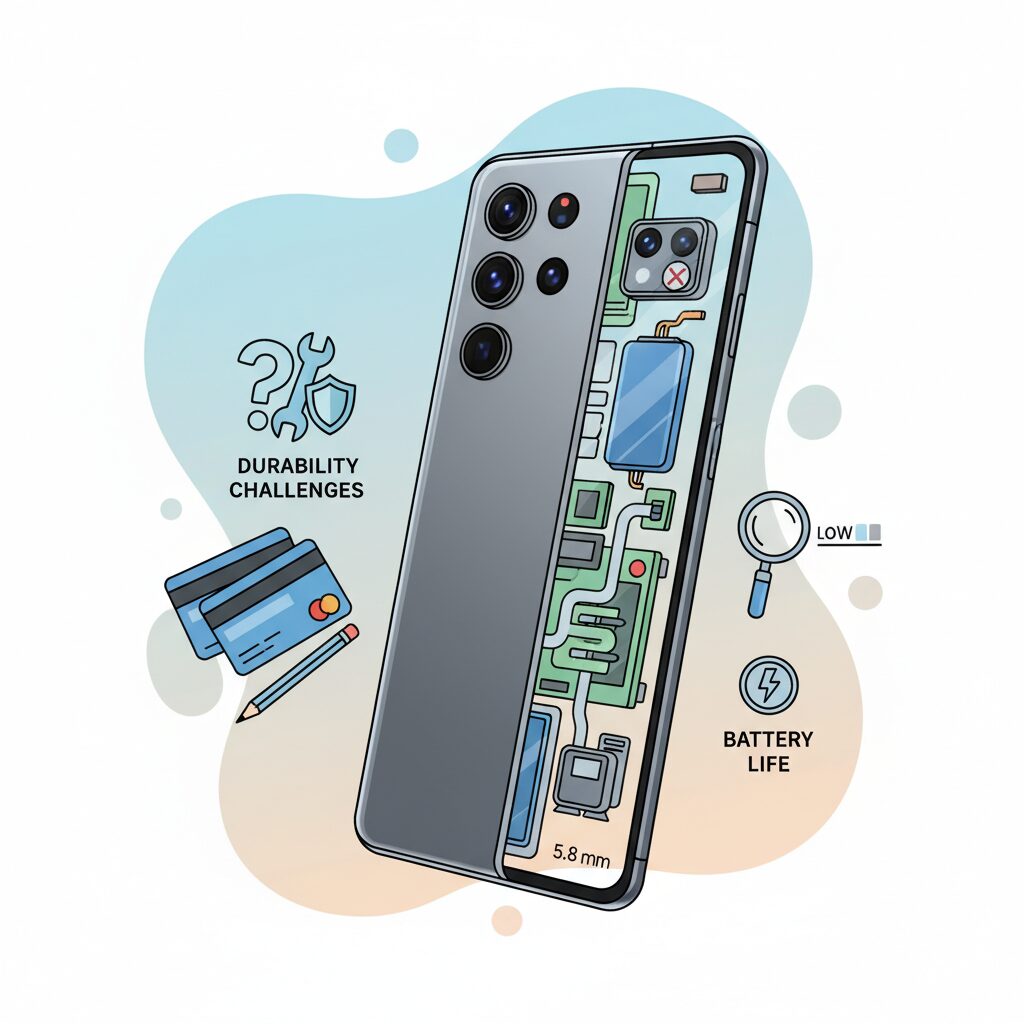
When engineers talk about a smartphone being 5.8mm thick, they are not describing a cosmetic achievement but a structural boundary that fundamentally reshapes how the device is built. **At this thickness, almost every internal component must be re‑engineered, not merely miniaturized.** In the case of the Galaxy S25 Edge, 5.8mm represents a point where traditional smartphone architecture starts to break down and new trade‑offs become unavoidable.
To understand why, it helps to look at the numbers. A typical 6.7‑inch flagship phone has a thickness of around 8mm. Reducing that by more than 2mm may sound modest, but in volumetric terms it removes close to a third of the internal space available for batteries, cooling systems, and structural reinforcement. According to analysis published by GSMArena and TechInsights, this loss of volume directly explains why ultra‑thin devices struggle simultaneously with heat dissipation and battery capacity.
| Design Aspect | ~8mm Flagship | 5.8mm Class Device |
|---|---|---|
| Battery packaging | Multi‑layer, higher capacity | Single, thinner cell with reduced margin |
| Cooling space | Thicker vapor chamber | Wide but ultra‑flat chamber |
| Frame rigidity | Aluminum or steel sufficient | Titanium or equivalent required |
One of the most important implications is mechanical strength. Apple’s well‑documented “Bendgate” incident is frequently cited in industrial design literature as a warning about pushing thinness without sufficient rigidity. Samsung’s choice of a titanium frame reflects this lesson. **At 5.8mm, aluminum alloys no longer provide enough stiffness per unit thickness**, forcing manufacturers to adopt stronger, more expensive materials simply to avoid deformation in daily use.
Another less visible consequence lies in interface design. Ports, buttons, and antenna clearances were originally standardized for thicker bodies. Teardown specialists such as iFixit and SamMobile note that in devices approaching 6mm, even the USB‑C port housing becomes a luxury. Integrating the port directly into the frame is not a design flourish but an engineering necessity to reclaim fractions of a millimeter.
From an engineering perspective, 5.8mm therefore marks a practical inflection point. It is thin enough that comfort and lightness are immediately noticeable to users, yet so thin that **thermal headroom, battery safety margins, and structural tolerance all operate at their limits**. This is why many industry experts describe this thickness not as a new norm, but as a controlled experiment at the edge of what current materials and manufacturing processes can reliably support.
Titanium Frames and Structural Durability in Slim Devices
When smartphones reach the extreme thinness of around 5.8 mm, structural durability becomes a central engineering concern rather than a secondary specification. In such slim devices, even minor torsional forces from daily use can translate directly into frame deformation. To address this risk, manufacturers increasingly rely on titanium frames, which offer a rare balance of strength and weight. **Titanium’s high strength-to-weight ratio allows a thinner structural skeleton without compromising overall rigidity**, which is especially critical for large-display devices.
According to materials science research cited by organizations such as ASM International, titanium alloys used in consumer electronics can achieve comparable stiffness to stainless steel at significantly lower mass. This property explains why Samsung selected a titanium frame for the Galaxy S25 Edge, despite the added manufacturing complexity. The choice was not cosmetic. It was a structural necessity driven by physics rather than branding.
| Frame Material | Relative Strength | Weight Efficiency |
|---|---|---|
| Aluminum Alloy | Moderate | Good |
| Stainless Steel | High | Low |
| Titanium Alloy | Very High | Very High |
Independent durability tests by JerryRigEverything further illustrate this point. During aggressive bend testing, the titanium frame showed only minor elastic flex and returned to its original shape without permanent warping. **This behavior indicates that the frame absorbs and redistributes stress rather than resisting it rigidly**, a key advantage in ultra-thin designs. However, the tests also revealed that while the frame itself remains intact, surrounding components such as the rear glass can be more vulnerable.
From a long-term usability perspective, titanium frames contribute not only to drop and bend resistance but also to dimensional stability over years of thermal cycling. Experts in mechanical engineering often note that thinner aluminum frames can gradually lose alignment under repeated stress, whereas titanium maintains tolerances more reliably. In slim smartphones, this difference directly affects button feel, port alignment, and overall perceived quality, making titanium a foundational element rather than a luxury upgrade.
Inside the Galaxy S25 Edge: Teardown Insights and Internal Layout
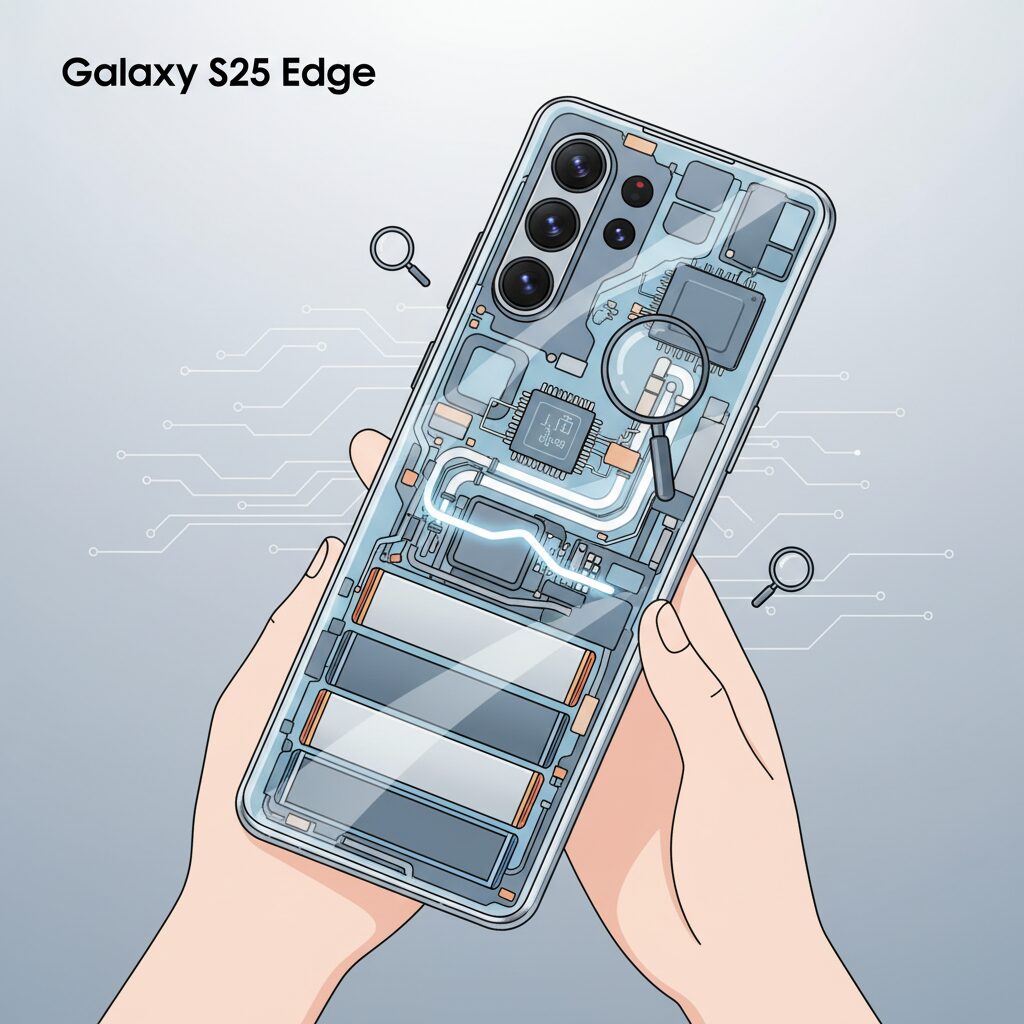
Opening up the Galaxy S25 Edge immediately reveals how aggressively Samsung has rethought internal architecture to fit within a 5.8mm chassis. According to teardown analyses by iFixit and PBKreviews, the most striking change is the move away from the traditional stacked motherboard design. Instead of a sandwich-style PCB, components are spread laterally across a single, flattened board, prioritizing thickness reduction over modular density.
This decision has clear consequences. By expanding the motherboard’s footprint, Samsung sacrifices vertical space that would normally be reserved for the battery. This layout explains why the S25 Edge pairs a large 6.7-inch display with a comparatively modest 3,900mAh battery, a trade-off confirmed by multiple teardown videos and TechInsights commentary.
| Internal Element | Design Approach | Primary Benefit |
|---|---|---|
| Motherboard | Single-layer, wide layout | Extreme thinness |
| Vibration Motor | Ultra-thin custom actuator | Maintained haptics |
| Cooling System | Flattened vapor chamber | Rapid heat spreading |
Haptics are another area where compromises could have been obvious, yet teardown specialists note Samsung’s use of a newly developed ultra-thin linear actuator placed beneath the fingerprint sensor. While it lacks the mass of the Ultra model’s motor, feedback remains crisp enough that reviewers describe it as precise rather than weak.
Thermal management shows both ingenuity and limitation. A custom vapor chamber spans a wide area directly above the Snapdragon 8 Elite, dispersing heat quickly into the titanium frame. Experts from Android Authority point out that this system sheds heat fast but cannot store it, which explains the rapid warming of the entire body under sustained load.
Overall, the internal layout of the Galaxy S25 Edge feels less like a conventional smartphone and more like a tightly packed engineering prototype. It demonstrates how far modern component miniaturization can go, while quietly reminding readers that every millimeter saved inside demands a real-world compromise elsewhere.
Thermal Limits: Snapdragon 8 Elite Performance Under Pressure
The Snapdragon 8 Elite inside the Galaxy S25 Edge delivers astonishing peak performance, but under sustained load its thermal limits quickly become apparent. This is not a matter of poor silicon quality; rather, it is a consequence of physics imposed by a 5.8mm chassis. Qualcomm’s 3nm Oryon-based SoC is designed to scale aggressively, reaching high clock speeds in short bursts, which is why initial benchmarks often look impressive.
However, when that power is confined within an ultra-thin enclosure, heat dissipation becomes the dominant constraint. Reviews from Android Authority and GSMArena consistently report that after several minutes of continuous CPU and GPU stress, the system reduces frequencies to maintain safe operating temperatures. **This behavior is a textbook example of thermal throttling driven by limited heat capacity rather than inefficient processing.**
| Test Scenario | Initial Performance | Sustained Performance |
|---|---|---|
| Geekbench CPU burst | Comparable to S25 Ultra | Noticeable drop after minutes |
| 3DMark Wild Life Extreme | High peak FPS | Stabilizes at a lower level |
The underlying reason lies in the thermal architecture. Samsung’s wide, ultra-flat vapor chamber spreads heat rapidly across the frame, which helps avoid localized hot spots. Yet this design also means the phone lacks thermal mass. Heat cannot be buffered; it must be shed immediately. As semiconductor researchers at TSMC have explained in public process briefings, thinner devices lose the ability to absorb transient heat loads, forcing earlier clock reductions.
In real-world use, this translates into a distinct performance profile. Short, demanding tasks such as launching apps, AI image processing, or brief gaming sessions feel exceptionally fast. By contrast, extended gaming or prolonged camera processing pushes the device into a lower, thermally sustainable state. **Users often feel the heat directly through the titanium frame, which conducts warmth efficiently to the hand.**
Importantly, this is not unique to Samsung. Independent analyses from publications like AnandTech have long shown that modern flagship chips are increasingly power-dense, and ultra-thin designs amplify this trade-off. The Galaxy S25 Edge simply makes the compromise more visible. Performance is not absent; it is rationed by time.
For enthusiasts, the key takeaway is clarity of expectation. The Snapdragon 8 Elite performs exactly as engineered, but the S25 Edge prioritizes form over sustained output. **It excels in responsiveness and short-term power, while deliberately conceding endurance under pressure.** Understanding this balance is essential to appreciating what the device can, and cannot, deliver.
Display Technology Without Compromise in an Ultra-Thin Body
Designing a no-compromise display inside a 5.8mm body requires far more than simply selecting a premium panel. Galaxy S25 Edge demonstrates how display engineering, materials science, and power control converge to preserve visual excellence despite extreme physical constraints.
The 6.7-inch Dynamic AMOLED 2X panel delivers QHD+ resolution with a pixel density exceeding 500ppi, matching Samsung’s thicker flagships. **This means text sharpness, image detail, and UI clarity remain indistinguishable from the Ultra model**, even though the structural margin beneath the glass is dramatically thinner.
| Display Attribute | Galaxy S25 Edge | Typical Slim Compromise |
|---|---|---|
| Resolution | QHD+ (1440 × 3120) | FHD+ |
| Refresh Rate | 1–120Hz LTPO | 60–90Hz fixed |
| Peak Brightness | Up to 2600 nits | Below 2000 nits |
According to Samsung Display’s technical briefings, LTPO backplane technology plays a decisive role here. By dynamically scaling refresh rates down to 1Hz for static content, the panel reduces power draw and thermal stress, both of which are critical in an ultra-thin enclosure where heat dissipation volume is limited.
Another overlooked achievement is optical durability. Ultra-thin phones typically sacrifice drop resistance due to shorter shock-absorption paths. Galaxy S25 Edge counters this by using Gorilla Glass Ceramic 2, a material Corning describes as combining ceramic crystal reinforcement with high transparency. **This choice directly compensates for the reduced structural buffer caused by thinness**, rather than masking the risk with marketing claims.
Visually, the near-bezel-less construction enhances immersion without relying on aggressive edge curvature. The subtle 2.5D glass avoids accidental touches while maintaining smooth gesture navigation, a balance praised by reviewers at GSMArena for preserving usability over spectacle.
Ultimately, the display of Galaxy S25 Edge proves that ultra-thin design does not inherently demand visual sacrifice. Instead, it demands precision: tighter tolerances, smarter power control, and materials chosen not for cost or trend, but for physics. **In this device, thinness becomes a constraint that sharpens engineering discipline, not a reason to lower expectations.**
Camera Design Choices: 200MP Power Without Optical Zoom
The camera design of the Galaxy S25 Edge presents a fascinating paradox: it delivers **200MP-class imaging power while deliberately abandoning optical zoom**. This choice is not a cost-cutting shortcut but a direct consequence of pursuing a 5.8mm-thin body, where every fraction of a millimeter forces hard engineering decisions.
Samsung equips the S25 Edge with the same 200MP ISOCELL HP2 sensor used in the Ultra model, a 1/1.3-inch sensor paired with an f/1.7 aperture. According to Samsung’s own technical briefings and evaluations by CNET, this sensor relies on Tetra2pixel technology to merge pixels for low-light scenes while preserving extreme resolution in bright environments.
This philosophy becomes clearer when examining the absence of a telephoto lens. Optical zoom modules, especially periscope designs, require depth that a 5.8mm chassis physically cannot provide. Rather than compromise sensor size or main-camera quality, Samsung removes the telephoto entirely and replaces it with high-quality in-sensor crop zoom.
Independent reviews from PhoneArena and CNET consistently note that at 2x zoom, the S25 Edge produces results comparable to optical zoom. This works because cropping the central 50MP region of a 200MP sensor still leaves ample detail, avoiding the mushy textures typical of digital zoom.
| Zoom Method | Effective Resolution | Image Quality Assessment |
|---|---|---|
| 1x (Full sensor) | 200MP / 12.5MP binned | Flagship-level clarity |
| 2x crop | 50MP | Near-optical quality |
| 4x crop + AI | 12.5MP | Practical but softened |
Beyond 4x, however, limitations emerge. Reviews from GSMArena and PhoneArena point out that higher zoom levels rely heavily on AI reconstruction, producing a painted look in fine details. This is where the Ultra’s dedicated telephoto lenses still dominate.
The secondary camera further reinforces the Edge’s priorities. A 12MP ultra-wide camera, identical to that of the standard S25, handles landscapes and group shots competently. It lacks the 50MP ultra-wide sensor found in the Ultra, signaling that Samsung intentionally concentrates resources on the main camera rather than camera versatility.
From a design perspective, the camera bump becomes unavoidable. To house the large 200MP sensor, Samsung allows a noticeable protrusion, a trade-off highlighted by TechRadar and CNET. **In essence, thickness is not eliminated; it is localized**, preserving overall thinness while protecting core imaging performance.
In practical use, this camera system excels at everyday photography: portraits, street scenes, food, and travel snaps within moderate zoom ranges. It is less suited to wildlife or sports photography, where long optical reach remains irreplaceable.
Seen through an engineering lens, the Galaxy S25 Edge camera is not incomplete but intentionally focused. By prioritizing sensor size and computational zoom over optical complexity, Samsung demonstrates how far modern smartphone imaging can go when physical constraints redefine what “high-end” truly means.
Battery Capacity vs Safety: Why Samsung Avoided Silicon-Carbon Cells
One of the most controversial decisions behind the Galaxy S25 Edge is Samsung’s choice to stay with a conventional lithium-ion battery rather than adopting newer silicon-carbon cells. For a device defined by its 5.8mm profile, this was not a technological oversight, but a deliberate trade-off between theoretical capacity gains and long-term safety.
Silicon-carbon batteries are attractive because silicon can store significantly more lithium ions than graphite, raising energy density by roughly 10–20% at the cell level according to materials research published by institutions such as Argonne National Laboratory. Chinese manufacturers like Honor and Xiaomi already leverage this advantage to pack larger batteries into thin chassis. On paper, the S25 Edge appears to be a perfect candidate for the same approach.
The core issue is swelling. Silicon anodes expand substantially during charge and discharge cycles, sometimes by more than 10%. In thicker phones this expansion can be absorbed by internal clearances, but in a 5.8mm body even minor deformation can stress the display, compromise seals, or increase thermal risk. Industry analysts at TechInsights note that managing this expansion reliably over several years remains one of the hardest problems for silicon-based cells.
| Battery Type | Energy Density | Swelling Risk | Long-term Stability |
|---|---|---|---|
| Conventional Li-ion | Moderate | Low | Well-characterized |
| Silicon-Carbon | High | Higher | Still under validation |
Samsung’s caution is also shaped by history. Following the Galaxy Note 7 incidents, the company implemented one of the industry’s strictest battery validation programs, including extended cycle testing and mechanical stress simulations. According to statements cited by Wccftech from Samsung executives, any new chemistry must clear these internal thresholds before mass deployment.
As a result, the S25 Edge accepts a smaller 3,900mAh capacity in exchange for structural and thermal certainty. In a device where even fractions of a millimeter matter, Samsung chose to reduce headline numbers rather than introduce variables that could undermine safety, durability, and brand trust.
Software, AI Optimization, and Long-Term Update Support
Software plays an outsized role in making an ultra-thin device like the Galaxy S25 Edge feel practical over time. It ships with Android 15 layered with One UI 7, and this combination is not just cosmetic polish but a deliberate response to the hardware limits imposed by a 5.8mm body. **Samsung has clearly leaned on software and AI to compensate where physics no longer allows easy gains**.
One UI 7 continues Samsung’s long-standing focus on one-handed usability, which becomes especially relevant on a large 6.7-inch display that is also extremely light. Menus, quick settings, and system animations are tuned to reduce unnecessary CPU and GPU spikes, an approach that aligns well with findings from Android Authority that sustained thermal headroom is limited on this model. The result is a UI that feels fluid in short bursts without constantly pushing the chipset into throttling.
At the core of this strategy is Galaxy AI, which is fully enabled on the S25 Edge without feature cuts. According to Samsung’s own briefings and corroborated by coverage from outlets like CNET, on-device AI handles tasks such as live call translation, note summarization, and generative photo edits while dynamically scaling performance. **This adaptive behavior is critical for battery efficiency on a 3,900mAh cell**, especially given Samsung’s conservative charging and thermal policies.
| Aspect | Galaxy S25 Edge Policy | User Impact |
|---|---|---|
| OS updates | Up to 7 major Android versions | Long-term feature relevance |
| Security patches | 7 years guaranteed | Enterprise-grade safety |
| AI processing | On-device first, cloud-assisted | Lower latency, better privacy |
Long-term update support may be the most underrated strength of the S25 Edge. Samsung now matches Google at the top of the Android ecosystem by committing to seven years of OS and security updates, a policy widely praised by industry analysts and referenced by Google itself as a benchmark for sustainable hardware. For a device positioned as a design experiment, this effectively turns it into a long-lived daily tool rather than a short-term novelty.
In practical terms, this means the S25 Edge is likely to age better in software than in raw endurance. **AI-driven optimization, predictable updates, and a mature UI are what make living with such an extreme form factor realistic over many years**, even as battery chemistry and cooling remain constrained.
Market Reception and the Reality Behind the Slim Flagship Strategy
The market reception of the Galaxy S25 Edge clearly shows that technical admiration does not always translate into commercial success. At launch, the device drew intense attention from media and enthusiasts, with outlets like GSMArena and Android Authority describing it as an engineering milestone. **However, early sales data and channel checks suggest that consumer enthusiasm cooled quickly once real-world trade-offs became clear**.
Samsung positioned the S25 Edge as a premium expression of the Slim Flagship concept, pricing it above the Galaxy S25+ and close to the S25 Ultra. According to analyses cited by Korean industry media, this pricing created immediate friction. Many buyers struggled to justify paying more for a device that was thinner and lighter, yet objectively compromised in battery endurance, sustained performance, and camera versatility.
| Model | Starting Price (USD) | Perceived Strength | Main Consumer Objection |
|---|---|---|---|
| Galaxy S25+ | $999 | Balanced flagship | Less distinctive design |
| Galaxy S25 Edge | $1,099 | Ultra-thin, lightweight | Battery life, heat, no telephoto |
| Galaxy S25 Ultra | $1,299 | Maximum features | Size and weight |
User feedback aggregated by GSMArena and Reddit communities reveals a consistent pattern. **While the thinness delighted users in the first days of ownership, battery anxiety and thermal throttling quickly became recurring complaints**. Reviewers noted that the Edge felt like a showcase device rather than a dependable daily driver, especially for users accustomed to all-day or multi-day battery life.
The competitive context further complicated the picture. The S25 Edge was widely interpreted as a preemptive strike against Apple’s rumored iPhone 17 Air. Yet reports from TechRadar and SammyFans indicate that Apple itself struggled with similar physical constraints, delaying or rethinking its slim model altogether. This effectively removed the Edge’s most compelling narrative: being the obvious alternative to a future iPhone. Without a direct rival, its compromises stood out even more starkly.
Industry analysts quoted by Android Headlines argue that the Slim Flagship strategy underestimated mainstream priorities. **Market data from late 2025 shows that overall Galaxy S25 sales surged, but growth was driven primarily by the standard and Ultra models, not the Edge**. Consumers rewarded practicality and longevity over aesthetic minimalism, even in the high-end segment.
The reported cancellation of the Galaxy S26 Edge reinforces this interpretation. Samsung’s internal projections reportedly concluded that, without a breakthrough in battery chemistry or thermal design, further iterations would repeat the same dilemma. The S25 Edge thus stands as a cautionary example: a product celebrated for what it proves is possible, yet quietly rejected for what it asks users to give up.
In this sense, the reality behind the slim flagship strategy is sobering. **Extreme thinness resonates as an idea, but the market still demands endurance, stability, and versatility first**. The S25 Edge earned respect as an engineering statement, but the market delivered a far colder verdict.
参考文献
- Samsung Mobile Press:Meet the Samsung Galaxy S25 Edge: An Engineering Marvel of New Slim Hardware Innovation
- GSMArena:Samsung Galaxy S25 Edge – Full phone specifications
- Android Authority:Samsung’s Galaxy S25 Edge isn’t built for power users — here’s why
- CNET:Samsung Surprised Us With the S25 Edge’s Camera, Rivaling the Top-Notch Ultra
- TechRadar:The iPhone 17 Air almost makes the Samsung Galaxy S25 Edge look thick in new dummy unit photos
- SamMobile:Video shows what’s really going on inside the Galaxy S25 Edge