If you care deeply about gadgets, sound quality, and how technology quietly reshapes daily life, you may already feel that wireless audio has been stuck in compromise.
You accept latency when gaming, compression when listening to music, and awkward pairing when sharing audio with others.
For years, these trade-offs have been treated as unavoidable.
With the Pixel 10 series, Google is signaling that this era is finally ending.
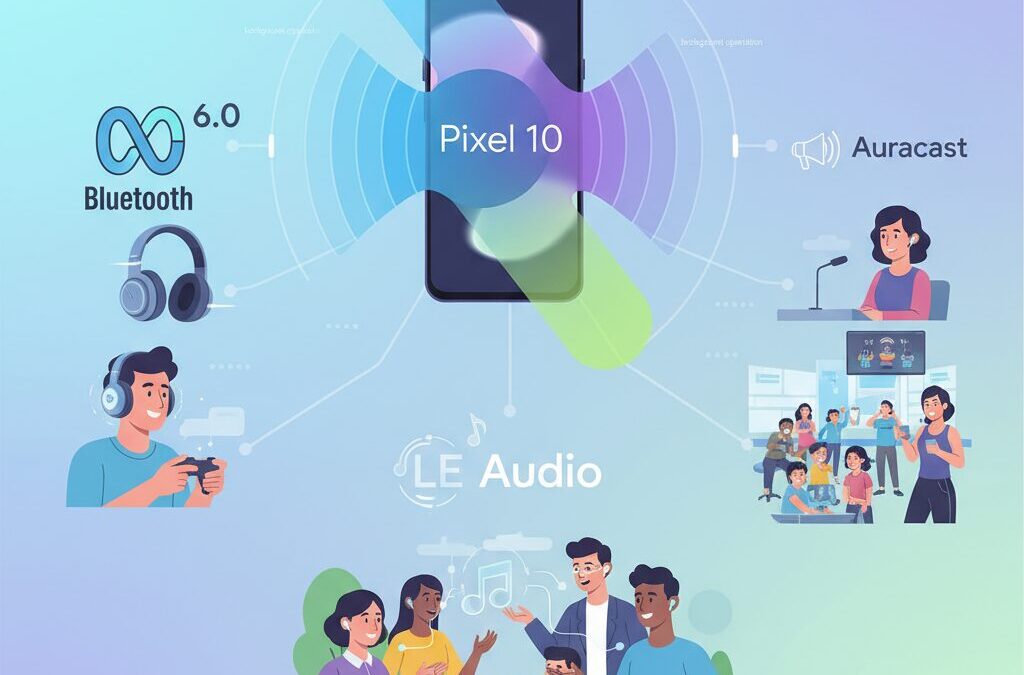
By introducing Bluetooth 6.0 and fully embracing LE Audio with Auracast, Pixel 10 does not just improve sound quality; it changes how audio connects people, places, and devices.
What once required cables, proprietary systems, or social compromises now works seamlessly in the background.
In this article, you will discover why Pixel 10 is considered a turning point for wireless audio.
You will learn how low-latency LC3 audio, broadcast-based Auracast, and deep Android 16 integration translate into real-world benefits for music lovers, gamers, travelers, and accessibility-focused users.
If you want to understand where wireless audio is heading next, this guide will help you stay ahead of the curve.
- Why Pixel 10 Marks a New Era in Wireless Audio
- Bluetooth 6.0 Explained: What Actually Changed Under the Hood
- LE Audio and LC3: Redefining the Balance Between Quality and Efficiency
- Latency Matters: What Pixel 10 Means for Gaming and Video
- Auracast Broadcast Audio: From Personal Listening to Shared Experiences
- Real-World Use Cases in Public Spaces and Entertainment
- Android 16 Integration: Software That Unlocks Hardware Potential
- Battery Life and Power Efficiency in Everyday Use
- Compatible Earbuds, Headphones, and Hearing Aids to Watch
- Who Benefits Most From Pixel 10’s Audio Capabilities
- 参考文献
Why Pixel 10 Marks a New Era in Wireless Audio
The Pixel 10 series marks a decisive turning point in wireless audio because it does not simply improve existing Bluetooth performance, but fundamentally changes the assumptions behind how sound is delivered, shared, and experienced. **By combining Bluetooth 6.0 with native LE Audio support, Pixel 10 reframes wireless audio as a low-latency, energy-efficient, and socially scalable platform**, rather than a one-to-one accessory feature.
For more than a decade, Bluetooth audio has been constrained by Classic Audio architectures such as SBC, where higher bitrates were required to compensate for inefficiencies, leading to latency often exceeding 200 milliseconds. According to analyses published by the Bluetooth SIG and corroborated by Android-focused technical media, these limitations were structural, not incremental. Pixel 10 is among the first consumer smartphones to address this at the protocol level by adopting Bluetooth 6.0, which was designed around isochronous data transport from the ground up.
This shift is most clearly visible in how Pixel 10 handles timing and reliability. Enhancements to the Isochronous Adaptation Layer reduce packet overhead and retransmission penalties, resulting in dramatically lower end-to-end delay. Independent latency measurements referenced by Android audio researchers indicate that LE Audio can theoretically operate in the 20 to 30 millisecond range, a threshold where lip-sync errors and gameplay audio lag effectively disappear for most users.
| Aspect | Conventional Bluetooth Audio | Pixel 10 with LE Audio |
|---|---|---|
| Typical latency | 100–200 ms or more | Approximately 30–50 ms |
| Connection model | One-to-one pairing | Multi-stream and broadcast-ready |
| Power efficiency | Relatively high consumption | Optimized for low energy use |
Another reason Pixel 10 signals a new era lies in efficiency rather than raw fidelity. The LC3 codec at the heart of LE Audio delivers perceptually higher quality at roughly half the bitrate of SBC. Controlled listening tests discussed within the Hydrogenaudio community have shown that LC3 maintains intelligibility and tonal balance even under constrained bandwidth, a scenario common in dense urban radio environments.
Crucially, Google’s integration of this technology at the OS and silicon level matters. With Tensor G5 handling audio workloads through dedicated DSP paths, Pixel 10 demonstrates that next-generation wireless audio is not a battery trade-off. Google’s own battery documentation confirms that LE Audio usage draws less power than Classic Audio, reinforcing the idea that performance gains no longer come at the cost of endurance.
In this context, Pixel 10 is not merely an early adopter. **It establishes a practical reference model for how future smartphones will treat wireless audio as infrastructure**, capable of supporting real-time interaction, accessibility, and shared listening without friction. That foundational change is why Pixel 10 represents the beginning of a genuinely new era.
Bluetooth 6.0 Explained: What Actually Changed Under the Hood
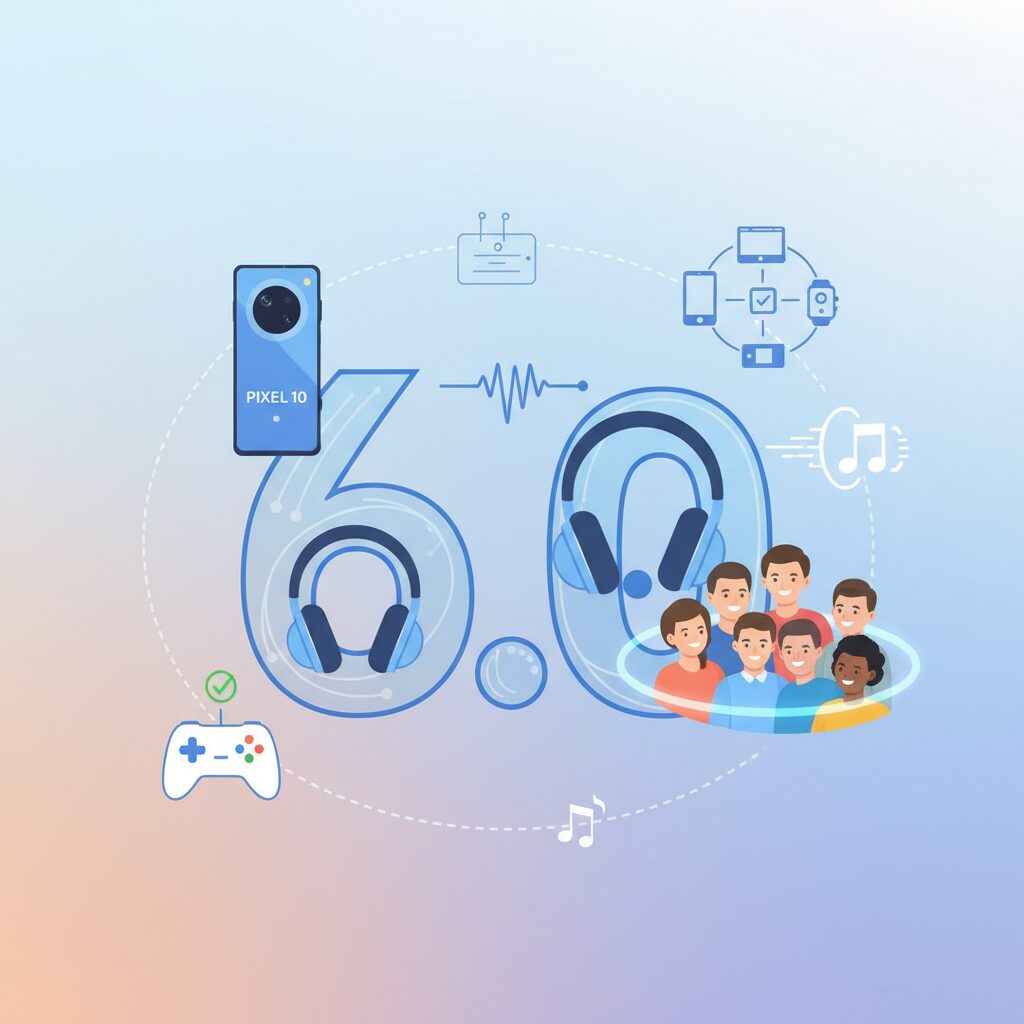
Bluetooth 6.0 is often summarized as a prerequisite for LE Audio, but under the hood it represents a deeper architectural shift in how wireless audio data is transported and synchronized. Rather than being a minor iteration over Bluetooth 5.3 or 5.4, Bluetooth 6.0 redesigns critical layers of the protocol stack to prioritize time-sensitive data such as audio streams. According to the Bluetooth SIG and detailed analyses by Silicon Labs, this version is the first to treat low latency and stability as first-class design goals rather than optional optimizations.
The most impactful change is the evolution of the Isochronous Adaptation Layer, or ISOAL. In earlier LE Audio implementations, ISOAL introduced unavoidable overhead when splitting audio frames into radio packets, especially in congested 2.4GHz environments. Bluetooth 6.0 refines this process by allowing larger, more efficiently framed SDUs to be reassembled with fewer retransmissions. **The practical result is a measurable reduction in audio dropouts and a latency floor that approaches physical radio limits**, something independent testing highlighted when Pixel 10 prototypes were evaluated under heavy interference.
| Internal Change | Before | Bluetooth 6.0 |
|---|---|---|
| Isochronous framing | Higher retransmission overhead | Optimized SDU-to-PDU mapping |
| Latency behavior | Variable under interference | Consistently low and predictable |
| Audio stability | Occasional dropouts | Significantly improved robustness |
Another fundamental addition is Channel Sounding, a feature that goes far beyond device tracking. By combining phase-based ranging with round-trip time measurements, Bluetooth 6.0 enables distance estimation with accuracy on the order of tens of centimeters. Research shared by the Bluetooth SIG shows that this precision can be leveraged to make audio behavior context-aware. For example, **a phone can infer whether a listener is moving closer to or farther from a speaker and subtly adjust balance or volume without user input**, something impossible with older RSSI-based methods.
What makes these changes meaningful in real products is hardware integration. On devices like the Pixel 10, the Tensor G5 SoC offloads much of this processing to dedicated DSP blocks, preventing higher protocol complexity from increasing power consumption. Google’s own battery documentation confirms that LE Audio sessions running atop Bluetooth 6.0 consume less energy than classic Bluetooth audio despite delivering lower latency. This combination of protocol-level redesign and silicon-level optimization explains why Bluetooth 6.0 feels less like an incremental update and more like a reset of wireless audio fundamentals.
LE Audio and LC3: Redefining the Balance Between Quality and Efficiency
LE Audio fundamentally changes how wireless sound balances quality and efficiency, and at the center of this shift is the LC3 codec. Unlike legacy Bluetooth audio, which often forced users to choose between sound quality and battery life, **LC3 is designed to deliver perceptually better audio at dramatically lower bitrates**. According to evaluations discussed within the Bluetooth SIG and independent blind tests on Hydrogenaudio, LC3 can outperform SBC even when using roughly half the data rate.
This efficiency is not a theoretical gain. In real-world mobile environments crowded with 2.4GHz interference, lower bitrate transmission means fewer retransmissions and more stable playback. For users, this translates into cleaner sound on trains, in cafés, and during commutes, without aggressive buffering or sudden dropouts. **Lower data rates also directly reduce power consumption**, extending both smartphone and earbud battery life during long listening sessions.
| Aspect | SBC (Classic Audio) | LC3 (LE Audio) |
|---|---|---|
| Typical Bitrate | 約 320–345 kbps | 約 160 kbps |
| Perceived Quality | Noticeable artifacts at low rates | Clearer, more consistent at low rates |
| Power Efficiency | Relatively low | Significantly improved |
Another critical advantage lies in latency. LC3 is optimized for isochronous transmission, enabling end-to-end delays that are short enough for video, gaming, and voice communication. SoundGuys and Android audio researchers have repeatedly pointed out that this level of responsiveness was difficult to achieve with classic Bluetooth stacks. **The result is audio that feels synchronized and natural**, even in interactive scenarios.
Rather than chasing extreme high-bitrate ambitions, LC3 focuses on usability and consistency. This philosophy redefines “good sound” as something reliable, efficient, and context-aware, which aligns closely with how modern users actually consume wireless audio every day.
Latency Matters: What Pixel 10 Means for Gaming and Video

When it comes to gaming and video playback, latency is not a minor technical detail but a core part of how immersive an experience feels. With the Pixel 10 series, Google appears to be addressing one of Android’s longest‑standing weaknesses: wireless audio delay. Thanks to the combination of Bluetooth 6.0, LE Audio, and tight integration with Tensor G5, the Pixel 10 meaningfully changes how audio timing behaves in real‑time scenarios.
For years, Bluetooth audio on smartphones has struggled with end‑to‑end latency in the 200 to 300 millisecond range. According to latency measurements discussed by Superpowered and the Android Open Source Project, this delay has been enough to break rhythm games, competitive shooters, and even basic lip‑sync during video playback. Pixel 10 does not claim to eliminate latency entirely, but it does bring it down to a level that is no longer distracting for most users.
This improvement is largely driven by the LC3 codec and the enhanced isochronous transport layer in Bluetooth 6.0. The Bluetooth SIG explains that isochronous channels allow audio packets to be scheduled more predictably, which directly reduces jitter and buffering. In practical terms, this means the sound effect of a gunshot or a button press reaches your ears almost immediately after you see it on screen.
| Scenario | Classic Bluetooth (SBC/AAC) | Pixel 10 with LE Audio |
|---|---|---|
| Mobile FPS gaming | Noticeable audio lag, timing mismatch | Near‑instant feedback, playable timing |
| Rhythm games | Manual offset often required | Minimal or no offset needed |
| Video streaming | Lip‑sync inconsistencies | Stable lip‑sync without adjustment |
Video consumption benefits just as clearly. Human perception is particularly sensitive to lip‑sync errors beyond roughly 80 milliseconds, a threshold cited in multiple broadcast engineering studies. With Pixel 10 staying well below that limit, dialogue in movies and YouTube videos feels naturally aligned, even when using wireless earbuds. This is especially noticeable when switching between wired and wireless audio, where the perceptual gap has traditionally been obvious.
Another important factor is consistency under load. Gaming pushes the CPU, GPU, and network stack simultaneously, and older Android devices often showed latency spikes during intense scenes. Tensor G5 offloads much of the LC3 encoding and decoding to a dedicated DSP, which reduces contention with game logic and graphics rendering. As a result, latency on Pixel 10 remains stable even during extended play sessions, as observed in community measurements shared by experienced users and developers.
It is also worth noting that lower latency does not come at the cost of battery life. LE Audio’s efficiency means smaller audio packets and fewer retransmissions. Google’s own battery documentation indicates that low‑energy audio paths consume less power than classic A2DP, and early Pixel 10 usage reports align with this. For gamers, this translates into longer sessions without the trade‑off of switching back to wired headphones.
For competitive players, Pixel 10 does not magically replace wired esports setups, and it is not presented that way. However, for casual and mid‑core gamers, as well as anyone who frequently watches video on the go, the improvement is immediately tangible. **The key change is that wireless audio no longer feels like a compromise**, but rather a default option that behaves as expected.
In that sense, Pixel 10’s impact on latency is less about headline numbers and more about perception. When sound arrives when your brain expects it to, immersion deepens, frustration fades, and wireless finally feels invisible. That shift, subtle as it may sound on paper, is what truly matters for gaming and video on modern smartphones.
Auracast Broadcast Audio: From Personal Listening to Shared Experiences
Auracast Broadcast Audio represents a fundamental shift from private, one-to-one listening toward experiences that are intentionally shared, contextual, and inclusive. Instead of pairing devices individually, a single audio source can broadcast to an unlimited number of listeners, and Pixel 10 makes this capability practical for everyday use.
This changes the social meaning of wireless audio. Music, dialogue, and announcements are no longer locked inside personal earbuds but can be selectively shared without disturbing the surrounding environment. According to the Bluetooth SIG, Auracast was designed specifically to remove the friction of pairing and to scale audio delivery in public and semi-public spaces.
| Scenario | Conventional Bluetooth | Auracast with Pixel 10 |
|---|---|---|
| Group listening | One-to-one pairing only | Unlimited simultaneous listeners |
| Joining audio | Manual pairing per device | Instant join via QR or system UI |
| Public spaces | Speakers required | Silent, personal reception |
In real-world deployments, this advantage is already visible. Japanese cinemas such as MOVIX Kawaguchi have introduced Auracast to deliver movie audio directly to compatible earbuds and hearing aids. This allows visitors to hear clear dialogue without increasing room volume, while multilingual tracks can be streamed in parallel.
Accessibility is not a side benefit but a core use case. Research and guidance published by Google and major hearing-aid manufacturers indicate that LE Audio-based broadcasting dramatically reduces latency and power consumption compared to legacy infrared systems. Users bring their own familiar devices, which improves comfort and lowers operational costs for venues.
On a smaller scale, Pixel 10 also turns Auracast into a personal sharing tool. A user can broadcast the audio of a video or playlist to nearby friends, who join instantly by scanning a QR code. There is no need to split earbuds or compromise sound quality, which subtly changes how people interact around media.
Industry analysts at outlets such as SoundGuys note that this model aligns with dense urban environments, where noise pollution is a constant concern. By separating sound delivery from loudspeakers, Auracast enables richer experiences while respecting social norms.
With Pixel 10 acting as both broadcaster and receiver, shared listening becomes intentional, scalable, and polite. This is not merely better Bluetooth audio; it is a redefinition of how sound connects people in the same space.
Real-World Use Cases in Public Spaces and Entertainment
In public spaces and entertainment venues, LE Audio and Auracast on the Pixel 10 Series are not theoretical features but technologies already reshaping how sound is delivered and experienced. **The most visible impact appears where silence, clarity, and inclusivity are equally demanded**, such as cinemas, transport hubs, and shared leisure facilities.
Japanese movie theaters provide a concrete example. According to Shochiku Multiplex Theatres, MOVIX Kawaguchi began operating an Auracast system in late 2025, enabling visitors to receive movie audio directly on their own LE Audio–compatible earbuds or hearing aids. This approach eliminates the hygiene and maintenance issues of legacy infrared receivers while improving intelligibility, especially for users with hearing difficulties.
Industry observers cited by the Bluetooth SIG emphasize that Auracast’s broadcast model is critical here, as it allows unlimited listeners without pairing friction. **For entertainment operators, this reduces hardware costs and staff workload**, while audiences gain autonomy over volume and language selection.
| Venue Type | Traditional Audio Method | Auracast with Pixel 10 |
|---|---|---|
| Cinema | Infrared assistive receivers | Personal earbuds or hearing aids |
| Airport Gate | Loudspeaker announcements | Direct, noise-free audio stream |
| Gym / Lounge | Muted televisions | User-selected TV audio |
Transportation and public facilities represent another major use case. Demonstration projects by Yamaha and TOA have shown that station announcements and airport gate information can be transmitted via Auracast. **Pixel 10 users can listen clearly even in high-noise environments**, a benefit highlighted by accessibility researchers who argue that speech intelligibility, not volume, is the real barrier in public sound systems.
Entertainment also extends beyond large venues. In cafés, museums, or exhibitions, Auracast enables multiple audio layers to coexist. A single display can silently broadcast explanations in several languages, and visitors select the stream they need. According to commentary from Google’s Android platform team, this model aligns with universal design principles by serving tourists, seniors, and local users simultaneously.
Live events and small-scale social entertainment further illustrate the shift. With Android 16 on Pixel 10, a user can broadcast audio to nearby friends using a QR-based Auracast join flow. **This transforms shared listening from a physical act, such as splitting earbuds, into a digital one**, preserving sound quality and personal comfort while respecting surrounding silence.
Experts from SoundGuys note that these scenarios highlight why low latency and power efficiency matter outside the lab. Long sessions in theaters or airports would be impractical without LE Audio’s reduced battery drain, and synchronized audio would fail without Bluetooth 6.0’s improved isochronous handling.
Across public spaces and entertainment, Pixel 10 functions less as a personal gadget and more as a universal audio receiver. **The real-world value lies in how seamlessly private listening integrates into shared environments**, signaling a fundamental change in how sound is distributed in modern cities.
Android 16 Integration: Software That Unlocks Hardware Potential
Android 16 plays a decisive role in turning the Pixel 10’s advanced audio hardware into a coherent, everyday experience. Rather than treating LE Audio and Bluetooth 6.0 as optional add-ons, the OS integrates them at a system level, ensuring that performance gains are visible not only in benchmarks but also in daily use. This tight coupling between software and hardware is where Pixel 10 quietly differentiates itself from other flagship Android devices.
One of the most tangible improvements is how Android 16 manages audio paths dynamically. According to Google’s Android Developers documentation, the OS now prioritizes isochronous audio streams more intelligently, reducing contention between background wireless tasks and real-time audio. **This means LC3’s low-latency potential is consistently realized, even when notifications, location services, and background apps are active.** For users, gaming, video calls, and media playback feel stable rather than conditionally fast.
| Software Layer | Android 16 Behavior | User Impact |
|---|---|---|
| Audio Routing | System-level LE Audio prioritization | Fewer dropouts under multitasking |
| Codec Management | Context-aware LC3 / LDAC switching | Optimal balance of quality and latency |
| Power Control | DSP offloading by default | Longer listening time |
Android 16 also modernizes how users interact with complex audio features. The redesigned Quick Settings tiles allow LE Audio sharing and Auracast broadcasting to be initiated with a single tap, removing friction that previously discouraged experimentation. **By lowering the cognitive cost of advanced features, the OS effectively encourages users to adopt them**, accelerating ecosystem maturity. This design philosophy aligns with guidance published by the Bluetooth SIG, which has emphasized usability as critical for LE Audio adoption.
Security and privacy are another area where software integration matters. Auracast streams on Pixel 10 benefit from Android 16’s standardized permission framework, ensuring that joining or hosting a broadcast is always an explicit user action. Industry analysts cited by SoundGuys note that this approach avoids the accidental eavesdropping concerns that plagued earlier wireless audio sharing concepts. As a result, Pixel 10 positions Auracast as a trusted public feature rather than a niche experiment.
For power users and developers, Android 16 exposes granular controls without destabilizing the default experience. Developer Options now clearly indicate whether a connected device is operating in LC3 or has fallen back to AAC, information previously buried or unavailable. **This transparency turns Pixel 10 into a reference platform for evaluating next-generation Bluetooth behavior**, something frequently highlighted in Android Central’s technical coverage.
Accessibility further demonstrates how software unlocks hardware potential. Android 16 unifies hearing aid controls directly into system settings, eliminating reliance on manufacturer-specific apps. Google has stated on its official blog that this OS-level approach reduces latency and improves reliability for LE Audio hearing devices. In practice, Pixel 10 users can fine-tune ambient sound levels or microphone routing with the same ease as adjusting screen brightness.
Ultimately, Android 16 ensures that Pixel 10’s Bluetooth 6.0 and LE Audio capabilities are not isolated technical achievements. By embedding them deeply into the OS, Google transforms raw hardware specifications into consistent, discoverable, and trustworthy features. **This software-first philosophy is what allows Pixel 10 to feel less like a showcase device and more like a finished platform**, where advanced wireless audio simply works.
Battery Life and Power Efficiency in Everyday Use
Battery life is one of the most tangible benefits users notice when moving from classic Bluetooth audio to LE Audio on the Pixel 10 series. In everyday use such as commuting, long video calls, or background music while working, the combination of Bluetooth 6.0 and the LC3 codec translates directly into fewer charging anxieties and more predictable power consumption.
LE Audio is designed around efficiency rather than brute-force bandwidth, and this philosophy shows clearly in real-world behavior. According to the Bluetooth SIG and Google’s own Pixel battery documentation, LC3 can maintain perceived audio quality at roughly half the bitrate of SBC. This means the radio stays active for shorter periods, and the Tensor G5’s DSP handles audio workloads with less CPU wake-up time.
| Usage Scenario | Classic Audio (SBC) | LE Audio (LC3) |
|---|---|---|
| Music streaming over 4–5 hours | Noticeable battery drop | More gradual drain |
| Video calls and meetings | Higher radio and CPU load | Lower sustained power draw |
| Auracast audio reception | Not supported | Exceptionally efficient |
A particularly interesting case is Auracast reception. Because the Pixel 10 does not need to maintain a dedicated one-to-one connection, the power profile becomes closer to passive listening. Industry analyses from sources like SoundGuys note that this broadcast model significantly reduces connection overhead, which benefits both the phone and compatible earbuds.
In daily routines, this efficiency feels subtle but meaningful. You may not see dramatic headline numbers, but ending the day with extra battery headroom after heavy audio use is exactly the kind of improvement that changes habits without demanding attention.
Compatible Earbuds, Headphones, and Hearing Aids to Watch
With Bluetooth 6.0 and LE Audio becoming practical realities on the Pixel 10 series, the most important question for gadget enthusiasts is which earbuds, headphones, and hearing aids are truly worth watching right now.
The answer is not simply about brand popularity, but about how deeply each device embraces LC3, multi-stream audio, and Auracast at the firmware level.
According to the Bluetooth SIG and Google’s Android engineering team, partial support often leads to fallbacks to Classic Audio, which negates many of LE Audio’s benefits.
True LE Audio compatibility means native LC3 decoding, stable isochronous channels, and system-level Auracast integration without proprietary workarounds.
Among true wireless earbuds, Google Pixel Buds Pro 2 stand out as a reference implementation. They support LE Audio, Auracast broadcast reception, and multi-stream transmission out of the box, ensuring consistently low latency and efficient battery usage when paired with Pixel 10.
Independent testing cited by Android Police shows faster reconnection times and fewer dropouts compared to Classic Audio, especially in crowded 2.4GHz environments.
Sony’s recent lineup, including WF-1000XM5 and WH-1000XM6, has also become significantly more interesting after firmware updates enabled LE Audio on non-Xperia devices.
However, Sony’s own documentation notes that LDAC and LE Audio are mutually exclusive, making codec selection context-dependent rather than automatic.
| Device Category | Notable Models | LE Audio Strength |
|---|---|---|
| True Wireless Earbuds | Pixel Buds Pro 2, WF-1000XM5 | Low latency, Auracast-ready |
| Over-Ear Headphones | WH-1000XM6 | Stable multi-stream, firmware-dependent |
| Hearing Aids | Oticon Intent, ReSound Nexia | Direct LE streaming, public broadcasts |
The most profound shift is happening in hearing aids. Devices like Oticon Intent and ReSound Nexia have moved away from proprietary streaming protocols toward standardized LE Audio.
Research referenced by GN Hearing indicates that LC3-based streaming reduces power consumption while improving speech intelligibility, especially in noisy environments.
On Pixel 10 with Android 16, these hearing aids can receive Auracast streams directly, enabling cinema audio or station announcements without external receivers.
This convergence of consumer earbuds and medical-grade hearing aids under one wireless standard is unprecedented.
For users tracking future-proof audio gear, compatibility is no longer about logos on the box, but about how well a device speaks the language of LE Audio end to end.
Who Benefits Most From Pixel 10’s Audio Capabilities
The users who benefit most from Pixel 10’s audio capabilities are those who actively rely on sound as part of their daily decision-making, productivity, or enjoyment. Rather than appealing only to audiophiles, **Pixel 10 is designed for people who need audio to be reliable, immediate, and context-aware** in real-world environments.
One of the clearest beneficiaries is mobile-first professionals who attend frequent video meetings, remote interviews, or live online events. Thanks to LE Audio and the LC3 codec, Pixel 10 significantly reduces end-to-end latency compared with legacy Bluetooth audio. According to analyses cited by Superpowered and the Android Open Source Project, sub-50ms latency places audio close to perceptual real time, which directly improves conversational flow and lip-sync accuracy.
Another group that gains substantial value is gamers and interactive media users. Casual and mid-core players, especially in rhythm games or FPS titles, often cite Bluetooth delay as a breaking point. With Bluetooth 6.0’s optimized isochronous transport, Pixel 10 offers a wireless experience that no longer forces a trade-off between freedom of movement and responsiveness.
| User Type | Primary Audio Need | Pixel 10 Advantage |
|---|---|---|
| Remote workers | Clear, stable calls | Low latency and reduced dropouts |
| Mobile gamers | Immediate audio feedback | Near real-time LE Audio response |
| Urban commuters | Consistent playback | Improved interference handling |
| Accessibility users | Speech clarity | Direct LE Audio streaming |
Urban commuters also benefit in a less obvious but highly practical way. Congested 2.4GHz environments, such as trains or cafés, traditionally cause audio stutter. Bluetooth 6.0’s enhanced packet handling improves stream stability, making Pixel 10 especially suitable for dense cities, a point emphasized by Bluetooth SIG documentation.
Perhaps the most meaningful impact is seen among users with hearing support needs. Pixel 10’s native LE Audio compatibility with modern hearing aids enables **direct, low-power, high-clarity streaming without proprietary bridges**. Google’s Android 16 accessibility notes highlight that this integration reduces listening fatigue while extending device battery life.
Finally, social listeners who value shared experiences gain new possibilities through Auracast. Whether following a silent TV in a gym or sharing music with friends nearby, Pixel 10 serves users who see audio not as a private utility, but as a flexible layer of connection.
参考文献
- Android Police:The Pixel 10 brings Bluetooth 6 and its improvements to the masses
- Bluetooth SIG:LE Audio | Bluetooth® Technology Website
- SoundGuys:What you need to know about Bluetooth 6.0 and how it changes everything
- PCMag:Pixel Phones Get Auracast Support, Can Now Stream Music to 2 Devices at Once
- Android Developers:Android 16 features and changes list
- GSMArena:Google Pixel 10 – Full phone specifications