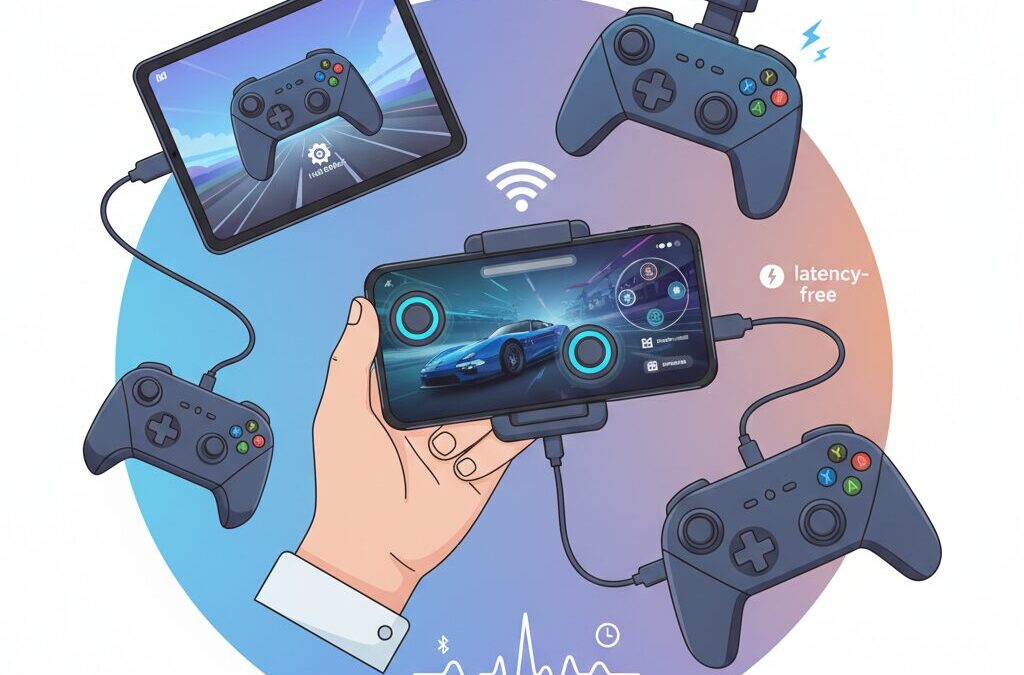
Mobile gaming is no longer a casual pastime, and many of you may already feel that your smartphone has become a true pocket-sized gaming console.
With flagship chips delivering console-class performance and 5G making cloud gaming viable, expectations for control precision, comfort, and responsiveness have risen dramatically.
However, touch controls still limit what competitive and immersive games can offer, especially in FPS, action RPGs, and racing titles.
That is why smartphone gaming controllers are now one of the fastest-growing gadget categories worldwide.
In this article, you will learn how cutting-edge technologies like Hall effect sensors eliminate stick drift, how USB-C and Bluetooth latency actually compare in real-world play, and why ergonomics matter as much as raw specs.
By understanding the market trends, technical breakthroughs, and ecosystem choices shaping 2025 and 2026, you will be able to choose a controller that truly matches your play style and protects your hands for the long term.
- Why Smartphone Gaming Is Entering a New Era
- Premium Smartphones and Their Impact on Gaming Accessories
- What Is Driving the Rapid Growth of the Mobile Controller Market
- Hall Effect Sensors Explained: Ending Stick Drift for Good
- From Hall Effect to TMR: The Next Generation of Input Technology
- USB-C vs Bluetooth: The Real Science Behind Input Latency
- Best Smartphone Gaming Controllers to Watch in 2025–2026
- Ergonomics, Hand Size, and Long-Term Gaming Health
- Cooling, Audio, and Accessories That Unlock Full Performance
- Software, Apps, and Customization That Most Specs Sheets Ignore
- Future Trends: How AI, Cloud Gaming, and Haptics Will Change Controllers
- 参考文献
Why Smartphone Gaming Is Entering a New Era
Smartphone gaming is entering a new era because the role of the smartphone itself has fundamentally changed. Once treated as a casual gaming device, the modern smartphone is now evaluated as a pocket-sized game console with serious performance expectations. According to Counterpoint Research, global smartphone shipments returned to growth in 2025, driven largely by premium models, and this shift signals that users are willing to invest in performance, not just connectivity.
This premiumization directly impacts gaming experiences. High-end chipsets, advanced displays, and sustained 5G connectivity allow complex, console-grade titles to run smoothly on mobile devices. As a result, games such as Call of Duty: Mobile and Genshin Impact are no longer compromises compared to console versions, but carefully optimized experiences that demand precise input and stable performance. The smartphone is no longer the weakest link in the gaming chain.
The ecosystem surrounding smartphones has also matured at the same time. Market analyses from Global Growth Insights estimate the mobile gaming controller market reached roughly 148 million dollars in 2025, with steady growth expected through the next decade. This is not driven by novelty, but by necessity, as touch controls struggle to keep up with increasingly complex game mechanics.
| Factor | Before | Now |
|---|---|---|
| Hardware perception | Casual device | Portable console |
| Game complexity | Simple touch input | Console-grade controls |
| User investment | Minimal accessories | Controllers and cooling |
Another key reason this era feels different is convergence. USB-C standardization, including Apple’s full transition, and improvements in low-latency wireless technologies have removed long-standing platform barriers. Research firms such as BCG highlight that cloud gaming and remote play are accelerating this convergence, making smartphones viable endpoints for high-end gaming rather than isolated platforms.
Smartphone gaming is evolving from a secondary pastime into a primary gaming platform. Hardware capability, market investment, and ecosystem readiness are aligning for the first time. This alignment explains why gamers, manufacturers, and publishers now treat mobile gaming as the next major frontier rather than an extension of casual play.
Premium Smartphones and Their Impact on Gaming Accessories
Premium smartphones released in 2025–2026 are increasingly positioned not just as communication devices, but as portable gaming platforms, and this shift is directly influencing the evolution of gaming accessories. According to Counterpoint Research, global smartphone shipments grew by 2% year over year in 2025, with growth concentrated in the premium segment. This trend is especially visible in mature markets such as Japan, where users are more willing to invest in high-end devices and complementary accessories.
As smartphone SoCs, displays, and connectivity improve, gaming accessories are required to match that performance ceiling. Flagship chips like Apple’s A-series and Qualcomm’s Snapdragon 8 class deliver console-level graphics, while 120Hz–144Hz OLED displays reduce motion blur and input perception. These advances expose the limitations of touch input and low-quality peripherals, accelerating demand for precision controllers, low-latency audio gear, and thermal solutions.
| Premium Smartphone Feature | Impact on Gaming Accessories | User Benefit |
|---|---|---|
| High-refresh-rate displays | Demand for low-latency controllers | More precise aiming and timing |
| High-performance SoCs | Need for active cooling accessories | Stable frame rates over long sessions |
| USB-C standardization | Cross-platform controller compatibility | Simpler setup across devices |
The standardization of USB-C, including on recent iPhone models, is particularly influential. It allows accessory makers to design a single premium controller that works across Android, iOS, tablets, and even PCs. Industry analysts at Fortune Business Insights note that semiconductor advances in logic chips and sensor technology are reinforcing this ecosystem, enabling more durable and accurate input devices.
In practical terms, premium smartphones raise user expectations. When a device can run titles like Call of Duty: Mobile or Genshin Impact at high settings, users begin to expect console-like ergonomics and reliability. This expectation is a key reason why the mobile gaming controller market reached roughly 148 million dollars in 2025 and continues to grow steadily.
Ultimately, premium smartphones act as a performance multiplier. They do not merely benefit from better accessories; they actively demand them. This reciprocal relationship is shaping a market where gaming accessories are no longer optional add-ons, but essential components of a high-end mobile gaming experience.
What Is Driving the Rapid Growth of the Mobile Controller Market
The rapid expansion of the mobile controller market is being driven by a clear shift in how smartphones are perceived by gamers. High-end smartphones released in 2025 and 2026 are no longer treated as casual gaming devices, but as portable consoles capable of handling console-class titles. According to Counterpoint Research, global smartphone shipments grew by 2% year over year in 2025, with premium models showing the strongest momentum. This premiumization directly increases user willingness to invest in high-quality peripherals, including dedicated controllers.
Another powerful growth engine is the normalization of cloud gaming and remote play. Services such as Xbox Cloud Gaming and PlayStation Remote Play have matured to the point where latency and image quality are acceptable for daily play, especially in regions with widespread 5G coverage. Industry analysis cited by Global Growth Insights estimates the mobile controller market at approximately 148.8 million dollars in 2025, with a projected CAGR of over 7%. This growth reflects a structural change: touch controls are no longer sufficient for games originally designed around physical inputs.
| Growth Factor | Impact on Demand | Concrete Example |
|---|---|---|
| Cloud gaming adoption | Higher need for precise input | Console titles streamed to smartphones |
| Premium smartphones | Accessory spending increases | iPhone 16 and flagship Android devices |
| Competitive mobile games | Touch control limitations exposed | FPS and action-heavy RPG titles |
The rise of competitive and action-intensive mobile games also plays a decisive role. Titles such as Call of Duty: Mobile, PUBG Mobile, and large-scale action RPGs demand simultaneous camera control, movement, and skill activation. Academic discussions on human–computer interaction, including studies referenced by ergonomics researchers, indicate that physical buttons reduce cognitive load and improve reaction consistency compared to complex touch gestures. This makes controllers not just an accessory, but a performance tool.
Finally, technological convergence is lowering barriers for both consumers and manufacturers. The standardization of USB-C across iPhone and Android devices, combined with advances in low-latency Bluetooth, has unified previously fragmented ecosystems. Market analysts frequently note that this compatibility reduces purchasing anxiety, as one controller can serve multiple devices. This sense of long-term usability is a subtle but critical psychological driver behind the market’s rapid and sustained growth.
Hall Effect Sensors Explained: Ending Stick Drift for Good
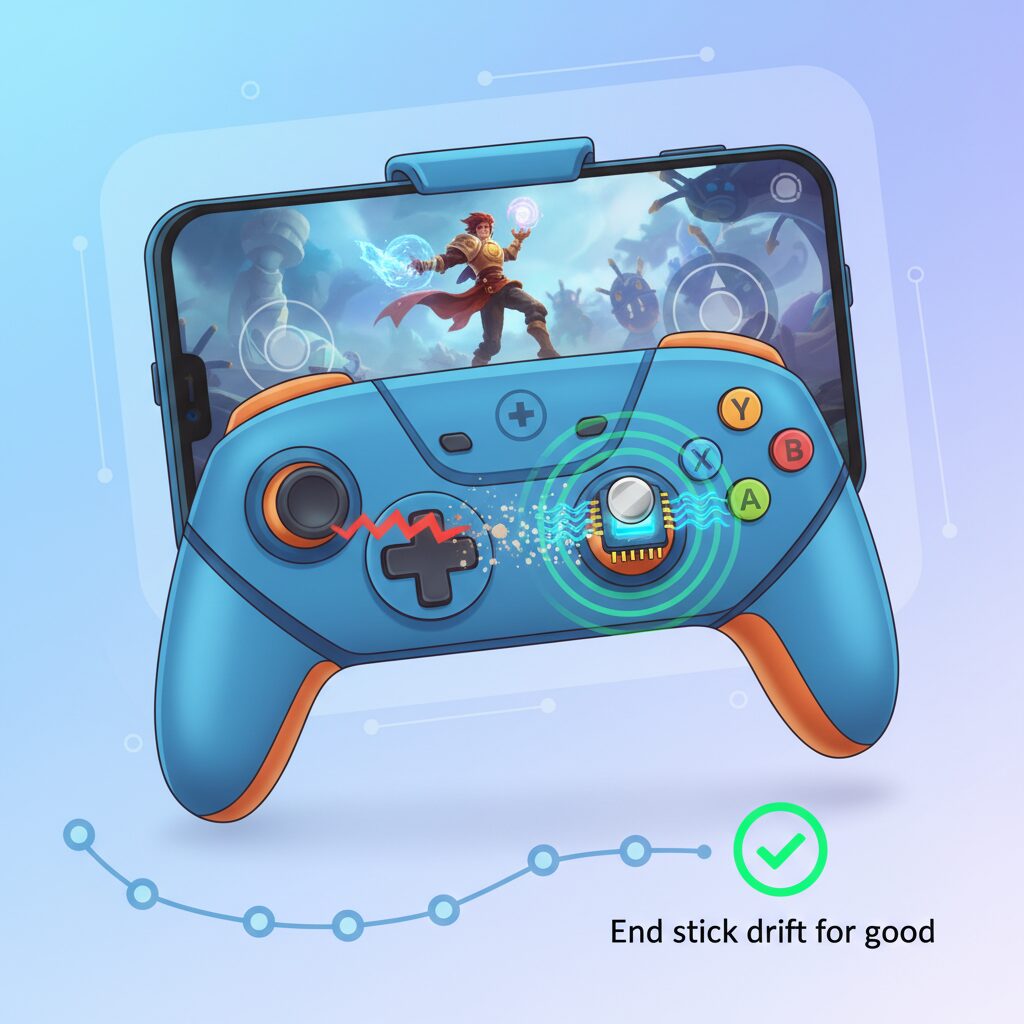
Stick drift has long been the most frustrating and unavoidable flaw in game controllers, especially for players who invest hundreds of hours into competitive titles. Hall Effect sensors are changing that reality by addressing the problem at its physical root, not through software compensation but through a fundamentally different way of detecting movement.
Traditional analog sticks rely on potentiometers, where a metal wiper scrapes across a resistive surface to measure position. Over time, this constant friction produces microscopic debris and uneven resistance, causing false inputs even when the stick is untouched. **According to teardown analyses cited by iFixit, this wear is not an anomaly but an inevitable outcome of the design itself**, which explains why recalibration or firmware updates only delay, rather than solve, the issue.
Hall Effect sensors eliminate physical contact entirely. By placing a small magnet on the stick shaft and measuring changes in the surrounding magnetic field, the sensor calculates position without any mechanical abrasion. The physics behind this phenomenon, first formalized by Edwin Hall in the 19th century, is well established and widely used in automotive and industrial systems where long-term reliability is mandatory.
Independent component testing referenced by controller manufacturers and semiconductor suppliers shows that Hall Effect mechanisms can last two to three times longer than potentiometer-based sticks under identical stress conditions. In gaming terms, this translates into thousands of additional gameplay hours without the gradual onset of dead zones or uncommanded camera movement.
Precision is another underappreciated advantage. With no electrical noise from worn contacts, Hall Effect sensors produce cleaner analog signals. **This allows manufacturers to ship controllers with smaller default dead zones**, which is particularly beneficial in FPS titles where micro-adjustments determine accuracy. Research into human input perception suggests that even small reductions in signal jitter can improve perceived control smoothness, reinforcing why competitive players often describe Hall Effect sticks as more “linear” or “predictable.”
| Aspect | Potentiometer Stick | Hall Effect Stick |
|---|---|---|
| Contact Method | Physical friction | Magnetic, contactless |
| Drift Risk Over Time | High and cumulative | Theoretically negligible |
| Signal Stability | Degrades with wear | Consistent long-term |
Industry adoption accelerated rapidly after high-profile drift complaints reached mainstream awareness. Analysts note that once premium mobile controllers began standardizing Hall Effect sensors, consumer expectations shifted almost overnight. **What was once a niche enthusiast feature is now increasingly viewed as a baseline requirement** in the high-end segment.
It is also worth noting that this technology pairs naturally with the broader premiumization trend in mobile gaming hardware. As smartphones become powerful enough to run console-class games, input devices must meet the same reliability standards. Semiconductor firms supplying Hall sensors to controller manufacturers have publicly emphasized that gaming now represents one of the fastest-growing non-industrial use cases for this mature sensing technology.
For players, the practical implication is simple but profound. A controller equipped with Hall Effect sensors does not slowly betray muscle memory over time. Aim training remains valid, sensitivity settings stay consistent, and the device ages gracefully instead of unpredictably. **In an ecosystem where replacement cycles are shortening for smartphones, Hall Effect sensors ensure that the controller itself does not become the weakest link.**
This is why many experienced users now describe Hall Effect adoption not as an upgrade, but as a correction. It aligns controller design with decades of proven sensing technology and finally brings analog input reliability in line with modern gaming expectations.
From Hall Effect to TMR: The Next Generation of Input Technology
Input technology in modern controllers is quietly undergoing a generational shift, and the move from traditional Hall Effect sensors toward TMR represents a meaningful inflection point. For gamers who demand precision, durability, and consistency, this evolution directly affects how every micro-movement is translated on screen. **What changes here is not marketing language, but the physics behind how motion is detected.**
Hall Effect sensors already solved the most infamous problem of analog sticks: mechanical wear. By detecting changes in a magnetic field rather than relying on physical contact, Hall-based designs virtually eliminate stick drift. Organizations such as iFixit have repeatedly pointed out that contact-based potentiometers fail due to unavoidable friction, while non-contact magnetic sensing fundamentally avoids that failure mode.
TMR, or Tunnel Magnetoresistance, builds on this foundation. Instead of measuring magnetic flux density like Hall sensors, TMR measures resistance changes caused by electron tunneling between magnetic layers. According to research widely cited in IEEE publications, TMR sensors offer significantly higher sensitivity at lower power consumption, which is particularly relevant for battery-powered mobile controllers.
| Sensor Type | Detection Method | Key Advantage |
|---|---|---|
| Potentiometer | Physical contact resistance | Low cost |
| Hall Effect | Magnetic field variation | No mechanical wear |
| TMR | Quantum tunneling resistance | Higher sensitivity, lower power |
In practical terms, this increased sensitivity means that smaller thumb movements can be detected more reliably without amplifying noise. **For FPS players, this translates into finer aim correction, while racing games benefit from smoother steering curves.** Early implementations in high-end and custom controllers suggest that TMR can feel more “solid” around the center position, an observation frequently discussed in enthusiast repair and modding communities.
Another important aspect is energy efficiency. TMR sensors typically require less current than Hall sensors to achieve the same resolution. Semiconductor manufacturers emphasize that this advantage becomes critical as controllers add features such as haptics, wireless connectivity, and onboard processing, all competing for limited battery capacity.
While TMR is not yet mainstream in mobile controllers, the trajectory is clear. Hall Effect sensors have moved from premium differentiator to baseline expectation, and TMR is positioned as the next step once costs stabilize. **This transition mirrors broader trends in consumer electronics, where mature magnetic sensing gives way to more precise, energy-aware technologies.** For users investing in next-generation controllers, understanding this shift helps separate genuine innovation from superficial upgrades.
USB-C vs Bluetooth: The Real Science Behind Input Latency
When gamers argue about USB-C versus Bluetooth, they are really debating milliseconds, not convenience. Input latency is the time between pressing a button and seeing the action on screen, and modern measurements show that this gap is small but scientifically meaningful. **For competitive play, consistency matters as much as raw speed**, and this is where the two connection methods diverge.
| Connection | Typical Latency | Stability | Primary Bottleneck |
|---|---|---|---|
| USB-C (wired) | 3–6 ms | Very high | Controller firmware |
| Bluetooth 5.x | 8–20 ms | Variable | Wireless interference |
With USB-C, the controller communicates directly with the smartphone’s input stack. According to latency analyses referenced by hardware reviewers and engineers involved in esports peripherals, wired connections eliminate packet scheduling and radio retransmission. **This results in extremely low jitter**, meaning each button press arrives at almost the same interval every time. For rhythm games or high-level FPS matches, this predictability often feels more important than shaving off a single millisecond.
Bluetooth has improved dramatically, especially with Bluetooth 5.3 and 5.4. Semiconductor vendors and peripheral manufacturers report that optimized Bluetooth controllers can reach latency levels that are imperceptible for most players. However, academic and industry testing cited in mobile gaming research highlights an inherent weakness: Bluetooth shares spectrum with Wi‑Fi. **When congestion occurs, latency spikes can appear suddenly**, even if the average delay looks acceptable.
From a neuroscience perspective, human reaction time typically ranges from 150 to 250 ms, which makes both methods seem trivial. Yet studies discussed by human–computer interaction researchers point out that players subconsciously adapt to stable delays better than fluctuating ones. This explains why professionals still favor USB-C, while Bluetooth feels “good enough” for action RPGs or cloud gaming on the go.
In practice, the choice becomes situational. USB-C maximizes deterministic performance by removing wireless uncertainty, while Bluetooth trades a small amount of latency control for flexibility across devices and cases. Understanding this trade-off helps players choose based on physics and signal behavior, not just personal preference.
Best Smartphone Gaming Controllers to Watch in 2025–2026
Looking ahead to 2025–2026, smartphone gaming controllers are entering a phase where maturity and experimentation coexist, and several models clearly deserve close attention. **The market’s projected growth toward roughly 256 million USD by the early 2030s**, as reported by global market analysts, is not driven by quantity but by refinement in sensors, connectivity, and software integration.
Among established names, GameSir continues to stand out as a bellwether. Its recent controllers popularized Hall effect sensors at consumer-friendly prices, and industry observers expect the company to further standardize contactless sticks across mid-range models. According to teardown analyses referenced by iFixit contributors, this shift alone can multiply stick lifespan by two to three times, a decisive factor for heavy mobile gamers.
| Brand | Key Focus 2025–2026 | Why It Matters |
|---|---|---|
| GameSir | Hall effect as default | Long-term reliability, zero drift |
| Razer | Tablet-scale compatibility | Expands mobile gaming beyond phones |
| Backbone | Software ecosystem | Lower barrier for casual players |
| Scuf | Pro-grade paddles | Competitive FPS advantages |
Razer is another brand to watch, not because of radical redesigns, but due to its push toward larger devices. Reviews by TechRadar and GamesRadar consistently note that accommodating 8-inch tablets changes how cloud gaming and remote play feel on mobile. **This effectively blurs the line between handheld console and smartphone accessory**, a trend expected to accelerate as cloud services mature.
Backbone and Scuf represent a different trajectory. Backbone’s strength lies in software cohesion, a point frequently highlighted by GamesRadar editors, while Scuf brings console esports DNA into mobile form factors. Together, they signal that the next generation of controllers will be judged as much by software and ergonomics as by raw hardware specs.
Ergonomics, Hand Size, and Long-Term Gaming Health
Ergonomics in mobile gaming controllers directly affects not only comfort but also long-term hand health, especially for players who log dozens of hours each month. **Hand size, grip geometry, and wrist angle form a three-point balance**, and when one element is mismatched, strain accumulates faster than many players realize.
Research in ergonomics and occupational health, including guidance cited by KOS Ergonomics and Dygma, shows that repetitive thumb movement combined with sustained wrist flexion significantly increases the risk of RSI and early carpal tunnel symptoms. This risk is amplified in mobile gaming because the screen and input device are physically connected, encouraging players to hold their hands closer together and lower than with console play.
| Hand Size | Ergonomic Risk | Preferred Controller Traits |
|---|---|---|
| Large | Thumb over-flexion | Deep grips, wider spacing |
| Small | Wrist extension | Compact body, low reach |
For players with larger hands, slim controllers can force a claw-like grip that overworks the thenar muscles at the base of the thumb. Community discussions among Android gaming users consistently report faster fatigue and numbness when grip volume is insufficient. In contrast, controllers with console-like grips support the palm arch and help maintain a neutral wrist posture.
Smaller hands face a different challenge. Oversized controllers may push the wrist into extension just to reach triggers, shifting stress from fingers to tendons. **This is why “one-size-fits-all” designs rarely succeed ergonomically**, even if their build quality is excellent.
Health specialists also emphasize behavioral ergonomics. Short breaks every 30–60 minutes, gentle hand shaking, and sensitivity settings that reduce extreme thumb travel all measurably lower cumulative strain. When hardware fit and play habits align, mobile gaming remains not only immersive but sustainable over years, not months.
Cooling, Audio, and Accessories That Unlock Full Performance
To unlock the true potential of a high-end mobile controller, thermal control, audio latency, and carefully chosen accessories play a decisive role. Even the most advanced Hall Effect sticks cannot compensate for performance drops caused by heat throttling or delayed sound cues, and this reality has become more visible as smartphone SoCs have reached console-class power.
Thermal management is the foundation of sustained performance. According to industry analyses frequently cited by semiconductor researchers and mobile gaming specialists, flagship chips such as Apple’s A‑series Pro and Snapdragon 8-class processors can enter thermal throttling within minutes under maximum GPU load. When this happens, frame rates dip and input response becomes inconsistent, directly undermining competitive play.
Peltier-based smartphone coolers have therefore shifted from niche accessories to essential tools for serious players. Unlike conventional fan-only designs, Peltier elements actively transfer heat away from the device surface, achieving rapid temperature drops within seconds. Reviews of 2025 AI-controlled models highlight adaptive cooling profiles that adjust power output in real time, reducing condensation risk while keeping chip temperatures stable during extended sessions.
| Accessory Type | Technical Role | Impact on Gameplay |
|---|---|---|
| Peltier Cooling Fan | Active heat transfer via electronic cooling | Prevents FPS drops and thermal throttling |
| Low-Latency Audio Device | Reduces codec and transmission delay | Improves reaction timing and spatial awareness |
| Controller-Compatible Mounts | Ensures physical clearance and airflow | Maintains comfort and cooling efficiency |
Physical compatibility is often overlooked but critically important. Magnetic coolers designed for MagSafe-equipped iPhones offer convenience, yet they can interfere with telescopic controllers if rear clearance is insufficient. Field reports and manufacturer guidance consistently recommend controllers with rear cutouts or integrated cooling channels when pairing with active cooling accessories.
Audio is the second pillar of full-performance gaming. Multiple studies on Bluetooth codecs and gaming latency show that standard wireless audio can introduce delays noticeable in rhythm games and competitive shooters. While Bluetooth 5.x has narrowed the gap, variability caused by radio interference remains a concern for high-skill players.
Wired audio remains the most reliable solution when a controller includes a 3.5 mm passthrough jack. This setup bypasses codec processing entirely, delivering near-instant feedback that aligns sound cues precisely with on-screen action. For wireless convenience without compromise, dedicated 2.4 GHz dongle-based gaming earbuds, evaluated positively by professional reviewers and market analysts, provide a practical alternative by achieving latencies far below standard Bluetooth.
Accessory selection should also consider power delivery. Active cooling units draw continuous USB power, and controllers with passthrough charging enable long sessions without battery anxiety. Experts in mobile hardware optimization often stress that stable power, controlled temperature, and consistent audio timing together form a performance triangle; weakening any side reduces the overall experience.
In practice, players who invest in cooling and audio accessories report not only smoother frame rates but also reduced hand fatigue, as devices remain cooler to the touch. This subtle ergonomic benefit supports longer play sessions and steadier input, reinforcing why accessories are no longer optional add-ons but integral components of a high-performance mobile gaming ecosystem.
Software, Apps, and Customization That Most Specs Sheets Ignore
When evaluating mobile gaming controllers, software and customization are often treated as secondary details, yet they shape daily usability more than raw hardware specs do. In practice, the companion app defines whether a controller feels like a precision instrument or a blunt tool. **Dead zone control, firmware maturity, and input mapping logic directly affect muscle memory and long-term comfort**, especially for players who log dozens of hours per month.
Research communities and teardown specialists such as iFixit have repeatedly noted that modern controllers are no longer static devices. They behave more like updatable peripherals, where firmware revisions can materially change stick response curves, trigger thresholds, and even Bluetooth stability. This is why brands like GameSir, Razer, and Backbone invest heavily in software layers that sit between the game and the hardware, quietly correcting imperfections that spec sheets never mention.
One concrete example is dead zone tuning. Many controllers ship with conservative defaults to avoid accidental input, but this can dull fine aiming. Through companion apps, users can reduce the dead zone to near zero and switch from filtered input to raw trajectories. **For FPS titles or racing simulators, this single toggle can feel like a generational upgrade**, even though no physical component has changed.
| Software Feature | Practical Impact | Hidden Trade-off |
|---|---|---|
| Dead zone adjustment | Sharper micro-aim and steering precision | May expose stick noise if calibration is poor |
| Firmware updates | Improved latency and stability over time | Requires active vendor support |
| Virtual touch mapping | Enables play in non-native controller games | Setup complexity and learning curve |
Another overlooked layer is virtual mapping for games without native controller support. On Android in particular, popular titles still rely on touch input. Companion apps translate physical button presses into simulated screen taps, letting players enjoy proper ergonomics. Industry analysts often describe this as a stopgap, but in reality it has become a defining feature of the ecosystem. **The quality of the mapping engine determines whether inputs feel intuitive or artificial**, and not all implementations are equal.
Backbone’s software philosophy illustrates a different angle. Rather than deep hardware tuning, it emphasizes a unified interface that organizes games, clips, and social features. According to coverage by GamesRadar, this approach lowers friction for casual users and shortens the path from launch to play. The controller effectively disappears, replaced by an OS-like layer that frames the phone as a dedicated console.
Razer’s Nexus ecosystem, by contrast, prioritizes flexibility. It allows users to create custom profiles per game, adjust sensitivity curves, and experiment with virtual controller modes. **This modularity appeals to enthusiasts who enjoy fine-tuning**, but it also highlights a broader truth: software freedom increases responsibility. Poorly chosen settings can degrade performance as easily as they can enhance it.
From a market perspective, analysts tracking the mobile controller segment note that software lock-in is becoming a competitive moat. As hardware differentiation narrows, brands retain users through familiar apps, saved profiles, and continuous updates. In other words, **customization is no longer an accessory feature but a retention strategy** that quietly influences purchasing decisions.
Ultimately, the controllers that age best are not always those with the most impressive internals, but those backed by thoughtful software. A stable app, transparent updates, and granular customization ensure that the device evolves alongside games and operating systems. For players who value consistency and control, this invisible layer is the real specification that matters.
Future Trends: How AI, Cloud Gaming, and Haptics Will Change Controllers
The future of mobile controllers will be shaped by the convergence of AI, cloud gaming, and advanced haptics, and this shift will fundamentally redefine what “input devices” mean for gamers. Rather than acting as passive peripherals, controllers are expected to become intelligent interfaces that actively adapt to players, networks, and game contexts.
AI-driven personalization will be one of the most visible changes. According to analyses from BCG and MarketsandMarkets, AI is increasingly embedded at the edge level, enabling real-time adaptation without relying solely on cloud processing. In practical terms, controllers will automatically adjust stick sensitivity, trigger resistance, and even button mapping based on player behavior. For example, in competitive shooters, AI models trained on user input patterns can subtly reduce overcorrection or compensate for fatigue during long sessions, improving consistency without altering game balance.
Cloud gaming will further accelerate this evolution. As services such as Xbox Cloud Gaming mature and network latency becomes more predictable with 5G and early 6G trials, the controller’s role shifts from hardware-bound to service-aware. Research cited by BCG suggests that future controllers may authenticate directly with cloud platforms, storing player profiles and latency preferences independently of the smartphone. This approach mirrors earlier experiments like Stadia’s controller, but with broader ecosystem support and standardized APIs.
| Technology | Primary Impact | User Benefit |
|---|---|---|
| AI Input Optimization | Adaptive sensitivity and mapping | More stable performance over time |
| Cloud-Native Controllers | Direct server communication | Reduced dependency on device power |
| Advanced Haptics | High-definition tactile feedback | Greater immersion and spatial awareness |
Haptics will also undergo a qualitative leap. Market research from MarketsandMarkets indicates that high-definition haptic systems are moving beyond simple vibration toward texture- and force-based feedback. In future mobile controllers, AI-controlled haptics will interpret in-game physics data to generate context-aware sensations, such as varying recoil intensity based on weapon type or subtle surface textures when traversing different terrain. This will make controllers a sensory extension of the game world rather than a simple input tool.
Together, these trends suggest that controllers will no longer be judged only by latency or build quality. Instead, their value will lie in how intelligently they integrate AI, cloud infrastructure, and haptics to deliver experiences that feel personalized, responsive, and deeply immersive.
参考文献
- Counterpoint Research:Global Smartphone Shipments Grew 2% YoY in 2025; Apple Emerged as Market Leader
- Global Growth Insights:Mobile Controllers for Video Games Market Size, Share | Industry Forecast to 2033
- Fortune Business Insights:Japan Semiconductor Market Size, Share, Growth, 2026–2034
- ELO Gaming:Hall Effect Joysticks: What Are They and Why They Matter for Gaming
- AimControllers:The Benefits of Hall Effect Sensors in Controllers
- TechRadar:The Best Mobile Controllers 2025: Upgrade Your Portable Play
- BCG:Video Gaming Report 2026: The Next Era of Growth