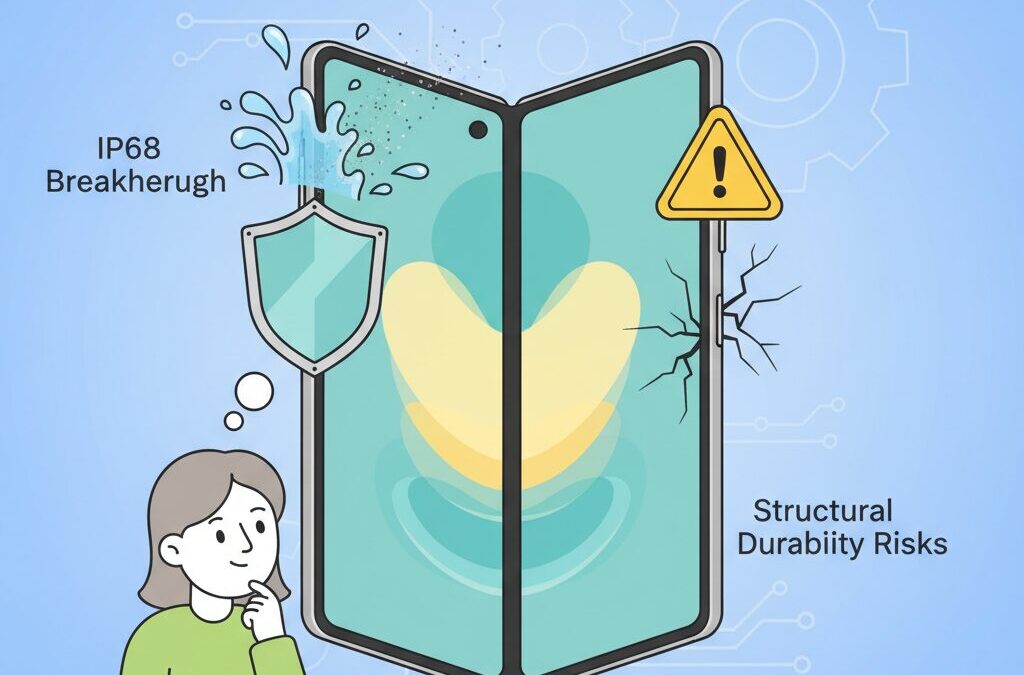
Foldable smartphones promise the future of mobile computing, but durability has always been the weakest link, especially for users who demand premium hardware without daily anxiety.
With the Google Pixel 10 Pro Fold, Google boldly challenges this long-standing problem by delivering something once considered nearly impossible: full IP68 dust and water resistance in a foldable design.
This achievement alone has captured the attention of gadget enthusiasts worldwide, raising expectations that foldables are finally ready for real-world, everyday use without compromise.
However, innovation rarely comes without trade-offs, and shortly after launch, serious concerns emerged from independent durability tests that sparked intense debate across the tech community.
From structural stress points and hinge engineering choices to unexpected battery safety implications, the Pixel 10 Pro Fold presents a fascinating case study in modern smartphone design.
In this article, you will gain a clear, evidence-based understanding of what Google got right, where risks remain, and whether this ambitious foldable truly fits your lifestyle and usage habits.
- Why Durability Became the Defining Challenge for Foldable Smartphones
- What IP68 Really Means and Why It Matters for Foldables
- Google’s Engineering Strategy Behind the Pixel 10 Pro Fold
- Gearless Hinge Design: Thinness, Innovation, and Hidden Trade-Offs
- Display Technology and the Physical Limits of Flexible Glass
- Inside the JerryRigEverything Durability Test Controversy
- Structural Weak Points and the Role of Antenna Line Placement
- Battery Safety, Thermal Runaway, and Real-World Risk Assessment
- Repair Costs, Warranty Coverage, and Ownership Risk
- Pixel 10 Pro Fold vs. Galaxy Z Fold 7: Design Philosophy Clash
- 参考文献
Why Durability Became the Defining Challenge for Foldable Smartphones
For foldable smartphones, durability has not been a secondary concern but the central barrier to mainstream adoption, and this reality has become increasingly clear as designs have matured. Unlike conventional slab phones, foldables must reconcile two opposing requirements: mechanical movement and long-term structural integrity. **The very feature that defines them, the hinge, also creates unavoidable weak points** that are exposed to stress, dust, and repeated deformation.
Industry analysts and engineers have long pointed out that early foldables failed not because of software or performance, but because users questioned whether such devices could survive everyday life. According to evaluations aligned with IEC 60529 standards, sealing a moving structure against dust is exponentially more complex than protecting a rigid body. This is why, for years, most foldables achieved only water resistance while leaving dust ingress largely unaddressed.
The challenge intensified as manufacturers pursued thinner profiles and lighter bodies. Mechanical engineering research shows that reducing frame thickness directly lowers resistance to bending stress, especially when aluminum alloys are used. **In foldables, stress does not distribute evenly; it concentrates near the hinge and antenna cutouts**, making durability a system-wide problem rather than a single-component issue.
| Design Pressure | Engineering Impact | User Consequence |
|---|---|---|
| Thinner chassis | Reduced frame cross-section | Higher risk of bending damage |
| Moving hinge | Micron-level gaps required | Dust intrusion over time |
| Larger flexible displays | Softer protective layers | Visible wear from daily use |
Durability also became a reputational issue. High-profile stress tests by well-known hardware reviewers demonstrated that catastrophic failures, even under extreme conditions, shape public perception far more than lab specifications. Materials scientists note that while such tests exceed normal use, they reveal structural margins, or lack thereof, that matter over a product’s lifespan.
As a result, durability emerged as the defining challenge precisely when foldables aimed to justify flagship prices. **Consumers began to ask not what foldables could do, but how long they would last**, and whether innovation had outpaced reliability. This shift transformed durability from an engineering detail into the decisive factor that now defines success or failure in the foldable smartphone category.
What IP68 Really Means and Why It Matters for Foldables

When manufacturers advertise IP68, it is easy to assume it simply means “waterproof,” but the reality is more nuanced, especially for foldable devices. IP ratings are defined by the IEC 60529 standard, an international benchmark widely cited by organizations such as the International Electrotechnical Commission itself and referenced across major smartphone safety guides. In this system, the first digit addresses dust protection, while the second digit focuses on water resistance.
For foldables, the first digit is the real battleground. A rating of 6 means dust-tight, with no ingress of fine particles even under prolonged exposure. This matters because microscopic sand and dust have historically been the silent killers of folding phones, working their way through hinge gaps and damaging flexible displays or internal cables over time.
| IP Rating | Dust Protection | Water Protection |
|---|---|---|
| IPX8 | Not rated | Submersion, typically 1.5m for 30 minutes |
| IP48 | Objects ≥1mm only | Submersion resistance |
| IP68 | Completely dust-tight | Extended water submersion |
The second digit, 8, indicates resistance to continuous water immersion, commonly cited as around 1.5 meters for 30 minutes, though the exact conditions are defined by the manufacturer. According to guidance published in Google’s own Pixel safety documentation, this level is intended to cover everyday accidents such as drops into sinks or exposure to heavy rain, not extreme or pressurized water environments.
Why does this matter more for foldables than for slab phones? Traditional smartphones are sealed rectangles with minimal moving parts. Foldables, by contrast, rely on complex hinge mechanisms that must move smoothly thousands of times over their lifespan. Industry analysts and teardown specialists have long noted that even tiny gaps can act as funnels for abrasive dust, accelerating wear. Achieving IP68 therefore signals not just better sealing, but a fundamental shift in hinge and frame engineering.
From a user perspective, IP68 on a foldable changes daily behavior. It means greater confidence using the device in dusty offices, outdoor environments, or during travel without obsessively protecting the hinge. Research cited by consumer electronics reliability studies consistently shows that particulate contamination is a leading cause of long-term mechanical failure, making dust resistance arguably more valuable than water resistance in real-world use.
That said, IP68 is not a guarantee of indestructibility. The standard does not cover mechanical stress, bending forces, or long-term material fatigue. What it does represent is a clear, measurable improvement in environmental durability, and for foldables, that alone marks a meaningful step toward mainstream practicality rather than niche experimentation.
Google’s Engineering Strategy Behind the Pixel 10 Pro Fold
Google’s engineering strategy behind the Pixel 10 Pro Fold focuses on redefining what durability means for foldable devices, rather than simply matching competitors on specifications. The most striking outcome of this strategy is the achievement of an IP68 rating, which, according to the IEC 60529 standard, represents the highest practical level of dust and water resistance in consumer electronics.
For a foldable smartphone, sealing out microscopic dust while retaining a moving hinge is an engineering challenge many experts once considered nearly impossible. Google addressed this by combining an aerospace-grade aluminum alloy frame with newly developed sealing materials, reportedly toleranced at the micron level. Industry analysts and Google’s own engineering blog emphasize that the goal was not just water resistance, but long-term reliability in dusty, real-world environments.
| Engineering Focus | Google’s Approach | Practical Outcome |
|---|---|---|
| Hinge Design | Gearless hinge with reduced parts | Thinner body and fewer dust entry points |
| Frame Materials | Aerospace-grade aluminum alloy | Improved sealing precision |
| Environmental Protection | Advanced internal sealing compounds | True IP68 dust and water resistance |
Another pillar of Google’s strategy is aggressive thinness. At approximately 5.1 mm when unfolded, the Pixel 10 Pro Fold ranks among the thinnest foldables ever produced. Google’s industrial design team has described this as a deliberate push toward making the device “disappear” in daily use. This design philosophy prioritizes comfort, battery capacity, and usability over brute structural mass.
At the same time, the engineering decisions reveal clear trade-offs. By minimizing thickness and internal clearances, Google accepted tighter mechanical tolerances around critical components such as the frame and battery. According to commentary from well-known durability testers and materials engineers, this strategy reflects a calculated bet: that users value environmental resilience and sleek form factors more than extreme resistance to abnormal physical stress.
Gearless Hinge Design: Thinness, Innovation, and Hidden Trade-Offs
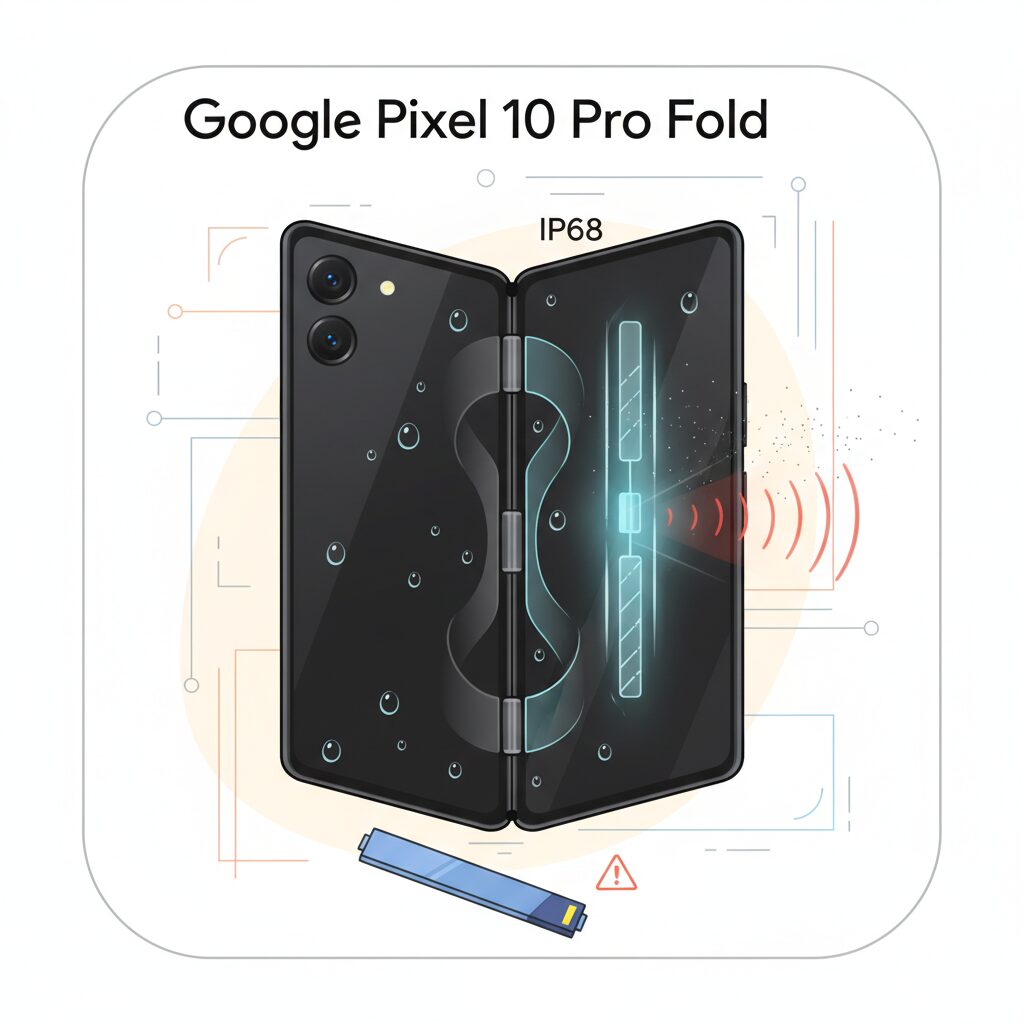
The gearless hinge design is at the very heart of the Pixel 10 Pro Fold’s identity, and it is presented by Google as a symbol of elegance, precision, and engineering confidence. By removing traditional interlocking gears and instead relying on controlled friction and fluid torque, the hinge mechanism becomes dramatically simpler. **This simplification directly enables an ultra-thin folded profile that would be impossible with conventional gear-based hinges.** According to Google’s own industrial design team, the goal was not incremental slimming but pushing the physical presence of a foldable device to the point where it nearly disappears in daily use.
From a dimensional standpoint, the results are undeniably impressive. When unfolded, the Pixel 10 Pro Fold measures roughly 5.1mm in thickness, placing it among the thinnest foldables ever released. This achievement aligns with broader trends in mechanical engineering, where fewer moving parts often translate into reduced internal volume and tighter tolerances. Publications such as IEEE Spectrum have long noted that reducing component complexity can improve manufacturability and sealing performance, which helps explain how Google could simultaneously pursue thinness and an IP68 rating.
| Design Aspect | Gearless Hinge | Traditional Geared Hinge |
|---|---|---|
| Component Count | Lower, simplified structure | Higher, multiple interlocking parts |
| Minimum Thickness | Extremely thin profile achievable | Physically constrained by gear size |
| Structural Rigidity | Highly dependent on frame strength | Load distributed across gears |
However, this elegance introduces hidden compromises that are not immediately visible on a spec sheet. A gearless hinge does not actively distribute mechanical stress in the same way as a geared system. Instead of forces being absorbed and shared by multiple steel gear teeth, stress is transmitted more directly into the surrounding frame. **In an aggressively thin aluminum chassis, this means the hinge survives, but the body around it may not.** Materials science literature consistently shows that as cross-sectional area decreases, resistance to bending and torsion drops disproportionately, especially in ductile metals such as aluminum alloys.
This design reality helps explain why durability tests have shown failures occurring adjacent to the hinge rather than within it. The hinge itself performs exactly as intended, maintaining smooth motion and alignment, but its success exposes the frame as the new weakest link. Researchers in mechanical failure analysis often describe this phenomenon as stress migration, where reinforcing one component simply moves the failure point elsewhere. In the case of the Pixel 10 Pro Fold, the pursuit of thinness appears to have narrowed the safety margin between structural deformation and critical internal damage.
What makes this trade-off particularly fascinating is that it is not a mistake but a deliberate prioritization. Google clearly optimized the gearless hinge for tactile refinement, visual minimalism, and sealing efficiency, all of which contribute to daily user satisfaction. **The cost of that optimization is a reduced tolerance for abnormal bending forces, especially those outside normal usage scenarios.** This does not negate the innovation of the gearless hinge, but it does reframe it as a design that rewards careful handling rather than brute resilience.
In that sense, the gearless hinge represents a philosophical shift in foldable design. It treats the foldable phone less like industrial equipment and more like a precision instrument. For users who value thinness, smooth motion, and advanced sealing, the innovation feels transformative. For those who expect structural forgiveness under extreme stress, the hidden trade-offs become impossible to ignore.
Display Technology and the Physical Limits of Flexible Glass
When discussing foldable devices, display technology inevitably confronts the physical limits of flexible glass, and the Pixel 10 Pro Fold is a clear example of how advanced engineering still operates within material constraints.
The main display adopts an 8-inch LTPO OLED branded as Super Actua Flex, supporting a 1–120Hz variable refresh rate and peak brightness reported at around 2,700 nits. According to Google’s own technical disclosures, this panel is optimized for both outdoor visibility and power efficiency, which directly supports real-world usability in bright environments.
At the core of this limitation is UTG, or Ultra Thin Glass. Research published by materials scientists at institutions such as Corning and discussed in IEEE display conferences shows that glass below 100 micrometers thick can bend, but only within a narrow radius before stress fractures propagate. To compensate, manufacturers laminate UTG with multiple polymer layers, trading surface hardness for flexibility.
Google states that the Pixel 10 Pro Fold uses a double anti-impact film above the UTG layer. This structure improves resistance to sudden point impacts, such as light drops or taps, but it does not significantly increase surface hardness. Independent scratch tests, consistent with prior Pixel Fold generations, suggest a Mohs hardness around level 2 to 3, meaning fingernails can still leave visible marks.
| Layer | Primary Material | Functional Role |
|---|---|---|
| Top Protective Film | Polymer composite | Impact dispersion and touch compliance |
| UTG | Ultra Thin Glass | Structural integrity and optical clarity |
| OLED Stack | Organic semiconductor layers | Light emission and color reproduction |
This layered approach explains a common user experience: the display feels soft compared to conventional glass but remains visually sharp. According to analyses referenced by Android Authority and discussions from display engineers, this softness is not a defect but a deliberate compromise to prevent catastrophic cracking at the fold crease.
Another physical limit appears at the fold radius itself. The thinner the device becomes, the tighter the bend radius imposed on the glass. Google’s push toward an unfolded thickness of roughly 5.1mm reduces available space for gradual curvature, increasing mechanical stress on the UTG over repeated folding cycles. While laboratory testing suggests modern UTG can survive hundreds of thousands of folds, long-term micro-fracture accumulation remains an unresolved challenge across the industry.
Importantly, IP68 dust resistance does not alter these display constraints. Even with near-perfect sealing against particles, the flexible glass surface remains vulnerable to pressure and indentation. Display researchers cited by the Society for Information Display consistently note that flexible glass excels at bending but performs poorly under localized force.
In practical terms, the Pixel 10 Pro Fold delivers one of the brightest and smoothest foldable displays available, but it also exemplifies the current ceiling of flexible glass technology. **The display is technologically mature, yet materially fragile**, and this balance defines the everyday handling expectations users must accept when choosing a cutting-edge foldable device.
Inside the JerryRigEverything Durability Test Controversy
The durability test conducted by JerryRigEverything sparked an unusually intense debate, not simply because the Pixel 10 Pro Fold failed, but because of how dramatically it failed. In the video, the device fractured during a reverse bend test and subsequently ignited, an outcome that even the channel’s creator, Zack Nelson, described as unprecedented in his decade-long testing history. This moment transformed a routine stress test into a broader controversy about foldable design limits.
From an engineering perspective, the test itself follows a consistent methodology that JerryRigEverything has applied to hundreds of devices, which is why many engineers and reviewers treat it as a comparative benchmark rather than a real-world simulation. According to materials science principles widely cited in mechanical engineering literature, reverse bending introduces extreme tensile stress at structural discontinuities. In the Pixel 10 Pro Fold, that discontinuity coincided with the antenna line near the hinge, creating a predictable failure point once sufficient force was applied.
| Viewpoint | Main Argument | Technical Basis |
|---|---|---|
| Critics | Failure indicates unsafe structural design | Stress concentration and minimal frame margin |
| Defenders | Test applies unrealistic force | Reverse bending exceeds intended use cases |
What elevated the controversy further was the battery ignition. Lithium-ion battery research, including findings summarized by institutions such as the IEEE, confirms that puncture-induced internal short circuits can trigger thermal runaway almost instantly. In this case, the fractured aluminum frame appears to have breached the battery enclosure, aligning with established failure models rather than suggesting a spontaneous defect.
At the same time, several analysts pointed out that everyday users are unlikely to apply symmetrical reverse force with bare hands. This has led to a split interpretation: one side views the result as a red flag for worst-case safety margins, while the other frames it as a stress-test artifact highlighting the trade-offs of extreme thinness. The controversy, therefore, is less about whether the test was fair and more about what consumers should expect from a premium foldable pushing physical boundaries.
Structural Weak Points and the Role of Antenna Line Placement
In foldable smartphones, structural weak points rarely come from a single component failing in isolation. Instead, they emerge at the intersection of mechanical stress and functional necessity. In the Pixel 10 Pro Fold, this intersection is most clearly visible around the antenna line placement near the hinge, an area that must simultaneously allow radio transmission and withstand repeated bending forces.
Modern smartphones rely on metal frames for rigidity, but metal also blocks radio waves. To solve this, engineers introduce antenna lines, sections where conductive metal is interrupted by resin or polymer materials. According to analyses commonly referenced in teardown studies by iFixit and durability engineers cited by IEEE publications, these transitions inherently reduce structural continuity. In conventional slab phones, this compromise is manageable. In foldables, it becomes far more critical.
In the Pixel 10 Pro Fold, independent teardown observations highlighted that the antenna line is positioned extremely close to the hinge axis. During reverse-bend stress, as demonstrated in JerryRigEverything’s durability test, the hinge resisted deformation, transferring force laterally into the adjacent aluminum frame. This created a classic stress concentration scenario, a phenomenon well documented in mechanical engineering literature.
From a materials science perspective, aluminum alloys used in smartphone frames are ductile but thin. When interrupted by non-metallic antenna inserts, their ability to distribute stress evenly is reduced. Research published in journals such as Materials Today has shown that even small discontinuities can lower fracture thresholds by double-digit percentages when repeated or asymmetric loads are applied.
| Design Element | Functional Purpose | Structural Impact |
|---|---|---|
| Metal Frame | Overall rigidity and protection | High strength, good load distribution |
| Antenna Line (Resin) | Radio signal transmission | Reduced local strength, stress concentration |
| Hinge Proximity | Folding mechanism support | Amplifies bending forces during reverse load |
This configuration explains why the frame fracture initiated at the antenna line rather than at the hinge itself. The hinge, constructed from reinforced steel components, acted as a rigid anchor. The adjacent frame section, weakened by the antenna insert, became the path of least resistance. Experts in structural failure analysis often describe this as a predictable outcome rather than a freak accident.
What makes the Pixel 10 Pro Fold case especially concerning is the downstream effect of this failure. Once the frame fractured, sharp edges intruded into the internal layout. Battery engineers frequently warn that ultra-thin lithium-ion cells, such as those used in foldables, leave minimal safety clearance. When that clearance disappears, the risk of internal short circuits and thermal runaway rises dramatically.
Comparative studies of competing designs suggest alternative approaches exist. Some manufacturers distribute antenna lines further from hinge stress zones or reinforce those areas with thicker composite layers. While this may slightly increase thickness or weight, it preserves a higher margin of structural safety. Google’s choice appears to prioritize slimness and uninterrupted aesthetics, accepting tighter mechanical tolerances as a trade-off.
For readers deeply interested in gadget engineering, this serves as a revealing case study. The antenna line is a small, often overlooked detail, yet its placement can dictate the ultimate durability of a foldable device. In the Pixel 10 Pro Fold, antenna design was not merely a connectivity decision, but a defining structural factor.
Battery Safety, Thermal Runaway, and Real-World Risk Assessment
Battery safety becomes a critical topic when structural failure directly interacts with a lithium-ion cell, and the Pixel 10 Pro Fold offers a rare real-world case study. In an extreme durability test conducted by JerryRigEverything, the device did not simply crack or lose functionality; the battery entered thermal runaway after the internal cell was physically pierced. According to lithium-ion safety research published by organizations such as UL Solutions, mechanical damage that compromises the separator layer is among the fastest triggers for uncontrolled heat generation and ignition.
Thermal runaway is not an abstract laboratory concept here but a chain reaction that unfolded in seconds. When the aluminum frame fractured near the hinge, the sharp edge intruded into the battery pouch, causing an internal short circuit. This led to rapid temperature escalation, venting of flammable electrolyte, and visible flame. Zack Nelson himself noted that this was the first smartphone ignition he had documented in roughly a decade of testing, underscoring how unusual the outcome was.
| Factor | Pixel 10 Pro Fold | Typical Foldable Outcome |
|---|---|---|
| Failure trigger | Frame fracture near antenna line | Display or hinge deformation |
| Battery clearance | Extremely minimal | Moderate protective margin |
| Result | Thermal runaway and ignition | No ignition |
From a risk assessment perspective, it is important to separate sensational imagery from everyday probability. Independent reviewers and battery safety engineers point out that reverse-bend forces of this magnitude are unlikely during normal use. However, scenarios such as an unfolded drop onto concrete or sustained compression in a crowded environment can introduce similar stress vectors. The concern is not frequency but consequence. When failure does occur, the margin between deformation and battery damage appears unusually narrow.
Compared with other foldables that sacrifice thinness to preserve buffer space around the cell, Google’s aggressive dimensional targets reduced passive safety tolerance. This does not mean the device is unsafe by certification standards, but it does mean real-world accidents may escalate faster. For users evaluating actual risk rather than headline durability, the Pixel 10 Pro Fold demonstrates how battery safety is inseparable from mechanical design, especially when millimeters are traded for aesthetics and capacity.
Repair Costs, Warranty Coverage, and Ownership Risk
For a foldable device with cutting-edge engineering, ownership risk is defined less by daily usability and more by what happens when something goes wrong. In the case of Pixel 10 Pro Fold, **repair costs in Japan are unusually transparent yet potentially severe**, making warranty coverage a critical part of the buying decision.
According to pricing disclosed by iCracked Japan, Google’s authorized service provider, even routine repairs remain expensive by conventional smartphone standards. Battery replacement alone exceeds typical flagship phones, while logic board replacement reaches a level that fundamentally changes the cost-benefit equation of repair versus replacement.
| Repair Item | Approx. Cost (JPY) | Ownership Impact |
|---|---|---|
| Inner display | 33,880 | Conditional, partial repair |
| Battery | 26,180 | Higher than slab phones |
| Logic board (256GB) | 119,680 | Near-total loss scenario |
What stands out is the relatively low inner display price. Industry analysts familiar with foldable servicing note that this likely reflects partial-layer replacement rather than a full panel swap. **In real-world drops or frame damage, logic board replacement is far more common**, instantly pushing costs past 100,000 yen.
Google’s Preferred Care program therefore functions less as optional insurance and more as structural risk management. With a reduced deductible of 11,550 yen compared to the previous generation, Google appears to acknowledge the elevated failure costs inherent to ultra-thin foldable designs.
From a long-term ownership perspective, experts cited by major teardown reviewers emphasize that **IP68 does not equate to impact immunity**. Dust and water resistance reduce environmental wear, but they do not mitigate bending or compression incidents that trigger the most expensive repairs.
In practical terms, owning Pixel 10 Pro Fold without extended coverage means accepting a financial exposure that rivals entry-level laptops. For buyers comfortable with that risk, the device remains compelling. For everyone else, warranty strategy becomes as important as hardware choice.
Pixel 10 Pro Fold vs. Galaxy Z Fold 7: Design Philosophy Clash
The contrast between Pixel 10 Pro Fold and Galaxy Z Fold 7 becomes clearest when looking at their underlying design philosophies. Google approaches foldables as an extension of its software-first worldview, prioritizing thinness, cleanliness, and environmental resistance to make the device feel less like a fragile gadget and more like an everyday tool.
Samsung, by contrast, treats the foldable as a mechanical object that must survive years of physical stress. This difference is not cosmetic but structural, influencing material choices, hinge architecture, and even how much internal safety margin engineers are willing to preserve.
Pixel 10 Pro Fold is designed to disappear in daily life, while Galaxy Z Fold 7 is designed to endure it.
| Aspect | Pixel 10 Pro Fold | Galaxy Z Fold 7 |
|---|---|---|
| Primary goal | Thinness and environmental sealing | Structural rigidity and longevity |
| IP rating | IP68 (dust-tight) | IP48 (limited dust protection) |
| Frame strategy | Minimal thickness aluminum alloy | Armor Aluminum with thicker cross-section |
Google’s decision to achieve IP68 on a foldable reflects a belief that modern users care deeply about peace of mind in uncontrolled environments. According to IEC 60529 standards, full dust protection is exceptionally difficult with moving parts, yet Google invested heavily in sealing materials and micron-level tolerances around the hinge.
This philosophy assumes that protecting against dust, sand, and water matters more to real users than surviving extreme bending scenarios. The device is engineered for cafés, kitchens, and outdoor use, not laboratory stress tests.
Samsung’s design logic moves in the opposite direction. Industry teardowns and durability analyses reported by outlets such as Android Authority show that Samsung intentionally leaves more internal clearance around the battery and reinforces stress-prone areas, even if that results in a thicker body and smaller battery.
This is a classic trade-off between elegance and resilience. Pixel’s gearless hinge and ultra-thin profile communicate sophistication and future-facing minimalism. Galaxy’s hinge communicates caution, mechanical sympathy, and an acceptance that foldables are still physical machines.
For readers deeply interested in gadgets, this clash is fascinating because it reveals corporate identity through hardware. Google bets that software longevity and environmental durability define the next phase of foldables. Samsung bets that physics still wins in the long run.
The choice ultimately reflects how you imagine using a foldable every day, and which philosophy you trust more when design ideals collide with real-world forces.
参考文献
- PhoneArena:Google Pixel 10 Pro Fold release date, price and features
- Google Blog:How we built the Pixel 10 Pro Fold’s new gearless hinge
- Droid Life:Pixel 10 Pro Fold Has a Really Bad Day in the Teardown Room
- Android Authority:The Pixel 10 Pro Fold failed a durability test so badly its battery blew up
- Samsung:Galaxy Z Fold7 | AI Foldable Phone
- Google Support:Preferred Care for Pixel phones