
What if you could leave your home with nothing but your smartphone—and still pay, prove your identity, visit a hospital, unlock your door, and drive your car? In Japan, this is no longer a futuristic concept but a rapidly normalizing reality.
As of 2026, cashless payments account for 42.8% of total transactions in Japan, surpassing the government’s original 40% target ahead of schedule. Digital IDs are now integrated into smartphones, mobile driver’s licenses are legally recognized, and even health insurance verification can be completed with a tap of your phone.
In this article, you will discover how regulatory reform, platform competition, NFC and UWB technologies, and large-scale digital government initiatives have converged to create one of the world’s most advanced wallet-free ecosystems. If you are passionate about gadgets, fintech, mobility, and the future of digital infrastructure, this deep dive into Japan’s structural transformation will give you valuable insights into what may soon happen in your own country.
- From Cash-Oriented Society to 42.8% Cashless: The Macroeconomic Shift in Japan’s Payment Market
- Credit Cards, QR Codes, and NFC: Platform Wars Behind Everyday Payments
- The Remaining 60%: Where Cash Still Survives and Why It Matters
- Digital Government Breakthrough: Smartphone-Based National ID Goes Mainstream
- Mobile Driver’s Licenses and Legal Recognition of Digital Identity
- The 2027 KYC Mandate: Why IC Chip Reading Will Replace ID Photo Uploads
- Digital Banking Case Studies: How PayPay Bank and Minna no Ginko Reinvent Onboarding
- Healthcare DX: Insurance Cards and Hospital Check-In Move to Smartphones
- Smart Locks, AI Security, and a $159 Million Market on the Rise
- Digital Car Keys and UWB: Turning Smartphones into Precision Mobility Devices
- MagSafe, Minimal Backups, and the Hybrid Strategy for Going Wallet-Free
- Security, Battery Anxiety, and Single-Point-of-Failure Risks in a Phone-Centric Life
- 参考文献
From Cash-Oriented Society to 42.8% Cashless: The Macroeconomic Shift in Japan’s Payment Market
For decades, Japan was described as a cash-oriented society. High trust in physical currency, dense ATM networks, and low crime rates supported a culture where banknotes were seen as efficient and safe. However, the data now shows a decisive structural shift in the payment market.
According to the Ministry of Economy, Trade and Industry, Japan’s cashless payment ratio reached 42.8% in 2024, with a total transaction value of approximately 141 trillion yen. In 2020, the ratio stood at 29.7% (85.8 trillion yen), meaning the country achieved a 13.1-point increase in just four years.
This growth allowed the government’s KPI of “around 40% by 2025” to be achieved ahead of schedule. The psychological “40% barrier” has effectively been broken, signaling that cashless payments are no longer peripheral but macroeconomically significant.
| Year | Cashless Ratio | Transaction Value |
|---|---|---|
| 2020 | 29.7% | 85.8 trillion yen |
| 2024 | 42.8% | 141 trillion yen |
The macroeconomic implications are substantial. A 141-trillion-yen digital transaction base reshapes fee structures, consumer data flows, and platform competition. Payment is no longer a mere settlement tool; it has become a gateway to economic ecosystems.
At the same time, international comparison highlights Japan’s transitional position. South Korea’s cashless ratio reportedly stands at 99%, while China’s is around 83%. In contrast, nearly 60% of payments in Japan are still conducted in cash, underscoring both progress and untapped potential.
The acceleration after 2020 was not accidental. The pandemic normalized contactless behavior, and the recovery of inbound tourism pushed merchants to upgrade terminals. Large-scale QR code campaigns and card-based touch payments expanded acceptance networks even among small retailers.
What makes this shift structural rather than cyclical is the integration of policy, infrastructure, and private platforms. Regulatory reforms, administrative digitalization, and aggressive merchant acquisition strategies converged between 2024 and 2025, creating reinforcing network effects.
As a result, Japan’s payment market is entering an irreversible phase of digitalization. Cash remains present, but it is no longer the default assumption. The macro trend points toward a hybrid economy where digital settlement is the baseline and physical currency plays a progressively narrower role.
Credit Cards, QR Codes, and NFC: Platform Wars Behind Everyday Payments
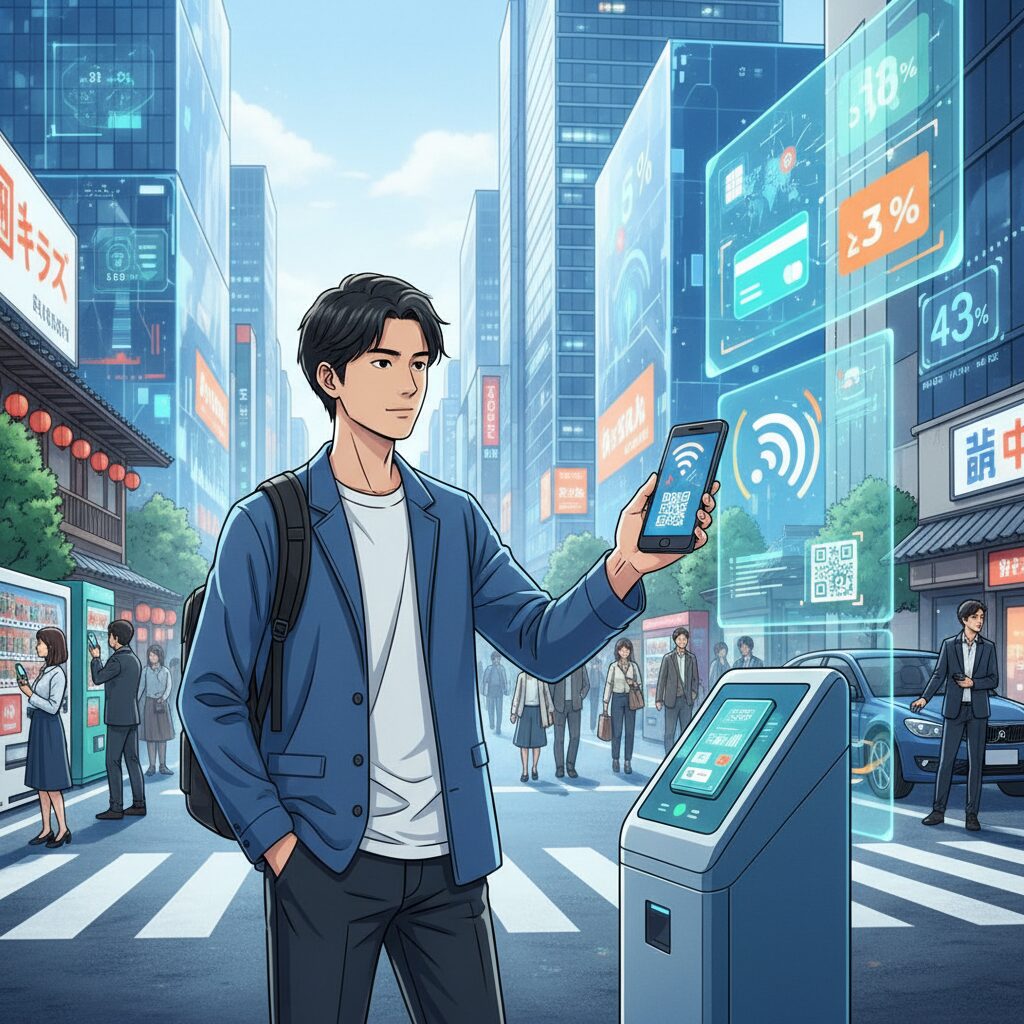
Behind the simple act of tapping or scanning at checkout, an intense platform war is unfolding. Credit cards, QR codes, and NFC are no longer just payment methods; they are competing operating systems for your daily economic life.
According to the Ministry of Economy, Trade and Industry, Japan’s cashless ratio reached 42.8% in 2024, surpassing the long‑discussed 40% milestone. This growth is not evenly distributed. Each method is expanding by capturing different moments of consumer behavior.
The battlefield is no longer the wallet, but the smartphone screen and the payment terminal.
| Method | Core Strength | Strategic Advantage |
|---|---|---|
| Credit Cards | High transaction value | Global network & tokenization |
| QR Codes | High usage frequency | Merchant expansion & loyalty points |
| NFC (Tap) | Speed & standardization | Convergence with global specs |
Credit cards remain dominant in transaction volume. However, their physical form is fading. As surveys such as those by MMD Labo indicate, usage is rapidly shifting toward tokenized payments via Apple Pay and Google Pay. The card brand still controls the network, but the interface has moved into the mobile OS.
This shift is strategically critical. When a card is stored in a wallet app, the platform owner gains data, user lock‑in, and control over authentication layers. In other words, the plastic card becomes infrastructure, while the smartphone becomes the command center.
QR code payments tell a different story. They grew explosively by lowering barriers for small merchants. Services like PayPay expanded through aggressive point campaigns and on‑the‑ground merchant acquisition, eventually overtaking traditional e‑money in frequency of use. The economics favor scale: more merchants attract more users, which in turn reinforces loyalty ecosystems.
QR platforms compete not only on payment, but on super‑app integration. Coupons, peer‑to‑peer transfers, mini‑apps, and financial services are layered on top, transforming payment into a gateway for daily engagement.
NFC-based contactless payments represent the global standardization wave. Visa’s tap-to-pay has gained top share among card-based contactless methods, reflecting convergence with international specifications. At the same time, mobile Suica continues to dominate smartphone-based transit payments, illustrating Japan’s dual structure: global NFC in retail, FeliCa strength in transportation.
This duality shapes device strategy. Smartphone manufacturers must support multiple secure elements and standards, while merchants balance terminal upgrades with cost considerations. The winner is not determined solely by technology, but by ecosystem depth.
Ultimately, these payment methods are fighting for habitual dominance. The method you default to at a convenience store, train gate, or online checkout determines which platform accumulates your data, your loyalty points, and your financial footprint. Everyday payments may feel frictionless, but behind each tap or scan lies a strategic contest for control of the digital economy.
The Remaining 60%: Where Cash Still Survives and Why It Matters
Even after Japan’s cashless ratio surpassed 42.8% in 2024 according to the Ministry of Economy, Trade and Industry, nearly 60% of transactions are still conducted in cash. This is not a statistical error. It is a structural reality. If you aim to operate fully wallet‑less, this remaining 60% is the terrain you must understand strategically.
Cash survives not because digital tools are weak, but because certain environments reward physical currency. These environments are shrinking, yet they remain influential in daily life, especially outside major urban cores.
| Domain | Why Cash Persists | Impact on Wallet-less Users |
|---|---|---|
| Local small shops | Fee sensitivity, terminal costs | Occasional payment friction |
| Some clinics | Legacy systems, slow DX adoption | Backup method required |
| Rural areas | Lower digital penetration | Higher probability of cash-only |
| Disaster scenarios | Power/communication outages | Resilience gap in digital-only setup |
In regional cities and individually operated stores, transaction fees for card and QR payments still weigh heavily on thin margins. While QR adoption expanded rapidly—MMD Research Institute shows PayPay maintaining dominant share in 2025—micro-merchants often prioritize cost stability over convenience.
Healthcare is another subtle frontier. Although smartphone-based insurance verification began rolling out in 2025, not every clinic has completed system upgrades. In these transitional spaces, cash functions as an operational fallback rather than ideological resistance.
More critically, Japan’s identity as a disaster-prone country shapes behavior. During earthquakes or typhoons, power grids and telecom infrastructure can be disrupted. In such moments, cash becomes an offline payment protocol with zero latency and zero dependency on batteries. This resilience dimension explains why even digitally fluent users keep a small emergency reserve.
International comparison sharpens the perspective. With South Korea reportedly near 99% cashless usage and China above 80%, Japan’s 60% cash segment is not stagnation—it is a buffer zone between legacy trust systems and fully tokenized economies.
For gadget enthusiasts pursuing extreme minimalism, the question is not “Why does cash still exist?” but “Where does it still create leverage?” A single high‑denomination bill inside a MagSafe wallet can neutralize 95% of edge cases without reintroducing full physical bulk.
Cash today operates as a strategic redundancy. It fills coverage gaps in geography, system migration, and crisis response. Until fee structures, infrastructure reliability, and universal DX adoption converge, this residual domain will continue to matter—not as the default, but as the safeguard beneath the digital surface.
Digital Government Breakthrough: Smartphone-Based National ID Goes Mainstream

The year 2025 marks a structural turning point for Japan’s digital government strategy. What was once limited to plastic cards is now embedded directly into smartphones, fundamentally redefining how citizens prove who they are in everyday life.
National ID is no longer something you carry. It is something your device securely becomes. This shift is not symbolic. It is backed by legislative reform, secure hardware architecture, and large-scale administrative system upgrades.
According to the Digital Agency, My Number Card adoption is approaching 80% of the population, creating the critical mass required for full-scale mobile integration. With both Android and iPhone now supporting smartphone-based My Number functionality as of June 24, 2025, the platform barrier has effectively disappeared.
From Plastic to Secure Element
| Component | Physical Card | Smartphone ID |
|---|---|---|
| Storage | IC chip (card) | Secure Element (device) |
| Security Standard | JPKI compliant | GP-SE international standard |
| Tamper Resistance | Physical protection | Hardware-level encryption |
Technically, the smartphone implementation stores electronic certificates inside the device’s Secure Element rather than relying on external FeliCa chips. The architecture follows GlobalPlatform Secure Element standards, ensuring resistance against tampering and unauthorized extraction.
This means authentication is executed within hardware-isolated environments, comparable to or exceeding the security of the physical card itself.
In practical terms, citizens can now access key administrative services using only their phone. These include convenience store issuance of resident certificates, online address change notifications via Mynaportal, and from the 2025 tax year onward, completing income tax filings entirely through smartphone-based authentication.
The legal necessity of carrying physical identification is rapidly diminishing. The introduction of mobile driver’s licenses in March 2025 further accelerates this trajectory. Recognized under the Road Traffic Act, smartphone-displayed credentials hold official validity during traffic stops when verified through dedicated police terminals.
Another overlooked breakthrough is data synchronization. Address updates made through My Number automatically reflect in the integrated mobile driver’s license, eliminating redundant visits to police stations. Administrative friction is being systematically engineered out of daily life.
To support the surge in usage, the Digital Agency has scheduled a major Mynaportal infrastructure upgrade in early 2026. The goal is not merely capacity expansion but UX redesign, preparing for a future in which mobile ID becomes the default interaction layer between citizen and state.
For gadget enthusiasts, the significance extends beyond convenience. Smartphones are evolving into sovereign identity terminals, anchored in cryptographic trust rather than physical tokens. The device in your pocket is transitioning from communication tool to legally recognized identity instrument.
This mainstreaming of smartphone-based national ID represents more than digitization. It signals a structural redesign of how trust, authentication, and civic rights are exercised in a post-wallet society.
Mobile Driver’s Licenses and Legal Recognition of Digital Identity
The launch of mobile driver’s licenses in March 2025 marked a structural turning point in Japan’s legal treatment of digital identity.
Under the revised framework led by the National Police Agency, a driver’s license integrated with the My Number Card and displayed on a smartphone is now defined as a legally valid license under the Road Traffic Act.
This means that carrying a physical card is no longer a legal prerequisite for driving, as long as the certified digital credential can be presented and verified.
| Item | Physical License | Mobile License |
|---|---|---|
| Legal validity | Recognized under Road Traffic Act | Equally recognized after 2025 reform |
| Verification method | Visual inspection | NFC / QR-based digital verification |
| Address updates | In-person endorsement required | Linked automatically via My Number data |
In roadside inspections, officers use dedicated terminals to read encrypted data from the smartphone via NFC or QR authentication.
This process verifies validity status and other license information in real time, reducing reliance on visual confirmation alone.
According to materials released by the National Police Agency, the reform is designed not only for convenience but also for administrative efficiency and fraud mitigation.
One of the most transformative aspects is address synchronization.
Previously, drivers had to visit a police station or licensing center after moving, waiting for manual endorsement on the back of the card.
With digital integration, address updates processed through the My Number system automatically propagate to the mobile license, enabling near one-stop compliance.
This legal recognition extends beyond driving itself.
As financial institutions and telecom operators shift toward IC-chip–based identity verification ahead of the 2027 mandate, a smartphone-stored credential becomes more than a convenience tool.
It becomes a foundational trust anchor in both public and private transactions.
The Digital Agency has emphasized that My Number Card adoption is approaching 80% of the population, creating a broad base for mobile credential deployment.
Once identity, residency, and licensing data converge within a secure element on the device, the smartphone effectively functions as a state-backed identity container.
This represents a transition from plastic-based proof to cryptographically verifiable identity infrastructure.
However, legal recognition does not eliminate operational constraints.
Verification requires compatible devices and properly maintained credentials, and users must manage authentication PINs securely.
The legal shift is therefore accompanied by a parallel demand for digital literacy and device readiness.
For gadget-savvy readers, the implication is clear.
The value of a modern smartphone is no longer measured solely by performance metrics or camera quality, but by its compatibility with national identity systems and secure element standards.
In practical terms, hardware capability has become inseparable from civic functionality in the emerging digital identity era.
The 2027 KYC Mandate: Why IC Chip Reading Will Replace ID Photo Uploads
In April 2027, Japan’s identity verification landscape will fundamentally change. The National Police Agency has announced that for bank account openings and mobile contracts, reading the IC chip embedded in a My Number Card or driver’s license will become the default method, effectively phasing out the conventional ID photo upload process.
This shift directly targets vulnerabilities in so‑called “photo-based eKYC,” where users simply upload images of their ID documents. While convenient, this method has been increasingly exploited through high-quality forgeries and identity spoofing, contributing to SIM swap fraud and unauthorized account openings.
The 2027 mandate is not just a technical update. It is a structural redesign of trust in the digital economy.
| Verification Method | Data Source | Forgery Resistance | User Requirement |
|---|---|---|---|
| ID Photo Upload | Printed surface information | Moderate to low | Camera + upload |
| IC Chip Reading | Cryptographically signed chip data | Extremely high | NFC smartphone + PIN |
The difference lies in the data layer. A photo captures visible information. An IC chip contains digitally signed credentials protected by cryptographic keys. Without access to the private key infrastructure, cloning or fabricating this data is virtually infeasible under current standards.
According to policy reporting cited in DX-focused industry media, authorities determined that surface-level verification was insufficient against increasingly sophisticated identity fraud. The IC chip requirement introduces hardware-level authentication, raising the bar dramatically for attackers.
For users, however, the mandate introduces new behavioral expectations. An NFC-enabled smartphone becomes mandatory. In addition, users must remember their PINs—typically a 4-digit code for user authentication and a longer 6–16 digit password for digital signatures.
This creates a subtle but important shift: identity verification moves from “what you show” to “what your secure element proves.” The smartphone transforms from a camera tool into a cryptographic reader.
Financial institutions are already preparing. Digital-native banks and fintech services have begun standardizing IC-based onboarding flows, allowing near-instant account activation once chip verification succeeds. The process removes manual image review queues, reducing both fraud risk and operational cost.
Speed and security are no longer opposing forces. With IC verification, they reinforce each other.
Still, usability challenges remain. Reading position sensitivity on some devices, interference from thick cases, and forgotten PINs can interrupt the flow. Industry stakeholders must refine UX design before 2027 to prevent exclusion of less tech-savvy users.
The broader implication is profound. When IC chip reading replaces photo uploads, digital identity becomes anchored in hardware-backed trust rather than visual inspection. This marks the beginning of a post-photographic KYC era—where cryptography, not images, defines legitimacy in the financial system.
Digital Banking Case Studies: How PayPay Bank and Minna no Ginko Reinvent Onboarding
The shift toward IC chip–based identity verification is not only a regulatory response to fraud, but also a UX battleground. As the National Police Agency moves toward mandatory IC chip reading for KYC by April 2027, digital banks are racing to redesign onboarding around NFC-native flows rather than photo uploads.
Among the most illustrative cases are PayPay Bank and Minna no Ginko. Both institutions treat onboarding not as paperwork digitization, but as a real-time identity handshake between a secure element and a banking core.
PayPay Bank: Instant Trust Through IC Authentication
PayPay Bank integrates My Number Card IC chip reading directly into its iPhone app. Instead of uploading license photos, users tap their card to the device, allowing encrypted certificate data to be verified instantly.
According to PayPay’s official guidance, this method reduces review time and enables same-day account opening in many cases. Address updates can also be reflected through renewed IC authentication, eliminating postal confirmations and manual checks.
| Aspect | Traditional eKYC (Photo) | IC Chip Reading |
|---|---|---|
| Verification Method | ID image + selfie | NFC secure element read |
| Fraud Resistance | Vulnerable to forgery | Cryptographically validated |
| Processing Time | Manual/queued review | Near real-time |
The key innovation is not speed alone, but the collapse of “trust latency.” By eliminating human document review, PayPay Bank converts compliance into an invisible background process.
Minna no Ginko: Mobile-Only as Design Philosophy
Minna no Ginko, Japan’s first fully digital bank, goes further by architecting onboarding as a smartphone-native journey from the ground up. Users complete identity verification via My Number IC reading or video-based facial confirmation, without receiving any physical mail.
This approach aligns with broader digital government infrastructure. As the Digital Agency promotes smartphone-based identity functions and My Number adoption approaches 80%, onboarding can assume NFC capability as a baseline rather than an exception.
The absence of paper is not a cost-cutting tactic; it is a strategic bet on a post-wallet society. By removing branch visits, postal delays, and physical tokens, Minna no Ginko shortens the psychological distance between intent and account activation.
Both banks illustrate a structural transformation: onboarding is no longer a defensive compliance gate but a product feature. In a 2027-ready environment where IC verification becomes standard, institutions that master secure, friction-minimized identity flows will define the next phase of digital banking competition.
Healthcare DX: Insurance Cards and Hospital Check-In Move to Smartphones
Healthcare is one of the last strongholds where people instinctively reach for their wallets. However, that assumption is rapidly fading. With the rollout of smartphone-based My Number Card functionality in the summer of 2025, patients can now verify insurance eligibility using only their phones at participating medical institutions, according to reporting on the Social Security Council’s medical insurance committee.
This shift effectively removes both the physical insurance card and the plastic My Number Card from the patient’s daily carry. The smartphone becomes the authentication device, the identity token, and the gateway to real-time insurance data.
The practical implications are significant. At reception desks equipped with facial recognition card readers or dedicated tablets, patients simply hold their smartphones over the reader and authenticate via face recognition or PIN. Insurance eligibility is checked instantly against centralized systems, reducing clerical workload and eliminating manual verification errors.
| Before DX | After Smartphone Integration |
|---|---|
| Physical insurance card required | Smartphone-based electronic certificate |
| Manual data confirmation | Real-time digital verification |
| Temporary full self-payment during transitions | Immediate eligibility confirmation |
One of the most impactful benefits appears during life transitions. Previously, when changing jobs or moving, patients often faced a gap between insurance updates and card issuance. During that window, they were sometimes required to pay the full medical cost upfront. With digital verification, eligibility data can be referenced in real time, dramatically reducing this financial friction.
Hospitals are also accelerating the digitization of patient identification itself. Case studies published on official medical portal sites highlight institutions such as Chiba University Hospital promoting integrated use of My Number-based verification, with measurable increases in digital insurance utilization rates shortly after implementation.
The transformation does not stop at insurance. Appointment management, pre-visit questionnaires, and even post-visit payments are increasingly handled inside hospital apps. By registering a credit card in advance, patients can leave immediately after consultation, with billing processed automatically. This “checkout-less” medical experience directly addresses one of healthcare’s most persistent pain points: waiting time.
From a systems perspective, the convergence of identity verification and hospital workflow optimization is crucial. Reception desks are no longer just administrative checkpoints; they are becoming digital authentication nodes connected to national infrastructure. This architecture reduces fraud risk, streamlines eligibility audits, and improves data consistency across insurers and providers.
For gadget-savvy users, the appeal is obvious. The same device that unlocks homes, pays for transit, and stores government ID now grants access to medical care. Yet the deeper story is infrastructural. By embedding insurance credentials into secure smartphone environments, healthcare access becomes software-defined.
As adoption expands, the hospital visit itself is being re-engineered around mobile identity. The wallet is no longer the default container of medical access. The smartphone is.
Smart Locks, AI Security, and a $159 Million Market on the Rise
Physical keys used to be the last barrier to a truly wallet-less lifestyle. That barrier is now rapidly disappearing as smart locks evolve from niche gadgets into core home infrastructure.
According to market trend reports covering 2025–2033, Japan’s smart lock market reached approximately 159 million US dollars in 2024, with a projected CAGR of 9.4%. This is not incremental growth. It signals structural adoption.
Recognition among consumers has already climbed to 71.2%, while actual installation rates have reached 20.0%, indicating the market has moved beyond early adopters and into the mainstream phase.
| Indicator | Latest Data | Implication |
|---|---|---|
| Market Size (2024) | $159M | Established commercial scale |
| CAGR (2025–2033) | 9.4% | Sustained expansion phase |
| Consumer Recognition | 71.2% | Mass awareness achieved |
What makes this surge especially interesting is that the conversation is no longer about remote unlocking via smartphone. The new frontier is AI-assisted security.
Recent implementations integrate behavioral pattern learning. The system analyzes typical entry times, device proximity signatures, and authentication habits. When deviations occur, such as repeated failed unlock attempts at unusual hours, alerts are triggered automatically.
This shifts smart locks from passive hardware into active security agents.
Battery intelligence is another quiet revolution. AI-based predictive alerts now estimate remaining battery life based on usage frequency and temperature patterns. This drastically reduces lockout risks, which historically discouraged adoption.
Hands-free unlocking has also matured. By combining Bluetooth, GPS, and proximity detection, doors can unlock automatically when the authorized smartphone approaches within a calibrated distance. The experience feels invisible rather than mechanical.
This level of frictionless access aligns perfectly with broader digital ID and mobile-centric infrastructure trends.
Market analysts point out that the real driver of growth is not convenience alone, but integration. Smart locks now connect with home IoT ecosystems, linking lighting, security cameras, and notification systems into a single operational layer.
In practical terms, unlocking the door can simultaneously deactivate alarms, switch on lights, and log entry records in the cloud.
This transforms the entrance into a data node rather than a simple mechanical barrier.
As installation costs decline and retrofitting becomes simpler, rental properties and multi-unit residences are beginning to adopt smart locks at scale. That expansion potential supports the projected 9.4% annual growth.
The 159 million dollar market size may seem modest compared to payments or mobility sectors, but its strategic importance is far greater. Physical access is foundational. Whoever controls authentication at the door controls the first layer of digital society.
For gadget enthusiasts, this is more than a hardware upgrade. It is the moment when AI security, IoT integration, and everyday living converge at the threshold of your home.
Digital Car Keys and UWB: Turning Smartphones into Precision Mobility Devices
Digital car keys are no longer a futuristic add-on for luxury vehicles. In 2026, they are rapidly becoming a structural component of the wallet-less lifestyle, transforming smartphones into high-precision mobility devices.
According to industry summaries of 2025 compatible models, major manufacturers such as BMW, Hyundai, and Honda have expanded support for smartphone-based keys across a broader range of vehicles. What began as a premium feature is now cascading into the mass market.
The real breakthrough, however, is not the “digital key” itself, but the shift from NFC to UWB.
From Tap-to-Unlock to Spatial Awareness
| Technology | User Action | Precision |
|---|---|---|
| NFC | Tap smartphone on door handle | Short-range contact |
| UWB | Approach vehicle naturally | Centimeter-level positioning |
Early digital keys relied on NFC. You had to physically touch the door handle with your smartphone to unlock the car. It worked, but it felt like a workaround.
UWB, or Ultra-Wideband, changes that experience entirely. Because UWB can measure distance with centimeter-level accuracy, the vehicle can determine not only that your phone is nearby, but exactly where it is.
This spatial awareness enables true passive entry. You simply walk toward the car with your smartphone in your pocket or bag, and the doors unlock automatically. Sit in the driver’s seat, and the engine start authorization is already validated.
This precision also enhances security. Relay attacks, which have plagued traditional keyless entry systems, rely on amplifying radio signals over distance. UWB’s distance-bounding capability makes it significantly harder to spoof proximity, because the system verifies physical distance rather than just signal presence.
As mobility analysts have pointed out in coverage of 2025 digital key rollouts, UWB effectively restores the convenience of classic smart keys while adding cryptographic authentication layered through the smartphone’s secure element.
Your phone is no longer just a remote—it becomes a cryptographically verified, location-aware identity token.
Honda’s connected services illustrate the broader shift. Through platforms such as Honda CONNECT, users can remotely lock or unlock doors and, depending on the model, start the engine via internet connectivity. This extends the key’s function beyond proximity into cloud-mediated control.
In practical terms, this means you can grant temporary access to a family member without handing over a physical key. Digital keys can be provisioned, revoked, or time-limited through apps, aligning car access with the same logic used in digital ID and mobile payments.
The implications go beyond convenience. When vehicles recognize authenticated smartphones with spatial precision, they can personalize seat positions, infotainment profiles, and driving modes automatically.
For gadget enthusiasts, the takeaway is clear. Choosing a smartphone with UWB support is no longer about finding lost trackers faster. It directly affects how seamlessly you interact with next-generation vehicles.
As compatible models expand and UWB becomes standard in both phones and cars, the physical car key begins to look like cash in a contactless economy—still usable, but increasingly redundant.
MagSafe, Minimal Backups, and the Hybrid Strategy for Going Wallet-Free
As Japan’s digital infrastructure matures, MagSafe accessories are no longer just stylish add-ons but strategic tools for wallet-free living. In 2026, the conversation is not about abandoning physical cards entirely, but about designing a resilient hybrid setup.
According to marketplace trend data on MagSafe wallets in early 2026, users increasingly prioritize magnetic strength, modularity, and multi-functionality over sheer card capacity. The shift is clear: the wallet becomes a backup module, not a primary payment device.
The optimal strategy today is not “zero cards,” but “minimum viable backup.”
In practice, many advanced users limit their physical carry to one credit card, one high-denomination banknote, and—depending on region—either a driver’s license or a physical key. This configuration reflects Japan’s current payment reality, where cashless ratios have surpassed 40% according to the Ministry of Economy, Trade and Industry, yet cash-only edge cases still exist.
The role of MagSafe makes this configuration frictionless. Detachable magnetic wallets allow users to separate backup assets from the phone body when unnecessary, reducing bulk while preserving redundancy.
| Component | Primary Function | Failure Scenario Covered |
|---|---|---|
| 1 Physical Card | Emergency payment | Smartphone malfunction or network outage |
| 1 Banknote | Cash-only merchants | Rural or small independent stores |
| Optional ID/Key | Regional compatibility | Non-supported digital checkpoints |
Hybridization is also psychological. Completely eliminating a wallet can create cognitive friction, especially in a society transitioning toward mandatory IC-based identity verification by 2027. A slim magnetic wallet lowers the emotional barrier while maintaining digital-first behavior.
Another emerging layer is integration with tracking ecosystems. As wallet functions concentrate into a single smartphone, loss impact increases. That is why MagSafe wallets compatible with Apple’s Find My network, or those designed to house tracking tags, are gaining popularity in late 2025 rankings.
This is not redundancy for convenience; it is redundancy for continuity. If the smartphone is the control center of payments, ID, mobility, and healthcare, then minimal physical backups serve as a fail-safe rather than a regression.
Importantly, the hybrid approach aligns with hardware evolution. Many users now treat MagSafe wallets as modular extensions—combining stand functionality, grip support, or even tripod mechanisms—transforming the backup layer into a productivity tool instead of dead weight.
The result is a balanced architecture: digital by default, physical by exception. In a society where mobile IDs, digital keys, and smartphone-based insurance verification are legally operational, the question is no longer whether to go wallet-free, but how intelligently you design the fallback layer.
Security, Battery Anxiety, and Single-Point-of-Failure Risks in a Phone-Centric Life
As smartphones absorb payments, IDs, medical credentials, and physical keys, security no longer means protecting a single function. It means protecting your entire civic and economic existence. When one device becomes your wallet, license, insurance card, and house key, the risk profile fundamentally changes.
The core issue is not only data theft, but functional paralysis. Even if encryption holds, losing access to the device itself can temporarily suspend your ability to move, pay, identify yourself, or receive services.
Single-Point-of-Failure: What Actually Breaks?
| Failure Type | Immediate Impact | Mitigation Layer |
|---|---|---|
| Device Loss/Theft | Loss of payment, ID, key access | Remote lock, certificate suspension |
| Battery Depletion | Inability to display QR/ID | Express reserve (NFC only) |
| System Outage | Service authentication failure | Physical backup, redundancy |
According to the Public Personal Authentication Service portal, smartphone-based electronic certificates can be suspended 24/7 via hotline in case of loss. This rapid revocation model dramatically limits misuse risk. However, it does not restore immediate usability for the owner.
Modern smartphones are protected by biometric authentication and hardware-level secure elements, significantly reducing unauthorized access risk. The Digital Agency’s architecture for smartphone-stored credentials relies on secure enclave environments designed to resist tampering. In practical terms, unauthorized data extraction is highly improbable.
Yet availability risk remains the blind spot. A locked but inaccessible device is still a failure from the user’s perspective.
Battery Anxiety in a Walletless Society
Battery depletion is the most realistic daily threat. Unlike theft, it requires no malicious actor. It simply happens.
Some iPhones support Express Cards with power reserve, allowing limited NFC functions such as transit or certain digital keys to operate for several hours after shutdown. However, QR-based payments, screen-displayed mobile licenses, and most app-based authentications do not function in this state.
This creates a hierarchy of survivability:
In a fully phone-centric life, carrying a compact battery pack becomes less an accessory and more a resilience strategy. The psychological shift is notable: power management becomes identity management.
Systemic and Infrastructure Risks
Japan’s ongoing digital transformation increases convenience but also increases dependency on network availability. During communication outages or disasters, QR payments and cloud-based authentication may fail simultaneously. Even though cashless adoption surpassed 40% according to the Ministry of Economy, Trade and Industry, a significant portion of transactions still rely on infrastructure uptime.
In disaster-prone environments, redundancy thinking remains rational. A minimal physical backup card or emergency cash note is not technological regression. It is distributed risk design.
The paradox of hyper-convenience is concentration risk. The more seamless the integration, the more catastrophic a total failure feels. Mature phone-centric users therefore shift from convenience optimization to resilience optimization, designing their setup not just for speed, but for survivability.
In this new paradigm, security is no longer just about encryption strength. It is about layered access, battery discipline, remote recovery literacy, and conscious redundancy. A phone-centric life is viable—but only when managed as critical infrastructure rather than as a gadget.
参考文献
- au PAY Media:Japan’s Cashless Payment Ratio Surpassed 40% in 2024
- MMD Research Institute:January 2025 Survey on Payment and Financial Service Usage Trends
- BCN+R:‘My Number Card on iPhone’ to Launch on June 24, 2025
- Impress Watch:My Number Card Adoption Nears 80% as iPhone-Only Tax Filing Accelerates Online Procedures
- Mobilitas:My Number Card and Driver’s License Integration to Begin in March 2025
- DX Magazine:From 2027, Identity Verification Will Require IC Chip Reading
- GemMed:Smartphone-Based Health Insurance Verification to Launch in Summer 2025
- LinkJapan Blog:Smart Home Market Insights from MyVoice Survey 2025
- Car Repo:2025 List of Vehicles Supporting Digital Car Keys
- Public Personal Authentication Service Portal:Procedures for Lost Electronic Certificates