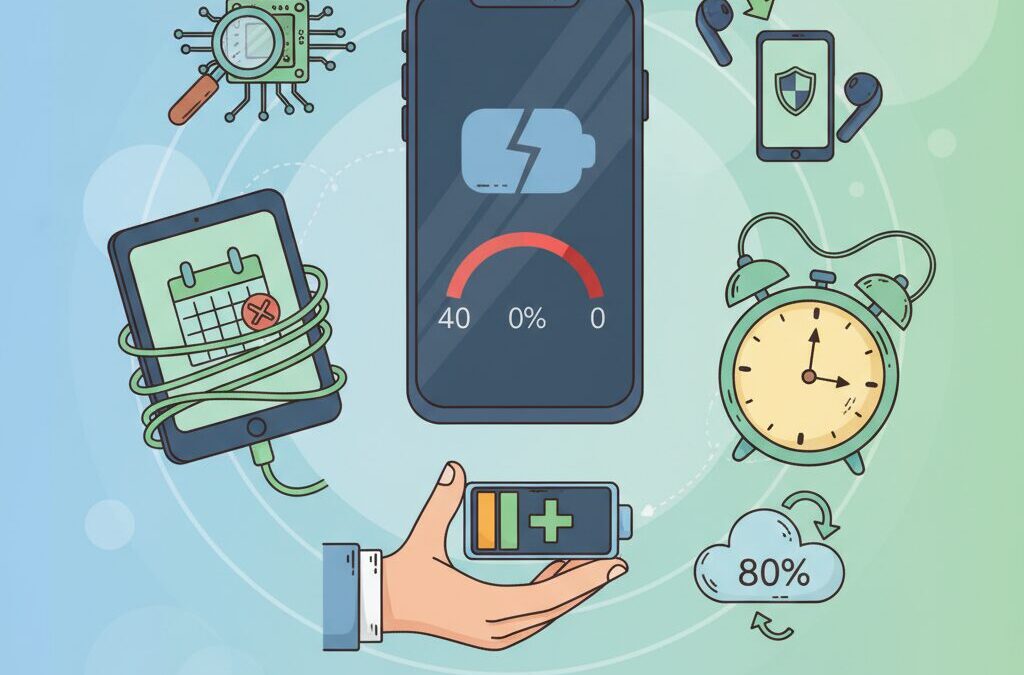
If you are passionate about gadgets, you have probably experienced it before: your smartphone still feels fast, the camera is excellent, and software updates keep coming, yet the battery suddenly becomes unreliable.
Unexpected shutdowns, rapid drops from 40% to zero, or dramatic performance throttling can appear even though the device looks perfectly fine.
This frustrating gap between “specs on paper” and real-world usability is one of the defining issues of modern devices.
In today’s market, processors are powerful enough for most users for many years, but batteries are governed by chemistry, not software promises.
Understanding how and why batteries degrade allows you to decide whether a replacement, a repair strategy, or a full upgrade makes the most sense.
It also helps you avoid unnecessary costs, data risks, and environmental waste.
In this article, you will explore the science behind the widely cited 80% battery health threshold, the latest durability shifts from Apple, Google, Samsung, and Sony, and the practical diagnostics used by advanced users.
You will also learn how repair ecosystems, regulations, and upcoming technologies like solid-state batteries may redefine device longevity after 2027.
By the end, you will be equipped to make smarter, more sustainable decisions about the gadgets you rely on every day.
- Why Battery Health Now Defines the Real Lifespan of Gadgets
- The Science Behind Battery Degradation and the Meaning of the 80% Threshold
- Internal Resistance, Voltage Drop, and Sudden Shutdowns Explained
- Heat, Cold, and Charging Habits That Quietly Accelerate Aging
- How Apple Redefined Battery Durability with the 1000-Cycle Standard
- Google Pixel’s Software-Driven Approach to Perceived Battery Longevity
- Samsung and Sony’s Practical Battery Care Philosophies
- Advanced Battery Diagnostics for Power Users on Android, iOS, and Windows
- Repair, Replacement, and the Economics of Battery Decisions
- EU Battery Regulation and the Future of User-Replaceable Designs
- Solid-State Batteries and the Next Breakthrough in Gadget Longevity
- 参考文献
Why Battery Health Now Defines the Real Lifespan of Gadgets
For many years, the real lifespan of gadgets was defined by performance gains, but that definition has quietly shifted. **Today, battery health has become the single most important factor that determines how long a device remains truly usable**, and this change is rooted in both technology maturity and electrochemistry.
According to industry analyses and public disclosures from companies such as Apple and Samsung, modern processors have already reached a level where everyday tasks rarely stress their limits. As a result, users no longer replace devices because they feel slow. Instead, they replace them because battery life collapses in ways that software updates cannot fix.
This shift can be understood by comparing the old and new drivers of device longevity.
| Era | Main Limiting Factor | User Experience Impact |
|---|---|---|
| 2010s | CPU and memory performance | Apps feel slow, OS updates unsupported |
| Mid-2020s | Battery degradation | Sudden shutdowns, unstable performance |
Battery degradation is not just about shorter screen-on time. Research in electrochemical engineering shows that as lithium-ion cells age, internal resistance increases. **This causes voltage drops during peak loads, making even powerful devices unreliable** when launching cameras, games, or 5G communication.
Well-documented cases, including Apple’s explanation of performance management in iPhones, illustrate that once battery health declines, the system must actively limit performance to prevent crashes. From the user’s perspective, the device feels old, even though its processor remains capable.
Another critical reason battery health defines lifespan is that batteries are governed by irreversible chemical aging. Unlike software, they cannot be patched. Academic studies and manufacturer data consistently show that around 80 percent remaining capacity marks a tipping point where instability becomes far more likely.
In practical terms, this means a gadget’s usable life is now bounded by how gracefully its battery ages. **The moment battery health fails, the entire ecosystem of performance, reliability, and trust collapses with it**, making battery condition the true clock that measures modern gadget longevity.
The Science Behind Battery Degradation and the Meaning of the 80% Threshold
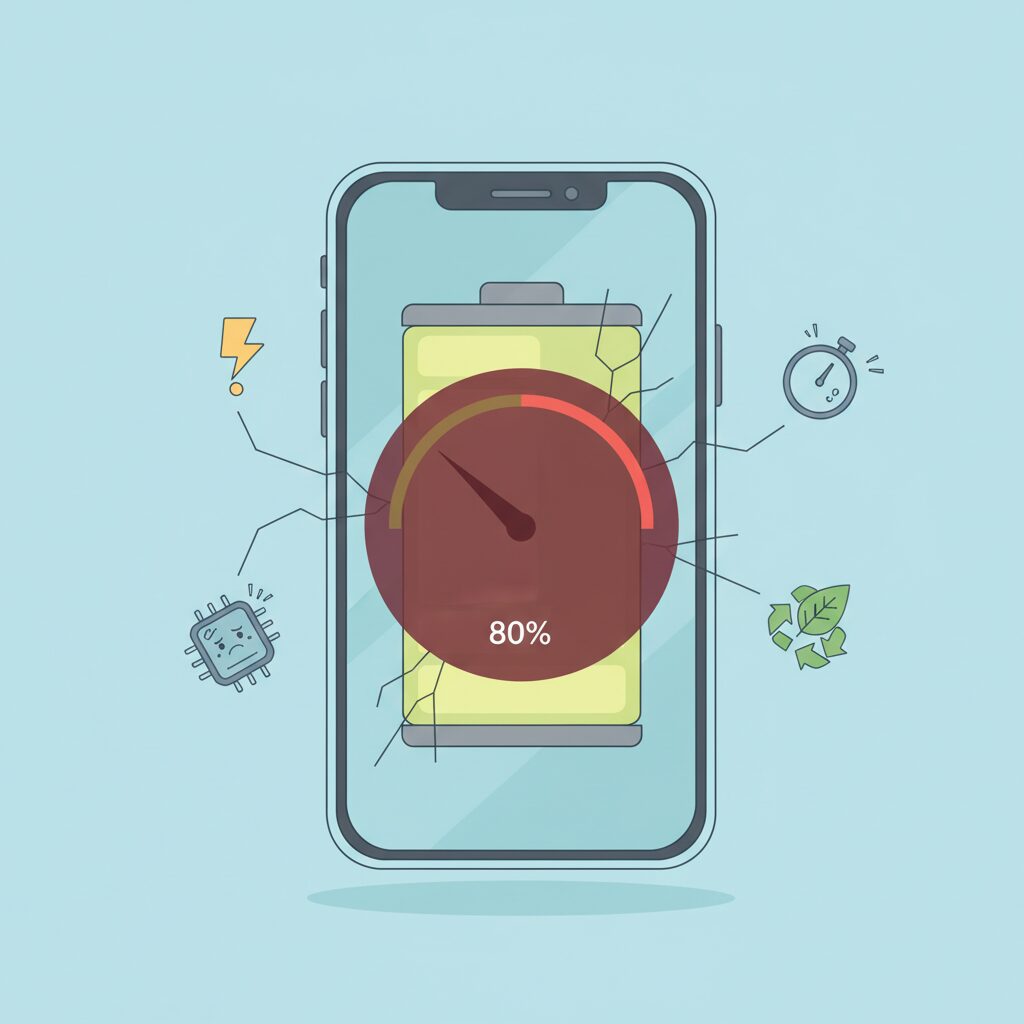
When discussing battery lifespan, the figure that appears most often is the 80% maximum capacity threshold. This number is not an arbitrary guideline created for warranty convenience. It represents a scientifically meaningful boundary where electrochemistry and modern device power demands begin to clash. Understanding why this happens requires looking beyond simple capacity loss and into the internal physics of lithium-ion cells.
At a fundamental level, battery degradation is driven by two irreversible processes recognized in academic electrochemistry. One is the loss of lithium inventory, where lithium ions are consumed by side reactions. The other is the loss of active material, where electrode structures themselves degrade. According to research published through institutions such as MIT and the Journal of Power Sources, these mechanisms operate from the very first charge cycle and accumulate silently over time.
| Degradation Mechanism | What Happens Internally | User-Visible Impact |
|---|---|---|
| Loss of Lithium Inventory | Lithium ions are trapped in side reactions and SEI growth | Shorter usable runtime per charge |
| Loss of Active Material | Electrode crystal structures slowly collapse | Reduced peak performance and stability |
A critical contributor to both processes is the SEI layer formed on the graphite anode. This layer is essential for safety, acting as a selective membrane that allows lithium ions to pass while blocking electrons. However, studies from Argonne National Laboratory show that the SEI continues to thicken with each cycle, especially under high temperature or high voltage conditions. Every micrometer of additional SEI consumes lithium that can never return to active duty.
While capacity fade is easy to visualize, experienced engineers warn that the more dangerous change is rising internal resistance. Modern smartphones routinely demand several amperes of current during camera activation, gaming, or 5G transmission. According to Ohm’s law, any increase in internal resistance amplifies voltage drop under load. This is why a phone can show 30% battery remaining and still shut down instantly.
Experimental data cited by Apple and corroborated by independent battery researchers indicates that once overall health drops near 80%, internal resistance growth accelerates nonlinearly. This is the point where peak power delivery, not energy storage, becomes the limiting factor. The device simply cannot maintain the minimum operating voltage required by high-performance processors.
Temperature further sharpens this threshold. Chemical kinetics described by the Arrhenius equation demonstrate that reaction rates roughly double with every 10°C increase. High temperatures accelerate electrolyte decomposition and SEI instability, while low temperatures slow ion diffusion and raise resistance. Research from the University of Tokyo highlights that cold-induced resistance spikes are a primary cause of winter shutdown events in aging smartphones.
Battery management systems attempt to mitigate these risks through thermal monitoring and charge control, but they cannot reverse chemistry. The 80% mark therefore signals the entry into a high-risk zone where electrochemical aging and real-world usage demands intersect. Recognizing this threshold as a physical reality rather than a cosmetic metric is key to making rational decisions about battery replacement and device longevity.
Internal Resistance, Voltage Drop, and Sudden Shutdowns Explained
One of the most confusing battery-related problems for gadget enthusiasts is the sudden shutdown that occurs even when the battery indicator still shows 30% or 40%. This behavior is not primarily caused by capacity loss, but by an increase in internal resistance inside the lithium-ion cell. **Internal resistance quietly determines whether your device can survive momentary power spikes** demanded by modern processors.
As lithium-ion batteries age, chemical side reactions gradually thicken internal layers such as the SEI film on the anode. According to research published by the Journal of Power Sources and analyses referenced by IEEE battery specialists, this structural change increases impedance, making it harder for electrons and ions to move quickly. The battery may still store energy, but it cannot deliver that energy fast enough when the system suddenly asks for it.
From an electrical standpoint, the mechanism is straightforward. When a device launches a camera app, initiates 5G transmission, or boosts CPU and GPU clocks, it demands a high instantaneous current. Ohm’s law dictates that voltage drop is proportional to current multiplied by internal resistance. **As resistance rises, voltage collapses more sharply under load**, even if the state of charge appears healthy.
| Battery Condition | Internal Resistance | Behavior Under High Load |
|---|---|---|
| New or lightly used | Low | Stable voltage, normal performance |
| Moderately aged | Medium | Noticeable throttling, occasional stutter |
| Heavily degraded | High | Sudden shutdowns despite remaining charge |
This voltage collapse becomes critical when the terminal voltage drops below the system cutoff threshold, typically around 3.0 to 3.4 volts for smartphones. At that point, the power management system has no choice but to shut the device down instantly to prevent instability or data corruption. Apple and Google have both acknowledged this behavior in technical documentation related to performance management, especially in colder environments where resistance increases further.
Temperature plays a decisive role here. Battery engineers frequently cite Arrhenius-based models showing that electrochemical resistance rises as temperature drops. This explains why older phones are notorious for shutting down in winter. **Cold weather amplifies existing resistance issues**, turning marginal batteries into unreliable power sources within seconds of a load spike.
Importantly, this phenomenon is why the widely discussed 80% health threshold matters so much. At roughly this point, impedance growth accelerates enough that modern SoCs, optimized for short bursts of very high power, begin to exceed what the battery can safely supply. Capacity alone does not tell this story, but voltage stability under load does.
Understanding internal resistance reframes how battery “health” should be interpreted. A device that lasts all day under light use may still be fundamentally unstable when pushed. **Sudden shutdowns are not software bugs or exaggerated warnings; they are hard physical limits imposed by aging electrochemistry.** For power users, photographers, and gamers, this invisible resistance is often the first true sign that a battery has reached the end of its practical life.
Heat, Cold, and Charging Habits That Quietly Accelerate Aging
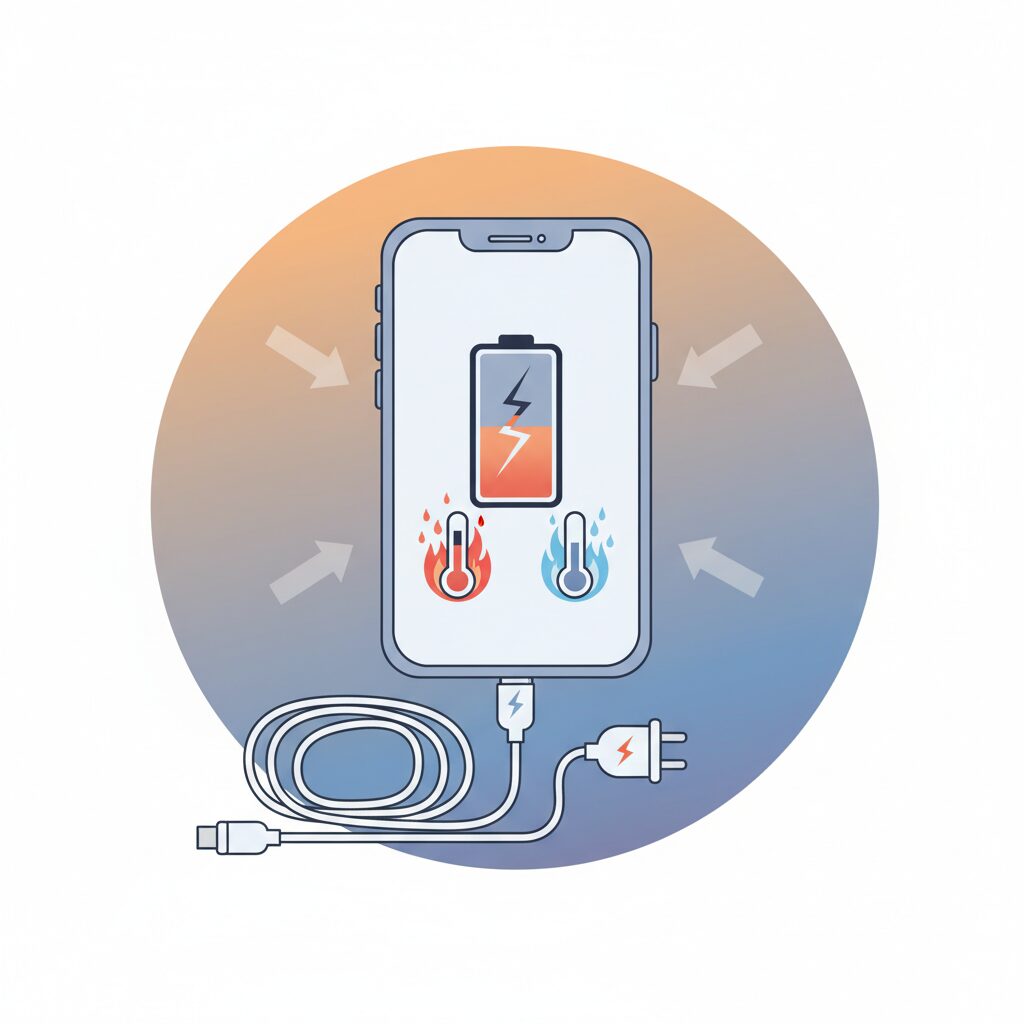
Heat, cold, and everyday charging habits play a far larger role in battery aging than most users realize, and the damage often accumulates quietly. **Lithium-ion batteries age fastest when high temperature and high state of charge overlap**, a condition that commonly occurs during fast charging or prolonged gaming while plugged in. According to electrochemical aging models widely cited in academic research from institutions such as MIT and Stanford, reaction rates inside the cell roughly double with every 10°C increase, accelerating electrolyte decomposition and SEI layer growth.
Modern smartphones can easily exceed 40°C internally during fast charging, especially in warm rooms or inside pockets. When a battery remains at or near 100% under these conditions, the cathode structure becomes unstable, increasing gas generation and long-term capacity loss. Apple and Samsung engineers have publicly acknowledged that sustained heat, not cycle count alone, is one of the primary drivers of early degradation.
| Condition | Short-Term Effect | Long-Term Impact |
|---|---|---|
| High heat + 100% charge | Faster charging slowdown | Permanent capacity loss |
| Sub-zero charging | Unstable voltage | Lithium plating risk |
Cold environments introduce a different but equally serious threat. At low temperatures, lithium ions move sluggishly, and charging under these conditions can cause metallic lithium to plate onto the anode. Battery researchers, including those referenced by the Journal of Power Sources, describe this process as irreversible, reducing usable lithium inventory and increasing internal resistance.
Daily habits matter just as much. Overnight charging that holds a device at full charge for hours, frequent top-ups from 90% to 100%, and reliance on maximum-speed chargers all compound stress. **Keeping batteries between roughly 20% and 80%, and avoiding extreme temperatures, consistently shows measurable lifespan benefits** across laboratory and real-world testing.
How Apple Redefined Battery Durability with the 1000-Cycle Standard
Apple’s move to a 1000‑cycle battery durability standard represents a fundamental rethinking of what long‑term device ownership should feel like. For many years, smartphones were implicitly treated as two‑year products, largely because batteries were engineered to retain around 80% capacity after roughly 500 full charge cycles. With the iPhone 15 generation and later, Apple has explicitly doubled that benchmark, signaling that battery longevity is no longer a secondary concern but a core design objective.
This shift is not merely a change in wording. According to Apple’s own technical documentation, a charge cycle is defined as the cumulative use of 100% of battery capacity, regardless of how many partial charges it takes to reach that total. By designing cells that can endure 1000 such cycles while still maintaining 80% of original capacity, Apple is effectively targeting a usage lifespan of three to four years for many users, assuming typical daily charging habits.
| Generation | Rated Cycles | Capacity at End of Rating |
|---|---|---|
| iPhone 14 and earlier | 500 cycles | 80% |
| iPhone 15 and later | 1000 cycles | 80% |
What makes this redefinition especially meaningful is the way hardware and software are tightly integrated. Battery researchers have long pointed out that lithium‑ion degradation accelerates when cells remain at high state of charge for extended periods. Apple’s introduction and refinement of optimized charging features, such as limiting charge to around 80% during predictable daily routines, directly address this issue. Academic studies on lithium‑ion aging, including those frequently cited in electrochemical journals, support the idea that reducing high‑voltage dwell time can significantly slow capacity fade.
Thermal management is another critical factor. Apple has invested heavily in internal layout changes, heat‑spreading materials, and SoC efficiency improvements to reduce peak temperatures during charging and heavy workloads. Lower operating temperatures translate directly into slower chemical degradation, a relationship well established in battery science through Arrhenius‑based aging models. By controlling heat more effectively, Apple increases the likelihood that real‑world users will actually approach the promised 1000‑cycle threshold.
From a user‑experience perspective, this standard subtly reshapes expectations. Sudden shutdowns, performance throttling, and rapid percentage drops have historically been associated with aging batteries. By extending the period before internal resistance rises to problematic levels, Apple reduces the frequency of these symptoms. Industry analysts often note that this contributes to higher resale values and longer hand‑me‑down lifecycles, reinforcing Apple’s broader ecosystem strategy.
In practical terms, the 1000‑cycle standard aligns battery life with the plateauing of processor performance gains. When raw speed improvements are less noticeable year to year, durability becomes a differentiator. Apple’s decision acknowledges this reality and reframes battery health as a long‑term asset rather than a consumable weakness. For users who care deeply about device longevity, this change quietly but decisively redefines what “normal” battery wear should look like.
Google Pixel’s Software-Driven Approach to Perceived Battery Longevity
Google Pixel’s approach to battery longevity stands out because it prioritizes software control over sheer physical capacity. Rather than relying solely on larger cells or conservative charging caps, Pixel devices increasingly focus on how battery health is perceived over time, aligning closely with user experience.
At the core of this strategy is the idea that what users feel as “battery aging” is not always the same as actual electrochemical degradation. Research in battery management systems, including studies cited by IEEE and academic lithium-ion lifecycle analyses, shows that early-life high-voltage stress is disproportionately damaging to long-term capacity. Pixel’s software is designed to mitigate this phase quietly.
In practice, this means that some Pixel models appear to ship with a hidden buffer. The system may limit maximum charge voltage during the first hundreds of cycles, then gradually relax that ceiling as natural degradation progresses. From the user’s perspective, battery life feels consistent for longer, even though the physical cell is aging in a normal way.
| Aspect | Traditional Control | Pixel Software-Led Control |
|---|---|---|
| Initial Voltage | Near maximum from day one | Conservatively limited |
| User-Visible Capacity | Declines steadily | Stays flatter over time |
| Perceived Aging | Early and noticeable | Delayed and subtle |
This approach aligns with broader findings from battery science. According to publications from the Journal of Power Sources, even a 0.1V reduction in upper charge voltage can significantly extend cycle life by reducing SEI layer growth and cathode stress. Pixel’s software essentially applies this principle dynamically, without requiring manual user intervention.
Another advantage lies in system-level optimization. Google tightly integrates Android power scheduling, Tensor SoC behavior, and thermal controls. When high transient loads occur, such as camera HDR processing or on-device AI tasks, the system can preemptively manage current spikes to avoid sharp voltage drops that accelerate impedance growth.
Importantly, this is not about claiming infinite battery life. The chemistry still obeys physical limits, and a Pixel battery will eventually degrade. However, by smoothing the curve of decline, Google reduces the psychological trigger that often pushes users toward premature replacement.
For gadget enthusiasts, this represents a subtle but meaningful shift. Pixel’s battery longevity is less about headline numbers and more about sustained satisfaction. By making degradation less visible and less disruptive, software becomes a powerful tool in redefining how long a smartphone feels “new” in everyday use.
Samsung and Sony’s Practical Battery Care Philosophies
Samsung and Sony approach battery longevity with a notably pragmatic mindset, prioritizing day‑to‑day usability over headline-grabbing cycle count numbers. Instead of competing directly in the “1000‑cycle” narrative, both companies focus on reducing the most harmful stress factors identified by electrochemical research, namely prolonged high state of charge and heat exposure.
This philosophy aligns closely with findings published in journals such as the Journal of Power Sources, which repeatedly show that time spent near 100% charge accelerates SEI layer growth and impedance rise. Samsung and Sony translate these academic insights into user-facing features that quietly work in the background.
On Galaxy devices, Samsung’s Battery Protection feature caps charging at 80% or 85%, a threshold chosen to stay well below the voltage region where cathode degradation accelerates. Internal Samsung SDI documentation, cited in industry briefings, has long emphasized voltage management as more impactful than raw capacity increases. In practice, this means Galaxy users experience slower visible degradation even after several hundred cycles.
Sony takes a slightly different but complementary route with Xperia’s Adaptive Charging and Care Charging systems. These features analyze charging habits and alarm times, then delay the final charging phase so the battery reaches full charge only shortly before unplugging. The result is a dramatic reduction in high‑voltage dwell time, one of the strongest predictors of calendar aging.
| Brand | Main Battery Care Mechanism | Primary Benefit |
|---|---|---|
| Samsung Galaxy | Charge limit at 80–85% | Lower voltage stress and heat buildup |
| Sony Xperia | Usage‑pattern‑based delayed charging | Minimized high‑SOC storage time |
What makes these approaches especially practical is their transparency. Samsung’s diagnostic feedback via Samsung Members gives users clear prompts when battery health declines, while Sony historically communicates its goal of maintaining usability over a three‑year span. Rather than promising abstract longevity metrics, both brands optimize for real‑world aging patterns backed by battery science.
For gadget enthusiasts, this understated strategy offers a compelling lesson: intelligent charge control, grounded in well‑established electrochemical principles, can often extend usable lifespan more reliably than chasing ever‑higher capacity figures.
Advanced Battery Diagnostics for Power Users on Android, iOS, and Windows
For power users, battery health is not a vague percentage shown in settings but a measurable system state that can be inspected, logged, and interpreted. **Advanced battery diagnostics allow you to see beyond simplified UI indicators and understand the real electrochemical condition of your device**. This section focuses on how Android, iOS, and Windows expose low-level battery data, and how that data can be used to make informed decisions.
Manufacturers intentionally abstract battery information for general users, smoothing values to avoid confusion or unnecessary anxiety. According to Apple’s own platform documentation and Google’s Android Open Source Project notes, the values shown in consumer settings are filtered estimates rather than raw measurements. For enthusiasts, accessing the underlying data reveals trends that are otherwise invisible.
On Android, this deeper view is accessible through system-level diagnostics. By using Android Debug Bridge and system dumps, users can retrieve charge counters, voltage, temperature, and historical usage data directly from the Battery Management System. Engineers involved in Android platform development have repeatedly emphasized that these counters are closer to the physical reality of the cell than UI-level health percentages.
iOS takes a more closed approach, but still allows advanced inspection through macOS-based tools. Apple’s battery design philosophy, outlined in its hardware engineering sessions, relies heavily on precise cycle counting and calibrated full-charge capacity values. When an iPhone or iPad is connected to a Mac, these internal metrics can be read and compared against the original design capacity, offering a clear picture of long-term degradation.
Windows laptops are, in some ways, the most transparent. Microsoft provides an official battery report generated by the operating system itself, intended originally for OEM validation and enterprise fleet management. Researchers in mobile computing often cite this report as a rare example of consumer-accessible longitudinal battery data.
| Platform | Key Diagnostic Output | Primary Insight |
|---|---|---|
| Android | Charge counter, voltage, temperature | Estimated real full-charge capacity and load behavior |
| iOS / iPadOS | Design vs full-charge capacity, cycles | Accurate long-term capacity fade tracking |
| Windows | Battery report history | Time-series analysis of degradation trends |
What makes these diagnostics especially powerful is trend analysis. **A single snapshot rarely tells the full story**, but repeated measurements over weeks or months can reveal accelerating degradation, abnormal resistance growth, or temperature-related stress. Academic studies in electrochemical aging consistently show that sudden drops in effective capacity often correlate with internal resistance increases rather than simple lithium loss.
For example, a Windows battery report may show a relatively stable design capacity but a rapidly declining full-charge capacity over a short period. This pattern frequently aligns with thermal stress or high-load usage, a relationship confirmed in peer-reviewed battery aging research. Similarly, Android charge counters that fluctuate significantly under identical usage conditions often indicate calibration drift or uneven cell aging.
In practical terms, advanced diagnostics shift battery management from reactive to predictive. Instead of waiting for unexpected shutdowns or dramatic runtime loss, users can anticipate when performance instability is likely to appear. **This predictive capability is what separates power users from casual users**, enabling smarter maintenance timing and more rational upgrade decisions.
Ultimately, advanced battery diagnostics are not about obsessing over numbers. They are about understanding how software, hardware, and chemistry intersect inside modern devices. By leveraging the diagnostic tools already embedded in Android, iOS, and Windows, power users gain a level of visibility once reserved for engineers and researchers, and that visibility directly translates into longer, more reliable device lifespans.
Repair, Replacement, and the Economics of Battery Decisions
When battery health drops into the critical zone, the discussion inevitably shifts from chemistry to economics. The key question is not simply whether a battery can be replaced, but whether it should be replaced, considering cost, remaining device value, and future usability. **Battery decisions are financial decisions**, and treating them as such helps avoid regret.
In practice, users face three broad options: official manufacturer repair, authorized third-party repair, or device replacement. According to disclosures from Apple and Google, official battery replacement pricing has risen steadily since 2023 due to parts inflation and labor costs, even as battery longevity improves. This creates a paradox where newer devices last longer, but repairing older ones becomes relatively more expensive.
| Option | Typical Cost | Economic Implication |
|---|---|---|
| Official manufacturer repair | High | Preserves resale value and full functionality |
| Authorized third-party repair | Medium | Lower upfront cost, partial value loss |
| Device replacement | Very high | Resets lifecycle, highest total spend |
From an economic perspective, the most overlooked factor is residual value. Market data from major refurbishers and trade-in programs show that devices with original batteries or officially replaced batteries command significantly higher resale prices. **An unofficial battery replacement can reduce trade-in value by 20–40 percent**, effectively erasing much of the short-term savings. This effect is especially pronounced in tightly controlled ecosystems like the iPhone.
Another layer is performance stability. Research published in IEEE journals has shown that degraded batteries with higher internal resistance increase system stress, potentially accelerating failure in power management ICs. In other words, delaying replacement does not merely save money; it can increase downstream repair risk. From a cost-avoidance standpoint, timely battery replacement often functions as preventive maintenance.
The break-even point is often reached when replacement cost exceeds roughly 30 percent of the device’s current market value. Beyond this threshold, economists specializing in consumer electronics lifecycle management argue that replacement becomes rational. However, this calculation shifts for devices with extended software support, where a new battery can unlock several additional years of secure use.
Finally, upcoming regulatory changes and longer-rated batteries are already reshaping these economics. Devices designed for 1,000 charge cycles dilute the annualized cost of replacement, making a single battery swap far more attractive than before. Seen through this lens, battery repair is no longer a stopgap measure but a strategic investment in extracting maximum value from mature hardware.
EU Battery Regulation and the Future of User-Replaceable Designs
The EU Battery Regulation is quietly but fundamentally reshaping how future gadgets will be designed, used, and maintained. At the center of this shift is a clear requirement: by 2027, portable devices such as smartphones must allow end users to replace batteries using commercially available tools. This policy reflects the EU’s broader circular economy strategy, which the European Commission positions as essential for reducing electronic waste and extending product lifespans.
This is not merely an environmental rule; it is a structural reset for hardware design. For over a decade, manufacturers optimized devices around thinness, water resistance, and internal adhesives. The regulation challenges that paradigm by prioritizing repairability as a first-class design constraint, forcing engineers to reconsider how batteries are fixed, accessed, and sealed.
| Design Element | Pre-Regulation Norm | Post-Regulation Direction |
|---|---|---|
| Battery Fixation | Strong chemical adhesives | Electrically releasable or mechanical systems |
| User Access | Authorized repair only | End-user replacement permitted |
| Global Models | Region-specific designs | Unified worldwide chassis |
Industry analysts note that maintaining separate EU-only designs would be economically inefficient. As a result, globally shipped devices are expected to inherit these user-replaceable characteristics. This aligns with observations from organizations such as the International Energy Agency, which has emphasized that design-for-repair delivers greater emissions reduction than recycling alone.
The most interesting impact may be on user behavior rather than hardware alone. When batteries become accessible again, replacement shifts from a last resort into routine maintenance. This lowers psychological and financial barriers to keeping devices longer, subtly redefining ownership from disposable consumption to long-term stewardship.
There is also a competitive dimension. Brands that successfully combine slim form factors with compliant, replaceable batteries will gain reputational capital among tech-savvy consumers. In that sense, the regulation does not freeze innovation; it redirects it. The future of user-replaceable design is not a return to the past, but a negotiated balance between sustainability, performance, and modern expectations.
Solid-State Batteries and the Next Breakthrough in Gadget Longevity
Solid-state batteries are widely regarded as the most promising answer to the fundamental question of gadget longevity, because they directly address the chemical weaknesses that limit today’s lithium-ion cells. Instead of a flammable liquid electrolyte, solid-state batteries use a solid electrolyte made from ceramics, sulfides, or polymers, which fundamentally changes how degradation occurs over time. This shift is not theoretical optimism but the result of decades of materials science research gradually converging on manufacturable solutions.
According to research published by institutions such as the University of Tokyo and the Massachusetts Institute of Technology, solid electrolytes dramatically suppress side reactions at the electrode interface. **This means the growth of resistive layers, a key driver of battery aging, progresses far more slowly than in conventional cells.** As a result, internal resistance increases at a reduced rate, preserving stable voltage delivery even after extensive charge and discharge cycles.
| Characteristic | Conventional Li-ion | Solid-State Battery |
|---|---|---|
| Electrolyte type | Liquid (organic solvent) | Solid (ceramic or sulfide) |
| Thermal stability | Moderate, requires safeguards | Extremely high |
| Cycle durability potential | 500–1,000 cycles | 2,000 cycles or more |
One concrete example already in the market is TDK’s CeraCharge, a compact solid-state battery currently used in industrial sensors and prototype wearables. Because there is no liquid to leak or evaporate, these cells maintain capacity with remarkable consistency over long calendar periods. Engineers involved in the project have publicly stated that the batteries are designed for environments where replacement is impractical, a design philosophy that aligns perfectly with consumer gadgets aiming for multi-year lifespans.
For smartphones and laptops, the most transformative implication is not just higher energy density but endurance against time itself. Samsung SDI has disclosed that its roadmap targets energy densities approaching 900 Wh/L with commercial-scale solid-state cells later in this decade. **If such cells are paired with modern battery management systems, devices could realistically retain over 80 percent capacity after several thousand cycles**, effectively outlasting the practical relevance of the hardware around them.
Safety is another decisive factor for longevity. The absence of volatile liquid electrolytes nearly eliminates the risk of thermal runaway, a conclusion supported by testing data from the National Institute of Advanced Industrial Science and Technology in Japan. This inherent stability allows manufacturers to operate batteries closer to their optimal voltage range without sacrificing safety margins, indirectly extending usable life by reducing conservative software throttling.
That said, mass adoption still faces challenges, particularly manufacturing cost and interface resistance between solid electrolytes and electrodes. Leading academic papers note that microscopic cracking and contact loss remain active research areas. Even so, pilot production lines announced by major suppliers suggest these obstacles are engineering problems rather than fundamental roadblocks.
In practical terms, solid-state batteries represent a future where battery replacement becomes an exception instead of a routine expense. For gadget enthusiasts who already find performance gains incremental, this technology signals a more meaningful upgrade: devices designed to remain reliable, safe, and responsive over many years of daily use.
参考文献
- Apple Support:iPhone Battery and Performance
- Apple Support:About Battery Health on iPhone
- Google Support:Extend your Pixel phone battery life
- Samsung Newsroom:Protecting Galaxy Battery Health with Battery Protection
- European Commission:EU Battery Regulation Explained
- TDK:CeraCharge Solid-State Battery Technology