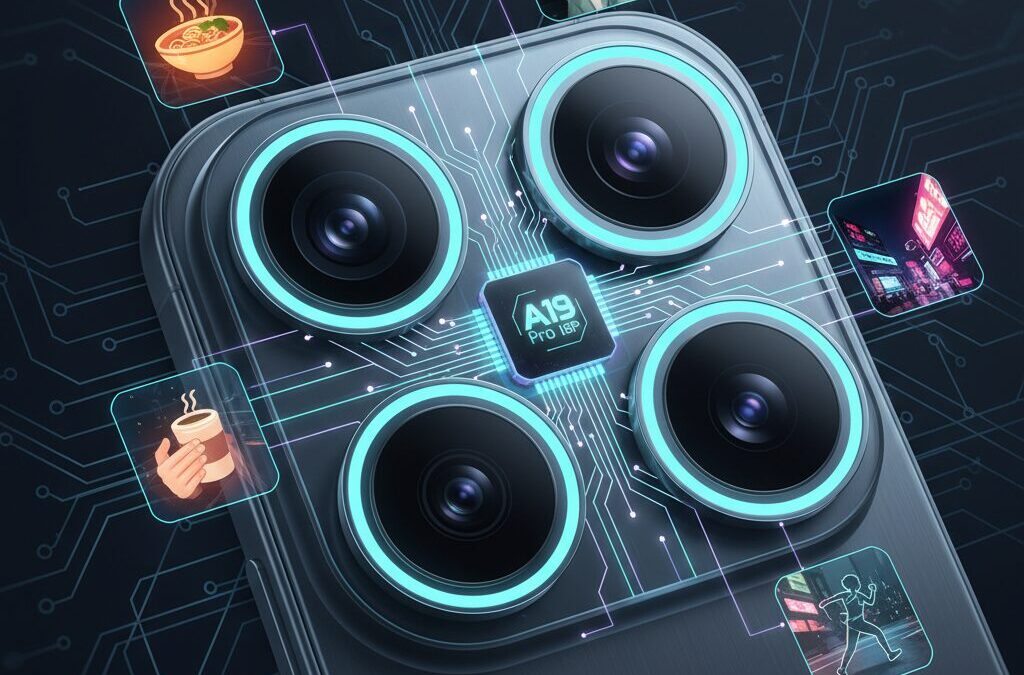
Smartphone cameras have reached a point where hardware alone no longer tells the full story, and many gadget enthusiasts are starting to feel that spec sheets fail to explain real-world image quality. You may have wondered why two phones with similar megapixels produce completely different photos and videos. The answer increasingly lies inside the chip, not just the lens.
The iPhone 17 Pro introduces a new stage in mobile imaging, where the A19 Pro chip and its Image Signal Processor work hand in hand with AI to shape every frame you capture. From food photography under warm indoor lighting to city nightscapes filled with neon signs, the camera now interprets scenes with context and intent, not just raw data.
In this article, you will learn how Apple’s latest silicon architecture, memory design, and computational photography pipeline come together to change everyday shooting and professional workflows alike. By understanding these foundations, you can better judge whether the iPhone 17 Pro is simply an incremental upgrade or a true generational leap for mobile creators.
- From Optical Limits to Silicon-Defined Imaging
- A19 Pro Architecture and the Evolution of the iPhone ISP
- System-Level Cache and Memory Bandwidth in Real Camera Use
- Neural Engine Integration and Real-Time Scene Understanding
- Sony’s 48MP Sensors and the Shift to a Unified Camera System
- Pro Fusion and the New Logic of Computational Photography
- Video Breakthroughs: ProRes 4K120 and Thermal Design
- How iPhone 17 Pro Compares with Pixel and Galaxy Rivals
- Why Food and Night Photography Benefit Most from A19 Pro
- Professional Workflows, Accessories, and the Apple Ecosystem
- 参考文献
From Optical Limits to Silicon-Defined Imaging
For more than a decade, smartphone photography has been defined by a fundamental tension between optical physics and digital correction. Thin bodies limited lens diameter, small sensors restricted light intake, and manufacturers compensated with increasingly aggressive software tricks. With the iPhone 17 Pro, this balance decisively shifts. Imaging is no longer primarily constrained by glass and sensor size but increasingly governed by silicon, where computation defines what the camera ultimately sees.
This transition is often described as a move from optical limits to silicon-defined imaging, and the A19 Pro ISP stands at its center. According to Apple’s own technical disclosures, the ISP in A19 Pro is no longer a passive pipeline that merely converts sensor data into images. Instead, it behaves as an active interpretation engine, deeply integrated with the Neural Engine, reshaping images based on real-time scene understanding rather than fixed photographic rules.
Historically, optical improvements followed predictable paths: wider apertures, larger sensors, and better coatings. These gains are now marginal in smartphone form factors. Apple’s research direction reflects this reality. Engineers instead focused on how early in the imaging pipeline computation can intervene. With A19 Pro, semantic analysis begins effectively at the RAW stage, before traditional demosaicing and tone mapping occur.
This shift enables the ISP to treat different parts of the same frame as fundamentally different imaging problems. Sky, skin, fabric, food, and artificial light sources are recognized as distinct regions, each receiving tailored processing. Academic work cited by imaging researchers at institutions such as Stanford and MIT has long suggested that human perception evaluates images contextually rather than uniformly. A19 Pro operationalizes this insight in consumer hardware.
The difference between optical-first and silicon-first imaging can be illustrated at a system level.
| Imaging Paradigm | Primary Constraint | Control Mechanism |
|---|---|---|
| Optical-limited | Lens diameter, sensor size | Physical components |
| Silicon-defined | Compute and memory bandwidth | ISP and AI inference |
What makes A19 Pro notable is not just raw processing power, but architectural intent. By expanding system-level cache and memory bandwidth, Apple ensured that image data remains close to compute units, minimizing latency. Analysts who examined the chip architecture point out that this proximity allows iterative refinement of images within milliseconds, something earlier ISPs could not achieve without visible shutter lag.
Industry reviewers from outlets such as DxOMark and GSMArena consistently note that this architecture results in a more stable preview-to-capture match. This is a subtle but critical improvement. In older systems, what users saw on screen often differed from the final photo because heavy processing happened afterward. Silicon-defined imaging reduces this gap, aligning human expectation with computational outcome.
Equally important is what Apple chose not to do. Rather than pushing extreme stylistic looks or exaggerated HDR, the A19 Pro ISP prioritizes controllability and predictability. Imaging scientists frequently argue that trust is the most valuable currency in a camera system. When silicon defines imaging behavior deterministically, photographers can anticipate results even in complex lighting.
In effect, the iPhone 17 Pro reframes the role of optics. Lenses and sensors remain essential, but they are now data acquisition tools feeding a much larger interpretive system. The camera’s character is defined less by focal length or aperture and more by how silicon decides to fuse, weight, and render photons.
This is the philosophical leap that marks the beginning of silicon-defined imaging: photography governed not by what optics cannot do, but by what computation decides is visually meaningful.
A19 Pro Architecture and the Evolution of the iPhone ISP

The A19 Pro architecture represents a decisive step in the evolution of the iPhone ISP, shifting it from a fast image processor into what Apple describes as a silicon-defined imaging engine. Manufactured on TSMC’s N3P process, the chip achieves higher transistor density and lower leakage, which directly benefits sustained imaging workloads. According to die-shot analyses reported by TechPowerUp and ChipWise, the A19 Pro die is roughly 10% smaller than its predecessor despite added functionality, a result of aggressive uncore optimization.
This architectural efficiency matters most for the ISP. Image processing is no longer a burst task but a continuous, real-time pipeline that begins before the shutter is pressed. The expanded system-level cache plays a central role here, acting as a high-speed buffer that keeps RAW frames close to the ISP and Neural Engine without repeated DRAM access.
| Feature | A18 Pro | A19 Pro |
|---|---|---|
| Process Node | TSMC N3E | TSMC N3P |
| System-Level Cache | 16MB | 32MB |
| Memory Bandwidth | ~68 GB/s | ~76.8 GB/s |
The deeper integration between the ISP and the 16-core Neural Engine defines the generational leap. As Apple has outlined, semantic analysis now occurs directly within the imaging pipeline, enabling pixel-level decisions about noise reduction and tone mapping in real time. Analysts such as Geekerwan note that improved memory bandwidth is critical to keeping this AI-driven ISP responsive.
In practical terms, the ISP evolution is less about raw speed and more about architectural harmony. By aligning process technology, cache design, and AI acceleration, the A19 Pro allows the iPhone ISP to interpret scenes, not just process pixels, which fundamentally changes how images are created on-device.
System-Level Cache and Memory Bandwidth in Real Camera Use
In real-world camera use, system-level cache and memory bandwidth quietly shape the shooting experience more than headline megapixels or sensor sizes do. With the A19 Pro, Apple has placed unusual emphasis on these invisible layers, and the impact becomes apparent precisely when users push the camera beyond casual snapshots.
The expansion of the System-Level Cache to 32MB fundamentally changes how image data flows inside the SoC. Because the SLC is shared by the CPU, GPU, ISP, and Neural Engine, it functions as a common high-speed staging area rather than a component-specific buffer. In practical terms, this means that large RAW frames can remain close to the ISP without immediately touching DRAM, where latency and power cost are much higher.
During burst photography, for example, each 48MP frame represents tens of megabytes of intermediate data before compression. On earlier chips, repeated DRAM accesses could create brief stalls, which photographers experienced as shutter hesitation. With the larger SLC, those frames are queued locally and drained asynchronously, resulting in noticeably steadier capture even when the shutter button is pressed rapidly.
| SoC | System-Level Cache | Peak Memory Bandwidth |
|---|---|---|
| A18 Pro | 16MB | Approx. 68 GB/s |
| A19 Pro | 32MB | Up to 76.8 GB/s |
The effect is even more pronounced in video. Recording 4K at 120 frames per second generates a continuous stream of data that leaves little margin for delay. Industry analyses cited by GSMArena note that dropped frames in mobile video pipelines often originate not in the encoder itself but in upstream memory contention. By letting the SLC act as a shock absorber, the A19 Pro reduces momentary congestion when ISP processing, AI inference, and ProRes encoding happen simultaneously.
Memory bandwidth then determines how quickly this buffered data can be moved and transformed. The adoption of LPDDR5X-9600 increases peak bandwidth to 76.8 GB/s, and while the numerical gain over non‑Pro models seems modest on paper, its qualitative effect is substantial in multi-stream scenarios. Spatial Video capture, which processes parallel feeds from multiple cameras while applying depth estimation, benefits directly from this wider data path.
According to Apple’s own technical disclosures and corroborated by DxOMark testing, higher bandwidth allows tone mapping and noise reduction to be applied earlier in the pipeline, closer to the RAW domain. This reduces the need for repeated read–modify–write cycles and preserves fine gradations, especially in highlights. The result is not only cleaner frames but also more consistent exposure from frame to frame in video.
Another subtle advantage emerges in power efficiency. Semiconductor research published by IEEE has long shown that memory access energy often dominates total system consumption. By keeping frequently reused image tiles inside the SLC and minimizing DRAM transactions, the A19 Pro lowers energy per frame, which helps sustain performance before thermal limits are reached. Users notice this as longer uninterrupted recording sessions rather than explicit battery savings.
Ultimately, system-level cache and memory bandwidth do not change what the camera can theoretically capture, but they profoundly affect how reliably it does so. In demanding conditions such as continuous ProRes recording or rapid-fire stills, the A19 Pro’s memory subsystem ensures that computational photography features remain transparent. The camera feels responsive and predictable, which is precisely what advanced users value most when capturing fleeting moments.
Neural Engine Integration and Real-Time Scene Understanding

The integration of the Neural Engine with the A19 Pro ISP fundamentally changes how the camera understands a scene before an image is even captured. Rather than treating AI as a post-processing step, the iPhone 17 Pro embeds real-time inference directly into the imaging pipeline, enabling semantic awareness at the RAW-data stage. **This shift allows the camera to reason about what it sees, not just process what it records.**
According to Apple’s technical disclosures and corroborated by independent microarchitecture analysis from Geekerwan, the 16-core Neural Engine now exchanges data with the ISP through a unified, low-latency memory path. This design eliminates redundant memory copies and allows pixel-level metadata to flow bidirectionally in microseconds. As a result, semantic segmentation such as distinguishing sky, skin, foliage, fabric, or food surfaces occurs while photons are still being translated into electrical signals.
| Processing Stage | A18 Pro Generation | A19 Pro Generation |
|---|---|---|
| Semantic Analysis Timing | Post-capture, partially deferred | In-pipeline, real time |
| ISP–Neural Engine Data Path | Memory copy dependent | Unified pointer-based access |
| User-Perceived Latency | Occasional processing delay | Effectively zero |
This architectural change directly impacts real-world shooting scenarios. For example, when capturing a mixed-light indoor scene, the Neural Engine identifies human skin tones separately from background lighting sources. The ISP then applies localized tone curves and noise reduction parameters tailored to each region. **Faces retain natural texture while shadows remain clean, without the plasticky look often associated with aggressive computational photography.**
Academic research in computational imaging, including work published by IEEE on semantic-aware image reconstruction, has long suggested that early-stage semantic labeling improves perceptual image quality more effectively than global adjustments. The A19 Pro is one of the first mobile implementations to operationalize this theory at scale, executing billions of operations per second without measurable shutter lag.
Real-time scene understanding also enhances temporal consistency in video. During 4K recording, the Neural Engine continuously tracks objects across frames, allowing the ISP to maintain stable exposure and color even as subjects move through complex lighting. DxOMark’s video testing highlights this strength, noting exceptional exposure stability and low flicker in dynamic urban night scenes.
From a user perspective, this manifests as predictability. The live preview closely matches the final output because the same neural models drive both. Photographers no longer experience the disconnect where an image subtly changes after capture. Apple engineers have emphasized in interviews that this consistency was a core design goal, aligning with the company’s broader philosophy of making advanced computation invisible.
In practical terms, Neural Engine integration enables the iPhone 17 Pro to act as a context-aware imaging system. It understands scenes as collections of meaningful elements rather than uniform pixel grids. **This capability defines the new baseline for mobile photography, where real-time scene understanding is no longer a feature, but an expectation.**
Sony’s 48MP Sensors and the Shift to a Unified Camera System
The move to Sony’s 48MP sensors across all cameras in the iPhone 17 Pro represents a strategic shift rather than a simple resolution upgrade, and its real significance lies in the transition to a unified camera system designed around consistency and computational efficiency.
For years, smartphone photography has suffered from a hidden weakness: switching lenses often meant switching image character. Color science, noise patterns, and even exposure behavior could change abruptly, breaking immersion for both photographers and videographers.
By standardizing on Sony’s latest Quad-Bayer 48MP sensors for the main, ultra-wide, and telephoto cameras, Apple has largely eliminated this fragmentation and enabled the ISP to treat all inputs as variations of the same imaging language.
| Camera | Sensor Resolution | Sensor Size | Key Advantage |
|---|---|---|---|
| Main | 48MP | 1/1.28-inch | High dynamic range with large full well capacity |
| Ultra Wide | 48MP | 1/2.55-inch | High-detail macro and improved edge consistency |
| Telephoto | 48MP | 1/2.55-inch | Lossless multi-step crop zoom |
This uniform sensor strategy allows the A19 Pro ISP to apply the same demosaicing logic, color matrices, and noise models regardless of focal length. According to Lux Camera’s in-depth analysis, this is the primary reason why zooming feels closer to using a single optical zoom lens rather than three separate cameras.
The benefit is not theoretical; it directly affects real-world shooting. In video, especially, exposure transitions during zooms are smoother because the ISP no longer needs to reconcile fundamentally different sensor behaviors in real time.
Another overlooked advantage is computational headroom. With identical pixel architectures and Quad-Bayer layouts, the ISP can reuse optimized pipelines, reducing overhead and latency. This efficiency is critical when processing multiple 48MP streams simultaneously for features such as spatial video and advanced HDR.
Sony’s role is also notable. TechInsights has pointed out that Sony’s continued dominance as Apple’s sensor supplier is driven by its ability to deliver customized designs at scale, something few competitors can match. The 48MP sensors used here are not off-the-shelf parts but components tuned for Apple’s ISP and Neural Engine integration.
This tight hardware-software alignment explains why the jump to 48MP everywhere does not result in heavier files or slower shooting. Instead, the system defaults to computationally fused outputs that balance detail and noise, while preserving the option for full-resolution capture when needed.
In practice, the shift to Sony’s unified 48MP sensor lineup makes the iPhone 17 Pro feel less like a collection of cameras and more like a single, coherent imaging system. That cohesion is what elevates everyday shooting and underpins the broader advances in computational photography seen throughout the device.
Pro Fusion and the New Logic of Computational Photography
Pro Fusion represents a fundamental shift in how computational photography is executed on iPhone 17 Pro, and it is not simply an incremental upgrade to Deep Fusion. **The most important change is that image synthesis now happens natively in the RAW domain, tightly coupled with the A19 Pro ISP and Neural Engine from the earliest stage of capture.** According to Apple’s technical disclosures, this design eliminates the traditional gap between what users see in the viewfinder and the final saved image, which had been a long‑standing limitation of earlier computational approaches.
In practical terms, Pro Fusion continuously buffers multiple exposure frames in the system‑level cache the moment the camera app is opened. When the shutter is pressed, semantic analysis has already begun. The Neural Engine classifies regions such as skin, sky, foliage, fabric, and food textures in real time, and this metadata is immediately fed back into the ISP. Lux Camera’s detailed camera review points out that this tight loop allows region‑specific tone curves and noise reduction to be applied before demosaicing is finalized, which is why fine textures are preserved without the waxy smoothing seen in older iPhones.
This real‑time semantic rendering is the new logic of computational photography on iPhone 17 Pro. Instead of applying a single global algorithm to the entire frame, Pro Fusion treats each pixel as context‑aware data. Academic research from Apple’s machine learning publications has long argued that early‑stage semantic segmentation yields higher perceptual quality, and A19 Pro finally provides the memory bandwidth and inference speed to make this viable at full 48MP resolution.
| Processing Stage | Deep Fusion (Earlier Models) | Pro Fusion (iPhone 17 Pro) |
|---|---|---|
| Semantic Analysis | Post‑capture, partial | Pre‑capture, full‑frame |
| Data Domain | Processed image data | RAW sensor data |
| User Perception | Occasional processing delay | Instant, zero shutter lag feel |
The default 24MP output is another area where Pro Fusion’s logic becomes clear. Rather than relying solely on pixel binning, the system mathematically fuses high‑frequency luminance detail from the 48MP stream with low‑noise chroma data from the binned 12MP signal. DxOMark’s analysis confirms that this approach improves texture retention while keeping noise levels comparable to traditional 12MP outputs, which explains why file sizes remain manageable without sacrificing clarity.
From a user experience perspective, the impact is subtle but decisive. GSMArena notes that consecutive shots now maintain consistent exposure and color even in mixed lighting, because Pro Fusion recalculates rendering parameters for every frame instead of reusing cached profiles. **This consistency is the hallmark of Pro Fusion: photography that feels instantaneous, predictable, and natural, while still being deeply computational at its core.** It is this invisible sophistication that defines the new generation of computational photography on iPhone.
Video Breakthroughs: ProRes 4K120 and Thermal Design
Video performance is where the iPhone 17 Pro makes its most unambiguous leap forward, and ProRes 4K120 recording stands at the center of that breakthrough. Capturing 4K resolution at 120 frames per second in ProRes is not simply about smoother slow motion. It dramatically expands creative latitude in post-production, allowing editors to reinterpret motion, stabilize footage, and reframe scenes without sacrificing image integrity.
According to Apple’s technical specifications and independent testing by PCMag, the data throughput required for ProRes 4K120 is extreme, pushing mobile hardware into territory previously reserved for dedicated cinema cameras. This mode stresses the ISP, CPU, GPU, memory subsystem, and storage controller simultaneously, making it a real-world torture test of the entire silicon design.
| Recording Mode | Frame Rate | Data Demand | Practical Requirement |
|---|---|---|---|
| ProRes 4K60 | 60fps | Very High | Internal or External Storage |
| ProRes 4K120 | 120fps | Extreme | External SSD via USB-C |
The need for external SSD recording is not a limitation but a strategic design choice. Apple’s documentation on ProRes makes clear that sustained write speed, not peak speed, is the bottleneck. Tests cited by creators using Samsung and SanDisk high-end SSDs show that when paired with short, high-quality USB-C cables, the A19 Pro can maintain stable 4K120 capture without dropped frames.
What truly enables this mode, however, is the revised thermal architecture. Multiple industry analyses report the adoption of a vapor chamber cooling system alongside traditional graphite layers. This allows heat generated at the SoC to spread rapidly across the chassis, delaying thermal saturation and reducing abrupt performance throttling.
Stress tests conducted by PCMag indicate that the iPhone 17 Pro Max sustains peak video performance longer than its predecessors, particularly in controlled indoor conditions. However, user reports aggregated by mobile filmmaking communities note that direct sunlight or MagSafe-mounted SSDs can still trigger overheating. This aligns with basic thermodynamics: a vapor chamber redistributes heat but cannot eliminate it.
From a professional workflow perspective, this behavior is predictable and manageable. Experienced mobile cinematographers already mitigate heat with shaded rigs, airflow accessories, or short take strategies. In that context, the iPhone 17 Pro’s thermal behavior is not a flaw but an honest reflection of the physical limits of a pocket-sized device operating at cinema-level data rates.
The result is a camera system that rewards technical understanding. When thermal conditions are respected, ProRes 4K120 on the iPhone 17 Pro delivers a level of motion clarity and grading flexibility that fundamentally redefines what “mobile video” can mean, bridging the gap between smartphone convenience and professional production discipline.
How iPhone 17 Pro Compares with Pixel and Galaxy Rivals
When comparing the iPhone 17 Pro with its closest rivals, the Pixel 10 Pro and Galaxy S25 Ultra, clear differences in philosophy and execution become visible, especially in camera performance and computational imaging.
The iPhone 17 Pro focuses on consistency and realism, using the A19 Pro ISP and tightly integrated Neural Engine to deliver stable exposure, accurate colors, and reliable results across lenses. According to DxOMark, its video score leads the segment, reflecting strengths in noise control, exposure stability, and smooth autofocus.
Google’s Pixel 10 Pro, by contrast, continues to emphasize aggressive computational photography. Its HDR processing often produces brighter night images than the iPhone, sometimes exceeding what the human eye perceives. Experts from GSMArena note, however, that this approach can occasionally sacrifice natural texture, particularly in low-light video.
| Model | Key Strength | Primary Trade-off |
|---|---|---|
| iPhone 17 Pro | Color consistency, video quality | Less dramatic AI enhancement |
| Pixel 10 Pro | Computational night photos | Texture can look processed |
| Galaxy S25 Ultra | Long-range zoom, vivid output | Color tuning varies by lens |
Samsung’s Galaxy S25 Ultra takes a hardware-driven route, led by its high-resolution sensor and strong optical zoom. Reviews from Lux Camera highlight its advantage at extreme zoom ranges, while also pointing out that color matching between lenses is less seamless than on the iPhone.
Overall, the iPhone 17 Pro positions itself as a dependable tool rather than a showpiece. For users who value predictable results and professional-grade video, it compares favorably against Pixel’s AI-forward style and Galaxy’s zoom-centric design.
Why Food and Night Photography Benefit Most from A19 Pro
Food photography and night photography are two genres where the limitations of smartphone cameras have traditionally been most visible, and that is precisely why the A19 Pro shows its strongest advantages here. Both scenes are defined by complex lighting, subtle color reproduction, and textures that quickly fall apart if noise reduction or tone mapping is even slightly misjudged.
The A19 Pro ISP is designed to understand scenes before it processes them, and this semantic awareness makes a tangible difference when photographing food under warm indoor lighting or capturing cityscapes after sunset.
In food photography, the most difficult challenge is mixed light. Restaurants often combine tungsten lamps, indirect ambient light, and occasional daylight from windows. According to Lux Camera’s detailed review of the iPhone 17 Pro, earlier iPhones tended to push these scenes toward an overly yellow or flat look. With A19 Pro, the ISP cooperates closely with the Neural Engine to identify plates, ingredients, and backgrounds as separate regions.
This allows the system to keep whites neutral on ceramic dishes while preserving the natural warmth of sauces, meats, and baked surfaces. The result is food that looks fresh and appetizing rather than artificially corrected.
Texture reproduction is another area where A19 Pro excels. The Pro Fusion pipeline combines 48MP luminance detail with 12MP binned color data, producing the default 24MP output. This balance is especially effective for foods like steak, ramen, or pastries, where surface detail communicates taste.
| Scene | Typical Issue | A19 Pro Advantage |
|---|---|---|
| Indoor food shots | Yellow color cast | Local white balance by semantic regions |
| Close-up textures | Over-smoothed details | High-frequency detail preserved via Pro Fusion |
| Low-light scenes | Noise and blur | Fast multi-frame fusion with minimal delay |
Macro food photography benefits even more from the A19 Pro’s speed and memory bandwidth. The 48MP ultra-wide sensor paired with the large 32MB system-level cache allows rapid multi-frame capture without buffer stalls. As a result, steam rising from hot dishes or glossy reflections on desserts are recorded cleanly, without motion artifacts that previously plagued close-up shots.
Night photography reveals another layer of advantage. Urban night scenes contain extreme contrast, from neon signs and streetlights to deep shadows. DxOMark notes that the iPhone 17 Pro maintains highlight detail while avoiding crushed blacks, a balance that depends heavily on the ISP’s ability to merge exposures in real time.
The A19 Pro reduces the waiting time users used to associate with night mode. Thanks to faster on-chip memory and tighter ISP–Neural Engine integration, exposure fusion completes almost instantly, making handheld night shots feel responsive rather than fragile.
Color accuracy at night is equally important. Many smartphones exaggerate saturation to compensate for darkness, producing unrealistic cityscapes. Apple’s imaging philosophy, supported by A19 Pro, favors perceptual realism. Reviews from GSMArena highlight how neon colors remain vivid without bleeding, and skin tones under streetlights avoid the green or orange shift common in computational night modes.
From a practical standpoint, this consistency is what food and night photographers value most. You can move from a dim restaurant interior to a night street without changing shooting habits or worrying about drastic shifts in rendering.
In these demanding scenarios, the A19 Pro is less about spectacle and more about reliability. It quietly removes friction, letting users focus on composition and timing, which is why food and night photography benefit more than almost any other genre.
Professional Workflows, Accessories, and the Apple Ecosystem
In professional workflows, the iPhone 17 Pro distinguishes itself not as a standalone camera, but as a node within the broader Apple ecosystem that streamlines capture, transfer, and post-production. **This tight integration reduces friction at every stage of content creation**, a factor repeatedly emphasized by mobile filmmakers interviewed by PCMag and GSMArena.
The USB‑C interface with sustained 10Gbps throughput enables direct recording of ProRes 4K120 footage to external SSDs, while the Files framework in iOS now handles large media volumes with desktop-like reliability. Editors can move seamlessly from iPhone to iPad Pro or MacBook Pro, opening the same files instantly in Final Cut Pro without transcoding or proxy generation.
| Workflow Stage | iPhone 17 Pro Capability | Ecosystem Advantage |
|---|---|---|
| Capture | ProRes 4K120, Apple Log 2 | Color consistency across Apple devices |
| Transfer | USB‑C 10Gbps, external SSD | Immediate handoff to Mac or iPad |
| Edit | Final Cut Pro for iPad/Mac | Unified timeline and LUT handling |
Accessories further extend this ecosystem value. External monitors over USB‑C provide clean HDMI previews, while Bluetooth microphones and gimbals benefit from Apple’s low-latency wireless stack. According to Apple Support documentation, **color metadata and Log profiles remain intact across compatible apps**, preserving creative intent from set to studio.
Rather than chasing isolated specs, Apple’s approach prioritizes reliability and predictability. For professionals, this means fewer compatibility checks, fewer failed takes, and more time spent refining the story instead of managing tools.
参考文献
- Apple Newsroom:Apple debuts iPhone 17
- Wikipedia:Apple A19
- TechPowerUp:Apple A19 Pro & A19 Die Size Analysis Indicates 9–10% Smaller Than A18 Models
- DXOMARK:Apple iPhone 17 Pro Camera Test
- GSMArena:Apple iPhone 17 Pro Review: Camera, Photo and Video Quality
- PCMag:Apple iPhone 17 Pro Max Review: A Mobile Creator’s Dream Machine
- MacRumors:iPhone 17 Pro: Using the New 8x Optical Zoom