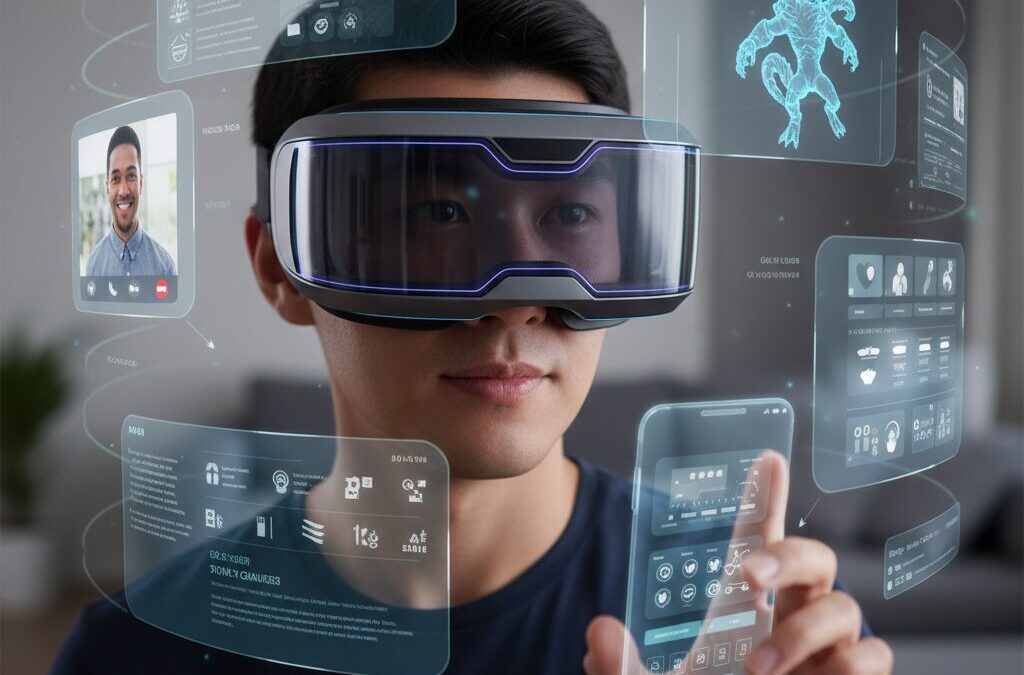
What comes after the smartphone? For more than a decade, our digital lives have been confined to rectangular screens in our hands and on our desks. Now, spatial computing is moving apps, video calls, games, and even workspaces into the physical space around us, transforming how we interact with information.
With the launch of Samsung’s $1,799 Galaxy XR and Google’s new Android XR platform, the Android ecosystem is making its boldest move yet against Apple Vision Pro. Backed by Qualcomm’s Snapdragon XR2+ Gen 2 and deeply integrated with Google’s Gemini AI, this is not just another headset—it is a strategic attempt to democratize high-end mixed reality.
In this article, you will discover how Galaxy XR’s 4K Micro-OLED displays, cross-device smartphone integration, PC Connect virtual desktops, and AI-driven avatars could reshape productivity, entertainment, and mobility. If you care about the future of gadgets, Android’s comeback, and the next paradigm shift beyond the smartphone, this is a story you cannot afford to miss.
- The Irreversible Shift Toward Spatial Computing
- Inside the Android XR Alliance: Google, Samsung, and Qualcomm’s Strategic Roles
- Galaxy XR Hardware Deep Dive: 4K Micro-OLED, Snapdragon XR2+ Gen 2, and Sensor Fusion
- Comfort as a Competitive Edge: Lightweight Design and External Battery Strategy
- Repairability and Sustainability: Why Galaxy XR Stands Out in Teardowns
- Smartphone DNA in 3D Space: The Core Philosophy of Android XR
- Cross-Device Services: Instant Tethering, Call Casting, and Seamless App Handoff
- PC Connect and the Rise of Infinite Virtual Workspaces
- Likeness Avatars and the Evolution of Digital Presence
- Travel Mode and Mobility: Turning Flights and Trains into Private Theaters
- Galaxy XR vs. Apple Vision Pro: Open vs. Closed Ecosystems Compared
- Price Strategy and Market Positioning: Is $1,799 the Tipping Point?
- Developer Ecosystem: Unity, WebXR, and Millions of Android Engineers
- From Headsets to AI Glasses: Agentic AI and the Road Ahead
- 参考文献
The Irreversible Shift Toward Spatial Computing
Personal computing is undergoing a structural transformation. For decades, our digital lives were confined to flat displays—desktops, laptops, and smartphones. Now, with the emergence of spatial computing powered by devices like Samsung’s Galaxy XR and the Android XR platform, digital information is expanding beyond the screen and embedding itself directly into our physical environment.
This shift is not a gadget trend; it is a redefinition of how humans access and interact with the internet. Apple framed the concept as a “spatial computer” with Vision Pro, but the real inflection point comes as Google, Samsung, and Qualcomm bring Android XR to market at scale. When a platform that builds on the world’s most widely used mobile OS moves into 3D space, the change becomes systemic rather than experimental.
According to Google’s official announcements, Android XR is deeply integrated with its Gemini AI models at the OS level. This means spatial interaction is no longer limited to gestures and controllers. Users can issue natural language commands, manipulate 3D windows conversationally, and rely on AI to interpret intent in real time. The interface shifts from touch-based input to context-aware presence.
The hardware foundation reinforces this inevitability. Qualcomm reports that the Snapdragon XR2+ Gen 2 platform inside Galaxy XR delivers 15% higher GPU and 20% higher CPU performance compared to its predecessor, enabling dual 4.3K-class visuals at 90fps. In spatial systems, latency directly affects comfort and immersion. Higher throughput reduces motion-to-photon delay, minimizing VR sickness and making extended use viable.
| Platform Layer | Key Player | Strategic Role |
|---|---|---|
| Operating System & AI | Android XR + Gemini integration | |
| Hardware Integration | Samsung | Galaxy XR device engineering |
| Compute Platform | Qualcomm | Snapdragon XR2+ Gen 2 processing |
What makes this shift irreversible is ecosystem gravity. Android holds roughly 70% of the global mobile OS market. When millions of developers gain access to Android XR through familiar tools like Android Studio and Unity integration, spatial applications scale rapidly. Unlike isolated hardware experiments of the past, this transition is backed by an existing distribution engine: Google Play.
Industry analysts, including IDC in its recent technology outlook, describe the mid-2020s as the beginning of an “Agentic Era,” where AI systems act proactively on user intent. Spatial computing provides the ideal interface for such AI—persistent, contextual, and visually anchored in the real world. Instead of opening apps, users interact with environments.
The screen is no longer the destination. Space itself becomes the interface. As Android XR extends smartphone DNA into three-dimensional computing, the migration feels evolutionary rather than disruptive. That seamless continuity is precisely why this transition is unlikely to reverse.
Inside the Android XR Alliance: Google, Samsung, and Qualcomm’s Strategic Roles
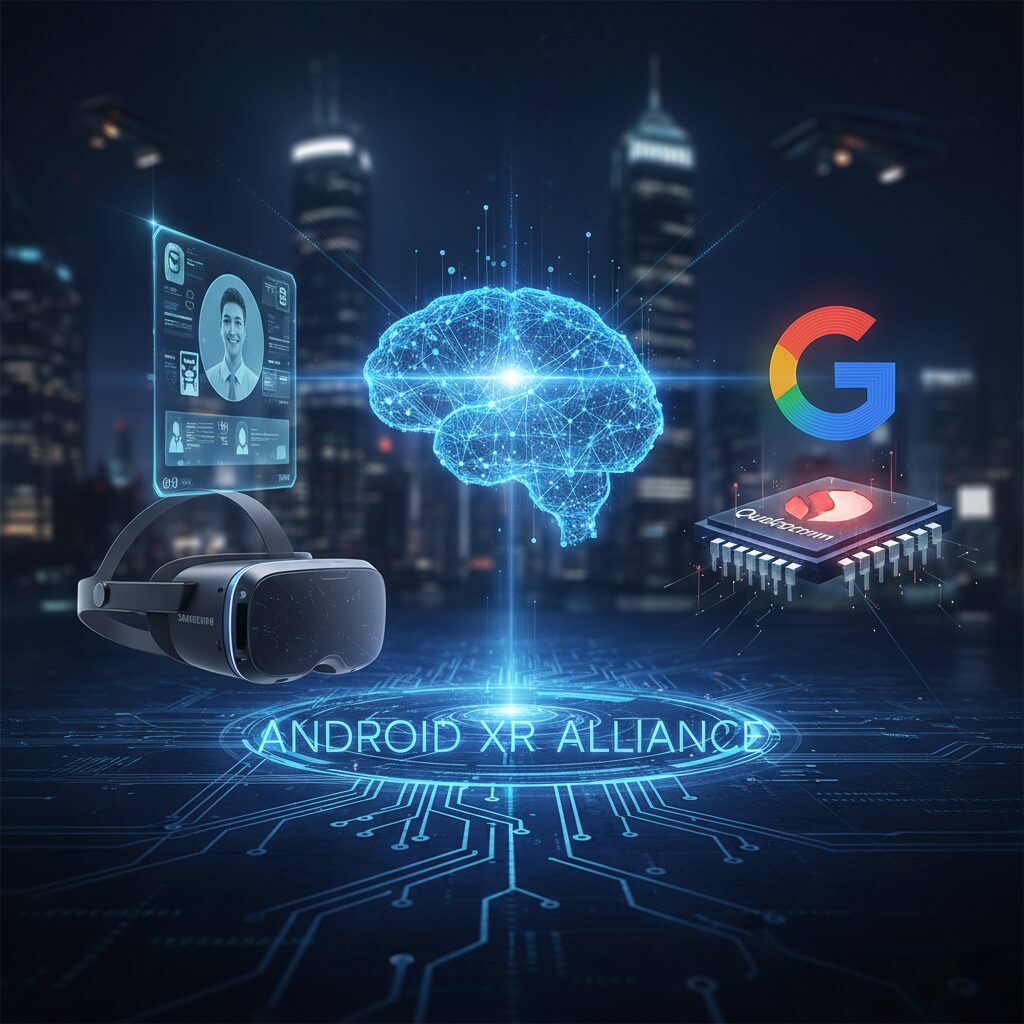
The Android XR Alliance is not a loose partnership but a deliberately structured division of power. Google, Samsung, and Qualcomm each control a critical layer of the spatial computing stack, and together they are building an alternative to vertically integrated rivals. According to Samsung Newsroom and Google’s official blog, this collaboration was designed from day one to combine platform scale, hardware engineering, and silicon optimization into a unified ecosystem.
Each company focuses on its core competency, minimizing overlap while maximizing ecosystem leverage. This clear role separation is what gives Android XR both speed and strategic depth.
| Company | Primary Role | Strategic Contribution |
|---|---|---|
| OS & AI Platform | Android XR, Gemini integration, Play ecosystem | |
| Samsung | Hardware Integration | Galaxy XR design, display, manufacturing scale |
| Qualcomm | Chipset & Processing | Snapdragon XR2+ Gen 2 performance optimization |
Google’s role extends beyond simply adapting Android for headsets. Android XR is architected specifically for spatial interfaces, and notably integrates the Gemini generative AI model deep into the system layer. As highlighted by Google, this enables natural language interaction and contextual understanding inside 3D environments. Instead of treating AI as an add-on feature, Google embeds intelligence into the operating fabric itself, strengthening long-term platform defensibility.
Equally important is Google Play compatibility. By enabling millions of existing Android applications to function in XR space, Google reduces the classic “cold start” problem that new platforms face. Industry analysts frequently cite ecosystem scale as Android’s greatest competitive weapon, and Android XR inherits that advantage immediately.
Samsung, meanwhile, translates platform ambition into physical reality. Under the internal codename Project Moohan, Galaxy XR reflects Samsung’s vertical strengths in display manufacturing, component miniaturization, and global distribution. Reports from CES coverage emphasize that Samsung deliberately prioritized practicality and productivity, signaling a device engineered not only for demonstration but for sustained daily use.
Qualcomm completes the triad with the Snapdragon XR2+ Gen 2 platform. According to Qualcomm’s technical briefings, the chipset delivers a 15% GPU uplift and 20% CPU improvement over its predecessor while supporting 4.3K per-eye resolution at 90fps. In spatial computing, latency directly impacts comfort and immersion. By optimizing silicon specifically for XR workloads, Qualcomm ensures that Google’s software ambitions and Samsung’s hardware precision are not bottlenecked by compute limitations.
Strategically, this alliance represents a horizontal counter-model to vertically integrated ecosystems. Instead of one company controlling every layer, the Android XR Alliance leverages specialization at scale. Each partner strengthens its own core business—Google expands Android’s reach, Samsung reinforces premium hardware leadership, and Qualcomm deepens its dominance in XR silicon—while collectively accelerating spatial computing adoption.
This structured interdependence is not accidental. It reflects a calculated move to democratize high-end XR through ecosystem leverage rather than exclusivity. For tech enthusiasts watching the next computing shift unfold, the real story is not just the device—it is the architecture of power behind it.
Galaxy XR Hardware Deep Dive: 4K Micro-OLED, Snapdragon XR2+ Gen 2, and Sensor Fusion
At the core of Galaxy XR lies a hardware architecture engineered to eliminate the traditional compromises of mixed reality. From display density to compute throughput and environmental awareness, every component is tuned for low latency, visual fidelity, and long-session usability.
4K Micro-OLED: Pixel Density Beyond Human Perception
Galaxy XR adopts Sony-manufactured 4K-class Micro-OLED panels built on silicon substrates. This OLED-on-Silicon approach enables dramatically higher pixel density than conventional smartphone OLEDs, reaching an estimated 4,032 PPI. With a per-eye resolution of 3,552 × 3,840 pixels, total pixel count exceeds 27 million across both eyes.
| Display Metric | Galaxy XR |
|---|---|
| Resolution (per eye) | 3,552 × 3,840 |
| Total Pixels (approx.) | 27–29 million |
| Pixel Density | ~4,032 PPI |
| Refresh Rate | Up to 90Hz |
According to PCMag and Tom’s Guide comparisons, this pixel density effectively eliminates the screen-door effect that has historically plagued VR headsets. Fine typography in floating browsers remains crisp, and 4K video playback appears cinema-grade even at large virtual screen sizes.
The maximum 90Hz refresh rate may appear slightly lower than some competitors’ peak modes, yet in real-world productivity and media scenarios, it delivers sufficiently smooth motion while maintaining thermal and power efficiency.
The combination of ultra-high pixel density and controlled refresh rate prioritizes sustained clarity over spec-sheet inflation.
Snapdragon XR2+ Gen 2: Sustained Throughput for Spatial Workloads
Driving those displays is Qualcomm’s Snapdragon XR2+ Gen 2 platform. Qualcomm states that compared to its predecessor, GPU performance improves by approximately 15% and CPU performance by 20%. More importantly, the chipset supports per-eye 4.3K rendering at 90 frames per second.
In spatial computing, raw performance is not about gaming benchmarks alone. It directly impacts motion-to-photon latency, which research consistently links to motion sickness in VR systems. By increasing parallel graphics throughput and AI acceleration capacity, the XR2+ Gen 2 reduces perceptible delay between head movement and visual update.
This computational headroom also enables real-time AI processing layered on top of sensor data, a critical requirement for stable mixed-reality passthrough and precise gesture recognition.
Sensor Fusion: Real-Time Environmental Intelligence
Galaxy XR integrates dual high-resolution passthrough cameras, six motion-tracking cameras, four eye-tracking cameras, and a depth sensor (ToF). Individually, these components are impressive. Collectively, they form a sensor fusion system that continuously maps the surrounding environment while tracking the user’s gaze and hands.
Industry teardown analyses and hands-on reports highlight that eye tracking operates at millisecond precision. This enables gaze-based selection, where simply looking at an interface element activates it, while subtle finger gestures confirm actions.
The key innovation is not the number of sensors, but the real-time fusion of visual, depth, inertial, and gaze data. The XR2+ Gen 2 processes these streams simultaneously, allowing spatial anchors to remain stable even as users walk, turn, or interact with physical objects.
Such stability is essential for productivity scenarios. Virtual monitors must remain fixed in physical space, and mixed-reality overlays must align precisely with real-world geometry. Without robust SLAM and sensor fusion, even minor drift would break immersion.
By combining ultra-dense Micro-OLED panels, a performance-optimized XR chipset, and a tightly integrated sensor array, Galaxy XR positions its hardware not merely as high-spec, but as infrastructure for sustained spatial computing sessions.
Comfort as a Competitive Edge: Lightweight Design and External Battery Strategy
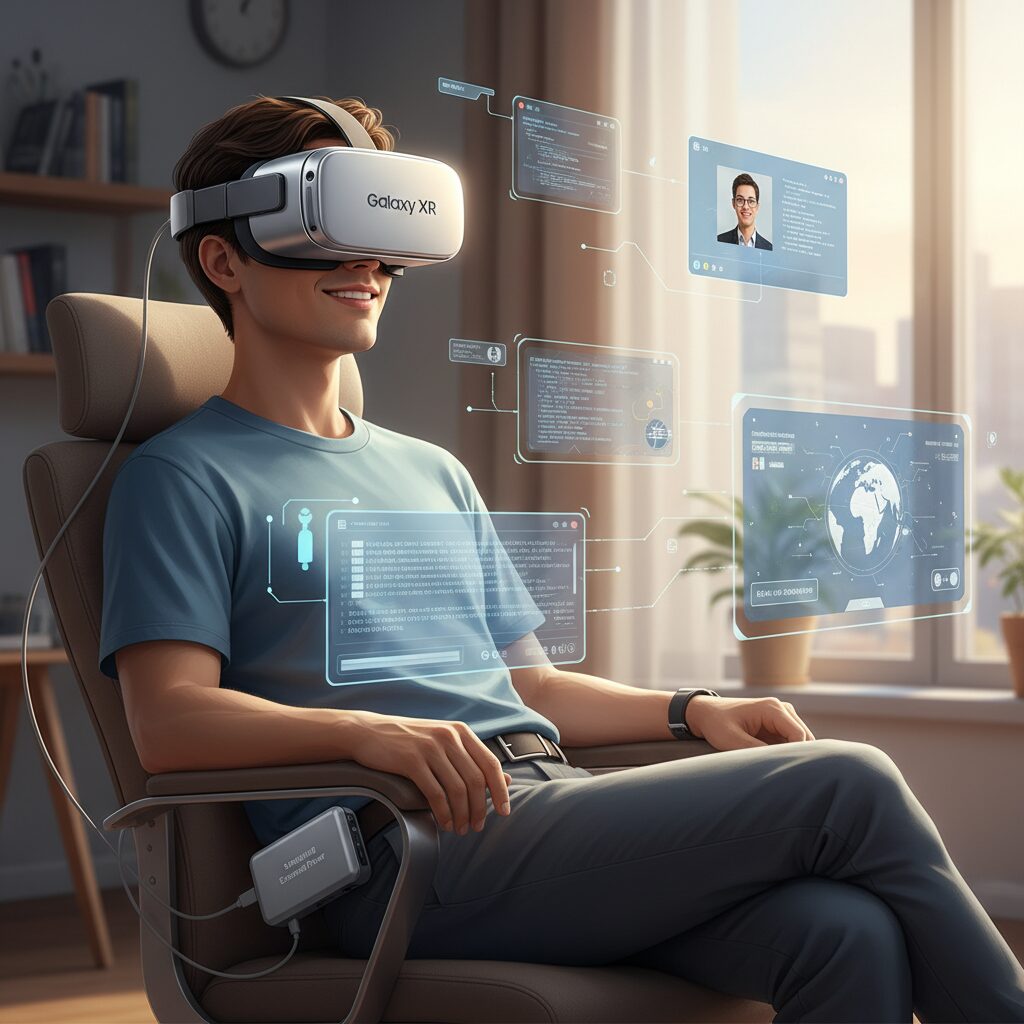
In spatial computing, raw performance means little if users cannot wear the device comfortably for hours.
Samsung approaches Galaxy XR with a clear premise: comfort is not a secondary feature but a competitive advantage.
This philosophy is most visible in its lightweight construction and external battery strategy.
According to specifications reported by Mashable and Android Central, Galaxy XR weighs approximately 545g.
By comparison, Apple Vision Pro is estimated at around 600–650g depending on configuration.
On paper, the difference may seem modest, but in head-mounted devices, even 50–100g significantly changes perceived strain.
| Device | Headset Weight | Battery Placement |
|---|---|---|
| Galaxy XR | Approx. 545g | External (tethered) |
| Vision Pro | Approx. 600–650g | External (tethered) |
The key differentiator is how that weight is distributed.
Galaxy XR removes the battery from the headset body and places it in a separate pack connected via cable.
This reduces frontal mass and minimizes torque on the neck during extended sessions.
Biomechanics research consistently shows that forward head posture increases cervical spine load exponentially as weight shifts away from the center of gravity.
Even small reductions in front-loaded mass lower muscular fatigue over time.
For users watching a two-hour film or working inside a virtual multi-monitor setup, that matters greatly.
There is, of course, a trade-off.
A tethered battery introduces a physical cable, which may appear less elegant than fully self-contained designs.
However, this choice prioritizes endurance and ergonomics over aesthetic minimalism.
This strategy also enhances practical usability.
Because the battery is modular and replaceable, users can potentially swap packs during long sessions instead of pausing to recharge the entire headset.
Teardown analysis from repair-focused outlets such as Phone Repair Guru further notes that external batteries improve long-term serviceability.
From a competitive standpoint, comfort directly influences total addressable usage time.
If a headset can be worn comfortably for three hours instead of one, it becomes viable for productivity, travel, and extended media consumption.
That expands its role from experimental gadget to daily computing device.
In the XR race, display resolution and chipset power often dominate headlines.
Yet adoption hinges on something more human: whether users forget they are wearing the device.
With its lightweight build and deliberate external battery architecture, Galaxy XR positions comfort not as compromise, but as strategy.
Repairability and Sustainability: Why Galaxy XR Stands Out in Teardowns
In the premium XR market, performance often dominates headlines, but long-term value is increasingly defined by repairability and sustainability. Galaxy XR stands out precisely because Samsung made structural decisions that favor durability over disposable design.
Teardowns by Phone Repair Guru describe it as one of the most repairable VR headsets to date. iFixit, known globally for its rigorous scoring methodology, has also highlighted the device’s modular internal layout and service-friendly construction. These assessments matter because XR headsets integrate dense optics, sensors, and thermals that are typically difficult to access.
Galaxy XR is engineered not just to impress on day one, but to remain serviceable years after purchase.
The most consequential design decision is the external, swappable battery pack. Unlike sealed internal batteries that degrade after hundreds of charge cycles, Galaxy XR allows battery replacement without dismantling the headset itself. According to repair experts, battery failure is statistically one of the most common causes of device retirement. By externalizing this component, Samsung effectively extends the product’s usable lifespan.
| Component | Design Approach | Impact on Longevity |
|---|---|---|
| Battery | External, replaceable pack | Reduces premature device disposal |
| Internal modules | Modular layout | Simplifies targeted repairs |
| Front assembly | Adhesive-sealed glass cover | Protects optics while allowing deeper access |
Teardown analyses further reveal a modular internal architecture. Key components such as sensor arrays and processing boards are organized in discrete sections rather than fused assemblies. This reduces the need to replace entire subsystems when only a single part fails. In contrast to tightly laminated consumer electronics, this approach lowers repair complexity and potentially repair cost.
iFixit has repeatedly emphasized that modern electronics are trending toward glue-heavy, non-serviceable builds. Against that backdrop, Galaxy XR represents a countercurrent. Even though the front glass is adhered for structural integrity and optical alignment, internal access after entry is comparatively straightforward for trained technicians.
Sustainability is not only about materials but about lifecycle extension. External batteries also distribute thermal stress away from the main headset body, which may reduce internal heat-related wear over time. Fewer heat cycles across core components can translate into improved durability, particularly in high-performance XR workloads.
There is also an economic sustainability angle. At a launch price of $1,799, Galaxy XR is a significant investment. Devices at this tier must justify ownership beyond early-adopter novelty. A repair-friendly design lowers total cost of ownership and increases resale viability, both critical factors for tech-savvy consumers who frequently upgrade.
From an environmental perspective, longer product lifespans directly reduce e-waste generation. Research cited by sustainability analysts consistently shows that extending device life by even one year meaningfully lowers lifecycle carbon impact. By enabling battery swaps and modular repairs, Galaxy XR aligns more closely with circular economy principles than many sealed XR competitors.
In teardown culture—where transparency exposes engineering philosophy—Galaxy XR earns credibility. It signals that Samsung anticipates real-world wear, not just showroom demos. For enthusiasts who follow disassembly reports before purchasing, that credibility translates into trust.
Ultimately, repairability is becoming a premium feature. Galaxy XR’s structural decisions demonstrate that high-end spatial computing does not have to come at the expense of serviceability. In a category still defining its standards, that stance alone sets it apart.
Smartphone DNA in 3D Space: The Core Philosophy of Android XR
At the heart of Android XR lies a simple but powerful idea: the smartphone is not replaced in 3D space—it is expanded. Rather than reinventing user behavior from scratch, Google and Samsung extend the familiar logic of Android into a volumetric environment. This approach lowers cognitive friction and accelerates adoption among users who already live inside the Android ecosystem.
According to Google’s official introduction of Galaxy XR, Android XR inherits core Android frameworks while optimizing them for spatial interaction. That means app lifecycle management, notifications, multitasking logic, and account synchronization behave in ways Android users already understand. The difference is that these elements are no longer confined to a 6-inch rectangle—they float, anchor, and scale in physical space.
This is what can be described as “Smartphone DNA in 3D.” The operating system treats space as an extension of the home screen. Windows can be resized like widgets, pinned like apps, and layered like multitasking cards—yet they exist meters away instead of millimeters away.
| Smartphone Principle | Android XR Interpretation | User Impact |
|---|---|---|
| Home screen layout | Spatial app grid in 3D | Instant familiarity |
| Notifications | Context-aware floating alerts | Reduced disruption |
| Multitasking | Resizable spatial windows | True parallel workflows |
| Google Account sync | Cross-device continuity | Seamless ecosystem flow |
Unlike vertically integrated competitors that build spatial computing as a closed, premium layer above existing devices, Android XR positions the smartphone as the computational and identity anchor. Cross-Device Services, documented in Google’s developer and support materials, ensure that authentication, connectivity, and app states persist across phone, headset, and PC. This architectural decision reinforces the smartphone as the core node in a distributed system.
Technically, this philosophy is efficient. Instead of duplicating identity stacks or fragmenting app ecosystems, Android XR leverages Google Play’s millions of existing applications from day one. As noted in Google’s blog announcement, standard Android apps can run as 2D surfaces inside XR. That dramatically reduces the “content gap” that has historically slowed new platforms.
More importantly, it reshapes spatial computing from an elite experiment into an accessible upgrade path. Users do not need to relearn interaction metaphors. Tapping becomes pinching in space. Swiping becomes gestural navigation. Voice commands powered by Gemini replace typed search. The logic remains consistent; the canvas expands.
Qualcomm’s Snapdragon XR2+ Gen 2 further enables this philosophy by delivering sufficient CPU and GPU headroom to render multiple high-resolution windows simultaneously. Rather than forcing users into a single immersive app, Android XR supports layered productivity—closer to how people already use smartphones with split-screen and background apps.
This continuity-first strategy reflects Android’s historical strength: horizontal scalability. From budget phones to flagship devices, Android has always adapted across hardware tiers. In spatial form, the same principle applies. Android XR is not conceived as one headset—it is a platform designed to scale across form factors, potentially including lighter smart glasses in the future.
From a market perspective, this matters. IDC’s broader outlook on AI and connected ecosystems highlights that the next wave of computing emphasizes interoperability over isolation. Android XR aligns with that trajectory by treating space as another layer in a multi-device graph rather than a self-contained universe.
For gadget enthusiasts, this philosophical stance carries strategic implications. It suggests that investment in Android XR is not a bet on a single premium headset, but on the expansion of an existing digital identity into three dimensions. Your apps, contacts, subscriptions, and workflows do not migrate—they unfold.
In that sense, Android XR does not ask, “What replaces the smartphone?” Instead, it quietly answers a more compelling question: “What happens when your smartphone gains depth?”
Cross-Device Services: Instant Tethering, Call Casting, and Seamless App Handoff
Cross-Device Services is the invisible engine that turns Galaxy XR from a standalone headset into a true extension of your Android life.
Rather than forcing you to manage each device separately, Google’s framework links smartphones, headsets, and PCs under a single Google account, allowing tasks, connectivity, and communication to flow naturally between them.
According to Google’s official documentation, Cross-Device Services is designed to let Android devices discover each other, share context, and respond proactively without manual setup each time.
Instant Tethering is the most practical example of this philosophy.
When Galaxy XR detects that no stable Wi-Fi network is available, it can automatically request a hotspot connection from your paired Android smartphone. The phone activates tethering in the background, authenticates securely, and provides connectivity within seconds.
You do not need to take the phone out of your pocket or navigate settings menus, which is crucial when wearing a head-mounted display.
| Scenario | Without Cross-Device | With Instant Tethering |
|---|---|---|
| Leaving home Wi-Fi | Manual hotspot setup on phone | Automatic hotspot activation |
| Café with unstable network | Reconnect and reauthenticate | Seamless fallback to mobile data |
This automatic fallback is particularly valuable for XR, where cloud rendering, streaming, and AI features such as Gemini integration depend on persistent connectivity.
The result is continuity, not interruption.
For power users who rely on real-time collaboration tools or cloud gaming, this stability directly translates into productivity and immersion.
Call Casting addresses another friction point: communication across contexts.
If you are on a Google Meet or standard voice call on your Android phone and put on Galaxy XR, the session can be transferred to the headset with minimal input. Samsung describes this as a fluid transition rather than a restart of the call.
Your audio routing, microphone input, and in supported apps even spatial presentation shift to XR, preserving the conversation thread.
This matters because XR is not meant to replace the smartphone, but to expand it.
In practice, you might begin a call while commuting, then continue it at home inside a spatial workspace with shared documents floating at life-size scale.
The conversation does not end when the device changes.
Equally transformative is Seamless App Handoff.
Cross-Device Services enables supported apps and tasks to move between Android devices while maintaining state. An article you were reading, a draft email, or a media session can resume inside Galaxy XR without starting over.
Google’s support materials emphasize account-based synchronization and encrypted device discovery as the backbone of this feature.
Consider a real-world workflow.
You bookmark research on your smartphone during lunch, open Galaxy XR in the evening, and the same Chrome session appears as a resizable window in 3D space. Tabs, login states, and scroll position remain intact.
This persistence of context is what makes spatial computing feel native rather than experimental.
Together, Instant Tethering, Call Casting, and Seamless App Handoff redefine the relationship between devices.
Instead of isolated hardware endpoints, your phone, headset, and PC become nodes in a coordinated system. The smartphone supplies connectivity and identity, while Galaxy XR amplifies screen real estate and immersion.
For gadget enthusiasts who value ecosystem efficiency as much as raw specs, Cross-Device Services is not a background feature. It is the structural layer that makes Android XR practical in everyday life.
PC Connect and the Rise of Infinite Virtual Workspaces
One of the most transformative features of Galaxy XR is PC Connect, a first-party virtual desktop solution designed to dissolve the physical limits of traditional monitors. Instead of being confined to a single laptop screen or even a dual-monitor setup, users can project their Windows PC directly into immersive 3D space and resize it at will.
According to reporting by Road to VR and updates shared on the Google Blog, PC Connect is not a simple screen mirroring tool. It is engineered as a low-latency virtual desktop environment optimized specifically for Android XR, enabling both productivity applications and PC gaming to run within a stable spatial interface.
The experience feels fundamentally different from remote desktop apps of the past. Once connected, your primary Windows desktop appears as a large, floating display that you can reposition, curve, or expand. More importantly, individual application windows can be separated and arranged independently across your field of view, creating what can best be described as an infinite virtual workspace.
| Feature | Traditional Monitor Setup | PC Connect on Galaxy XR |
|---|---|---|
| Screen Size | Physically fixed | Freely resizable in space |
| Number of Displays | Limited by hardware ports | Multiple floating windows in 3D space |
| Portability | Desk-bound | Usable anywhere with headset + PC |
This flexibility has practical implications for real workflows. Imagine editing photos in Photoshop on a massive central canvas, placing reference images to your left, and keeping a YouTube tutorial or documentation window to your right. Because you continue using your existing keyboard and mouse, there is no need to relearn input methods. The spatial layer enhances, rather than replaces, established PC productivity habits.
Latency and visual clarity are critical for such a system to feel viable. Galaxy XR’s Snapdragon XR2+ Gen 2 platform, combined with high-resolution Micro-OLED displays, ensures that text remains sharp and interface elements are readable even when scaled to large virtual sizes. This makes spreadsheet work, coding, and document editing realistic tasks rather than novelty demos.
Another overlooked advantage is ergonomic freedom. With PC Connect, your virtual monitors can be positioned at eye level and at ideal distances, reducing neck strain caused by constantly looking down at a laptop. Over long sessions, this spatial adjustability may prove more comfortable than rigid desk-bound configurations.
For gamers, the appeal is equally compelling. Windows titles can be projected onto a cinema-sized virtual screen, effectively transforming any room into a private gaming theater. Because the processing still happens on the PC, Galaxy XR functions as an immersive display layer, extending the life and relevance of existing gaming hardware.
Importantly, this approach reflects Android XR’s broader philosophy of ecosystem expansion rather than replacement. Instead of asking users to abandon their PC workflows, PC Connect integrates them into spatial computing. As highlighted during Android XR announcements, this cross-device continuity is central to the platform’s vision.
In practical terms, PC Connect lowers the barrier to entry for spatial productivity. You do not need to repurchase software, migrate files, or adapt to unfamiliar operating systems. Your Windows environment remains intact, simply liberated from the constraints of physical screens.
For gadget enthusiasts and power users, this is where Galaxy XR moves beyond entertainment and into genuine infrastructure. The rise of infinite virtual workspaces is not about replacing the PC, but about amplifying it—turning every compatible computer into a boundless, immersive command center.
Likeness Avatars and the Evolution of Digital Presence
Digital presence is no longer limited to profile photos and flat video windows. With Android XR, Google introduces “Likeness,” a system that transforms how we appear and interact in spatial environments.
Instead of showing a headset-covered face during calls, users generate a realistic 3D avatar using their smartphone camera. This approach leverages the higher-quality sensors already embedded in flagship phones, enabling detailed facial texture capture and more natural representation.
Likeness shifts digital identity from a static image to a responsive, spatially aware embodiment.
According to Samsung Newsroom and coverage from 9to5Google, Likeness avatars reflect real-time facial expressions and hand gestures captured by the headset’s internal sensors. Eye movement, mouth motion, and subtle micro-expressions are translated onto the avatar, reducing the emotional disconnect common in traditional video conferencing.
This evolution matters because presence is psychological as much as visual. Research from Stanford’s Virtual Human Interaction Lab has shown that realistic avatars can significantly influence perceived trust and engagement in virtual communication.
By combining smartphone-based facial scanning with XR sensor fusion, Android XR aims to balance realism and comfort without requiring users to remove their headset mid-session.
From Video Windows to Spatial Embodiment
| Aspect | Traditional Video Call | Likeness Avatar in XR |
|---|---|---|
| Visual Framing | 2D rectangle on screen | 3D presence in shared space |
| Facial Capture | Webcam-dependent | Smartphone high-res scan + XR sensors |
| Body Language | Limited upper body | Hand tracking + spatial gestures |
| Immersion Level | Low to moderate | High, with depth perception |
The difference is not cosmetic. In spatial meetings, participants appear life-sized, positioned naturally in front of you rather than tiled across a grid. This spatial anchoring reduces cognitive load when tracking multiple speakers.
Google has positioned Likeness as a cross-application identity layer, meaning the same avatar can potentially function across Google Meet, collaborative productivity apps, and future social XR platforms. This continuity strengthens digital identity consistency.
For creators and digital natives, this opens a new layer of personal branding. Instead of relying solely on profile images or VTuber-style custom rigs, users can deploy a photorealistic yet privacy-controlled representation.
Importantly, because the initial scan occurs via a personal smartphone, users retain agency over when and how their likeness is created. This contrasts with systems that require on-headset scanning during active sessions.
As spatial computing matures, avatars are evolving from novelty features into core infrastructure. Likeness demonstrates that digital presence is no longer about being seen on a screen—it is about being felt in space.
Travel Mode and Mobility: Turning Flights and Trains into Private Theaters
Long flights and train rides have always been a paradox for gadget lovers. You have time, but limited space. You want immersion, but you are surrounded by strangers. With Travel Mode on Galaxy XR, that constraint turns into an opportunity.
According to Samsung’s announcement on Android XR updates, Travel Mode recalibrates motion tracking algorithms specifically for moving vehicles. Instead of interpreting acceleration and vibration as user movement, the system compensates for them. As a result, virtual screens remain anchored in space even when the aircraft banks or the train shifts tracks.
Travel Mode transforms unstable transit environments into visually stable private theaters and focused workspaces.
This technical adjustment has a profound experiential impact. In conventional XR use, sensor drift during motion can cause virtual displays to slide or wobble, increasing discomfort and even motion sickness. By stabilizing spatial anchors in transit scenarios, Galaxy XR makes two-hour flights or cross-country rail trips viable sessions for entertainment or productivity.
The practical implications become clear when you compare typical travel constraints with XR-enabled possibilities.
| Scenario | Traditional Device | Galaxy XR with Travel Mode |
|---|---|---|
| Airplane economy seat | 10–13 inch screen, limited viewing angle | Virtual 100-inch-class screen, fixed in space |
| Shinkansen table space | Laptop + physical clutter | Multiple floating windows, no physical monitor |
| Night travel | Cabin light interference | Controlled immersive environment |
In an airplane cabin, where seatback screens are often smaller than a tablet, Galaxy XR can render a cinema-scale display directly in front of you. With its dual high-resolution Micro-OLED panels and 90Hz refresh rate, films stream with clarity that rivals home setups. External noise fades as you focus on a stabilized, floating screen that does not jitter with turbulence.
On trains, the benefit shifts from spectacle to concentration. Instead of balancing a laptop on a narrow tray, you can place a large virtual desktop at eye level while keeping your physical posture relaxed. Windows apps streamed via PC Connect can occupy separate zones in space, allowing document editing on one side and reference material on the other, all while the carriage moves at high speed.
Crucially, Travel Mode works in tandem with the headset’s external battery design. Because weight is reduced on the face, longer sessions during intercontinental flights become more realistic. You are not just watching a movie; you are inhabiting a controlled digital environment inside a chaotic physical one.
Industry observers such as Road to VR have noted that transit use cases were historically a weak point for XR headsets. By directly addressing motion-induced instability, Samsung and Google reposition mobility as a strength rather than a limitation. For frequent business travelers and tech-forward commuters, the commute itself becomes premium screen time.
The result is a paradigm shift: planes and trains stop being dead time and start functioning as personal theaters and distraction-free studios. In a world where attention is the scarcest resource, reclaiming travel hours may be one of the most practical advantages of spatial computing.
Galaxy XR vs. Apple Vision Pro: Open vs. Closed Ecosystems Compared
When comparing Galaxy XR and Apple Vision Pro, the core difference lies not only in hardware, but in philosophy. Android XR represents an open, horizontally integrated ecosystem, while Vision Pro extends Apple’s tightly controlled vertical integration model. This structural divergence directly shapes how users, developers, and businesses experience spatial computing.
Apple’s approach centers on deep integration across iPhone, iPad, and Mac. Vision Pro works best when surrounded by Apple hardware, leveraging iCloud, Continuity, and macOS virtual display. According to Apple’s product briefings and independent reviews from outlets like PCMag, the experience feels seamless—but primarily within Apple’s own universe.
By contrast, Galaxy XR is built on Android XR, designed to scale across multiple manufacturers and device categories. Google’s developer documentation confirms that Android XR extends existing Android frameworks, enabling compatibility with millions of Play Store apps from day one. This fundamentally lowers ecosystem friction.
| Aspect | Galaxy XR (Android XR) | Apple Vision Pro |
|---|---|---|
| Ecosystem Model | Open, multi-partner | Closed, vertically integrated |
| App Distribution | Google Play (existing Android apps) | visionOS + adapted iPad apps |
| Device Compatibility | Android phones, Windows PCs | Primarily Apple devices |
| Hardware Expansion | Multiple OEM potential | Apple-only hardware |
The openness of Android XR creates a compounding network effect. Because Android already powers roughly 70% of the global smartphone market, developers familiar with Android Studio and Unity can extend existing apps into spatial form factors without rebuilding from scratch. As Google notes in its Android Developers documentation, XR support integrates into established toolchains. This lowers barriers to experimentation and accelerates innovation.
Apple’s closed system, however, delivers a different strength: optimization. By controlling silicon, OS, and hardware design, Apple can tightly calibrate latency, UI consistency, and security. Analysts frequently describe this as a “walled garden” that trades flexibility for refinement. For users deeply invested in the Apple ecosystem, this cohesion can feel magical.
The strategic difference is clear: Apple optimizes inward, Android scales outward.
Security and control also diverge. Apple enforces strict App Store policies and hardware certification, which can enhance privacy consistency but limit customization. Android XR, following the broader Android tradition, allows wider hardware participation and potentially broader peripheral support, including third-party controllers and cross-platform integrations.
From a long-term market perspective, IDC’s outlook on the “Agentic Era” suggests spatial computing will increasingly depend on AI-driven services across devices. In that context, Android’s cross-device services—linking phones, PCs, and XR headsets through a shared Google account—position Galaxy XR as part of a distributed computing mesh rather than a standalone premium device.
Ultimately, the decision between Galaxy XR and Vision Pro reflects a broader ideological choice. Do you prefer a curated, tightly controlled environment optimized for internal harmony, or an expansive ecosystem designed for interoperability and scale? The answer will define not just your XR experience, but how your digital life evolves in the spatial era.
Price Strategy and Market Positioning: Is $1,799 the Tipping Point?
The $1,799 price tag is not just a number. It is a strategic signal.
In the premium XR category, pricing defines who the device is for and how fast the ecosystem can scale. With Galaxy XR positioned at $1,799 in the U.S., Samsung and Google are clearly targeting what could become the psychological tipping point between niche experimentation and early mainstream adoption.
According to PCMag and Engadget’s comparative analyses, Apple Vision Pro enters the market at $3,499. That effectively doubles the financial barrier to entry for spatial computing at the high end. By contrast, Galaxy XR undercuts that figure by roughly 49%, while still offering dual 4K-class Micro-OLED panels and Qualcomm’s Snapdragon XR2+ Gen 2 platform.
| Device | Launch Price (USD) | Positioning |
|---|---|---|
| Galaxy XR | $1,799 | Premium but access-oriented |
| Apple Vision Pro | $3,499 | Ultra-premium, pro-first |
From a behavioral economics perspective, this matters enormously. Research frequently cited by Harvard Business Review suggests that consumers react disproportionately to prices that cross perceived category thresholds. In XR, $2,000 appears to be such a boundary. Staying below that line reframes the device from “luxury experiment” to “serious tech investment.”
$1,799 positions Galaxy XR closer to high-end smartphones and gaming PCs than to enterprise-only hardware.
Consider the comparison set. Flagship smartphones now routinely exceed $1,200. High-end gaming laptops often sit between $1,500 and $2,000. In that context, Galaxy XR does not look absurdly priced; it looks ambitious but attainable for enthusiasts.
This is especially critical for Android’s broader strategy. Google’s strength lies in scale. IDC has repeatedly emphasized that platform success depends not only on hardware margins but on ecosystem velocity. A lower entry price increases install base growth, which in turn incentivizes developers. More developers mean more native XR apps, reinforcing platform value.
Samsung’s pricing also suggests margin discipline rather than margin maximization. Given the cost structure implied by dual high-resolution Micro-OLED panels and advanced sensor arrays, $1,799 likely reflects a strategic compromise: sufficient premium perception, but aggressive enough to accelerate adoption.
There is also a competitive signaling dimension. By launching at roughly half the price of Vision Pro, Samsung reframes the narrative from “Can XR justify $3,499?” to “Is $1,799 reasonable for spatial computing?” That reframing alone shifts media and consumer discourse.
However, $1,799 is not cheap. It remains a high-consideration purchase. The tipping point question therefore hinges on perceived substitution value. If consumers view Galaxy XR as:
– a monitor replacement,
– a portable cinema,
– a productivity expansion tool,
– and a next-generation gaming platform,
then the price becomes easier to rationalize.
If instead it is seen as an accessory, adoption slows dramatically.
The strategic brilliance of $1,799 lies in its ambiguity. It is expensive enough to preserve premium brand equity, yet low enough to enable financing models, carrier bundles, and enterprise procurement without executive-level approval processes.
In many markets, sub-$2,000 hardware qualifies for consumer installment plans with manageable monthly payments. That transforms a four-figure upfront cost into a subscription-like expense, dramatically altering purchasing psychology.
Ultimately, the tipping point is not just numerical. It is narrative-driven. If developers, carriers, and early adopters validate Galaxy XR as a daily-use device rather than a novelty, $1,799 may be remembered as the moment spatial computing stepped out of the lab and into the enthusiast mainstream.
If not, it risks becoming the price that proved XR is still aspirational rather than essential.
Developer Ecosystem: Unity, WebXR, and Millions of Android Engineers
The true battleground of spatial computing is not hardware but developers. In this respect, Android XR enters the market with a structural advantage that no newcomer can easily replicate. By extending the existing Android stack rather than replacing it, Google effectively invites millions of engineers into spatial computing from day one.
According to Google’s Android Developers documentation, Android XR builds on familiar tools such as Android Studio and Jetpack Compose. That means developers do not need to learn an entirely new paradigm to begin shipping spatial apps. The transition cost is dramatically lower compared to closed or proprietary XR platforms.
This continuity transforms XR from an experimental niche into an incremental upgrade path for existing teams.
| Layer | Existing Ecosystem | XR Extension |
|---|---|---|
| Mobile Apps | Android SDK / Jetpack | Spatial UI components |
| Game Development | Unity | Native Android XR support |
| Web | Chrome / Web APIs | WebXR compatibility |
Unity’s role is particularly strategic. As Unity has announced support for Android XR in its latest engine releases, studios can port or optimize existing 3D projects without rebuilding from scratch. For developers who already ship VR or AR experiences, this dramatically reduces friction. Instead of choosing between ecosystems, they can extend their content pipeline to another high-end headset with minimal architectural change.
This matters because Unity remains one of the dominant engines in real-time 3D, powering everything from indie games to enterprise visualization tools. When engine-level support arrives early, content velocity accelerates.
That acceleration helps solve the classic “chicken-and-egg” problem that often delays new XR platforms.
Equally important is WebXR. By supporting browser-based immersive experiences, Android XR lowers the barrier even further. Web developers can prototype spatial interfaces using standard web technologies, leveraging Chrome’s mature rendering stack. For companies hesitant to commit to full native XR builds, WebXR offers a lightweight entry point.
This approach mirrors Android’s historical growth strategy: openness at multiple layers. Instead of forcing exclusivity, Google enables participation across native apps, game engines, and the web. The result is not a single funnel but a multi-lane highway into spatial computing.
Industry analysts have long emphasized ecosystem scale as the deciding factor in platform wars. IDC, in its broader technology outlooks, frequently highlights how developer reach determines long-term viability. In that context, Android XR’s inheritance of the Android developer base is not incremental—it is exponential.
Consider the implications. Android already powers the majority of global smartphones. Even a small percentage of active Android engineers experimenting with spatial features would represent a developer population larger than the total ecosystem of many competing XR platforms. Scale creates optionality, and optionality drives innovation.
Furthermore, backward compatibility with existing Android applications ensures immediate functional density. Traditional 2D apps can run inside virtual windows while developers gradually enhance them with spatial affordances such as depth layering, gaze interaction, or gesture input.
This layered adoption model reduces risk for product teams and investors alike.
Another overlooked advantage is talent distribution. Android engineers are not concentrated in a single geography or vertical. They span fintech, e-commerce, social media, education, and gaming. When spatial APIs become extensions of familiar SDKs, innovation does not remain confined to entertainment. Enterprise dashboards, collaborative design tools, medical visualization apps, and remote learning environments can all evolve organically.
In contrast to vertically integrated ecosystems that tightly control distribution, Android XR’s compatibility with Google Play introduces immediate discoverability. Developers can rely on established monetization frameworks, billing systems, and analytics tools. The infrastructure for scaling a business already exists.
This continuity reduces uncertainty—a critical factor when investing in a new computing paradigm.
Ultimately, the alliance between Unity, WebXR, and the global Android engineering community represents more than technical interoperability. It signals a philosophy: spatial computing should not be an elite experiment reserved for specialized studios. It should be an extension of mainstream software development.
If hardware defines the first impression of XR, the developer ecosystem defines its future. By mobilizing millions of Android engineers and aligning with industry-standard tools, Android XR positions itself not merely as a device platform but as a scalable foundation for the next wave of spatial applications.
From Headsets to AI Glasses: Agentic AI and the Road Ahead
The evolution from head-mounted displays to lightweight AI glasses is not a hardware race alone. It is a shift in how intelligence moves from screens into our daily field of view. Galaxy XR represents a critical bridge in this journey, but the real transformation lies in what comes next: Agentic AI embedded in wearable form factors.
Today’s XR headsets deliver immersion and productivity. Tomorrow’s AI glasses will deliver continuity and autonomy. According to IDC’s technology outlook, 2026 marks the beginning of the “Agentic Era,” where AI systems no longer wait for commands but proactively assist based on context and intent.
The future of spatial computing is not just immersive—it is proactive, context-aware, and self-initiating.
Agentic AI differs fundamentally from traditional voice assistants. Instead of responding to isolated prompts, it maintains situational awareness across devices. Through Android XR’s deep Gemini integration and cross-device services, the groundwork for this persistent intelligence is already in place.
Consider how this progression unfolds:
| Stage | Primary Device | Role of AI |
|---|---|---|
| VR Era | Headsets | Reactive commands |
| Mixed Reality | Galaxy XR | Context-aware assistance |
| Agentic Era | AI Glasses | Autonomous task execution |
In practical terms, AI glasses connected to an Android smartphone could recognize a restaurant in your field of view, check availability, and complete a reservation through your phone without requiring manual navigation. The intelligence would not reside solely in the glasses but operate across the Android ecosystem.
Google has emphasized that Android XR is designed to scale across device categories, from fully immersive headsets to more compact wearable displays. This scalability is essential. Hardware miniaturization takes time, but software intelligence can evolve continuously through updates.
The strategic advantage of Android lies in its distributed ecosystem. Smartphones provide connectivity and compute support. Cloud AI models provide reasoning. Wearables provide presence. Together, they form a layered architecture capable of supporting agent-level autonomy.
Qualcomm’s XR chip roadmap also signals this trajectory. Increased on-device AI acceleration reduces latency and preserves privacy, both critical for glasses intended for all-day wear. As processing becomes more efficient, bulky battery packs give way to lightweight frames.
Importantly, the transition to AI glasses is not about replacing smartphones overnight. It is about redefining the interface. The smartphone becomes the silent backbone, while glasses become the visible gateway. Tasks begin in the environment, not on a touchscreen.
Industry observers note that sustained adoption will depend on subtlety and social acceptability. Unlike headsets, glasses must feel natural in public settings. This makes agentic intelligence even more vital—interaction must be minimal, discreet, and frictionless.
What Galaxy XR demonstrates today is proof of concept at scale: spatial interfaces, AI-native operating systems, and seamless device continuity. What AI glasses promise is permanence—intelligence that accompanies you throughout the day without demanding attention.
From headsets to AI glasses, the road ahead is defined less by display resolution and more by autonomous capability. When AI begins to anticipate needs, coordinate across devices, and act responsibly on behalf of the user, spatial computing ceases to be an experience and becomes an infrastructure.
The Agentic Era is not a distant vision. Its foundation is already embedded in Android XR. The next step is simply making it small enough to wear like ordinary glasses—and powerful enough to think alongside you.
参考文献
- Qualcomm:The Samsung Galaxy XR is Here: How Snapdragon Powers Next-Gen Spatial Computing
- Samsung Newsroom:Introducing Galaxy XR: Opening New Worlds
- Google Blog:Introducing Galaxy XR, the first Android XR headset
- Engadget:Google and Samsung’s first Android XR headset is the $1,800 Galaxy XR
- PCMag:Samsung Galaxy XR vs. Apple Vision Pro: A Head-to-Head, Reality-Bending Battle
- Android Developers:Understand the types of Android XR devices