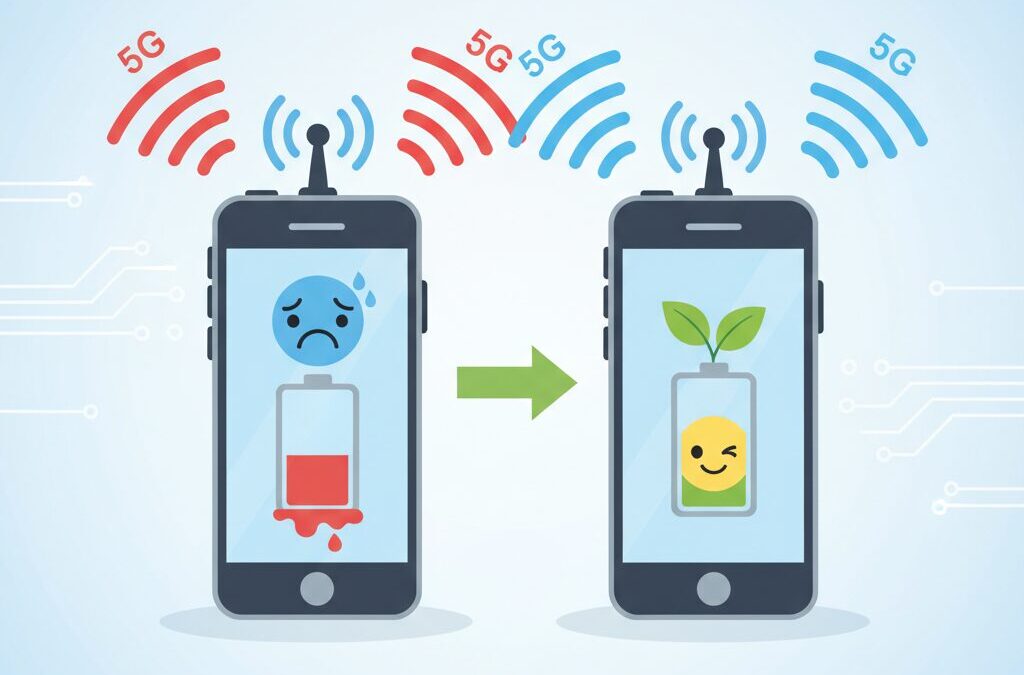
Have you ever switched on 5G, enjoyed blazing-fast speeds, and then noticed your battery melting away faster than expected? You are not alone, and this frustration has been widely shared among gadget enthusiasts around the world.
For years, 5G has carried a reputation for being powerful but power-hungry. Early smartphones struggled to balance ultra-fast data rates, complex radio systems, and already-limited battery capacities. As a result, many users were left wondering whether 5G was truly worth the trade-off.
However, the story is changing rapidly. Thanks to advances in modem design, semiconductor manufacturing, network architecture, and even AI-driven power control, modern smartphones are far more efficient than their predecessors. In some cases, the battery gap between 5G and 4G has become surprisingly small.
In this article, you will learn why 5G originally consumed more power, how real-world data from iPhones and Android flagships reveals a clear turning point, and what practical strategies you can use to extend battery life without giving up performance. By understanding what is happening under the hood, you can make smarter choices about devices, settings, and networks—and finally enjoy 5G without battery anxiety.
- The Fundamental Reason 5G Uses More Power Than 4G
- NSA vs SA: How Network Architecture Impacts Battery Life
- High Frequencies, Cell Edges, and the Hidden Cost of Signal Hunting
- Modern Modems and Chipsets: Why New Phones Last Longer
- Power-Saving Protocols Inside 5G You Never See
- Real-World Battery Data from iPhone and Android Flagships
- Is the Battery Gap Between 5G and 4G Finally Shrinking?
- Advanced Battery Optimization Tips for Power Users
- What 5G Advanced, RedCap, and 6G Mean for Future Battery Life
- 参考文献
The Fundamental Reason 5G Uses More Power Than 4G
When people notice that their smartphones drain faster on 5G than on 4G, the most fundamental reason is not higher speed itself, but the way early and current 5G networks are structurally built. In many regions, including major markets, 5G has been deployed primarily using a Non-Standalone architecture, which inherently places a heavier power burden on user devices.
In an NSA environment, a smartphone does not truly switch from 4G to 5G. Instead, it maintains simultaneous connections to both technologies. Control signaling continues to rely on LTE, while high-speed data is delivered over 5G New Radio. **This dual connectivity means the modem, RF front-end, and power amplifiers must stay active for two radio systems at the same time**, even when the user is performing a simple task such as scrolling a webpage.
| Architecture | Active Radio Links | Impact on Device Power |
|---|---|---|
| 4G LTE | LTE only | Single modem and RF chain |
| 5G NSA | LTE + 5G NR | Dual modem activity and signaling |
| 5G SA | 5G NR only | Simplified signaling and lower baseline load |
According to Samsung’s technical white papers on 5G architecture, this EN-DC setup was designed to accelerate network rollout rather than maximize handset efficiency. As a result, devices must constantly monitor two sets of channels, manage frequent handovers, and keep multiple baseband processes alive. **Even in standby or light-use scenarios, the baseline power consumption is already higher than with pure LTE**.
This effect becomes more pronounced when signal conditions are imperfect. If 5G coverage fluctuates, the device repeatedly negotiates between LTE and NR, triggering additional signaling exchanges. Ericsson’s network studies have shown that signaling complexity directly translates into increased energy usage on the user equipment side, particularly during mobility or cell-edge situations.
Another fundamental factor is that NSA often pairs wide-area LTE coverage with higher-frequency 5G bands. When the 5G signal weakens, the handset compensates by boosting uplink transmit power while still maintaining the LTE anchor. **From a battery perspective, this is equivalent to running two engines instead of one**, which explains why early 5G phones gained a reputation for poor endurance.
By contrast, Standalone 5G fundamentally changes this equation. With both control and data handled entirely by 5G, the device can power down LTE circuitry and simplify radio management. Industry reports from Ericsson indicate that SA networks reduce unnecessary signaling and allow terminals to remain in low-power states more effectively. However, since SA coverage is still expanding, many users continue to experience the structural inefficiencies of NSA today.
In other words, 5G is capable of being energy-efficient, and in terms of energy per transmitted bit, it can outperform 4G. The problem lies in the transitional design choices made to ensure backward compatibility. Until NSA is fully phased out, smartphones are politely but persistently asked to do more work in the background, and the battery pays the price.
NSA vs SA: How Network Architecture Impacts Battery Life
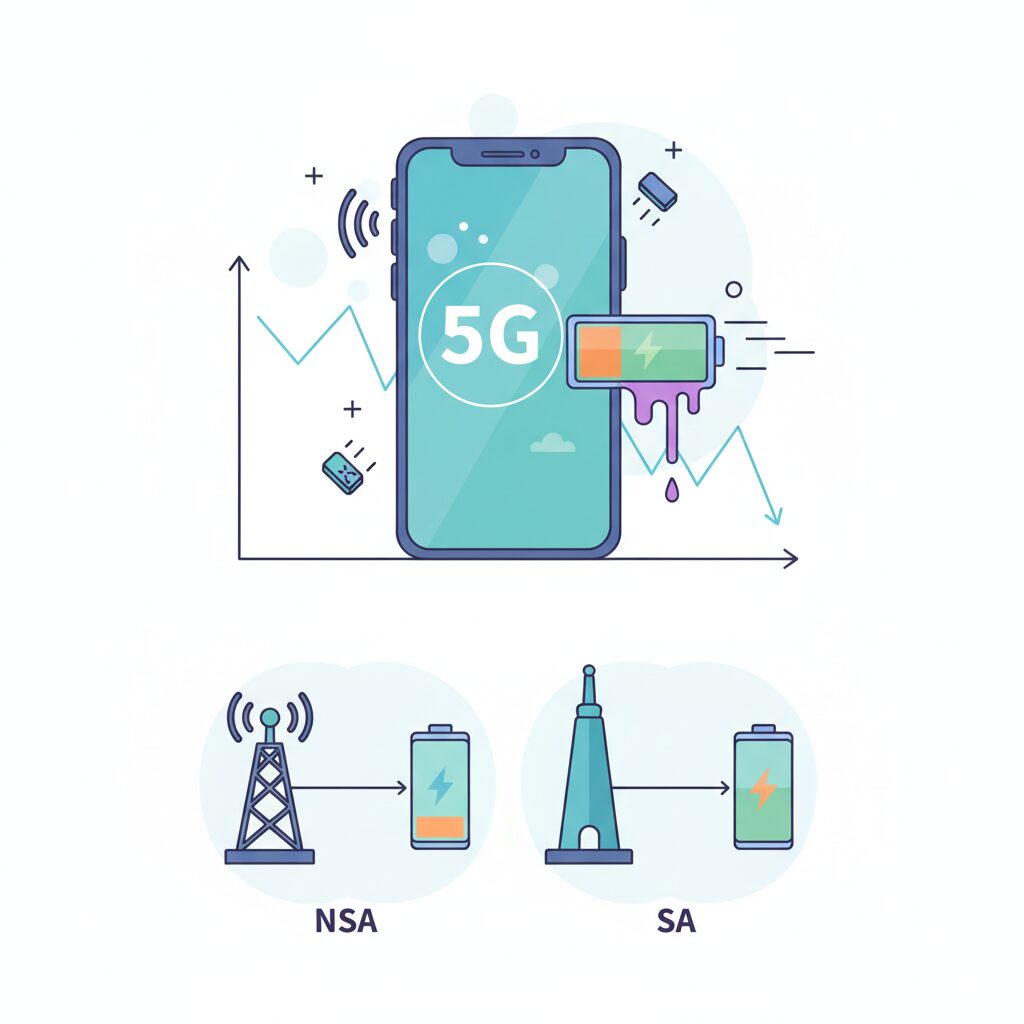
When discussing 5G battery life, the difference between NSA and SA architectures cannot be overstated. **Network architecture directly determines how many radios, signal paths, and control processes a device must keep active**, and this structural choice has a measurable impact on everyday battery drain. For gadget enthusiasts who closely monitor screen-on time and idle consumption, NSA versus SA often explains why two phones on the same network can behave very differently.
NSA, or Non-Standalone, relies on an LTE core network while adding 5G NR mainly for data transmission. In practice, this means the smartphone must maintain simultaneous connections to both LTE and 5G. According to Samsung’s 5G Standalone Architecture technical white paper, the device keeps dual radio access technologies active at the same time, including separate RF chains and baseband processing. **This dual connectivity creates a constant power overhead**, even when the user is not actively transferring large amounts of data.
From a battery perspective, the most critical issue is that LTE continues to handle control signaling in NSA. The phone must constantly listen for LTE control messages while also monitoring 5G data channels. Ericsson has pointed out in its network energy studies that this duplicated signaling increases baseline power consumption in both idle and active states. The result is familiar to early 5G users: faster speeds, but noticeably shorter battery life during mixed or standby usage.
| Aspect | NSA (Non-Standalone) | SA (Standalone) |
|---|---|---|
| Core network | LTE EPC | 5G Core (5GC) |
| Active radio systems | LTE + 5G simultaneously | 5G only |
| Battery efficiency | Lower due to dual signaling | Higher with simplified signaling |
SA, or Standalone, changes this equation fundamentally. Control and data planes are both handled entirely by 5G NR, allowing the device to deactivate LTE radios when they are not needed. Ericsson reports that this simplification reduces signaling complexity and lets smartphones monitor only a single radio access technology. **Fewer active components translate directly into lower power draw**, especially during background tasks and light usage.
Real-world measurements support this architectural advantage. The GTI 5G Device Power Consumption White Paper shows that NSA operation can increase power demand by roughly 10 percent compared with SA in certain uplink-heavy scenarios, particularly near the cell edge. This difference becomes visible over a full day of mixed usage, where SA-capable networks consistently deliver longer standby and browsing times.
For users, the key takeaway is that battery life on 5G is not determined by speed alone. **Whether a network runs on NSA or SA quietly shapes how efficiently a smartphone can manage its radios**. As more operators transition to SA and expand coverage, the long-standing perception that “5G drains the battery” continues to weaken, not because phones are larger, but because the network itself has finally become more power-aware.
High Frequencies, Cell Edges, and the Hidden Cost of Signal Hunting
High-frequency spectrum is one of the defining features of 5G, and it is also one of the most misunderstood causes of battery drain. While faster speeds are often highlighted, the less visible reality is that higher frequencies fundamentally change how a smartphone must behave to stay connected. This effect becomes most severe at cell edges, where signal strength is marginal and the device is forced into energy‑intensive survival mode.
From a physics standpoint, radio waves at higher frequencies suffer greater path loss and weaker diffraction. According to established propagation models referenced by Ericsson and other major network vendors, a Sub‑6 GHz 5G signal at around 3.7 GHz attenuates noticeably faster than a 4G signal in the 800 MHz range, even over the same distance. As a result, **a phone that appears “within coverage” may still experience a fragile link**, especially indoors or near large structures.
| Scenario | Radio Behavior | Battery Impact |
|---|---|---|
| Strong mid‑band 5G | Low uplink power, stable scheduling | Moderate consumption |
| Cell edge Sub‑6 | Near‑max uplink power, retries | High drain |
| mmWave boundary | Frequent beam search and switching | Very high drain |
When a device operates near the cell edge, it compensates by increasing uplink transmit power. This is not a linear adjustment. Power amplifiers become dramatically less efficient as they approach their upper limits, which means **each additional dB of transmit power can cost disproportionately more battery energy**. GTI’s device power consumption analysis reports that in NSA environments, high‑power user equipment behavior can increase power draw by roughly 10 percent compared to SA under similar conditions.
The situation becomes even more demanding with millimeter‑wave deployments. Unlike lower bands, mmWave relies on continuous beamforming using multiple antenna elements. The phone must constantly evaluate beam quality, adjust phase alignment, and switch beams as the user moves or even changes grip. Qualcomm and Ericsson research both indicate that this beam management overhead becomes especially costly at cell boundaries, where beams break more easily and must be rediscovered repeatedly.
The hidden cost is not speed, but persistence. When a phone struggles to maintain a usable link, it keeps searching, retrying, and negotiating, even if no meaningful data is transferred.
This explains a common user complaint: the battery drains rapidly even when the phone is idle and no apps are actively used. In weak 5G conditions, the modem remains busy performing measurement reports, cell reselection checks, and beam tracking. Industry documentation from Samsung and Ericsson both emphasize that these background radio activities can dominate power consumption when the link is unstable.
In practical terms, high frequencies magnify the penalty of being in the wrong place. A café near a base station may feel efficient, while a desk ten meters deeper inside a building may silently trigger worst‑case power behavior. Understanding this dynamic helps explain why some users see dramatic battery differences simply by changing rooms or commuting routes. The technology is working as designed, but **the energy cost of signal hunting at the edge is the price users pay for high‑frequency performance**.
Modern Modems and Chipsets: Why New Phones Last Longer
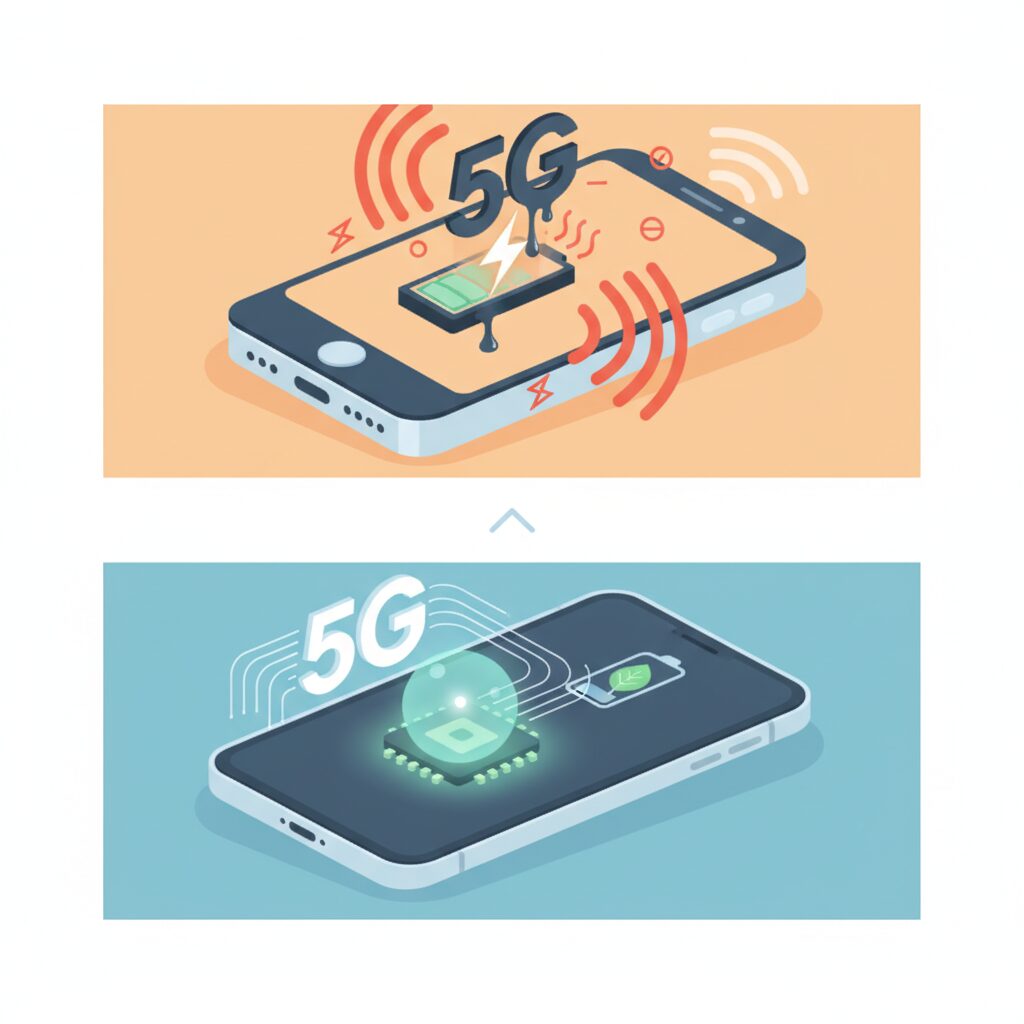
Modern smartphones tend to last longer on a single charge largely because the modem and chipset at their core have fundamentally evolved. Early 5G phones relied on discrete modems built on relatively coarse manufacturing processes, which meant higher leakage current, more heat, and inefficient coordination with the application processor. **Today’s integrated modem-RF systems have changed that equation in a very measurable way.**
Flagship chipsets such as Qualcomm’s Snapdragon 8 Gen 2 and Gen 3 or MediaTek’s Dimensity 9200 integrate the 5G modem directly into the SoC and are manufactured on advanced 4 nm or even 3 nm nodes. According to analyses based on Ookla’s Speedtest Intelligence data, devices using Snapdragon 8 Gen 2 recorded a 5G battery drain rate of around 31%, significantly lower than earlier generations. This narrowing gap between 4G and 5G power consumption illustrates how silicon-level efficiency now offsets much of the radio’s historical power penalty.
Another major shift is the introduction of AI-assisted modem control. Qualcomm’s Snapdragon X70 and X75 modem-RF systems embed dedicated AI processors that continuously optimize antenna tuning, beam tracking, and link selection. Qualcomm’s technical documentation explains that these systems dynamically close unnecessary receive windows and extend sleep cycles without degrading throughput. In practical terms, this means the phone spends less time in high-power transmit states, especially in challenging 5G environments.
| Generation | Modem Design | Typical Impact on Battery |
|---|---|---|
| Early 5G (2019–2020) | Discrete modem, 7 nm | High drain, noticeable heat |
| Current flagship | Integrated modem, 4–3 nm | Lower drain, stable thermals |
MediaTek has followed a similar path, with independent tests showing the Dimensity 9200 achieving a 5G drain rate in the mid-30% range, a dramatic improvement over its predecessors. Even Apple benefits from this industry-wide progress, as tighter integration between its custom silicon and modem firmware has contributed to longer cellular runtimes in recent iPhone generations.
In short, **new phones last longer not because batteries suddenly improved, but because modern modems became smarter, smaller, and more tightly integrated.** This silent revolution in chipset design is one of the most important, yet least visible, reasons why using 5G no longer automatically means sacrificing battery life.
Power-Saving Protocols Inside 5G You Never See
When people talk about 5G battery drain, they often blame radios or frequencies, but a large part of the story lives deep inside the protocol stack. **Modern 5G devices constantly negotiate when to listen, when to sleep, and how little circuitry needs to stay awake**, all without the user ever noticing. These invisible rules are defined by the 3GPP standards and have evolved rapidly since Release 15.
One of the most important mechanisms is Connected Mode Discontinuous Reception, or C‑DRX. Even while a phone is technically “connected,” data does not flow continuously. C‑DRX exploits these micro-gaps by letting the receiver power down between short monitoring windows. Ericsson’s technical analyses show that properly tuned C‑DRX cycles can cut active radio time dramatically during messaging, social feeds, or background sync, without breaking responsiveness.
| Protocol Feature | Main Purpose | Battery Impact |
|---|---|---|
| C‑DRX | Periodic receiver sleep in connected state | Lower baseline power during light traffic |
| WUS | Ultra‑low‑power pre‑wake check | Fewer unnecessary wake‑ups |
Release 16 introduced an even more surgical tool: Wake‑Up Signal. Instead of waking the full receiver just in case data arrives, the device listens for a tiny, low‑power cue. **Only when this signal is detected does the main modem wake up**. Rohde & Schwarz measurements indicate that this approach significantly improves standby efficiency, especially for devices that receive data infrequently.
What makes these protocols powerful is coordination. Network and device continuously adapt timers, sleep depth, and bandwidth usage based on real traffic patterns. Qualcomm explains that newer modems combine these standards with on‑chip intelligence, closing receive windows that are statistically unlikely to carry data. The result is not a single breakthrough, but thousands of tiny savings per hour that quietly make 5G practical for all‑day use.
Real-World Battery Data from iPhone and Android Flagships
When looking beyond lab benchmarks, real‑world battery behavior on flagship iPhones and Android devices tells a more nuanced story. Daily usage in 5G environments combines variable signal strength, screen brightness, background sync, and mobility, and this is where differences between platforms become visible. According to large‑scale user tests aggregated by Ookla and community measurements discussed by Apple analysts, **modern flagships no longer suffer from the extreme 5G drain seen in early deployments**, but meaningful gaps still remain.
On the iPhone side, recent generations show steady progress driven by tighter hardware–software integration. Community tests under harsh conditions such as maximum brightness and continuous cellular connectivity indicate that larger models maintain a clear advantage. This is not only about battery size, but also about Apple’s aggressive modem scheduling and OS‑level traffic batching, which reduce unnecessary wake‑ups during idle moments.
| Device | Typical 5G Screen‑On Time | Observed Trend |
|---|---|---|
| iPhone 16 Plus | ~8h 50m | Best endurance in lineup |
| iPhone 16 Pro Max | ~8h 28m | Stable drain under load |
| iPhone 16 Pro | ~6h | Capacity‑limited |
Android flagships show wider variance, largely determined by the SoC and modem generation. Ookla’s Speedtest Intelligence analysis highlights Snapdragon 8 Gen 2 devices as particularly efficient, with a **5G drain rate close to 4G usage**, something unthinkable just two years ago. MediaTek’s Dimensity 9200 follows closely, confirming that process node shrink and modem integration matter more than brand loyalty.
By contrast, Google’s Tensor‑based Pixels demonstrate how optimization priorities shape outcomes. While video playback endurance can be excellent, users and reviewers consistently report faster battery loss during sustained 5G connectivity. This aligns with expert commentary noting that Tensor platforms still trail Qualcomm in modem power efficiency, despite improvements in newer revisions.
The broader implication is important for enthusiasts. **Real‑world battery life is no longer dictated by 5G itself, but by how intelligently each flagship manages the radio stack under imperfect network conditions**. As SA coverage expands and modem designs mature, the remaining differences increasingly reflect engineering philosophy rather than unavoidable 5G penalties.
Is the Battery Gap Between 5G and 4G Finally Shrinking?
For years, many users have felt that switching from 4G to 5G inevitably meant sacrificing battery life, and that perception was not without reason. Early 5G deployments relied heavily on NSA architecture, forcing smartphones to keep both LTE and 5G radios active. However, recent data suggests that this long-standing battery gap is finally narrowing in a meaningful way, especially on modern flagship devices.
One of the clearest indicators comes from large-scale real-world measurements rather than lab benchmarks. According to an analysis by Ookla using Speedtest Intelligence data, devices powered by newer chipsets such as Snapdragon 8 Gen 2 show a 5G battery drain rate of about 31%, compared to roughly 25% on 4G. A gap of around six percentage points may sound significant, but it is dramatically smaller than what users experienced just a few generations ago.
| SoC Generation | 4G Drain Rate | 5G Drain Rate |
|---|---|---|
| Snapdragon 8 Gen 1 | 32% | Higher than 4G by double digits |
| Snapdragon 8 Gen 2 | 25% | 31% |
This improvement is not accidental. Semiconductor advances such as modem integration into the SoC, migration to 4 nm and 3 nm processes, and smarter power management have all contributed. Qualcomm, for example, explains that its newer modem-RF systems dynamically adjust antenna tuning and sleep cycles using on-device AI, reducing wasted power during idle or low-traffic periods.
Another often-overlooked factor is network-side maturity. As operators gradually expand Standalone 5G and refine features like optimized C-DRX, devices spend less time in high-power states. Ericsson has pointed out that simplified signaling in SA networks allows terminals to monitor only a single radio access technology, which directly translates into lower baseline consumption.
The practical takeaway is that for many users, the “5G equals bad battery” narrative is becoming outdated. On a modern phone, the difference between staying on 4G all day and using 5G normally may amount to minutes rather than hours. In some cases, faster 5G transfers even complete tasks sooner, letting the modem return to sleep earlier than a slower 4G connection would allow.
While older devices and fringe coverage areas can still exaggerate the gap, the trend is clear. With current hardware and more mature networks, 5G is no longer the battery villain it once was, and the gap with 4G is shrinking to a level that many users will barely notice in daily use.
Advanced Battery Optimization Tips for Power Users
For power users who actively rely on 5G performance, battery optimization is no longer about simple toggles but about understanding how the modem, network, and OS interact in real time. Advanced optimization focuses on reducing unnecessary radio activity while preserving throughput when it truly matters. This approach is supported by findings from Qualcomm and Ericsson, which show that modern 5G devices are most efficient when transmission bursts are short, predictable, and thermally stable.
One of the most effective techniques is managing how the device behaves at the cell edge. When signal quality fluctuates, smartphones repeatedly increase uplink transmission power and retry failed packets, which sharply increases energy draw. According to GTI’s device power consumption white paper, HPUE operation can raise battery demand by more than 10 percent in NSA environments. Power users who identify such locations can deliberately fall back to LTE, reducing modem retries and stabilizing power usage without sacrificing usability.
| Network State | Typical Modem Behavior | Battery Impact |
|---|---|---|
| Stable 5G SA | Single RAT, optimized DRX | Low to moderate drain |
| 5G NSA at cell edge | Dual connectivity, HPUE | High drain |
| Forced LTE | Single RAT, stable uplink | Moderate but predictable |
Another advanced lever is exploiting modem-side intelligence. Qualcomm’s Snapdragon X70 and X75 platforms integrate AI-assisted power control that dynamically tunes antenna matching and beam tracking. Ookla’s Speedtest Intelligence analysis shows that devices using Snapdragon 8 Gen 2 achieved a 5G battery drain rate of roughly 31 percent, narrowing the gap with LTE to only six points. This demonstrates that hardware-aware scheduling, not raw capacity, is now the dominant factor.
Power users can amplify these gains by reducing background wakeups that interfere with C-DRX and WUS behavior. 3GPP Release 16 introduced Wake-Up Signal precisely to avoid needless receiver activation, but frequent background syncs negate its benefits. Google’s Android power management documentation explains that aggressive background limits allow the modem to remain in deep sleep states longer, which is especially valuable on always-connected 5G links.
Thermal control is another often overlooked optimization layer. Sustained 5G downloads or tethering sessions raise modem temperature, and lithium-ion batteries lose efficiency under heat stress. Apple and Google both note in their platform guidance that elevated temperature increases internal resistance, accelerating drain. Removing insulating cases during heavy 5G usage and avoiding simultaneous fast charging can materially extend runtime, particularly on compact devices.
Finally, advanced users should view battery optimization as a system-level strategy rather than a single setting. Ericsson’s energy modeling research emphasizes that predictable traffic patterns allow networks and devices to coordinate sleep cycles more efficiently. By consciously batching data-heavy tasks and avoiding constant low-level activity, users align their behavior with how modern 5G power-saving mechanisms are designed to work.
What 5G Advanced, RedCap, and 6G Mean for Future Battery Life
When people hear about 5G Advanced, RedCap, and even 6G, they often imagine faster speeds and futuristic applications, but the more important story for everyday gadgets is battery life. **The next phases of mobile standards are explicitly designed to fix the energy inefficiencies that early 5G exposed**, and this shift is already visible at the specification level.
5G Advanced, defined from 3GPP Release 18 onward, places AI-driven optimization at the center of radio control. According to 3GPP working documents and vendor analyses from Ericsson and Qualcomm, networks will predict user behavior and traffic demand in advance, allowing devices to stay in deep sleep states longer. Instead of reacting to traffic bursts, smartphones can wake up only when data is truly needed, reducing idle power drain that historically accounted for a large share of battery loss.
| Technology | Main Target | Battery Impact |
|---|---|---|
| 5G Advanced | Smartphones, AR devices | Lower idle and signaling power |
| RedCap | Wearables, IoT | Multi-day to multi-week operation |
| 6G (concept) | All device classes | Ultra-low or energy-neutral use |
RedCap, also known as NR-Light, takes a different but equally important approach. By intentionally limiting bandwidth, antenna count, and peak data rates, RedCap devices avoid the constant high-power states required by full 5G. Industry testing summarized by 3GPP contributors shows that RedCap can cut modem power consumption by several tens of percent compared to standard 5G NR. **This is why future smartwatches and AR glasses can adopt cellular connectivity without sacrificing all-day or even multi-day battery life**.
Looking further ahead, 6G research reframes the problem entirely. Academic and industry groups, including initiatives referenced by major telecom vendors, are exploring energy-harvesting radios and extreme sleep-state efficiency. The goal is not merely longer battery life, but devices that consume so little power that ambient energy sources meaningfully extend operation time. **In this context, today’s 5G battery challenges are becoming the training ground for a fundamentally more sustainable wireless era**.
For gadget enthusiasts, this means future upgrades will not force a trade-off between speed and endurance. Instead, each generational step is expected to deliver connectivity that feels both faster and quieter in terms of energy use, redefining what “always connected” truly means.
参考文献
- Samsung:5G Standalone Architecture Technical White Paper
- Ericsson:Breaking the Energy Curve: Network Energy Consumption Modeling
- Ookla:Combating 5G Battery Drain Concerns
- Qualcomm:Snapdragon X70 Modem-RF System Product Brief
- Rohde & Schwarz:Power Saving Techniques for User Equipment
- PCMag:Qualcomm’s Latest 5G Modem Blends More Airwaves to Boost Upload Speeds