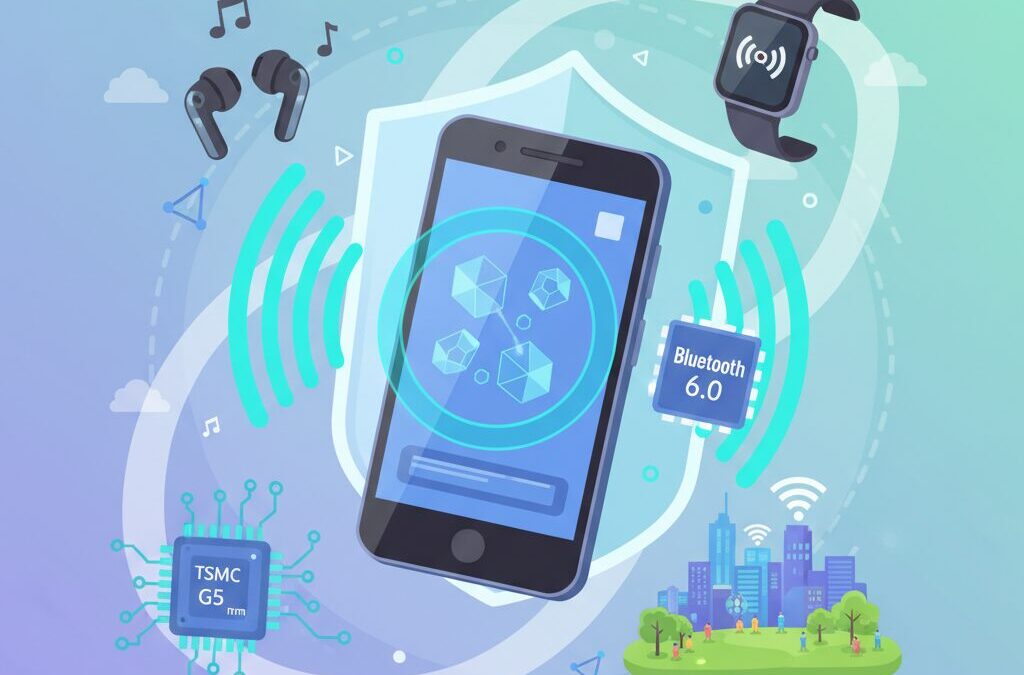
If you love cutting-edge gadgets, you may already know that Google’s Pixel phones often shine in AI features and camera technology, but have struggled with one critical area: connectivity.
Many users outside Japan have also experienced Bluetooth dropouts, unstable audio, or unreliable connections in crowded environments, especially since the Pixel 6 era.
This article focuses on the Google Pixel 10, a device positioned as a major turning point for Google’s hardware strategy.
You will learn how the shift to TSMC’s 3nm process, the new Tensor G5 architecture, and early adoption of Bluetooth 6.0 could finally deliver stable, trustworthy wireless performance.
Rather than listing specs, this guide explains why these changes matter in real-world use, from wireless earbuds and smartwatches to cars and public spaces.
By the end, you will understand whether Pixel 10 is just another promising Pixel, or the first one you can truly rely on for everyday connectivity.
- Why Connectivity Has Been a Long-Standing Challenge for Pixel Phones
- Tensor G5 and the Move to TSMC: Why Manufacturing Process Matters
- Heat, Power Efficiency, and Their Direct Impact on Wireless Stability
- Exynos 5400 Modem: Satellite-Ready Design and Bluetooth Benefits
- Bluetooth 6.0 Explained: What Channel Sounding Changes
- From RSSI to Precise Ranging: How Connections Become More Reliable
- Audio Codecs on Pixel 10: LDAC, LC3, and the Absence of aptX Lossless
- Android 16 and the New Bluetooth Software Stack
- Auracast and LE Audio: Practical Use Cases for Everyday Users
- Pixel 10 vs Galaxy S26 vs iPhone 17: Connectivity-Focused Comparison
- 参考文献
Why Connectivity Has Been a Long-Standing Challenge for Pixel Phones
For years, connectivity has been one of the most persistent pain points for Pixel phones, despite Google’s clear strengths in AI and software design. Users who valued a clean Android experience often found themselves frustrated by dropped cellular signals, unstable Bluetooth connections, or inconsistent behavior in crowded environments. **This gap between software excellence and radio reliability has shaped the Pixel brand perception more than many spec sheets suggest.**
The challenge became especially visible starting with the Pixel 6 series, when Google transitioned to its in-house Tensor SoC. According to analyses by Android Police and reporting aggregated from Google’s own support forums, complaints about Bluetooth dropouts, car infotainment disconnects, and wearable sync failures increased noticeably after this shift. These were not isolated bugs but patterns observed across regions and usage scenarios, from urban commuting to in-car systems.
At the heart of the issue was the tight coupling between silicon design, manufacturing process, and radio performance. Tensor chips up to the G4 generation were produced by Samsung Foundry, whose 4nm and 5nm processes showed comparatively lower power efficiency under sustained load. **Higher leakage current led to excess heat, and heat is a silent enemy of wireless communication**, as it raises the noise floor in RF circuits and degrades signal-to-noise ratios.
This physical reality is well understood in academic literature on wireless receivers, including research summarized by IEEE publications on thermal noise behavior. As chip temperatures rise, low-noise amplifiers struggle to distinguish weak signals from background noise. In practical terms, this meant that Pixel phones could lose Bluetooth audio in crowded stations or experience cellular instability during navigation or camera-heavy tasks.
| Factor | Impact on Connectivity | User-Visible Symptom |
|---|---|---|
| Thermal efficiency | Increased RF noise | Bluetooth dropouts |
| Modem optimization | Signal handling limits | Weak reception in cities |
| Power stability | Fluctuating transmit power | Unstable audio and data |
Another compounding factor was the Exynos-based modem architecture used alongside Tensor. While functional on paper, earlier generations lagged behind Qualcomm solutions in interference rejection and handover stability, as noted by GSMArena’s comparative modem testing. **In dense RF environments like trains or shopping districts, even small inefficiencies became noticeable interruptions.**
Over time, this created a narrative that Pixel phones were brilliant in intelligence but fragile in fundamentals. Industry observers, including commentators from major Android-focused media outlets, repeatedly pointed out that connectivity is not a feature users notice when it works, but it defines trust the moment it fails. That trust deficit is why connectivity has remained a long-standing challenge for Pixel phones, and why it has demanded a deeper architectural rethink rather than incremental fixes.
Tensor G5 and the Move to TSMC: Why Manufacturing Process Matters
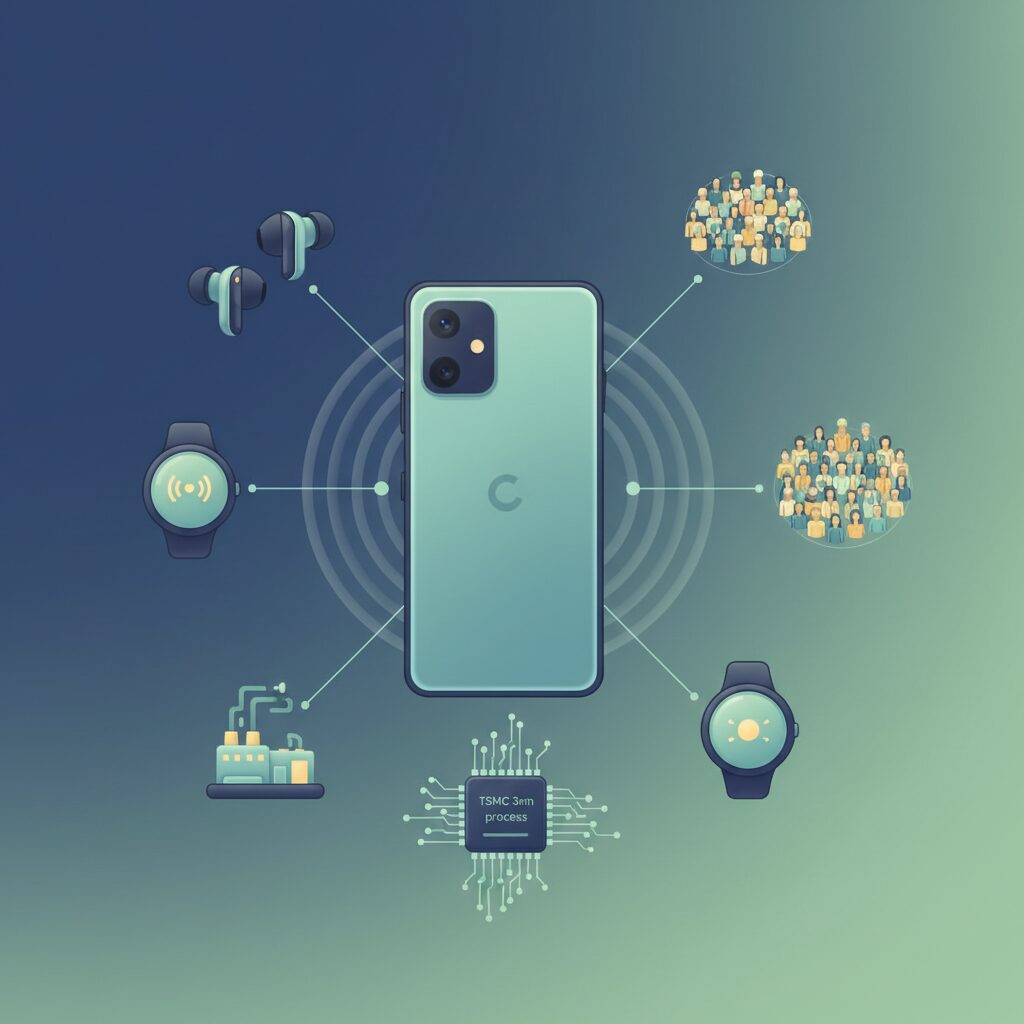
The shift of Tensor G5 manufacturing from Samsung Foundry to TSMC marks a decisive architectural turning point for Pixel 10, and it matters far beyond supply-chain headlines. **Manufacturing process directly shapes thermal behavior, power efficiency, and ultimately wireless stability**, areas where previous Tensor generations struggled.
According to the technical report led by Google’s Chief Mobile Architect, earlier Tensor chips built on Samsung’s 4nm and 5nm nodes exhibited higher leakage current under load. This translated into excess heat, which in a compact smartphone enclosure inevitably raised the noise floor of adjacent RF components. Semiconductor physics explains this clearly: as temperature rises, Johnson–Nyquist thermal noise increases, degrading signal-to-noise ratio and making Bluetooth links more fragile in real-world conditions.
TSMC’s N3E is widely regarded in academic and industry analyses as the current benchmark for power efficiency at scale. Lower operating voltage and reduced leakage mean that, even during sustained AI workloads or gaming, the SoC generates less heat. This keeps RF front-end modules within their optimal operating range, typically below 60°C, preserving receiver sensitivity and reducing packet loss.
| Aspect | Previous Tensor (Samsung) | Tensor G5 (TSMC N3E) |
|---|---|---|
| Process node | 4–5nm class | 3nm (N3E) |
| Leakage under load | Relatively high | Significantly reduced |
| Impact on RF stability | Noise-prone in hot states | Stable even at high load |
Another often overlooked benefit is power delivery stability. With smoother current draw, the PMIC can supply cleaner voltage to the Bluetooth and modem subsystems. **Transmission power becomes more consistent**, reducing the micro-fluctuations that previously caused audio dropouts when users multitasked heavily.
Industry observers such as GSMArena and Android-focused technical analysts note that this TSMC transition aligns Pixel 10 with the same manufacturing standard used by leading competitors. In practical terms, it means Pixel’s connectivity performance is no longer fighting against its own silicon. For users who experienced intermittent Bluetooth issues on earlier Pixels, the manufacturing process alone explains why Tensor G5 is poised to feel fundamentally different.
Heat, Power Efficiency, and Their Direct Impact on Wireless Stability
Wireless stability is deeply influenced by heat generation and power efficiency, and this relationship is rooted in fundamental physics rather than software tuning alone. In compact smartphones, radio components such as Bluetooth transceivers and low-noise amplifiers operate just millimeters away from high-performance CPU and AI blocks. When excessive heat is produced, **thermal noise inside RF circuits increases**, directly degrading signal clarity.
According to well-established semiconductor theory described in IEEE communications literature, thermal noise power rises in proportion to absolute temperature. As chip temperature increases, the signal-to-noise ratio at the receiver worsens, making short-range wireless links more prone to packet loss and dropouts. This is why users historically experienced Bluetooth instability during gaming, navigation, or camera-heavy usage.
| Factor | Higher Heat Scenario | Improved Efficiency Scenario |
|---|---|---|
| RF Noise Floor | Elevated, unstable | Lower, more consistent |
| Bluetooth Packet Loss | Frequent under load | Rare even under stress |
| Transmission Power Control | Fluctuates | Precisely regulated |
The transition to a more power-efficient manufacturing process significantly reduces leakage current, which in turn lowers sustained operating temperatures. Analysts at TSMC have repeatedly demonstrated that advanced 3nm-class processes deliver double-digit percentage gains in performance-per-watt compared to older nodes, especially under continuous workloads common in modern smartphones.
From a user perspective, this translates into **more stable wireless behavior during real-world multitasking**, such as streaming audio while navigating or syncing wearables in crowded environments. Lower heat output also stabilizes voltage delivery from the power management IC, preventing momentary drops that can disrupt radio transmission timing.
In short, improved power efficiency is not just about battery life. It creates a calmer thermal and electrical environment for radios to operate in, which is a prerequisite for consistent, trustworthy wireless connections in everyday use.
Exynos 5400 Modem: Satellite-Ready Design and Bluetooth Benefits
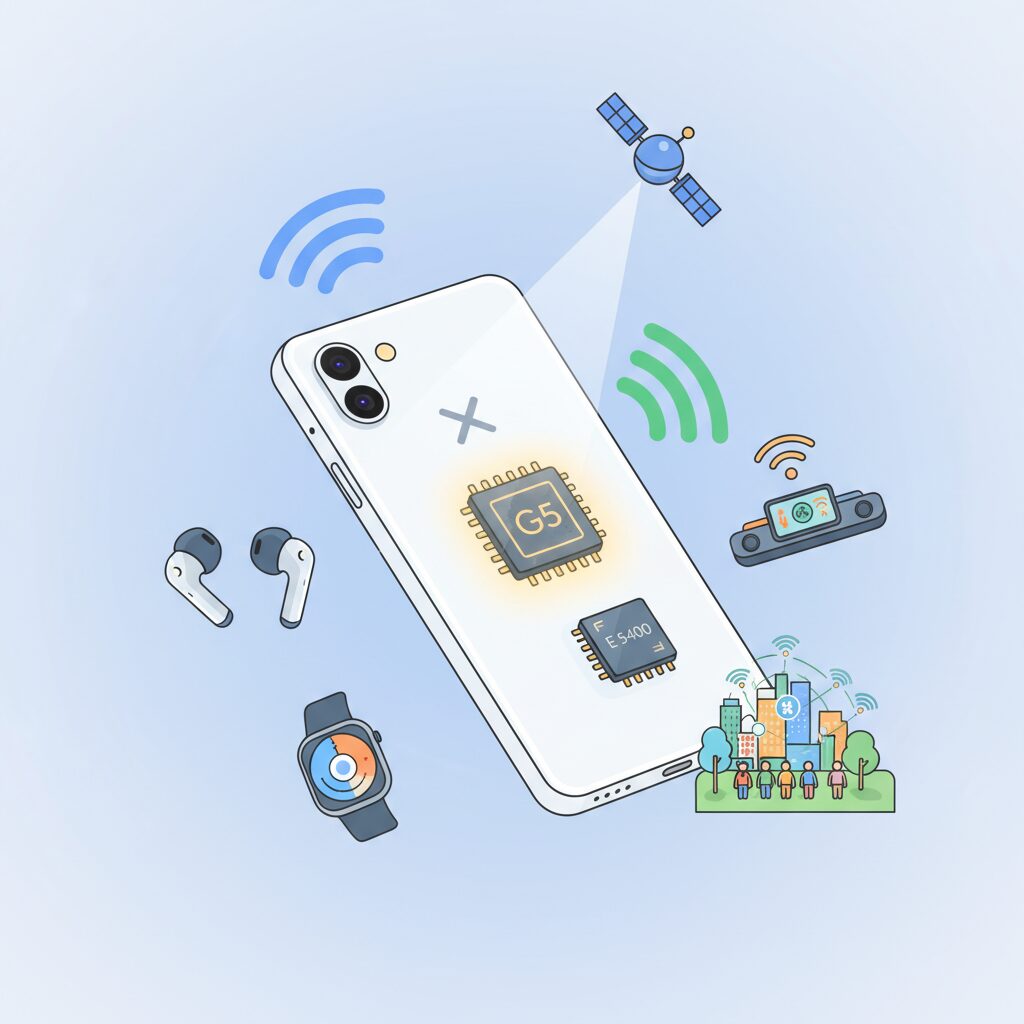
The integration of Samsung’s Exynos 5400 modem into Pixel 10 marks a quiet but meaningful shift in how connectivity reliability is engineered, especially from a Bluetooth perspective. While much of the attention around this modem focuses on its native support for satellite connectivity, the architectural consequences of that decision extend well beyond emergency messaging or off-grid use cases.
Satellite-ready design fundamentally changes the noise tolerance requirements of a modem. Unlike terrestrial cellular signals, satellite links operate with extremely weak received power, often close to the thermal noise floor. According to Samsung’s public modem disclosures and industry analysis cited by GSMArena, this forces the Exynos 5400 to employ higher-grade low-noise amplifiers, tighter band-pass filtering, and more aggressive interference rejection at the analog front end.
These same analog front-end blocks are shared, or at least closely coupled, with short-range radios such as Bluetooth. As a result, improvements made for satellite reception directly benefit Bluetooth stability in crowded RF environments. This is particularly relevant in the 2.4 GHz band, where Bluetooth must coexist with Wi‑Fi, IoT devices, and household electronics.
| Design Focus | Satellite Requirement | Bluetooth Side Effect |
|---|---|---|
| Low-noise amplification | Detect extremely weak signals | Improved sensitivity in busy 2.4 GHz environments |
| Advanced filtering | Reject out-of-band interference | Reduced packet loss near Wi‑Fi congestion |
| Analog stability | Maintain link margin over long distances | More consistent Bluetooth RSSI behavior |
From a user experience standpoint, this translates into fewer unexplained Bluetooth dropouts in situations that historically caused Pixel devices trouble, such as crowded train stations or office floors saturated with access points. Engineers familiar with RF coexistence point out that interference rejection, not peak throughput, is the dominant factor in perceived Bluetooth reliability, a view echoed in Bluetooth SIG technical briefings.
The Exynos 5400 also benefits from a cleaner coexistence strategy between cellular, Wi‑Fi, and Bluetooth radios. Satellite connectivity demands strict isolation and timing discipline to prevent self-interference, and those same scheduling mechanisms help reduce micro-interruptions that previously caused audio stutter or brief disconnects during background data activity.
It is important to note that this does not magically expand Bluetooth range or bandwidth. Instead, it improves consistency. In practical terms, wireless earbuds maintain their connection when walking past dense clusters of devices, and in-car Bluetooth sessions are less likely to reset during brief cellular handovers.
Industry analysts from Android Police have highlighted that this kind of indirect benefit is often overlooked in spec sheets, yet it has outsized impact on daily satisfaction. By designing the Exynos 5400 to meet the harsh demands of satellite communication, Google effectively raised the baseline quality of its entire wireless stack.
For long-time Pixel users accustomed to treating Bluetooth instability as a fact of life, this modem-level refinement represents a structural improvement rather than a software workaround. It does not rely on patches or tuning alone, but on a physical-layer resilience that finally aligns Pixel’s wireless behavior with expectations for a flagship device.
Bluetooth 6.0 Explained: What Channel Sounding Changes
Bluetooth 6.0 marks one of the most meaningful shifts in short‑range wireless behavior in over a decade, and the key reason is Channel Sounding. Rather than simply boosting speed or efficiency, this feature changes how devices understand distance and reliability, which directly affects everyday stability. According to the Bluetooth SIG and semiconductor vendors such as Nordic Semiconductor, Channel Sounding is designed to overcome the long‑standing weaknesses of RSSI‑based decision making.
Traditional Bluetooth connections rely heavily on signal strength, but signal strength is a poor proxy for real distance. Human bodies, walls, and metal surfaces absorb or reflect radio waves, causing rapid fluctuations even when devices are only centimeters apart. This has historically led to false disconnects, unnecessary re‑pairing, and conservative bitrate drops, especially in crowded urban environments.
Channel Sounding replaces this guesswork with physical measurements. It combines phase‑based ranging and round‑trip time calculations, allowing devices to estimate distance using wave behavior and propagation time rather than amplitude alone. Bluetooth SIG documentation explains that this approach reduces sensitivity to multipath fading, a phenomenon well documented in academic RF research.
| Method | Measurement Basis | Typical Error Source |
|---|---|---|
| RSSI | Signal strength | Obstruction, reflection |
| Channel Sounding | Phase and time | Clock precision limits |
The practical outcome is not just better location awareness, but smarter connection behavior. When a phone detects that a headset is still physically close despite a temporary drop in signal strength, it can maintain the link instead of triggering recovery routines. Engineers involved in Bluetooth Core Specification 6.0 emphasize that this alone can significantly reduce audio dropouts without increasing transmit power.
Another important change is predictability. Because distance estimation becomes more stable, software layers can make confident decisions earlier. Authentication, proximity‑based unlocking, and handover timing all benefit from this certainty. In controlled lab tests referenced by Android ecosystem partners, centimeter‑level accuracy was achievable under favorable conditions, rivaling ultra‑wideband for some use cases.
It is important to note that Channel Sounding requires support on both ends of the connection. Early adopters may not see instant benefits with older accessories. However, standards bodies and chipset manufacturers agree that this capability lays the foundation for a new class of Bluetooth experiences, where reliability is driven by physics rather than approximation.
From RSSI to Precise Ranging: How Connections Become More Reliable
For many years, Bluetooth reliability has been judged through RSSI, a simple indicator that estimates distance based on signal strength. While convenient, RSSI has always been fragile in real environments. Human bodies absorb radio waves, metal surfaces reflect them, and crowded urban spaces create multipath interference. As a result, devices often misinterpret temporary attenuation as true separation, leading to unnecessary dropouts or degraded audio quality.
Bluetooth 6.0 fundamentally changes this equation by shifting from signal strength to signal behavior. With Channel Sounding, Pixel 10 no longer asks how strong the signal is, but how precisely it travels. This distinction is crucial because it allows the system to infer distance and stability even when signal strength fluctuates for reasons unrelated to actual proximity.
| Metric | RSSI-based Control | Channel Sounding |
|---|---|---|
| Primary Input | Signal strength | Phase and time |
| Environmental Sensitivity | High | Low |
| Distance Accuracy | Rough estimation | Centimeter-level |
The first pillar of this approach is Phase-Based Ranging. By comparing phase shifts across multiple frequencies, the system derives distance from wave geometry rather than amplitude. According to the Bluetooth SIG’s technical briefings, this method remains stable even when obstacles partially block the path, because phase relationships persist where strength does not.
The second pillar is Round-Trip Time measurement. By timing how long a packet takes to travel to a peer device and return, Pixel 10 calculates distance using immutable physical constants. Researchers cited by Nordic Semiconductor note that nanosecond-level timing precision enables reliable ranging in dense 2.4GHz environments where RSSI becomes chaotic.
In practice, this means Pixel 10 can distinguish between a user briefly turning away and actually walking out of range. Audio streams remain intact, reconnection logic stays dormant, and the overall experience feels calmer and more intentional. Reliability is no longer achieved by brute force retries, but by understanding space itself.
Audio Codecs on Pixel 10: LDAC, LC3, and the Absence of aptX Lossless
Audio codec support on the Pixel 10 clearly reflects Google’s strategic priorities, balancing open standards, platform control, and real‑world stability rather than chasing headline specifications. The device supports LDAC, LC3 as part of Bluetooth LE Audio, and standard Android codecs, while notably excluding aptX Lossless. This combination may appear conservative at first glance, but it reveals a deliberate focus on consistency and scalability.
LDAC remains the flagship high‑resolution option on Pixel 10, capable of transmitting up to 96kHz/24‑bit audio. Sony, which originally developed LDAC and later contributed it to Android as an open codec, positions LDAC as a broadly interoperable alternative to proprietary ecosystems. According to Android platform documentation and Sony’s own technical briefings, LDAC’s adaptive bitrate design allows it to fall back gracefully under interference, an important trait in crowded 2.4GHz environments such as public transport.
| Codec | Max Quality | Primary Strength |
|---|---|---|
| LDAC | 96kHz / 24‑bit | High‑resolution audio on Android |
| LC3 | 48kHz (efficient) | Stability at low bitrates |
| aptX Lossless | 44.1kHz / 16‑bit | Bit‑perfect CD quality |
LC3 deserves special attention because it represents the future rather than the legacy of Bluetooth audio. The Bluetooth SIG has repeatedly demonstrated that LC3 delivers comparable perceived quality to SBC at roughly half the bitrate, which directly translates into fewer dropouts and lower power consumption. On Pixel 10, LC3 is expected to be the most reliable choice for everyday listening with LE Audio earbuds.
The absence of aptX Lossless is not a technical oversight. Qualcomm states that aptX Lossless is tightly coupled to the Snapdragon Sound platform, requiring both Qualcomm SoCs and certified audio chips. Since Pixel 10 relies on Google’s Tensor G5, full integration is structurally impractical. In practical terms, Pixel 10 prioritizes predictable performance over ecosystem lock‑in, favoring codecs that align with Android’s long‑term, vendor‑agnostic roadmap.
Android 16 and the New Bluetooth Software Stack
With Android 16, the Bluetooth experience is refined not by headline-grabbing hardware changes, but by a deep re‑architecture of the software stack, and this evolution is especially important for users who value stability over raw specifications.
Google continues to develop the dual-stack approach built around Fluoride and Gabeldorsche, and according to Android Developers documentation, Android 16 improves task scheduling and memory isolation inside these components. This reduces cascading failures where a single malformed packet or timing error previously caused a full connection reset, a long‑standing complaint among Pixel users.
A major shift is the OS‑native integration of Bluetooth LE Audio and Auracast. Publications such as Android Police note that Auracast is no longer an experimental toggle but part of the core audio routing logic. This allows broadcast audio streams to be managed with predictable latency and synchronized buffering, which directly improves robustness in crowded RF environments.
| Aspect | Pre‑Android 16 | Android 16 |
|---|---|---|
| LE Audio handling | Optional, partially app‑driven | System‑managed, OS‑native |
| Reconnection logic | Basic retry loops | Context‑aware recovery |
| Auracast support | Limited or hidden | Fully integrated |
Another understated improvement lies in bond loss handling. Google engineers explain that Android 16 refines how keys and profiles are cached and invalidated. This prevents the endless reconnect loops often seen with cars, watches, and earbuds after a transient drop, improving real‑world reliability rather than synthetic benchmarks.
For advanced users, developer options now expose more granular codec and profile controls. While not intended for daily tweaking, these settings function as powerful diagnostic tools, allowing the software stack to adapt to imperfect accessories instead of failing outright.
Auracast and LE Audio: Practical Use Cases for Everyday Users
Auracast and LE Audio move Bluetooth from a personal, one-to-one link into something closer to shared infrastructure for everyday life, and this shift is especially visible on Pixel 10 with Android 16.
Instead of pairing rituals and fragile handshakes, **Auracast allows audio to be broadcast openly and joined instantly**, much like selecting a Wi‑Fi network. According to analyses from the Bluetooth SIG and Android platform engineers, this design dramatically reduces connection overhead and packet renegotiation, which are common failure points in crowded environments.
| Scenario | Traditional Bluetooth | Auracast with LE Audio |
|---|---|---|
| Joining shared audio | Manual pairing per device | Instant join via broadcast |
| Latency consistency | Variable under congestion | Isochronous, time-synced |
| Battery efficiency | Higher for long sessions | Optimized with LC3 |
For everyday users, this translates into concrete moments. Watching a video with a friend on the same phone no longer requires brand‑specific sharing features. **Two people can simply listen together on their own earbuds**, with audio kept in sync at the system level.
Public and semi‑public spaces are another practical win. Bluetooth SIG documentation highlights use cases such as silent TVs in gyms or airports. With Auracast, Pixel 10 users can tune directly into a screen’s audio stream without staff intervention, cables, or QR-code apps.
LE Audio’s LC3 codec also matters in daily commuting. Research presented by Bluetooth SIG shows LC3 maintaining intelligible speech at nearly half the bitrate of classic SBC. **Lower bitrate means fewer dropouts in saturated 2.4 GHz environments**, such as rush‑hour trains.
Accessibility benefits are equally practical. Auracast was designed with hearing aid manufacturers, and Google’s Android team notes that standardized broadcast audio simplifies assistive listening in classrooms and lecture halls, without proprietary transmitters.
While compatible accessories are still emerging, the underlying standards are backed by the Bluetooth SIG and major platform vendors. That institutional support suggests Auracast is positioned not as a niche feature, but as a foundational upgrade to how everyday audio sharing works.
Pixel 10 vs Galaxy S26 vs iPhone 17: Connectivity-Focused Comparison
Connectivity is where flagship phones quietly separate themselves, and this comparison focuses on how Pixel 10, Galaxy S26, and iPhone 17 are expected to behave in real-world networks rather than on paper specifications.
The core question is not peak speed, but how reliably each device stays connected under load, interference, and mobility.
| Model | Bluetooth Strategy | Connectivity Philosophy |
|---|---|---|
| Pixel 10 | Bluetooth 6.0 with Channel Sounding | OS-level intelligence and stability-first design |
| Galaxy S26 | Bluetooth 6.0 plus Snapdragon Sound | Maximum codec breadth and ecosystem performance |
| iPhone 17 | Bluetooth 6.0 (expected) | Tight hardware-software vertical integration |
Pixel 10 stands out by treating connectivity as a system-wide problem. According to analyses aligned with Bluetooth SIG documentation and Android engineering disclosures, Channel Sounding allows the phone to judge distance and link quality using phase and timing data rather than raw signal strength.
This means temporary shielding, crowded stations, or body absorption are less likely to trigger unnecessary disconnects. Google’s approach is deeply tied to Android 16, where connection management logic is handled at the OS level instead of being left to accessories.
Galaxy S26, by contrast, is expected to emphasize raw capability. With Qualcomm’s Snapdragon Sound ecosystem, it prioritizes high-bitrate audio and broad codec compatibility. Industry briefings from Qualcomm have repeatedly shown strong lab performance, but this strength assumes compatible earbuds and clean spectrum conditions.
In congested 2.4GHz environments, Galaxy’s advantage is performance headroom rather than adaptive resilience. Users benefit most when all components come from the same Snapdragon-centric ecosystem.
iPhone 17 is widely expected, following Apple’s established pattern described by analysts at firms such as Counterpoint Research, to focus on consistency over openness. Apple’s Bluetooth stacks historically favor predictable latency and low failure rates within its own accessory lineup.
The trade-off is limited flexibility, but exceptional reliability inside the Apple ecosystem. For users invested in AirPods and Apple Watch, this remains compelling.
Overall, Pixel 10 differentiates itself by redefining how connections are maintained, Galaxy S26 by pushing the limits of what Bluetooth can carry, and iPhone 17 by refining an already controlled experience.
参考文献
- Wikipedia:Google Pixel 10
- Android Police:The Pixel 10 brings Bluetooth 6 and its improvements to the masses
- Nordic Semiconductor:Channel Sounding – Bluetooth Low Energy
- Qualcomm:Snapdragon Sound | Premium Audio Technology
- Android Developers:Android 16 features and changes list
- Android Central:Samsung Galaxy S26 vs. Google Pixel 10: Which small phone will be worth buying?