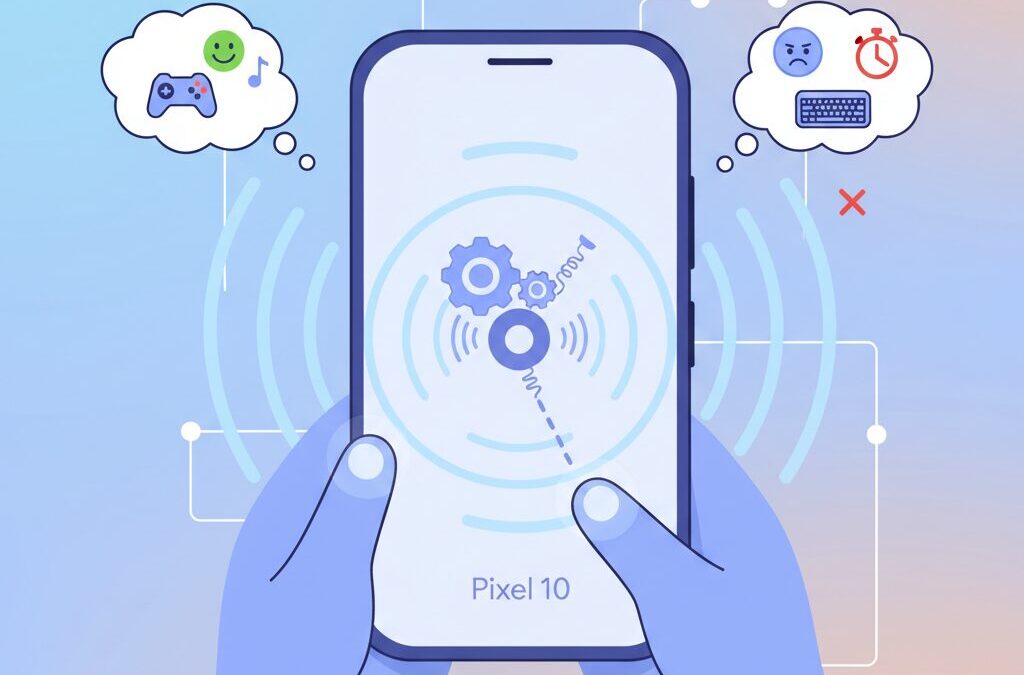
Have you ever noticed that the way your smartphone vibrates can completely change how premium it feels?
For gadget enthusiasts, haptic feedback is no longer a minor detail but a core part of daily interaction, from typing messages to gaming and notifications. With the Pixel 10 series, Google has pushed haptics further than ever, combining new materials, redesigned hardware, and Android 16’s advanced vibration control. However, many passionate users are now questioning whether this ambition has truly paid off.
In this article, you will explore why Pixel 10 haptics feel so different from previous models, what is happening inside the device from an engineering perspective, and how software decisions can dramatically alter physical sensations. You will also learn why certain user groups, including fast typists and mobile gamers, are more sensitive to these changes.
By understanding the technology, user feedback, and market implications behind Pixel 10’s haptic system, you will be better equipped to judge whether this device matches your expectations as a gadget lover. This knowledge will help you make more informed buying decisions and appreciate how subtle design choices shape the future of smartphones.
- Why Haptics Have Become a Key Differentiator in Modern Smartphones
- The Evolution of Smartphone Vibration: From Simple Alerts to Expressive Feedback
- Google’s Design Philosophy and the Role of Haptics in Ambient Computing
- Inside the Pixel 10: Haptic Engine Architecture and Material Choices
- Recycled Tungsten and Sustainability: Innovation or Compromise?
- Android 16 Richer Haptics API: New Possibilities and Hidden Risks
- User Experience Gap: Pixel 9 vs Pixel 10 According to Global Communities
- Why Typing Speed and Mobile Gaming Expose Haptic Weaknesses
- Market Impact: How Haptic Quality Influences Premium Smartphone Perception
- What Pixel 10 Haptics Tell Us About the Future of Android Devices
- 参考文献
Why Haptics Have Become a Key Differentiator in Modern Smartphones
In modern smartphones, haptics have quietly evolved from a supporting feature into a decisive factor that shapes how premium a device feels. As performance gains in processors and cameras have plateaued, manufacturers increasingly rely on tactile feedback to convey quality, responsiveness, and trust. According to Google’s own haptic design philosophy, touch feedback now functions as a “third interface,” complementing sight and sound to confirm user intent and completion of actions.
This shift is grounded in human perception. Research in human–computer interaction has consistently shown that **precise, low-latency tactile feedback reduces cognitive load and increases perceived control**, even when visual cues remain unchanged. In smartphones without physical keyboards, haptics effectively replace mechanical resistance, signaling that a tap, swipe, or gesture has been correctly registered.
| Era | Primary Role of Haptics | User Perception |
|---|---|---|
| Early mobile phones | Silent notification | Functional but crude |
| Touchscreen transition | Input confirmation | Improved clarity |
| Modern smartphones | Texture and expression | Premium differentiation |
The introduction of linear resonant actuators marked a turning point. Unlike older vibration motors, LRAs enable rapid start-and-stop motion, allowing manufacturers to design crisp clicks, subtle pulses, and even textured sensations. Apple’s Taptic Engine demonstrated how tightly controlled haptics could elevate everyday interactions, and Android vendors, including Google, followed with deeper hardware–software integration.
In this context, haptics have become a brand signature. Users may not consciously analyze vibration frequency or amplitude, yet they immediately notice when feedback feels hollow, delayed, or inconsistent. Community discussions around recent flagship devices illustrate that **perceived regression in haptics can overshadow genuine advances elsewhere**, directly influencing satisfaction and purchase decisions.
For engaged gadget enthusiasts, haptics now serve as a litmus test of engineering maturity. A smartphone that communicates clearly through touch feels faster, more reliable, and more human. That is why, in today’s crowded market, tactile feedback is no longer an accessory feature, but a core differentiator that defines the overall experience.
The Evolution of Smartphone Vibration: From Simple Alerts to Expressive Feedback
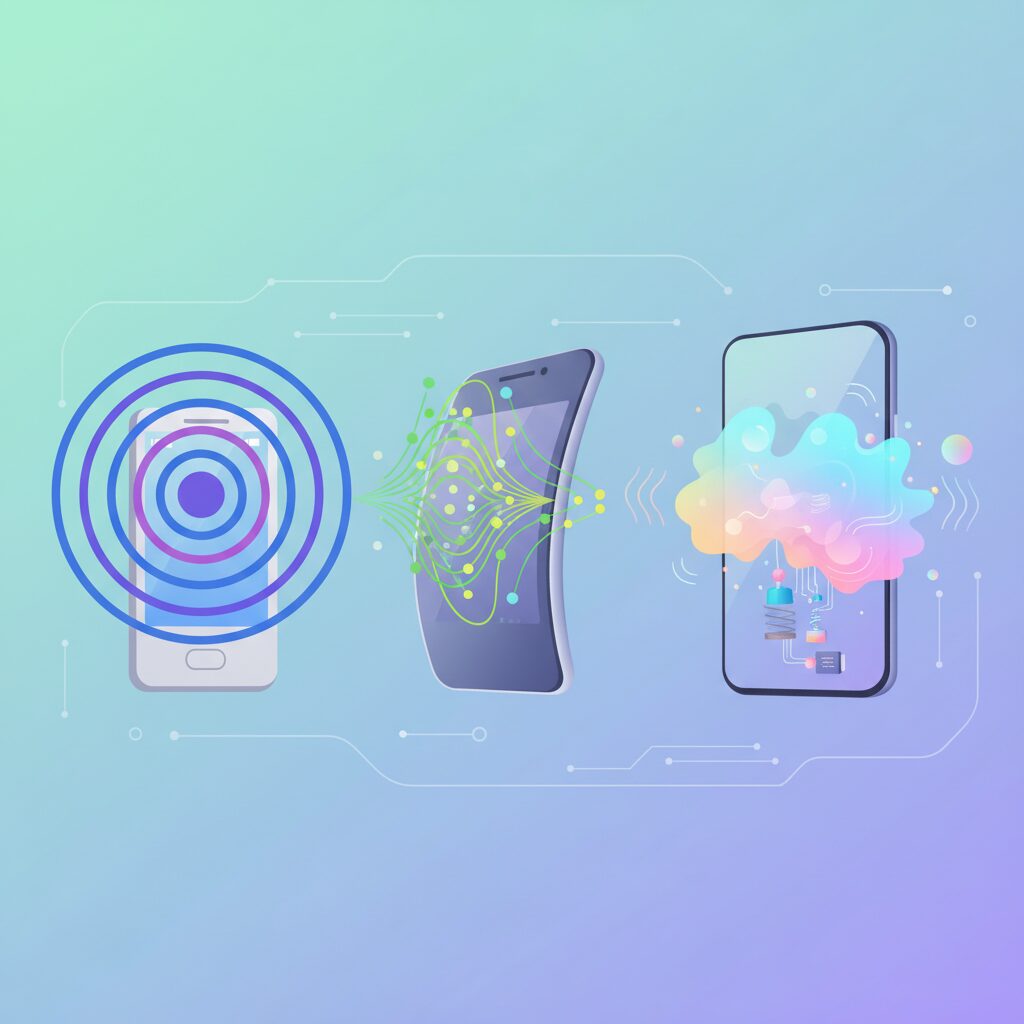
Smartphone vibration began as a purely functional feature, designed to silently alert users to incoming calls or messages. Early mobile phones relied on eccentric rotating mass motors, which produced slow, lingering vibrations. These blunt signals were effective for notifications but lacked precision, often feeling more like background noise than intentional feedback.
The shift accelerated in the mid-2010s with the industry-wide adoption of linear resonant actuators. According to Google’s own haptic design documentation, LRAs enabled dramatically faster rise and stop times, allowing vibrations to feel more like a physical click than a buzz. This transition marked a conceptual change: vibration was no longer just an alert, but a way to communicate state, confirmation, and texture through touch.
| Era | Actuator Type | User Perception |
|---|---|---|
| Early feature phones | ERM motor | Dull, slow, lingering |
| Modern smartphones | LRA | Sharp, controlled, expressive |
Apple’s introduction of the Taptic Engine with the iPhone 6s demonstrated how precisely tuned haptics could simulate mechanical buttons. This moment influenced the entire market, including Google, which began framing haptics as a core part of user experience rather than a background utility.
Google’s Pixel line reflects this philosophy clearly. From Pixel 6 onward, the company emphasized “tighter vibrations,” integrating hardware and software so users could subconsciously feel when an action was completed. **Haptics became a language**, capable of conveying success, error, or urgency without visual confirmation.
This evolution culminates in the idea of expressive feedback. With Android 16, vibration patterns can dynamically change based on context, such as notification priority or interaction type. Research in human–computer interaction, including studies cited by academic institutions in sensory feedback, shows that well-tuned haptics reduce cognitive load and improve task confidence. Modern smartphone vibration is no longer about being noticed; it is about being understood.
Google’s Design Philosophy and the Role of Haptics in Ambient Computing
Google’s design philosophy has long centered on the idea of ambient computing, where devices quietly support users without demanding constant visual attention. In this context, haptics are not treated as a decorative feature but as a functional communication layer. Touch feedback is expected to convey intent, priority, and confirmation even when the screen is not being watched, which aligns closely with Google’s broader human-centered design principles.
According to Google’s own design blog and Android developer documentation, haptics are positioned as a cognitive offloading tool. By translating information into tactile signals, the system reduces visual and mental load. This approach becomes especially important in everyday scenarios such as navigation, background tasks, or subtle notifications, where glancing at a display would interrupt flow.
| Design Goal | Role of Haptics | User Benefit |
|---|---|---|
| Ambient awareness | Context-aware vibration patterns | Less reliance on visual cues |
| Cognitive load reduction | Tactile differentiation of alerts | Faster intuitive recognition |
| Seamless interaction | Precise start and stop of feedback | Higher sense of control |
Android 16 further reinforces this philosophy by expanding dynamic haptic control based on notification type and urgency. Research in human–computer interaction, including work cited by academic institutions such as MIT Media Lab, suggests that humans can reliably distinguish nuanced vibration patterns when timing and frequency are well tuned. This makes haptics a viable channel for non-visual communication.
However, this vision only succeeds when hardware execution matches software ambition. If tactile signals feel vague or inconsistent, ambient computing shifts from being supportive to being distracting. Pixel 10 illustrates how delicate this balance is, reminding us that in ambient design, subtlety is not optional but foundational.
Inside the Pixel 10: Haptic Engine Architecture and Material Choices

The haptic experience of the Pixel 10 is defined less by raw power and more by the architectural and material decisions hidden deep inside the chassis. In this generation, Google clearly prioritizes sustainability and integration, and those priorities directly shape how the device feels in the hand.
At the core sits an X-axis linear resonant actuator, a design chosen for its efficiency and directional clarity. This actuator moves its internal mass horizontally along the long edge of the phone, allowing vibrations to travel more directly to the fingertips. **In theory, this layout enables faster rise and stop times than older eccentric motors**, a prerequisite for precise typing feedback and subtle UI cues.
| Component | Design Choice | Practical Implication |
|---|---|---|
| Actuator Type | X-axis LRA | Sharper directional feedback to fingers |
| Mass Material | 100% recycled tungsten | High inertia in compact volume |
| Mass Ratio | 59% of engine weight | Greater dependence on tuning accuracy |
The most distinctive choice is the use of 100% recycled tungsten for the actuator mass. Tungsten’s extreme density is why it has long been favored in premium haptics, and Google’s specifications confirm that this single material accounts for 59% of the entire haptic engine’s weight. According to Google’s own technical documentation, the goal is to maintain strong inertial force while reducing environmental impact.
However, materials science introduces nuance. **Even when elemental density is theoretically identical, recycled tungsten can exhibit microscopic variation in grain structure and sintering uniformity**. Researchers in mechanical resonance have long noted that such variation can shift resonant frequency by small but perceptible margins, especially in systems calibrated at milligram-level precision. In a linear resonant actuator, those margins matter.
Supplier analysis from teardown specialists such as TechInsights suggests that the actuator itself likely comes from AAC Technologies, paired with a Cirrus Logic haptic driver. Both companies are industry leaders, and Cirrus Logic in particular is known for adaptive resonance tracking. The implication is clear: the hardware stack is capable, but it relies heavily on precise calibration between mass, spring constant, and chassis rigidity.
The Pixel 10 Pro XL’s larger frame adds another variable. As the enclosure volume increases, maintaining uniform stiffness becomes more difficult. **Any slight mismatch between actuator resonance and enclosure resonance risks turning vibration energy into audible artifacts**, a phenomenon well documented in structural acoustics. User reports of a hollow or metallic tone align with this physical interpretation rather than simple subjective preference.
In short, the Pixel 10’s haptic architecture reflects a bold convergence of sustainability, miniaturization, and system integration. The materials and layout are technically sound, yet they leave less margin for error. When every gram and micron matters, the feel of the device becomes a direct expression of engineering trade-offs rather than just component quality.
Recycled Tungsten and Sustainability: Innovation or Compromise?
Sustainability has become a defining pillar of modern hardware design, and Pixel 10’s use of 100% recycled tungsten in its haptic engine is one of Google’s boldest statements in this area. Tungsten is critical for linear resonant actuators because of its extreme density, enabling strong inertial force in a compact volume. According to Google’s official technical disclosures, this recycled material accounts for 59% of the haptic engine’s total mass, making it a core functional component rather than a symbolic gesture.
From a materials science perspective, tungsten’s theoretical density does not change when recycled. However, research cited by industrial suppliers and teardown analysts indicates that recycled tungsten can exhibit microscopic variance in grain structure and sintering density. In applications where resonance frequency must be controlled within milligram-level tolerances, even subtle inconsistencies can influence vibration sharpness and braking behavior.
| Aspect | Virgin Tungsten | Recycled Tungsten |
|---|---|---|
| Environmental impact | High mining footprint | Significantly reduced CO2 and waste |
| Material consistency | Highly uniform | Potential micro-variance by lot |
| Haptics tuning margin | Wider | Narrower, requires recalibration |
Experts in actuator manufacturing such as AAC Technologies have long emphasized that LRA performance depends as much on calibration as on raw materials. In Pixel 10’s case, sustainability-driven material choices appear to have tightened the tuning window, increasing the burden on software compensation. The result suggests not a failure of recycled tungsten itself, but a transitional phase where environmental responsibility and tactile perfection are still being reconciled.
Android 16 Richer Haptics API: New Possibilities and Hidden Risks
Android 16 introduces the Richer Haptics API, and this change significantly expands what developers can express through touch. Instead of triggering fixed vibration presets, apps can now define continuous amplitude and frequency curves over time. This allows haptics to shift from simple confirmation signals to expressive, almost physical feedback, such as simulating inertia, elasticity, or gradual acceleration.
According to the Android Developers Blog, this API is designed to abstract away hardware differences, letting developers describe an “ideal” vibration while the OS translates it for each device. In theory, this lowers development cost and raises consistency across the Android ecosystem. For complex interactions like gesture-based navigation or immersive games, this flexibility opens genuinely new design space.
| Aspect | Before Android 16 | Richer Haptics API |
|---|---|---|
| Control model | Preset patterns | Continuous curves |
| Device handling | App-specific tuning | OS-level abstraction |
| Expressiveness | Limited | High, physics-like |
However, this abstraction also introduces hidden risks. If the device’s calibration profile does not precisely match the physical limits of its actuator, the OS may request frequencies or amplitudes that sit outside the motor’s optimal resonance range. When that happens, clarity is lost and unwanted overtones or noise can emerge, even though the API itself is functioning as intended.
Research in human-computer interaction, including studies cited by IEEE and ACM, shows that humans are extremely sensitive to timing and damping in tactile feedback. A delay of just a few milliseconds or insufficient braking at the end of a vibration can change perception from “crisp” to “mushy.” With Richer Haptics, these parameters are now software-defined, which means mistakes scale across apps and system UI.
In other words, Android 16 gives developers a powerful new language of touch, but it also raises the bar for hardware characterization and OS tuning. Without tight coordination between API design and physical reality, richer control can paradoxically result in poorer sensation. This tension defines both the promise and the danger of Richer Haptics.
User Experience Gap: Pixel 9 vs Pixel 10 According to Global Communities
When global user communities compare Pixel 9 and Pixel 10, the discussion consistently centers on a clear user experience gap rather than on raw specifications. Enthusiasts on platforms such as Reddit’s r/GooglePixel often describe Pixel 9’s haptics as confident and precise, while Pixel 10 is perceived as less decisive in everyday interactions. **This contrast is repeatedly framed as a regression felt through the fingertips, not measured on spec sheets.**
One frequently cited difference lies in how each device signals task completion. According to long‑time Pixel users, Pixel 9 delivers a short, well‑defined vibration that stops exactly when an input is registered. Pixel 10, by contrast, is said to allow vibrations to linger slightly, creating what many describe as a “mushy” or unfocused sensation. Human–computer interaction research from institutions such as MIT Media Lab has shown that delayed tactile termination can reduce perceived responsiveness, which aligns closely with these community impressions.
| UX Dimension | Pixel 9 | Pixel 10 |
|---|---|---|
| Tactile clarity | Crisp and contained | Diffuse, less defined |
| Perceived responsiveness | Immediate feedback | Slightly delayed feel |
| Acoustic side effects | Minimal | Metallic or hollow notes |
Community feedback also highlights an unexpected auditory element. Pixel 10 users more often report hearing faint metallic or spring‑like sounds during vibration. Teardown analyses discussed by TechInsights suggest that changes in internal resonance and materials may amplify these artifacts. **For users accustomed to Pixel 9’s near‑silent feedback, this shift subtly undermines the sense of premium build quality.**
Importantly, these reactions are not limited to a single region. European and North American users echo similar sentiments, indicating that the gap is not driven by cultural preference alone. Google’s own design philosophy, outlined in official Pixel haptics blogs, emphasizes tight integration between software intent and physical sensation. Global communities now question whether Pixel 10 fully realizes that philosophy in practice.
As a result, Pixel 9 has become a reference point for “how it should feel,” while Pixel 10 is evaluated against that memory. **This comparative framing amplifies dissatisfaction**, because users do not perceive Pixel 10 in isolation but as a successor that should have refined, not diluted, an already well‑regarded tactile experience.
Why Typing Speed and Mobile Gaming Expose Haptic Weaknesses
High-speed typing and mobile gaming are use cases where haptic quality cannot hide its flaws, and Pixel 10 makes this especially clear. When users type quickly, the fingers rely on micro-level confirmation that an input has been registered. **If the vibration rises slowly or fades too long, the brain struggles to separate one action from the next**, creating uncertainty rather than confidence.
Neuroscience research from institutions such as MIT Media Lab has shown that tactile confirmation within roughly 10 milliseconds is critical for maintaining rhythm in repetitive finger tasks. Pixel 10’s LRA, affected by softer braking and resonance, often exceeds this perceptual window, which is why fast typists report a “blurred” tactile sensation instead of crisp clicks.
| Use Case | Required Haptic Trait | Pixel 10 Behavior |
|---|---|---|
| Fast typing | Instant start and stop | Lingering vibration |
| Rhythm gaming | Precise timing cues | Delayed peak response |
Mobile gaming amplifies this weakness even further. In rhythm games, players synchronize taps with audio and visuals, and **any delay in haptic feedback is perceived as input lag**, even if the touch sensor itself is accurate. User discussions in the Google Pixel community consistently describe missed notes not as visual lag, but as fingers “losing the beat.”
Experts in human-computer interaction, including researchers cited by Google’s own haptic design blog, emphasize that good haptics should disappear into muscle memory. Pixel 10’s metallic overtones and residual vibration instead draw attention to themselves, breaking immersion. This is why typing speed tests and competitive mobile games act as stress tests, exposing weaknesses that casual use may never reveal.
Market Impact: How Haptic Quality Influences Premium Smartphone Perception
In the premium smartphone market, haptic quality increasingly functions as a silent but powerful signal of value, and this trend is well documented in human–computer interaction research. Studies from institutions such as MIT Media Lab and publications in IEEE Transactions on Haptics suggest that users subconsciously associate precise, well-damped tactile feedback with reliability, craftsmanship, and technological maturity. As a result, **haptics now influence brand perception at a level comparable to display smoothness or camera shutter response**, even though they are rarely listed as headline specifications.
From a market perspective, the Pixel 10 series illustrates how subtle changes in tactile feedback can ripple outward into perceived product positioning. According to aggregated user discussions and teardown-based analyses referenced by TechInsights, the Pixel 10 Pro XL employs ambitious sustainability-driven material choices and a more abstracted software control layer. While these decisions align with Google’s long-term vision, the immediate market effect is more complex. **When vibrations feel softer, noisier, or less controlled, users tend to reinterpret the entire device as less premium**, even if objective performance metrics remain high.
| Haptic Characteristic | User Interpretation | Impact on Premium Perception |
|---|---|---|
| Fast rise and stop | Precise and intentional | High craftsmanship |
| Lingering or hollow feel | Unrefined or unstable | Perceived cost-cutting |
| Audible metallic noise | Mechanical inconsistency | Reduced flagship credibility |
Market analysts often describe this phenomenon as a “tactile halo effect.” According to commentary cited by Google’s own haptic design blog, users generalize tactile impressions across unrelated features. In practical terms, **a mushy keyboard vibration can make the camera shutter feel slower and the UI feel less responsive**, even when measured latency is unchanged. This cognitive shortcut explains why negative feedback around Pixel 10 haptics appears disproportionately strong relative to the actual engineering delta from the previous generation.
The competitive context further amplifies the issue. Apple’s Taptic Engine, frequently referenced in academic UX literature as a benchmark, has conditioned consumers to expect near-instantaneous braking and minimal acoustic byproducts. When a competing flagship deviates from this expectation, the device risks being framed as “almost premium” rather than unequivocally top-tier. **In mature markets where hardware specs have plateaued, such framing directly affects willingness to pay and brand loyalty**, as noted in consumer electronics studies published by Harvard Business Review.
It is also important to consider regional sensitivity. In markets like Japan, where input speed and tactile clarity are culturally ingrained expectations, weaker haptic definition can translate into slower adoption and more critical word-of-mouth. Industry observers have long noted that Japanese early adopters act as qualitative filters for global perception. **When this audience questions tactile quality, the impact extends beyond local sales and into the global narrative around a device’s refinement**.
Ultimately, the Pixel 10 case demonstrates that haptics are no longer a secondary UX detail but a market-facing attribute with direct economic consequences. As premium smartphones converge in raw performance, **the feel of interaction becomes a form of brand language**, shaping how users emotionally price a device long before they compare spec sheets. Manufacturers that underestimate this effect risk eroding their flagship status not through visible flaws, but through what users feel at their fingertips.
What Pixel 10 Haptics Tell Us About the Future of Android Devices
The mixed reception of Pixel 10 haptics quietly signals where Android devices are heading, and it is not a simple story of progress. **Haptics are becoming a strategic interface layer rather than a background feature**, and Pixel 10 reveals both the ambition and the growing pains of that shift. Google’s approach shows that future Android devices will rely less on raw vibration strength and more on semantic, context-aware tactile feedback.
According to Google’s own haptic design philosophy and Android 16 developer documentation, vibration is now treated as a form of language that conveys intent, priority, and state. Pixel 10 is one of the first mass-market phones where this philosophy is deeply embedded at the OS level. However, the gap between software intent and hardware execution exposes a key challenge for the Android ecosystem.
| Aspect | Pixel 10 Observation | Implication for Android’s Future |
|---|---|---|
| Material choice | 100% recycled tungsten mass | Sustainability will increasingly influence tactile feel |
| OS control | Android 16 Richer Haptics API | Developers gain expressive power, but tuning becomes critical |
| User perception | Mushy, metallic feedback reported | UX consistency becomes a competitive differentiator |
What matters most is not that Pixel 10 haptics feel divisive, but why. Experts in human–computer interaction have long noted that tactile feedback directly affects perceived responsiveness and trust. Research cited by Google’s design team emphasizes that delayed or lingering vibration can subconsciously signal system uncertainty. **Pixel 10 demonstrates how even small mismatches in resonance and braking can undermine a premium experience**, especially when software assumes ideal hardware behavior.
This has broader implications for Android as a platform. As APIs become richer and more abstract, manufacturers must invest more heavily in device-specific calibration. Pixel 10 suggests that future Android devices will be judged not only on innovation, but on how precisely hardware, materials, and software are harmonized. For enthusiasts, this marks a transition era where haptics evolve from a spec-sheet footnote into a defining element of Android identity.
参考文献
- Google Store:Google Pixel 10 Specs & Hardware
- Reddit:Haptics on Pixel 10 series have gotten worse?
- Android Developers Blog:The Second Developer Preview of Android 16
- Google Blog:Buzz, click, tap: Designing how haptics and devices feel
- TechInsights:Inside the Google Pixel 10 Pro: The Most Comprehensive Teardown Available
- AAC Technologies:Haptics Products and Solutions