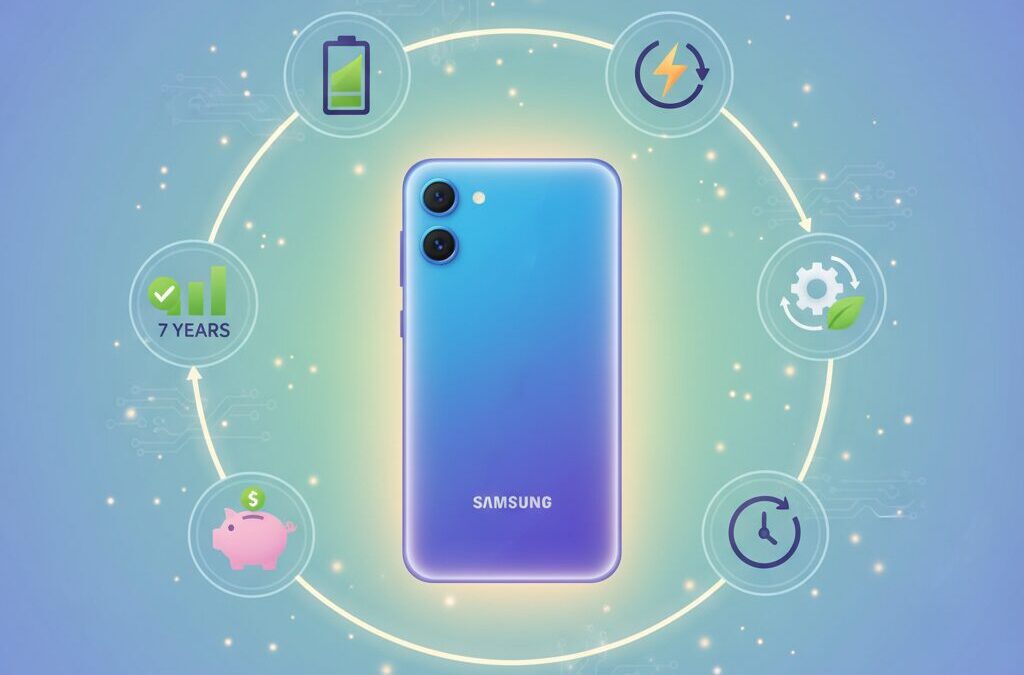
Smartphone upgrades used to feel inevitable every two years, but that assumption is quietly disappearing.
High-end devices like the Samsung Galaxy S24 are now powerful enough to stay relevant for most of a decade, thanks to long OS support and security updates.
For gadget enthusiasts outside Japan, this shift raises an important question: can modern smartphones truly survive long-term daily use?
The biggest obstacle is not performance or software, but the battery.
Lithium-ion batteries age chemically, and once daily battery life collapses, even the fastest phone becomes frustrating to use.
This article will explain how Galaxy devices manage battery aging, and why Samsung’s hardware and software choices matter more than ever.
You will also learn how intelligent charging features in One UI 6.1 can significantly slow degradation without sacrificing convenience.
Beyond technology, we will explore how repair ecosystems, sustainability-focused materials, and resale value all connect to battery health.
By the end of this article, you will clearly understand how to treat your Galaxy not as a disposable gadget, but as a long-term tech asset you can actively manage.
- Why Smartphones Are Finally Built for Long-Term Ownership
- The Physical Limits of Lithium-Ion Batteries Explained Simply
- Galaxy vs iPhone: Real-World Battery Endurance and Degradation
- Sustainability as a Battery Strategy: Recycled Cobalt and Supply Stability
- Thermal Design and Internal Structure: Hidden Factors That Extend Battery Life
- One UI 6.1 Battery Protection Modes and How They Actually Work
- Smart Charging Habits That Reduce Wear Without Changing Your Lifestyle
- Repair Ecosystems and Why Official Battery Replacement Still Matters
- Battery Health and Resale Value: What the Second-Hand Market Really Cares About
- Designing a Personal Galaxy Lifecycle Strategy for 3, 5, or 7 Years
- 参考文献
Why Smartphones Are Finally Built for Long-Term Ownership
For many years, smartphones were treated as short‑term consumables, and replacing them every two years felt natural. That assumption is now quietly collapsing. **Modern smartphones are finally engineered for long‑term ownership**, not because users suddenly became frugal, but because the technology itself reached a point of maturity.
According to industry analysis from Samsung Electronics, performance gains in processors and displays have slowed to the point where flagship devices already exceed the needs of most users. In practical terms, a phone released today can remain fast, smooth, and secure for most of a decade. The Galaxy S24 series symbolizes this shift by guaranteeing seven generations of Android OS upgrades and seven years of security updates, a commitment that rivals the lifecycle of laptops and enterprise PCs.
This policy changes the psychological contract between user and device. Software support is no longer the limiting factor, which historically forced premature upgrades due to security risks or app incompatibility. Instead, smartphones are repositioned as durable assets that can be planned, maintained, and amortized over time.
| Aspect | Past Norm | Current Reality |
|---|---|---|
| OS Support | 2–3 years | Up to 7 years |
| Security Updates | Limited | Long‑term guaranteed |
| Upgrade Motivation | Obsolescence | Choice‑driven |
At the same time, manufacturers openly acknowledge the remaining physical constraint: batteries inevitably degrade. Rather than ignoring this reality, Samsung’s strategy assumes battery replacement as part of normal ownership. Research into lithium‑ion chemistry shows that performance loss is predictable and manageable, which reframes battery wear as a maintenance issue, not a failure.
Environmental policy reinforces this direction. Samsung’s public sustainability reports explain how recycled cobalt is reintegrated into Galaxy batteries, stabilizing long‑term parts supply and reducing cost volatility. **Long‑term ownership is therefore supported not only by software promises, but by material and supply‑chain design.**
What emerges is a fundamental shift. Smartphones are no longer disposable upgrades but devices designed to stay relevant, secure, and serviceable for years. For enthusiasts who value both performance and rational ownership, this marks a long‑awaited turning point.
The Physical Limits of Lithium-Ion Batteries Explained Simply
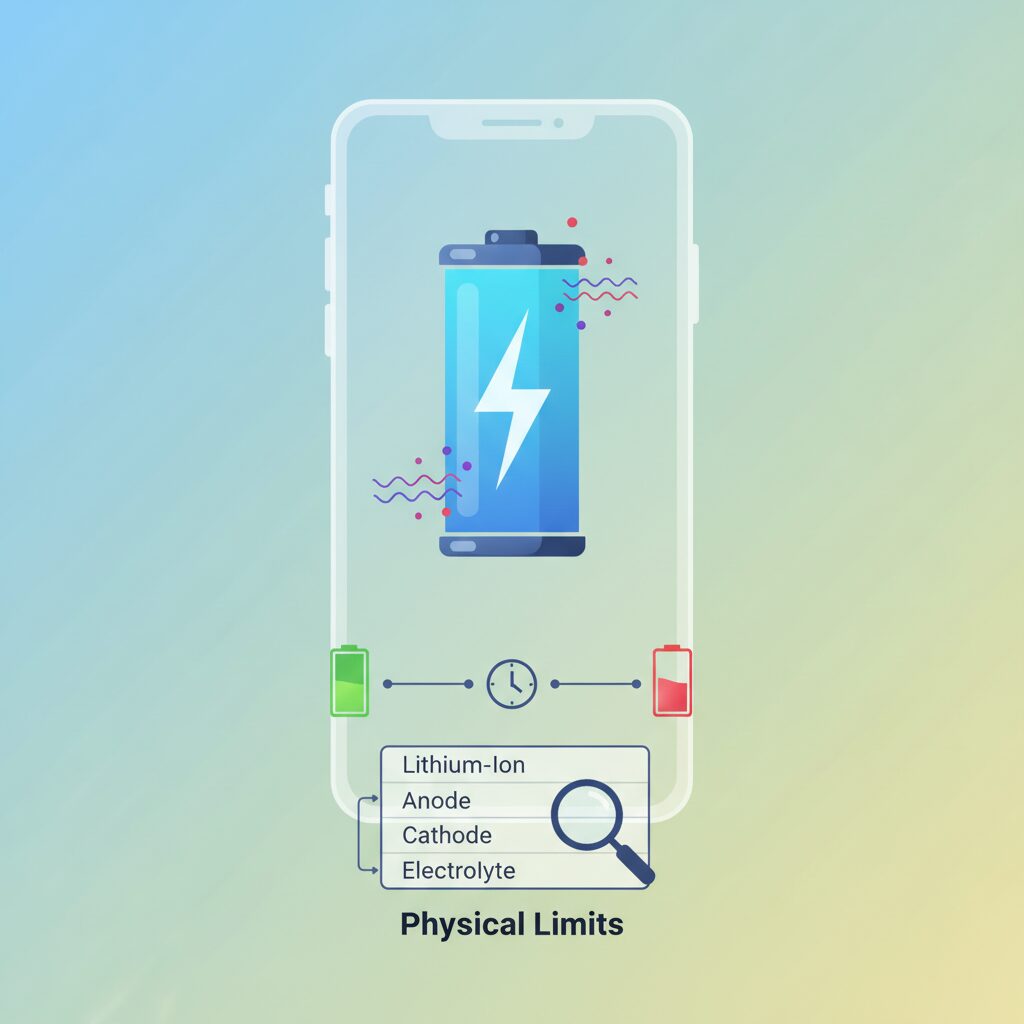
Lithium-ion batteries feel almost magical, but they are tightly bound by physics and chemistry. **No amount of software updates or careful handling can completely escape these limits**, and understanding them explains why battery aging is inevitable even in premium smartphones.
At the core is electrochemistry. Each charge and discharge cycle moves lithium ions between the anode and cathode. Over time, side reactions occur, forming a solid electrolyte interphase layer that permanently traps some lithium. According to electrochemistry research widely cited by institutions such as MIT, this gradual loss of active lithium is the main reason capacity fades, not poor manufacturing or user error.
| Constraint | What Physically Happens | User-Visible Result |
|---|---|---|
| Cycle aging | Structural stress in electrodes | Lower maximum capacity |
| Calendar aging | Chemical reactions at rest | Shorter daily battery life |
| Heat sensitivity | Accelerated side reactions | Faster long-term degradation |
Heat deserves special attention. Studies summarized by battery researchers at Stanford University show that **every sustained rise in operating temperature dramatically accelerates chemical decay**. This is why heavy gaming, fast charging, and hot environments silently reduce lifespan, even if the phone still feels usable day to day.
Another hard limit is voltage. Charging close to 100 percent pushes the battery into a high-voltage state where the cathode becomes unstable. Industry data has long shown that cells kept near full charge age faster than those operated in a mid-range window. This is not a design flaw but a universal trade-off between energy density and longevity.
In simple terms, lithium-ion batteries are consumable by nature. **They trade compact size and high energy for gradual, unavoidable wear**, which is why long-term smartphone use ultimately depends not on stopping degradation, but on managing and planning around it.
Galaxy vs iPhone: Real-World Battery Endurance and Degradation
When comparing Galaxy and iPhone in real-world battery endurance, headline capacity numbers tell only part of the story. What matters more for daily users is how long the battery lasts under mixed workloads and how gracefully it degrades over hundreds of charge cycles. Recent stress tests by well-known tech reviewers on YouTube, including large-scale drain tests under mobile data with social apps and video streaming, show that the Galaxy S24 series delivers surprisingly strong endurance despite its power-hungry 120Hz display and feature-rich One UI.
In continuous-use scenarios with TikTok, Instagram, and YouTube running back to back, Galaxy S24 models often matched or exceeded iPhone 15 in total screen-on time. This suggests that Samsung’s thermal design and display power management are compensating effectively for raw hardware demands. According to these reviewers, the difference was not minutes but sometimes close to an hour, which is meaningful in real commuting or travel situations.
| Aspect | Galaxy S24 Series | iPhone 15 Series |
|---|---|---|
| Heavy app endurance | Very strong, stable until low % | Strong, slight late-stage drop |
| Thermal behavior | Lower sustained heat | Higher peak temperatures |
| Degradation focus | Software-controlled charging | Hardware and OS optimization |
Battery degradation over time, however, paints a more nuanced picture. Lithium-ion chemistry inevitably degrades, but how fast that happens depends on charging voltage, heat, and software behavior. Apple has long emphasized tight hardware–software integration, and anecdotal data from user communities shows iPhone 15 Pro Max devices retaining around 97 percent battery health after more than 200 cycles. This has fueled the perception that iPhones age more slowly.
Galaxy users, on the other hand, benefit from a different strategy. With One UI 6.1, Samsung introduced adaptive charging modes that actively avoid long periods at 100 percent. Battery researchers, including those cited by major electronics manufacturers, agree that avoiding high-voltage states during idle hours significantly slows chemical wear. **This means Galaxy devices can trade short-term convenience for long-term stability in a way iPhones do not fully expose to the user.**
Another often overlooked factor is heat. Teardown analyses and thermal measurements indicate that Galaxy S24’s enlarged vapor chamber reduces sustained heat around the battery during 5G and AI workloads. Since elevated temperature is one of the strongest accelerants of degradation, this design choice directly impacts long-term health. Apple’s chips are highly efficient, but their aggressive performance bursts can still raise internal temperatures during prolonged use.
Ultimately, real-world endurance favors Galaxy in heavy, continuous scenarios, while degradation depends heavily on user habits. **A Galaxy used with adaptive or capped charging can age as well as, or better than, an iPhone used at constant 100 percent cycles.** The comparison is less about which brand is superior and more about which philosophy aligns with how long you plan to keep your device.
Sustainability as a Battery Strategy: Recycled Cobalt and Supply Stability

Sustainability in battery design is often discussed as a moral or environmental choice, but in the case of Galaxy smartphones, it also functions as a pragmatic battery strategy. Samsung’s decision to integrate recycled cobalt into the Galaxy S24 series directly affects long-term battery availability, repair feasibility, and cost stability for users who intend to keep their devices for many years.
According to Samsung’s official environmental disclosures, the batteries used in the Galaxy S24 Ultra and S24+ contain at least 50% recycled cobalt. This cobalt is not downcycled material of uncertain quality, but refined metal recovered from discarded batteries and manufacturing waste, then reintroduced into new battery cells. Independent supply-chain analyses, including reports cited by Supply Chain Digital, confirm that Samsung’s recycling process achieves a cobalt recovery rate exceeding 90%, which is unusually high by industry standards.
Cobalt is a structurally critical component of lithium-ion cathodes, yet its global supply is heavily concentrated in a small number of regions. The Democratic Republic of the Congo alone accounts for the majority of primary cobalt mining, a fact long highlighted by organizations such as the International Energy Agency. This geographic concentration exposes battery makers to geopolitical instability, price volatility, and ethical sourcing challenges. By contrast, recycled cobalt originates from already-secured material streams, which significantly reduces dependency on raw extraction.
| Aspect | Virgin Cobalt | Recycled Cobalt |
|---|---|---|
| Supply risk | High, geopolitically concentrated | Lower, domestically recoverable |
| Price stability | Highly volatile | More predictable over time |
| Impact on replacement batteries | Susceptible to shortages | More stable long-term availability |
For end users, this material strategy translates into a subtle but meaningful advantage. When a smartphone is designed to be supported for seven years, as Samsung now promises with OS and security updates, the weakest link inevitably becomes the battery. A stable cobalt supply increases the likelihood that official replacement batteries remain available years after launch, even during periods when global raw material prices spike.
Samsung’s own Product Environmental Report emphasizes that recycled cobalt is chemically equivalent to newly mined cobalt once refined. This means there is no trade-off in energy density or cycle life, a point also supported by broader battery research literature from academic and industrial sources. In practical terms, users are not accepting lower battery performance in exchange for sustainability, but rather benefiting from a more resilient supply chain.
The strategic implication is clear: sustainability here functions as risk management. A manufacturer that controls a circular battery supply can continue offering affordable, official battery replacements even under adverse market conditions. For Galaxy users planning long-term ownership, recycled cobalt is therefore not an abstract green label, but a quiet guarantee that their device can realistically be kept alive and healthy far into the future.
Thermal Design and Internal Structure: Hidden Factors That Extend Battery Life
Battery longevity is often discussed in terms of charging habits or software optimization, but the internal thermal design is an equally critical and less visible factorです。**Heat is the single strongest accelerator of lithium-ion battery degradation**, and how a smartphone manages, spreads, and isolates that heat directly determines how gracefully its battery ages over several yearsです。
According to materials science research published by institutions such as MIT and the U.S. Department of Energy, sustained operation above roughly 35°C significantly accelerates electrolyte breakdown and capacity loss in lithium-ion cellsです。In smartphones, this heat does not come only from the battery itself but from nearby components such as the application processor, 5G modem, and power management ICです。
In the Galaxy S24 series, Samsung has visibly reworked the internal structure to address this issue at a system levelです。Teardown analyses conducted by professional repair specialists show a substantially enlarged vapor chamber compared with previous generations, positioned to draw heat away from the SoC and distribute it across a wider surface area before it reaches the battery cellです。
| Thermal Element | Design Role | Impact on Battery Aging |
|---|---|---|
| Enlarged vapor chamber | Spreads peak heat from SoC | Reduces localized battery overheating |
| Graphite heat sheets | Guides heat laterally | Lowers sustained cell temperature |
| Internal spacing layout | Separates hot components | Slows long-term chemical degradation |
This structural approach reflects a key insight shared by battery researchers at Stanford University: **it is not momentary heat spikes but prolonged thermal exposure that does the most damage**です。By preventing hotspots and shortening the time the battery remains at elevated temperatures, thermal architecture effectively extends usable battery life even if nominal capacity remains unchangedです。
Another overlooked aspect is mechanical layoutです。In modern Galaxy devices, the battery is no longer treated as a passive block filling empty space but as a component that must be thermally isolatedです。Strategic placement of shielding layers and adhesives reduces direct heat conduction from the logic board, which is especially important during AI-driven workloads and continuous 5G data transmissionです。
Repairability changes, such as the introduction of pull tabs for battery removal in the S24 Ultra, also serve a thermal purposeです。They allow for more uniform adhesive layers rather than excessively rigid bonding, which improves heat dispersion across the chassis while still maintaining structural integrityです。This balance between rigidity and thermal flexibility is rarely advertised but crucial for long-term stabilityです。
From a user perspective, this means that two phones with identical battery sizes and similar daily usage can age very differently depending on internal heat flowです。Independent durability observations from professional device refurbishers consistently show that models with superior thermal management retain higher real-world endurance after three to four years of useです。
Thermal design may be invisible, but it quietly works every second the device is powered onです。In long-term ownership, it becomes one of the most decisive hidden factors separating a phone that merely survives from one that remains reliable years beyond its purchase dateです。
One UI 6.1 Battery Protection Modes and How They Actually Work
One UI 6.1 introduces a significantly more nuanced approach to battery protection than earlier Samsung software, and understanding how each mode actually works helps users make informed long-term decisions. Rather than treating battery care as a single on-or-off switch, Samsung now frames it as a behavioral control system that manages voltage stress and time spent at full charge.
At the core of all three modes is a well-established principle in lithium-ion research: batteries degrade fastest when they remain at high voltage for extended periods, especially under elevated temperatures. According to findings summarized by battery researchers cited by IEEE and academic electrochemistry journals, keeping a cell near 100 percent state of charge accelerates electrolyte oxidation and cathode wear. One UI 6.1 directly targets this problem.
| Mode | Charge Ceiling Behavior | Primary Benefit | Trade-off |
|---|---|---|---|
| Basic | Stops at 100%, resumes at ~95% | Reduces trickle charging stress | Still spends time at full voltage |
| Adaptive | Holds at ~80% during sleep, finishes before wake | Minimizes overnight high-voltage exposure | Depends on stable sleep patterns |
| Maximum | Hard limit at 80% | Strongest reduction of chemical aging | Lower daily usable capacity |
The Basic mode is often misunderstood as a full battery protection feature, but in reality it acts as a safeguard against constant trickle charging. When a phone is left plugged in at 100 percent, micro-charging cycles occur repeatedly. By allowing the charge to fall to around 95 percent before resuming, Basic mode reduces these micro-cycles, which Samsung documentation explains as a way to lower unnecessary voltage stress.
Adaptive mode is where One UI 6.1 becomes genuinely intelligent. By learning user sleep patterns through on-device analysis, the system delays the final charging phase until shortly before wake-up time. This means the battery avoids sitting at 100 percent for six to eight hours overnight, a practice that battery experts consistently identify as one of the most harmful everyday habits. Community feedback on Reddit and developer forums indicates that once the learning period stabilizes, this mode delivers a strong balance between convenience and longevity.
Maximum mode is the most conservative option and aligns closely with laboratory best practices. Limiting charge to 80 percent keeps the battery within a voltage range that researchers describe as chemically stable. Tech reviewers and engineers frequently note that cells operated under this ceiling can exceed 500 full charge cycles with far less capacity loss. **For users prioritizing multi-year durability over daily range, this mode provides the clearest long-term advantage.**
What makes One UI 6.1 notable is not just the presence of these modes, but the fact that they are designed to be switched dynamically. Samsung’s own support materials emphasize flexibility, implicitly acknowledging that battery health is shaped by usage patterns rather than a single ideal setting. Used correctly, these modes turn battery care into an active, software-driven process rather than a passive hope for the best.
Smart Charging Habits That Reduce Wear Without Changing Your Lifestyle
Smart charging habits do not have to mean micromanaging percentages or changing how you live your day. The most effective practices are those that work quietly in the background, aligning with your existing routines while reducing chemical stress on the battery. **Modern Galaxy smartphones are explicitly designed to support this kind of low-friction optimization**, according to Samsung’s own One UI 6.1 documentation.
The first habit is simply letting software do the heavy lifting. Keeping Battery Protection set to Adaptive allows the system to learn your sleep and wake patterns, holding the charge at a lower voltage overnight and finishing just before you unplug. Battery researchers widely agree that time spent at 100% state of charge accelerates lithium-ion degradation, and Samsung’s approach mirrors recommendations published by academic groups studying smartphone battery aging. You gain a full charge when you need it, without the hidden overnight wear.
Heat management is the second habit, and it is often overlooked because it feels unrelated to charging. In reality, charging while the device is warm compounds battery stress. Samsung’s thermal design, including larger vapor chambers in recent Galaxy models, reduces internal heat buildup, but user behavior still matters. **Avoiding charging immediately after gaming, video recording, or navigation keeps cell temperature closer to the chemically stable range**, typically cited as below 30°C in battery engineering literature.
| Charging Context | Battery Stress Level | Practical Adjustment |
|---|---|---|
| Overnight bedside charging | Low with Adaptive mode | Enable Adaptive Battery Protection |
| After heavy app usage | High due to heat | Wait 10–15 minutes before plugging in |
| Desk charging during work | Very low | Use Maximum or partial charging |
A third habit is reframing short, opportunistic charging as beneficial rather than harmful. Contrary to older myths, frequent top-ups do not damage modern lithium-ion batteries. Studies referenced by battery specialists, including those cited by Samsung’s support materials, show that partial charge cycles are less stressful than full 0–100% cycles. **Plugging in for 20 or 30 minutes during the day actually reduces total cycle wear**, especially when it prevents deep discharges.
Finally, consistency matters more than precision. You do not need to watch percentages obsessively. By charging in cool conditions, letting Adaptive protection manage overnight behavior, and accepting short daytime charges as normal, you minimize degradation without conscious effort. These habits fit seamlessly into daily life, which is precisely why they work. A battery strategy you can forget about is far more sustainable than one that demands constant attention.
Repair Ecosystems and Why Official Battery Replacement Still Matters
As smartphones move firmly into a long-term ownership era, repair ecosystems have become just as important as raw hardware performance. This is especially true for Galaxy devices, where seven years of OS and security updates make battery replacement not an exception, but an expected milestone in the product lifecycle. In this context, the quality and structure of the official repair ecosystem directly determine whether long-term use is realistic or merely theoretical.
According to Samsung’s own environmental and product documentation, batteries are treated as consumable components designed to be replaced under controlled conditions. **Official battery replacement is not just about restoring capacity, but about preserving the device’s original design parameters**, including thermal behavior, water resistance, and radio performance. Independent teardown analyses consistently show that Galaxy batteries are integrated into tightly engineered assemblies where even small deviations can have cascading effects.
| Aspect | Official Replacement | Unofficial Replacement |
|---|---|---|
| Battery quality | OEM-certified, matched to firmware | Variable cells, unknown aging profile |
| Water resistance | Factory-grade resealing and testing | Often reduced or lost entirely |
| Regulatory compliance | Maintains original certification | Potential compliance risk |
Research into lithium-ion battery degradation published by academic and industry sources alike highlights that **battery chemistry and system-level calibration are inseparable**. Samsung calibrates charging curves, thermal thresholds, and safety margins based on the electrical characteristics of its genuine batteries. When a non-official cell is installed, even if its nominal capacity appears similar, the charging algorithm may no longer operate within optimal parameters, accelerating degradation or triggering thermal throttling.
This is where the broader repair ecosystem matters. Samsung’s circular supply chain, which recovers over 90% of cobalt from discarded batteries according to sustainability reports, ensures a stable flow of genuine replacement parts years after launch. **This stability is a hidden advantage of official repair channels**, reducing both long-term cost volatility and the risk of part shortages as devices age.
Equally important is the preservation of secondary value. Major resale platforms and professional refurbishers consistently downgrade devices with unofficial battery replacements, regardless of cosmetic condition. Industry evaluators note that uncertainty around cell origin and safety history introduces resale risk, which is immediately reflected in lower offers. By contrast, devices serviced through official channels retain clear maintenance provenance, a factor increasingly scrutinized in mature used-device markets.
From a user experience perspective, official battery replacement also minimizes subtle regressions. Proper adhesive application, pressure-controlled sealing, and post-repair diagnostics ensure that heat dissipation and antenna performance remain within original specifications. **These factors rarely show up on spec sheets, yet they define day-to-day reliability over years of use**.
In a world where smartphones are expected to last half a decade or more, repair ecosystems are no longer peripheral services. They are core infrastructure. Choosing official battery replacement is ultimately a decision to protect not only battery health, but the integrity, safety, and long-term value of the entire device.
Battery Health and Resale Value: What the Second-Hand Market Really Cares About
When it comes time to sell a used Galaxy device, battery health is not a vague bonus point but a concrete pricing leverです。In the second-hand market, especially in Japan, buyers and professional resellers treat the battery as a measurable asset rather than an invisible internal partです。Even if the exterior looks pristine, a weakened battery immediately reframes the device as a high-risk purchaseです。
Major reuse retailers such as Iosys and Janpara publicly state that devices with battery health below roughly 80% are subject to automatic downgradesです。This threshold is not arbitraryです。According to lithium-ion aging research summarized by institutions like Battery University, capacity loss accelerates once internal resistance rises past a certain point, directly affecting daily usabilityです。Resellers price in the likelihood of early replacement costs the moment that line is crossedです。
| Battery Condition | Typical Evaluation | Impact on Price |
|---|---|---|
| 90–100% | Healthy | Near top market value |
| 80–89% | Acceptable | Minor reduction |
| Below 80% | Degraded | Automatic downgrade |
This evaluation logic explains why two visually identical Galaxy S24 units can differ by several thousand yen in buyback offersです。**Battery health functions as a hidden depreciation curve** that runs in parallel with cosmetic wearです。Professional buyers assume that a sub‑80% battery will require immediate service, and that assumption is directly deducted from the offer priceです。
An interesting nuance is that resale markets care less about how the battery was treated and more about its present conditionです。Whether the owner used adaptive charging, capped charging at 80%, or charged aggressively does not matter at the point of saleです。What matters is the reported maximum capacity at inspectionです。This makes software-based protection features indirectly valuable, because they preserve a future number rather than a current feeling of longevityです。
From an economic perspective, there are two rational resale strategiesです。One is selling before degradation becomes visible, typically within three years, when battery health is still above the psychological 80% lineです。The other is fully committing to long-term use, replacing the battery through official channels, and then selling later with a documented fresh batteryです。Half measures tend to perform worst in resale outcomesです。
Industry analysts quoted by Nikkei have repeatedly noted that Japanese consumers place unusually high trust in graded evaluations from established retailersです。Because of this trust culture, battery-related downgrades carry more weight than in peer-to-peer markets overseasです。**In short, battery health is not just a technical metric but a credibility signal** in Japan’s resale ecosystemです。
Designing a Personal Galaxy Lifecycle Strategy for 3, 5, or 7 Years
Designing a personal Galaxy lifecycle strategy starts with a simple question: how many years do you truly want to live with the same device. Thanks to Samsung’s commitment to seven generations of OS upgrades and long-term security support, the answer is no longer constrained by software. Instead, the decisive factor becomes how proactively you manage battery degradation and repairs over time.
The 3-year, 5-year, and 7-year strategies each represent a distinct philosophy of ownership, balancing convenience, cost efficiency, and residual value in different ways. Understanding these differences allows you to align your Galaxy usage with your lifestyle rather than following a generic replacement cycle.
| Usage Horizon | Core Objective | Key Battery Action | Economic Outcome |
|---|---|---|---|
| 3 Years | Maximize resale value | Avoid replacement | High residual value |
| 5 Years | Stability and balance | One planned replacement | Lowest total cost |
| 7 Years | Full depreciation | Multiple controlled replacements | Minimum monthly cost |
For a 3-year strategy, the Galaxy is treated as a high-value asset rather than a consumable. Research from major Japanese resale retailers shows that devices with battery health above 80 percent consistently achieve higher grades, regardless of cosmetic condition. By using One UI’s Adaptive or Maximum battery protection modes, you can slow chemical aging and exit ownership before the first major capacity drop.
This approach deliberately avoids battery replacement. Spending money on a new battery shortly before resale rarely yields a proportional increase in buyback price. Instead, the focus is on preserving original components and maintaining battery health just above the critical threshold that triggers automatic devaluation.
The 5-year strategy is where Galaxy’s ecosystem truly shines. Academic research on lithium-ion batteries, including findings referenced by institutions such as IEEE, confirms that most capacity loss accelerates after the second to third year of regular cycling. Planning a single, official battery replacement around year three effectively resets daily usability while keeping the device within Samsung’s supported lifecycle.
Carrier repair programs in Japan reinforce this logic. As documented by major operators, the cost of an official battery replacement after long-term use often drops to a few thousand yen under warranty schemes. This creates a unique inflection point where professional repair is cheaper than premature replacement, allowing the device to remain reliable through years four and five.
The 7-year strategy represents a mindset shift from ownership to infrastructure. Samsung’s own environmental reports highlight the use of recycled cobalt and a circular battery supply chain, which helps stabilize long-term parts availability. From a user perspective, this means replacement batteries are less likely to become scarce or prohibitively expensive even late in the product’s life.
In this scenario, the Galaxy is fully depreciated, and resale value is no longer a priority. Instead, the goal is functional longevity. Controlled battery replacements, potentially more than once, are treated as routine maintenance, similar to replacing a laptop battery. The result is an exceptionally low monthly device cost spread over seven years, often outperforming any short upgrade cycle in pure economic terms.
Experts in sustainable electronics, including those cited in Samsung’s Galaxy for the Planet initiative, emphasize that extending usable life is the single most effective way to reduce environmental impact. A 7-year strategy aligns personal economics with sustainability without sacrificing security updates or daily performance.
Ultimately, designing your Galaxy lifecycle strategy is not about choosing the longest possible duration, but the most intentional one. Whether you prioritize liquidity at year three, balance at year five, or maximum value extraction at year seven, the key is proactive battery management and timely use of the official repair ecosystem. With that discipline, the Galaxy evolves from a fragile gadget into a long-term digital tool that adapts to your life.
参考文献
- Samsung Newsroom:Galaxy S24 series – New recycled materials introduced to the Samsung Galaxy family
- SamMobile:Samsung enters a new era of sustainability with the Galaxy S24
- Samsung Support:Introducing the Battery protection feature for your Samsung Galaxy
- YouTube:Samsung Galaxy S24 vs iPhone 15 vs Pixel 8 EXTREME Battery Drain Test
- Supply Chain Digital:Samsung’s Circular Battery Chain Boosts Cobalt Recycling
- Reddit:Basic, Adaptive or Maximum battery protection option?