
Smartphones have become the most personal devices we own, storing financial data, private conversations, health records, and even digital identities.
As mobile threats grow more sophisticated with AI-powered phishing and social engineering, traditional screen locks and passwords are no longer enough.
In 2026, mobile app security is undergoing a fundamental shift toward OS-native app locks, continuous authentication, and intelligent biometrics.
This article explains how the latest versions of iOS and Android are transforming app protection at the system level, not as optional add-ons.
You will learn how technologies like stealth app hiding, behavioral biometrics, adaptive multi-factor authentication, and passkeys work together to protect users in real time.
If you are passionate about gadgets and want to understand where smartphone security is heading next, this guide will help you stay informed and one step ahead.
- Why 2026 Marks a Turning Point for Mobile App Security
- From Device Locks to App-Level Protection Built Into the OS
- Inside iOS 19: Stealth Mode, Secure Folders, and On-Device AI
- Android 16 and 17: Native App Lock APIs and Real-Time AI Defense
- The Rise of Behavioral Biometrics and Continuous Authentication
- Multi-Modal Biometrics: Combining Face, Fingerprint, and Vein Scanning
- Adaptive MFA and AI-Driven Risk Scoring Explained
- How Side-Loading Laws Are Changing the Mobile Security Landscape
- Passkeys and the End of Passwords in Financial Apps
- The Limits of AI Security and the Emerging 2026 Data Challenge
- 参考文献
Why 2026 Marks a Turning Point for Mobile App Security
2026 marks a decisive turning point for mobile app security because the very assumptions that once kept smartphones safe have fundamentally collapsed. Until recently, mobile protection relied on a simple perimeter model: unlock the device once, and everything inside was trusted. This approach no longer holds. **In 2026, mobile operating systems formally abandon device-level trust and move toward continuous, app-level verification rooted in zero-trust principles**, a shift driven by both technological pressure and real-world damage.
The first catalyst is the weaponization of generative AI by attackers. According to security researchers cited by Aware and the broader identity-security community, AI-driven phishing and social engineering have reached a level where passwords and static two-factor authentication can be bypassed at scale. Attack campaigns are now automated, personalized, and persistent. **This makes one-time authentication at device unlock mathematically insufficient**, because the highest-risk moment often occurs after the phone is already unlocked and in use.
At the same time, mobile operating systems have matured enough to respond at their core. In 2026, iOS 19 and Android 16–17 integrate app-level protection natively into the OS kernel, replacing fragile third-party overlays with system-enforced controls. Industry analysts at Android Police and OS comparison studies note that this is the first time both ecosystems converge on the same philosophy: every app is a potential security boundary, and every interaction must be re-evaluated in context.
| Security Model | Before 2026 | 2026 Reality |
|---|---|---|
| Trust Assumption | Unlocked device is trusted | No implicit trust, even after unlock |
| App Protection | Optional, third-party, inconsistent | OS-native, standardized, enforced |
| Authentication | Static biometrics or passwords | Dynamic, continuous, risk-based |
The second driver is societal and regulatory pressure. High-profile data breaches in Japan, including cases involving major publishers and consumer platforms, exposed how easily compromised accounts could cascade into massive leaks. Reports compiled by domestic security analysts and the IPA show a sustained rise in unauthorized logins throughout 2025. **By 2026, both enterprises and individual users recognize that mobile apps are not peripheral tools but primary vaults for identity, finance, and health data.**
This awareness coincides with stricter legal accountability. Amendments to Japan’s personal information protection framework require immediate disclosure even for single-user breaches, dramatically increasing the cost of weak authentication. As a result, OS vendors are no longer optimizing only for convenience. They are embedding security defaults that assume users will face coercion, device theft, and AI-assisted fraud. Apple’s long-stated position that privacy is a fundamental right, and Google’s push to eliminate security fragmentation on Android, converge here into concrete architecture rather than marketing language.
Finally, 2026 is the year when biometrics stop being a login method and start becoming an always-on signal. Market forecasts from Straits Research show the biometric sector entering a high-growth phase precisely now, not because fingerprints are new, but because behavior, context, and on-device AI can be evaluated continuously without sending data to the cloud. **This allows mobile security to react in real time, locking apps the moment risk increases rather than after damage occurs.**
For users deeply invested in mobile technology, this moment matters. 2026 is not just another OS update cycle. It is the year mobile app security transitions from passive locks to living systems that actively defend the user, even when the user is unaware, distracted, or under pressure.
From Device Locks to App-Level Protection Built Into the OS

For many years, mobile security focused almost exclusively on locking the entire device. Once the screen was unlocked, the operating system largely assumed the user was trustworthy. In 2026, this assumption is no longer considered safe, and mobile platforms have shifted toward app-level protection that is deeply embedded into the OS itself.
This change reflects a move from perimeter-based security to continuous, zero-trust thinking, where every app access is treated as a fresh decision rather than a one-time event. According to analyses published by Apple and Google ecosystem researchers, more than half of recent mobile breaches occurred while the device itself was already unlocked.
As a result, modern operating systems now treat each app as an independent security domain. Instead of relying on third-party overlay apps or custom developer solutions, the OS enforces authentication, isolation, and visibility control at a kernel and framework level.
| Protection Layer | Pre-2023 Model | OS-Native Model (2026) |
|---|---|---|
| Authentication | Single device unlock | Per-app biometric verification |
| Implementation | Third-party or OEM-specific | Standardized OS framework |
| Attack Resistance | Vulnerable to overlays | Kernel-level enforcement |
This OS-native approach dramatically reduces common attack vectors such as fake login overlays, accessibility abuse, and screen recording attacks. Security teams at Google have explained that native enforcement prevents malicious apps from drawing over protected apps, something that plagued earlier Android-based solutions.
Another important evolution is context-aware locking. Even when a device remains unlocked, sensitive apps can automatically require re-authentication if the OS detects unusual behavior. This includes changes in location, device handling, or interaction patterns, all evaluated in real time by on-device AI models.
Apple has emphasized that these decisions are processed entirely on the device, within secure hardware enclaves, ensuring that behavioral data never leaves the user’s phone. This design aligns with long-standing privacy principles advocated by institutions such as the Electronic Frontier Foundation.
For users, the experience feels subtle rather than intrusive. Opening a banking or private messaging app may trigger Face ID instantly, while less sensitive apps open normally. The key difference is that trust is no longer inherited from the device state, but continuously earned at the app level.
By embedding app-level protection directly into the operating system, mobile security in 2026 becomes both stronger and more humane. Instead of forcing users to manage multiple lock apps or complex settings, the OS itself quietly enforces boundaries exactly where sensitive data lives.
Inside iOS 19: Stealth Mode, Secure Folders, and On-Device AI
With iOS 19, Apple quietly but decisively redefines what privacy means on a personal device. The focus is no longer limited to locking the screen or authenticating at launch. Instead, iOS 19 introduces a security model where the system actively conceals intent, context, and even the existence of sensitive apps, aligning with Apple’s long-standing position that privacy is a fundamental human right.
At the center of this shift is Stealth Mode, a feature designed not merely to protect access, but to obscure knowledge. When Stealth Mode is enabled for high-risk apps such as banking, crypto wallets, or dating platforms, those apps are removed from system-wide visibility. Even when the device itself is unlocked, a third party handling the phone cannot discover that these apps exist.
| System Layer | Conventional App Lock | iOS 19 Stealth Mode |
|---|---|---|
| Home Screen | Icon remains visible | Icon is completely hidden |
| Spotlight Search | Searchable | Excluded from results |
| Siri Suggestions | Usage-based recommendations | Removed from suggestion engine |
| App Library | Always visible | Accessible only after biometric verification |
This design directly addresses real-world threats such as shoulder surfing or coercive scenarios where users may be forced to unlock their phones. According to mobile security researchers frequently cited by Apple, knowledge disclosure alone can escalate risk, even without data exfiltration. Stealth Mode treats visibility itself as an attack surface.
Complementing this approach is the evolution of Secure Folders at the OS level. Secure Folders in iOS 19 allow photos, notes, and documents to be relocated into an encrypted enclave protected by military-grade cryptography. Even if the iPhone is connected to a computer and the file system is scanned, the contents remain unreadable without Face ID or Touch ID authentication.
What distinguishes this implementation is the tight coupling with on-device AI. Apple’s Neural Engine analyzes access patterns and context locally, without transmitting data to external servers. This architecture, validated repeatedly in Apple security whitepapers and echoed by independent cryptography experts, ensures that privacy-preserving intelligence does not become a new data leak vector.
A notable application of this intelligence appears in notification handling. iOS 19 introduces AI-driven notification obfuscation, where incoming messages are analyzed in real time. If the system determines that a notification contains sensitive information, the preview is automatically replaced with a generic label such as a new notification received. All inference runs within the Secure Enclave, maintaining strict data locality.
This shift reflects a broader industry transition from perimeter defense to zero-trust, continuous authentication. Apple’s approach stands out because it integrates concealment, encryption, and AI reasoning directly into the operating system kernel. Analysts from established mobile security firms note that this reduces reliance on third-party app locks, which historically operated with limited system privileges.
For users deeply invested in their devices, iOS 19 does not simply add more locks. It redesigns the relationship between visibility and vulnerability, demonstrating how on-device AI and OS-native controls can quietly, but profoundly, raise the baseline of mobile privacy.
Android 16 and 17: Native App Lock APIs and Real-Time AI Defense
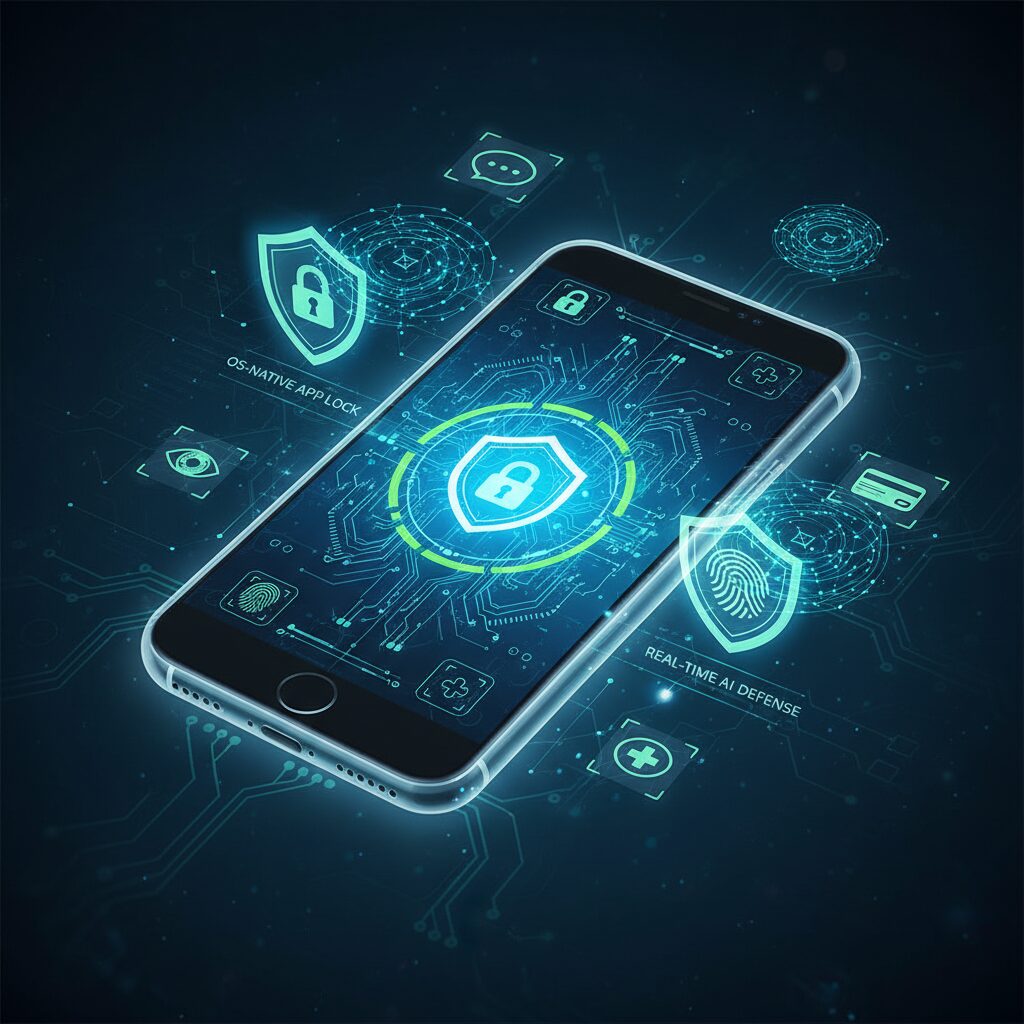
In Android 16 and 17, application security shifts from optional add‑ons to a deeply integrated, OS‑native capability. Google’s decision to standardize app‑level protection marks a clear break from the long era in which users relied on OEM features or third‑party overlays. **The core idea is simple but profound: app locking is no longer a workaround, but a first‑class security primitive built into Android itself.**
The most visible change arrives with the Native App Lock API planned for Android 17. By introducing the LOCK_APPS permission at the framework level, Google enables individual apps to be locked directly from the launcher context menu, without any screen‑overlay tricks. Android Police reports that this API operates at the kernel and system service layers, eliminating the instability and spoofing risks associated with “draw over app” methods that malware has abused for years.
| Security Feature | Technical Scope | Status in 2026 |
|---|---|---|
| Private Space | Profile‑level app isolation | Standard since Android 15 |
| Native App Lock API | Per‑app biometric enforcement | Rolling out with Android 17 |
| Real‑time Fraud Detection | System‑wide AI monitoring | Enhanced in Android 16 |
What makes this evolution particularly compelling is its interaction with Android 16’s AI‑driven defense layer. Gemini AI is not limited to reactive malware scanning; it continuously evaluates message content, call metadata, and UI behavior patterns. According to Google’s own security briefings summarized by ScrumLaunch, the system can detect phishing flows or fake login overlays in real time and suspend the offending process before credentials are entered.
**This transforms app locking from a static gate into a dynamic response mechanism.** For example, when Gemini AI identifies a suspicious SMS containing a banking lure, the OS can proactively enforce an app lock on financial applications, even if the user normally accesses them without friction. This aligns closely with zero‑trust principles advocated by security researchers at institutions such as NIST, where continuous verification replaces one‑time authentication.
Performance concerns, historically a weakness of always‑on security, are mitigated by updates to Android Runtime. ART optimizations allow background monitoring with minimal battery impact, a point emphasized in comparative analyses by Cashify. The result is persistent surveillance of app behavior that feels invisible to the user but materially raises the cost of attack.
From a market perspective, this standardization also addresses Android’s long‑standing fragmentation problem. Developers no longer need to support dozens of OEM‑specific APIs to offer secure app locking. Instead, they can rely on a unified interface backed by Google’s security update pipeline. Analysts cited by Android Police note that this dramatically lowers the barrier for smaller developers to implement bank‑grade protection.
Crucially, these defenses operate without exporting sensitive data off‑device. Google emphasizes that message analysis and behavioral inference occur locally whenever possible, echoing privacy‑preserving design principles promoted by academic research in mobile security. **In an era of AI‑assisted fraud, Android 16 and 17 demonstrate that effective defense must be both native and intelligent.**
The Rise of Behavioral Biometrics and Continuous Authentication
In 2026, behavioral biometrics and continuous authentication are redefining how mobile security works, moving beyond one-time identity checks toward an always-on trust model. Unlike fingerprints or facial scans that verify who you are at a single moment, behavioral biometrics quietly confirm who you continue to be, based on how you naturally use your device. This shift is gaining momentum as attackers increasingly bypass static credentials through phishing automation and AI-generated deepfakes, according to analysis from leading identity-security researchers.
Behavioral signals include gait patterns captured by accelerometers, typing cadence, swipe pressure, and even how a device is held. **These traits are difficult to steal, hard to imitate, and constantly refreshed**, which makes them ideal for zero-trust mobile environments. Research cited by biometric vendors and standards bodies indicates that gait recognition alone can reach accuracy rates above 90 percent in controlled conditions, without requiring any conscious user action.
| Behavioral Signal | Sensor Used | Security Benefit |
|---|---|---|
| Gait pattern | Accelerometer, Gyroscope | Detects device snatching or abnormal movement |
| Typing rhythm | Touchscreen | Flags account takeover attempts |
| Grip and posture | Motion sensors | Validates owner during ongoing use |
Continuous authentication applies these signals in real time. If behavior suddenly deviates, such as when a stolen phone is carried by someone else, the system can instantly lock sensitive apps or require stronger verification. According to industry forecasts on the biometric market, this approach is a key driver behind the sector’s double-digit growth through the late 2020s.
Importantly, most modern implementations process data entirely on-device. This design choice, emphasized by major OS vendors and privacy advocates, ensures that **behavioral profiles remain private while still delivering adaptive, high-friction security only when risk truly rises**.
Multi-Modal Biometrics: Combining Face, Fingerprint, and Vein Scanning
Multi-modal biometrics has emerged as a decisive response to the growing weaknesses of single-factor authentication in 2026. Instead of relying solely on face or fingerprint recognition, modern mobile security systems now combine multiple biological signals to verify identity with far greater confidence. **By layering face, fingerprint, and vein scanning, smartphones can dramatically reduce false acceptance rates while maintaining everyday usability.**
This approach is grounded in a simple reality acknowledged by institutions such as NIST and IDEMIA: every biometric modality has its own failure modes. Facial recognition can be challenged by high-quality deepfakes, fingerprints by sophisticated molds, and behavioral signals by environmental noise. When these signals are evaluated together, however, the probability of a successful spoof attack drops exponentially rather than linearly.
| Biometric Signal | Strength | Primary Risk |
|---|---|---|
| 3D Face Recognition | Fast, contactless | Deepfake and mask attacks |
| Fingerprint | Mature, low friction | Replica fingerprints |
| Vein Scanning | Extremely hard to forge | Sensor cost |
Vein recognition plays a particularly important role in this combination. Because it analyzes patterns beneath the skin using near-infrared light, it is widely regarded as one of the most forgery-resistant biometrics available. According to biometric technology providers such as IDEMIA, internal biological features offer a level of assurance that external traits alone cannot achieve.
In practical terms, multi-modal systems are adaptive rather than rigid. Low-risk actions may require only facial recognition, while higher-risk scenarios, such as accessing financial or health data, silently add fingerprint or vein verification in the background. **This dynamic orchestration allows security to scale with risk, not inconvenience.**
Market data also supports this shift. Analysts tracking the biometric authentication market report sustained double-digit growth through the late 2020s, driven largely by enterprise and government demand for multi-modal solutions. As these technologies move from high-end devices into mainstream smartphones, users increasingly benefit from protection that feels invisible yet remains exceptionally resilient.
Adaptive MFA and AI-Driven Risk Scoring Explained
Adaptive MFA and AI-driven risk scoring represent a decisive shift from static authentication toward continuously evaluated trust in 2026. Instead of asking every user for the same credentials every time, modern mobile platforms now assess context, behavior, and intent in real time, and then decide how much friction is truly necessary. **This approach reduces both security risk and user fatigue at the same time**, which is why it has rapidly become the default model for high‑value applications.
At the core of Adaptive MFA is real-time risk scoring powered by machine learning. According to analyses cited by major identity security vendors and standards bodies such as NIST, dozens of signals are evaluated within milliseconds. Location consistency, device fingerprint stability, network reputation, and subtle behavioral biometrics are fused into a single probabilistic score. **Authentication is no longer a yes-or-no gate, but a sliding scale of trust** that adjusts dynamically with every interaction.
| Risk Level | Typical Context | Authentication Response |
|---|---|---|
| Low | Home location, known device, normal behavior | Silent pass or biometric-only unlock |
| Medium | New network or time anomaly | Step-up biometric verification |
| High | Foreign location, behavior deviation | Access block or hardware-backed MFA |
What makes 2026 distinct is the introduction of AI reasoning engines on-device. These systems do not evaluate events in isolation. They correlate sequences of actions across apps and system settings. **If a suspicious link click is followed by security-setting changes and an immediate attempt to open a banking app, the AI infers active compromise rather than coincidence**, and can proactively lock sensitive applications before damage occurs.
Security research referenced by industry analysts shows that organizations adopting adaptive, risk-based authentication have reduced account takeover incidents by up to 98 percent compared with password-centric models. This improvement is not only due to stronger checks, but because attackers are forced into unpredictable, high-friction paths that expose them faster. Adaptive MFA therefore functions as both a shield and an early-warning system.
In practical terms, Adaptive MFA transforms authentication from a ritual into an intelligent conversation between user and device, where trust is continuously earned, measured, and adjusted.
As mobile devices increasingly act as wallets, identity documents, and health records, this adaptive model aligns security with real human behavior. It does not assume that trust granted once should last forever. Instead, it reflects a zero-trust reality where every action is verified in context, quietly and efficiently, exactly when it matters most.
How Side-Loading Laws Are Changing the Mobile Security Landscape
The legalization of side-loading under new mobile competition laws is quietly but fundamentally reshaping the mobile security landscape. Until recently, closed ecosystems, especially on iOS, relied on centralized app store reviews as a primary trust anchor. With side-loading now permitted, that assumption no longer fully applies, and security responsibility is being redistributed from platforms to operating systems and end users.
From a security engineering perspective, this shift removes what many researchers described as a “single choke point.” According to analyses by Apple and independent security academics, centralized review processes historically blocked entire classes of malware, such as repackaged trojans and credential-stealing overlays, before they ever reached users. Side-loading weakens this preventive layer and forces defenses to operate at runtime instead.
This change accelerates a move from pre-install trust to continuous verification. Modern mobile OS versions increasingly assume that any installed app could be hostile, regardless of its origin. Behavioral monitoring, permission anomaly detection, and OS-native app isolation are no longer optional enhancements but core safeguards.
| Security Dimension | Before Side-Loading | After Side-Loading |
|---|---|---|
| Primary trust model | App store vetting | OS-level continuous monitoring |
| Malware entry point | Store submission | Any external installer |
| User responsibility | Low to moderate | Significantly higher |
Regulators expected increased competition and innovation, but security teams observed a parallel rise in social engineering techniques. Security advisories cited by Japan’s IPA note that attackers increasingly disguise malicious installers as “alternative app stores” or “security tools,” exploiting users’ unfamiliarity with side-loading workflows. These attacks succeed not through technical exploits, but through persuasive UI and urgency-driven messaging.
As a countermeasure, OS vendors are embedding stronger guardrails directly into the platform. Runtime permission auditing, automatic revocation of unused privileges, and biometric re-authentication when sensitive apps are launched after risky events are all direct responses to side-loading risk. Google’s security research teams have emphasized that post-install signals, not download origin, now drive threat detection accuracy.
In practical terms, side-loading laws are transforming mobile security from a gatekeeping model into a resilience model. Instead of assuming apps are safe until proven dangerous, modern mobile systems increasingly assume the opposite and continuously prove safety through context, behavior, and identity. This philosophical shift may be less visible to users, but it defines how secure mobile computing remains viable in an open app distribution era.
Passkeys and the End of Passwords in Financial Apps
In financial apps, the shift from passwords to passkeys has become one of the most decisive security transformations in 2026. Traditional passwords, even when combined with one-time codes, have proven increasingly fragile against AI-driven phishing and social engineering. **Passkeys fundamentally change this equation by removing shared secrets altogether**, replacing them with device-bound cryptographic credentials protected by native biometrics.
This transition is not theoretical. Major Japanese financial institutions, including MUFG Bank and online securities platforms under the same group, began full-scale passkey adoption in 2026. According to their public disclosures, users can now complete logins and transactions using Face ID or fingerprint authentication only, without entering IDs or passwords. This design directly aligns with standards promoted by the FIDO Alliance and supported by platform providers such as Apple and Google.
The core security advantage of passkeys lies in their resistance to phishing. When a user attempts to authenticate, the passkey protocol verifies the legitimate domain at the OS level. Even if a highly realistic fake banking site is generated by AI, the authentication request is automatically rejected due to domain mismatch. **This makes credential theft via phishing technically impossible**, rather than merely harder, a distinction emphasized repeatedly by security researchers at NIST and FIDO.
| Aspect | Passwords | Passkeys |
|---|---|---|
| Secret storage | Shared server-side hashes | Private key stored on device |
| Phishing resistance | Low | Very high |
| User experience | Manual input required | Biometric, one tap |
Another critical factor is regulatory pressure. Following repeated large-scale data breaches in Japan and revisions to the Personal Information Protection Law, financial service providers are now expected to minimize the retention of sensitive authentication data. Passkeys help meet this requirement because servers never store reusable credentials. According to guidance from Japan’s Digital Agency, this architecture significantly reduces the legal and operational impact of potential breaches.
From a usability perspective, the benefits are equally compelling. Studies referenced by platform vendors show that biometric-based logins reduce abandonment rates and login errors, especially among older users. **Security is no longer achieved by adding friction, but by embedding trust directly into the device itself**. OS-native biometric systems, backed by secure enclaves, handle authentication in milliseconds without exposing data to applications.
However, the end of passwords does not mean the end of risk. Experts caution that device security becomes paramount. If a smartphone is compromised at the OS level, the trust model collapses. This is why passkeys are increasingly deployed alongside continuous authentication and OS-level app protection. Financial apps are no longer secured in isolation but as part of an integrated, device-centric security posture.
In this context, passkeys represent more than a login upgrade. They signal a broader redefinition of digital identity in finance, where **the device, the user’s biometrics, and cryptography converge into a single trust anchor**. For users who value both security and convenience, the disappearance of passwords from financial apps is not a loss, but a long-overdue evolution.
The Limits of AI Security and the Emerging 2026 Data Challenge
As AI-driven security becomes the default layer of defense in mobile operating systems, its limitations are becoming clearer rather than disappearing. In 2026, the industry is facing what many researchers have long warned about: a structural shortage of high-quality, human-generated data needed to continuously train and validate security AI models. This challenge is not theoretical anymore, and it directly affects how reliably AI can distinguish legitimate user behavior from increasingly sophisticated attacks.
According to analyses shared by AI researchers and industry observers, including discussions referenced by OpenAI-affiliated commentators and academic circles, the supply of fresh, high-signal text and behavioral data on the open internet is rapidly declining. **Large language models and security classifiers are now frequently trained on content that already contains AI-generated patterns**, which introduces feedback loops and statistical bias. As a result, anomaly detection systems may become overly confident while silently losing precision.
| Data Source | Strength | Security Risk |
|---|---|---|
| Human-generated data | High semantic diversity | Rapid depletion by 2026 |
| Synthetic data | Scalable and controllable | Model bias and overfitting |
To compensate for this shortage, the security industry has embraced synthetic data at scale. Attack scenarios, phishing flows, and credential-stuffing behaviors are now simulated by AI itself and fed back into defensive models. This approach has clear benefits, especially for covering rare or extreme cases, but it also creates a subtle risk. **When both attackers and defenders rely on similar generative techniques, their behaviors begin to converge**, reducing the defender’s ability to detect truly novel threats.
Another emerging limitation lies in context awareness. Even the most advanced AI reasoning engines introduced in 2026 remain probabilistic systems. They infer intent from correlations, not understanding. In edge cases such as shared devices, accessibility use, or abrupt lifestyle changes, AI-based security may misclassify legitimate actions as hostile. Experts in applied machine learning caution that false positives in security contexts are not merely inconveniences; they can lock users out of financial or medical services at critical moments.
The rise of what analysts call the “physical AI” era further complicates the situation. Security models now ingest signals from sensors, location beacons, and environmental data, dramatically expanding the attack surface. While this improves resilience against certain threats, it also increases dependency on complex data pipelines. **A single corrupted data stream can cascade through the system**, leading to systemic misjudgments that are difficult to audit after the fact.
Ultimately, the 2026 data challenge forces a philosophical shift in how AI security is evaluated. Instead of assuming constant improvement, organizations and users alike must accept that AI has ceilings shaped by data entropy and human behavior itself. Leading security researchers emphasize that transparency, human oversight, and periodic model retraining with verified real-world data are not optional safeguards, but essential counterweights to the growing opacity of AI-driven defense.
参考文献
- ScrumLaunch:iOS 19 vs. Android 16 – Mobile OS Comparison
- Android Police:Android’s Native App Lock Feature May Arrive Next Year
- Aware:AI, Fraud, and Identity: The Biggest Biometrics Trends for 2026
- Biotime Technologies:Biometrics in 2026: Which Trends Will Transform Security?
- Security Boulevard:Adaptive MFA: The Future of Dynamic Identity Security
- Auth0:What Is Biometric Authentication?