
Smartphones are no longer just communication tools or social media hubs. In 2026, they are becoming intelligent agents that think, summarize, translate, and even anticipate our needs in real time.
Flagship chips such as Snapdragon 8 Elite Gen 5 and Apple A19 Pro now deliver unprecedented on-device AI performance, while compact language models like MobileLLM-Pro prove that even 1B-parameter models can outperform larger rivals. This technological leap is not theoretical—it is already reshaping consumer behavior, business workflows, and platform competition.
Japan, long known as an iPhone-dominant market, is experiencing a historic shift as Android surpasses iOS in market share. At the same time, over one-third of users actively use generative AI, with nearly 80% of teenagers accessing it primarily through smartphones. By examining silicon innovation, AI model optimization, real-world use cases, and regulatory frameworks, you will gain a clear, data-driven understanding of where mobile AI is heading next—and what it means for the global gadget ecosystem.
- From Cloud AI to On-Device Intelligence: The Beginning of the AI-Native Smartphone Era
- Silicon Wars 2026: Snapdragon 8 Elite Gen 5, Dimensity 9500, A19 Pro, and Tensor G5 Compared
- AI Benchmark Scores and Power Efficiency: What 16,000+ Points Really Mean for Users
- The Rise of Small Language Models: How MobileLLM-Pro Achieves 1B-Parameter Breakthroughs
- Quantization, 128K Context Windows, and Offline AI: Why Edge Models Are Becoming Practical
- Japan’s Smartphone OS Reversal: Android Surpasses iPhone for the First Time
- Generative AI Adoption in Japan: 35.7% Usage and the Search Behavior Shift
- Platform Strategies in Action: Apple Intelligence, Galaxy AI, and Google Gemini
- Real-World Use Cases: From Cookpad’s Recipe AI to Tabelog’s Conversational Search
- AI in Logistics, Education, and Knowledge Work: Closing Japan’s Labor Gap
- Privacy, Regulation, and Hallucination Risks: Building Trust in Mobile AI
- The Agent-Centric Future: From App-Based Interfaces to Intent-Driven Smartphones
- 参考文献
From Cloud AI to On-Device Intelligence: The Beginning of the AI-Native Smartphone Era
As of early 2026, the epicenter of generative AI has clearly shifted from massive cloud data centers to the device in your hand. What began in 2023 as a cloud-dominated revolution is now entering a new phase defined by on-device intelligence, often referred to as edge AI. Smartphones are no longer just terminals connected to powerful servers; they are becoming self-contained AI engines.
This transition marks the true beginning of the AI-native smartphone era. Instead of sending every voice command, image, or query to the cloud, next-generation devices process complex AI workloads locally. According to AI-Benchmark rankings published in early 2026, flagship mobile SoCs such as Qualcomm’s Snapdragon 8 Elite Gen 5 achieve AI scores exceeding 16,000 points, dramatically outperforming many previous-generation chips. This leap is not incremental; it fundamentally changes what can run offline.
| Chipset | AI Benchmark Score | Notable Characteristic |
|---|---|---|
| Snapdragon 8 Elite Gen 5 | 16,226 | 37% faster NPU, 45% better efficiency |
| Dimensity 9500 | 15,015 | All big-core design |
| Apple A19 Pro | 7,005 | Heterogeneous AI processing |
These numbers matter because AI performance is no longer a background specification. It directly shapes user experience. Near-zero latency voice interactions, real-time multimodal processing of text, images, and video, and always-on assistants become feasible only when neural processing units are both powerful and energy efficient. Qualcomm reports up to 45% improvement in performance per watt, enabling persistent AI features without sacrificing battery life.
At the same time, breakthroughs in compact language models accelerate this shift. The MobileLLM-Pro technical report on arXiv demonstrates that a 1-billion-parameter model can outperform earlier 1B-class models while supporting a 128k token context window. This means a smartphone can analyze hundreds of pages of documents or hours of meeting transcripts entirely offline. The implication is profound: intelligence no longer depends on constant connectivity.
This architectural transformation also responds to growing privacy concerns. Japanese users, in particular, show heightened sensitivity toward personal data usage, as highlighted in surveys by MMD Research Institute. On-device processing minimizes data transmission, reducing exposure risks while maintaining responsiveness. Apple’s approach of prioritizing on-device computation before selectively using secure cloud resources reflects this broader industry direction.
What defines an AI-native smartphone is not just higher benchmark scores, but a new design philosophy. Silicon is optimized around NPUs. Operating systems are rebuilt to orchestrate heterogeneous computing across CPU, GPU, and neural engines. Applications are increasingly conceived with embedded AI at their core rather than as add-on features.
In previous eras, smartphones were gateways to the cloud. In this new era, they are autonomous cognitive nodes. The migration from cloud AI to on-device intelligence does not eliminate the cloud, but it redistributes power. Intelligence becomes ambient, immediate, and personal. That redistribution is what truly signals the dawn of the AI-native smartphone age.
Silicon Wars 2026: Snapdragon 8 Elite Gen 5, Dimensity 9500, A19 Pro, and Tensor G5 Compared
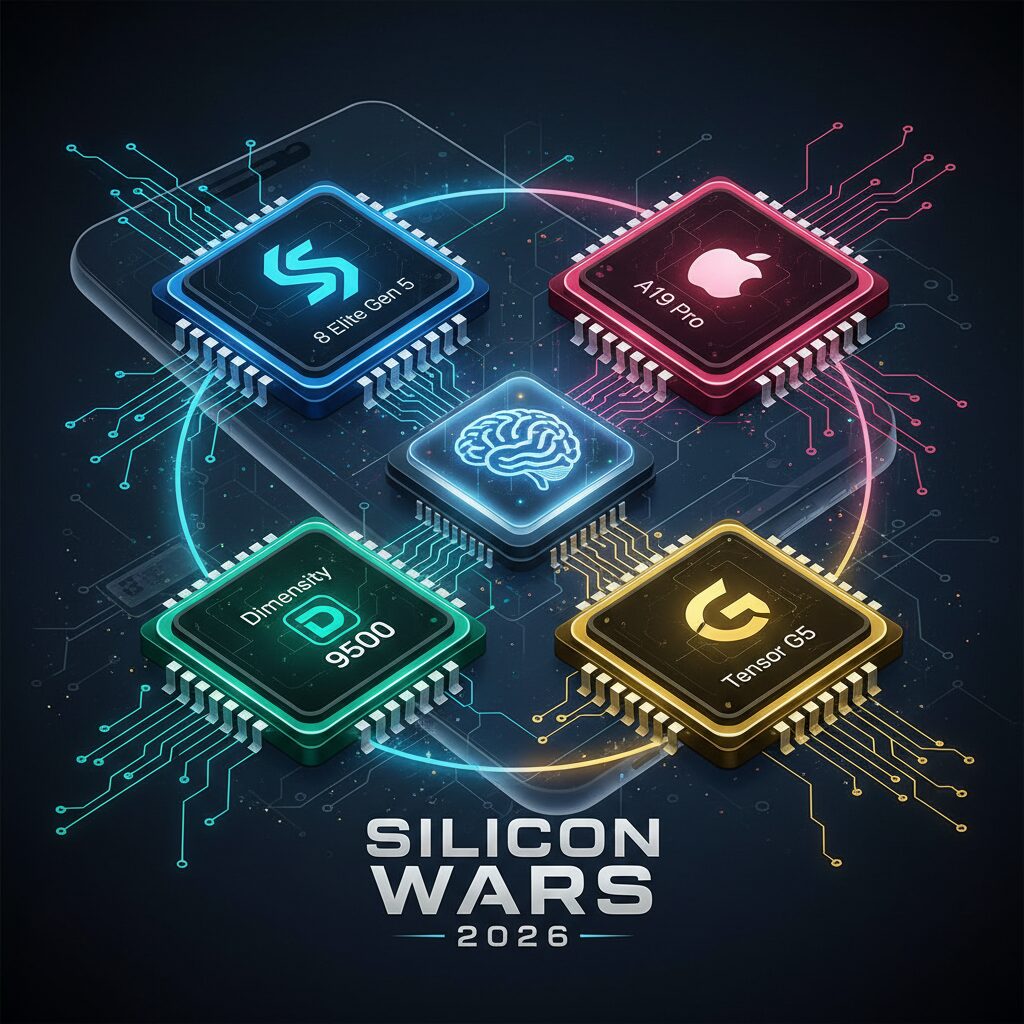
The battle for AI supremacy in 2026 is no longer about raw CPU clocks alone. It is about how efficiently each chip executes on-device generative AI, how fast it responds in real time, and how intelligently it balances performance with battery life.
According to AI-Benchmark rankings and vendor disclosures, four flagship SoCs define this year’s competition: Qualcomm’s Snapdragon 8 Elite Gen 5, MediaTek’s Dimensity 9500, Apple’s A19 Pro, and Google’s Tensor G5.
| Chipset | AI Benchmark Score | Key AI Architecture Focus |
|---|---|---|
| Snapdragon 8 Elite Gen 5 | 16,226 | Upgraded Hexagon NPU, 37% faster AI |
| Dimensity 9500 | 15,015 | All Big Core design, NPU 9th Gen |
| A19 Pro | 7,005 | Heterogeneous CPU/GPU/Neural Engine |
| Tensor G5 | Near Snapdragon 8 Gen 3 class | Custom TPU optimized for Gemini |
Snapdragon 8 Elite Gen 5 currently leads in synthetic AI inference performance. With a score of 16,226 on AI-Benchmark, it nearly doubles the A19 Pro’s 7,005. Qualcomm reports a 37% NPU performance uplift and 45% better performance-per-watt compared to the prior generation. This matters because on-device multimodal models continuously run in the background, making efficiency just as critical as peak throughput.
Its near-zero latency voice interaction, achieved through end-to-end on-device processing rather than cloud round trips, signals a shift toward truly conversational AI assistants. Support for Unreal Engine 5’s Nanite on mobile further shows how AI acceleration now intersects with advanced graphics rendering.
Dimensity 9500 narrows the gap with a score of 15,015. MediaTek’s All Big Core strategy removes efficiency cores altogether, aiming to complete heavy AI inference bursts quickly and return to idle states faster. This “race-to-sleep” philosophy contrasts with Qualcomm’s balanced efficiency scaling, offering a different interpretation of sustainable AI performance.
Its integration with Wi-Fi 7 and extended range technologies also suggests a broader systems approach, where connectivity and AI co-evolve rather than operate as isolated subsystems.
Apple’s A19 Pro tells a different story. Despite lower benchmark numbers, Apple prioritizes tightly integrated heterogeneous computing. AI workloads dynamically distribute across CPU, GPU, and Neural Engine, particularly benefiting image generation and computational photography. As industry analysts frequently note, Apple optimizes for perceived responsiveness rather than benchmark dominance.
Tensor G5, meanwhile, represents Google’s AI-first philosophy. Built around a mobile TPU architecture tailored for Gemini, it embeds custom instruction pathways for translation, voice recognition, and contextual search. While its raw performance aligns roughly with Snapdragon 8 Gen 3-class silicon, its strength lies in workload specialization rather than universal dominance.
The 2026 silicon war is therefore not a simple race for the highest score. It is a strategic divergence: Qualcomm pushes absolute NPU leadership, MediaTek refines burst efficiency and connectivity synergy, Apple perfects vertical integration, and Google custom-builds for its AI ecosystem. For power users and AI enthusiasts, the real question is no longer “Which chip is fastest?” but “Which architecture best matches your AI workload?”
AI Benchmark Scores and Power Efficiency: What 16,000+ Points Really Mean for Users
When you see an AI benchmark score exceeding 16,000 points, it is easy to assume it is just another spec-sheet victory. However, in 2026, these numbers directly translate into everyday responsiveness, battery behavior, and how often your phone needs the cloud.
According to AI-Benchmark rankings, Snapdragon 8 Elite Gen 5 records 16,226 points, compared with 15,015 for Dimensity 9500 and 7,005 for Apple A19 Pro. These figures are not abstract; they represent measurable differences in on-device inference throughput.
| SoC | AI Benchmark Score | Relative Position |
|---|---|---|
| Snapdragon 8 Elite Gen 5 | 16,226 | Top tier |
| Dimensity 9500 | 15,015 | Near top tier |
| Apple A19 Pro | 7,005 | Mid-high tier |
So what does “16,000+ points” actually mean for users? In practical terms, it enables heavier multimodal models and longer context windows to run locally without stuttering. When summarizing a long PDF or transcribing and analyzing a meeting offline, the difference shows up as seconds saved per query and fewer thermal slowdowns.
More importantly, Qualcomm reports a 37% NPU performance uplift and a 45% improvement in performance per watt over the previous generation. Performance per watt is the hidden metric that determines whether AI feels magical or annoying.
Higher raw scores without efficiency would drain batteries quickly. With improved efficiency, continuous features such as real-time translation, voice assistants with near-zero latency, and background image enhancement can stay active without cutting screen-on time dramatically.
MediaTek’s approach with its all-big-core design reflects a similar philosophy: finish intensive AI inference quickly, then return to low activity. This burst processing model reduces sustained power draw, which matters during gaming with AI upscaling or live video effects.
According to industry analyses cited by The Futurum Group, flagship chips are now designed assuming persistent AI workloads rather than occasional bursts. That shift means benchmark scores increasingly correlate with daily fluidity, not just peak lab performance.
For users, the benefits appear in subtle but compounding ways: faster on-device search suggestions, smoother generative photo edits, and reliable offline assistance during travel. A 16,000+ score does not mean your phone is twice as “smart” as a 7,000-point device, but it often means more tasks stay local, private, and instant.
Ultimately, AI benchmark numbers become meaningful when paired with efficiency metrics. In 2026, the real victory is not just higher scores, but sustaining advanced AI experiences all day without reaching for a charger.
The Rise of Small Language Models: How MobileLLM-Pro Achieves 1B-Parameter Breakthroughs
The rapid evolution of on-device AI would not have been possible without a parallel breakthrough in model efficiency. In 2026, the spotlight has shifted from massive 7B or 13B parameter models to compact yet highly optimized Small Language Models. MobileLLM-Pro represents a decisive turning point in this shift toward “small but powerful” AI.
According to its technical report published on arXiv in late 2025, MobileLLM-Pro achieves state-of-the-art performance with just 1 billion parameters. This challenges the long-standing assumption that larger parameter counts automatically translate into better reasoning or language understanding.
What makes this breakthrough remarkable is not merely size reduction, but performance density. Benchmarks show that MobileLLM-Pro surpasses other 1B-class models such as Llama 3.2-1B and Gemma 3-1B across major evaluation tasks, demonstrating that architectural and training innovations can outweigh brute-force scaling.
| Model | Parameters | Context Window | Positioning |
|---|---|---|---|
| MobileLLM-Pro | 1B | 128k tokens | On-device optimized SLM |
| Llama 3.2-1B | 1B | Standard | General-purpose compact LLM |
| Gemma 3-1B | 1B | Standard | Lightweight open model |
One of the most striking specifications is the 128,000-token context window. On a smartphone, this enables offline analysis of hundreds of pages of PDFs or multi-hour meeting transcripts. Instead of sending sensitive data to the cloud, users can perform long-context reasoning entirely on-device.
This capability becomes especially meaningful in regions where privacy sensitivity is high. As Japanese regulatory guidelines emphasize careful handling of personal and confidential data, the ability to process long documents locally is not just a technical milestone but a strategic advantage.
The real engineering leap, however, lies in quantization. MobileLLM-Pro adopts 4-bit quantization with Quantization-Aware Training combined with Self-Distillation. Even at 4-bit precision, inference accuracy remains largely intact, dramatically reducing memory bandwidth and power consumption.
For smartphones constrained by thermal limits and battery capacity, this is transformative. Smaller memory footprints translate into faster token generation and sustained performance without aggressive throttling. In practical terms, this means conversational AI that feels instantaneous rather than delayed.
Industry analysts increasingly describe this shift as a “parameter efficiency race” rather than a scale race. Instead of competing on sheer size, model developers now compete on compression techniques, training curriculum design, and hardware-aware optimization.
MobileLLM-Pro embodies this philosophy. By proving that 1B parameters can outperform larger legacy architectures in specific benchmarks, it signals a broader industry direction: the future of mobile AI belongs to models engineered for silicon, not just scaled for servers.
Quantization, 128K Context Windows, and Offline AI: Why Edge Models Are Becoming Practical
Until recently, running advanced generative AI fully on a smartphone felt unrealistic.
Large models required massive memory, constant cloud connectivity, and significant power consumption. However, three technological breakthroughs have changed that equation: aggressive quantization, ultra-long context windows, and architectures optimized for offline inference.
Edge models are no longer experimental demos. They are becoming practical tools that live inside your device.
Quantization: Doing More with Fewer Bits
At the heart of this shift is quantization, a technique that reduces the numerical precision of model weights. Instead of using 16-bit or 32-bit representations, modern mobile models operate at 8-bit or even 4-bit precision.
The MobileLLM-Pro technical report on arXiv explains that 4-bit quantization, combined with quantization-aware training and self-distillation, maintains strong inference accuracy while dramatically reducing memory footprint. This is critical on smartphones, where memory bandwidth and thermal limits are strict.
| Precision | Memory Usage | Mobile Impact |
|---|---|---|
| 16-bit | High | Thermal and battery strain |
| 8-bit | Medium | Balanced performance |
| 4-bit | Low | Efficient on-device AI |
By compressing weights to 4-bit precision, models can fit comfortably within mobile RAM constraints. This enables faster token generation and lower energy consumption, directly translating into better battery life.
Quantization is not just compression. It is the enabler of always-on AI.
128K Context Windows: Memory That Feels Human
Another breakthrough is the expansion of context windows. MobileLLM-Pro supports up to 128,000 tokens, which is exceptionally large for an on-device model.
In practical terms, this means a smartphone can process hundreds of pages of PDF documents or hours of meeting transcripts locally. Instead of summarizing in fragments, users can ask follow-up questions that reference earlier sections without losing continuity.
This long-context capability fundamentally changes edge AI from a “quick reply tool” into a “portable research assistant.” For professionals reviewing contracts on a train or students analyzing lecture notes offline, the difference is substantial.
Large context windows also reduce dependency on repeated cloud calls, minimizing latency and preserving user privacy.
Offline AI: Performance Without the Cloud
The final pillar is offline execution. According to AI-Benchmark rankings, modern mobile SoCs such as Snapdragon 8 Elite Gen 5 demonstrate significant AI inference gains over previous generations, making sustained on-device workloads feasible.
When inference happens entirely on the device, three advantages emerge. First, latency approaches real-time levels because there is no round-trip to remote servers. Second, sensitive data such as voice recordings or business documents never leaves the device. Third, AI remains usable even in low-connectivity environments.
Offline AI transforms the smartphone into a self-contained intelligence node rather than a thin client for the cloud.
This architectural shift aligns with growing privacy awareness, particularly in markets like Japan where users are cautious about data sharing. By combining 4-bit quantized models, 128K context memory, and increasingly powerful NPUs, edge AI has crossed the threshold from possibility to practicality.
The result is a new computing paradigm: intelligence that is fast, private, and available anytime, even in airplane mode.
Japan’s Smartphone OS Reversal: Android Surpasses iPhone for the First Time
For more than a decade, Japan was widely known as an “iPhone kingdom.” However, that narrative shifted in 2025. According to a survey by MMD Research Institute conducted in September 2025, Android reached 51.4% share of the domestic smartphone OS market, while iPhone fell to 48.3%. It is the first time in years that Android has overtaken iPhone on a nationwide basis.
This reversal is not a temporary fluctuation but a structural change driven by AI, pricing, and mid-range competition. The shift reflects how Japanese consumers are redefining value in the AI-native era.
| OS | Share (Sep 2025) | YoY Change |
|---|---|---|
| Android | 51.4% | +1.3pt |
| iPhone | 48.3% | -1.3pt |
The numbers themselves may appear close, but the psychological impact is significant. Japan has long been an outlier among advanced economies, where Android typically dominates. Crossing the 50% threshold gives Android symbolic momentum among carriers, retailers, and app developers.
Several forces converged to create this turning point. First, the depreciation of the yen has pushed iPhone prices higher, making flagship upgrades increasingly expensive. At the same time, Google Pixel and Samsung Galaxy aggressively promoted on-device AI capabilities, especially in mid-range models. As ITmedia Mobile reported, AI-equipped smartphones have rapidly expanded beyond premium tiers, with broader adoption expected across mid-priced devices.
In other words, Android’s growth is closely tied to the democratization of AI features. Consumers are no longer evaluating smartphones purely on camera megapixels or brand prestige. Instead, they are asking practical questions: Can this device summarize meetings offline? Can it translate conversations in real time? Can it search visually and contextually?
Interestingly, the reversal does not mean uniform preference across demographics. MMD’s data shows strong polarization. Among women in their 20s, iPhone usage remains as high as 81.0%, while Android is dominant among older male users. This suggests that Android’s majority is built on breadth across price-sensitive and practicality-driven segments rather than cultural dominance among youth.
Carrier dynamics also matter. SoftBank maintains a higher iPhone ratio, while Rakuten Mobile shows stronger Android adoption, reflecting different subsidy strategies and target audiences. The OS battle in Japan is therefore not only a consumer choice issue but also a distribution and pricing strategy outcome.
From an industry perspective, Android surpassing iPhone signals a rebalancing of negotiation power. Device makers leveraging Qualcomm’s Snapdragon 8 Elite Gen 5 or MediaTek’s Dimensity 9500 can highlight benchmark-leading AI scores and on-device multimodal processing. As AI-Benchmark rankings indicate, these chipsets significantly outperform Apple’s A19 Pro in raw AI scoring, giving Android vendors a clear marketing narrative centered on performance.
The 2025–2026 OS reversal marks Japan’s transition from a brand-driven market to an AI-performance-driven market. Whether iPhone regains momentum or Android consolidates its lead will depend less on ecosystem loyalty and more on who delivers the most tangible, trustworthy, and localized AI experience to Japanese users.
Generative AI Adoption in Japan: 35.7% Usage and the Search Behavior Shift
Generative AI usage in Japan has reached 35.7%, marking a clear transition from curiosity to daily utility. According to surveys by MMD Institute and Mobile Society Research Institute, adoption is no longer limited to early adopters or IT professionals. It is spreading across age groups, with smartphones serving as the primary access point.
Among teenagers, nearly 80% of those who use generative AI do so via smartphones. This mobile-first behavior is critical. It means AI is not experienced as a separate tool on a PC, but as an always-available layer embedded in search, messaging, and everyday apps.
Usage patterns clearly reflect this behavioral change. Data reported by ケータイ Watch based on MMD research shows that AI-powered search functions are the most common use case at 61.7%, surpassing traditional chatbot-style conversations and creative tasks such as translation or image correction.
| Category | Usage Rate |
|---|---|
| AI-powered Search | 61.7% |
| Chatbot Conversations | 35.5% |
| Translation / Image Editing | 31.8% |
This indicates that generative AI is increasingly replacing or augmenting conventional keyword-based search. Instead of typing fragmented keywords into a search engine, users now input full questions or contextual requests. The cognitive load shifts from “finding links” to “evaluating synthesized answers.”
Service preference data reinforces this trend. ChatGPT leads with 80.6% recognition and usage among AI users, followed by Google Gemini at 50.8% and Microsoft Copilot at 39.1%. The dominance of conversational interfaces suggests that natural language has become the new search bar.
Importantly, this shift alters the SEO landscape. Traditional search optimization focused on ranking for specific keywords. In contrast, AI-mediated search prioritizes semantic relevance, structured data, and authoritative signals that large language models can interpret and summarize. Content is no longer competing only for clicks, but for inclusion in generated answers.
Another notable behavioral change is session depth. Users tend to engage in iterative questioning—refining, expanding, and contextualizing their queries within a single conversation thread. This reduces bounce behavior seen in classic search and increases dependency on a single AI interface as an information gateway.
For marketers and platform operators, the implication is clear. Discovery is shifting from link-based navigation to answer-based mediation. Visibility now depends on whether your information is structured, trustworthy, and machine-readable enough to be surfaced in AI responses.
At 35.7% adoption, Japan is not yet fully saturated. However, the behavioral inflection point has already occurred. Search is no longer merely about retrieval. It is becoming dialogue-driven, context-aware, and increasingly mobile-native.
Platform Strategies in Action: Apple Intelligence, Galaxy AI, and Google Gemini
Platform competition in 2026 is no longer about raw AI benchmarks alone. It is about how deeply AI is woven into the operating system and daily workflows. Apple Intelligence, Galaxy AI, and Google Gemini each represent a distinct platform strategy, and those differences directly shape user experience and lock-in.
The battlefield has shifted from apps to ecosystems. According to ITmedia Mobile, by 2025 one in three smartphones shipped globally is expected to feature built-in generative AI, signaling that AI is becoming infrastructure rather than an optional feature. What matters now is execution.
| Platform | Core Strategy | Differentiation Focus |
|---|---|---|
| Apple Intelligence | On-device first + Private Cloud Compute | Privacy and writing assistance |
| Galaxy AI | Hybrid AI with strong NPU performance | Real-time translation and visual search |
| Google Gemini (Pixel) | AI-native OS integration | Agent-like multimodal interaction |
Apple Intelligence entered the Japanese market with a delay but emphasized localization and privacy. As reported by Ops Today, Japanese language support officially began in March 2025, with tuning for honorific expressions and contextual nuance. Features like Writing Tools transform rough notes into business-ready emails, aligning well with Japan’s formal communication culture.
Apple’s architectural bet is trust. By prioritizing on-device processing and limiting cloud reliance to Private Cloud Compute, Apple addresses privacy sensitivity highlighted in MMD Research Institute surveys. In a market where users remain cautious about data sharing, this positioning strengthens long-term loyalty rather than short-term feature hype.
Samsung’s Galaxy AI takes a more performance-driven and practical route. Powered by high NPU throughput such as Snapdragon 8 Elite Gen 5, Galaxy devices enable real-time interpretation directly on the device. This is not just a travel convenience. With inbound tourism rising, retail and hospitality businesses in Japan increasingly use live translation as an operational tool.
The “Circle to Search” capability further demonstrates Samsung’s platform thinking. By allowing users to circle objects on screen to initiate contextual search, Galaxy AI shortens the path from curiosity to commerce. This tight coupling between AI recognition and search intent has attracted attention from the marketing industry because it reshapes product discovery funnels.
Google’s Gemini strategy on Pixel devices goes even further toward an AI-first paradigm. As technology journalist Atsushi Ishikawa noted after Google I/O 2025, Project Astra signals a transition to conversational, camera-aware interfaces. Gemini Live integrates Maps, Gmail, and Calendar so that complex instructions are executed as unified tasks rather than isolated commands.
Pixel is positioned not merely as hardware, but as a native vessel for Gemini. Tensor G5’s custom design prioritizes Google’s AI workloads, enabling efficient translation, image understanding, and multimodal reasoning tightly embedded within Android. This reduces friction between intent and action, a key requirement for agent-style computing.
In action, these three strategies reveal contrasting philosophies. Apple optimizes for controlled integration and privacy assurance. Samsung optimizes for tangible, high-impact utility. Google optimizes for agentic orchestration across services. For power users and gadget enthusiasts, understanding these platform choices is essential, because the true value of AI smartphones in 2026 lies not in isolated features, but in how seamlessly intelligence permeates the entire system.
Real-World Use Cases: From Cookpad’s Recipe AI to Tabelog’s Conversational Search
The true impact of generative AI on smartphones becomes clearest when we look at how leading Japanese platforms are embedding it into everyday user journeys. Rather than positioning AI as a standalone feature, companies such as Cookpad and Tabelog are redesigning core experiences around conversational and assistive intelligence.
These cases demonstrate how AI moves from novelty to infrastructure, quietly reducing friction in tasks that millions of users already perform.
Cookpad: Lowering the Barrier to Creation
Cookpad, Japan’s largest recipe-sharing platform, introduced an AI-powered recipe creation assistant in its iOS app. According to its official support documentation, users can input a rough memo such as “I made a tomato stew with leftover vegetables and added miso as a secret ingredient,” and the AI automatically generates a structured draft including a title, ingredient list, and step-by-step instructions.
This directly addresses a long-standing friction point: manually formatting ingredients and procedures has historically discouraged casual users from posting. By converting unstructured text into publishable content, the AI shifts the cognitive load from formatting to creativity.
| Before AI | With Recipe AI | User Impact |
|---|---|---|
| Manual input of quantities and steps | Auto-generated structured draft | Reduced posting time |
| High effort for casual cooks | Chat-style memo submission | Lower entry barrier |
The strategic significance lies not only in automation, but in activating dormant contributors. As more users document home cooking as a form of life logging, platform engagement deepens without requiring them to master complex UI flows.
Tabelog: From Filters to Dialogue
Tabelog, Japan’s leading restaurant review and reservation platform, has integrated ChatGPT-based functionality to enable conversational restaurant search. Instead of manually applying filters for area, budget, cuisine, and availability, users can express complex intent in natural language.
For example, a query such as “Next Friday in Shibuya, for a business dinner, the guest prefers fish, a quiet private room, around 10,000 yen per person” can be interpreted holistically. The system extracts constraints, matches them against reservable listings, and presents relevant options.
This transition from parameter selection to intent interpretation represents a structural UX shift. According to coverage by AIsmiley, the integration connects conversational AI with Tabelog’s reservation system, ensuring that suggested venues are not only relevant but bookable.
For power users accustomed to traditional filters, this reduces multi-step navigation. For less tech-savvy users, it removes the need to understand category hierarchies at all. In a market where, as MMD Research Institute reports, over 60% of generative AI users leverage it for search-related tasks, this alignment with evolving behavior is particularly strategic.
Together, Cookpad and Tabelog illustrate a broader pattern: AI succeeds when it augments existing habits rather than demanding new ones. By embedding intelligence into recipe logging and restaurant discovery—two culturally central activities in Japan—these platforms show how smartphone-based generative AI becomes invisible, practical, and indispensable.
AI in Logistics, Education, and Knowledge Work: Closing Japan’s Labor Gap
Japan’s labor shortage is no longer a future risk but a present constraint, especially in logistics, education, and knowledge work. As the working-age population shrinks, the role of on-device generative AI on smartphones is shifting from convenience to critical infrastructure.
According to multiple industry reports cited by SoftBank’s enterprise case studies, frontline industries are increasingly adopting AI agents accessible via mobile devices. The key is not replacing workers, but amplifying each individual’s productivity in real time.
Smartphone-based AI is becoming a “pocket co-worker” that scales human capability without requiring additional headcount.
Logistics: Real-Time Intelligence in the Field
In logistics, where the so-called “2024 problem” intensified driver shortages, speed of decision-making directly impacts profitability. Seino Information Service has developed AI agents that allow drivers and warehouse staff to query core systems using natural language from their smartphones.
Instead of logging into complex enterprise software, a worker can ask, “What is tomorrow’s Nagoya shipment status?” The AI retrieves inventory and routing data instantly. This reduces communication lag and eliminates dependency on back-office intermediaries.
| Challenge | AI-Enabled Solution | Impact |
|---|---|---|
| Driver shortages | Voice-based AI access to logistics systems | Faster on-site decisions |
| Information silos | Natural language system queries | Reduced coordination delays |
| Limited PC access | Smartphone-first workflows | Higher field productivity |
The combination of high-performance NPUs such as Snapdragon 8 Elite Gen 5 and lightweight models like MobileLLM-Pro enables these interactions to occur with minimal latency, even on-device. This reduces cloud dependency and improves reliability in warehouse environments with unstable connectivity.
Education: AI as a Force Multiplier for Teachers
Japan’s education sector faces aging faculty demographics and increasing administrative burdens. Kawai Juku has introduced generative AI to draft personalized study plans based on student performance data.
Teachers review and refine AI-generated plans rather than creating them from scratch. This workflow redesign shifts human effort from paperwork to mentorship. According to case examples published by SoftBank’s enterprise solutions, such implementations significantly reduce preparation time while improving responsiveness to individual student needs.
AI does not replace educators; it reallocates their time toward high-value human interaction.
Knowledge Work: From Search to Synthesis
In knowledge-intensive roles, generative AI is transforming smartphones into synthesis engines. MMD Institute reports that 61.7% of Japanese generative AI users employ it primarily for AI-driven search. This signals a shift from keyword retrieval to contextual problem-solving.
Applications like Otter.ai automatically transcribe and summarize meetings, while tools accessible via mobile browsers such as NotePM enhance on-site knowledge retrieval. Workers no longer need to “remember everything”; they need to ask the right question.
When combined with 128k-token context windows available in models like MobileLLM-Pro, professionals can analyze lengthy documents or meeting transcripts directly on mobile devices. This dramatically compresses the cycle between information intake and actionable insight.
By embedding intelligence into everyday workflows, AI reduces the labor gap not by adding people, but by multiplying the cognitive output of each worker.
Privacy, Regulation, and Hallucination Risks: Building Trust in Mobile AI
As mobile AI becomes embedded into everyday workflows, trust has emerged as the decisive factor for long-term adoption.
Performance benchmarks and model size matter, but they are secondary to a more fundamental question: can users rely on the system without compromising their privacy or being misled?
In Japan in particular, where privacy sensitivity is high and regulatory scrutiny is increasing, building trustworthy mobile AI is not optional but essential.
On-device AI architecture plays a central role in strengthening privacy. Unlike traditional cloud-based processing, edge AI minimizes the need to transmit sensitive data externally.
Apple’s approach with on-device processing as the default, and Private Cloud Compute only when necessary, reflects this shift toward data minimization.
Qualcomm and MediaTek similarly emphasize improved power efficiency in their NPUs, enabling persistent AI inference locally without draining battery life.
| Processing Model | Data Flow | Privacy Risk Profile |
|---|---|---|
| Cloud-based AI | Data sent to remote servers | Higher exposure, dependent on provider safeguards |
| On-device AI | Data processed locally | Reduced transmission risk, stronger user control |
Regulatory frameworks are evolving in parallel. According to guidance issued by Japan’s Ministry of Internal Affairs and Communications and the Ministry of Education, Culture, Sports, Science and Technology, organizations are expected to implement clear risk management when handling personal or confidential data through generative AI.
This includes verifying whether user inputs are stored, whether they are used for further training, and whether opt-out mechanisms are available.
Compliance is increasingly becoming a competitive differentiator in the smartphone AI market.
However, privacy is only one dimension of trust. Hallucination risk remains a structural limitation of large language models.
Even compact on-device models such as MobileLLM-Pro, despite their efficiency gains reported on arXiv, are still probabilistic systems that generate outputs based on learned patterns rather than verified facts.
This becomes critical in finance, healthcare, or logistics, where incorrect information can have real-world consequences.
To mitigate this, vendors are implementing Retrieval-Augmented Generation architectures, restricting outputs to verified internal databases or curated knowledge bases.
In enterprise deployments highlighted in Japanese business case studies, AI agents are often connected directly to structured corporate systems rather than open web data.
The future of trustworthy mobile AI lies in constrained intelligence rather than unrestricted creativity.
For consumers, transparency will define confidence. Clear labeling of AI-generated content, visible privacy controls, and explainable system behavior are no longer optional UX enhancements.
They are prerequisites for mainstream acceptance.
As smartphones evolve into persistent AI agents, trust architecture will matter as much as silicon architecture.
In 2026, the brands that succeed will not simply be those with the highest AI benchmark scores.
They will be those that convince users that their data is protected, their outputs are reliable, and their intelligence is accountable.
Only then can mobile AI transition from novelty to indispensable infrastructure.
The Agent-Centric Future: From App-Based Interfaces to Intent-Driven Smartphones
For more than a decade, smartphones have been organized around apps. We tapped icons, switched screens, and manually orchestrated tasks. In 2026, that model is quietly dissolving. The rise of on-device AI and multimodal agents is shifting the center of gravity from app-based interfaces to intent-driven computing.
The user no longer navigates software. The user expresses intent. The AI agent interprets, plans, and executes across multiple services in the background.
From App Launcher to Intent Engine
According to coverage of Google I/O 2025 by respected tech journalist Atsushi Ishikawa, the industry is moving toward a “No-UI” future, where conversation replaces navigation. With Gemini Live and Project Astra, users can issue compound instructions such as finding a meeting location, checking traffic, and suggesting a nearby café in a single request. The system coordinates Maps, Calendar, and search functions without explicit app switching.
This architectural shift is enabled by advances in mobile silicon. Snapdragon 8 Elite Gen 5 and Dimensity 9500 deliver AI benchmark scores exceeding 15,000 points, while Apple’s A19 Pro and Google’s Tensor G5 focus on deep OS-level integration. The result is near-zero latency inference performed directly on the device, removing the friction of cloud round-trips.
| Era | User Action | System Role |
|---|---|---|
| App-Centric | Open and control individual apps | Respond to explicit commands |
| Intent-Driven | State goals in natural language | Plan and execute across services |
Why On-Device AI Changes Everything
Research such as the MobileLLM-Pro technical report on arXiv demonstrates that even 1B-parameter models can support 128k-token context windows with efficient 4-bit quantization. Practically, this means your smartphone can remember long conversations, documents, and behavioral patterns without constant cloud dependence.
Intent-driven smartphones rely on persistent contextual memory. They do not simply answer queries; they understand ongoing objectives.
In Japan, where MMD Research Institute reports growing use of AI for search replacement, this evolution is especially significant. When 61.7% of users already rely on AI-powered search functions, the logical next step is delegation. Instead of searching for restaurants, booking tables, and adding calendar entries separately, users will increasingly instruct their agent to “organize dinner with a client in Shibuya next Friday,” and the system will coordinate reservation platforms, maps, and messaging tools autonomously.
The Strategic Implications
This transformation reshapes competition. Platforms are no longer fighting for home screen real estate; they are competing to become the default agent layer. Apple emphasizes privacy-first on-device processing. Google leverages Gemini integration. Samsung focuses on real-time translation and contextual search. Each strategy aims to control the intent gateway.
The smartphone is evolving from a device you operate to a digital proxy that operates on your behalf. As AI becomes infrastructural in 2026, the winning ecosystems will be those that best interpret human intent, not those with the most colorful icons.
参考文献
- MMD Research Institute:September 2025 Smartphone OS Share Survey
- Mobile Society Research Institute:Devices Used for Generative AI: Around 80% of Teenagers Use Smartphones
- The Futurum Group:Is Snapdragon 8 Elite Gen 5 the Benchmark for Next-Gen Flagship Phones?
- AI-Benchmark:Mobile SoCs AI Performance Ranking
- arXiv:MobileLLM-Pro Technical Report
- ITmedia Mobile:In 2025, One in Three Smartphones Will Feature Generative AI
- K-Tai Watch:ChatGPT Tops Generative AI Popularity Survey, Followed by Gemini and Copilot
- Cookpad Help:AI Assistant for Recipe Creation on iPhone/iPad App
- AIsmiley:Tabelog Integrates ChatGPT with Reservation System