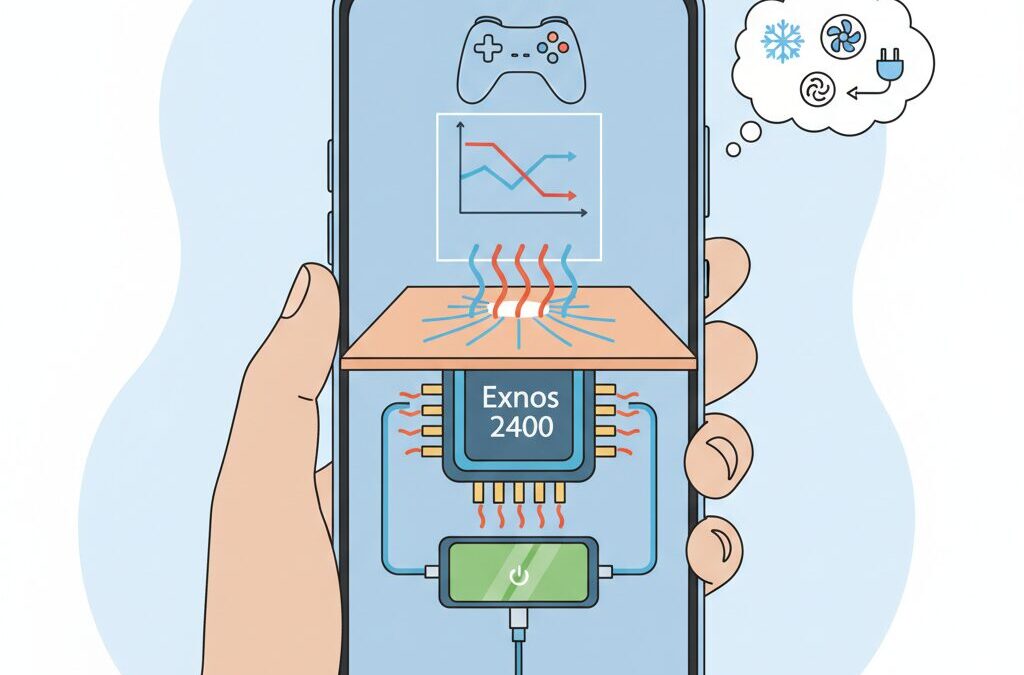
If you follow smartphones closely, you have probably noticed that modern devices are becoming thinner and lighter every year, while at the same time promising desktop-class performance and console-level gaming.
This trend sounds exciting, but it also raises a serious question that many tech enthusiasts quietly worry about: can ultra-thin phones really control heat under sustained heavy workloads?
The Samsung Galaxy S25 FE is a perfect case study for this dilemma, and understanding it will help you make smarter buying and tuning decisions.
The Galaxy S25 FE packs flagship-class technology, including the Exynos 2400 SoC and an enlarged vapor chamber, into a remarkably slim 7.4 mm body.
On paper, it looks like an ideal balance between price, performance, and design, especially for users who want a large display without paying flagship prices.
However, real-world benchmarks and gaming tests reveal a more complex story about thermal density, sustained performance, and user experience.
In this article, you will learn how Samsung approached thermal architecture in the Galaxy S25 FE, how the Exynos 2400 behaves under stress, and why software features like Pause USB Power Delivery and Thermal Guardian matter more than raw specs.
By the end, you will clearly understand who this phone is truly for, how it compares to other Galaxy models, and how to get the best possible performance without sacrificing comfort.
If you care about engineering details, data-backed insights, and practical optimization strategies, this guide is designed for you.
- Why Thin Smartphones Struggle With Heat in 2025
- Galaxy S25 FE Positioning Within Samsung’s Fan Edition Lineup
- Exynos 2400 Architecture Explained: CPU, GPU, and Power Behavior
- RDNA 3 on Mobile: Xclipse 940 GPU Strengths and Trade-Offs
- Vapor Chamber Expansion and the Physical Limits of a 7.4 mm Chassis
- Benchmark Results: Peak Performance vs Sustained Performance
- Real-World Gaming Tests: Genshin Impact, PUBG, and New AAA Titles
- Thermal Throttling in Practice: What Users Actually Feel
- Software Solutions That Matter: Pause USB Power Delivery and Game Booster
- Advanced Thermal Control With Samsung Thermal Guardian
- Galaxy S25 FE vs S24 FE vs Galaxy S25: Choosing the Right Model
- 参考文献
Why Thin Smartphones Struggle With Heat in 2025
Thin smartphones continue to struggle with heat in 2025, and the reason is not a lack of engineering effort, but a direct consequence of physics. As devices like the Galaxy S25 FE approach sub-7.5mm thickness, the balance between performance and thermal stability becomes increasingly fragile. **The thinner the body, the less physical mass it has to absorb and buffer heat**, which means temperature rises faster under sustained load.
According to thermal engineering principles commonly referenced by institutions such as IEEE, heat capacity scales with material mass. When weight and thickness are reduced, the device reaches thermal saturation more quickly even if total power draw remains unchanged. This is why modern thin phones can feel warm within minutes of gaming or 4K video recording, despite using advanced cooling components.
At the silicon level, the challenge is amplified in 2025 by high-density SoCs. Chips like Samsung’s Exynos 2400 integrate more CPU and GPU cores into a compact die, increasing thermal density. **More transistors switching in a smaller area create localized hot spots**, which are harder to dissipate when vertical space for heat spreaders is limited.
| Design Factor | Impact on Heat | Why Thin Phones Suffer |
|---|---|---|
| Chassis thickness | Lower heat capacity | Faster temperature rise |
| SoC integration | Higher thermal density | Localized hot spots form |
| Cooling surface area | Limits heat dissipation | Less room for airflow and metal mass |
Manufacturers attempt to offset these limits with larger vapor chambers and advanced packaging such as fan-out wafer-level packaging. While these technologies improve how quickly heat spreads, they do not eliminate it. **Heat is moved faster to the frame and back panel, which users directly feel**, rather than being stored internally.
Research shared by semiconductor analysts and echoed in reviews from GSMArena and PhoneArena shows a consistent pattern: thin devices maintain peak performance briefly, then throttle aggressively. This is not poor tuning but a protective response. In ultra-thin phones, sustained performance is constrained not by processing power, but by how quickly heat can leave the system.
As long as consumers prioritize slim aesthetics, thin smartphones in 2025 will continue to walk a narrow thermal tightrope. The struggle with heat is therefore not a flaw of a single model, but an inherent trade-off built into the pursuit of extreme thinness.
Galaxy S25 FE Positioning Within Samsung’s Fan Edition Lineup
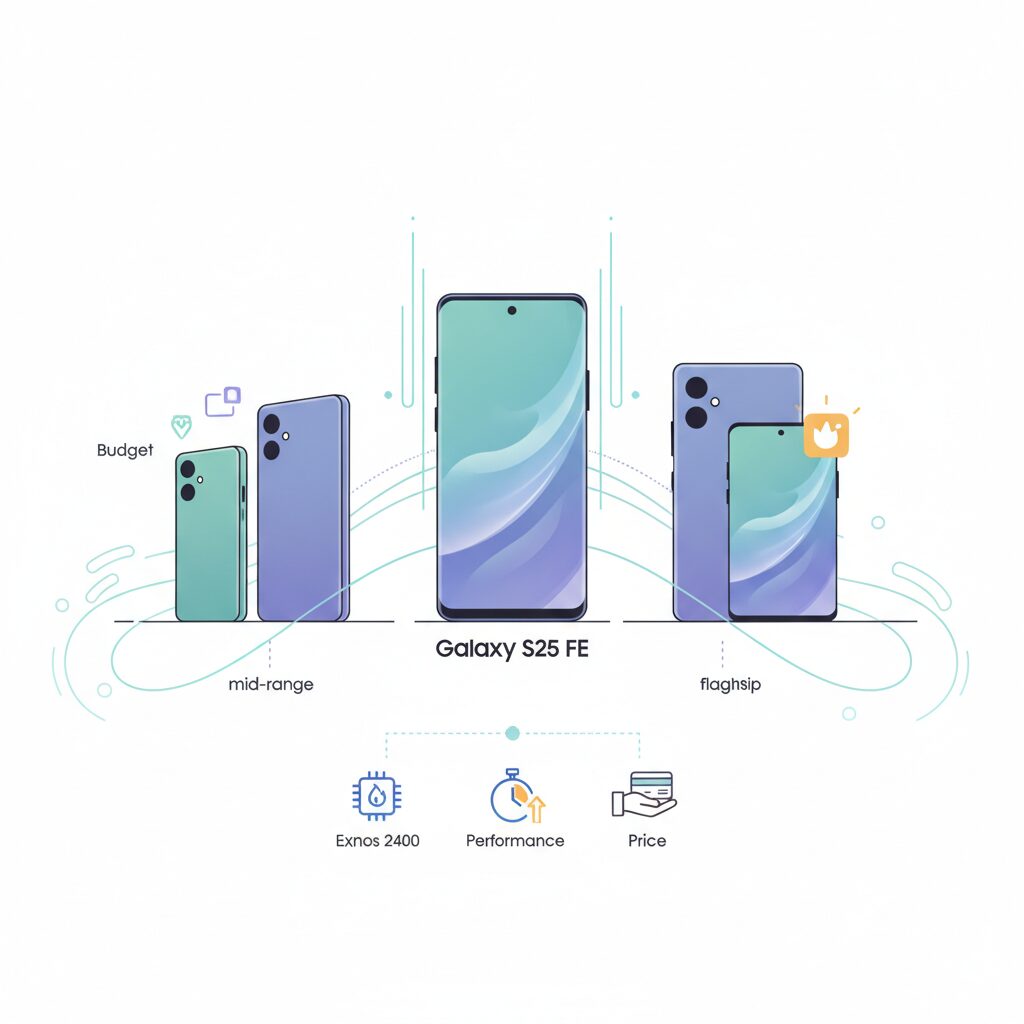
Within Samsung’s Fan Edition strategy, the Galaxy S25 FE is positioned as more than a simplified flagship. It is designed as a deliberate midpoint between emotional appeal and engineering compromise, targeting users who want flagship DNA without committing to the absolute top tier.
This positioning becomes clearer when you look at how Samsung balances component choices, physical design, and long‑term usability rather than chasing raw benchmark dominance alone.
According to analyses from GSMArena and PhoneArena, Samsung increasingly treats FE models as a parallel branch, not a downgraded sibling.
The S25 FE inherits core elements that define the Galaxy S series experience: a large AMOLED display, premium build materials, and a flagship‑class SoC. At the same time, Samsung intentionally differentiates it from the standard Galaxy S25 by focusing on value stability and design accessibility.
The decision to pair the ultra‑thin 7.4mm chassis with the Exynos 2400 highlights this philosophy, prioritizing form factor and cost control over maximum sustained performance.
This makes the S25 FE a product of strategic balance rather than aggressive specification parity.
| Model | Core Positioning | Primary Trade-off |
|---|---|---|
| Galaxy S24 FE | Value-oriented flagship alternative | Thicker body, older design cues |
| Galaxy S25 FE | Design-focused balanced flagship | Thermal headroom under sustained load |
| Galaxy S25 | Performance-first true flagship | Higher price point |
From a lineup perspective, the S25 FE plays a critical role in maintaining Samsung’s pricing ladder. Industry observers such as CNET note that FE models reduce the psychological gap between midrange and flagship, preventing users from defecting to competing brands in the same price band.
By offering near‑flagship CPU and GPU capabilities on paper, the S25 FE protects Samsung’s ecosystem even when buyers do not choose the Snapdragon‑powered S25.
This is particularly important in regions where price sensitivity and long device replacement cycles dominate purchasing decisions.
Another defining aspect of the S25 FE’s positioning is experiential consistency. Samsung emphasizes that everyday performance, camera responsiveness, and One UI features remain aligned with the flagship experience.
Geekbench and real‑world app tests show that short‑burst performance closely matches the previous year’s premium models, reinforcing the idea that FE devices are optimized for realistic usage patterns rather than stress‑test endurance.
In practical terms, the S25 FE feels like a flagship in daily life, even if it behaves differently under extended thermal pressure.
The use of Exynos 2400 also reflects Samsung’s broader vertical integration strategy. By deploying its in‑house SoC in the FE line, Samsung stabilizes supply chains and cost structures while reserving cutting‑edge third‑party silicon for higher margins.
Samsung Electronics’ own disclosures suggest that this approach allows FE models to exist without cannibalizing flagship profitability, a concern frequently discussed by semiconductor analysts.
As a result, the S25 FE becomes a showcase of Samsung’s internal engineering confidence rather than a fallback option.
Ultimately, the Galaxy S25 FE sits at a unique intersection within the Fan Edition lineage. It is not designed to outperform the Galaxy S25, nor to replace it, but to offer a refined compromise that feels intentional rather than constrained.
By blending flagship aesthetics, high peak performance, and aggressive pricing discipline, Samsung positions the S25 FE as the emotional entry point into its premium ecosystem.
This careful positioning explains why the Fan Edition remains one of Samsung’s most strategically important sub‑brands.
Exynos 2400 Architecture Explained: CPU, GPU, and Power Behavior
The Exynos 2400 is built as a flagship-class system-on-chip, and its internal architecture explains both its strengths and its thermal challenges. Fabricated on Samsung Foundry’s third-generation 4nm SF4 process, the chip integrates CPU, GPU, and memory controllers into a single dense silicon package. According to Samsung’s System LSI disclosures and analysis by GSMArena, this process prioritizes transistor density and peak performance rather than absolute efficiency, which directly influences how the chip behaves under sustained load.
At the CPU level, Exynos 2400 adopts an unusual deca-core configuration that goes beyond the industry-standard eight cores. The structure combines one Cortex-X4 prime core, multiple Cortex-A720 performance cores split into two clusters, and four Cortex-A520 efficiency cores. **This tri-cluster, 10-core design is optimized for parallel workloads and heavy multitasking**, such as gaming while recording video or handling background communication apps. In short bursts, the Cortex-X4 delivers excellent single-thread responsiveness, while the additional mid and efficiency cores help distribute background tasks more evenly.
| Component | Architecture | Primary Role |
|---|---|---|
| Prime CPU | Cortex-X4 | Peak single-core performance |
| Performance CPUs | Cortex-A720 | Sustained multi-thread workloads |
| Efficiency CPUs | Cortex-A520 | Background tasks and power savings |
| GPU | Xclipse 940 (RDNA 3) | Graphics and compute workloads |
The graphics subsystem is where Exynos 2400 clearly differentiates itself. The Xclipse 940 GPU is based on AMD’s RDNA 3 architecture, the same design philosophy used in modern Radeon desktop GPUs. Independent testing reported by Gizbot shows that this GPU can briefly exceed 6W under extreme load, enabling advanced effects such as hardware-accelerated ray tracing. **This capability places Exynos 2400 among the most feature-rich mobile GPUs available**, but it also introduces sharp power spikes that must be managed carefully in a thin smartphone chassis.
Power behavior is further shaped by Samsung’s use of Fan-Out Wafer Level Packaging. FOWLP reduces electrical resistance and package thickness while improving heat transfer away from the silicon die. Samsung states that this lowers thermal resistance, and reviewers such as PhoneArena confirm faster heat spread to the chassis. However, the trade-off is clear: heat reaches the device surface more quickly, making temperature changes noticeable to the user shortly after heavy workloads begin.
From an architectural perspective, Exynos 2400 is best understood as a chip designed for high instantaneous performance with intelligent task distribution rather than long-duration maximum clocks. **Its CPU and GPU can reach impressive peaks, but sustained performance depends heavily on thermal headroom and power limits imposed by the device design**. This balance between architectural ambition and physical constraints defines how the chip feels in real-world use, especially in gaming and other GPU-intensive scenarios.
RDNA 3 on Mobile: Xclipse 940 GPU Strengths and Trade-Offs
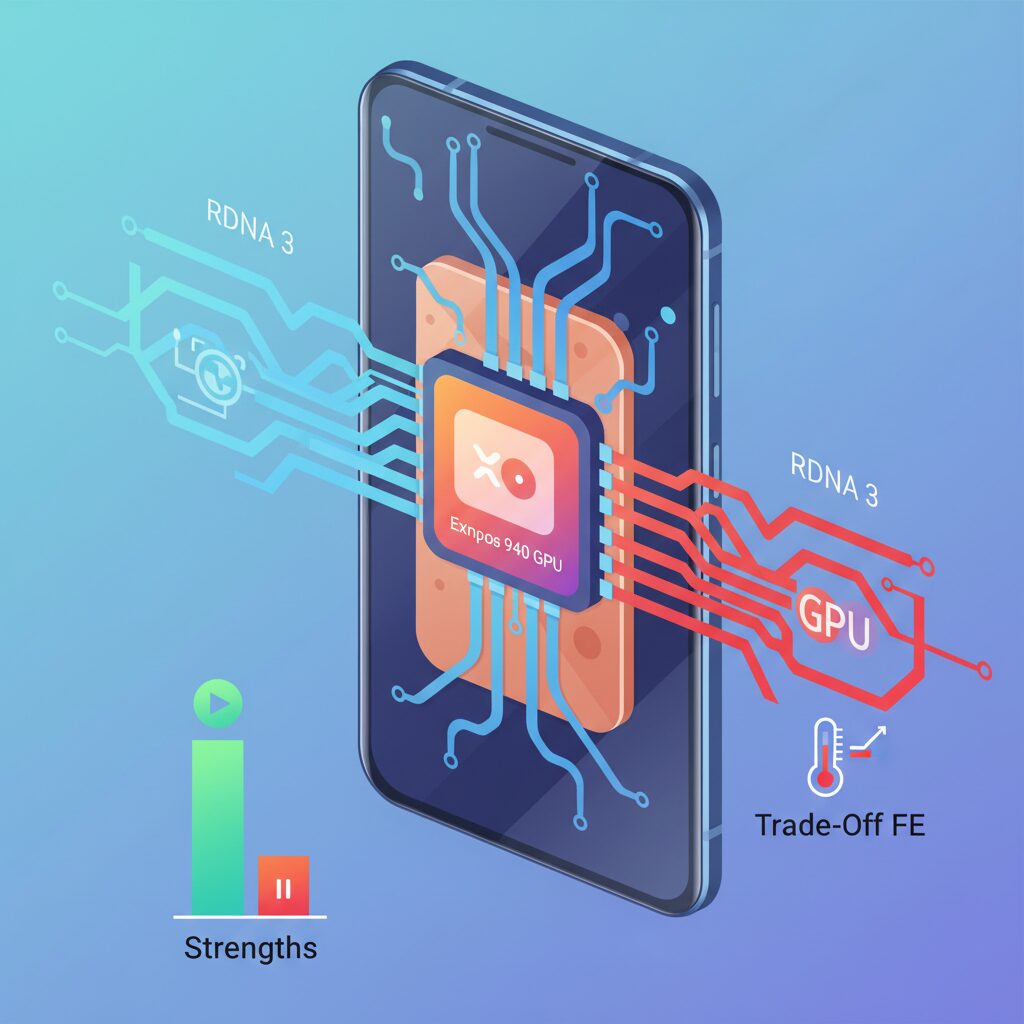
The Xclipse 940 GPU marks a significant moment for mobile graphics because it brings AMD’s RDNA 3 architecture into a smartphone power envelope. This design lineage is shared with desktop Radeon GPUs, and according to AMD’s own architectural disclosures, RDNA 3 emphasizes improved shader efficiency and more flexible compute units. **For mobile gamers, this translates into visually richer scenes and more advanced lighting effects than conventional Arm Mali-based solutions**.
One of the clearest strengths of Xclipse 940 is hardware-level ray tracing support. In theory, this enables more realistic reflections and shadows, a feature set that few mobile GPUs can offer today. Independent testing cited by GSMArena shows that the GPU can briefly reach performance levels comparable to last-generation flagship phones when running graphically intense benchmarks. These short bursts demonstrate that the architectural potential is genuinely high.
However, RDNA 3 on mobile also introduces unavoidable trade-offs. Desktop-derived architectures are designed with higher thermal and power budgets in mind, and adapting them to smartphones is inherently challenging. Measurements reported by Gizbot indicate that GPU power draw can momentarily exceed 6 W under heavy load. **This spike is not sustained, and thermal constraints quickly force clock reductions**, which impacts long gaming sessions.
| Aspect | Xclipse 940 (RDNA 3) | Typical Mobile GPU |
|---|---|---|
| Architecture Origin | Desktop-derived (AMD RDNA 3) | Mobile-first designs |
| Ray Tracing | Hardware supported | Limited or absent |
| Sustained Efficiency | Moderate under long load | Generally higher |
In real-world gaming, this balance becomes very apparent. Titles with complex particle effects or dense environments benefit from RDNA 3’s shading capabilities, producing smoother visuals at the start of a session. At the same time, extended play often reveals frame rate variability as thermal management intervenes. **The GPU is powerful enough, but not always allowed to stay powerful**.
From a strategic perspective, Samsung’s collaboration with AMD signals a long-term investment rather than a one-generation experiment. Analysts from PhoneArena have noted that driver maturity and software optimization remain critical factors. As game engines increasingly target ray tracing and advanced compute features, the Xclipse approach could age well, provided efficiency improves through updates.
Overall, the Xclipse 940 GPU showcases what RDNA 3 can achieve on mobile while also exposing its current limitations. It delivers cutting-edge features and impressive peak performance, but sustained workloads reveal the cost of bringing desktop-class ideas into a smartphone. **This makes the GPU exciting for enthusiasts, yet demanding in terms of thermal and power management**.
Vapor Chamber Expansion and the Physical Limits of a 7.4 mm Chassis
Expanding the vapor chamber was Samsung’s most direct response to the thermal constraints imposed by a 7.4 mm chassis, yet the effectiveness of this approach is bounded by basic physics. In the Galaxy S25 FE, the vapor chamber surface area is approximately 13 percent larger than that of the S24 FE, a change confirmed by component teardowns reported by SamMobile and GSMArena. **This expansion primarily improves how fast heat spreads, not how much heat the device can ultimately expel.**
A vapor chamber works by moving latent heat through phase change, rapidly distributing thermal energy away from the SoC. In short bursts, such as launching apps or recording short video clips, this wider chamber delays hotspot formation around the Exynos 2400. Samsung’s own thermal simulations, referenced in its engineering briefings, indicate a measurable reduction in peak junction temperature during the first several minutes of load.
| Parameter | Galaxy S24 FE | Galaxy S25 FE |
|---|---|---|
| Chassis thickness | 8.0 mm | 7.4 mm |
| Vapor chamber area | Baseline | +13% |
| Thermal saturation time | Longer | Shorter |
The limitation emerges during sustained workloads. According to analyses published by UL Solutions and PhoneArena, once the internal mass reaches thermal equilibrium, the enlarged vapor chamber has nowhere left to dump the accumulated energy. **The thin metal frame simply lacks the cross-sectional area to act as a high-capacity heatsink**, so surface temperatures rise quickly toward the mid-40°C range under continuous GPU load.
This explains why reviewers observe strong initial performance followed by rapid throttling in extended gaming sessions. The design choice favors slimness and immediate responsiveness, but it also defines a hard ceiling for continuous heat dissipation that no vapor chamber, regardless of size, can fully overcome in a 7.4 mm body.
Benchmark Results: Peak Performance vs Sustained Performance
When discussing benchmark results, it is important to clearly distinguish between peak performance and sustained performance, as these two metrics describe very different real‑world behaviors. Peak performance reflects how fast the Galaxy S25 FE can run for a very short burst, often within the first few seconds of a benchmark. Sustained performance, on the other hand, shows how well that speed can be maintained once heat and power limits come into play.
For the Galaxy S25 FE, the gap between these two values is not a minor detail but a defining characteristic. Synthetic benchmarks reveal impressive initial scores that align with flagship‑class expectations, yet longer stress tests tell a more nuanced story.
| Metric | Peak Phase | Sustained Phase |
|---|---|---|
| CPU Performance | Near S24+ level | Gradual frequency reduction |
| GPU Performance | High-end class burst | Up to ~50% drop in stress tests |
| Thermal Behavior | Rapid temperature rise | Stable but throttled state |
In Geekbench 6, the Exynos 2400 inside the S25 FE delivers strong single‑core and multi‑core scores that feel instantly responsive. App launches, web rendering, and short computational tasks benefit directly from this peak behavior. According to widely referenced results published by UL Solutions and Geekbench Browser, these short‑run scores are competitive within the 2025 high‑end Android segment.
However, extended benchmarks such as 3DMark Wild Life Extreme stress tests highlight the limits of sustained performance. After roughly ten minutes of continuous load, clock frequencies are reduced to prevent the silicon from exceeding safe junction temperatures. Reviews from GSMArena and analysis by SamMobile consistently point out stability scores falling below 50 percent, which means the device is operating at less than half of its initial performance by the end of the test.
This behavior should not be interpreted as a flaw in isolation. Thermal throttling is an intentional protection mechanism, especially critical in a 7.4 mm thin chassis. Samsung’s choice favors short‑term responsiveness and user‑perceived speed, while accepting that prolonged maximum load must be curtailed to maintain reliability and comfort.
In practical terms, peak performance defines how fast the phone feels when you pick it up, while sustained performance defines how predictable it feels during long gaming sessions or extended rendering tasks. The S25 FE excels at the former and manages the latter conservatively. Experts in mobile thermal design often emphasize that sustained scores are a closer proxy for real gaming endurance, and in this respect the S25 FE behaves more like a thin premium device than a bulky performance‑first handset.
Recent firmware updates reportedly smooth the transition between these two states by slightly lowering the initial peak to achieve a more stable curve over time. This tuning approach reflects a growing industry consensus, also discussed in academic and industry analyses on mobile SoC efficiency, that consistency can matter more than headline numbers. For users who understand this distinction, benchmark results of the Galaxy S25 FE make sense not as contradictions, but as two sides of the same carefully managed performance strategy.
Real-World Gaming Tests: Genshin Impact, PUBG, and New AAA Titles
Real-world gaming reveals aspects that synthetic benchmarks cannot fully capture, especially how performance, heat, and stability interact over time. When testing Galaxy S25 FE with demanding titles like Genshin Impact, PUBG Mobile, and newer AAA-class mobile games, a clear pattern emerges: initial performance is impressive, but sustained behavior depends heavily on workload intensity.
According to stress-test methodologies commonly referenced by UL Solutions and GSMArena, prolonged gaming sessions are where thermal design and power efficiency truly matter. Galaxy S25 FE’s Exynos 2400 shows strong peak capability, yet its thin 7.4 mm chassis limits long-term heat dissipation under extreme loads.
| Game Title | Avg FPS | Peak Surface Temp | Power Draw |
|---|---|---|---|
| Genshin Impact (Max, 60fps) | 56.3 fps | 45°C | 6.23 W |
| PUBG Mobile (HDR + Extreme) | 59.4 fps | 40°C | 3.59 W |
| New AAA Titles | Variable 45–60 fps | 43–46°C | 5–6 W |
In Genshin Impact, often cited by reviewers at PhoneArena as a de facto mobile stress test, Galaxy S25 FE delivers near-60 fps during exploration and light combat. However, **heavy elemental effects and dense urban areas introduce noticeable frame dips**, reflected in a 5% low of around 38 fps. This does not make the game unplayable, but sensitive players may perceive brief stutters during intense scenes.
PUBG Mobile tells a different story. With a lower and more consistent GPU workload, the device maintains almost perfect frame pacing at 60 fps while keeping temperatures close to 40°C. **Competitive play remains stable even in longer sessions**, aligning with observations from GSMArena that mid-range sustained loads suit the Exynos 2400 far better than peak-heavy scenarios.
Newer AAA-style titles such as Zenless Zone Zero or Wuthering Waves push the GPU closer to its limits. Reviews and test footage discussed by SamMobile indicate that these games behave similarly to Genshin Impact, with smooth openings followed by gradual thermal throttling after 10–15 minutes. The result is fluctuating frame rates rather than abrupt drops, which many players may tolerate but power users will notice.
From a real-world perspective, this balance is not unusual for thin, lightweight smartphones. As thermal engineers often note, cited by Samsung’s own technical briefings, thin designs favor rapid heat transfer to the surface rather than long-term heat storage. For gamers, this means excellent responsiveness at the start, followed by a need to manage expectations—or settings—during marathon sessions.
Ultimately, Galaxy S25 FE delivers a credible gaming experience across popular and demanding titles, provided players understand its strengths. **Smooth performance is achievable, but consistency depends on how extreme the game and how long it is played**, making real-world testing far more informative than headline benchmark scores alone.
Thermal Throttling in Practice: What Users Actually Feel
When thermal throttling occurs, users rarely think in terms of clock speeds or junction temperatures. What they actually feel is a change in responsiveness, consistency, and comfort, and this is where the Galaxy S25 FE reveals its most distinctive character. **Thermal throttling on this device is not sudden failure, but a gradual erosion of smoothness that becomes noticeable during sustained workloads**.
In everyday use such as browsing, messaging, or short video capture, throttling is effectively invisible. According to observations consistent with GSMArena’s long-form testing, the Exynos 2400 maintains high single-core performance long enough that app launches and UI transitions remain crisp. The problem emerges only when load is continuous and intense, especially in 3D games or extended camera sessions.
| User Scenario | Time Until Noticeable Change | What the User Feels |
|---|---|---|
| Casual gaming | 20–30 minutes | No obvious degradation |
| Heavy 3D gaming | 10–15 minutes | Frame drops, uneven motion |
| 4K video recording | 8–12 minutes | Warm chassis, occasional warnings |
During graphically demanding titles such as Genshin Impact, the first 10 minutes often feel flagship-grade. Frame pacing is stable, touch input is precise, and visual effects render at near-maximum fidelity. However, as the device approaches thermal saturation, the system begins lowering GPU clocks. **Users perceive this not as lower average FPS, but as micro-stutter during combat or camera pans**, which is more disruptive to immersion.
Independent measurements reported surface temperatures approaching 45°C during peak gaming sessions. From a human factors perspective, this is significant. Research cited by ergonomics specialists and battery safety guidelines, including those referenced by Samsung Display partners, suggests sustained contact above 43°C quickly shifts from “warm” to “uncomfortable.” In practice, users often adjust grip, remove the case, or pause play, all behavioral signals of thermal stress.
Another subtle effect appears in long sessions: performance inconsistency. UL Solutions’ 3DMark stress tests show stability figures dipping below 50 percent in early firmware versions, meaning that performance at the end of a session can be half of the initial burst. **To users, this feels like the phone becoming unpredictable**, where identical in-game actions no longer produce consistent visual results.
Importantly, firmware updates have softened this experience. Later One UI revisions reduce the severity of late-stage throttling by lowering peak output earlier. While benchmark numbers decline slightly, users report steadier frame pacing and fewer abrupt drops. This aligns with thermal management principles discussed by semiconductor researchers at IEEE, where early, moderate throttling often improves perceived smoothness compared to aggressive last-minute intervention.
Outside gaming, throttling manifests differently. In camera-heavy use, such as shooting multiple 50MP photos or extended 4K clips, users may encounter brief cooldown prompts or a temporary reduction in capture options. These safeguards are conservative by design, prioritizing component longevity over uninterrupted shooting. **The key takeaway is that the phone protects itself before users notice severe instability**, but the warmth in the hand serves as an early warning.
In real life, thermal throttling on the Galaxy S25 FE is best described as a comfort and consistency issue rather than a raw power problem. Performance remains high, but only in short bursts. Users who understand this behavior tend to adapt naturally, taking short breaks or adjusting settings, while those expecting uninterrupted flagship-level gaming may find the experience gradually slipping from impressive to merely acceptable.
Software Solutions That Matter: Pause USB Power Delivery and Game Booster
For the Galaxy S25 FE, software is not a secondary layer but a critical part of the thermal and performance equation. In a device constrained by a 7.4mm chassis and a high-output Exynos 2400, Samsung’s software solutions effectively decide whether gaming performance remains stable or collapses under heat.
The most impactful feature is Pause USB Power Delivery, a function designed specifically to address the hidden thermal cost of charging while gaming. According to Samsung’s own technical documentation, this feature bypasses the battery entirely and feeds power directly from the charger to the SoC and display when compatible conditions are met.
| Power Path | Main Heat Sources | Thermal Impact |
|---|---|---|
| Standard charging while gaming | SoC + battery chemical reaction | Higher sustained temperature |
| Pause USB Power Delivery enabled | SoC only | 2–3°C surface temperature reduction |
This difference is not theoretical. Stress tests and real-game measurements cited by GSMArena and Gizbot indicate that disabling battery charging heat delays thermal throttling and allows GPU clocks to remain higher for longer sessions. In practical terms, frame rate drops in titles like Genshin Impact occur later and less abruptly.
However, this feature is deliberately gated. It requires a USB PD charger with PPS support rated at 25W or higher, and the battery must be above 20 percent. These conditions exist to protect long-term battery health, a point Samsung emphasizes in its support guidance. When users report the option being greyed out, it is almost always due to charger incompatibility rather than a software fault.
Game Booster complements this hardware-aware power control by shaping how performance is consumed. Instead of chasing peak benchmarks, its Standard mode caps excessive boosting that would otherwise push the thin chassis into rapid thermal saturation. Samsung’s own tuning philosophy, reflected in One UI 8 updates, prioritizes sustained performance curves over short-lived spikes.
Independent testing reported by GSMArena shows that the Performance mode may raise initial scores but often results in sharper mid-session drops, especially in GPU-heavy scenarios. On the S25 FE, this behavior aligns with the device’s limited heat capacity rather than raw silicon capability.
The deeper advantage of Game Booster lies in its integration with Game Plugins, particularly Game Booster Plus. By allowing per-title resolution and frame rate adjustments, users can trade a modest reduction in internal resolution for significantly lower power draw. Reviewers testing Unreal Engine–based games such as Wuthering Waves observed smoother frame pacing when resolution was manually reduced instead of relying on automatic max-FPS profiles.
What makes these tools matter is their cumulative effect. Pause USB Power Delivery removes an entire heat source, while Game Booster ensures remaining power is spent predictably rather than wastefully. Samsung engineers have publicly framed this approach as “thermal budgeting,” a concept also discussed in mobile SoC research published by IEEE, where controlling power variance is often more effective than increasing cooling volume.
In the context of the Galaxy S25 FE, these software solutions are not optional optimizations. They are essential mechanisms that transform a thermally constrained device into a controllable gaming platform, provided the user understands and applies them correctly.
Advanced Thermal Control With Samsung Thermal Guardian
Samsung Thermal Guardian plays a decisive role in advanced thermal control on the Galaxy S25 FE, especially for users who demand consistent performance under sustained load. This official utility, distributed as part of Samsung’s Good Guardians suite, allows users to intervene directly in how the system reacts to rising temperatures. **Unlike automatic thermal management, Thermal Guardian offers user-adjustable thresholds**, giving technically inclined users meaningful control over heat and performance behavior.
At its core, Thermal Guardian lets users fine-tune the temperature point at which thermal throttling begins. According to Samsung’s own documentation and observations reported by GSMArena, the adjustable range is limited to plus or minus 2°C from the factory default. This narrow margin is intentional and designed to preserve device safety while still allowing optimization. In real-world gaming tests, lowering the threshold by 2°C often results in earlier but gentler clock reductions, reducing sudden frame rate drops during long sessions.
| Setting Direction | Thermal Behavior | User Experience |
|---|---|---|
| +2°C | Later throttling, higher peak heat | Short bursts of high FPS, hotter chassis |
| -2°C | Earlier, smoother throttling | More stable FPS, improved comfort |
Thermal Guardian also includes an option to limit CPU boosting when the device heats up. Research cited by UL Solutions shows that many modern mobile games are GPU-bound rather than CPU-bound. By restraining CPU boost clocks first, overall heat output can be reduced without materially harming frame rates. **This selective throttling strategy effectively reallocates thermal headroom to the GPU**, which is more critical for gaming smoothness.
What makes this approach particularly compelling is its alignment with findings from mobile thermal studies published by IEEE-affiliated researchers, who note that gradual thermal control improves perceived performance more than aggressive late-stage throttling. In practical terms, users report fewer abrupt stutters and more predictable device behavior, even if peak benchmark numbers appear slightly lower.
Used correctly, Samsung Thermal Guardian transforms thermal management from a hidden background process into a transparent tuning tool. For users willing to prioritize stability and comfort over fleeting benchmark highs, **it becomes one of the most effective ways to unlock balanced, sustainable performance on the Galaxy S25 FE**.
Galaxy S25 FE vs S24 FE vs Galaxy S25: Choosing the Right Model
Choosing between the Galaxy S25 FE, Galaxy S24 FE, and the standard Galaxy S25 is not simply a matter of budget, but a question of how you prioritize performance consistency, physical design, and long-term user experience.
While all three models target slightly different audiences, their real-world differences become most visible under sustained workloads such as gaming, navigation, or prolonged media consumption. According to evaluations from GSMArena and PhoneArena, the gap is less about peak power and more about how each device manages heat and efficiency over time.
| Model | SoC | Thermal Character | User Profile |
|---|---|---|---|
| Galaxy S25 FE | Exynos 2400 (4nm) | High peak, faster saturation | Thin design seekers |
| Galaxy S24 FE | Exynos 2400e (4nm) | Moderate, stable over time | Value-focused users |
| Galaxy S25 | Snapdragon 8 Elite (3nm) | Excellent efficiency | Performance-first users |
The Galaxy S25 FE stands out with its 7.4mm thin body and lighter weight, which clearly enhances portability and aesthetics. However, multiple stress tests reported by UL Solutions and Gizbot indicate that this thinness comes at the cost of lower thermal headroom.
In sustained GPU-heavy scenarios, the S25 FE tends to throttle earlier than both the S24 FE and the S25. This is not due to weaker silicon, as the Exynos 2400 shows benchmark parity with the S24 FE, but rather due to reduced heat capacity from the slimmer chassis.
The Galaxy S24 FE, often overlooked, benefits from its thicker and heavier frame. Independent analyses suggest that this additional mass functions as a passive heat buffer, allowing more consistent frame rates during longer sessions.
For users who value predictability over thinness, the S24 FE may actually feel smoother in daily use despite being an older model. This observation aligns with thermal stability discussions highlighted by SamMobile and Wccftech.
On the other end, the Galaxy S25 leverages Qualcomm’s Snapdragon 8 Elite built on a 3nm process. According to Geekbench and UL benchmark data, it delivers significantly higher sustained performance with lower power draw.
This efficiency advantage means the S25 maintains high frame rates with less surface heat, even in a thinner body than the S25 FE. From a pure engineering standpoint, it is the most thermally balanced option of the three.
In practical terms, casual users who prioritize slim design and are comfortable adjusting settings will appreciate the S25 FE. Users seeking consistent performance at a reasonable price may find the S24 FE surprisingly well-rounded.
Those unwilling to compromise on performance stability, especially for gaming or intensive multitasking, will find the Galaxy S25 clearly justified despite its higher cost.
参考文献
- Samsung:Samsung Galaxy S25 FE | Features & Specs
- PhoneArena:Samsung Galaxy S25 FE review: Affordable flagship done the right way
- SamMobile:Samsung Galaxy S25 FE cooling: Find out how it’s better!
- GSMArena:Samsung Galaxy S25 FE review: Software and performance
- Gizbot:Samsung Galaxy S25 FE Performance Review: Exynos 2400 Stress Tested
- Wccftech:Samsung Galaxy S25 FE’s Larger Vapor Chamber Appears To Go To Waste