
Fast charging has become an invisible but critical part of modern digital life, and by 2026 it is no longer just about filling a battery quickly. It is about standards, ecosystems, safety, and how all of them interact behind a single USB‑C port. Many gadgets look compatible on the surface, yet behave very differently in real use, which often leaves even tech‑savvy users confused.
If you have ever wondered why a 100W charger does not always charge your phone faster, why some cables silently limit performance, or why wireless charging suddenly feels practical instead of slow, this article is designed for you. The charging landscape has matured, but it has also become more layered and technical than ever before.
In recent years, USB Power Delivery has established itself as a global common language for power, extending its reach from smartphones to laptops and even gaming devices. At the same time, USB‑PD 3.1 has pushed power delivery to 240W, while Qi2 has redefined wireless charging with magnetic alignment and higher efficiency. These advances promise simplicity, yet they also introduce new decision points for users who care about performance and device longevity.
Beyond raw speed, safety and battery health now play a central role in how charging technologies are designed. Research data, real‑world device testing, and stricter safety certifications have reshaped the way manufacturers balance heat, voltage, and long‑term reliability. Fast charging is no longer automatically harmful, but only when it is implemented and used correctly.
This article will guide you through the fast‑charging frontier of 2026 from a practical, evidence‑based perspective. You will learn how modern standards really work, why different devices respond differently to the same charger, and how to choose charging gear that is not only fast, but also safe and future‑proof. By the end, you will be able to make confident decisions that match your devices, your usage style, and your expectations.
- How Charging Evolved into Core Digital Infrastructure
- USB Power Delivery as the Global Power Language
- USB‑PD 3.1 and the Meaning of 240W Charging
- PPS vs AVS: Why Voltage Control Matters More Than Wattage
- Why Proprietary Fast Charging Still Exists in a USB‑C World
- Qi2 and the Wireless Charging Turning Point
- Real‑World Charging Behavior of Popular Devices
- GaN Chargers, Heat Management, and Market Competition
- Battery Degradation, Safety Data, and What Actually Causes Damage
- Next‑Generation Technologies Beyond GaN and Lithium‑Ion
- 参考文献
How Charging Evolved into Core Digital Infrastructure
Charging has quietly transformed from a background utility into a pillar of digital infrastructure that shapes how people work, travel, and consume content daily. As of 2026, the act of plugging in a device is no longer about simply refilling a battery, but about ensuring continuous access to cloud services, communication platforms, and productivity tools that define modern digital life.
This shift began when charging stopped being device-specific. The European Union’s mandate to standardize USB Type-C accelerated a global unification trend, pushing USB Power Delivery to become a shared electrical language across smartphones, laptops, tablets, and even select home electronics. **According to USB-IF documentation, USB-PD is designed not merely as a fast-charging protocol, but as a negotiated power contract between devices**, allowing power delivery to scale safely with computing demands.
| Era | Charging Role | User Impact |
|---|---|---|
| Pre-standardization | Accessory-level function | Multiple adapters, limited mobility |
| USB-PD adoption | Unified power interface | Fewer chargers, cross-device use |
| 2026 infrastructure phase | Digital lifestyle backbone | Always-on work and content access |
However, standardization did not eliminate complexity. With USB Type-C connectors looking identical on the outside, critical differences moved inside cables and chargers. Power limits, data lanes, and the presence of E-Marker chips now determine whether a setup can support a smartphone at 25W or a workstation-class laptop at over 200W. **This hidden layer has effectively turned charging into an invisible infrastructure that users rely on, often without fully understanding its constraints.**
The expansion of USB-PD to 240W through PD 3.1 illustrates how charging tracks computing evolution. High-performance laptops and monitors increasingly expect desktop-class power from a single cable, reflecting a broader industry move toward flexible, location-independent work. Semiconductor manufacturers such as Texas Instruments emphasize that negotiated power delivery is essential to avoid thermal and electrical failures as wattage increases.
In Japan’s gadget market, this infrastructural role is especially visible. Brands like Anker Japan and CIO focus on translating complex standards into consumer-ready products, effectively acting as intermediaries between global specifications and everyday users. At the same time, public institutions such as NITE and MCPC frame charging as a matter of social safety, not just convenience. Their guidance highlights that **when charging fails, the risk extends beyond downtime to physical hazards like overheating and fire**.
Seen from this perspective, charging infrastructure now resembles broadband or cloud access: it is expected to be reliable, interoperable, and safe by default. Users may rarely think about voltage negotiation or certification marks, yet their digital lives depend on these systems functioning seamlessly. Charging has evolved into core digital infrastructure precisely because it disappears into the background, enabling devices to remain continuously connected and ready for use.
USB Power Delivery as the Global Power Language

By 2026, USB Power Delivery has effectively become the global power language for modern electronics. This shift is not merely about faster charging but about establishing a shared grammar for how devices negotiate, accept, and manage power across brands and categories. **The unification around USB Type-C and USB-PD has transformed charging from a brand-specific accessory into a universal infrastructure**, reshaping user behavior and the entire accessory ecosystem.
One decisive catalyst was regulatory pressure. The European Union’s mandate to standardize charging ports on USB Type-C accelerated global adoption, pushing manufacturers to align with USB-PD as the only realistic cross-border solution. According to documentation from USB-IF, USB-PD was designed from the outset to be vendor-neutral, scalable, and forward-compatible, which explains why it could absorb smartphones, tablets, laptops, and even monitors into a single framework without fragmenting.
This universality rests on a technical foundation that is often invisible to users. USB-PD relies on real-time negotiation over the Configuration Channel, allowing a charger and a device to agree on voltage and current before any significant power flows. **This handshake-based model is why a single charger can safely power both a 5W earbud case and a 100W-class laptop**, something impossible in the era of fixed-voltage USB charging.
| Era | Typical Power | User Experience | Limitations |
|---|---|---|---|
| Legacy USB | 2.5–4.5W | Slow, predictable | Phones only |
| USB-PD 2.0/3.0 | Up to 100W | One charger for many devices | High-performance laptops excluded |
| USB-PD 3.1 | Up to 240W | Truly universal power | Requires certified cables |
The introduction of USB-PD 3.1 reinforced this role as a common language rather than a niche protocol. By extending maximum power to 240W through higher voltage profiles, USB-PD crossed a psychological threshold. High-performance gaming laptops and mobile workstations, once the last holdouts clinging to proprietary barrel connectors, could now realistically speak the same power language as smartphones. Texas Instruments’ reference designs emphasize that this approach prioritizes higher voltage over higher current to control heat, a choice grounded in basic electrical physics rather than marketing.
However, standardization has not automatically translated into simplicity. From a user’s perspective, the physical uniformity of USB-C can be deceptive. **Not all USB-C cables or chargers speak the same “dialect” of USB-PD**, and critical capabilities such as maximum wattage or E-Marker support are hidden beneath identical-looking connectors. Independent test labs and organizations like Granite River Labs have repeatedly pointed out that this opacity is now the primary source of consumer confusion, replacing the old chaos of incompatible plugs.
Despite this complexity, the market momentum is unmistakable. Accessory manufacturers have reorganized their portfolios around USB-PD-first designs, and device makers increasingly assume PD availability as a baseline. Even companies that maintain proprietary fast-charging systems now fall back to USB-PD for interoperability, effectively acknowledging it as the default global language. **In practice, USB-PD has become the Esperanto of power delivery: not always the fastest in niche scenarios, but universally understood and indispensable.**
What makes USB-PD especially powerful as a global standard is its extensibility. The specification continues to evolve without breaking backward compatibility, allowing new power ranges and control mechanisms to coexist with older devices. This characteristic, highlighted by USB-IF technical briefs, ensures that investments in high-quality PD chargers and cables remain relevant for years. As charging becomes ever more central to digital life, USB Power Delivery’s role as a shared power language is no longer aspirational—it is already the grammar that the industry speaks every day.
USB‑PD 3.1 and the Meaning of 240W Charging
USB Power Delivery 3.1 represents a turning point in how much power a single USB‑C cable can safely and reliably deliver. The headline number, 240W, often attracts attention, but its real meaning goes far beyond raw wattage. It fundamentally redefines what USB‑C can replace in everyday gadget ecosystems, especially for power‑hungry devices that previously depended on proprietary adapters.
Until USB‑PD 3.0, the upper limit was 100W, defined as 20V and 5A. This was sufficient for ultrabooks and many creator laptops, yet it fell short for gaming laptops and mobile workstations. USB‑PD 3.1 introduces Extended Power Range, or EPR, which raises the maximum voltage instead of the current. This design choice is critical for safety and efficiency.
According to technical documentation published by the USB Implementers Forum and detailed analyses by testing labs such as Granite River Labs, EPR adds new voltage profiles of 28V, 36V, and 48V while keeping the current capped at 5A. From a physics standpoint, this minimizes resistive heat loss, which increases with the square of the current. By avoiding higher amperage, USB‑PD 3.1 maintains connector durability and cable safety.
| Power Range | Max Power | Voltage Profiles | Typical Devices |
|---|---|---|---|
| SPR | 100W | 5V–20V | Phones, tablets, standard laptops |
| EPR | 240W | 28V–48V | Gaming laptops, workstations, monitors |
The meaning of 240W becomes clearer when viewed from a replacement perspective. A single USB‑C charger can now theoretically power devices that once required bulky barrel‑plug adapters. For manufacturers, this opens the door to slimmer designs and unified ports. For users, it reduces cable clutter and travel friction, aligning with the EU‑driven push toward connector standardization.
However, 240W does not mean that every connected device will suddenly draw massive power. USB‑PD remains a negotiated protocol. The charger advertises its capabilities, the device requests an appropriate profile, and power only flows after mutual agreement. This layered handshake is one reason why organizations such as Texas Instruments emphasize USB‑PD 3.1 as an infrastructure‑grade power standard rather than a simple fast‑charging gimmick.
Another crucial implication lies in cables. EPR requires dedicated 240W‑rated USB‑C cables with updated E‑Marker chips. Without proper identification, the system automatically falls back to safer lower‑power modes. This behavior, defined by the USB‑IF specification, ensures backward compatibility while preventing dangerous misuse, a point often highlighted in independent safety discussions.
From a market perspective, 240W USB‑PD also reshapes competition with proprietary charging systems. While some manufacturers achieve higher headline numbers using low‑voltage, high‑current designs, USB‑PD 3.1 prioritizes universality and long‑term ecosystem stability. In that sense, the true meaning of 240W is not speed alone, but the establishment of USB‑C as a credible, standardized power backbone for the next generation of high‑performance gadgets.
PPS vs AVS: Why Voltage Control Matters More Than Wattage
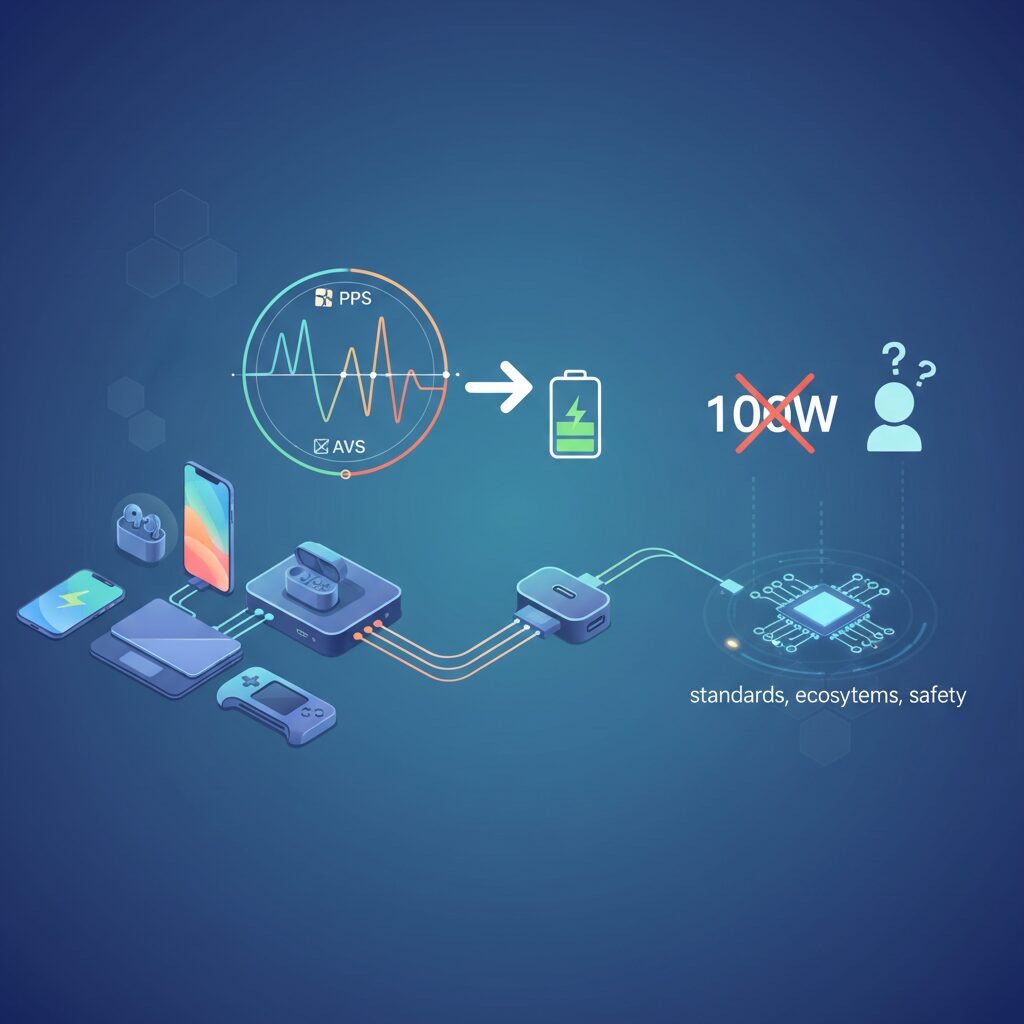
When consumers compare chargers, wattage is often treated as the ultimate metric. However, in modern USB Power Delivery, how voltage is controlled matters far more than the headline watt number. This is precisely where the distinction between PPS and AVS becomes critical, especially as devices grow more thermally constrained and charging systems more intelligent.
PPS, introduced with USB‑PD 3.0, was engineered around the realities of smartphone batteries. Lithium‑ion cells operate in a narrow voltage window, and every unnecessary voltage drop inside the phone is converted directly into heat. By allowing the charger to adjust output voltage in 20 mV steps from 3.3 V up to 21 V, PPS minimizes conversion losses inside the device. According to technical explanations published by USB‑IF contributors and semiconductor vendors such as Texas Instruments, this fine‑grained control significantly reduces thermal stress during high‑power charging.
| Aspect | PPS | AVS |
|---|---|---|
| Voltage range | 3.3–21 V | 15–48 V |
| Voltage step | 20 mV | 100 mV |
| Main target devices | Smartphones, tablets | High‑power laptops, workstations |
This explains real‑world behavior seen in flagship phones. Samsung’s Super Fast Charging and Google Pixel’s fast‑charge profiles rely heavily on PPS negotiation. Independent measurements reported by ChargerLAB show that when PPS is unavailable, these devices fall back to fixed 9 V or 15 V profiles, often reducing sustained charging power by 20–30 percent despite using the same “high‑wattage” adapter. The limiting factor is not maximum wattage, but the lack of voltage precision.
AVS, by contrast, emerges in USB‑PD 3.1’s Extended Power Range. Its purpose is not micro‑optimization at the battery level, but system‑level efficiency at high voltages. Operating from 15 V up to 48 V with 100 mV steps, AVS helps large devices keep DC‑DC conversion efficient when drawing 140 W, 180 W, or even 240 W. USB‑IF documentation makes it clear that AVS trades fine granularity for stability and safety at elevated voltages, which is why it does not support current‑limit behavior like PPS.
The key insight for users is that wattage alone cannot predict charging performance. A 100 W charger without PPS may underperform a 45 W charger with robust PPS support when paired with a modern smartphone. Conversely, a workstation‑class laptop gains little from PPS but benefits enormously from AVS stability at 28 V or 36 V input.
Industry safety bodies such as NITE and MCPC consistently emphasize thermal management as the cornerstone of charging safety. Voltage control is the invisible mechanism behind that guidance. By shaping voltage to the device’s real‑time needs rather than forcing it to adapt internally, PPS and AVS demonstrate why intelligent voltage regulation has become more important than ever in the post‑100 W charging era.
Why Proprietary Fast Charging Still Exists in a USB‑C World
Even in 2026, when USB‑C and USB Power Delivery are effectively the global default, proprietary fast charging has not disappeared. This persistence is not accidental or purely political; it is rooted in physics, product design priorities, and competitive differentiation. **Standardization solves compatibility, but it does not always maximize speed or thermal efficiency**.
USB‑PD is built on a high‑voltage, low‑current philosophy. By negotiating profiles such as 9V, 15V, or up to 48V under PD 3.1, it keeps current capped at 5A to control heat and connector stress. This approach is elegant and safe, as emphasized by USB‑IF and semiconductor vendors like Texas Instruments, but it pushes the burden of voltage conversion onto the device itself. In a smartphone chassis measured in millimeters, that conversion inevitably generates heat.
Proprietary systems such as OPPO’s SuperVOOC or Xiaomi’s HyperCharge deliberately invert that trade‑off. They rely on lower voltages and much higher currents, often combined with dual‑cell battery architectures, so that energy conversion happens earlier in the chain or is distributed across cells. According to OPPO’s own technical disclosures, this design shifts heat away from the phone’s main logic board, allowing sustained charging at 120W or higher without throttling.
| Approach | Power Strategy | Primary Benefit |
|---|---|---|
| USB Power Delivery | High voltage, low current | Universality and connector safety |
| Proprietary Fast Charge | Low voltage, high current | Extreme speed with controlled device heat |
This is why proprietary charging still exists in a USB‑C world. It enables manufacturers to claim tangible user benefits such as “0–50% in under 10 minutes,” a message that resonates strongly in marketing and reviews. **Fast charging has become a brand signature**, not just a technical feature.
At the same time, regulatory pressure from the EU and consumer frustration with cable sprawl have forced compromise. Most modern phones now implement a hybrid model: they fall back to USB‑PD at 30–65W with any compliant charger, but unlock their headline speeds only with bundled accessories. This dual behavior reflects a broader reality. USB‑C defines the common language, yet proprietary dialects survive wherever speed, heat management, and brand differentiation still matter.
Qi2 and the Wireless Charging Turning Point
Qi2 represents a clear turning point in the history of wireless charging, and it is best understood not as a speed upgrade, but as an architectural reset of how power is delivered without cables. Until recently, wireless charging was tolerated rather than trusted, largely because coil misalignment caused energy loss, heat buildup, and inconsistent performance.
By introducing mandatory magnetic alignment through the Magnetic Power Profile, Qi2 fundamentally changes this relationship. **Charging efficiency is no longer left to chance placement by the user**, but is physically enforced by design. According to the Wireless Power Consortium, this shift directly addresses the single largest cause of thermal inefficiency in earlier Qi generations.
| Aspect | Conventional Qi | Qi2 |
|---|---|---|
| Alignment method | User-dependent placement | Magnetic alignment |
| Typical heat loss | High when misaligned | Consistently low |
| User experience | Unpredictable | Repeatable and stable |
This physical certainty has a second-order effect that is often overlooked. With reliable alignment guaranteed, manufacturers can safely raise power ceilings. The arrival of Qi2.2 and its 25W output is not an isolated improvement, but a direct consequence of magnetic coupling. Industry analysis cited by WPC members indicates that without enforced alignment, sustained 25W wireless charging would carry unacceptable thermal risk.
What makes this moment decisive is parity. **At 25W, wireless charging enters the same performance envelope as mainstream wired fast charging**, which has historically sat between 20W and 30W for many flagship smartphones. This erases the long-standing mental model that wireless charging is inherently slow, repositioning it as a primary rather than secondary option.
Apple’s early MagSafe ecosystem demonstrated this principle in a closed environment, but Qi2 converts that lesson into an open standard. Analysts at major accessory manufacturers note that open magnetic interoperability reduces friction across ecosystems, allowing chargers, power banks, and mounts to be reused across brands without proprietary lock-in.
The ripple effects extend beyond phones. Automotive suppliers such as Panasonic Automotive Systems have highlighted that stable magnetic alignment is critical for in-car wireless charging, where vibration previously made reliable power transfer difficult. Qi2’s design directly supports these use cases, enabling consistent charging even under motion.
Safety also improves in measurable ways. Qi2.2 refines foreign object detection algorithms alongside better loss estimation, a change that aligns with broader industry safety guidance from organizations such as NITE. Lower waste heat reduces stress on lithium-ion cells, reinforcing research consensus that temperature, not charging method, is the dominant factor in battery degradation.
From a market perspective, Qi2 lowers the barrier to entry for innovation. Accessory makers no longer need to engineer oversized coils or aggressive thermal throttling to compensate for misalignment. This efficiency translates into thinner designs, smaller magnetic power banks, and modular charging stands that would have been impractical under earlier Qi constraints.
In practical daily use, the impact is subtle but decisive. Devices attach instantly, charging behavior is predictable, and thermal throttling events become rare. **Qi2 marks the moment wireless charging stops being a compromise and starts behaving like infrastructure**, redefining expectations for how power should be delivered in a cable-free world.
Real‑World Charging Behavior of Popular Devices
When people talk about fast charging, they often focus on advertised wattage, but real‑world charging behavior is shaped far more by how popular devices actually negotiate power in daily use. **What users experience at the outlet is the result of firmware decisions, thermal limits, and battery management strategies**, not just the charger’s maximum output.
Independent test labs such as ChargerLAB have shown that flagship smartphones rarely sustain their peak wattage for long. For example, recent iPhone Pro models briefly approach the mid‑30W range, then quickly taper as battery voltage rises and internal temperature increases. This behavior aligns with Apple’s long‑standing emphasis on longevity, where charging curves are intentionally conservative once the battery passes roughly 50 to 60 percent.
| Device category | Observed peak input | Typical sustained range |
|---|---|---|
| Flagship smartphones | 30–45W | 18–30W |
| Tablets | 35–45W | 25–35W |
| Ultrabook laptops | 65–100W | 45–65W |
Android devices show wider variation. Pixel phones, according to multiple user measurements and Google documentation, rely heavily on USB‑PD PPS profiles. Without PPS support, they deliberately fall back to slower charging even when connected to high‑wattage adapters. **This explains why many users own 100W chargers yet still see sub‑30W speeds in practice**, a mismatch rooted in protocol compatibility rather than hardware failure.
Samsung’s Galaxy Ultra series illustrates another real‑world constraint: cables. Although the phones support 45W charging, this level often requires a 5A‑rated E‑Marker cable. Using a common 3A cable silently caps charging speed, a detail frequently misunderstood by users who assume all USB‑C cables behave the same.
For laptops, behavior diverges again. Business‑class machines from Japanese manufacturers are known to reject or throttle charging unless the connected adapter meets strict wattage thresholds. This design, discussed by engineers in MCPC guidance, prevents battery drain during high CPU loads but surprises users who expect “PD compatible” to guarantee full performance.
Across all these devices, a consistent pattern emerges: **real‑world charging is adaptive, cautious, and context‑aware**. Ambient temperature, concurrent workloads, and even regional safety standards influence how much power actually flows. Understanding these everyday behaviors helps users choose chargers and cables based on realistic needs, not headline numbers.
GaN Chargers, Heat Management, and Market Competition
GaN chargers have become the default choice in the fast‑charging market by 2026, but the real battlefield has shifted from sheer compactness to heat management and long‑term reliability. Gallium nitride enables high‑frequency switching and smaller components, yet **miniaturization inevitably increases thermal density**, making heat the primary limiting factor for sustained high‑wattage output.
According to analyses by Texas Instruments and USB‑IF member companies, conversion efficiency alone is no longer sufficient as a differentiator. Once efficiency exceeds roughly 93–95 percent at common load levels, **how quickly and predictably heat is dissipated** determines whether a charger can maintain peak output or must throttle. This is why surface temperature, not advertised wattage, has become a critical user experience metric.
| Design approach | Heat behavior | User impact |
|---|---|---|
| Ultra‑compact high density | Rapid internal heat buildup, higher surface temperature | Very portable but can feel hot during long sessions |
| Moderate size with thermal margin | Slower temperature rise, stable output | Less pocketable but reassuring for desk use |
Japanese market leaders such as Anker Japan and CIO illustrate two distinct philosophies shaped by this reality. Anker emphasizes sensor‑driven control, monitoring temperature hundreds of times per second and dynamically adjusting output. Independent teardowns reported by major review outlets show extensive use of graphite sheets and thermally conductive potting compounds, spreading heat across the enclosure. **The result is short‑term performance leadership at the cost of higher perceived warmth**.
CIO, by contrast, prioritizes load distribution efficiency. By reallocating power intelligently across ports, unnecessary losses are reduced before they become heat. This approach aligns with findings from MCPC‑related safety guidance, which stress that preventing excess heat generation is more effective than reacting to it afterward. Users often report that these chargers feel cooler, even when total output is similar.
Competition has intensified as global brands like UGREEN adopt a third path: physically larger enclosures. Research cited by thermal engineering journals confirms a simple principle: increased surface area lowers steady‑state temperature. While less elegant, this strategy appeals to users who value **thermal stability over minimal size**, especially for continuous laptop charging.
By 2026, the GaN charger market is no longer about who can make the smallest brick. It is about who can balance efficiency, heat, and trust. Regulatory expectations in Japan, reinforced by PSE compliance and NITE safety messaging, amplify this trend. **In a mature GaN era, thermal design has become the clearest signal of true engineering quality**, and consumers are increasingly choosing brands that prove it not in specs, but in sustained, cool operation.
Battery Degradation, Safety Data, and What Actually Causes Damage
When discussing fast charging, concerns about battery degradation and safety often surface first, especially among users who rely on their devices daily. However, recent large-scale data and peer‑reviewed research suggest that the reality is more nuanced than the common belief that “fast charging ruins batteries.” According to a well‑known fleet analysis by Geotab, which examined data from over 22,000 electric vehicles, the difference in long‑term battery degradation between frequent fast charging and conventional charging was statistically small. Because smartphones and EVs share the same lithium‑ion chemistry, these findings are widely referenced by battery researchers when explaining consumer electronics behavior.
The key takeaway is that charging speed itself is not the primary cause of damage. What matters far more is the electrochemical environment inside the cell during charging. Academic reviews published in journals such as those by MDPI consistently identify two dominant stress factors: prolonged high voltage states and elevated temperature. **Keeping a battery near 100% state of charge for long periods, especially in warm conditions, accelerates side reactions that permanently reduce capacity.** Fast charging only becomes harmful when it pushes the battery into these conditions repeatedly.
| Stress Factor | What Happens Inside the Battery | Long‑Term Impact |
|---|---|---|
| High State of Charge | Electrolyte decomposition and SEI layer growth | Gradual capacity loss |
| High Temperature | Accelerated chemical reactions | Faster aging and resistance increase |
| Mechanical Damage | Separator or electrode deformation | Safety risk and potential failure |
Modern fast‑charging systems are explicitly designed to avoid these extremes. USB‑PD with PPS, for example, dynamically adjusts voltage in small steps so that less excess energy is converted into heat inside the device. Wireless standards such as Qi2 further improve alignment efficiency, reducing waste heat that previously contributed to degradation. **From a safety perspective, today’s charging protocols are far more conservative than their wattage numbers imply**, backing off power as soon as thermal thresholds are approached.
Actual safety incidents, when they occur, are usually linked not to certified fast charging itself but to physical damage or non‑compliant accessories. Japan’s NITE has repeatedly warned that lithium‑ion fires often originate from crushed cells inside mobile batteries or from chargers lacking proper protection circuits. A notable commuter train incident investigated by NITE showed that internal cell damage from repeated impacts led to thermal runaway, not excessive charging power. This distinction is critical when evaluating risk.
For everyday users, this means that behavior matters more than specifications. Charging a phone rapidly while it is idle and well‑ventilated is far less stressful than slowly charging it under a pillow or inside a hot car. Battery scientists often emphasize that temperature management can double effective lifespan compared to power reduction alone. In other words, choosing certified chargers and avoiding heat buildup provides more protection than deliberately avoiding fast charging.
In summary, battery degradation is driven by chemistry and physics, not by marketing wattage figures. **Fast charging has become safer precisely because standards bodies and manufacturers now design around known aging mechanisms**, rather than ignoring them. Understanding these actual causes allows users to charge quickly with confidence, while focusing attention where it truly belongs: heat, handling, and accessory quality.
Next‑Generation Technologies Beyond GaN and Lithium‑Ion
As fast‑charging ecosystems mature around GaN chargers and lithium‑ion batteries, research attention is clearly shifting toward materials that can redefine the physical limits of power conversion and energy storage. These next‑generation technologies are not incremental upgrades but structural changes that directly affect size, heat, safety, and long‑term sustainability.
One of the most discussed post‑GaN candidates is the diamond semiconductor. According to research initiatives supported by the Japanese government and universities such as Waseda and Saga University, diamond offers thermal conductivity several tens of times higher than silicon and far beyond GaN. This property allows heat generated during high‑power switching to dissipate almost instantly, making passive cooling viable even at very high wattages.
In practical charging hardware, this means future adapters could maintain hundreds of watts of output without bulky heat sinks or active cooling. Engineers involved in early prototypes report that power density improvements of several times over current GaN designs are theoretically achievable, which would fundamentally change how portable high‑power chargers are designed.
| Material | Key Strength | Impact on Charging |
|---|---|---|
| GaN | High‑frequency switching | Compact 65–240W chargers |
| Diamond | Extreme heat dissipation | Fanless ultra‑high‑power designs |
On the battery side, sodium‑ion technology is emerging as a realistic alternative to lithium‑ion rather than a distant experiment. Industry analysis and product announcements from Japanese manufacturers indicate that sodium‑ion cells tolerate rapid charging and low temperatures better, while avoiding the resource constraints associated with lithium.
Although current energy density is lower, making packs slightly larger, safety characteristics are markedly improved. Researchers note reduced risk of thermal runaway and more stable charge‑discharge behavior over long cycles. For mobile batteries and entry‑level devices, this trade‑off is increasingly acceptable.
When diamond semiconductors and sodium‑ion batteries eventually intersect in consumer products, charging will no longer be defined mainly by watts and minutes. Instead, the focus will shift to thermal stability, material sustainability, and predictable longevity, marking a genuine generational transition beyond today’s GaN and lithium‑ion baseline.
参考文献
- USB-IF:USB Charger (USB Power Delivery)
- Granite River Labs:Introduction to PD 3.1 – the Latest USB-IF Power Delivery Specification
- Wireless Power Consortium:News & Events
- INIU:Qi 2.2 Wireless Charging: Key Facts You Need to Know
- Battery Technology Online:EV Battery Health Holds Up as Fast Charging Rises
- NITE:Accidents Involving Lithium-Ion Battery Products