Modern smartphones are becoming thinner, larger, and more expensive every year, and many flagship models now cost well over USD 1,500. For gadget enthusiasts, this creates a constant dilemma: how to properly protect such a valuable device without ruining its original design or adding unnecessary bulk.
You may have experienced this frustration yourself. Heavy-duty cases feel safe but make your phone thick and awkward, while ultra-thin cases look beautiful yet seem unreliable when accidents happen. As a result, many users keep switching cases, never fully satisfied with either option.
In 2025 and 2026, however, smartphone case technology is entering a new phase. Advanced materials originally developed for aerospace, body armor, and industrial protection are now being adapted for everyday mobile accessories. This evolution is allowing manufacturers to combine minimal thickness with real, measurable shock resistance.
At the same time, user expectations have become far more demanding. Resistance to yellowing, perfect MagSafe compatibility, precise button feedback, and support for foldable devices are no longer optional features. They are now core requirements, especially for early adopters and prosumers.
In this article, you will discover how leading brands are solving these challenges through material science, engineering design, and smart compromises. By understanding the technology behind ultra-thin yet shockproof cases, you will be better equipped to choose a case that truly matches your lifestyle and usage habits.
If you care about performance, aesthetics, and long-term satisfaction, this guide will help you see smartphone cases not as accessories, but as precision tools designed to protect your digital life.
- Why Thinness and Protection Have Long Been a Contradiction
- Global Smartphone Case Market Trends in 2025–2026
- What Tech-Savvy Users Really Expect from Modern Cases
- Understanding MIL-STD-810G and What It Actually Guarantees
- The Physics of Shock Absorption: Dispersion vs Cushioning
- Advanced Materials Making Ultra-Thin Protection Possible
- Aramid Fiber Cases: Extreme Lightness and Structural Strength
- D3O and Non-Newtonian Materials: Smart Impact Protection
- Hybrid Designs Using Reinforced Glass and Elastomers
- How Leading Brands Balance Specs and Real-World Usability
- Foldable Smartphones and the Unique Challenge of Hinge Protection
- 参考文献
Why Thinness and Protection Have Long Been a Contradiction
For many years, thinness and protection have been treated as mutually exclusive goals in smartphone case design. As smartphones themselves became thinner, larger, and more expensive, especially in the 2025–2026 Japanese market where flagship devices commonly exceed ¥200,000, users began demanding protection without sacrificing the original form factor.
However, from a physics standpoint, this demand has long been unrealistic. **Impact protection traditionally relies on material volume**, allowing shock energy to be dispersed or absorbed through thickness. According to drop-test methodologies referenced in U.S. military standards such as MIL-STD-810G, thicker structures naturally reduce peak G-forces by extending impact duration.
This structural reality created a persistent contradiction. Ultra-thin cases preserved aesthetics and pocketability but offered limited real-world protection, while rugged cases ensured survival at the cost of bulk and weight.
| Design Priority | Typical Material Choice | Inherent Trade-off |
|---|---|---|
| Extreme thinness | Polycarbonate, aramid fiber | Low shock absorption |
| High protection | TPU, multi-layer hybrids | Increased thickness and weight |
Material scientists and product engineers have long acknowledged this dilemma. Research in polymer engineering and impact mechanics, cited by manufacturers such as Elecom and Spigen, shows that **reducing thickness below a certain threshold sharply degrades energy attenuation**, regardless of brand claims.
As a result, early “thin but tough” cases often relied more on marketing language than measurable performance. Users learned through experience that minimalism frequently meant accepting scratches, cracked glass, or compromised corners.
This historical context explains why skepticism still surrounds thin protective cases today. The contradiction was not a failure of design ambition, but a consequence of fundamental physical limits that the industry is only now beginning to challenge through new materials and structural thinking.
Global Smartphone Case Market Trends in 2025–2026
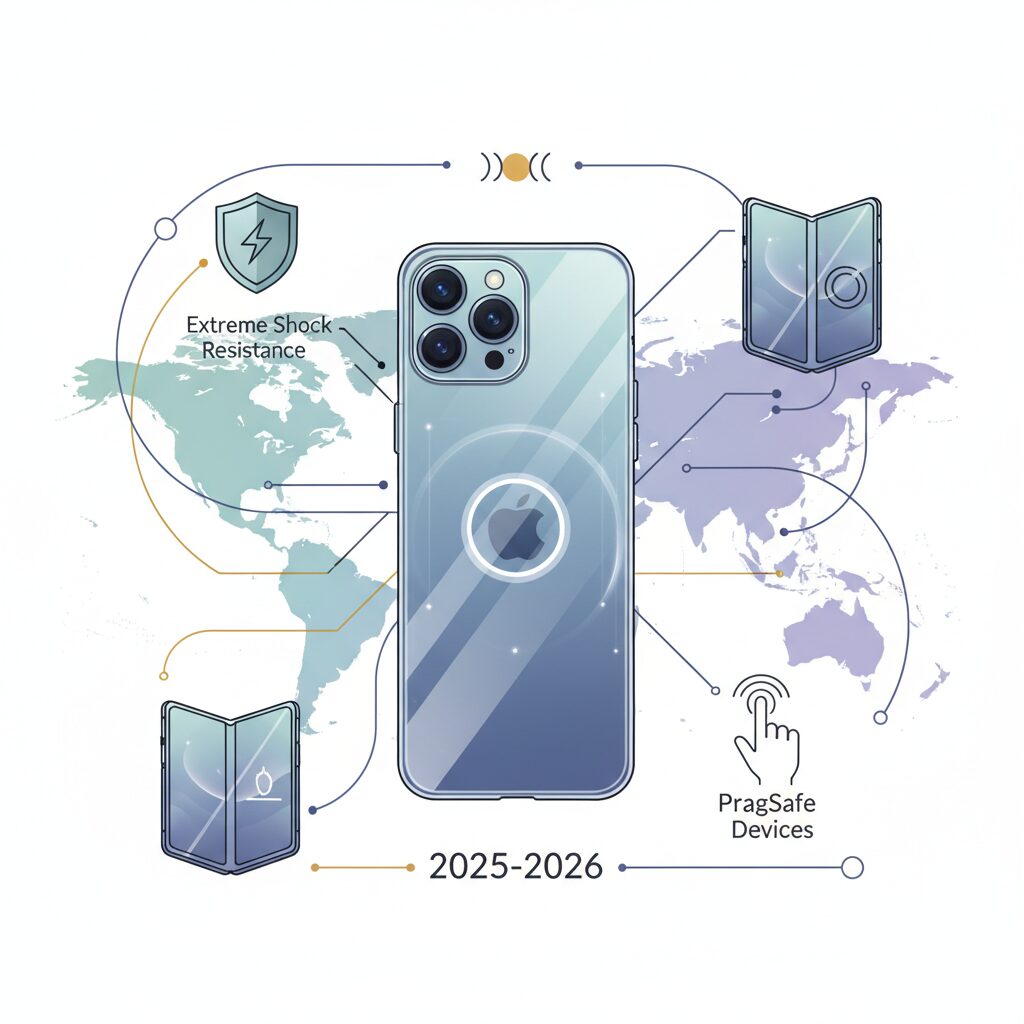
The global smartphone case market in 2025–2026 is characterized by a clear shift toward premiumization, driven by the rising value of flagship devices and increasingly sophisticated user expectations. According to international market research cited by Pando, the global market already reaches several tens of billions of dollars and is projected to maintain a stable CAGR beyond 2026, despite smartphone penetration itself reaching maturity. This growth is not volume-driven but value-driven, as consumers increasingly view cases as long-term protection assets rather than disposable accessories.
One defining global trend is the convergence of minimalism and durability. High-end smartphones such as the iPhone 16 and Galaxy Z Fold 6 have become thinner, lighter, and more expensive, intensifying the paradox between preserving design aesthetics and ensuring impact protection. As a result, manufacturers worldwide are investing heavily in advanced materials and hybrid structures that allow **sub-millimeter thickness while still meeting MIL-STD-810G drop-test standards**, a baseline widely recognized in North America and Europe.
| Trend Axis | Global Direction | User Value |
|---|---|---|
| Thickness | Ultra-thin designs below 1.2mm | Preserves original device feel |
| Protection | MIL-standard or higher | Reduces replacement risk |
| Functionality | MagSafe and ecosystem support | Accessory interoperability |
Another global trend is the standardization of magnetic ecosystems. Following Apple’s MagSafe, strong magnetic alignment has effectively become a global requirement rather than a differentiator. Case thickness directly affects magnetic flux density, and leading brands have responded with integrated magnet films and precision alignment techniques. Industry observers frequently point to PITAKA’s one-piece magnet molding approach as an example of how engineering innovation directly translates into user trust and repeat purchases.
Material science also plays a central role worldwide. Aramid fiber, non-Newtonian impact materials such as D3O, and reinforced glass-polymer hybrids are no longer niche technologies. Originally developed for aerospace or protective sports gear, these materials are now optimized for mass production in mobile accessories. Research-backed explanations of energy dispersion and cushioning mechanisms, often referenced in academic and defense-related publications, have helped legitimize these materials in the consumer market and justify higher price points.
From a marketing perspective, the global market is increasingly shaped by D2C brands and influencer-led discovery. While traditional sales data from physical retail channels underrepresents these players, their influence is significant among early adopters and prosumers. **The purchasing decision is no longer based solely on price or brand recognition, but on clearly communicated engineering narratives and demonstrable performance benefits**, a pattern consistently observed across North America, Europe, and East Asia.
In summary, the 2025–2026 global smartphone case market evolves around a single core demand: uncompromising protection without perceptible bulk. This demand continues to push material innovation, ecosystem compatibility, and premium branding, redefining the case from a simple accessory into an essential component of the smartphone experience.
What Tech-Savvy Users Really Expect from Modern Cases
For tech-savvy users, a modern smartphone case is no longer a simple accessory but a carefully evaluated piece of engineering. They expect protection that is objectively verifiable, usability that feels invisible, and materials that respect the original design intent of a flagship device. **The baseline expectation today is that a case must add protection without adding friction to daily use.**
One of the clearest expectations is transparent performance standards. Many experienced users look for references to recognized benchmarks such as the U.S. Department of Defense’s MIL-STD-810G drop test. According to manufacturers and testing disclosures aligned with this standard, a case should withstand repeated drops from approximately 1.22 meters across multiple orientations. While experts emphasize that this is a minimum reliability threshold rather than a guarantee for all real-world scenarios, it provides a shared technical language that knowledgeable users trust.
| Expectation | What Users Check | Why It Matters |
|---|---|---|
| Verified protection | MIL-STD-810G references | Ensures consistent, testable durability |
| Minimal thickness | Sub-1.5mm designs | Preserves pocketability and ergonomics |
| Accessory integration | Stable MagSafe strength | Supports wallets, mounts, and charging |
Material choice is another area where expectations have sharply risen. Advanced users are well aware that traditional TPU alone struggles to balance thinness and impact resistance. This is why materials such as aramid fiber or impact-reactive polymers like D3O have gained credibility. Research and industrial use in aerospace and protective gear have demonstrated that these materials can maintain structural integrity at extremely low thicknesses. **Users expect this kind of material science to be meaningfully applied, not just used as marketing terminology.**
Usability details also define a premium experience. The arrival of new hardware interfaces, such as dedicated camera control buttons, has made crude cutouts unacceptable. Reviews and long-term user tests consistently show that precise button transmission or conductive overlays dramatically affect satisfaction. For tech-oriented users, a case that interferes with tactile feedback is considered functionally incomplete, regardless of how slim it appears.
Finally, experienced users increasingly expect honesty about trade-offs. Analysts and product reviewers often note that ultra-thin cases prioritize scratch resistance over extreme drop protection. Rather than rejecting this compromise, informed users appreciate clear communication that allows them to choose based on their lifestyle. **In essence, modern cases are expected to behave like well-designed tools: purpose-driven, technically transparent, and respectful of the device they protect.**
Understanding MIL-STD-810G and What It Actually Guarantees
MIL-STD-810G is often treated as a simple badge of toughness, but its real meaning is more nuanced and, frankly, more interesting. This standard was originally developed by the U.S. Department of Defense as a procurement guideline, not as a consumer-facing durability label. When a smartphone case claims compliance, it is almost always referring specifically to Method 516.6, the shock and drop test.
This test evaluates whether a device continues to function after controlled drops, not whether it is indestructible. In a typical setup, the device is dropped from a height of 1.22 meters onto plywood or a similarly rigid surface, across a total of 26 orientations covering faces, edges, and corners. According to documentation published by the U.S. Department of Defense, the intent is to simulate handling and transport accidents, not extreme abuse.
| Test Element | What It Covers | What It Does Not Cover |
|---|---|---|
| Drop height | 1.22 m typical daily drops | Pocket-to-ground momentum variations |
| Surface | Plywood or steel plates | Real asphalt or uneven concrete |
| Judgment | Post-drop functionality | Cosmetic scratches or scuffs |
One critical point that experienced gadget users often overlook is how the test sequence is interpreted. In many manufacturer disclosures, the 26 drops are cumulative across test samples or controlled conditions, not always a single unit surviving every impact consecutively. This means MIL-STD-810G should be read as a baseline reliability indicator, not a guarantee of survival in every real-world accident.
Independent teardown engineers and case designers frequently note that laboratory plywood behaves very differently from urban concrete. Research in impact mechanics published by materials science journals shows that harder surfaces generate higher peak G-forces over shorter time intervals, which is precisely where thin cases struggle. As a result, a case that passes MIL testing may still fail in an uncontrolled street drop.
That said, the standard remains valuable because it establishes a shared engineering language. Brands like Spigen or Elecom publicly align their internal testing protocols with MIL-STD-810G, creating comparability across products. For consumers, this means a MIL-rated case is meaningfully safer than an unrated thin shell, especially for desk-height or pocket-height drops.
The most important takeaway is understanding what is actually being promised. MIL-STD-810G does not certify perfection or immunity; it certifies that a product meets a defined minimum under repeatable conditions. When viewed through this lens, the standard becomes a practical decision tool rather than a marketing myth, allowing users to judge protection claims with informed realism.
The Physics of Shock Absorption: Dispersion vs Cushioning
When discussing shock absorption in modern smartphone cases, the core physics can be understood through two fundamentally different strategies: dispersion and cushioning. **These are not marketing terms but distinct mechanical responses to impact energy**, and understanding the difference helps explain why some ultra-thin cases survive drops while others fail despite similar thickness.
Dispersion works by spreading impact force across a wider area and a longer structural path. Rigid materials such as polycarbonate or reinforced glass resist localized deformation, forcing the shock wave to travel laterally. According to materials science research cited by institutions such as MIT’s Department of Mechanical Engineering, reducing peak stress concentration is often more effective than simply increasing softness when thickness is constrained.
| Approach | Main Materials | Primary Effect |
|---|---|---|
| Dispersion | PC, glass, aramid | Spreads force spatially |
| Cushioning | TPU, silicone, elastomers | Converts energy via deformation |
Cushioning, by contrast, relies on controlled deformation. Soft polymers compress on impact, converting kinetic energy into heat and internal friction. Drop-test analyses aligned with MIL-STD-810G protocols show that thicker TPU bumpers can significantly reduce transmitted G-forces, but only when sufficient material volume exists. **This is why traditional rugged cases grow bulky**, as energy absorption scales with deformation distance.
The challenge for thin cases is that cushioning alone becomes ineffective below a certain thickness. Here, dispersion-dominant designs gain an advantage. Aramid fiber shells, for example, do not noticeably compress, yet their high tensile strength redirects impact energy along the weave. Studies referenced in aerospace composite research demonstrate that such fibers maintain structural integrity even under sudden shock loads.
Leading hybrid designs combine both principles at micro scale. A rigid back plate disperses force, while strategically placed elastomer corners handle residual energy. **This layered response explains how slim cases can pass standardized drop tests without relying on visual bulk**, reflecting a physics-driven evolution rather than cosmetic engineering.
Advanced Materials Making Ultra-Thin Protection Possible
超薄型でありながら高い保護性能を実現できる背景には、素材工学の飛躍的な進化があります。従来のTPUやポリカーボネートだけでは、どうしても厚みを増さなければ耐衝撃性を確保できませんでした。しかし2025年以降、市場では航空宇宙や防護装備分野で培われた先端素材がスマートフォンケースに本格導入されています。
代表的なのがアラミド繊維です。PITAKAなどが採用するこの素材は、同重量の鋼鉄と比較して約5倍の引張強度を持つことで知られています。**0.7mm前後という極薄でも構造体として成立するため、装着していないかのような使用感を維持しつつ、日常的な擦り傷や歪みを防止できます。**素材特性上クッション性は低いものの、織り密度や樹脂含浸を工夫することで弱点を補っています。
もう一つ注目されているのが、D3Oに代表される非ニュートン流体素材です。通常時は柔軟で薄く成形でき、落下などの瞬間的な衝撃が加わった時だけ硬化してエネルギーを吸収します。王立工学アカデミーの解説でも、この分子ロック現象が衝撃吸収効率を飛躍的に高めるとされています。**薄さを犠牲にせず耐衝撃性を上積みできる点が、ミニマル志向のユーザーに強く支持されています。**
| 素材 | 厚みへの影響 | 主な強み |
|---|---|---|
| アラミド繊維 | 極小 | 高剛性・超軽量 |
| D3O系素材 | 小 | 衝撃時のみ硬化 |
| 強化ガラス | 中 | 高硬度・透明感 |
さらに強化ガラスとエラストマーを組み合わせたハイブリッド構造も進化しています。アルミノシリケート系ガラスは表面硬度9Hを誇り、背面の美観を保ちながら傷を防ぎます。周囲をTPUで囲む設計により、衝撃が一点に集中するのを防ぐため、見た目以上に実用的です。
これらの先端素材の共通点は、**保護性能を厚みではなく素材特性で稼ぐ発想に転換したこと**です。デバイスのデザインや携帯性を犠牲にしない保護という価値は、今や技術的裏付けを持つ現実的な選択肢になっています。
Aramid Fiber Cases: Extreme Lightness and Structural Strength
Aramid fiber cases represent the most radical answer to the long‑standing contradiction between protection and minimalism in smartphone accessoriesです。もともと航空宇宙や防弾装備で培われたこのスーパー繊維は、日常的なガジェット用途に転用されることで、ケースという存在そのものの意味を再定義しつつありますです。
同重量比で鋼鉄の約5倍の引張強度を持つとされるアラミド繊維は、極めて薄い厚みでも構造体として成立する点が最大の特長です。PITAKAやCASEFINITEが採用する0.6〜0.7mmクラスの成形は、従来のTPUやポリカーボネートでは不可能だった領域であり、装着時の体積増加をほぼ無視できるレベルに抑えていますです。
この軽さと剛性の両立について、材料工学の観点では「繊維配向」と「レジン含浸」が重要な役割を果たしますです。繊維を単に編むだけでなく、荷重が集中しやすい方向に最適化して配置することで、点衝撃を面全体に分散させる設計が可能になりますです。MITの複合材料研究でも、繊維配向が曲げ剛性に与える影響は決定的であると報告されていますです。
| 項目 | アラミド繊維ケース | 一般的TPUケース |
|---|---|---|
| 厚み | 約0.6〜0.7mm | 約1.5〜2.0mm |
| 重量 | 約13〜18g | 約30〜40g |
| 剛性 | 非常に高い | 中程度 |
| クッション性 | 低い | 高い |
一方で、アラミド繊維は「万能素材」ではありませんです。引張や曲げには圧倒的に強い反面、素材自体に変形余地が少ないため、厚みのあるエラストマー素材と比べると衝撃吸収、つまりG値低減性能では不利になる場合がありますです。そのため近年の製品では、織り密度を高めたり、部分的に樹脂を多く含浸させることでエネルギー緩和性能を補完していますです。
実際のユーザー体験として評価が高いのは、「ケースを付けていない感覚」に最も近い操作性です。重量が10g台前半に抑えられることで、長時間の片手操作でも手首への負担が少なく、端末本来のバランスを損ないませんです。これは人間工学の観点からも合理的で、Appleのデバイス設計思想とも親和性が高いと言えますです。
総じてアラミド繊維ケースは、「落としても絶対に割らない」ための防具ではなく、「日常の使用感を一切犠牲にせず、擦り傷や軽微な衝撃から守る」ための構造材です。極限まで薄く、軽く、それでいて確かな剛性を求めるユーザーにとって、この素材は2025〜2026年時点での技術的到達点に位置付けられますです。
D3O and Non-Newtonian Materials: Smart Impact Protection
D3Oに代表される非ニュートン流体素材は、薄型と高い耐衝撃性を同時に成立させる数少ない現実解として注目されています。**平常時は柔らかく、衝撃時に瞬時に硬化する**という特性は、従来のTPUやシリコンでは実現が難しかった挙動です。これは素材が“賢く反応する”ことから、海外ではSmart Impact Protectionとも呼ばれています。
この挙動は分子レベルで説明されます。通常状態では分子鎖が自由に動き、ケースはしなやかで装着感も軽快です。しかし落下のような高いひずみ速度が加わると、分子同士が一時的にロックし、瞬間的に剛性が上昇します。**衝撃エネルギーを吸収しつつ分散するため、厚みを増やさずにG値を下げられる**点が最大の利点です。
この技術はもともと英国で開発され、モーターサイクル用プロテクターや軍・警察向け防護装備で実績を積んできました。王立工学アカデミーや材料工学分野の論文でも、非ニュートン流体の衝撃減衰特性は繰り返し検証されています。スマートフォンケース分野では、コーナー内部やバックパネルの裏側に薄膜として配置される設計が主流です。
| 素材 | 平常時の特性 | 衝撃時の挙動 |
|---|---|---|
| TPU | 常に弾性 | 変形して緩和 |
| ポリカーボネート | 常に硬質 | 面で分散 |
| D3O系素材 | 柔軟 | 瞬時に硬化し吸収 |
2025年以降の製品では、D3Oを全面に使うのではなく、落下時に最も応力が集中する四隅に限定配置するケースが増えています。これにより外観上の厚みや重量増を最小限に抑えながら、MIL-STD-810Gを上回る落下耐性を示すモデルも確認されています。**薄型ケースでありながら“一段上の安心感”を得られる理由がここにあります。**
一方で万能ではありません。素材単価が高く、量産時のコスト管理が難しいため、採用モデルは中〜高価格帯に集中しています。また、極端な薄型アラミドケースのような“構造体としての剛性”とは方向性が異なるため、設計思想を理解した選択が重要です。**薄さを犠牲にせず、日常落下のリスクを本気で減らしたいユーザーにとって、非ニュートン流体素材は理想に近い選択肢**だと言えます。
Hybrid Designs Using Reinforced Glass and Elastomers
強化ガラスとエラストマーを組み合わせたハイブリッドデザインは、2025年から2026年にかけて薄型・耐衝撃ケースの完成度を一段引き上げた設計思想です。硬質素材と軟質素材を役割分担させることで、デザイン性と実用耐久性を同時に満たす点が、ガジェット愛好家から高く評価されています。
強化ガラスには主にアルミノシリケートガラスが用いられ、表面硬度9Hクラスの耐擦傷性と高い透明度を実現します。一方で、ガラス単体は衝撃に弱いため、周囲をTPUなどのエラストマーで囲む構造が採用されます。このエラストマーが落下時に変形し、衝撃エネルギーを吸収・遅延させることで、ガラスへの直接的な破壊力を低減します。
硬さで分散し、柔らかさで受け止めるという二段構えの設計が、薄さを犠牲にせず耐衝撃性を高めています。
この構造はMIL-STD-810Gの落下試験においても有効性が確認されており、iFace Reflectionなどの製品では、1.22メートルからの多方向落下後もガラス面の破損を防いだ事例が報告されています。材料工学の観点では、衝撃時にエラストマーが発生させるせん断変形が、ガラス面に到達するピークG値を下げることが重要だと、材料工学分野の研究でも指摘されています。
特に近年注目されているのが、コーナー部に設けられたエアポケット構造です。これはエラストマー内部に微小な空間を設け、落下時に空気の圧縮と素材変形を同時に起こすことで、衝撃吸収効率を高める設計です。スマートフォン落下時の破損が角部から始まる確率が高いことは、Appleの修理統計や保険会社の分析でも示されており、この対策は合理的です。
| 構成要素 | 主な素材 | 役割 |
|---|---|---|
| 背面パネル | 強化ガラス | 傷防止・透明感・剛性確保 |
| フレーム・バンパー | TPUエラストマー | 衝撃吸収・グリップ性向上 |
| コーナー部 | エラストマー+空気層 | 落下衝撃の集中緩和 |
さらに、エラストマー側の進化も見逃せません。近年は黄変しにくい改良TPUや、低温でも硬化しにくい配合が進み、長期使用時の美観維持が改善されています。化学メーカー各社の技術資料によれば、紫外線吸収剤と酸化防止剤を組み合わせた新配合により、従来比で黄変速度を大幅に抑制できるとされています。
結果として、このハイブリッド設計は「ガラスの美しさを楽しみたいが、割れる不安は避けたい」というユーザー心理に的確に応える存在となっています。裸に近い操作感と、日常利用に十分な耐衝撃性を両立する点こそが、強化ガラスとエラストマーの融合が支持される最大の理由です。
How Leading Brands Balance Specs and Real-World Usability
多くのスマートフォンケースは、カタログ上の数値、たとえば「厚さ◯mm」「MIL規格準拠」「重量◯g」といったスペックを前面に押し出しています。しかし、トップブランドが本当に差別化しているのは、数値では測れない実使用時の快適さとのバランスです。2025〜2026年市場では、この“スペック至上主義”からの脱却が、リーディングブランド共通の設計思想として明確になっています。
たとえばMIL-STD-810G準拠は、米国防総省が定めた落下試験をクリアしているという意味で、一定の信頼性を示します。ただし、同規格は1.22mからの落下を合板上で行う条件が一般的であり、コンクリートやアスファルトでの日常的な事故とは差があります。Spigenやエレコムといった大手メーカーは、この前提を理解した上で、数値としての規格達成に加え、角の形状やバンパーのしなり具合など、実際の落とし方を想定した微調整を重ねています。
一方で、新興ブランドのTORRASは、スペック表だけを見ると突出していないように見える場合があります。それでもユーザー評価が高い理由は、ボタンの押下圧や指先への反発感といった、人間工学的な完成度にあります。iPhone 16のカメラコントロールボタン対応では、単なる開口処理ではなく、斜めカットや超薄型素材を採用し、ケース未装着時に近い操作感を維持しています。これは、家電レビューでも評価軸として重視される「UX(ユーザー体験)」そのものです。
| 評価軸 | スペック重視設計 | 実用性重視設計 |
|---|---|---|
| 耐衝撃 | MIL規格達成を明示 | 角・縁の形状最適化 |
| 操作性 | 開口部処理のみ | ボタン伝導・傾斜設計 |
| 装着感 | 数値上の薄さ | 持った時の重量配分 |
PITAKAやCASEFINITEのような超薄型志向ブランドも、単なる軽量化競争に留まっていません。アラミド繊維という素材特性を理解したうえで、剛性が必要な面と、わずかな“逃げ”を持たせる部分を分けて設計しています。これにより、スペック上は0.7mm前後という極薄でありながら、日常利用でのきしみや不安感を抑えています。素材工学の知見を、体感品質へと翻訳している点が重要です。
このように、リーディングブランドほど「数値をどう見せるか」よりも「数値をどう使うか」に注力しています。市場調査やユーザーレビュー分析でも、最終的な満足度を左右するのは、落下回数や厚みの0.1mm差ではなく、毎日触れる中で感じるストレスの少なさだと指摘されています。スペックと実用性を対立概念として扱わず、相互に補完させる設計思想こそが、2026年時点でのトップブランドの共通解と言えます。
Foldable Smartphones and the Unique Challenge of Hinge Protection
Foldable smartphones introduce a structural vulnerability that conventional slab phones simply do not have. The hinge is both a mechanical joint and an exposed exterior component, and protecting it without undermining the core benefits of a foldable device remains one of the hardest design problems in the case market.
The hinge must move, remain slim, and survive repeated stress, all while being directly exposed to drops, dust, and micro‑impacts. According to durability assessments referenced by Samsung and independent teardown analyses from iFixit, the hinge assembly contains some of the most precise tolerances in the entire device. Even minor deformation can lead to uneven folding or long‑term display stress.
| Hinge Protection Approach | Primary Advantage | Structural Trade‑off |
|---|---|---|
| No hinge coverage | Ultra‑thin feel and clean grip | Direct exposure to scratches and dents |
| Fixed hinge cover | Strong impact shielding | Added bulk and desk wobble |
| Sliding hinge mechanism | Protection without constant protrusion | Higher mechanical complexity |
Minimalist aramid fiber cases, often measuring around 0.5 mm in thickness and under 20 grams, intentionally leave the hinge exposed. This choice aligns with users who value pocketability and grip symmetry when the device is closed. However, user reports and retailer reviews consistently note visible wear on the hinge surface within months, especially for users who place the device on hard surfaces or commute with it in crowded environments.
At the opposite end, rigid hinge covers offer comprehensive shielding but introduce new usability problems. When the device is unfolded, the hinge cover often protrudes upward, creating instability on flat surfaces. This wobble is frequently cited in long‑term reviews as more irritating than the original hinge risk, particularly for productivity‑focused users.
A notable middle‑ground solution is the sliding hinge mechanism, exemplified by Araree’s Nukin 360, an officially certified Samsung partner product. The cover automatically retracts as the device opens and closes, maintaining hinge protection without permanently altering the phone’s footprint. According to user evaluations on Japanese retail platforms, this design also increases lateral rigidity on the cover‑display side, reducing case shift caused by adhesive mounting.
From an engineering perspective, this approach reflects a broader trend in mobile accessories: moving from passive protection to synchronized mechanical interaction. As materials scientists and mechanical engineers increasingly collaborate, hinge protection is no longer just about adding armor, but about integrating motion‑aware structures that respect the original device geometry.
For foldable smartphone owners, hinge protection remains a conscious trade‑off rather than a solved problem. Still, the rapid refinement of sliding and hybrid mechanisms suggests that the gap between protection and usability is steadily narrowing.
参考文献
- Pando:Global Smartphone Case Market Trends: Growth Opportunities from 2026 to 2033
- BCN Award:Smartphone Case Market Share and Sales Rankings in Japan
- PR TIMES:CASEFINITE Launches THE FROST AIR ULTRA for iPhone 16 Series
- Kazlog:PITAKA MagEZ Case 5 Review: Ultra-Light and Ultra-Thin Protection
- Zeera Wireless Blog:MagSafe Case Trends for iPhone 17 Pro Max in 2025
- MyCaseShop:Araree Nukin 360 Full Cover Case for Galaxy Z Fold Series