
Have you ever recorded a brilliant idea on your phone, only to forget where it was saved or what exactly was said? In 2026, that frustration is rapidly disappearing as AI transforms simple voice memos into fully searchable, structured knowledge assets.
What used to be passive audio files are now analyzed by intelligent agents that summarize meetings, detect action items, connect conversations across weeks, and even understand emotional nuance. With platforms like Notta, Otter.ai, and tl;dv, alongside deep OS-level integration in iOS 19 and Android 16, voice is becoming the most powerful input method for digital productivity.
At the same time, wearable AI recorders such as PLAUD NotePin S and advances in semantic search are turning everyday conversations into a “second brain.” However, this shift also raises serious questions about biometric data, privacy laws, and AI governance. In this article, you will explore the technologies, research evidence, real-world use cases, and legal frameworks that are shaping the future of mobile voice knowledge management in 2026.
- From Transcription to Autonomous Voice Knowledge Management
- AI Meeting Platforms in 2026: Notta Brain, Otter.ai, tl;dv, and CLOVA Note Compared
- CRM and Workflow Automation: How Voice Data Flows Into Salesforce and HubSpot
- Native OS Integration: Apple Intelligence in iOS 19 and Smart Folders in Voice Memos
- Android 16 and Gemini Live: Hands-Free Control and Screen Automation
- Wearable AI Recorders at CES 2026: PLAUD NotePin S and the Rise of the Physical Second Brain
- The Hidden Cost of Unrecorded Conversations: Productivity Gaps and Workplace Data
- Semantic Search and Audio Knowledge Graphs: The Science Behind Context-Aware Retrieval
- Cognitive Load Theory and EEG Findings: Why Structured Audio Improves Decision-Making
- Biometric Data, AI Transparency, and Global Compliance in 2026
- Real-World Implementations: Healthcare, Sales Teams, and High-Performance Professionals
- Technical Limitations and What to Expect in 2027
- 参考文献
From Transcription to Autonomous Voice Knowledge Management
In 2026, voice technology has moved far beyond simple transcription. What once meant converting speech into text now evolves into autonomous voice knowledge management, where AI structures, connects, and operationalizes spoken information without constant human intervention.
Traditional voice memos created passive archives. You had to replay recordings, manually extract insights, and remember context yourself. Today’s systems transform raw conversations into searchable, categorized, and actionable knowledge assets in real time.
This shift is powered by the convergence of AI-native transcription platforms, OS-level intelligence, and wearable capture devices.
| Stage | Primary Function | User Effort | Knowledge Value |
|---|---|---|---|
| Recording Era | Store audio files | High (manual review) | Low (unstructured) |
| Transcription Era | Convert speech to text | Moderate (manual organization) | Medium (searchable text) |
| Autonomous Era | Structure, connect, summarize, automate | Low (AI-driven) | High (actionable intelligence) |
Platforms such as Notta, Otter.ai, and tl;dv no longer stop at transcripts. Notta Brain, released in January 2026, integrates primary voice data with secondary sources like internal documents and web content, enabling cross-meeting reasoning. You can ask complex questions about past discussions, and the system synthesizes answers across multiple recordings and materials.
Globally, Otter.ai maintains strong real-time transcription and speaker identification, while tl;dv extracts weekly insights across up to 20 meetings and pushes structured intelligence into CRM systems. This integration eliminates invisible manual work such as copying action items into Salesforce or HubSpot.
The key transformation is not accuracy alone, but autonomy. AI now categorizes conversations, assigns project context, highlights decisions, and even identifies recurring objections in sales calls without explicit tagging.
Operating systems reinforce this autonomy. Apple’s integration of Apple Intelligence into Voice Memos and Notes enables automatic summaries and Smart Folder classification. Android 16’s Gemini, with screen automation, can move summarized content into documents and share them based on natural language commands. The voice memo becomes a trigger for workflows, not just a stored artifact.
Wearable devices like PLAUD NotePin S extend this capability beyond formal meetings. With features such as Press to Highlight, users mark key moments physically, reducing cognitive load while giving AI semantic anchors for later processing. According to recent business surveys in Japan, 77.6% of professionals report important exchanges outside formal meetings, yet recording behavior drops significantly during mobility. Autonomous capture closes this “information gap.”
Academic research supports this evolution. The iKnow-audio framework presented at EMNLP 2025 integrates audio-centric knowledge graphs, allowing systems to understand contextual meaning rather than isolated keywords. Meanwhile, cognitive load studies published in Frontiers in Psychology and PubMed Central show that poorly structured multimedia increases semantic processing strain in the brain. Automated structuring therefore reduces cognitive burden and enhances decision quality.
Autonomous voice knowledge management is ultimately about reallocating human cognition. Instead of remembering what was said, you focus on interpreting why it matters. Instead of organizing files, you interrogate insights. The voice layer becomes a continuously updating knowledge graph that reflects projects, relationships, risks, and opportunities in real time.
This is not merely productivity enhancement. It is the emergence of a parallel cognitive system—one that listens, organizes, connects, and prepares intelligence before you even ask for it.
AI Meeting Platforms in 2026: Notta Brain, Otter.ai, tl;dv, and CLOVA Note Compared
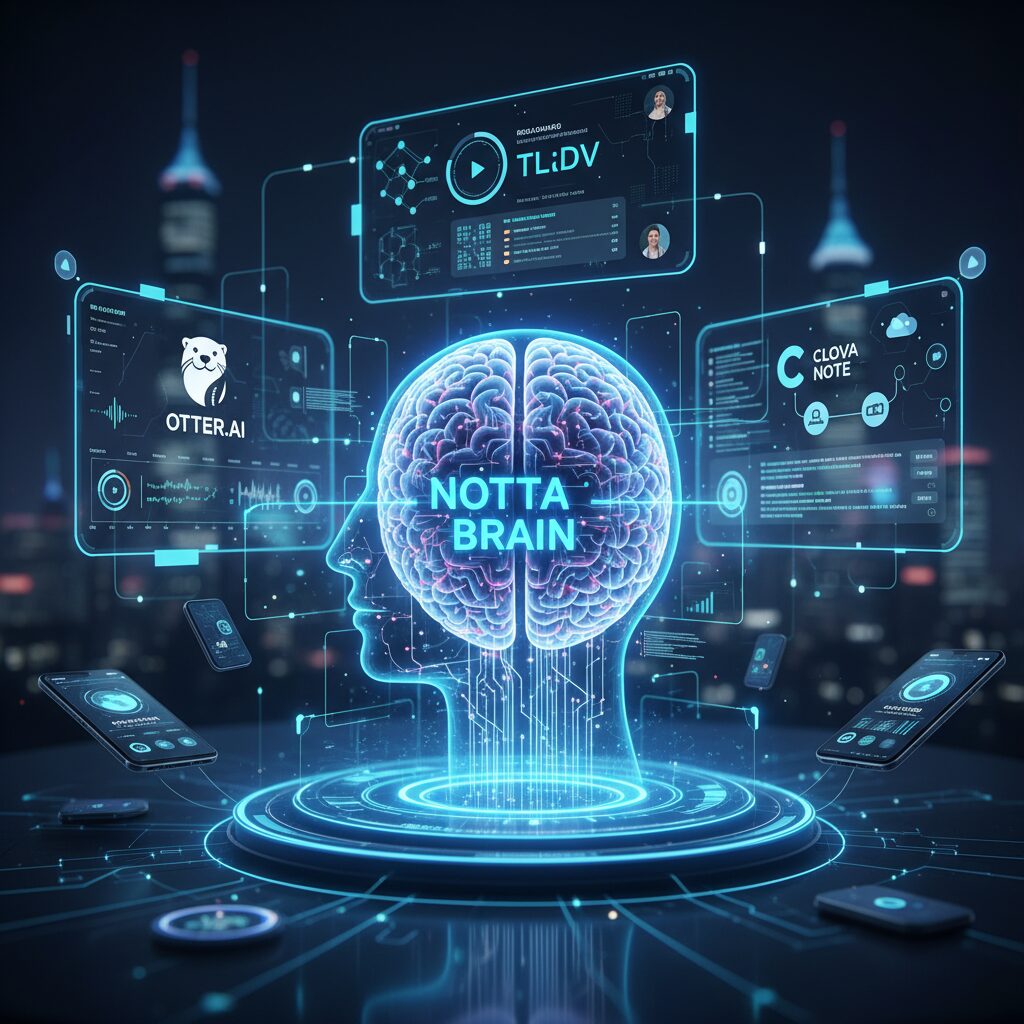
By 2026, AI meeting platforms have evolved from simple transcription tools into intelligent knowledge engines. Notta, Otter.ai, tl;dv, and CLOVA Note now compete not just on accuracy, but on how effectively they transform conversations into structured, searchable business assets.
The real differentiator is no longer “who transcribes best,” but “who thinks with you.” Each platform approaches this challenge from a distinct strategic angle.
| Platform | Core Strength (2026) | Ideal User |
|---|---|---|
| Notta (Notta Brain) | Integrated voice-centered knowledge base | Japanese enterprises, cross-functional teams |
| Otter.ai | Real-time transcription & structured summaries | PMs, executives, founders |
| tl;dv | Cross-meeting AI insights & weekly reports | Sales & product teams |
| CLOVA Note | Ease of use within LINE ecosystem | Journalists, general users |
Notta’s 2026 release of Notta Brain marks a decisive shift toward voice-first AI agents. According to its official announcement, the system connects primary data such as meetings and calls with secondary sources like internal documents and web information. This enables complex queries that span multiple recordings, effectively building a personalized knowledge infrastructure rather than isolated transcripts.
Notta also maintains a strong edge in Japanese-language nuance, handling honorifics and contextual hierarchy with notable precision. However, reviews from global users indicate that multilingual environments still require careful validation, particularly in accent recognition and speaker attribution.
Otter.ai remains a benchmark for polished, real-time transcription. Its speaker identification and structured summary outputs are widely trusted in professional settings. Community discussions among productivity-focused users frequently cite Otter’s reliability in high-stakes meetings where live clarity matters most.
tl;dv, by contrast, focuses on aggregation intelligence. Its AI Insights and automated weekly reports analyze up to 20 meetings, extracting competitor mentions, objections, and action items. This cross-meeting synthesis turns scattered conversations into strategic patterns, especially when integrated with CRM systems like Salesforce or HubSpot via automated workflows.
CLOVA Note emphasizes simplicity and ecosystem familiarity. For users embedded in LINE services, its frictionless recording and summarization experience lowers the barrier to AI adoption, even if its external integrations remain more limited.
The 2026 battlefield is integration depth. CRM auto-sync, cross-session memory, and agent-style querying now define competitive advantage. As government AI guidelines from Japan’s Digital Agency stress transparency and data governance, enterprise users increasingly evaluate not only features but also compliance posture and data handling policies.
Choosing among these platforms therefore depends less on raw transcription quality and more on organizational workflow design. Whether you prioritize linguistic nuance, executive-ready summaries, revenue intelligence, or ecosystem convenience, each tool represents a different philosophy of how AI should augment human conversation.
CRM and Workflow Automation: How Voice Data Flows Into Salesforce and HubSpot
In 2026, voice data no longer ends as a transcript stored in a note-taking app. It flows directly into CRM systems such as Salesforce and HubSpot, where it becomes structured revenue intelligence.
The shift is from “recording conversations” to “activating conversations.” Platforms like tl;dv, Notta, and Otter.ai now push summaries, action items, and key objections into CRM fields automatically, eliminating manual entry after meetings.
According to vendor documentation and product updates referenced in 2026 reviews, this automation typically relies on native integrations or middleware such as Zapier, enabling triggers the moment a meeting ends.
| Stage | AI Processing | CRM Outcome |
|---|---|---|
| Meeting Recorded | Speech-to-text + speaker ID | Call log created |
| AI Summary Generated | Action items, objections, sentiment | Notes auto-filled in opportunity |
| Insight Extraction | Competitor mentions, risks | Fields/tags updated |
For sales teams, this means that the moment a Zoom or in-person meeting concludes, the CRM opportunity can already contain a structured summary, next steps, and highlighted risks. tl;dv’s AI insights and weekly reports, for example, aggregate patterns across multiple meetings and synchronize them with CRM records, reducing what used to be invisible administrative work.
HubSpot users benefit from automated timeline enrichment. Instead of typing follow-up notes, representatives can rely on AI-generated summaries that attach to contact and deal records. This improves pipeline visibility without increasing cognitive load.
CRM automation powered by voice AI reduces data loss in the “information gap”—especially for calls, hallway conversations, and field meetings that previously went unlogged.
A 2025 business survey in Japan found that 73.0% of professionals experienced issues due to unrecorded communication outside formal meetings. By integrating wearable or mobile-recorded voice data into Salesforce or HubSpot automatically, organizations directly address this structural blind spot.
Technically, the workflow often follows three layers: capture via mobile or wearable device, AI structuring in the cloud, and conditional routing into CRM objects. Salesforce fields such as “Next Step,” “Close Date Risk,” or custom competitor fields can be populated based on detected keywords or semantic intent.
Research such as the iKnow-audio framework presented at EMNLP 2025 highlights how knowledge graph integration enhances contextual understanding. When applied to CRM automation, this enables systems to recognize not just words like “budget issue,” but the relational meaning—linking it to risk scoring or forecast adjustments.
However, governance cannot be ignored. Under Japan’s revised personal information guidelines, voiceprints qualify as biometric identifiers. Organizations must ensure proper consent and secure processing before syncing recordings into CRM databases, particularly when cloud AI processing is involved.
Ultimately, voice-to-CRM automation transforms conversations into structured, queryable business assets. Instead of relying on memory or delayed documentation, teams operate with near real-time intelligence embedded directly inside Salesforce and HubSpot dashboards.
Native OS Integration: Apple Intelligence in iOS 19 and Smart Folders in Voice Memos
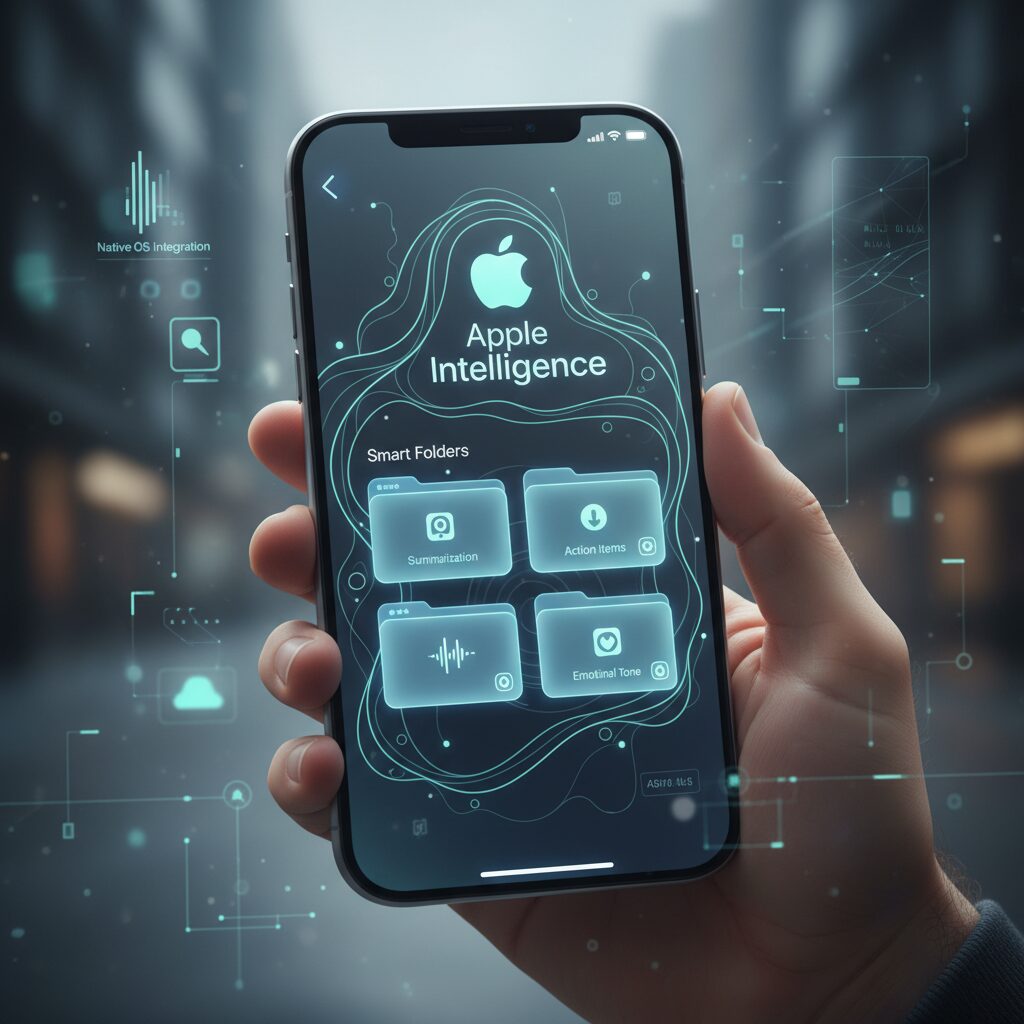
In 2026, voice memo management is no longer confined to standalone apps. With iOS 19, Apple has embedded Apple Intelligence directly into the operating system, transforming Voice Memos into a native knowledge engine rather than a passive recording tool.
According to Apple Support documentation, Apple Intelligence now works seamlessly across Notes and Voice Memos, enabling real-time transcription, summarization, and tone adjustment through built-in Writing Tools. This deep OS-level integration reduces friction and eliminates the need for third-party workflows.
Voice recording is no longer an isolated action. In iOS 19, it becomes an intelligent, auto-structured asset the moment you hit record.
One of the most significant shifts is the fusion between Notes and Voice Memos. Users can initiate a recording directly inside the Notes app, where transcription appears instantly. When the session ends, Apple Intelligence automatically inserts a concise summary at the top of the note, prioritizing key points over raw dialogue.
This mirrors broader trends in AI-assisted cognition. Research published on PubMed Central has shown that unstructured audio increases semantic processing load, while structured summaries reduce cognitive strain during recall. Apple’s approach operationalizes this insight at the OS level.
Smart Folders: Context-Aware Organization
Smart Folders represent the second pillar of this transformation. Instead of manually tagging recordings, iOS 19 analyzes metadata and content signals to categorize files dynamically.
| Signal Type | Detected By | Organizational Outcome |
|---|---|---|
| Topic & Keywords | On-device AI analysis | Project-based folder assignment |
| Date & Time | System metadata | Chronological grouping |
| Location Data | GPS context | Event-based clustering |
| Device Source | Apple Watch / iPhone | Idea vs. Meeting separation |
For example, a quick idea captured on Apple Watch during a commute may automatically appear in an “Ideas” Smart Folder, while a one-hour office recording is categorized under a specific project. The user does not move files; the system continuously reorganizes them as context evolves.
This shift from static folders to dynamic, AI-driven classification fundamentally changes retrieval behavior. Instead of remembering where a file was saved, users search semantically—by theme, client, or even inferred intent.
Importantly, Apple Intelligence balances cloud and on-device processing. Apple emphasizes privacy-centric AI architecture, processing many tasks locally before invoking secure cloud computation when necessary. This hybrid model addresses the growing regulatory sensitivity around biometric voice data, particularly under updated data protection frameworks.
The result is subtle but powerful: voice memos in iOS 19 no longer feel like audio files. They behave like living documents—summarized, indexed, context-aware, and continuously organized without manual effort.
For power users and productivity-focused professionals, this native integration means fewer export steps, fewer tagging rituals, and dramatically lower cognitive overhead. The OS itself becomes the first layer of knowledge management, turning everyday speech into structured intelligence in real time.
Android 16 and Gemini Live: Hands-Free Control and Screen Automation
Android 16 transforms voice memo management from a passive recording task into an intelligent, hands-free workflow powered by Gemini Live.
Instead of tapping through apps, users can now control the entire lifecycle of a voice memo with natural speech. According to AbilityNet’s official guide to Gemini in Android 16, voice interaction is deeply embedded at the OS level, allowing real-time commands without breaking context.
This shift means your smartphone no longer waits for input—it collaborates with you in the background.
Gemini Live: True Hands-Free Memo Control
| Function | Traditional Workflow | Android 16 + Gemini Live |
|---|---|---|
| Start recording | Open app → Tap record | Voice command only |
| Summarize memo | Manual review or separate AI tool | Instant spoken request |
| Share to Docs | Export → Open app → Paste | Automated cross-app execution |
With Gemini Live, users can say, “Record this as a project memo,” and the assistant handles activation, labeling, and categorization. After recording, a simple command such as “Summarize and send to the team” triggers AI summarization and distribution.
What makes this remarkable is contextual awareness. Gemini does not treat each command as isolated. It understands temporal cues like “this meeting” or “earlier today,” dramatically reducing prompt friction.
Screen Automation: From Voice to Execution
The real breakthrough arrived with Android 16 QPR3’s Screen Automation feature, reported by 9to5Google. This allows Gemini to read and interact with on-screen content across apps.
For example, after recording a client call, you can say, “Insert key decisions into my Google Docs template and share with sales.” Gemini references the current screen, extracts the summary, opens the appropriate document, populates structured sections, and initiates sharing.
This is not just transcription—it is task orchestration across the Android ecosystem.
In productivity terms, this removes what behavioral researchers often call “micro-switching costs,” the small cognitive burdens caused by moving between apps. By automating these transitions, Android 16 reduces the mental overhead associated with documentation.
Notification Organizer and Expressive Context
Android 16 also introduces AI-powered notification summaries. As reported by The Tech Buzz, important AI-generated memo summaries can be separated into a prioritized notification lane, preventing critical insights from being buried.
On the accessibility front, Google’s official blog highlights improvements to Expressive Captions. Emotional indicators such as tone shifts can now be reflected in captions, preserving non-verbal nuance in structured text.
This matters because decision-making often depends not only on what was said, but how it was said. By embedding emotional cues into searchable summaries, Android 16 preserves conversational context in a way traditional notes never could.
For gadget enthusiasts and productivity-focused professionals, the implication is clear. The smartphone is evolving into a command center where spoken intent directly translates into automated digital action.
Hands-free no longer means limited control. In Android 16, it means expanded capability with reduced friction.
Wearable AI Recorders at CES 2026: PLAUD NotePin S and the Rise of the Physical Second Brain
At CES 2026, wearable AI recorders are no longer experimental gadgets. They are presented as the physical infrastructure of what many call a “second brain.” Among them, PLAUD NotePin S stands out as a device designed not just to record sound, but to externalize memory itself.
As CNET reported during CES coverage, the NotePin S was positioned as a discreet, always-ready AI note-taker that you can clip to a collar, wear on your wrist, or hang like a pendant. This shift in form factor is critical. By moving recording away from the smartphone, it reduces friction and makes continuous capture realistic in fieldwork, sales visits, and spontaneous discussions.
The key innovation is not miniaturization alone, but the transformation of raw audio into structured, searchable knowledge with minimal user effort.
The defining feature of the NotePin S is “Press to Highlight.” With a single physical press, users mark critical moments in real time. Instead of passively generating hours of undifferentiated audio, the device embeds human judgment into the dataset. Later, the AI prioritizes these flagged segments for summaries and action items.
This interaction model directly addresses a problem identified in Japanese business surveys: important conversations frequently occur outside formal meetings, yet recording behavior drops significantly during travel or informal exchanges. A wearable with one-tap highlighting lowers the cognitive barrier to capturing those moments.
| Device | Primary Use Case | Distinctive Interface | Battery (Max Recording) |
|---|---|---|---|
| PLAUD NotePin S | Fieldwork / Always-on capture | Pressure highlight button | Up to 20 hours |
| PLAUD Note Pro | Large meetings | Button + touch display | Up to 50 hours |
Beyond hardware, PLAUD integrates recordings into Plaud Desktop, merging in-person and online meeting data into a unified knowledge base. This convergence is what turns a recorder into a “physical hub” for voice-driven knowledge management.
PLAUD also supports more than 10,000 custom templates, enabling automatic transformation of conversations into structured formats such as medical SOAP notes, sales logs, or lecture summaries. In practice, this means the device is not merely archiving speech. It is pre-formatting expertise.
Compared with traditional recorders like the Zoom H5 or Sony ICD-TX660, which emphasize audio fidelity but lack AI structuring, wearable AI recorders prioritize downstream usability. In 2026, the competitive edge lies not in clearer sound waves, but in faster retrieval and contextual intelligence.
Wearable AI recorders at CES 2026 signal a broader transition: memory is becoming a distributed system, where hardware captures experience and AI continuously organizes it into actionable insight. The rise of devices like the PLAUD NotePin S suggests that the second brain is no longer metaphorical. It is clipped to your collar, waiting for the next idea worth remembering.
The Hidden Cost of Unrecorded Conversations: Productivity Gaps and Workplace Data
Unrecorded conversations may feel harmless in the moment, but in knowledge-driven workplaces they create invisible productivity gaps. In 2025, a Japanese business survey found that 77.6% of professionals experience important work-related exchanges outside formal meetings, yet recording behavior drops significantly when people are on the move. As a result, 73.0% reported experiencing problems such as miscommunication or missed instructions due to lack of records.
These numbers reveal a structural issue. Work no longer happens only in scheduled meetings. It unfolds in hallways, during calls, and while commuting. When those moments are not captured, organizations accumulate what can be described as “data blind spots.”
The productivity cost is not only operational but neurological. Research published on PubMed Central in 2025 shows that when individuals process poorly structured auditory information, semantic processing in the brain slows down and weakens. In practical terms, revisiting raw, unorganized audio demands significantly more cognitive effort than reviewing structured summaries.
When conversations are not recorded at all, the burden shifts entirely to human memory. Cognitive load theory research in Frontiers in Psychology identified additional mental strain when people must reconstruct information without structured support. That strain compounds when employees juggle multiple projects.
| Scenario | Data Availability | Impact on Productivity |
|---|---|---|
| Recorded & Structured | Searchable, summarized, cross-referenced | Faster decisions, reduced redundancy |
| Recorded but Raw | Playable but unstructured | High review time, cognitive fatigue |
| Not Recorded | Dependent on memory | Errors, repetition, knowledge loss |
The third scenario is more common than many executives assume. The same Japanese survey indicates that when employees leave the office, the proportion of people who “do not record at all” increases by 14.8%. This gap directly correlates with recurring monthly issues reported by 37.0% of respondents.
From a data strategy perspective, unrecorded conversations represent missing organizational assets. Modern AI platforms such as Notta Brain and tl;dv demonstrate how recorded dialogue can be transformed into searchable knowledge bases and CRM-linked action items. When conversations are absent from the system, that entire analytical layer becomes impossible.
This creates asymmetry inside organizations. Teams that systematically capture and structure discussions accumulate compounding knowledge. Teams that rely on memory operate in short-term cycles, repeatedly rediscovering insights that were already spoken but never preserved.
In competitive industries, this gap widens over time. Decisions slow down because context must be rebuilt. Onboarding becomes harder because historical reasoning is undocumented. Strategic intelligence fragments across individuals instead of living in shared systems.
The hidden cost of unrecorded conversations is therefore not just lost words, but lost leverage. In 2026, where AI-driven semantic search and automated reporting are becoming standard, the absence of structured voice data is equivalent to operating without analytics in a data-first economy.
Organizations that recognize this shift treat everyday dialogue as enterprise data. Those that do not risk falling behind—not because they lack ideas, but because their ideas were never captured, connected, or converted into usable knowledge.
Semantic Search and Audio Knowledge Graphs: The Science Behind Context-Aware Retrieval
Context-aware retrieval in 2026 is no longer powered by simple keyword matching. It is driven by semantic search models and Audio Knowledge Graphs that transform raw sound into structured, relational intelligence.
Traditional voice memo apps relied on transcripts and string matching. If a word was not spoken exactly as searched, it was effectively invisible.
Semantic search changes this paradigm by mapping audio and text into meaning-based vector spaces, allowing systems to retrieve intent, not just vocabulary.
From Waveforms to Meaning Structures
The breakthrough comes from research such as iKnow-audio, presented at EMNLP 2025 and archived in the ACL Anthology. The framework integrates what researchers call an Audio-centric Knowledge Graph (AKG) with acoustic modeling.
Instead of recognizing a “siren” merely as a sound event, the system connects it to related entities such as emergency vehicles, traffic incidents, and urban environments. These relationships form a semantic layer on top of audio signals.
This relational modeling enables AI systems to infer context even when explicit keywords are missing.
| Layer | Function | Impact on Retrieval |
|---|---|---|
| Acoustic Layer | Waveform and spectral recognition | Identifies sound events |
| Transcription Layer | Speech-to-text conversion | Extracts linguistic content |
| Knowledge Graph Layer | Entity and relationship mapping | Enables contextual inference |
By combining these layers, retrieval becomes probabilistic and relational rather than literal. A query such as “the urgent discussion during last week’s client visit” can activate signals from calendar metadata, GPS traces, emotional tone, and conversational themes.
The result is not just a matching transcript, but the most contextually relevant audio segment.
Cognitive Load and Why Structure Matters
The importance of this architecture is reinforced by cognitive science. A 2025 study in Frontiers introduced the CL-AI-L2W scale, identifying new dimensions of cognitive load when humans collaborate with AI.
Researchers found that users experience prompt management load, critical evaluation load, integrative synthesis load, and authorial processing load when working with AI-generated summaries.
If retrieval systems return unstructured or weakly contextualized outputs, these cognitive burdens increase significantly.
Complementary findings from PubMed Central on brain responses to auditory and linguistic stimuli show that poorly structured multimedia content delays semantic processing and reduces neural response amplitude.
This means raw audio archives are not just inconvenient. They actively strain the brain when revisited.
Semantic indexing and knowledge graph alignment reduce this strain by pre-organizing meaning before the user even searches.
In practical terms, this science explains why modern AI agents can answer abstract questions such as “What concerns did the client repeatedly hint at?” even if the word “concern” never appears.
The system detects tonal shifts, repeated entities, and relational signals within the knowledge graph. Retrieval becomes a reasoning process.
Audio Knowledge Graphs act as the connective tissue between sound, language, metadata, and human intent.
For gadget enthusiasts and power users, understanding this foundation clarifies why 2026 voice systems feel dramatically smarter. The intelligence does not reside solely in transcription accuracy.
It emerges from layered semantic modeling, graph-based reasoning, and cognitive load optimization grounded in peer-reviewed research.
Context-aware retrieval is therefore a scientific evolution, not just a feature upgrade.
Cognitive Load Theory and EEG Findings: Why Structured Audio Improves Decision-Making
When we talk about AI-powered voice memo organization, the real breakthrough is not convenience but cognitive science. Cognitive Load Theory explains that our working memory has strict limits, and when information is poorly structured, decision quality declines.
Research published in Frontiers in 2025 introduced the CL-AI-L2W scale, identifying four distinct types of cognitive load in AI-assisted tasks: prompt management, critical evaluation, integrative synthesis, and authorial processing. Even with AI support, the brain still allocates resources to supervising and validating outputs.
This means that unstructured audio does not simply “wait” for later review. It actively increases future cognitive cost.
| Load Type | Description | Impact on Decisions |
|---|---|---|
| Prompt Management | Formulating precise AI instructions | Delays clarity if intent is vague |
| Critical Evaluation | Checking AI summaries for accuracy | Prevents blind trust errors |
| Integrative Synthesis | Merging AI output with prior knowledge | Shapes strategic insight |
| Authorial Processing | Final human judgment | Determines action quality |
EEG-based research on auditory and linguistic processing, reported in PubMed Central in 2025, provides neurological evidence. When learners were exposed to poorly organized multimedia audio, semantic processing signals in the brain showed delayed responses and reduced amplitude. In practical terms, the brain worked harder but understood less efficiently.
Structured audio changes this equation. When AI systems automatically segment conversations, extract action items, and label emotional tone, they reduce extraneous cognitive load. The brain can then reallocate resources toward higher-order reasoning instead of reconstruction.
Decision-making improves because working memory is preserved for evaluation rather than recovery.
Consider two scenarios. In the first, a manager replays a 60-minute raw recording to identify a client’s key concern. In the second, the system highlights a tagged segment and provides a concise semantic summary. The difference is not just time saved. It is neural efficiency gained.
Cognitive Load Theory distinguishes intrinsic load from extraneous load. The complexity of a negotiation is intrinsic. Searching through disorganized audio is extraneous. AI-driven structuring directly targets this second category, which is the only load we can realistically reduce without oversimplifying reality.
Importantly, EEG findings suggest that when semantic cues are clearly organized, neural synchronization with linguistic stimuli becomes more stable. Stable processing correlates with improved retention and faster comprehension. For knowledge workers handling dozens of conversations weekly, that stability compounds into measurable performance advantages.
As AI voice management systems in 2026 increasingly provide contextual summaries, cross-meeting synthesis, and semantic search, they align directly with what cognitive science tells us about human limits. The result is not automation replacing thinking. It is automation protecting thinking.
In high-stakes environments such as medical consultations, sales negotiations, or executive planning, preserving cognitive bandwidth can determine outcomes. Structured audio ensures that decision-makers spend their neural resources on judgment, not on reconstructing fragmented memory.
This convergence of Cognitive Load Theory and EEG evidence makes one conclusion clear: the smarter the structure, the sharper the decision.
Biometric Data, AI Transparency, and Global Compliance in 2026
In 2026, voice memo management is no longer just a productivity issue. It has become a matter of biometric governance, AI transparency, and cross-border regulatory compliance. As voice data increasingly powers AI-driven knowledge systems, organizations must treat every recording as both an asset and a regulated biometric identifier.
Under Japan’s revised Act on the Protection of Personal Information and related guidelines, voiceprints derived from vocal cord vibration and vocal tract characteristics are explicitly classified as biometric identifiers. According to the Personal Information Protection Commission, data capable of identifying a specific individual through physical traits falls under strict handling requirements.
This means that storing, analyzing, or uploading meeting recordings to cloud AI services without proper consent can create immediate legal exposure.
| Framework | Scope | Key Requirement in 2026 |
|---|---|---|
| Revised APPI (Japan) | Biometric data (voiceprints) | Explicit consent and strict data control |
| Digital Agency AI Guidelines | Public & private AI procurement | Transparency, IP protection, hallucination safeguards |
| EU AI Act (in force 2026) | AI-generated content | Clear disclosure of AI-generated outputs |
The transparency requirement is particularly critical. Japan’s 2025 government guidelines on generative AI procurement emphasize that AI-generated outputs must be clearly indicated as such. This aligns with the EU AI Act, which mandates disclosure when content is AI-generated, especially in high-risk contexts.
For AI-powered voice knowledge platforms, this affects automated summaries, action item extraction, and even CRM auto-fill features. If an AI-generated meeting summary influences a contract decision, organizations must be able to explain how it was produced and what data it relied on.
This is where AI transparency shifts from theory to operational necessity.
Another critical dimension is data reuse for model training. Some commercial AI transcription services may reuse user data for model improvement outside enterprise-tier contracts. In sectors handling intellectual property, medical records, or strategic negotiations, this creates red-flag compliance risks.
International standards such as ISO 27001 for information security and ISO 27701 for privacy management are rapidly becoming baseline expectations. In healthcare-related deployments, alignment with HIPAA-equivalent safeguards is often required, particularly when voice recordings are converted into structured medical documentation.
Compliance in 2026 is no longer about having a privacy policy. It is about traceability, auditability, and demonstrable control over biometric voice data.
Cross-border collaboration further complicates governance. A Japanese company using a U.S.-based AI transcription provider while serving EU clients must simultaneously satisfy APPI obligations, contractual transparency requirements, and EU AI Act disclosure standards. Data residency, encryption at rest, and clear opt-in consent flows become architectural decisions, not afterthoughts.
For gadget-savvy users and enterprises alike, the competitive edge lies in selecting platforms that clearly state whether processing occurs on-device or in the cloud, whether training data is segregated, and how AI outputs are labeled.
In 2026, biometric voice data sits at the intersection of innovation and regulation. Those who master transparent AI operations and global compliance frameworks will not only avoid legal risk, but also build durable trust in an era where every spoken word can become structured, searchable intelligence.
Real-World Implementations: Healthcare, Sales Teams, and High-Performance Professionals
In 2026, autonomous voice knowledge management is no longer experimental. It is actively reshaping how healthcare providers, sales teams, and high-performance professionals operate on a daily basis. What differentiates leaders from laggards is not access to AI, but how deeply it is embedded into real workflows.
Healthcare: From Documentation Burden to Patient-Centered Time
In clinical environments, documentation has historically consumed hours of after-work charting. With devices such as PLAUD Note Pro combined with AI platforms capable of structured outputs, physicians now record consultations and instantly convert them into SOAP-formatted drafts. According to PLAUD’s published use cases, templates tailored for medical records enable immediate structuring into Subjective, Objective, Assessment, and Plan fields.
This shift moves cognitive energy from clerical recall to clinical judgment. Instead of reconstructing fragmented memories at the end of the day, doctors review AI-generated drafts and focus on verification. The result is not automation replacing expertise, but augmentation supporting it.
| Workflow Stage | Before AI Voice Structuring | After AI Voice Structuring |
|---|---|---|
| Consultation | Manual notes during or after visit | Wearable passive recording |
| Chart Creation | Memory-based reconstruction | Auto-generated SOAP draft |
| Physician Focus | Administrative completion | Clinical validation and care |
In high-pressure emergency and psychiatric settings, where nuance matters, structured voice capture reduces omission risk. This aligns with cognitive load research published in Frontiers in Psychology, which shows that AI-assisted structuring redistributes mental effort away from mechanical tasks toward evaluative thinking.
Sales Teams: AI Shadowing and Pattern Extraction
Global sales organizations are leveraging tl;dv’s CRM integrations and weekly AI reports to create what many call “AI shadowing.” Every call is recorded, summarized, and synchronized into systems such as Salesforce or HubSpot without manual entry.
The competitive advantage emerges not from transcription, but from cross-meeting pattern detection. tl;dv’s AI Insights and weekly summaries analyze up to 20 meetings at once, extracting recurring objections, competitor mentions, and action items. Managers no longer listen to dozens of hours of recordings. Instead, they review structured intelligence.
This transforms coaching. Rather than anecdotal feedback, leaders rely on aggregated linguistic evidence: which phrasing correlates with deal progression, which objections repeat across regions, and which commitments lack follow-up. Voice becomes a searchable performance dataset.
High-Performance Professionals: Eliminating the “Information Gap”
Japanese market research conducted in late 2025 revealed that 77.6% of business professionals encounter important conversations outside formal meetings, yet recording behavior drops significantly during travel or informal exchanges. As a result, 73.0% reported experiencing work-related problems due to missed information.
Wearables such as PLAUD NotePin S directly address this “information gap.” The Press to Highlight function allows users to mark critical moments in real time, dramatically reducing later review friction. This simple physical interaction lowers retrieval cost and strengthens long-term knowledge retention.
For executives, consultants, and researchers, the workflow is increasingly seamless: continuous capture, semantic organization through AI agents, and weekly automated reflection. Instead of relying on fragmented memory, professionals operate with a living, queryable archive of their thinking and conversations.
As semantic search frameworks like iKnow-audio demonstrate, context-aware retrieval—combining location, acoustic cues, and conversational meaning—enables users to search not just what was said, but under what circumstances it was said. In performance-driven environments, that contextual recall becomes a decisive advantage.
Across healthcare, sales, and elite individual workflows, the pattern is consistent. Voice is no longer a passive recording medium. It is an active, structured intelligence layer embedded into daily execution.
Technical Limitations and What to Expect in 2027
As autonomous voice knowledge management matures in 2026, it is important to understand what the technology still cannot do and what realistic progress we can expect by 2027.
The ecosystem is powerful, but it is not frictionless, fully private, or cognitively effortless. Recognizing these limits will help you design workflows that are resilient rather than over-automated.
Key Technical Constraints in 2026
| Area | Current Limitation | Practical Impact |
|---|---|---|
| Language Detection | Manual selection often required in mixed-language meetings | Reduced accuracy in bilingual contexts |
| On-Device AI | Limited processing power compared to cloud models | Trade-off between privacy and depth of analysis |
| Battery & Energy | 20-hour active recording typical in wearables | Not yet “always-on” in practice |
First, multilingual environments remain imperfect. Reviews of tools such as Notta in 2026 point out that automatic language detection can struggle when Japanese and English are mixed in a single session. In global teams, this means manual configuration is still necessary to avoid transcription drift and speaker misattribution.
Second, the cloud-versus-device dilemma is unresolved. Apple Intelligence increasingly processes data on-device, yet complex semantic analysis still benefits from cloud-scale models. According to Apple’s own platform documentation, certain advanced transformations rely on hybrid processing. This creates a structural tension between maximum privacy and maximum intelligence.
Third, energy efficiency limits the dream of continuous capture. Devices like PLAUD NotePin S advertise long standby times, but active recording typically lasts around 20 hours. For professionals expecting seamless week-long logging, charging cycles remain a behavioral constraint rather than a solved problem.
There is also a cognitive limitation that is often overlooked. Research published in Frontiers on AI-assisted cognitive load shows that users experience prompt management and critical evaluation burdens when working with AI summaries. Even if transcription becomes flawless, humans must still verify, interpret, and integrate outputs. Automation reduces mechanical effort, but it does not eliminate mental responsibility.
Legal and governance frameworks add another technical boundary. Under Japan’s updated personal information guidelines, voiceprints qualify as biometric identifiers. This means that large-scale, passive recording without explicit consent will remain structurally constrained. In practice, compliance architecture will shape product design as much as model capability.
What to Expect in 2027
By 2027, incremental rather than revolutionary improvements are realistic. Automatic language switching is likely to improve through better acoustic-semantic modeling, especially as knowledge-graph approaches such as those presented in recent ACL research gain adoption in commercial systems.
On-device AI will probably handle first-pass summarization and tagging, while deeper cross-meeting reasoning remains cloud-based. Expect smarter energy management rather than infinite battery life, with context-aware recording that pauses during silence or low-value audio segments.
Most importantly, systems will likely become better at uncertainty signaling. Instead of presenting summaries as definitive, next-generation tools may highlight ambiguity, confidence scores, or conflicting interpretations. That shift would directly address the cognitive load findings from EEG-based research showing that poorly structured media delays semantic processing.
The future, therefore, is not about eliminating limitations but about making them transparent and intelligently managed. In 2027, the competitive edge will belong not to those who record everything, but to those who understand precisely where automation ends and human judgment must begin.
参考文献
- PR Times:“Voice-First” AI Agent Notta Brain Released in January 2026
- tl;dv Blog:Honest Notta AI Review (2026)
- Apple Support:Use Apple Intelligence in Notes on Mac
- 9to5Google:Android 16 QPR3 Adds ‘Screen Automation’ on Pixel 10
- CNET:Why Plaud’s Newest Tiny AI Gadget Is My CES 2026 Secret Weapon
- ACL Anthology:iKnow-audio: Integrating Knowledge Graphs with Audio-Centric Models
- Frontiers in Psychology:Cognitive Load Scale for AI-Assisted L2 Writing: Scale Development and Validation