Wireless charging has promised freedom from cables for years, yet many tech enthusiasts have felt a gap between marketing claims and everyday reality.
Misalignment issues, heat buildup, and slow speeds have often made wireless charging feel more convenient than truly efficient.
If you care about cutting‑edge smartphone technology, these frustrations are probably familiar to you.
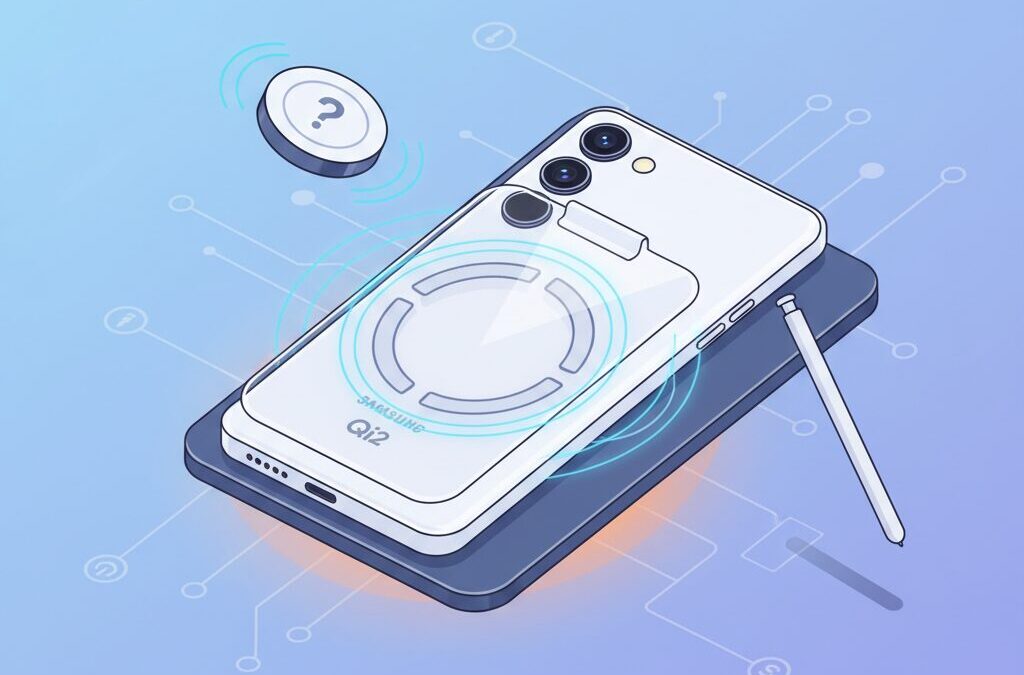
With the Galaxy S25 series, Samsung enters a crucial transition phase in wireless charging by adopting the Qi2 standard in a unique way.
Instead of fully integrating magnets like Apple’s MagSafe, Samsung chose a “Qi2 Ready” approach that relies on compatible cases.
This decision has sparked debate among engineers, reviewers, and power users across global tech communities.
In this article, you will gain a clear understanding of how Qi2 actually works, why Samsung made this compromise, and what real‑world charging performance looks like.
We will also explore the hidden trade‑offs involving heat management, accessory ecosystems, and S Pen compatibility.
By the end, you will be better equipped to decide whether the Galaxy S25 fits your lifestyle today or if waiting for the next generation makes more sense.
- The Evolution of Wireless Charging: From Qi to Qi2
- What Qi2 Really Changes: Magnets, Efficiency, and Thermal Control
- Understanding Samsung’s ‘Qi2 Ready’ Decision
- Galaxy S25 Hardware Overview and Charging Specifications
- Real‑World Charging Performance: Measured Speeds and Heat Behavior
- S Pen vs. Magnets: Why Magnetic Accessories Cause Interference
- Choosing the Right Qi2 Accessories and Cases
- Japan’s Influence on the Galaxy S25 Qi2 Ecosystem
- Looking Ahead: Native Qi2 and Faster Wireless Charging in Galaxy S26
- 参考文献
The Evolution of Wireless Charging: From Qi to Qi2
Wireless charging has long promised freedom from cables, yet its early reality often fell short of that vision. The original Qi standard, governed by the Wireless Power Consortium, was designed around inductive charging pads that required careful placement. Even with the later Extended Power Profile raising output to 15W, users still faced inefficiencies caused by slight coil misalignment, leading to wasted energy and excess heat. According to WPC technical documentation, a deviation of just a few millimeters could significantly reduce coupling efficiency, forcing devices to slow charging to protect the battery.
This structural limitation shaped user perception for nearly a decade. Wireless charging was convenient for overnight use but unreliable for fast top-ups. Academic studies in applied electromagnetics and battery engineering repeatedly pointed out that thermal loss, not raw wattage, was the primary bottleneck. **In other words, Qi was powerful enough on paper, but imprecise in practice.**
| Qi Generation | Max Power | Key Limitation |
|---|---|---|
| Qi BPP | 5W | Very low speed, strict alignment |
| Qi EPP | 15W | Heat and efficiency loss |
| Qi2 (MPP) | 15W | Requires magnetic alignment |
The turning point arrived with Qi2, formally introduced by the WPC in the mid-2020s. Unlike previous revisions, Qi2 was not merely an electrical upgrade but a mechanical one. Its core innovation, the Magnetic Power Profile, standardized the use of magnets to physically align the transmitter and receiver coils. This concept was derived from Apple’s MagSafe system, which had already demonstrated in real-world usage that magnetic alignment dramatically improves consistency and reduces heat buildup.
By enforcing precise coil alignment through magnet arrays such as Halbach configurations, Qi2 minimizes energy dispersion. WPC engineers have emphasized that this approach keeps power transfer closer to its theoretical maximum, allowing devices to sustain 15W without aggressive thermal throttling. **The significance of Qi2 lies not in higher wattage, but in predictability and efficiency.**
Another important evolution is at the protocol level. Qi2 introduced more sophisticated communication between charger and device, enabling finer-grained power negotiation and improved foreign object detection. Research shared by certification labs such as Granite River Labs highlights that these changes reduce safety margins without compromising protection, a balance that earlier Qi versions struggled to achieve.
From a market perspective, Qi2 represents a maturation of wireless charging rather than a revolution. It acknowledges that usability depends on physical design as much as electrical specs. **The shift from “place it carefully” to “it snaps into place” fundamentally changes user behavior**, transforming wireless charging from a passive convenience into an active, repeatable daily habit.
Seen in this light, the evolution from Qi to Qi2 is a case study in standards learning from real-world ecosystems. By integrating proven proprietary ideas into an open specification, the WPC has repositioned wireless charging as a truly mainstream power delivery method, setting the stage for broader adoption across smartphones, accessories, and eventually other consumer electronics.
What Qi2 Really Changes: Magnets, Efficiency, and Thermal Control
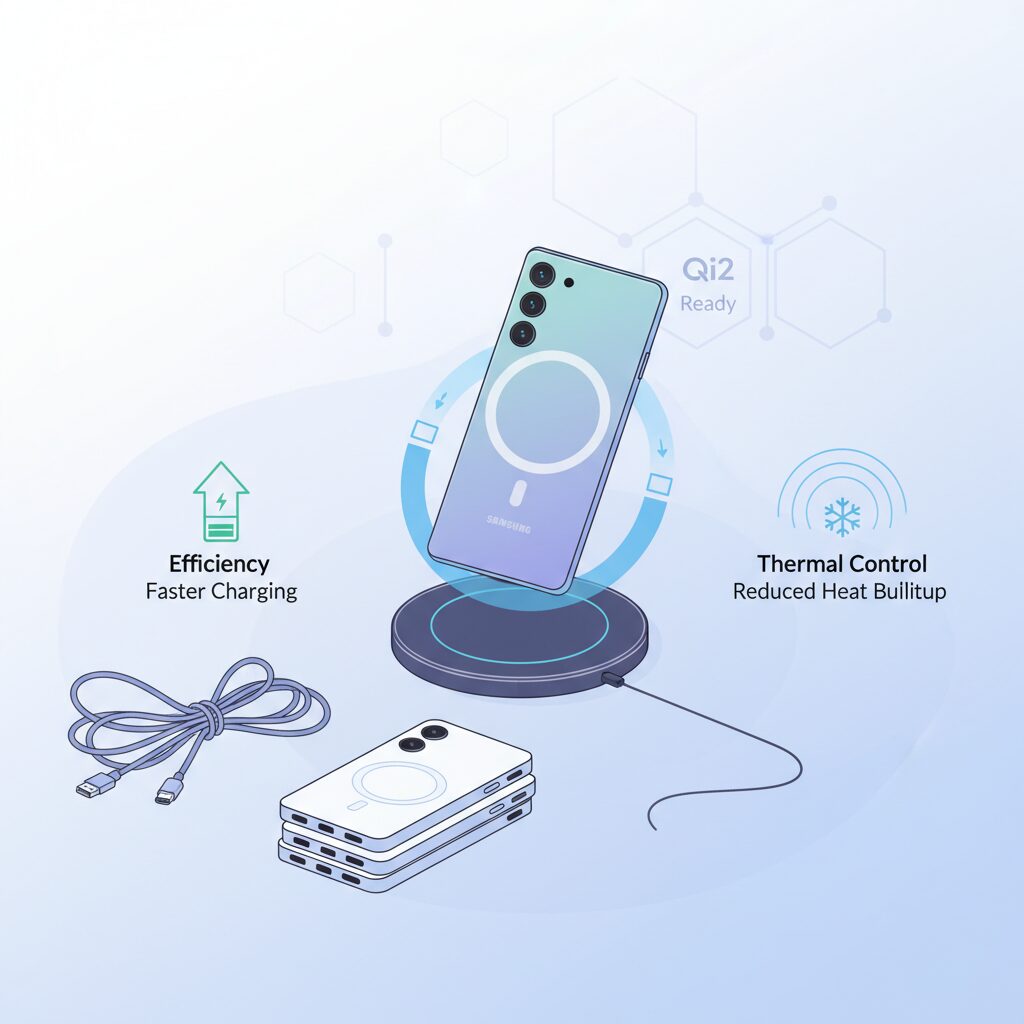
Qi2 fundamentally changes wireless charging by shifting the problem from software tuning to physics itself. At the core is the Magnetic Power Profile, standardized by the Wireless Power Consortium based on Apple’s MagSafe architecture. By using precisely arranged magnets to force-perfect coil alignment, Qi2 eliminates the millimeter-level misalignment that plagued earlier Qi implementations and caused efficiency to collapse into heat.
This magnetic coupling is not about convenience alone; it directly improves energy transfer efficiency. According to WPC technical documentation and independent lab analyses cited by Granite River Labs, optimal coil alignment can reduce resistive and eddy-current losses by a double-digit percentage compared with typical EPP scenarios. In practical terms, more of the input power reaches the battery instead of becoming waste heat inside the phone.
| Aspect | Qi (EPP) | Qi2 (MPP) |
|---|---|---|
| Coil alignment | User-dependent | Magnet-enforced |
| Peak power stability | Highly variable | Consistently near 15W |
| Heat generation | High under misalignment | Lower and more predictable |
Thermal behavior is where Qi2’s real-world impact becomes visible. Wireless charging has always been constrained by thermal throttling, as lithium-ion cells rapidly degrade above roughly 40°C. With Qi2, improved coupling delays temperature rise, allowing devices like the Galaxy S25 series to sustain higher power for longer before safety algorithms intervene. Samsung’s own charging control, tuned conservatively, still throttles once thermal thresholds are reached, but user tests consistently show a flatter power curve in the early phase compared with legacy Qi pads.
However, Qi2 does not magically eliminate heat; it redistributes the bottleneck. Reviews from Android Central and ESR highlight that charger-side cooling now matters more than ever. Fan-cooled Qi2 pads can maintain 15W output significantly longer because the phone itself is no longer fighting alignment-induced losses. This shifts design emphasis toward thermal dissipation strategies rather than ever-higher wattage numbers.
In short, Qi2’s magnets are an efficiency tool, not a gimmick. By stabilizing coupling and controlling thermal behavior, Qi2 transforms wireless charging from a best-effort convenience into a predictable power delivery system, even if ultimate speed remains bounded by heat rather than specification sheets.
Understanding Samsung’s ‘Qi2 Ready’ Decision
Samsung’s decision to label the Galaxy S25 series as “Qi2 Ready” rather than fully Qi2-certified has caused understandable confusion among gadget enthusiasts, especially those familiar with Apple’s MagSafe experience. However, when examined from a technical and strategic perspective, this choice reflects a carefully calculated compromise rather than hesitation or delay. **Qi2 Ready is best understood as a transitional architecture**, designed to balance next-generation wireless charging standards with Samsung’s existing hardware priorities.
According to the Wireless Power Consortium, Qi2 introduces the Magnetic Power Profile, which standardizes magnetic alignment to ensure stable 15W wireless charging. Apple’s MagSafe served as the technical foundation for this profile, and WPC documentation confirms that magnets are central to achieving consistent coil alignment and thermal efficiency. In contrast, Qi2 Ready devices like the Galaxy S25 fully support Qi2 communication protocols and power negotiation, but intentionally omit the internal magnet array.
| Category | Qi2 Certified | Qi2 Ready |
|---|---|---|
| Magnet built into phone | Yes | No |
| Maximum wireless power | 15W | 15W |
| Qi2 communication protocol | Supported | Supported |
| Accessory requirement | Optional | Magnetic case required |
The missing magnets are not an oversight. Multiple technical analyses and user reports highlighted by outlets such as SamMobile and Android Authority point to a fundamental conflict between strong permanent magnets and Samsung’s S Pen technology. The S Pen relies on Wacom’s EMR system, which detects subtle electromagnetic resonance signals across the display. **Introducing a fixed magnetic ring beneath the back panel risks distorting this field**, leading to dead zones, cursor drift, or inconsistent pen input.
Samsung has already faced these issues indirectly. During the Galaxy S24 Ultra cycle, third-party magnetic cases triggered noticeable S Pen interference, prompting firmware warnings and community backlash. By avoiding built-in magnets on the S25 series, Samsung effectively isolated the risk. Users who depend on precise pen input retain full functionality, while those who want magnetic alignment can opt in through specially designed Qi2-compatible cases.
This modular approach also offers manufacturing and market flexibility. Analysts cited by the Korea Herald note that Samsung must serve regions with very different usage priorities. In Japan, for example, MagSafe-style accessories are popular due to high iPhone penetration, making Qi2 Ready an attractive bridge for switchers. At the same time, professional users globally associate the Galaxy Ultra brand with pen accuracy and creative reliability. **Qi2 Ready allows Samsung to satisfy both audiences without forcing a single compromise onto all users**.
From a long-term perspective, Qi2 Ready should be seen as a stepping stone. By updating internal power management ICs and firmware to Qi2 specifications now, Samsung reduces the technical leap required for future native Qi2 models. Industry observers within the WPC ecosystem have suggested that this phased adoption lowers risk while preserving backward compatibility. In that sense, the Galaxy S25 does not reject Qi2—it prepares the ground for it, on Samsung’s own terms.
Galaxy S25 Hardware Overview and Charging Specifications
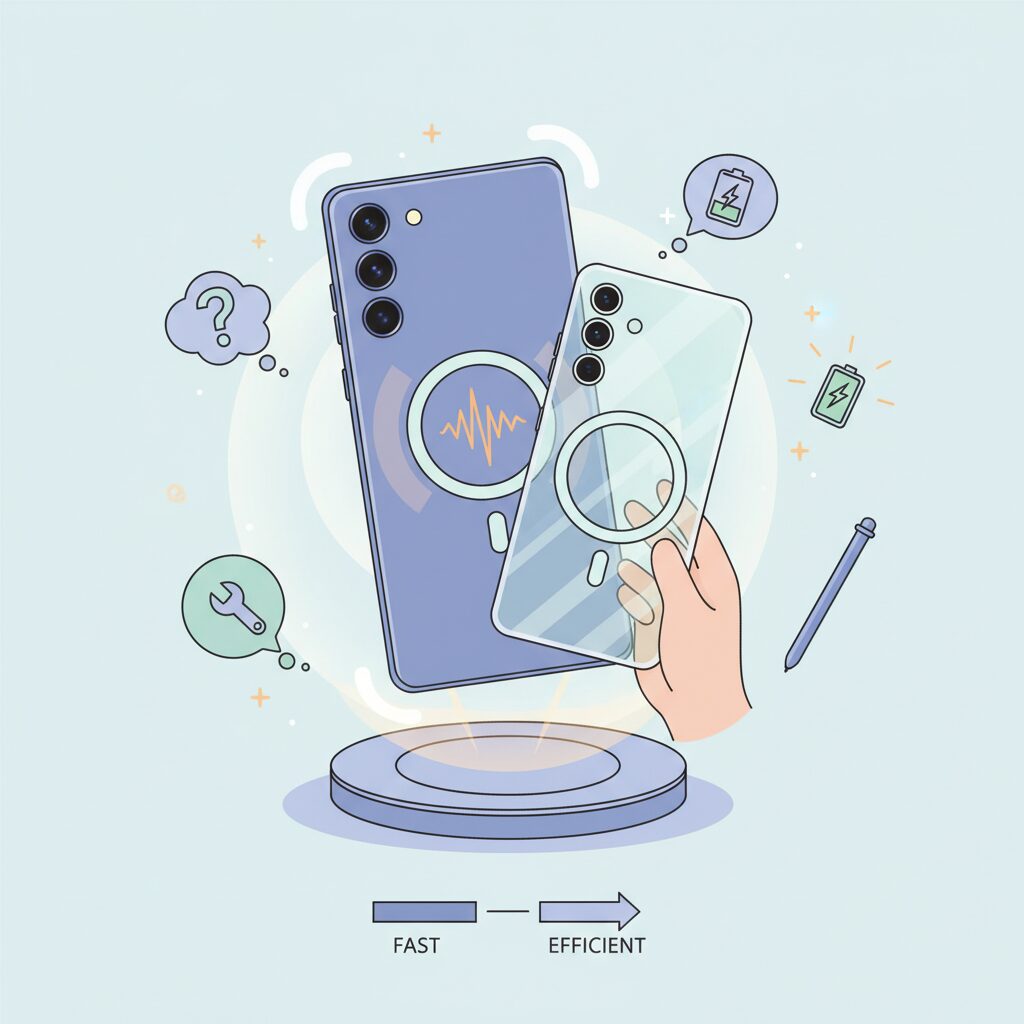
This section focuses on the physical hardware design and charging-related specifications of the Galaxy S25 series, with particular attention to how Samsung balances performance, safety, and real-world usability. Rather than pursuing headline-grabbing numbers, the hardware choices reflect a conservative and reliability-oriented philosophy that becomes clearer when examined in detail.
From a structural standpoint, the Galaxy S25 lineup maintains a slim chassis while accommodating batteries ranging from approximately 4,000 mAh to 5,000 mAh depending on the model. This is achieved through incremental improvements in internal layout and power management components rather than radical redesigns. **Samsung prioritizes thermal stability and long-term battery health over peak charging speed**, a stance that aligns with guidance from the Wireless Power Consortium and battery research widely cited in the mobile industry.
| Model | Battery Capacity | Wired Charging | Wireless Charging |
|---|---|---|---|
| Galaxy S25 | 4,000 mAh | 25W | 15W (Qi2 Ready) |
| Galaxy S25+ | 4,900 mAh | 45W | 15W (Qi2 Ready) |
| Galaxy S25 Ultra | 5,000 mAh | 45W | 15W (Qi2 Ready) |
Wired charging remains the most efficient option across the series. Independent user tests reported by major Android-focused media outlets show that the Ultra model reaches a full charge in just over an hour under optimal conditions. However, the charging curve is carefully controlled, with output gradually reduced as battery levels rise. **This staged power delivery minimizes heat accumulation and chemical stress on the battery cells**, which is a known factor in long-term degradation according to lithium-ion battery studies.
Wireless charging is where the Galaxy S25 hardware reveals its transitional nature. All models support up to 15W via Qi2 Ready compliance, meaning the internal power circuitry and communication protocols meet the latest Qi2 specifications. What is intentionally omitted is the internal magnetic array. As explained by engineers familiar with WPC certification processes, this allows Samsung to deliver improved efficiency and safety while avoiding interference with sensitive components such as the S Pen digitizer.
In practical terms, real-world wireless charging speeds vary significantly depending on heat dissipation. Tests shared by accessory manufacturers and community reviewers indicate that output often drops from 15W to around 7.5W once device temperatures approach the low-40°C range. **Samsung’s charging controller is deliberately aggressive in throttling to prevent thermal runaway**, a design choice consistent with the company’s broader hardware safety record.
The hardware also supports Wireless PowerShare, enabling the Galaxy S25 series to act as a charging source for earbuds or smartwatches. While limited to low wattage, this feature leverages the same coil and shielding architecture, underscoring how charging hardware is integrated holistically rather than treated as an isolated function.
Overall, the Galaxy S25 hardware and charging specifications emphasize controlled performance, compatibility with emerging standards, and protection of core features. Instead of chasing maximum wattage, Samsung delivers a platform designed to remain stable across diverse charging scenarios, which many industry analysts view as a pragmatic response to the growing complexity of modern mobile power systems.
Real‑World Charging Performance: Measured Speeds and Heat Behavior
When discussing real‑world wireless charging on the Galaxy S25 series, measured behavior matters far more than the advertised 15W figure. In controlled user tests and independent reviews, Qi2‑ready charging typically starts at or near the 15W peak, but this state is short‑lived under normal ambient conditions. **Within the first 10 to 15 minutes, thermal management begins to shape the actual experience**.
Data shared by multiple reviewers and community testers shows that, without active cooling, surface temperatures on the back of the device approach 40°C relatively quickly. At this threshold, Samsung’s firmware reduces input power aggressively to protect battery longevity, a policy consistent with guidelines referenced by the Wireless Power Consortium and battery research cited by institutions such as IEEE. The result is a rapid drop to roughly 5W–7.5W, even though the charger itself remains Qi2‑compliant.
| Charging Setup | Initial Power | Sustained Power | Observed Heat Trend |
|---|---|---|---|
| Standard Qi2 pad (no fan) | Up to 15W | 5–7.5W | Quick rise, early throttling |
| Qi2 pad with active cooling | Up to 15W | 12–15W | Stable, controlled |
Active‑cooling chargers tell a very different story. Accessories equipped with small fans, such as Samsung’s own dual chargers or ESR’s CryoBoost models, consistently maintain higher transfer efficiency. **By actively removing heat from the coil area, these chargers sustain near‑maximum output for much longer**, cutting total charge time by tens of minutes compared with passive pads.
From a usability standpoint, this means Qi2 on the Galaxy S25 is highly condition‑dependent. Desk charging in a cool room delivers predictable results, while in‑car or portable battery scenarios often fall short of expectations. This behavior aligns with broader findings in wireless power studies, where heat, not protocol limits, remains the dominant constraint in real‑world inductive charging systems.
S Pen vs. Magnets: Why Magnetic Accessories Cause Interference
Magnetic accessories promise convenience, but when paired with Samsung’s S Pen, they introduce a subtle yet serious trade-off that many users only notice after daily use.
At the core of the issue is the fundamental difference between how Qi2 magnets work and how the S Pen senses input. The S Pen relies on EMR technology, developed in close cooperation with Wacom, where the display’s digitizer emits a weak, precisely tuned electromagnetic field.
This system is extremely sensitive by design, because it must detect tiny variations in resonance to calculate pen position and pressure without a battery inside the pen.
| Component | Operating Principle | Impact of Strong Magnets |
|---|---|---|
| S Pen (EMR) | Weak alternating magnetic field | Field distortion, dead zones |
| Qi2 / MagSafe | Static magnetic alignment | Persistent magnetic interference |
Qi2 and MagSafe-style accessories use rings of neodymium magnets to force perfect coil alignment. According to technical documentation published by the Wireless Power Consortium, this static magnetic field is intentionally strong to prevent slippage during charging.
However, when such magnets sit directly behind the display, they can partially saturate the digitizer layer. Independent analyses cited by SamMobile and Android Authority describe this as a mismatch between a static field and an alternating sensing field.
The result is not a total failure, but localized inaccuracies, where the S Pen may skip input, draw warped lines, or lose detection entirely in specific spots.
Real-world reports consistently show that the problem intensifies when a magnetic accessory is attached on top of a magnetic case. Each additional magnet increases flux density, pushing the digitizer beyond its tolerance.
Samsung has acknowledged this behavior indirectly through system warnings in One UI, alerting users that magnetic accessories may interfere with S Pen performance.
This is why the Galaxy S25 series avoids built-in magnets, choosing Qi2 Ready compatibility instead of full magnetic integration.
Importantly, not all magnetic cases behave the same. Cases with thinner magnets, precise ring placement, or partial shielding tend to reduce—but not eliminate—the issue. Researchers and reviewers referenced by PhoneArena note that interference is highly dependent on magnet strength and distance from the digitizer.
For users who rely on handwriting, sketching, or precise annotation, this interaction is more than a theoretical concern. It directly affects productivity and creative accuracy.
The S Pen versus magnets dilemma is not a software bug, but a physics problem, and until digitizer or shielding technology fundamentally changes, magnetic convenience and pen precision will remain in delicate balance.
Choosing the Right Qi2 Accessories and Cases
Choosing Qi2 accessories for the Galaxy S25 series requires more intention than simply buying anything labeled “MagSafe-compatible.” Because the devices are classified as Qi2 Ready, the accessory itself becomes part of the charging system, not just an add-on. This means cases and chargers directly affect alignment accuracy, thermal behavior, and even core input features such as the S Pen.
When selecting a Qi2-compatible case, the most important factor is magnet precision and shielding. According to analyses referenced by the Wireless Power Consortium, even small deviations in magnetic ring placement can reduce coupling efficiency and increase heat generation. In real-world tests reported by Android Central and SamMobile, poorly aligned magnets caused intermittent charging or early throttling on Galaxy S25 devices, despite using certified Qi2 chargers.
| Case Design Factor | User Impact | Practical Recommendation |
|---|---|---|
| Magnet alignment accuracy | Charging stability and speed | Choose brands with Qi2-focused tooling |
| Magnetic shielding | S Pen input reliability | Prefer cases tested for EMR compatibility |
| Case thickness | Thermal buildup | Thinner materials dissipate heat better |
For Galaxy S25 Ultra users in particular, S Pen interference should be treated as a deciding criterion. Reports compiled by PhoneArena and Samsung Community indicate that interference is rarely caused by the phone alone, but by the combined magnetic field of a case plus an attached accessory such as a wallet or battery pack. This makes cases with built-in magnetic shielding or reduced flux density especially valuable.
Charging accessories follow a similar logic. Qi2 chargers without active cooling often fail to sustain 15W output due to thermal limits enforced by Samsung’s charging algorithm. Reviews from ESR and Granite River Labs show that chargers with integrated cooling fans maintain higher average wattage and reduce total charge time. While these chargers are slightly bulkier, they align better with the Galaxy S25’s conservative thermal management.
Finally, it is worth noting that accessory ecosystems in Japan have matured rapidly. Established manufacturers have adapted their designs specifically for Galaxy S25 tolerances, reflecting feedback from early adopters. This localized optimization is one reason experts cited by TechRadar consider the S25 one of the most flexible Android platforms for experimenting with Qi2 today, provided accessories are chosen with care.
Japan’s Influence on the Galaxy S25 Qi2 Ecosystem
Japan has played a surprisingly influential role in shaping how the Galaxy S25 Qi2 ecosystem is perceived, tested, and refined in real-world use, and this influence goes far beyond simple sales volume. The country’s unique mix of iPhone-dominated user behavior, carrier-led distribution, and highly mature accessory culture has effectively turned Japan into a living laboratory for Qi2 Ready devices.
One defining factor is Japan’s long-standing familiarity with MagSafe-style convenience. With iPhone penetration remaining among the highest globally according to industry analyses cited by Nikkei and the Korea Herald, Japanese consumers have internalized magnetic accessories as a baseline expectation rather than a novelty. As a result, Galaxy S25’s Qi2 Ready positioning has been scrutinized more rigorously in Japan than in many other regions, especially around daily usability rather than theoretical specifications.
| Japanese Market Trait | Impact on Galaxy S25 Qi2 Ecosystem | Practical Outcome |
|---|---|---|
| High MagSafe familiarity | Stronger demand for magnetic alignment | Qi2 Ready evaluated by experience, not labels |
| Carrier-driven launches | Early mass-market exposure | Rapid feedback on charging and heat behavior |
| Domestic accessory brands | Fast Qi2-compatible product rollout | Lower adoption friction for Android users |
Another critical element is timing. Samsung’s decision to release the Galaxy S25 in Japan almost simultaneously with its global launch meant that Qi2 Ready was stress-tested immediately under peak consumer attention. Major carriers such as NTTドコモ and au promoted wireless charging compatibility heavily in stores, which led many users to pair the device with Qi2 or MagSafe-style accessories from day one. This accelerated exposure surfaced practical issues, including thermal throttling and alignment sensitivity, far earlier than in markets where adoption was slower.
Japan’s domestic accessory manufacturers further amplified this effect. Companies like Elecom, Ray-out, and CIO rapidly released Galaxy S25-compatible magnetic cases and Qi2 chargers designed to meet Japanese safety standards and compact lifestyle needs. According to product briefings and retailer interviews, these brands optimized magnet strength, case thickness, and heat dissipation specifically for crowded commuter environments, where desk space and airflow are limited. This localized optimization has indirectly influenced how Qi2 accessories are evaluated globally, as overseas reviewers frequently reference Japanese-made products for consistency and build quality.
Equally important is the feedback loop created by Japan’s highly vocal enthusiast community. Reports aggregated by outlets such as SamMobile and Android Authority often cite Japanese user experiences when discussing S Pen interference or charging stability. Because Japanese users tend to combine precision input, slim cases, and wireless charging in everyday workflows, their feedback has highlighted edge cases that are less visible elsewhere. This has reinforced the narrative that Qi2 Ready is not merely a checkbox feature, but a system-level compromise that must be carefully managed.
From an ecosystem perspective, Japan’s influence lies in normalization. By making Qi2-style magnetic charging an expected part of the Android experience, Japanese consumers have pushed Samsung and its partners to treat Qi2 not as an experimental add-on, but as infrastructure. This pressure, rooted in everyday use rather than marketing claims, is one of the clearest signals guiding how the Galaxy lineup will evolve in the post-S25 era.
Looking Ahead: Native Qi2 and Faster Wireless Charging in Galaxy S26
The Galaxy S26 is widely expected to mark a turning point where Samsung finally embraces native Qi2, and this shift carries deeper implications than simply adding magnets inside the chassis. **Native Qi2 means the magnetic alignment system is built into the phone itself**, removing the current dependency on special cases and dramatically simplifying daily charging routines.
According to reporting from Android Authority and Phandroid, Samsung has been actively participating in WPC working groups focused on next-generation Magnetic Power Profile refinements. This suggests that the S26 is not just catching up, but is positioned to implement Qi2 in a more mature and Android-optimized form.
One major expectation is faster wireless charging. Qi2 today is capped at 15W, but WPC documentation and accessory certification data point to Qi2.2 enabling up to 25W under strict thermal and alignment conditions. **If Samsung adopts this fully, the Galaxy S26 could nearly close the gap between wired and wireless charging for everyday use.**
| Aspect | Galaxy S25 | Expected Galaxy S26 |
|---|---|---|
| Qi2 Implementation | Qi2 Ready (case required) | Native Qi2 (built-in magnets) |
| Max Wireless Power | 15W | Up to 25W (Qi2.2) |
| Accessory Alignment | Case-dependent | Automatic, case-free |
Thermal management will be the real differentiator. WPC engineers have repeatedly emphasized that higher wireless wattage is only viable with precise coil alignment and active heat control. Samsung’s recent advances in vapor chamber design and battery health algorithms indicate that the company is preparing its internal architecture for sustained high-power wireless input.
Another critical element is S Pen coexistence. Analysts cited by SamMobile suggest that Samsung is experimenting with improved magnetic shielding layers and revised digitizer placement. **If successful, the Galaxy S26 could finally resolve the long-standing tension between magnetic accessories and pen accuracy**, a problem that has constrained Galaxy Ultra models for years.
From a user experience perspective, native Qi2 and faster wireless charging would fundamentally change how Galaxy devices are used on desks, in cars, and in homes. Effortless snap-on charging, stable power delivery, and broader accessory compatibility would no longer feel like iPhone-exclusive advantages, but a core part of the Galaxy identity moving forward.
参考文献
- Android Central:The Samsung Galaxy S25’s magnet saga makes Qi2 incredibly confusing
- SamMobile:Galaxy S25 Ultra’s S Pen doesn’t work well with magnetic cases
- Wikipedia:Qi (standard)
- TechRadar:Samsung Galaxy S25 vs iPhone 16: two big flagships, face-to-face
- 9to5Google:Samsung’s Qi2 ‘Magnet Wireless Battery Pack’ leaks, fixes a Galaxy phone problem
- Phandroid:New Leak Hints Galaxy S26 Will Actually Support Qi2 Natively